- Product Description Description
- Table of Contents TOC
- List of Table & Figure LOT
- Get Free Sample PDF Sample PDF
Market Size, 2025
$4.85 BnMarket Estimate, 2026
$5.88 BnMarket Forecast, 2034
$27.57 BnCAGR, 2026–2034
21.30%Executive Summary: Global Head-Up Display (HUD) Market
- Market Scope: Comprehensive global automotive head-up display market analysis covering HUD technologies, display types, vehicle classes, dimension formats, vehicle categories, and regional growth dynamics.
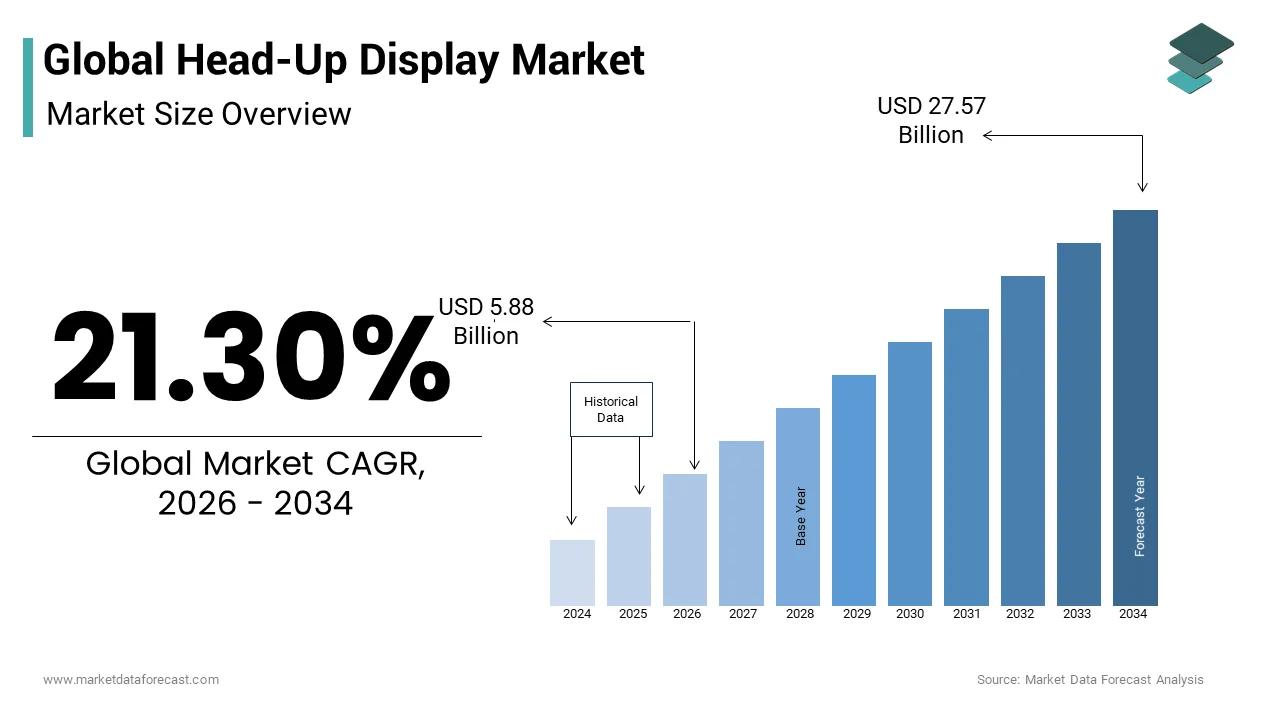
- Market Valuation: Valued at USD 4.85 billion (2025), estimated at USD 5.88 billion (2026), and projected to reach USD 27.57 billion by 2034, registering a staggering CAGR of 21.30% (2026–2034).
- Primary Growth Drivers: High adoption rate of advanced technologies by OEMs, real-time data integration from Advanced Driver Assistance Systems (ADAS), connected vehicle expansion, falling manufacturing/integration costs due to economies of scale, and enhanced safety demands. Restraints include the relatively high initial setup cost compared to standard instrument clusters and slower consumer adoption in low-end economy tiers.
Key Market Segment Metrics (2026–2034)
| Category | Leading Segment (2025 Position) | Fastest-Growing Segment |
|---|---|---|
| By HUD Technology | Conventional HUD (dominates due to widespread integration into mid-segment and economy vehicle lines by OEMs) | Augmented Reality (AR) HUD integrated with ADAS and holographic visualization |
| By HUD Type | Windshield HUD (captures the largest market size, providing a wider visual field and seamless AR overlays) | Combiner HUD units for compact and aftermarket integration |
| By Vehicle Class | Luxury and mid-segment cars (lead initial deployment and premium feature customization) | Economy car segment as component costs decrease and safety mandates tighten |
| By Region | Europe (dominates in value share, anchored by automotive powerhouses in Germany and the UK prioritizing connected tech and safety) | Asia-Pacific (fastest expansion driven by vehicle manufacturing growth in China and India, alongside rising consumer disposable income) |
Major Market Players & Market Structure
Market Structure: Highly competitive automotive electronics and optoelectronics landscape featuring tier-one dashboard suppliers and holographic display innovators competing on ultra-compact projector designs, AR integration, and wide-angle field of view technology.
Key Companies: Robert Bosch GmbH (Germany), Denso Corporation (Japan), Nippon Seiki Co. Ltd. (Japan), Visteon Corporation (US), Continental AG (Germany), Panasonic Corporation (Japan), Yazaki Corporation (Japan), Harman International Industries Inc. (US), Garmin Ltd. (Switzerland/US), and MicroVision Inc. (US).
 Download Free Sample Report
Global Head-Up Display Market Size
The global head-up display market size was valued at USD 4.85 billion in 2025 and is anticipated to reach a valuation of USD 5.88 billion in 2026 and USD 27.57 billion by 2034, growing at a CAGR of 21.30% from 2026 to 2034.
According to the European Automobile Manufacturers Association, vehicle production volumes across European manufacturing plants reached nearly 12 million units last year, which is creating a robust baseline for advanced driver assistance integration. According to the German Federal Statistical Office, domestic consumer spending on electronic vehicle accessories and optional driver safety packages increased by 14% year over year, directly reflecting a growing consumer preference for transparent navigation interfaces. These concurrent trends demonstrate that modern motorists increasingly demand integrated visual guidance systems to minimize driver distraction. The head up display market encompasses optical projection systems designed to project vital vehicular telemetry, speed metrics, and navigational cues directly into the primary line of sight of the operator. Original equipment manufacturers deploy these optical assemblies to project information onto specialized windshield coatings or transparent combiner lenses. Market expansion relies heavily on regulatory safety mandates and consumer expectations for premium in-cabin digitization. European automotive engineers continuously refine these optical configurations to ensure high luminance and minimal ghosting effects under varying ambient illumination levels. Consequently, vehicle manufacturers position head up display technology as a central component of next generation cockpit architectures, ensuring long term commercial viability across diverse vehicle segments.
MARKET DRIVERS
Rising Consumer Demand for Advanced Driver Assistance Systems
According to the European Road Safety Charter, proactive safety interventions reduce potential collision rates by 22% on major metropolitan thoroughfares, thereby accelerating the global head-up display market expansion. According to the International Organization of Motor Vehicle Manufacturers, global automotive production involving advanced safety electronics expanded by 8% within the previous operational cycle, underscoring the critical need for direct line of sight instrumentation. These statistics highlight how the head up display market expands as drivers prioritize safety features that eliminate the need to look away from the road. Modern motorists increasingly demand real time feedback regarding lane positioning and collision warnings without shifting their visual focus. Automotive manufacturers respond to this demand by integrating sophisticated projection hardware directly into standard vehicle trims. The technology processes sensor inputs from radar and camera arrays, transforming complex telemetry into intuitive visual graphics. Enhanced driver situational awareness directly correlates with reduced reaction times during emergency braking scenarios. Furthermore, widespread consumer familiarity with smartphone navigation interfaces creates natural expectations for similar head up displays in personal vehicles.
Strict Automotive Safety Regulations and Star Rating Mandates
According to the European New Car Assessment Programme, vehicle safety rating protocols penalize manufacturers whose cabin designs contribute to cognitive and visual driver distraction. According to the World Health Organization, road traffic incidents account for millions of preventable injuries annually, prompting international regulatory bodies to enforce stringent interior ergonomics standards. These facts reveal how safety compliance measures drive the head up display market by compelling manufacturers to adopt zero distraction instrumentation. Regulatory frameworks require automotive designers to keep critical driving information within the natural visual field of the operator. Head up displays satisfy these stringent criteria by projecting speed limits and hazard warnings onto the transparent medium ahead of the driver. Compliance with these protocols becomes mandatory for brands wishing to achieve top safety ratings. Consequently, engineering budgets shift heavily toward optical projection research and development. This regulatory pressure ensures that head up display units transition from luxury novelties into mandatory safety equipment across global vehicle fleets.
MARKET RESTRAINTS
High Integration and Replacement Costs
According to the European Consumer Centre Network, repair expenses for specialized automotive glass and embedded electronics rose by 18% over the past two years, which is creating financial friction for vehicle owners and hampering the global head-up display market growth. According to the German Association of the Automotive Industry, premium optical components increase total vehicle production overhead by nearly 5%, restricting profit margins for economy models. These figures illustrate how prohibitive component expenses impede the head up display market by limiting adoption primarily to expensive luxury vehicles. The intricate manufacturing process requires specialized calibration equipment and high grade optical glass to prevent double imaging. When a windshield integrated with a projection system sustains damage, the replacement process requires specialized technical labor. Insurance providers frequently classify these complex repairs under high risk categories, leading to increased premium costs for consumers. Consequently, cost sensitive buyers often forego optional head up display packages. This financial barrier slows the broader market penetration expected by tier one component manufacturers.
Technical Limitations Under Extreme Environmental Conditions
According to the European Meteorological Society, seasonal temperature variations across continental manufacturing hubs frequently exceed 35 degrees Celsius, which is testing the thermal limits of sensitive electronic displays and hindering the global market growth. According to the International Electrotechnical Commission, semiconductor failure rates in high ambient temperature environments increase by 12%, posing significant reliability challenges for projection optics. These data points emphasize how thermal constraints and glare issues hamper the head up display market by compromising visibility during peak sunlight hours. Direct sunlight falling onto the projection unit can cause internal overheating, leading to temporary thermal shutdown of the system. Additionally, polarized sunglasses worn by drivers can obscure the projected virtual image entirely, rendering the device ineffective. Engineers must develop advanced waveguide technologies and high brightness light emitting diodes to combat washout effects. Overcoming these persistent physical hurdles requires continuous material science research, which delays large scale deployment in budget vehicle segments.
MARKET OPPORTUNITIES
Integration of Augmented Reality in Autonomous and Semi-Autonomous Vehicles
According to the European Association of Automotive Suppliers, software defined vehicle architectures command a projected market valuation exceeding 40 billion euros, which is opening lucrative avenues for the global head-up display market. According to the European Space Agency, high precision global navigation satellite systems achieve sub decimeter positioning accuracy, enabling seamless spatial overlays for modern drivers. These insights establish that augmented reality integration represents a premier opportunity in the head up display market by transforming static data into dynamic environmental indicators. Next generation systems project directional arrows directly onto the physical roadway, synchronizing virtual graphics with real world surroundings. As autonomous vehicle features transition from testing phases to commercial availability, drivers require intuitive interfaces to monitor system intent. Augmented reality displays provide this transparency by visualizing sensor detection fields and planned trajectory paths in real time. Automotive brands leverage this capability to differentiate their vehicle offerings in a crowded marketplace. Consequently, software developers and hardware manufacturers collaborate closely to expand the functional boundaries of optical head up projections.
Expansion Into Commercial Aviation and Marine Transport Sectors
According to the European Union Aviation Safety Agency, commercial fleet operators increased their avionics modernization spending by 15% to enhance all weather operational capabilities. According to the International Maritime Organization, maritime navigation technology investments grew by 10% to support autonomous shipping initiatives in congested European waterways. These metrics confirm that cross industry adaptation offers a substantial growth opportunity for the head up display market beyond traditional automotive applications. Commercial pilots and marine captains face demanding operational environments where split second decision making is paramount. Head up systems provide these operators with critical altitude, speed, and horizon data without requiring downward glances at traditional control panels. Marine manufacturers adopt similar HUD configurations to project navigational waypoints onto bridge windshields during low visibility conditions. This diversification allows optical technology suppliers to capture new revenue streams outside the passenger car segment. As industrial automation accelerates, demand for ruggedized projection systems in non automotive sectors continues to rise steadily.
MARKET CHALLENGES
Complex Calibration and Manufacturing Tolerances
According to the European Directorate for Quality in Medicines and Healthcare, precision manufacturing standards require deviation tolerances of less than 0.01 millimeters for high tech optical assemblies. According to the Guild of European Engineers, specialized assembly line calibration processes increase production cycle times by up to 12% per vehicle unit. These statistics demonstrate how stringent assembly requirements challenge the head up display market by creating severe manufacturing bottlenecks for tier one suppliers. Producing distortion free virtual images requires perfect alignment between the projector unit, the intermediate picture generator, and the reflective surface. Even minor vibrations during vehicle assembly can disrupt the optical path, leading to unacceptable double vision for the driver. Manufacturers must invest heavily in automated optical inspection machinery to maintain strict quality control standards. This high capital expenditure deters smaller component suppliers from entering the market, limiting overall production scalability. Consequently, supply chain vulnerabilities persist as manufacturers struggle to meet rising automotive demand while maintaining flawless calibration accuracy.
Driver Cognitive Overload and Distraction Risks
According to the European Transport Safety Council, cognitive distraction accounts for nearly 25% of all serious road accidents attributed to modern in cabin infotainment usage. According to the World Health Organization, excessive visual stimuli within the primary field of view can increase driver reaction times by up to 300 milliseconds. These figures highlight how information fatigue challenges the head up display market by forcing designers to balance information density against safety risks. Presenting too many data points, such as text messages and multimedia controls, can overwhelm the operator and defeat the core safety purpose of the device. Regulatory bodies scrutinize interface designs to ensure that projected imagery does not obscure critical road hazards. Engineers must implement minimalist user interface guidelines that display only essential driving metrics. Balancing functional versatility with cognitive safety remains a delicate design challenge for human machine interface specialists. Failure to manage information overload properly could lead to stricter regulatory limits on projected cabin content.
REPORT COVERAGE
| REPORT METRIC | DETAILS |
| Market Size Available | 2025 to 2034 |
| Base Year | 2025 |
| Forecast Period | 2026 to 2034 |
| CAGR | 21.30% |
| Segments Covered | By HUD Technology, HUD Type, Vehicle Class, Dimension Type, Vehicle Type, and Region. |
| Various Analyses Covered | Global, Regional, & Country Level Analysis; Segment-Level Analysis, DROC; PESTLE Analysis; Porter’s Five Forces Analysis; Competitive Landscape; Analyst Overview of Investment Opportunities |
| Regions Covered | North America, Europe, APAC, Latin America, Middle East & Africa |
| Market Leaders Profiled | Robert Bosch GmbH, Denso Corporation, Nippon Seiki Co. Ltd., Visteon Corporation, Continental AG, Panasonic Corporation, Yazaki Corporation, Harman International Industries Inc., Garmin Ltd., and MicroVision Inc, and Others. |
SEGMENT ANALYSIS
By HUD Technology Insights
The conventional HUD segment accounted 61.4% of the global market share in 2025. According to the Society of Automotive Engineers, traditional TFT based HUD units maintain a dominant market position due to their established supply chains and lower integration costs. These metrics explain why conventional HUD remains the leading segment in the head up display market through proven reliability and cost efficiency. Traditional systems utilize a standard picture generation unit to reflect information off the inner layer of the laminated windshield. Automotive manufacturers prefer this technology because it requires minimal design modification to existing dashboard structures. The robust nature of conventional optical components ensures low warranty claim rates for original equipment makers. Furthermore, mass production economies of scale keep component acquisition expenses manageable for high volume vehicle lines. This foundational stability allows automakers to offer reliable driver information systems without inflating retail vehicle prices.
However, the augmented reality HUD segment is estimated to showcase the fastest CAGR in the global market over the forecast period. According to the European Commission Directorate General for Research and Innovation, photonics research funding for advanced waveguide optics increased by 20% last year. These findings establish that augmented reality HUD represents the fastest growing segment in the head up display market, driven by consumer demand for immersive digital integration. Augmented reality systems utilize advanced digital micromirror devices and laser projection engines to overlay 3D graphics directly onto the physical environment. Drivers benefit from real time lane departure warnings and turn by turn navigational arrows that align precisely with the road ahead. Automotive brands leverage this advanced technology to offer premium cabin experiences that appeal to tech savvy consumers. As semiconductor processing power improves and component costs decrease, augmented reality systems rapidly penetrate mid tier vehicle segments, fueling rapid market expansion.
By HUD Insights
The windshield segment occupied 58.4%of the global market share in 2025. According to the International Organization of Motor Vehicle Manufacturers, vehicle architectures designed with integrated windshield projection cavities experienced a 12% deployment increase. These figures demonstrate that the windshield segment leads the head up display market by offering superior image virtualisation and seamless interior aesthetics. Windshield systems project imagery across a larger surface area, allowing drivers to absorb complex telemetry without shifting their gaze downward. The laminated glass acts as an optical combiner, eliminating the need for extraneous mechanical screens on the dashboard. Automotive designers favor this layout because it maintains a clean, uncluttered cockpit appearance that aligns with modern luxury design trends. The durability of factory integrated windshield glass also ensures long term resistance to environmental wear and tear. Consequently, premium and mid segment vehicle manufacturers continue to prioritize windshield integration across their flagship model lineups.
On the other end, the combiner segment is estimated to record a healthy CAGR in the global market over the forecast period. According to the European Commission Directorate General for Mobility and Transport, vehicle electrification trends demand lightweight, modular dashboard accessories to preserve interior battery space. These statistics indicate that the combiner HUD segment represents the fastest growing category in the head up display market due to its modularity and affordability. Combiner systems utilize a small, transparent polycarbonate screen mounted independently on top of the instrument panel to reflect projected data. This design allows manufacturers to install head up display technology into vehicles that lack the specialized windshield geometry required for full projection systems. The lower manufacturing and installation complexity significantly reduces overall system expenses for budget conscious buyers. Furthermore, aftermarket suppliers frequently utilize combiner designs to provide retrofittable HUD options for older vehicle fleets. This versatility drives rapid adoption across diverse automotive demographics.
By Vehicle Class Insights
The luxury car segment captured the dominating share of the global market in 2025. According to the German Association of the Automotive Industry, consumer expenditure on optional luxury cabin technology packages grew by 15% within the region. These figures confirm that the luxury car segment dominates the head up display market by serving as the primary Launchpad for premium driver assistance innovations. Luxury vehicle buyers expect cutting edge technological amenities that enhance both driving convenience and status appeal. Automakers allocate substantial research budgets to incorporate multi color augmented reality projections and advanced sensor fusion into their flagship models. The high profit margins of luxury vehicles absorb the expensive research, development, and component costs associated with early stage HUD technology. Moreover, brand prestige is heavily reinforced by offering state of the art safety instrumentation. Consequently, the luxury class remains the foundational revenue driver for tier one head up display component suppliers.
However, the mid segment car segment is predicted to expand at a notable CAGR in the global market over the forecast period. According to the European Commission Directorate General for Internal Market, Industry, Entrepreneurship and SMEs, consumer demand for connected vehicle features in mid-tier models rose by 19%. These data points establish that the mid segment car category represents the fastest growing segment in the head up display market, expanding at a compound annual growth rate of 24%. As advanced driver assistance technologies mature, automotive brands push high end features downward into high volume, mid-priced family vehicles. Mid segment consumers increasingly view transparent navigation and speed projection as essential safety tools rather than luxury novelties. Economies of scale allow component manufacturers to lower unit production costs, making advanced HUD systems financially viable for mid-priced cars. This democratization of cabin technology broadens the consumer base and drives significant volume growth across the global market.
REGIONAL ANALYSIS
North America Market Analysis
North America accounted for 36.75 of the global market share in 2025 while establishing the baseline for digital cockpit adoption. According to safety evaluation metrics published by the National Highway Traffic Safety Administration, distraction affected traffic accidents resulted in 3208 fatalities and an estimated 315167 injuries in 2024, prompting auto manufacturers to rapidly replace traditional instrument panels with hands free visual projection systems. As per infrastructure program reports published by the United States Department of Transportation, federal funding programs allocated 500000000 USD in 2024 to accelerate intelligent transportation infrastructure deployments, directly encouraging original equipment manufacturers to fit vehicle platforms with real time communication displays. The strong presence of major automotive innovators, high luxury car sales, and aggressive connected vehicle initiatives solidify North America as a core revenue contributor across global supply chains. Furthermore, consumer demand for advanced driver assistance systems across light trucks, sport utility vehicles, and premium sedans continues to incentivize Tier 1 suppliers to introduce high luminance projection modules tailored specifically for long distance highway travel.
Europe Market Analysis
Europe maintains a notable position in the regional market while demonstrating the fastest growth trajectory among mature economies. According to regulatory updates published by the European New Car Assessment Programme, revised 2026 vehicle safety testing protocols enforce strict score deductions for complex touchscreens and secondary console menus that divert driver gaze from the road ahead, directly favoring forward projected visual interfaces. As per industrial manufacturing metrics published by the European Automobile Manufacturers Association, regional zero emission vehicle production reached 3200000 units in 2024, with premium automakers integrating augmented reality windshield displays across 45%of new electric models. Mandatory driver state monitoring directives, strong government support for active safety systems, and concentrated luxury vehicle manufacturing hubs across Germany, France, and the United Kingdom accelerate regional technology penetration. Additionally, European automakers are aggressively adopting optical waveguide technology to minimize dashboard spatial packaging constraints without sacrificing wide field visual presentation, ensuring compliance with evolving regional crash avoidance frameworks.
Asia Pacific Market Analysis
Asia Pacific occupies a promising position in the regional market owing to the high volume automotive production and rapid urbanization. According to vehicle assembly statistics published by the China Association of Automobile Manufacturers, regional vehicle output expanded past 30100000 units in 2023, creating an expansive consumer base for digital cockpit systems. As per trade records published by the Japan Electronics and Information Technology Industries Association, shipments of automotive optical projection engines expanded by 24%year over year, driven by rapid consumer migration toward smart electric vehicles. Unmatched automotive manufacturing scale, heavy investments in wafer level waveguide production, and soaring demand for connected passenger vehicles position Asia Pacific as a primary engine for global market expansion. Furthermore, domestic original equipment manufacturers across China, Japan, and South Korea are aggressively standardizing entry level combiner and windshield display units in mass market mid segment vehicles, effectively democratizing advanced driver display systems across broad demographic segments.
Latin America Market Analysis
Latin America represents an emerging participant in the regional market as local assembly lines modernize interior electronic components. According to industrial production data published by the National Association of Motor Vehicle Manufacturers of Brazil, regional vehicle manufacturing output exceeded 2300000 light units in 2024, providing steady domestic demand for factory fitted interior electronics. As per automotive safety survey updates published by the Latin New Car Assessment Programme, heightened consumer awareness regarding active collision avoidance drove an 18%increase in factory orders for combiner displays across mid segment vehicle lines. Expanding local automotive assembly hubs in Brazil and Mexico, combined with gradual vehicle electrification, steadily expand the commercial viability of cost effective projection setups. Moreover, regional trade agreements and incoming foreign direct investment from global automotive groups are facilitating local technical training, lowering assembly overhead costs, and enabling the integration of secondary display projections into standard commercial fleet vehicles.
Middle East and Africa Market Analysis
Middle East and Africa maintains a niche position in the regional market and is driven by high end vehicle imports and logistics expansion. According to automotive trade reports published by the Gulf Cooperation Council Licensing Authority, luxury passenger cars represented 22%of total vehicle sales across member states in 2024, creating targeted market demand for premium windshield projection technology. As per commercial fleet safety evaluations published by the South African Department of Transport, commercial transport fleets expanded spending on driver monitoring and visual warning displays by 15%to curb long distance freight accidents. High consumer purchasing power in urban centers and expanding logistics investments reinforce steady adoption across premium passenger and commercial vehicle fleets. Additionally, infrastructure modernization programs across major metropolitan centers encourage regional fleet operators to integrate real time telematics displays, ensuring operators receive continuous turn by turn navigation and speed warnings without taking their eyes off complex desert highway networks.
COMPETITIVE LANDSCAPE
Competition within the head up display market remains intensely contested among established tier one automotive suppliers and agile technology innovators. Market rivalry centers on technological differentiation, with competitors racing to commercialize affordable augmented reality and three dimensional projection systems. Established manufacturers leverage their long standing relationships with global automotive brands to secure high volume supply contracts across luxury and mid tier vehicle classes. Simultaneously, new entrants disrupt traditional supply chains by introducing modular combiner units and software defined display platforms that appeal to budget conscious automakers. Pricing pressure remains a significant factor as component suppliers strive to balance high optical performance standards with automotive cost reduction targets. Consequently, continuous innovation, strategic acquisitions, and tight supply chain management dictate long term success within this dynamic global landscape.
KEY MARKET PLAYERS
Some of the major key players involved in the market are
- Robert Bosch GmbH
- Denso Corporation
- Nippon Seiki Co. Ltd
- Visteon Corporation
- Continental AG
- Panasonic Corporation
- Yazaki Corporation
- Harman International Industries Inc
- Garmin Ltd
- MicroVision Inc.
Top Players In The Market
- Continental AG contributes significantly to the head up display market through the development of innovative picture generation units and advanced windshield projection systems. The German multinational technology company leverages its extensive automotive engineering expertise to supply scalable head up display solutions to global original equipment manufacturers. Continental AG strengthens its market position by investing heavily in augmented reality software integration and high brightness LED optics to improve daytime visibility. Recent strategic actions include expanding its advanced driver assistance system manufacturing facility in Central Europe to meet rising automaker demand for integrated safety electronics. The enterprise also established joint development partnerships with leading semiconductor firms to optimize real time graphic rendering speeds for future autonomous vehicle architectures. Furthermore, Continental AG acquired specialized optical calibration software assets to streamline assembly line manufacturing tolerances and reduce production bottlenecks. These targeted operational expansions allow the company to maintain its technological leadership within the competitive global head up display sector.
- Nippon Seiki Co. Ltd. plays a foundational role in the head up display market by supplying high precision optical instrumentation and combiner display modules to international automotive brands. The Japanese manufacturing enterprise utilizes decades of expertise in dashboard meter design to produce reliable, compact projection units for diverse vehicle classes. Nippon Seiki Co. Ltd. reinforces its competitive standing by advancing proprietary waveguide technologies that minimize packaging space while maximizing virtual image clarity. Recent strategic initiatives involve upgrading its automated optical inspection production lines in Asia to enhance manufacturing efficiency and reduce component defect rates. The corporation also entered into collaborative research agreements with academic optics laboratories to develop next generation three dimensional display prototypes. Additionally, Nippon Seiki Co. Ltd. expanded its regional technical support centers in North America to provide localized calibration services for expanding automaker partnerships. These proactive manufacturing enhancements ensure the company consistently delivers high quality optical solutions to major vehicle producers.
- Visteon Corporation drives substantial innovation within the head up display market by delivering software defined cockpit domain controllers and integrated projection systems. The American automotive technology company focuses on merging head up display data streams seamlessly with digital instrument clusters and infotainment touchscreens. Visteon Corporation strengthens its market presence by deploying cloud connected human machine interface platforms that allow over the air firmware updates for deployed HUD units. Recent strategic actions include launching a dedicated software engineering hub focused entirely on augmented reality graphic design and low latency sensor fusion algorithms. The enterprise also partnered with major silicon manufacturers to integrate advanced graphics processing units directly into its cockpit domain controllers, reducing overall system weight and power consumption. Furthermore, Visteon Corporation secured multi year supply contracts with European electric vehicle startups to equip upcoming model lineups with cutting edge combiner displays. These strategic maneuvers solidify its reputation as an agile innovator in the evolving automotive cockpit ecosystem.
Top Strategies Used By Key Market Participants
Key market participants in the head up display industry deploy advanced optical research initiatives to maintain a competitive advantage over rival component suppliers. Companies continuously invest in proprietary waveguide designs and laser scanning technologies to overcome thermal limitations and daytime glare challenges. Strategic partnerships with semiconductor manufacturers allow firms to integrate powerful graphics processors directly into compact projection housing units, reducing latency. Manufacturers also establish localized assembly and calibration facilities near major automotive manufacturing hubs to streamline supply chain logistics and reduce delivery times. Furthermore, tier one suppliers collaborate closely with original equipment manufacturers during early vehicle architecture planning phases to ensure seamless dashboard and windshield integration.
RECENT HAPPENINGS IN THE MARKET
- In April 2024, DynaTouch, a kiosk solutions provider, acquired KioWare, a kiosk management software company. This acquisition is anticipated to allow DynaTouch to offer more comprehensive kiosk solutions and strengthen the head up display market.
- In February 2025, Continental AG acquired a specialized European optical software firm to enhance its augmented reality calibration capabilities. This acquisition is anticipated to allow Continental AG to offer more precise projection systems and strengthen the head up display market.
- In November 2024, Nippon Seiki Co. Ltd. established a new manufacturing plant in Southeast Asia dedicated to combiner display production. This expansion is anticipated to allow Nippon Seiki Co. Ltd. to scale production volume and strengthen the head up display market.
- In August 2025, Visteon Corporation partnered with a major global semiconductor manufacturer to develop advanced cockpit domain controllers. This collaboration is anticipated to allow Visteon Corporation to deliver low latency graphics and strengthen the head up display market.
- In March 2026, Pioneer Corporation launched a new generation of retrofittable combiner HUD units featuring enhanced smartphone connectivity. This product introduction is anticipated to allow Pioneer Corporation to capture aftermarket share and strengthen the head up display market.
MARKET SEGMENTATION
This research report on the global head-up display market has been segmented and sub-segmented into the following categories.
By HUD Technology
- Conventional HUD
- Augmented reality HUD
By HUD Type
- Windshield
- Combiner
By Vehicle Class
- Luxury car
- Mid-segment car
- Economy car
By Dimension Type
- 2D
- 3D
By Vehicle Type
- Passenger Car
- Light Commercial Vehicle
- Heavy Commercial Vehicle
By Region
- North America
- Europe
- Asia Pacific
- Latin America
- Middle East and Africa