- Product Description Description
- Table of Contents TOC
- List of Table & Figure LOT
- Get Free Sample PDF Sample PDF
Market Size, 2025
$237.9 BnMarket Estimate, 2026
$275.35 BnMarket Forecast, 2034
$886.64 BnCAGR, 2026–2034
15.74%Executive Summary: Healthcare IT Market
- Market Scope: Global healthcare IT market analysis covering product categories, component types, end-user segments, regional leadership frameworks, and digital health adoption metrics.
- Market Valuation: Valued at USD 237.9 billion in 2025, estimated at USD 275.35 billion in 2026, and projected to reach USD 886.64 billion by 2034, registering a CAGR of 15.74% from 2026 to 2034.
- Primary Growth Drivers: Rising burden of chronic diseases requiring coordinated digital care, rapid adoption of telehealth and virtual healthcare services, government support for digital health infrastructure, and the growing implementation of EHRs and AI-enabled healthcare systems.
Key Market Segment Metrics (2026–2034)
| Category | Leading Segment (Position) | Fastest-Growing / Key Growth Segment |
|---|---|---|
| By Product & Component | Electronic Health Records (EHR) (largest product) & Software (largest component) | Healthcare Analytics (fastest product) & Services (fastest-growing component) |
| By End User Segment | Healthcare Providers (largest end user) | Payers (fastest-growing end user) |
| By Technology & Innovation | Standard health information systems and traditional hospital software | AI-driven predictive analytics, cloud-based health IT platforms, and remote patient monitoring |
| By Region / Country | North America (leading regional market) | Asia Pacific (fastest-growing regional market) |
Major Market Players & Market Structure
Market Structure: Highly competitive global healthcare IT landscape characterized by AI-driven diagnostics integration, cloud-based platform expansion, interoperable digital ecosystem development, telehealth investments, and robust cybersecurity compliance frameworks.
Key Companies: McKesson Corporation, Epic Systems Corporation, Cerner Corporation, GE Healthcare, Philips Healthcare, Athena Health, Inc., Allscripts Healthcare Solutions, Inc., Oracle Corporation, and Cognizant Technology Solutions Corporation.
Global Healthcare IT Market Size
The global healthcare IT market size was worth USD 237.9 billion in 2025. The global market is anticipated to grow at a CAGR of 15.74% from 2026 to 2034 and be worth USD 886.64 billion by 2034 from USD 275.35 billion in 2026.
Healthcare IT is a comprehensive ecosystem of digital systems and technologies designed to manage health information, enhance clinical workflows, and improve patient outcomes. This includes electronic health records (EHRs), telehealth platforms, health information exchanges (HIEs), clinical decision support systems (CDSS), and AI-driven diagnostic tools. According to the World Health Organization, over 120 countries have implemented national digital health strategies as of 2023, signaling institutional commitment to technological transformation.
MARKET DRIVERS
Rising Chronic Disease Burden Driving Demand for Healthcare IT Solutions
The global surge in chronic disease burden, with continuous monitoring and coordinated care across multiple providers, is propelling the growth of the Healthcare IT Market. According to the World Health Organization, non-communicable diseases such as cardiovascular conditions, diabetes, and cancer account for 74% of all global deaths annually, with many patients requiring long-term management involving multiple specialists. This complexity demands robust health information systems capable of aggregating and analyzing longitudinal patient data. As per the International Diabetes Federation, over 537 million adults live with diabetes, a condition requiring frequent data exchange between endocrinologists, primary care physicians, and remote monitoring devices. Healthcare IT platforms enable real-time tracking of glucose levels, medication adherence, and complications, reducing hospitalizations.
Telehealth Adoption and Policy Reforms Boosting Healthcare IT Growth
The rapid adoption of telehealth services with policy reforms and post-pandemic normalization of virtual care is additionally enhancing the growth of the Healthcare IT Market. The Commonwealth Fund reports that 45% of U.S. adults used telehealth in 2023, up from 12% in 2019, with primary care, mental health, and follow-up consultations being the most common use cases. Countries like Australia and Canada have institutionalized telehealth through public reimbursement frameworks, with Australia’s Medicare billing over 110 million telehealth services between 2020 and 2023.
MARKET RESTRAINTS
Interoperability Gaps and Fragmented Health Information Systems
The persistent challenge of interoperability across disparate health information systems is restricting the growth of the healthcare IT market. As per a 2023 report by the Office of the National Coordinator for Health IT, only 55% of U.S. hospitals can electronically send, receive, find, and integrate patient data from outside organizations. This fragmentation impedes care coordination, particularly during emergencies or transitions between providers. The European Health Data Space initiative identifies that 28 different EHR systems operate across Germany’s federal states, which is complicating national data exchange. According to the World Health Organization, in low-resource settings, legacy systems and paper-based records coexist with digital platforms by creating data silos.
Rising Cybersecurity Threats and Data Breaches in Healthcare IT
The escalating threat of cyberattacks targeting healthcare institutions, which hold highly sensitive personal and medical data, is another factor hampering the growth of the healthcare IT market. According to the U.S. Department of Health and Human Services, healthcare organizations reported 725 data breaches in 2023, which affected over 133 million patient records, the highest annual total on record. Legacy systems with insufficient cybersecurity training and third-party vendor risks exacerbate exposure.
MARKET OPPORTUNITIES
AI Integration Driving Predictive Analytics and Diagnostic Advancements
The integration of artificial intelligence into clinical workflows for predictive analytics and diagnostic augmentation is greatly influencing the growth of the healthcare IT market. The Mayo Clinic has demonstrated that AI algorithms can predict cardiac arrest up to six hours in advance by analyzing EHR data, improving survival rates. According to the Nature Medicine journal, deep learning models now match or exceed radiologists in detecting breast cancer from mammograms, with a 7.8% reduction in false positives and a 5.7% decrease in false negatives. The U.S. Food and Drug Administration has cleared over 520 AI/ML-based medical devices as of 2023, including tools for stroke detection and diabetic retinopathy screening.
Growth of Patient-Generated Health Data Enabling Personalized Care
The expansion of patient-generated health data (PGHD) through wearable devices and mobile health applications by enabling proactive and personalized care is to level up the growth of the healthcare IT market. The Consumer Technology Association states that global shipments of health-focused wearables exceeded 200 million units in 2023, with devices tracking heart rate, sleep, blood oxygen, and activity levels. Apple’s Heart Study, involving over 400,000 participants, demonstrated that smartwatch-based irregular pulse detection could identify undiagnosed atrial fibrillation in 0.5% of users.
MARKET CHALLENGES
Regulatory Complexity and Lack of Harmonized Digital Health Standards
The regulatory complexity and lack of harmonized standards across jurisdictions impede the growth of the healthcare IT market. According to the World Health Organization, only 40 of 194 member states have comprehensive digital health legislation, creating legal uncertainty for multinational vendors. The differences in medical coding, consent protocols, and data ownership rules complicate cross-border health data exchange. For instance, genomic data sharing between the U.S. and the EU is constrained by conflicting privacy frameworks. These regulatory misalignments increase compliance costs and delay product launches for AI-based tools that require large, diverse datasets for training and validation.
Clinician Resistance and Workflow Disruptions from Inefficient Health IT Systems
The clinician resistance and workflow disruption caused by poorly designed health IT systems is also to degrade the growth of the healthcare IT market. A 2023 study published in JAMA Internal Medicine found that physicians spend nearly two hours on EHR documentation for every hour of direct patient care, which is contributing to burnout and reduced job satisfaction. Poor interface design, excessive alert fatigue, and lack of voice-enabled navigation exacerbate inefficiencies. The Agency for Healthcare Research and Quality notes that cognitive overload from non-intuitive systems can lead to diagnostic errors and missed alerts.
REPORT COVERAGE
| REPORT METRIC | DETAILS |
| Market Size Available | 2025 to 2034 |
| Base Year | 2025 |
| Forecast Period | 2026 to 2034 |
| Segments Covered | By Products & Services, Component, End-User, and Region. |
| Various Analyses Covered | Global, Regional and Country-Level Analysis, Segment-Level Analysis, Drivers, Restraints, Opportunities, Challenges; PESTLE Analysis; Porter’s Five Forces Analysis, Competitive Landscape, Analyst Overview of Investment Opportunities |
| Regions Covered | North America, Europe, Asia Pacific, Latin America, Middle East & Africa |
| Market Leaders Profiled | McKesson Corporation (US), Epic Systems Corporation (US), Cerner Corporation (US), GE Healthcare (US), Philips Healthcare (Netherlands), Athena Health, Inc. (US), Allscripts Healthcare Solutions, Inc. (US), Oracle Corporation (US), Cognizant Technology Solutions Corporation (US)., and Others. |
SEGMENTAL ANALYSIS
By Products & Services Insights
The Electronic Health Records (EHR) segment accounted in holding 26.3% of the healthcare IT market share in 2025, with the widespread regulatory mandates and financial incentives for digital health adoption. In the United States, the Centers for Medicare & Medicaid Services’ Meaningful Use program has driven EHR adoption in over 96% of non-federal acute care hospitals. The World Health Organization affirms that 112 countries now require or strongly encourage EHR implementation in public health facilities. Additionally, the integration of EHRs with telehealth and remote monitoring tools has expanded their utility by making them central to coordinated, patient-centered care models across primary, specialty, and post-acute settings.
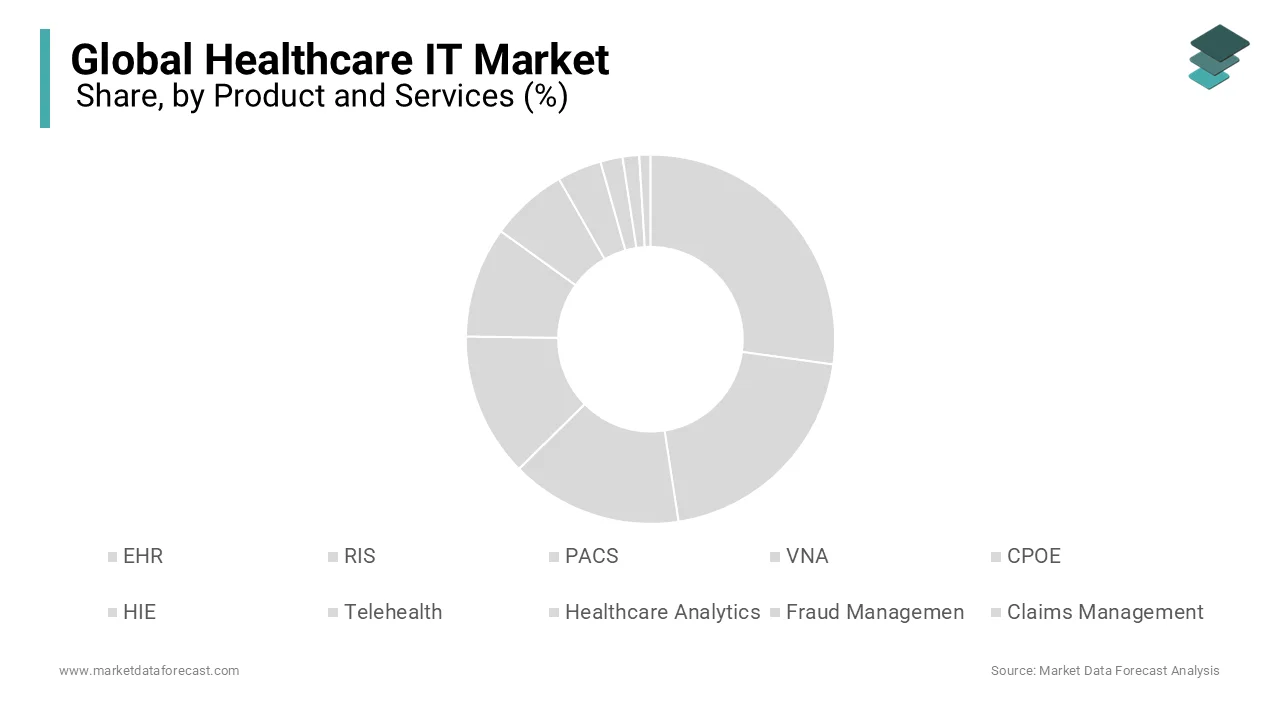
The healthcare analytics segment is anticipated to grow with an expected CAGR of 16.4% from 2025 to 2033, with the exponential growth of clinical and operational data, necessitating advanced tools for actionable insights. The Mayo Clinic reports that predictive analytics reduced ICU transfers by 22% through early warning scores derived from real-time EHR data. According to the Centers for Disease Control and Prevention, analytics-powered surveillance systems detected disease outbreaks 3.5 days faster than traditional methods during the 2023 flu season. Furthermore, payers are leveraging analytics for fraud detection and population health management, with the American Health Information Management Association noting a 38% increase in analytics adoption among Medicaid managed care organizations between 2021 and 2023.
By Component Insights
The software segment accounted in holding 58.3% of the healthcare IT market share in 2025, with the shift from capital-intensive hardware installations to cloud-based, subscription-model software solutions that offer scalability and continuous updates. Modern healthcare software includes EHRs, clinical decision support systems, revenue cycle management platforms, and AI-driven diagnostic tools. According to the U.S. Department of Health and Human Services, over 80% of newly deployed hospital IT systems are cloud-hosted, reducing on-premise infrastructure costs. According to the European Commission, SaaS-based health IT adoption grew by 29% annually between 2020 and 2023, which is driven by agility and compliance with GDPR data residency rules.
The services segment is anticipated to grow at a CAGR of 14.7% throughout the forecast period, owing to the increasing complexity of IT implementation, maintenance, and regulatory compliance. Hospitals and clinics now require specialized expertise in system integration, cybersecurity, data migration, and staff training. As per the Joint Commission, 62% of U.S. hospitals outsource at least one major IT function, including managed security services and cloud support. According to the World Bank, low- and middle-income countries are investing heavily in technical assistance programs to build digital health capacity through public-private partnerships.
By End-user Insights
The healthcare providers segment accounted in holding a significant share of the healthcare IT market in 2025, with the direct operational dependency of hospitals, clinics, and physician practices on IT systems for patient care, billing, and regulatory reporting. Over 1.2 million healthcare facilities worldwide now use digital records, with the U.S. Department of Veterans Affairs operating the largest integrated EHR system, serving over 9 million patients annually. The Commonwealth Fund states that 78% of primary care physicians in high-income countries rely on clinical decision support tools embedded in their EHRs to reduce diagnostic errors.
The payers segment is expected to grow with a CAGR of 13.9% from 2025 to 2033, with the need for advanced claims processing, fraud detection, and population health analytics in an era of rising healthcare costs and regulatory scrutiny. UnitedHealthcare has reduced fraudulent claims by 35% using machine learning algorithms, as disclosed in its 2023 annual report. Additionally, payers are integrating with provider EHRs through health information exchanges to enable prior authorization automation and real-time eligibility checks. As perthe Kaiser Family Foundation, 70% of large U.S. insurers now use predictive analytics to identify high-risk members for early intervention.
REGIONAL ANALYSIS
North America Healthcare IT Market Analysis
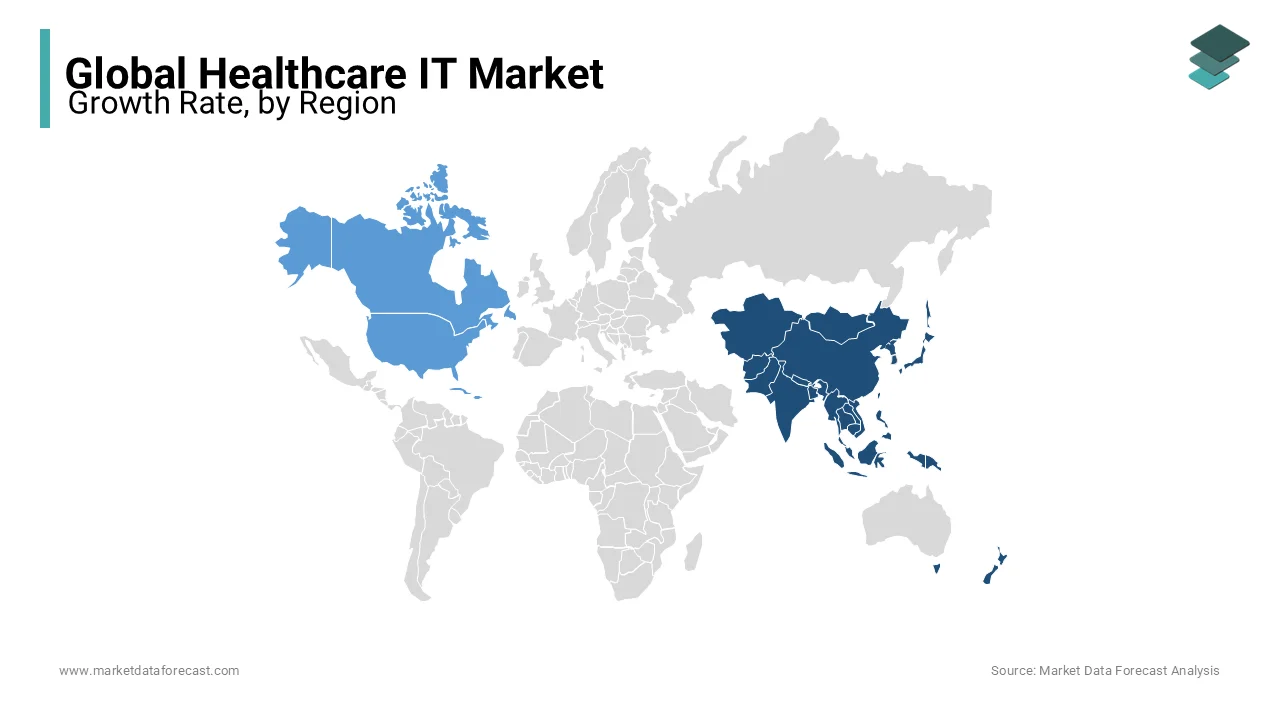
North America was the top performer of the global healthcare IT market by capturing 39.3% of share in 2025, with the robust regulatory frameworks, high healthcare spending, and early adoption of digital health technologies. The United States has institutionalized EHR use through the HITECH Act, with over $40 billion in federal incentives disbursed since 2010. The U.S. Food and Drug Administration has cleared more AI-based medical devices than any other country by fostering innovation in diagnostic and therapeutic software.
Europe Healthcare IT Market Analysis
Europe was positioned next with 27.3% of the North America healthcare IT market share in 2025. The region exhibits a balanced approach between innovation and stringent data protection, with the General Data Protection Regulation (GDPR) setting a global benchmark for privacy.
Asia Pacific Healthcare IT Market Analysis
Asia Pacific healthcare IT market growth is attributed in holding a prominent CAGR by the end of the forecast period. Rapid urbanization, rising chronic disease burden, and government-led digital health initiatives are accelerating IT adoption. China’s “Healthy China 2030” strategy includes a national health information platform linking 80,000 hospitals, with 65% already connected as of 2023, according to the National Health Commission. India’s Ayushman Bharat Digital Mission has created over 500 million digital health IDs, enabling interoperability across public and private providers.
Latin America Healthcare IT Market Analysis
Latin America healthcare IT market growth is likely to grow with steady opportunities in the coming years, with fragmented healthcare systems and uneven infrastructure, yet urban centers are embracing IT to improve access and efficiency. Brazil’s e-SUS system has digitized primary care records for over 100 million citizens by enabling real-time monitoring of vaccination and maternal health. Mexico’s Institute for Health of the State Workers (ISSSTE) has implemented a nationwide EHR system across 1,200 facilities.
Middle East & Africa Healthcare IT Market Analysis
Middle East & Africa healthcare IT market growth is propelled by digital transformation through national health strategies aligned with economic diversification goals. Saudi Arabia’s Vision 2030 includes a $1.3 billion investment in digital health infrastructure, including AI diagnostics and telemedicine. The Ministry of Health in Saudi Arabia reports that telehealth usage increased by 300% between 2020 and 2023. In South Africa, private hospitals use advanced EHR and analytics systems, but public sector adoption remains limited.
COMPETITIVE LANDSCAPE
Competition in the healthcare IT market is intensifying as legacy vendors, tech giants, and agile startups converge on a fragmented yet high-stakes domain. Established players like Epic and Cerner face pressure from cloud-native entrants and vertically integrated ecosystems led by companies such as Microsoft and Google Cloud, which offer scalable infrastructure and AI tools. Differentiation now hinges on interoperability, clinician usability, and outcomes-based performance rather than mere feature sets. The rise of open standards like FHIR has lowered entry barriers, enabling niche innovators to challenge incumbents with specialized solutions in analytics, telehealth, and cybersecurity.
KEY MARKET PLAYERS
A few of the noteworthy companies dominating the global healthcare IT market profiled in this report are
- McKesson Corporation (US)
- Epic Systems Corporation (US)
- Cerner Corporation (US)
- GE Healthcare (US)
- Philips Healthcare (Netherlands)
- Athena Health, Inc. (US)
- Allscripts Healthcare Solutions, Inc. (US)
- Oracle Corporation (US)
- Cognizant Technology Solutions Corporation (US)
- Dell Technologies (US)
- Optum, Inc. (US)
- Infor, Inc. (US)
TOP LEADING PLAYERS IN THE MARKET
- Epic Systems Corporation has significantly expanded its influence in the Asia Pacific healthcare IT landscape through strategic partnerships and localized implementations of its integrated electronic health record (EHR) platform. While historically dominant in North America, Epic has made targeted inroads into Australia and Singapore, collaborating with major health institutions such as Singapore’s National University Health System (NUHS) to deploy its secure, interoperable EHR system. In 2023, Epic launched a regional support hub in Sydney to provide real-time technical assistance and training for healthcare providers across Oceania. The company also adapted its interface to align with local clinical workflows, including integration with Australia’s My Health Record national digital health platform.
- Cerner Corporation (now part of Oracle Health) has played a transformative role in the Asia Pacific healthcare IT market by delivering scalable clinical and revenue cycle management solutions tailored to diverse healthcare ecosystems. The company has implemented its Millennium platform in key facilities across Japan, South Korea, and the UAE, with recent deployments at Abu Dhabi’s Tawam Hospital and Japan’s Saitama Medical Center. In 2022, Cerner partnered with India’s Apollo Hospitals to enhance interoperability and analytics capabilities across its 70+ facilities. Following its acquisition by Oracle, the integration of cloud infrastructure and AI-driven insights has accelerated digital health adoption in the region. Oracle Health has also invested in local data centers in Singapore and Sydney to ensure compliance with data sovereignty regulations.
- Allscripts (now Veradigm) has strengthened its presence in the Asia Pacific market by focusing on ambulatory care solutions, data analytics, and interoperability services for mid-sized clinics and specialty practices. The company’s Sunrise EHR platform is utilized in private hospitals across Malaysia and the Philippines, where it supports clinical documentation, pharmacy integration, and regulatory reporting. In 2023, Veradigm launched a regional health information exchange (HIE) pilot in collaboration with Thailand’s Ministry of Public Health to improve care coordination in Bangkok’s public hospital network. Additionally, its data analytics arm, Veradigm Insights, provides real-world evidence generation services to pharmaceutical firms conducting clinical trials in the region.
TOP STRATEGIES USED BY KEY MARKET PARTICIPANTS
Key players in the healthcare IT market are prioritizing cloud migration, artificial intelligence integration, and ecosystem partnerships to maintain a competitive advantage. Companies are shifting from on-premise installations to cloud-native platforms to enhance scalability, reduce IT burden, and ensure rapid updates. Strategic alliances with telecom providers, cybersecurity firms, and life sciences organizations enable broader service offerings. AI is being embedded into clinical workflows for predictive analytics, diagnostic support, and automated documentation. Vendors are also investing in FHIR-based interoperability to connect disparate systems and support national health data exchanges. Additionally, companies are expanding into adjacent domains such as remote patient monitoring and patient engagement platforms. Acquisitions of niche health tech startups allow rapid innovation in areas like natural language processing and genomics data integration, ensuring long-term relevance in an evolving digital health landscape.
GLOBAL HEALTHCARE IT MARKET NEWS
- In February 2022, Epic Systems partnered with Singapore’s National University Health System to implement its integrated EHR platform by enhancing clinical coordination and patient data accessibility across tertiary and community care settings in the region.
- In June 2022, Cerner Corporation collaborated with Apollo Hospitals in India to upgrade its digital infrastructure using the Millennium platform, which is improving interoperability and analytics capabilities across 70+ hospital locations.
- In November 2023, Oracle Health launched a cloud-based data center in Sydney, enabling Cerner clients in Australia and New Zealand to meet data residency requirements while leveraging AI-powered clinical decision support tools.
- In January 2024, Veradigm initiated a health information exchange pilot with Thailand’s Ministry of Public Health to connect public hospitals in Bangkok by improving real-time data sharing and care continuity.
- In March 2024, Epic Systems established a regional support hub in Sydney to provide localized training, technical assistance, and workflow optimization for healthcare providers across the Asia Pacific region.
MARKET SEGMENTATION
This research report has segmented and sub-segmented the global healthcare IT market based on the products & services, component, end-user, and region.
By Products & Services
- EHR (Electronic Health Record)
- RIS (Radiology Information Systems)
- PACS (Picture Archiving and Communication System)
- VNA (Vendor Neutral Archive)
- CPOE (Computerized Provider Order Entry)
- HIE (Healthcare Information Exchange)
- Telehealth
- Healthcare Analytics
- Fraud Management
- Claims Management
By Component
- Services
- Software
- Hardware
By End-user
- Healthcare Providers
- Payers
- Others
By Region
- North America
- Europe
- Asia Pacific
- Latin America
- The Middle East and Africa