- Product Description Description
- Table of Contents TOC
- List of Table & Figure LOT
- Get Free Sample PDF Sample PDF
Market Size, 2025
$12.56 BnMarket Estimate, 2026
$13.38 BnMarket Forecast, 2034
$22.19 BnCAGR, 2026–2034
6.53%Global High Heat Foam Market Size, Growth, Trends & Forecast (2026–2034)
The global high heat foam market size was valued at USD 12.56 billion in 2025, reached USD 13.38 billion in 2026, and is projected to expand at a CAGR of 6.53% from 2026 to 2034, reaching USD 22.19 billion by 2034. Driven by stringent fire safety standards, aerospace lightweighting requirements, thermal management needs in electric vehicles, and extreme temperature demands in industrial applications, the market continues robust global expansion.
Key Executive Metrics (At-a-Glance)
- 2025 Base Valuation: USD 12.56 Billion
- 2026 Current Valuation: USD 13.38 Billion
- 2034 Forecast Valuation: USD 22.19 Billion
- Compound Annual Growth Rate (CAGR): 6.53% (2026–2034)
- Dominant Type Segment: Silicone Foam (accounting for 42.4% share in 2025 due to unmatched thermal stability and inherent flame retardancy)
- Fastest-Growing Type Segment: Polyimide Foam (projected at the highest CAGR of 16.8% from 2026 to 2034 driven by aerospace and defense applications)
- Dominant Application Segment: Industrial (capturing 39.6% market share in 2025 owing to extreme thermal processes and chemical manufacturing protection)
- Fastest-Growing Application Segment: Aerospace (registering the fastest CAGR of 18.2% fueled by next-generation spacecraft and lightweight requirements)
- Dominant Region: North America (holding 37.5% market share in 2025 anchored by aerospace primes and strict fire codes)
- Fastest-Growing Region: Asia-Pacific (surging due to rapid industrialization, EV manufacturing, and government-backed aerospace development)
Core Market Drivers
- Stringent Fire Safety Regulations: Aviation and construction codes requiring passive fire protection, regulatory compliance under ASTM E119/E814, and structural integrity under high heat.
- Electrification & Thermal Management: Escalating thermal loads in electric vehicle battery packs, renewable energy installations, and next-gen aerospace propulsion systems.
Primary Market Restraints & Challenges
- High Raw Material & Manufacturing Costs: Expensive precursor resins, nitrogen-atmosphere autoclave processing, and complex production cycles limiting access for mid-tier industries.
- Recyclability & Supply Chain Vulnerabilities: Thermoset cross-linked polymer matrices resisting conventional recycling and geopolitical concentration of specialty monomer sources.
Global High Heat Foam Market Segmentation Breakdown
| Segment Category | Leading Sub-Segment | Fastest-Growing Sub-Segment |
|---|---|---|
| By Type | Silicone Foam (42.4% share in 2025 due to thermal stability and flame retardancy) | Polyimide Foam (16.8% CAGR driven by lightweight aerospace and defense utility) |
| By Application | Industrial (39.6% share in 2025 due to high-temp process protection and energy systems) | Aerospace (18.2% CAGR driven by extreme temperature, lightweighting, and burn-through standards) |
| By Region | North America (37.5% share in 2025 backed by aerospace primes and fire codes) | Asia-Pacific (rapid growth driven by EVs, industrialization, and regional self-sufficiency) |
Major Industry Players Profiled
Key global market leaders include BASF SE, Rogers Corporation, Evonik Industries AG, Dow, DuPont, SABIC, 3M, Wacker Chemie AG, Saint-Gobain, and Morgan Advanced Materials.
Global High Heat Foam Market Size
The global high heat foam market size was valued at USD 12.56 billion in 2025 and is anticipated to reach USD 22.19 billion by 2034 from USD 13.38 billion in 2026, growing at a CAGR of 6.53% during the forecast period from 2026 to 2034.

High heat foam refers to a specialized class of polymeric cellular materials engineered to maintain structural integrity, thermal insulation, and flame resistance under continuous exposure to temperatures exceeding two hundred fifty degrees Celsius. These foams are formulated using high performance base resins such as polyimide, phenolic, silicone, or syntactic variants strengthened with ceramic microspheres or intumescent additives. Unlike conventional insulation foams that degrade or emit toxic volatiles under thermal stress, high heat foams are designed for mission essential applications in aerospace, automotive exhaust systems, industrial furnaces, and fire rated construction assemblies. According to sources, materials used in fire barrier applications must retain dimensional stability for few hours at notable degrees Celsius to meet ASTM E119 compliance. As per research, commercial aircraft thermal acoustic insulation must withstand significant degrees Celsius for few minutes without flame propagation. The growing complexity of high temperature environments in next generation propulsion systems and energy infrastructure is compelling engineers to adopt advanced foam solutions that combine lightweighting with passive fire protection and acoustic damping, which establishs high heat foam as a non negotiable material in modern thermal management design.
MARKET DRIVERS
Stringent Fire Safety Regulations in Aviation and Construction Are Driving Material Substitution
Regulatory mandates requiring passive fire protection in enclosed or high-risk environments are compelling manufacturers to replace conventional foams with high heat resistant alternatives, which drives the growth of the high heat foam market. Advanced materials like polyimide foams, ceramics, or syntactic foams are of interest for high-temperature and fire-resistant applications. In construction, the International Building Code requires that firestop assemblies maintain integrity under ASTM E814 conditions, a requirement met only by intumescent phenolic or silicone based foams. According to the National Fire Protection Association, buildings using certified fire rated insulation materials reduce fire related structural collapse risk. This regulatory tightening is transforming high heat foam from a specialty option into a compliance necessity across safety essential sectors.
Thermal Management Demands in Electric Vehicles and Energy Systems Are Accelerating Performance Innovation
The shift toward electrification in mobility and power generation is creating unprecedented thermal loads that conventional insulation materials cannot withstand, which propels the expansion of the high heat foam market. According studies, battery packs in electric vehicles must be insulated against thermal runaway events that can exceed very high degrees Celsius, which necessitates ceramic syntactic or aerogel infused silicone foams. Some of the companies are either studying or have embed phase change material enhanced polyimide foams between battery modules to delay propagation during fault conditions. In renewable energy, as per the National Renewable Energy Laboratory, concentrated solar power receivers operate at over seven hundred degrees Celsius, requiring insulation that resists sintering and outgassing. Industrial equipment manufacturers such as retrofitting gas turbine enclosures with high heat foam reduces casing temperature by degrees Celsius, extending maintenance intervals. Hence, high heat foam is becoming integral to system reliability and longevity as energy density and operational temperatures climb.
MARKET RESTRAINTS
High Raw Material Costs and Complex Manufacturing Processes Limit Accessibility for Mid Tier Industries
The production of high heat foam involves expensive precursor resins, specialized curing equipment, and multi stage processing, which boosts the expansion of the high heat foam market. This renders it cost prohibitive for many commercial applications. According to the American Chemistry Council, polyimide resin, a key component in aerospace grade foams, costs notable dollars per kilogram, compared to that for per kilogram for expanded polystyrene. The manufacturing process requires autoclave curing under nitrogen atmosphere at three hundred degrees Celsius, which increases capital expenditure compared to conventional foam extrusion. Even in the United States, only a portion of small to mid sized fabricators can afford UL certified high heat foam for industrial enclosures, as per sources. Thus, adoption remains confined to high margin and regulated sectors due to the lack of scalable production methods or government subsidized material programs.
Lack of Standardized Testing Protocols Across Industries Creates Specification Confusion and Delays Adoption
The absence of harmonized performance benchmarks for high heat foam across end use sectors leads to inconsistent material selection, prolonged certification cycles, and project delays, which slows down the growth of the high heat foam market. According to ASTM International, many test methods exist for evaluating foam performance under thermal stress, including UL 94, ISO 11925 2, ASTM E84, and FAA AC 20 135, each with different pass fail criteria. As per the Society of Automotive Engineers, automotive suppliers often reformulate foam compositions to meet OEM specific thermal aging tests, even when base materials are identical. In construction, as per sources, a portion of firestop submittals were rejected due to mismatched test documentation between foam manufacturers and assembly integrators. Redundant testing costs and fragmented supply chains suppress broader market penetration until global standards align.
MARKET OPPORTUNITIES
Integration of Aerogel and Nanocomposite Technologies Enables Ultra Lightweight Thermal Barriers
The incorporation of silica aerogel particles and nanoclay reinforcements gives potential opportunities for the high heat foam market. It is creating unprecedented combinations of thermal resistance and weight reduction for aerospace and defense applications. According to NASA’s Glenn Research Center, aerogel infused polyimide foam exhibits low thermal conductivity per meter Kelvin at notable degrees Celsius, lower than conventional syntactic foams. Therefore, these hybrid foams are redefining the performance ceiling for thermal insulation in extreme environments as additive manufacturing enables precise dispersion of nano reinforcements.
Expansion Into Hydrogen Infrastructure and Nuclear Applications Opens New Frontiers for Passive Safety Design
The global transition to hydrogen energy and next generation nuclear power is creating demand for insulation materials capable of withstanding cryogenic to ultra high temperature extremes, which offers new prospects for the high heat foam market. According to sources, hydrogen storage tanks and piping require insulation that remains dimensionally stable from minus two hundred fifty three degrees Celsius to over five hundred degrees Celsius during rapid venting events. Companies specify dual layer silicone phenolic foams for hydrogen refueling stations, certified under ISO standard. So, high heat foam is becoming foundational to passive safety and operational resilience because hydrogen and nuclear projects are scaling.
MARKET CHALLENGES
Recyclability and End of Life Management Remain Technically and Economically Unresolved
Environmental challenges due to their thermoset chemistry and composite structure severely affects the growth rate of the high heat foam market. This resist conventional recycling and generate persistent waste streams. According to the research, a portion of polyimide or phenolic based foams are recovered at end of life, with a share landfilled or incinerated due to cross linked polymer matrices that cannot be remelted. Also, thermal decomposition of silicone foams releases volatile siloxanes that require secondary scrubbing, increasing reprocessing costs by over two hundred percent. Even mechanical grinding for filler reuse degrades particle morphology, reducing performance in subsequent formulations. High heat foam remains at odds with circular economy mandates. This is due to a lack of scalable chemical recycling pathways and design for disassembly protocols and situation risks future regulatory penalties and brand reputational exposure.
Supply Chain Vulnerability for Specialty Monomers and Reinforcing Fillers Threatens Production Continuity
The global supply of key raw materials for high heat foam is concentrated among a handful of producers, and is creating systemic risk for manufacturers, inhibits the growth of the high heat foam market. According to studies, a large share of high-purity polyimide materials used globally come from chemical plants located in China and Japan, leaving the supply chain exposed to geopolitical risks. As per sources, production disruptions at major facilities have previously caused significant shortages in specialized resins, affecting downstream manufacturing sectors. According to research, key raw materials like borosilicate microspheres are extracted from limited deposits within the United States, putting pressure on existing capacity. As per sources, European industry groups have identified ceramic fillers as essential components for strategic applications, recommending stockpiling and diversification of supply. Hence, producers of high-performance foams are expected to face ongoing cost pressures and supply instability.
REPORT COVERAGE
| REPORT METRIC | DETAILS |
| Market Size Available | 2025 to 2034 |
| Base Year | 2025 |
| Forecast Period | 2026 to 2034 |
| CAGR | 6.53% |
| Segments Covered | By Type, Application, and Region |
| Various Analyses Covered | Global, Regional & Country Level Analysis, Segment-Level Analysis, DROC, PESTLE Analysis, Porter’s Five Forces Analysis, Competitive Landscape, Analyst Overview of Investment Opportunities |
| Regions Covered | North America, Europe, APAC, Latin America, Middle East & Africa |
| Market Leaders Profiled | BASF SE, Rogers Corporation, Evonik Industries AG, SINOYQX, puren gmbh, UBE Corporation, Intecfoams, ARMACELL, Wacker Chemie AG, SABIC, 3M, Dow, DuPont, Rath-Group, Morgan Advanced Materials, Knauf Insulation, Grupo NUTEC, Vitafoam Nig. PLC, Saint-Gobain, and Stepan Company |
SEGMENTAL ANALYSIS
By Type Insights
The silicone foam segment dominated the high heat foam market by accounting for a 42.4% share in 2025. The dominance of the silicone foam segment is primarily driven by its unmatched thermal stability, flexibility across wide temperature ranges, and inherent flame retardancy without halogenated additives. According to sources, silicone foam retains structural integrity after few hours of exposure to high temperatures, which makes it the preferred choice for firestop seals and gasketing in mass transit and data centers. The material’s non corrosive outgassing profile also makes it ideal for aerospace cabin insulation, where Boeing specifies it for overhead bin and galley paneling to meet FAA flammability standards. This convergence of regulatory compliance, multi sector adaptability, and performance under extreme conditions cements silicone foam’s volume dominance.
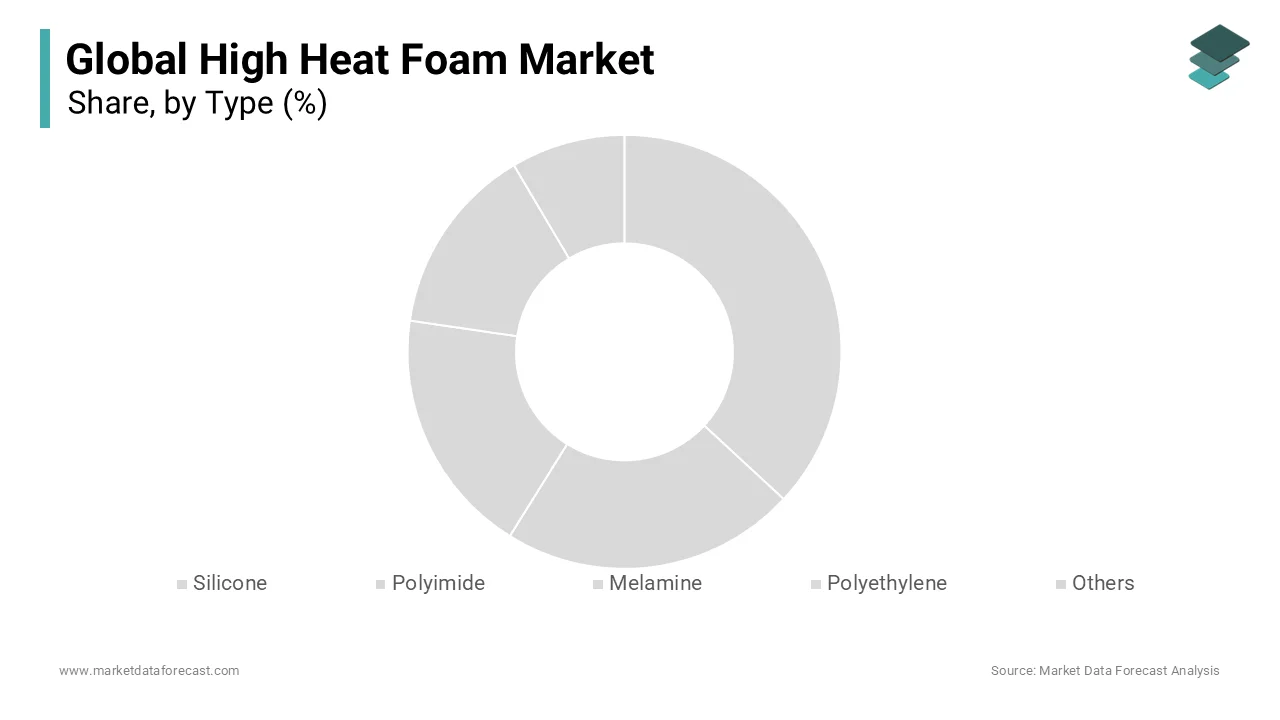
The polyimide foam segment is predicted to witness the highest CAGR of 16.8% from 2026 to 2034. The growth of the polyimide foam segment is propelled by its ultra lightweight structure, exceptional specific strength, and suitability for aerospace and defense applications where mass reduction is non negotiable. Polyimide foam is valued in aerospace applications for its ability to lower payload weight while maintaining high thermal stability, as per sources. It is also used in hypersonic vehicle structures to protect sensitive electronics from extreme aerodynamic heating, according to studies. In the microelectronics sector, leading manufacturers employ polyimide foam in chip packaging because its thermal expansion properties align with silicon, helping reduce long-term material stress, as per research. Emerging technologies are requiring materials that combine heat resistance with lightweight performance. So, polyimide foam is steadily moving from specialized use into broader adoption.
By Application Insights
The industrial applications segment led the high heat foam market by capturing 39.6% of the global market share in 2025. The proliferation of high temperature processes in power generation, chemical manufacturing, and metal processing that require passive insulation solutions resistant to thermal cycling and chemical exposure is a majorly contributor to the expansion of the industrial applications segment. Retrofitting industrial turbine enclosures with high heat foam can improve thermal efficiency and extend equipment lifespan, as per sources. In large petrochemical operations, major companies require certified fire-resistant foam for safety barriers, which leads to significant improvements in incident prevention, according to studies. These operational needs and compliance requirements help maintain the sector’s strong position in terms of production volume.
The aerospace segment is estimated to register the fastest CAGR of 18.2% from 2026 to 2034 due to the need for lightweight, fire resistant materials in next generation aircraft and spacecraft where every gram impacts fuel efficiency and payload capacity. According to the Federal Aviation Administration, commercial aircraft must use insulation materials that pass the revised burn through test at high degrees Celsius, a standard only met by polyimide and ceramic syntactic foams. NASA's Artemis program leverages advanced insulation systems for its Orion spacecraft, including ablative material called Avcoat for the heat shield. Also, NASA has researched foam/aerogel composite materials for thermal and acoustic insulation and has used aerogels on previous missions like Stardust. As urban air mobility and hypersonic flight emerge, demand for thermally stable, ultralight foams will intensify, positioning aerospace as the highest growth application vertical.
REGIONAL ANALYSIS
North America Market Analysis
North America was the top performing region in the global high heat foam market by accounting for 37.5% share in 2025. The domination of North America in the global market is primarily driven by its concentration of aerospace primes, defense contractors, and advanced manufacturing facilities governed by stringent fire safety codes. In the United States, national agencies have set material requirements for the use of silicone or polyimide foam in advanced aircraft and missile designs, according to sources. Major aerospace companies are incorporating high heat foam into turbine assemblies to boost energy efficiency. In Canada, data centers in key provinces use certified fire-resistant insulation to comply with national safety standards. Updated industrial safety guidelines also require enhanced fire protection in petrochemical facilities, which drives widespread upgrades and retrofits. Strong intellectual property protection and federal R and D grants for thermal materials further entrench North America’s technological and commercial prominence.
Europe Market Analysis
Europe was the second largest in the high heat foam market by capturing 31.4% share in 2025. The growth of the Europe is fuelled by its advanced automotive and rail manufacturing sectors, harmonized fire safety regulations, and dominance in sustainable material innovation. Germany certifies that high speed trains use foam insulation rated for one thousand two hundred degrees Celsius under DIN 5510, driving adoption of ceramic enhanced silicones. Some European companies specify polyimide foam in battery enclosures for electric models by citing compliance with ECE fire propagation standards. The European Union’s REACH regulation bans halogenated flame retardants, compelling manufacturers to reformulate with inherently fire resistant chemistries. Strong vocational training in polymer engineering and cross border material certification frameworks ensure consistent quality and rapid adoption across member states.
Asia Pacific Market Analysis
Asia Pacific is rapidly growing in the high heat foam market. Government backed material innovation hubs and rising export oriented manufacturing are accelerating regional self sufficiency and technological parity, which accelerates the expansion of Asia Pacific in the global market. Also, growth is concentrated in China, Japan, and South Korea, where rapid industrialization, electric vehicle production, and aerospace development are reshaping material demand. Many industrial facilities in China have adopted high heat foam insulation to meet national fire safety regulations, as per sources. Leading electric vehicle manufacturers in the country are also incorporating silicone foam separators in battery systems to improve safety and reduce overheating risks, according to studies. In Japan, government policies require the use of polyimide foam in satellite manufacturing, as per research by helping achieve significant weight reduction in thermal protection components. South Korea partnered with industries to develop domestically produced polyimide foam for its KSLV III launch vehicle.
Latin America Market Analysis
Latin America grew moderately in the high heat foam market with the growth being concentrated in Brazil and Mexico, driven by oil and gas infrastructure expansion and automotive manufacturing modernization. Brazil requires the use of fire-rated foam insulation for offshore platform piping systems, which leads to improved incident prevention. In Mexico, automotive manufacturers must certify foam components for flammability compliance, which prompts wider adoption of advanced materials in vehicle production. Major carmakers have updated engine bay insulation in Mexican plants with high heat foam to meet broader regional performance and warranty standards. Building codes in key cities mandate fire containment materials in high-rise construction by generating increased demand in the construction sector. Hence, regulatory alignment with North American standards and foreign direct investment in heavy industry are laying foundations for sustained regional growth.
Middle East and Africa Market Analysis
Middle East and Africa is likely to expand in the high heat foam market during forecast period. The growth is supported by the United Arab Emirates, Saudi Arabia, and South Africa, where extreme ambient temperatures and energy infrastructure expansion are driving specification of thermally stable materials. The United Arab Emirates requires fire protection systems in public transport and airport infrastructure to ensure safety under extreme heat. South Africa's National Building Regulations and Building Standards Act (Act 103 of 1977), read with the SANS 10400 series of standards, governs fire safety in all buildings, including industrial structures like power plants. Though small in volume, the region’s focus on mega projects and sovereign industrialization is creating high value and specification driven opportunities for advanced material suppliers willing to navigate complex certification landscapes.
COMPETITIVE LANDSCAPE
KEY MARKET PLAYERS
A few of the notable players in the global high heat foam market include
- BASF SE
- Rogers Corporation
- Evonik Industries AG
- SINOYQX
- puren gmbh
- UBE Corporation
- Intecfoams
- ARMACELL
- Waker Chemie AG
- SABIC
- 3M
- Dow
- DuPont
- Rath-Group
- Morgan Advanced Materials
- Knauf Insulation
- Grupo NUTEC
- Vitafoam Nig. PLC
- Saint-Gobain
- Stepan Company
TOP STRATEGIES USED BY THE KEY MARKET PLAYERS
Leading players in the high heat foam market prioritize application specific material innovation by co developing formulations with OEMs to meet exact thermal, mechanical, and regulatory thresholds. They invest in vertically integrated production to secure supply of specialty monomers and ceramic fillers, reducing dependency on external suppliers. Strategic certification under global standards such as FAA, UL, ISO, and REACH ensures market access and compliance readiness. Companies also pursue partnerships with research institutions to pioneer aerogel and nanocomposite enhancements that push performance boundaries. Modular manufacturing and digital twin process control improve batch consistency and reduce waste. End of life recyclability programs are being piloted to align with circular economy mandates and preempt regulatory risk.
COMPETITION OVERVIEW
The gasoline fuel additives market is marked by intense rivalry among global chemical manufacturers competing on formulation efficacy, regulatory compliance, and supply chain agility. Players differentiate through proprietary additive packages that enhance octane, clean injectors, and reduce emissions under evolving fuel standards such as Euro 7 and Tier 3. Innovation cycles are rapid, driven by mandates for lower sulfur and aromatic content. Regional competitors focus on cost dominance and localized distribution, while multinationals leverage R and D scale and long term contracts with refiners. Mergers and acquisitions are common as firms consolidate intellectual property and expand geographic reach. Technical service teams play a vital role in maintaining customer loyalty through on site diagnostics and customized additive solutions. Sustainability burdens are accelerating investment in bio based and low toxicity chemistries, which reshaping competitive dynamics.
TOP PLAYERS IN THE MARKET
- Rogers Corporation, a global engineered materials leader, develops high performance silicone and polyimide based foams for aerospace, defense, and electric vehicle applications. Rogers also partnered to qualify its foam for use in next generation hypersonic vehicle skins. These innovations support Rogers’ position as a solutions provider for extreme environment thermal management within the high heat foam market.
- Dow, a multinational materials science leader, produces silicone elastomeric foams under its DOWSIL brand for industrial and transportation fire protection. The company also expanded production capacity to meet rising demand from North American battery manufacturers. These moves enhance Dow’s ability to serve regulated and safety essential sectors within the high heat foam market.
- Sekisui Chemical, a Japanese advanced materials innovator, specializes in polyimide and phenolic syntactic foams for aerospace and electronics. The company also collaborated to develop battery insulation foam that delays thermal runaway by fifteen minutes. These advancements strengthen Sekisui’s role in enabling lightweight and fire safe electrification and space systems within the high heat foam market.
Global High Heat Foam Market News
- In April 2025, DynaTouch, a kiosk solutions provider, acquired KioWare, a kiosk management software company. This acquisition is anticipated to allow DynaTouch to offer more comprehensive kiosk solutions and strengthen the high heat foam market presence.
MARKET SEGMENTATION
This research report on the global high heat foam market is segmented and sub-segmented into the following categories.
By Type
- Silicone
- Polyimide
- Melamine
- Polyethylene
- Others
By Application
- Automotive
- Railway
- Industrial
- Aerospace
- Others
By Region
- North America
- Europe
- Asia Pacific
- Latin America
- The Middle East and Africa