- Product Description Description
- Table of Contents TOC
- List of Table & Figure LOT
- Get Free Sample PDF Sample PDF
Market Size, 2025
$13.17 BnMarket Estimate, 2026
$13.71 BnMarket Forecast, 2034
$18.94 BnCAGR, 2026–2034
4.12%Global Home Fitness Equipment Market Size
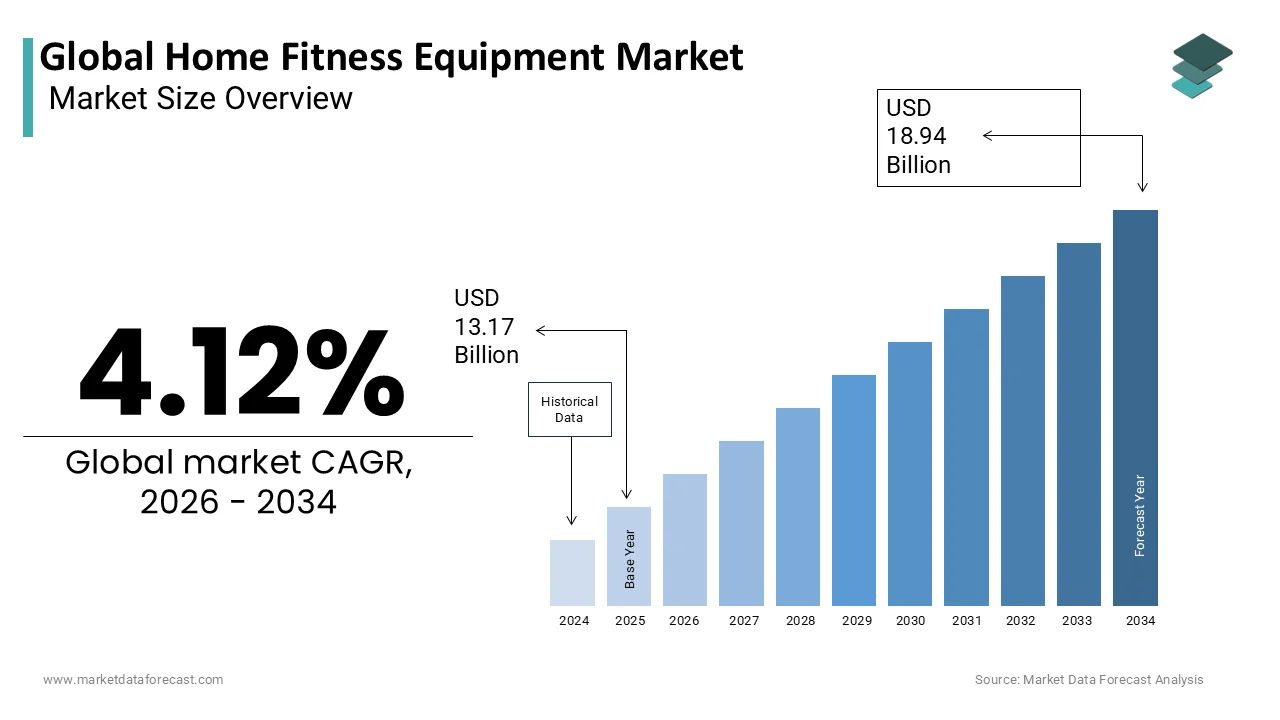
The global home fitness equipment market size was valued at USD 13.17 billion in 2025, and the market size is expected to be worth USD 18.94 billion by 2034 from USD 13.71 billion by 2026. The market is growing at a CAGR of 4.12%. From 2026 to 2034.
Home fitness equipment are physical training apparatuses designed for residential use, including connected cardio machines, strength training systems, compact functional trainers, and digitally integrated accessories that enable guided workouts without gym attendance. Unlike commercial grade equipment built for high frequency institutional use, home fitness products prioritize space efficiency, aesthetic integration, noise reduction, and user friendly digital interfaces. The category has evolved beyond static treadmills and dumbbell sets to include AI powered mirrors, electromagnetic resistance bikes, and biomechanically adaptive rowers that sync with subscription based coaching platforms. According to sources, millions of American adults now engage in home based structured exercise at least three times per week, a thirty four percent increase since two thousand nineteen. As per studies, a portion of former gym members who transitioned to home workouts during the pandemic have maintained or increased their equipment investment. This behavioral permanence, combined with advancements in immersive technology and real time performance analytics, has transformed home fitness from a temporary convenience into a fully equipped and digitally native wellness ecosystem.
MARKET DRIVERS
Permanent Behavioral Shift Toward Hybrid Fitness Models
The normalization of home based exercise as a primary or complementary fitness modality has created structural demand for resaidential equipment accelerates the growth rate of the home fitness equipment market. This supports consistency, personalization, and measurable progress. According to studies, adults who maintained home workout routines post pandemic demonstrated a higher adherence rate over several months compared to those relying solely on gym memberships. Real estate trends further support this shift. Developers in urban markets such as New York and San Francisco now include “fitness ready” floorplans with strengthened flooring and pre wired connectivity as standard features. Insurance providers like UnitedHealthcare and Aetna have begun subsidizing equipment purchases through wellness incentives, which recognizes the correlation between home exercise and reduced chronic disease claims. This convergence of behavioral permanence, spatial adaptation, and institutional validation ensures sustained demand.
Integration of AI Coaching and Immersive Content Is Elevating
The infusion of artificial intelligence, real time form correction, and cinematic workout experiences is bolstering the expansion of the home fitness equipment market. It is transforming from inert hardware into dynamic as well as adaptive training partners that reduce boredom and increase efficacy. According to Stanford University’s Human Performance Lab, users of AI guided strength equipment demonstrated greater strength gains over several weeks compared to those using free weights without feedback. Streaming platforms integrated into NordicTrack and ProForm machines offer live classes with leaderboard competition and terrain matching, which increasing session completion rates, according to iFit’s internal analytics. Hence, consumers perceive higher lifetime value because equipment are evolving into interactive wellness platforms, which justifies premium pricing and reducing abandonment rates that historically plagued home gyms.
MARKET RESTRAINTS
High Upfront Cost and Space Constraints Continue to Limit Penetration
The capital intensity and spatial footprint of premium home fitness systems remain prohibitive for a significant portion of the population, particularly in urban rental environments and cost sensitive regions, degrades the growth of the home fitness equipment market. According to the United States Census Bureau, the median monthly rent for a two bedroom apartment in major metropolitan areas exceeds one thousand eight hundred dollars, leaving limited budget for equipment costing two thousand to five thousand dollars. As per the Joint Center for Housing Studies at Harvard University, only a portion of renters feel permitted to install anchored fitness equipment due to lease restrictions and damage deposit concerns. Even among homeowners, as per research, fewer share of residences built before two thousand ten include rooms or layouts suitable for dedicated fitness zones. Financing options offered by manufacturers often carry interest rates exceeding twelve percent, deterring budget constrained buyers.
Post Purchase Engagement Decline Affects Long Term Value Proposition and Brand Loyalty
Declining utilization after the initial three to six month period, eroding consumer satisfaction and reducing referral potential, which hampers the expansion of the home fitness equipment market. According to the American Psychological Association a portion of smart equipment owners report a greater than fifty percent drop in weekly usage after ninety days, primarily due to content fatigue, lack of social accountability, and absence of progressive programming. As per the consumer Reports’, only a portion of treadmill and elliptical owners rated their equipment as “worth the investment” after two years, citing repetitive workouts and unmotivating interfaces. Equipment without live coaching or adaptive resistance struggles to maintain novelty, particularly among casual users. Brands that fail to continuously refresh content, introduce gamification, or integrate community challenges risk high attrition, which turns capital intensive purchases into underutilized furniture and damaging long term brand equity.
MARKET OPPORTUNITIES
Expansion Into Preventive Health and Clinical Rehabilitation Creates New Revenue and Partnership Pathways
The increasing prescription as a therapeutic modality for chronic disease management and postoperative recovery is opening institutional channels beyond retail consumers, which gives new opportunities for the growth of the home fitness equipment market. According to the Centers for Disease Control and Prevention, over sixty percent of American adults have at least one chronic condition such as hypertension or type two diabetes, for which structured exercise is a first line intervention. Companies have partnered with hospital systems to deploy equipment in cardiac rehab and mobility restoration programs, with outcomes tracked via HIPAA compliant dashboards. As per the American Physical Therapy Association, home based rehab patients using connected resistance equipment demonstrate faster functional recovery than those using manual bands. Thus, home fitness brands are transitioning from consumer goods to clinical tools, which unlocks insurance reimbursed revenue and long term care partnerships.
Emerging Markets in Asia and Latin America Offer Untapped Growth Through Urbanization and Digital Fitness Adoption
Rapid urbanization, rising disposable incomes, and smartphone penetration in previously underpenetrated regions such as India, Brazil, and Southeast Asia, which creates potential opportunities for the expansion of the home fitness equipment market. In Brazil, Gympass and Smart Fit have introduced rental and installment models for connected bikes and strength machines, which reduces entry barriers in a market where sixty one percent of consumers cite cost as the primary deterrent. As per the International Telecommunication Union, mobile broadband coverage now exceeds ninety five percent in urban India, enabling seamless streaming of live classes on budget devices. Localized content featuring regional trainers and culturally relevant music is accelerating trial. So, these markets represent the next frontier for scalable and digitally native fitness adoption as logistics and financing infrastructure mature.
MARKET CHALLENGES
Supply Chain Fragmentation and Component Shortages Constrain Scalability and Innovation Cycles
Disruptions in specialized component supply, particularly for motion sensors, electromagnetic resistance systems, and touchscreen displays, which are sourced from a limited number of global manufacturers, constrains the growth of the home fitness equipment market. According to sources, a portion of torque controlled motors used in smart strength machines are produced by suppliers, which creates systemic risk during geopolitical or logistical shocks. As per research, lead times for custom printed circuit boards with biometric feedback capabilities exceed weeks by forcing companies to over forecast and carry excess inventory. Unlike commodity electronics fitness equipment cannot easily substitute components without recalibrating resistance curves or motion algorithms. This increases redesign costs and manufacturers face a margin burden plus innovation delays until supply chains diversify or vertical integration expands. This limits responsiveness to consumer demand.
Consumer Skepticism Around Data Privacy and Algorithmic Coaching Weakens Trust in Premium Connected Systems
Concerns over biometric surveillance, algorithmic bias, and third party data sharing are deterring privacy conscious consumers from adopting premium connected systems, which slows down the expansion of the home fitness equipment market. According to Pew Research Center, a portion of Americans believe fitness companies collect more personal health data than necessary, and a portion do not trust brands to secure it from breaches. The Federal Trade Commission has opened investigations into three major fitness platforms for allegedly sharing heart rate and workout location data with advertising networks without explicit consent. European consumers are even more cautious. Brands risk alienating a growing segment of ethically minded and security aware users. This happens without transparent data governance, without opt-in controls, and without third-party audits.
REPORT COVERAGE
| REPORT METRIC | DETAILS |
| Market Size Available | 2025 to 2034 |
| Base Year | 2025 |
| Forecast Period | 2026 to 2034 |
| Segments Covered | By Equipment Type, End User and Region |
| Various Analyses Covered | Global, Regional & Country Level Analysis, Segment-Level Analysis, DROC, PESTLE Analysis, Porter’s Five Forces Analysis, Competitive Landscape, Analyst Overview of Investment Opportunities |
| Regions Covered | North America, Europe, Asia Pacific, Latin America, The Middle East and Africa |
| Market Leaders Profiled | Technogym, Brunswick Corporation, Amer Sports (Precor), Cybex International Inc., Nautilus Inc., Johnson Health Tech, Paramount and Torque |
SEGMENTAL ANALYSIS
By Equipment Type Insights
In 2024, the cardiac respiratory equipment segment led the home fitness equipment market by capturing 46.4% share in 2024. The dominance of the cardiac respiratory equipment segment is fueled by rising cardiovascular disease prevalence and consumer preference for quantifiable, metrics driven workouts that track progress over time. According to sources, millions of American adults suffer from hypertension or pre hypertension, for which aerobic exercise is a primary non pharmacological intervention. Connected treadmills, bikes, and rowers from brands provide real time heart rate zones, VO2 max estimates, and calorie burn analytics, which increases user accountability. Insurance providers including UnitedHealthcare reimburse up to five hundred dollars annually for qualifying cardio machines under preventive care programs. The integration of live leaderboards, terrain matching, and trainer led interval programs further enhances engagement.
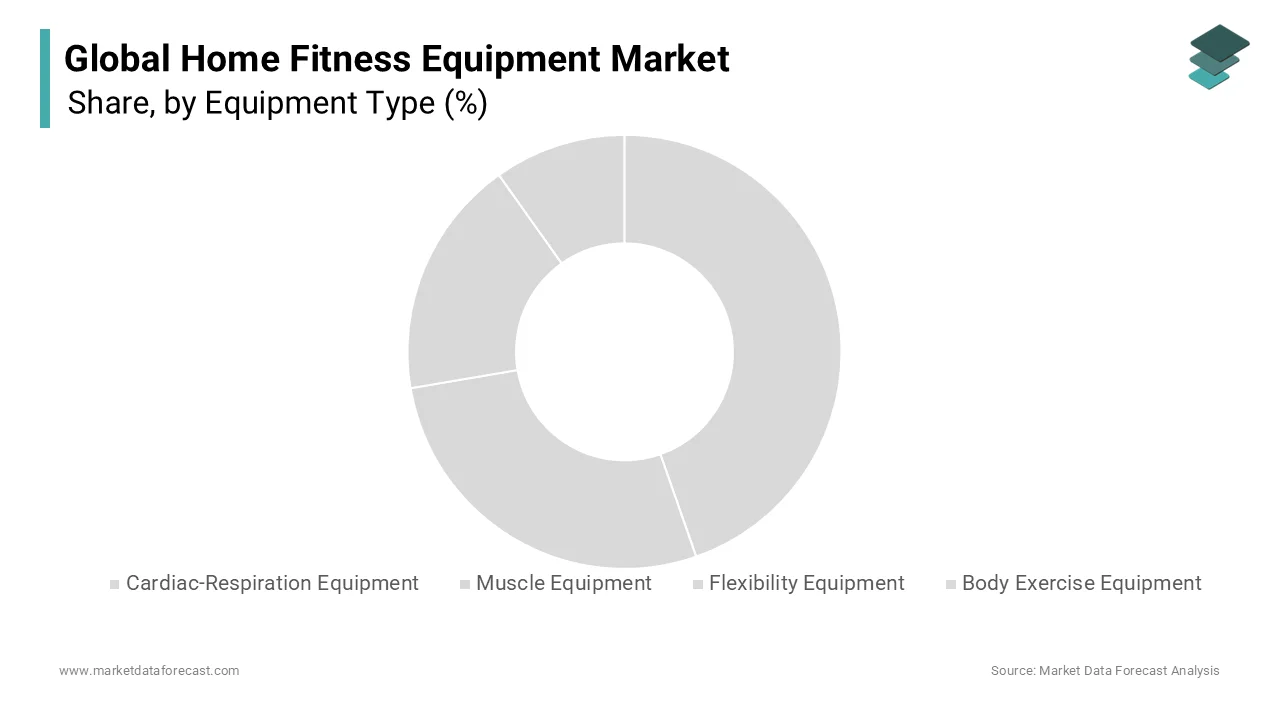
The muscular equipment segment is anticipated to witness the fastest CAGR of 21.4% from 2025 to 2033. The growth of the muscular equipment segment is propelled by the rise of hybrid strength training, AI guided form correction, and space efficient electromagnetic resistance systems that replace traditional weights. Tonal and Tempo, which utilize digital weight stacks and 3D motion sensors, report user retention rates exceeding eighty two percent at twelve months, far higher than free weight users. As per the National Strength and Conditioning Association, users of AI coached strength machines demonstrate greater hypertrophy gains over weeks due to optimized tempo and load progression. In urban markets, where space is constrained, wall mounted systems are gaining traction. Strength training is becoming digitally native and clinically validated. Muscular equipment is now transitioning from a garage accessory to a core health infrastructure.
By End User Insights
The homecare segment was the largest segment in the home fitness equipment market by capturing substantial share in 2024. The expansion of the homecare segment is driven by the irreversible shift toward residential wellness investment, supported by pandemic induced gym closures and sustained by convenience, personalization, and long term cost efficiency. According to the Physical Activity Council, millions of American adults perform the majority of their structured exercise at home, with a portion citing no commute and schedule flexibility as primary motivators. Real estate developers in high density markets include floorplans with reinforced subfloors and pre wired connectivity as standard features. Insurance reimbursement programs from Aetna and Kaiser Permanente cover for qualifying cardio and strength equipment when prescribed for chronic conditions. The homecare segment’s dominance is structural, not cyclical, because fitness is becoming embedded in daily domestic routines rather than scheduled external appointments.
The hospital segment is likely to experience the fastest CAGR of 24.7% during the forecast period. The rapid growth of the hospital segment is driven by the integration of connected fitness equipment into post-acute recovery, cardiac rehab, and chronic disease management protocols. Cleveland Clinic and Mayo Clinic now deploy Tonal and Hydrow machines in outpatient rehab centers, with outcomes tracked via HIPAA compliant dashboards that share progress with physicians in real time. Medicare’s initiative permits reimbursement for remote monitored exercise equipment as part of bundled care episodes. Hospitals are becoming key distribution and validation channels for next generation home fitness systems as value based care models prioritize functional outcomes over facility visits.
REGIONAL ANALYSIS
North America Market Analysis
North America was the top performer in the global home fitness equipment market by accounting for 44.3% share in 2024. The domination of the North America is driven by high disposable income, mature e commerce logistics, widespread insurance reimbursement for preventive equipment, and cultural normalization of home based wellness. In the United States, a portion of households earning notable amount annually own connected fitness equipment, according to reserach. Peloton, Tonal, and NordicTrack are headquartered in the U S and benefit from direct to consumer marketing, live class ecosystems, and integration with Apple Health and Google Fit. Strong venture capital backing and clinical validation through hospital partnerships further entrench North America’s innovation and commercial prominence.
Europe Market Analysis
Europe was the second largest in the home fitness equipment market by capturing 30.6% share in 2024. The growth of the Europe is fuelled by its aging population, universal healthcare systems that increasingly cover preventive fitness, and stringent data privacy regulations that build consumer trust. Germany’s Techniker Krankenkasse reimburses for WHO approved home cardio and strength equipment for patients with metabolic syndrome. Urbanization and small living spaces have accelerated demand for foldable and wall mounted systems. Europe’s blend of public health integration and privacy by design positions it as a model for sustainable and regulated home fitness adoption.
Asia Pacific Market Analysis
Asia Pacific is expected to be the most lucrative region in the home fitness equipment market. The growth of the Asia Pacific is fuelled by China, Japan, and India, where rising middle class incomes, urban density, and digital fitness culture are reshaping consumer behavior. Sales of smart fitness devices have surged in China, with affordable AI-enabled trainers gaining strong consumer traction, as per sources. In Japan, compact urban living has fueled demand for space-saving fitness equipment, with major brands expanding production to meet rising demand. Supportive financial policies have also made it easier for consumers to buy home fitness equipment on installment plans, according to studies. Hence, the Asia Pacific region is emerging as a major growth hub for digitally connected fitness solutions.
Latin America Market Analysis
Latin America expanded gradually in the home fitness equipment market. Brazil and Mexico are primary growth engines, driven by rising chronic disease rates, urbanization, and fintech enabled installment purchasing. According to studies, rising obesity rates in Brazil are driving greater demand for affordable and easily accessible fitness solutions. Also, regional fitness brands are introducing rental programs and long-term installment options to make equipment ownership more manageable for consumers. Social media influencers and TikTok trainers have amplified visibility, with hashtag #treinocasa generating billion of views. Though nascent, the region’s blend of affordability innovation and digital community building is laying foundations for scalable and culturally resonant adoption.
Middle East and Africa Market Analysis
Middle East and Africa region is predicted to grow in the home fitness equipment market due to the United Arab Emirates, Saudi Arabia, and South Africa, where extreme climates, luxury wellness culture, and government backed fitness initiatives are driving premium adoption. The United Arab Emirates requires that large residential projects include built-in spaces for fitness activities with preinstalled equipment connections. Saudi Arabia’s national wellness initiative under Vision 2030 provides government support for home fitness adoption to encourage more active lifestyles. In South Africa, health insurance programs offer partial reimbursements for fitness equipment purchases to motivate members to maintain consistent exercise routines. Though small in volume, the region’s focus on high margin, incentive driven, climate adapted solutions is creating unique opportunities for premium and smart equipment providers willing to navigate localized distribution and content preferences.
COMPETITIVE LANDSCAPE
KEY MARKET PLAYERS
Some of the key players dominating the global home fitness equipment market are
- Technogym
- Brunswick Corporation
- Amer Sports (Precor)
- Cybex International Inc.
- Nautilus Inc.
- Johnson Health Tech
- Paramount
TOP STRATEGIES USED BY THE KEY MARKET PLAYERS
Leading players in the home fitness equipment market prioritize ecosystem lock in by combining proprietary hardware with subscription based digital content and community features to increase retention. They invest in artificial intelligence to deliver real time form correction, adaptive resistance, and personalized programming that enhances efficacy and reduces injury risk. Strategic partnerships with healthcare providers and insurers enable reimbursement pathways and clinical validation. Companies also localize content by language, culture, and music to expand global appeal. Financing and rental models reduce entry barriers in emerging markets. Integration with wearables and electronic health records creates seamless wellness tracking. Gamification through leaderboards and achievement badges sustains motivation beyond initial novelty.
COMPETITION OVERVIEW
The gasoline fuel additives market is defined by fierce competition among multinational chemical corporations and specialty formulators vying for contracts with refiners, distributors, and original equipment manufacturers. Players compete on technical performance, regulatory compliance, supply chain reliability, and pricing efficiency. Innovation in deposit control, octane enhancement, and emission reduction technologies serves as the primary differentiator. Companies invest heavily in proprietary additive packages and long term supply agreements to lock in market access. Regional players focus on cost dominance and localized customer service while global giants leverage R and D scale and brand equity. Mergers and acquisitions are frequent as firms seek to consolidate intellectual property and expand geographic footprint. Customer education and technical support teams play a vital role in maintaining loyalty and ensuring correct product application. Regulatory shifts toward cleaner fuels compel continuous reformulation and testing.
TOP PLAYERS IN THE MARKET
- Peloton Interactive Inc revolutionized home fitness by merging premium cardio equipment with live and on demand instructor led content. It also expanded its corporate wellness program to over five hundred employers, offering subsidized memberships and health metric integration. These initiatives support Peloton’s ecosystem approach, blending hardware, software, and community to drive long term engagement within the home fitness equipment market.
- Tonal Systems Inc pioneered digital weight technology, replacing traditional plates with electromagnetic resistance and AI guided strength training. The company also partnered with Cleveland Clinic to validate clinical outcomes for post rehabilitation users. These advancements position Tonal as a leader in intelligent, space efficient strength solutions within the home fitness equipment market. NordicTrack LLC, a subsidiary of iFit Health and Fitness Inc, offers connected cardio machines with global terrain streaming and trainer led workouts. It also expanded content localization for European and Asian markets, adding multilingual trainers and region specific programming. These moves enhance NordicTrack’s global relevance and technological depth within the home fitness equipment market.
Global Home Fitness Equipment Market News
- In April 2024, DynaTouch, a kiosk solutions provider, acquired KioWare, a kiosk management software company. This acquisition is anticipated to allow DynaTouch to offer more comprehensive kiosk solutions and strengthen the home fitness equipment market presence.
MARKET SEGMENTATION
This research report on the global home fitness equipment market has been segmented and sub-segmented based on equipment, end user and region.
By Equipment Type
- Cardiac-Respiration Equipment
- Muscle Equipment
- Flexibility Equipment
- Body Exercise Equipment
By End User
- Hospitals
- Gyms/Health Clubs
- Home Care
By Region
- North America
- Europe
- Asia Pacific
- Latin America
- Middle East, and Africa