- Product Description Description
- Table of Contents TOC
- List of Table & Figure LOT
- Get Free Sample PDF Sample PDF
Market Size, 2025
$19.37 BnMarket Estimate, 2026
$20.75 BnMarket Forecast, 2034
$35.92 BnCAGR, 2026–2034
7.10%Global Honeycomb Packaging Market Size, Growth, Trends & Forecast (2026–2034)
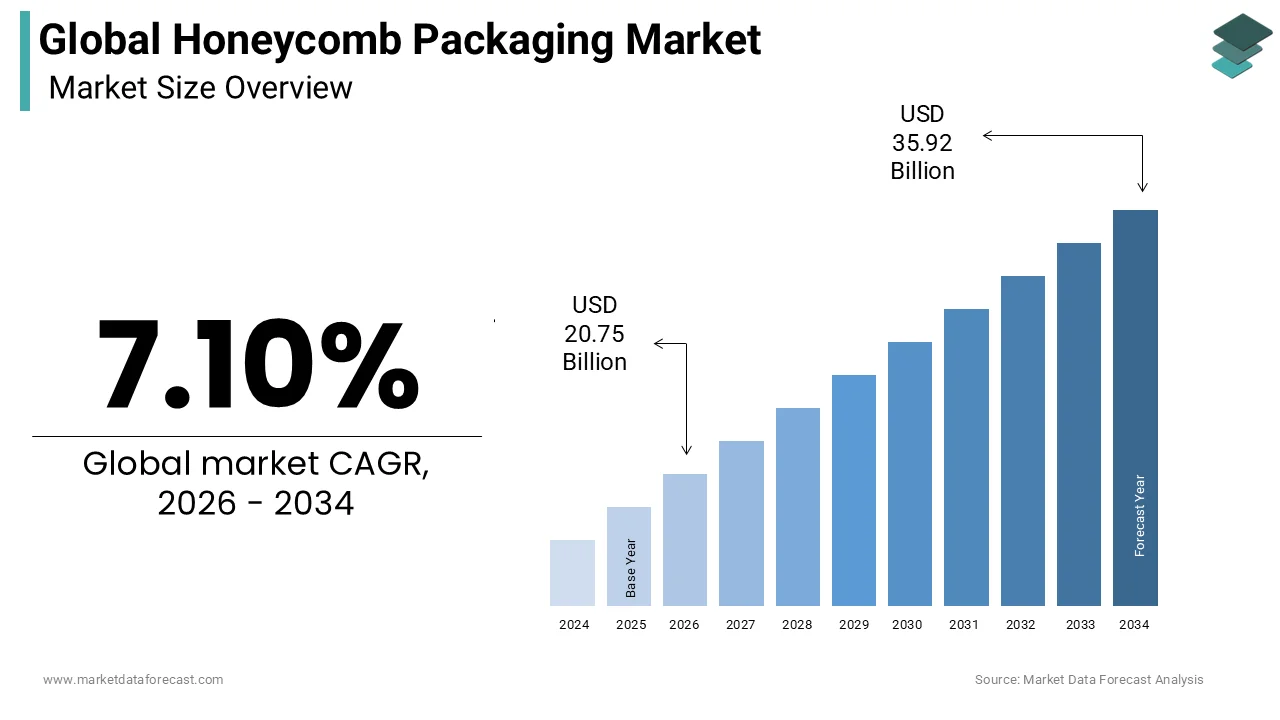
The global honeycomb packaging market size was calculated to be USD 19.37 billion in 2025, is anticipated to reach USD 20.75 billion in 2026, and is projected to scale up to USD 35.92 billion by 2034, registering a compound annual growth rate (CAGR) of 7.10% during the forecast period from 2026 to 2034. Driven by the global push for sustainable, plastic-free alternatives and the soaring protective requirements of the e-commerce sector, the market is experiencing robust and continuous expansion.
Key Executive Metrics (At-a-Glance)
- 2025 Base Valuation: USD 19.37 Billion
- 2026 Current Valuation: USD 20.75 Billion
- 2034 Forecast Valuation: USD 35.92 Billion
- Compound Annual Growth Rate (CAGR): 7.10% (2026–2034)
- Dominant Packaging Segment: Exterior Packaging (leads due to its structural integrity and role as a preventive barrier against external elements)
- Dominant End-Use Segment: Automotive (holds the largest share, followed closely by the fast-growing furniture packaging segment)
- Dominant Region: Asia-Pacific (anchors the market via rapid urbanization, massive e-commerce growth, and a booming manufacturing sector)
Core Market Drivers
- Eco-Friendly Alternatives to Plastic: Heightened global emphasis on mitigating plastic pollution is accelerating the transition to 100% recyclable, paper-based honeycomb structures.
- E-Commerce Packaging Surge: Expanding online retail networks require robust shock absorption and cushioning to ensure the safe delivery of fragile and high-value items.
- Manufacturing Technological Advancements: Modern tools and production technology have optimized manufacturing efficiency, making customized honeycomb packaging more affordable and accessible for businesses of all sizes.
Primary Market Restraints & Challenges
- Production & Customization Costs: The specialized equipment and customization processes can drive up initial expenses compared to traditional, less sustainable packaging formats.
- Vulnerability to Sharp Objects: Pointed or irregularly shaped cargo can damage the hexagonal cells, compromising the overall structural integrity without specialized handling.
- Raw Material Supply Chains: Fluctuating availability and prices of high-quality paper and cardboard can disrupt manufacturing schedules and impact profit margins.
Global Honeycomb Packaging Market Segmentation Breakdown
| Segment Category | Leading Sub-Segment (2025 Base) | Secondary & Fast-Growing Segments |
|---|---|---|
| By Packaging Type | Exterior Packaging (dominant barrier protection) | Interior Packaging (minimizing transit movement and damage) |
| By End-Use Industry | Automotive (leading segment for heavy-duty protection) | Furniture & Consumer Goods (highly reliant on customized cushioning) |
| By Region | Asia-Pacific (largest market; driven by high e-commerce & manufacturing volume) | North America (strong demand fueled by green logistics and sustainability goals) |
Major Industry Players Profiled
Key enterprises shaping the competitive global honeycomb packaging market include BASF S.E., ACH Foam Technologies, DS Smith Plc, Huhtamaki Group, Lsquare Eco-Products Pvt. Ltd., Packaging Corporation of America, Sealed Air Corporation, Sonoco Products Company, Smurfit Kappa Group, and WestRock Company.
 Download Free Sample Report
Global Honeycomb Packaging Market Size
The global honeycomb packaging market size was calculated to be USD 19.37 billion in 2025 and is anticipated to be worth USD 35.92 billion by 2034, growing from USD 20.75 billion in 2026 at a CAGR of 7.10% during the forecast period.
"Honeycomb packaging" describes a particular kind of protective packaging material that makes use of a honeycomb structure with hexagonal cells. Typically, plastics, cardboard, or paper are used to create the cells. Excellent strength, lifespan, and cushioning are provided by its design's distinctive features. Due to its higher resistance to shocks, vibrations, and other outside pressures, honeycomb packaging is frequently utilized to transport and store delicate or fragile goods.
MARKET DRIVERS
Globally, there is greater emphasis being given to environmentally conscious packaging solutions as a result of growing environmental concerns, the need to address situations like plastic pollution and waste management, and other issues. In such a scenario, honeycomb packing comes out as a sustainable alternative due to the use of recyclable materials, mainly paper or cardboard. The demand for the honeycomb packaging market is on the rise as a result of the growing global emphasis on sustainability as both industry and consumers prioritize environmentally friendly alternatives to non-recyclable materials like plastics.
It's crucial to protect the goods throughout transportation as more shipments are being shipped as a result of increased online purchasing. An excellent approach to this issue is packaging made of honeycomb. It is capable of withstanding impacts and securing fragile goods because of its outstanding cushioning and shock absorption properties, which help in the safe delivery of goods that are propelling market growth.
Production of honeycomb packing is now more productive and economical owing to ongoing improvements in manufacturing technology. Modern tools and processes provide more efficiency, accuracy, and flexibility for modification decisions, making honeycomb packing more easily accessible and cost-effective when it comes to businesses of all sizes. Hence there is an increase in the demand for the honeycomb packaging market in several industries, due to which the honeycomb packaging market is gaining a significant market share.
MARKET RESTRAINTS
Honeycomb packaging can sometimes be more expensive compared to other traditional packaging materials. The manufacturing processes, customization options, and specialized equipment required for producing honeycomb structures can contribute to higher production costs. This cost factor may limit its adoption, especially for price-sensitive industries or products with lower profit margins. Hence this cost factor restrains the growth of the honeycomb packaging market.
In the honeycomb packaging market, the availability of raw materials like high-quality paper or cardboard can sometimes serve as a barrier. Demand for these materials, particularly from the packaging or other industries, may affect their supply, raising prices or disrupting the supply chain, which leads to a decrease in the demand for the honeycomb packaging market.
Honeycomb packaging provides good cushioning and protection, but in some environments or situations, the honeycomb structure itself can be problematic. Sharp or pointed items pose the risk of damaging or breaking the cells, harming the packaging's effectiveness and integrity as a whole. Packaging products with irregular ways or edges that are pointed demands special handling and care, which restrains the demand for the honeycomb packaging market.
MARKET OPPORTUNITIES
A major opportunity for the honeycomb packaging market is presented by the ongoing growth of the e-commerce industry. There is a growing demand for packaging materials that can protect goods during transportation as more people prefer to purchase things online. Fragile items delivered through e-commerce channels are particularly suited for honeycomb packaging because of their outstanding cushioning and shock absorption characteristics. The honeycomb packaging market is going to become more and more popular as the e-commerce sector expands.
Manufacturers in the honeycomb packaging market have an opportunity to offer customized solutions for packaging. Packaging that suits specific product requirements, branding needs, and personal tastes is often looked after by businesses and consumers. To meet these particular requirements, honeycomb packaging can easily be modified in terms of size, thickness, and volume. Manufacturers who provide specialized honeycomb packaging solutions might take advantage of this opportunity and meet various demands from customers, which may lead to an increase in the demand for the honeycomb packaging market.
The honeycomb packaging market and ongoing developments in material technology offer an opportunity for innovation and product development.
Impact of COVID-19 on the Global Honeycomb Packaging Market
The COVID-19 pandemic had a major impact on the honeycomb packing market. On the one hand, an increase in consumer demand for e-commerce and requirements boosted the market. As more consumers turned to online shopping and home delivery, the need for safe packaging grew. Honeycomb packaging proved to be effective in providing the safe transportation of products, which helped the honeycomb packaging market to obtain a significant share. COVID-19, however, created problems for the honeycomb packaging market. The availability and cost of raw materials required to make honeycomb packaging, like paper and cardboard, were affected by issues with the global supply chain, which impacted the demand from consumers for the honeycomb packaging market.
REPORT COVERAGE
| REPORT METRIC | DETAILS |
| Market Size Available | 2025 to 2034 |
| Base Year | 2025 |
| Forecast Period | 2026 to 2034 |
| CAGR | 7.1% |
| Segments Covered | By Packaging, End-use industry, and Region |
| Various Analyses Covered | Global, Regional & Country Level Analysis, Segment-Level Analysis, DROC, PESTLE Analysis, Porter’s Five Forces Analysis, Competitive Landscape, Analyst Overview on Investment Opportunities |
| Regions Covered | North America, Europe, Asia Pacific, Latin America, and Middle East & Africa |
| Market Leaders Profiled | BASF S.E., ACH Foam Technologies, DS Smith Plc, Huhtamaki Group, Lsquare Eco-Products Pvt. Ltd., Packaging Corporation of America, Sealed Air Corporation, Sonoco Products Company, Smurfit Kappa Group and WestRock Company |
SEGMENTAL ANALYSIS
Global Honeycomb Packaging Market Analysis By Packaging
The exterior packaging segment is anticipated to dominate the honeycomb packaging market owing to its properties to provide structural integrity and serves as a preventive barrier against external elements. It is followed by the internal packaging segment, which is projected to have a significant market share in the honeycomb packaging market as internal packaging minimizes movement and prevents damage during the transportation of the products.
Global Honeycomb Packaging Market Analysis By End-use Industry
The Automotive segment is anticipated to have a dominating market share in the honeycomb packaging market, and it is followed by the furniture segment, which is deemed to have a significant market share in the honeycomb packaging market during the forecasted period 2025 to 2029.
REGIONAL ANALYSIS
The Asia-Pacific honeycomb packaging market is projected to gain the largest market share during the period 2025 to 2029.
Owing to rapid urbanization, expanding e-commerce markets, and a booming manufacturing sector contributing to the demand for efficient and sustainable packaging solutions in this region.
The North American honeycomb packaging market is next in having dominating market shares, driven by elements like e-commerce development, sustainability objectives, and the increasing need for protective packaging across different industries.
KEY PLAYERS IN THE GLOBAL HONEYCOMB PACKAGING MARKET
The global honeycomb packaging market is concentrated with well-established players. Key players in the market include BASF S.E., ACH Foam Technologies, DS Smith Plc, Huhtamaki Group, Lsquare Eco-Products Pvt. Ltd., Packaging Corporation of America, Sealed Air Corporation, Sonoco Products Company, Smurfit Kappa Group and WestRock Company
RECENT HAPPENINGS IN THE MARKET
In June 2022, the Shiseido brand launched sustainable product packaging options for e-commerce consumers. The company used more environmentally friendly stuffing paper & honeycomb wrap instead of the bubble wrap previously used in the e-commerce packaging. Kraft paper is used to prepare the new cushioning honeycomb wrap, which is entirely recyclable.
In May 2022, Alkindo Naratama Tbk (ALDO) launched a green product substitute for Indonesia's first plastic bubble wrap, Hexcel Wrap. This product is made to reduce the amount of plastic waste generated by online retailers. In the form of a honeycomb structure composed of recycled paper, Hexcel Wrap is a green product and an alternative to bubble wrap for protecting shipments of products, particularly for the e-commerce sector.
In September 2021, one of India's leading Industrial tape manufacturers, Ajit Industries Private Limited (AIPL), introduced Self Adhesive Kraft Paper Tape and Honeycomb Paper. These environmentally responsible and sustainable packaging options were created to reduce secondary packaging's use of plastic. The company wants to switch to these sustainable and biodegradable substitutes for the non-biodegradable plastic now used in secondary packaging.
DETAILED SEGMENTATION OF THE GLOBAL HONEYCOMB PACKAGING MARKET INCLUDED IN THIS REPORT
This research report on the global honeycomb packaging market has been segmented and sub-segmented based on packaging, end-use industry, and region.
By Packaging
- Exterior Packaging
- Interior packaging
- Pallets
- Others
By End-use industry
- Automotive
- Consumer goods
- Food and beverages
- Furniture
- Industrial goods
- Others
By Region
- North America
- Europe
- Asia-Pacific
- Latin America
- Middle East and Africa