- Product Description Description
- Table of Contents TOC
- List of Table & Figure LOT
- Get Free Sample PDF Sample PDF
Global Human Capital Management Market Size
The global human capital management (HCM) market was valued at USD 24.34 billion in 2024 and is projected to reach USD 43.63 billion by 2033, growing at a CAGR of 6.7% from 2024 to 2033.
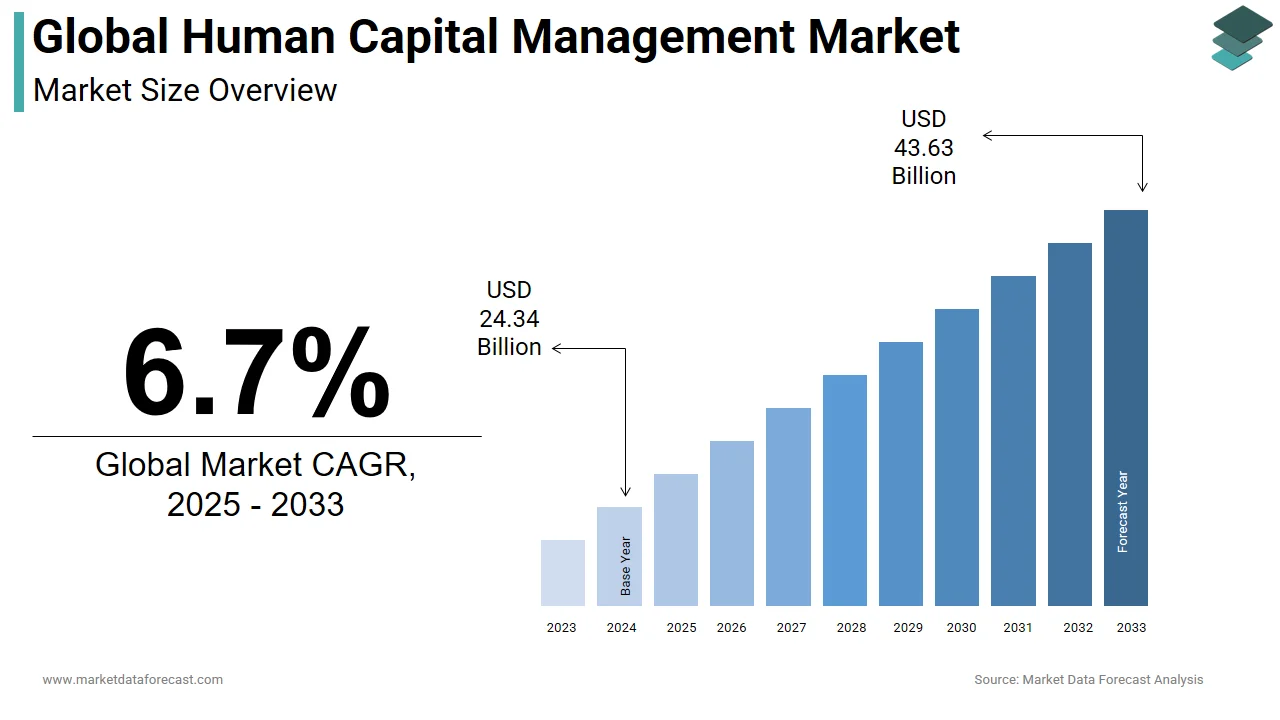
Human capital management software (HCM), an enterprise application solution, has been a necessity in every business as it automates the heavy administrative tasks related to employee data, payroll, and benefits management. Also, the expansion of the HCM software market is credited to the opportunities developed by the demand for SMEs across the globe.
Employee-driven internet usage patterns persuade companies to implement mobile apps that extend employee management functions to improve culture, that is, people management, offering growth prospects to HCM suppliers. Since several companies had the same human resource software for more than seven years, which must be updated to keep up with the market, these factors should influence the growth of the human capital management software market.
Data security has become a major concern since the implementation of HCM software. The software must prevent unauthorized access to confidential and confidential data. Several levels of security must be established, which hampers market growth.
MARKET TRENDS
The wealth of functionality, ease of use, and data capacity features of cloud-based applications led to the adoption of the cloud in all enterprise application solutions, of which CRM and HCM were the first to be introduced to the cloud.
Cloud-based HCM solutions enable companies to create effective employee engagement tools that leverage the integration of social media and other APIs to learn, train, and recruit tools that disrupt the market.
In 2018, Oracle predicted that almost half of production workloads would migrate to the cloud by the end of 2020.
Anticipating the growth of cloud adoption in enterprises, HCM providers also offer cloud-based solutions while continuing their on-premise offerings, but with less emphasis on innovation than based solutions on the cloud.
MARKET DRIVERS
The increasing adoption of software to manage the entire employee lifecycle and the growing need to comply with government regulations are some of the critical factors responsible for the development of this market during the prognosis period. Factors such as the growing need to manage a diverse workforce, increase employee productivity, and comply with regulations are some of the factors responsible for this strong growth.
REPORT COVERAGE
| REPORT METRIC | DETAILS |
| Market Size Available | 2024 to 2033 |
| Base Year | 2024 |
| Forecast Period | 2025 to 2033 |
| CAGR | 6.7% |
| Segments Covered | By Component, Deployment Mode, Organization Size, Application, Industry Vertical, and Region. |
|
Various Analyses Covered | Global, Regional & Country Level Analysis, Segment-Level Analysis, DROC, PESTLE Analysis, Porter’s Five Forces Analysis, Competitive Landscape, Analyst Overview on Investment Opportunities |
| Regions Covered | North America, Europe, APAC, Latin America, Middle East & Africa |
|
Market Leaders Profiled | ADP LLC, Cornerstone, Epicor Software Corporation, IBM Corporation, Infor, Kronos, Inc., Oracle Corporation, SAP SE, SumTotal Systems, LLC Ultimate Software Group, Inc., and Others. |
REGIONAL ANALYSIS
North America generated the highest revenue in the world market in 2016 due to the growing need to automate human resource processes such as talent management, performance management, compensation management, and high ICT spending. Additionally, Asia Pacific is expected to grow at the highest CAGR due to the increased adoption of mobility and cloud computing trends in countries such as China, Australia, Singapore, and Japan. According to the Asia-Pacific Economic Cooperation, small and medium-sized enterprises (SMEs) represent more than 90% of all companies in the APEC region and employ between 60 and 80% of the workforce. Therefore, the trend should continue in the future with the increase in population.
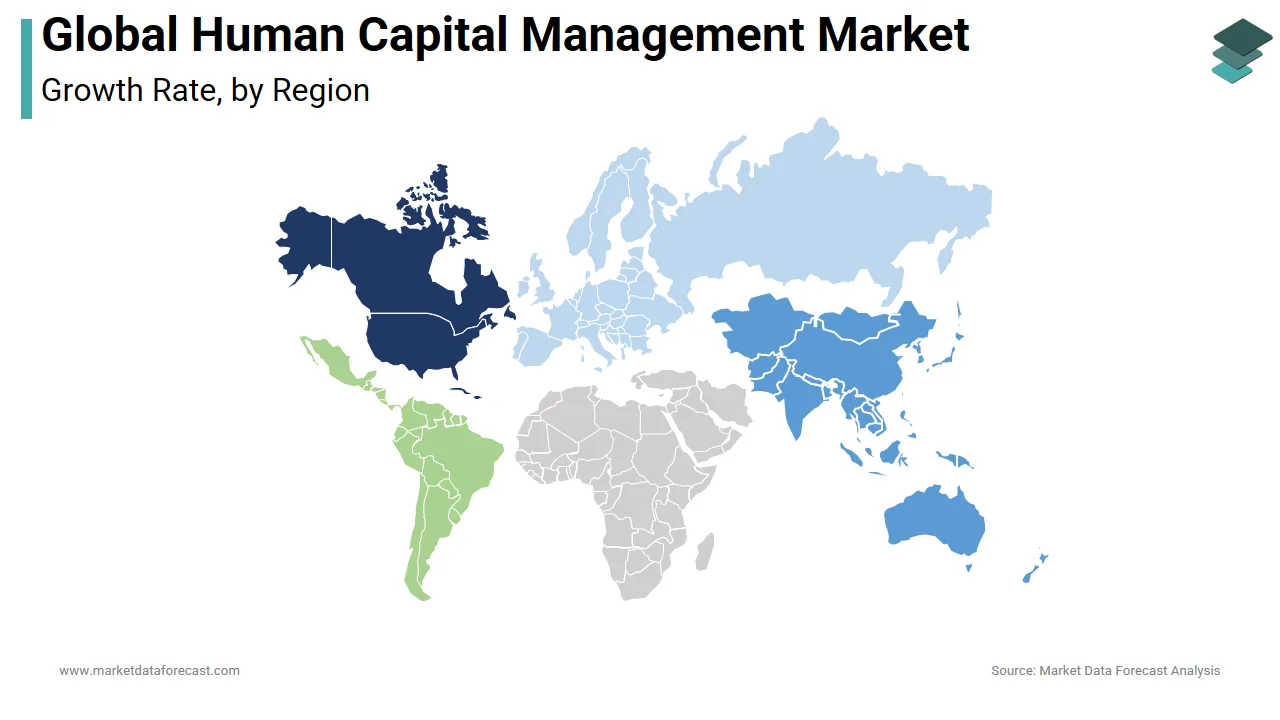
APAC is expected to grow at the fastest rate due to the increase in adoption of this technology. According to the International Labor Organization, unemployment was low by international standards, around 4.2% in 2018, while the number of people employed in the region increased by around 23 million (or 1.2%). Workers in China are moving from agriculture and manufacturing to services due to an aging population.
KEY MARKET PLAYERS
The main players in the global HCM market are ADP LLC, Cornerstone, Epicor Software Corporation, IBM Corporation, Infor, Kronos, Inc., Oracle Corporation, SAP SE, SumTotal Systems, LLC, and Ultimate Software Group, Inc. These players have expanded their presence in the market by adopting various business strategies, such as acquisition, geographic expansion, product development, strategic alliance, and collaboration.
RECENT MARKET HAPPENINGS
- In June 2019, WorkForce Software announced a significant capital investment in the subsidiaries of Evergreen Coast Capital Corp., the technology-driven private equity arm of Elliott Management Corporation. Evergreen will hold equal shares in Insight Partners, which has been a significant funder of WorkForce Software.
- In February 2019, SAP AG acquired a stake in Newgen Software Technologies Limited, which provides business solutions in the banking, financial services, insurance, telecommunications, and public administration sectors. He also manages business process management and business content management.
MARKET SEGMENTATION
The global human capital management market is divided based on component, deployment mode, organization size, application, industry vertical, and geography.
By Component
- Software
- Services
By Deployment Mode
- Cloud
- On-Premises
By Organization Size
- Small and Medium-Sized Enterprises (SMEs)
- Large Enterprises
By Application
- Talent Management
- Workforce Management
- Core HR & Payroll
- Recruitment and Onboarding
- Analytics & Reporting
By Industry Vertical
- Banking, Financial Services and Insurance (BFSI)
- Information Technology and Telecommunications (IT & Telecom)
- Healthcare and Life Sciences
- Retail and Consumer Goods
- Manufacturing
- Government and Public Sector
- Education
- Others
By Region
- North America
- Europe
- Asia-Pacific
- Latin America
- The Middle East and Africa