- Product Description Description
- Table of Contents TOC
- List of Table & Figure LOT
- Get Free Sample PDF Sample PDF
Market Size, 2025
$18.11 BnMarket Estimate, 2026
$19.23 BnMarket Forecast, 2034
$31.11 BnCAGR, 2026–2034
6.2%Executive Summary: Global Hybrid Battery Energy Storage System Market
- Market Scope: Comprehensive global hybrid battery energy storage system (HESS) market analysis covering application segments, technology types, regional leadership frameworks, key growth drivers, market trends, and strategic industry developments.
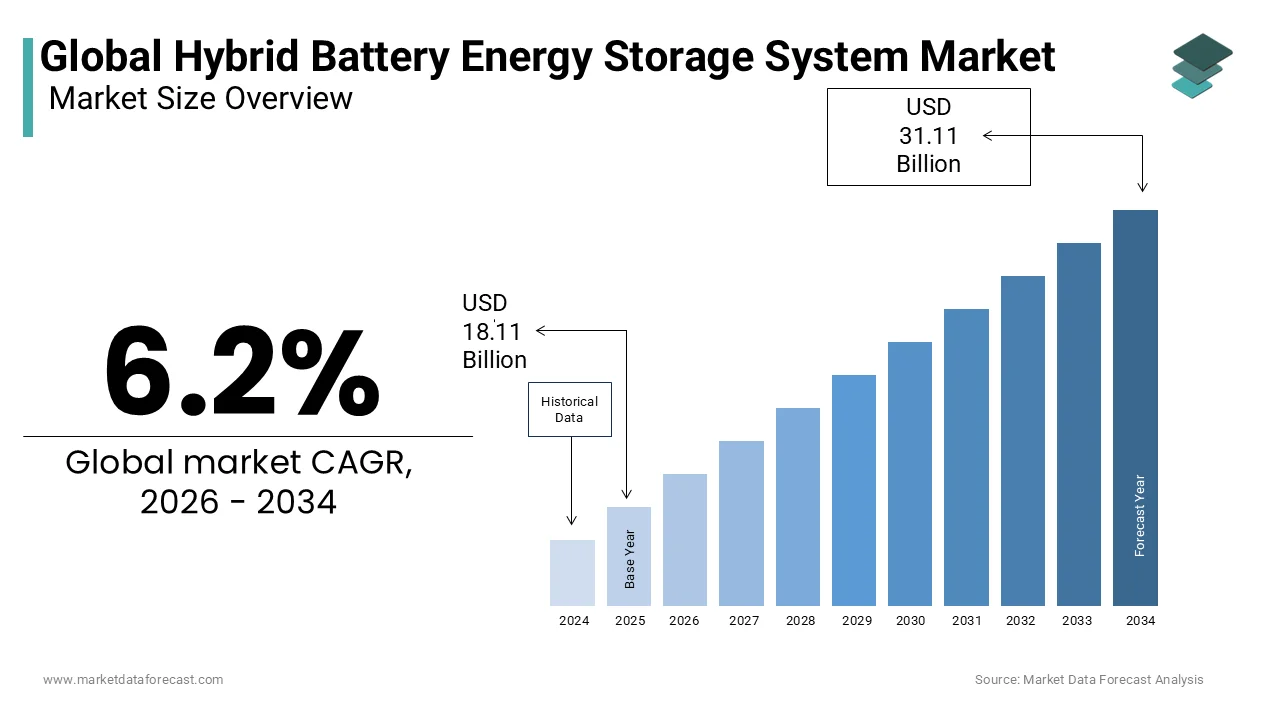
- Market Valuation: Valued at US$ 18.11 billion (2025), estimated at US$ 19.23 billion (2026), and projected to reach US$ 31.11 billion by 2034, registering a robust CAGR of 6.2% (2026–2034).
- Primary Growth Drivers: Escalating demand for high-power, high-energy-density batteries, industrial expansion requiring continuous power, and government clean energy initiatives. Notable trends include public-private sustainability collaborations, residential/automotive sector installations, and microgrid deployments.
Key Market Segment Metrics (2026–2034)
| Category | Leading Segment (2025 Position) | Fastest-Growing Segment |
|---|---|---|
| By Technology & Application | Lithium-ion batteries (employed for high-power storage) and Automotive application sector (receives significant segment boosts) | Advanced hybrid battery storage solutions and remote microgrid integrations |
| By Region | North America (dominates global landscape due to state-level storage mandates and renewable programs) | Asia-Pacific region (fastest-growing regional market fueled by electricity demand in China, India, Malaysia, and Japan) |
Major Market Players & Market Structure
Market Structure: Highly competitive energy storage and power electronics landscape featuring major global enterprises competing through compact residential HESS product launches, independent hybrid microgrid systems, and strategic technological advancements.
Key Companies: Siemens AG, Lockheed Martin, General Electric Corporation, Tesla Motors Ltd., Samsung SDI Co., ltd., Panasonic Corporation, Hitachi Ltd, NEC Corporation, Amphenol Corporation, AEG Power Solutions, Jakson, and Wärtsilä.
Global Hybrid Battery Energy Storage System Market Size
The Global Hybrid Battery Energy Storage System Market was worth US$ 18.11 billion in 2025 and is anticipated to reach a valuation of US$ 31.11 billion by 2034 from US$ 19.23 billion in 2025. It is predicted to register a CAGR of 6.2% from 2026 to 2034.
MARKET SCENARIO
The call for hybrid battery energy storage systems can be segmented into residential, non-residential, automotive, utility, and other applications. Due to the expansion of the automotive sector around the world, the automotive segment is receiving a significant boost. Due to the escalating activity in the housing sector, the residential sector can also lead to expansion. The hybrid battery energy storage system is a coupling of two or more energy storage technologies that provide additional operational characteristics such as energy and power density, self-discharge rate efficiency, durability, etc. The investment cost is less than that of a single storage system. In many HESS applications, lithium-ion batteries are employed for high-power storage. Industrial expansion worldwide is benefiting the hybrid battery storage market, as industries require a continuous supply of power to maximize production rate.
MARKET TRENDS
The hybrid battery energy storage system market has several factors that influence its expansion. The public and private sectors are coming together to focus on the use of renewable and sustainable energy for resources. Government initiatives are also helping to provide a much-needed backup solution for manufacturers to introduce technology that sufficiently helps the market move forward. The worldwide market for hybrid battery energy storage systems is predicted to grow substantially by 2026.
MARKET DRIVERS
The growing call for clean energy and increased power and energy activities in the industrial, commercial, and residential sectors will drive the worldwide market for hybrid battery energy storage systems during the forecast period.
The main expansion driver of the hybrid battery energy storage systems market includes the escalating call for high-power, high-energy-density batteries, the escalating need for high-energy storage systems for charge transfer, and the expansion of small and medium companies, among others. The main expansion driver of the hybrid battery energy storage systems market includes the escalating call for high power and high energy battery density, the escalating need for high energy charge transfer storage systems, and the expansion of small and medium-sized companies, among others. The worldwide market for hybrid battery energy storage systems is benefiting from the industrial expansion experienced by countries around the world. Industries callfor a continuous energy supply to maximize their production rate. The emphasis is on the use of clean and sustainable energy for mixed services between the public and private sectors. Government initiatives are also commendable and provide much-needed support for manufacturers to develop technology that helps the hybrid battery energy storage market move further. The emergence of several small and medium-sized companies is a direct product of the changing manufacturing strategies of developed countries. This also influences an increase in the contribution of the hybrid energy storage battery.
MARKET RESTRAINTS
The lack of energy flow control and energy management possibilities results in inefficient storage use. Incorporating renewable energy sources reduces reliability due to the intermittent supply of solar and wind energy. The lack of skilled jobs and complex manufacturing processes is the main ffactorhampering the expansion of the hybrid battery energy storage systems market.
MARKET OPPORTUNITIES
The escalating investment and installation of battery energy storage systems in countries such as China, India, and Japan, as well as the residential sector's escalating interest in using renewable resources, are supporting the expansion of the market for battery energy storage systems in the region.
The hybrid battery energy storage system can face challenges s,uch that the energy production of the storage system will be limited to the amount of energy stored. Also, the lack of compatibility between the existing utility and the utility's energy storage system can delay communication.
REPORT COVERAGE
| REPORT METRIC | DETAILS |
| Market Size Available | 2025 to 2034 |
| Base Year | 2025 |
| Forecast Period | 2026 to 2034 |
| Segments Covered | By Application, Technology, and Region. |
| Various Analyses Covered | Global, Regional, and country-level analysis; Segment-Level Analysis, DROC, PESTLE Analysis, Porter’s Five Forces Analysis, Competitive Landscape, Analyst Overview of Investment Opportunities |
| Regions Covered | North America, Europe, APAC, Latin America, Middle East & Africa |
| Market Leaders Profiled | Siemens AG (Germany), Lockheed Martin (U.S.), Amphenol Corporation (U.S.), General Electric Corporation (U.S.), AEG Power Solutions (The Netherlands), Panasonic Corporation (Japan), Hitachi Ltd (Japan), Samsung SDI Co., ltd. (South Korea), NEC Corporation (Japan), Tesla Motors Ltd. (U.S.), and Others. |
SEGMENTAL ANALYSIS
Global Hybrid Battery Energy Storage System Market Analysis By Application
- Residential
- Non-Residential
- Automotive
- Utility
Global Hybrid Battery Energy Storage System Market Analysis By Technology
- Fly Wheel
- Lithium-Ion
- Supercapacitor
- Ultracapacitor
REGIONAL ANALYSIS
- North America
- Europe
- Asia Pacific
- Latin America
- Middle East & Africa
The North American market is predicted to dominate the world market. This is attributed to the growing number of grid reliability issues in some parts of the country, state-level storage mandates, and renewable energy support programs. The growing call for disruptive energy storage technologies is helping to increase the call for hybrid battery energy storage systems in North America. Technology in the United States has been on the rise in recent years, and as an alternative source, energy needs have increased. The Asia-Pacific markets are predicted to see expansion in the coming years due to an escalating call for electricity and security of supply issues and a strong call for and adoption of renewable resources in the residential sector. The dynamics of the APAC market is different since each country has different call, supply and transport scenarios that are studied in the report. In the worldwide market, North America is the leader.
The region's significant investments in research and development are paying off, and as a result, the region may also dominate for years to come. The growing call for innovative energy storage technologies is helping to increase competition for hybrid battery energy storage systems in North America. Technology in the United States has been on the rise in recent years, and as an alternative source, energy needs have increased. Europe is also making a substantial contribution. The regional market has many governments that enforce strict power laws that give traction to the industry. During the foreseen period, the APAC market is predicted to be the fastest-growing regional market. Developing countries such as China, India, Malaysia, and developed countries such as Japan have proven to be ideal foci for market expansion. Markets in the Asia-Pacific region are predicted to experience expansion in the coming years due to escalating call for electricity and security concerns regarding supply and high call and adoption of residential renewable resources.
MARKET KEY PLAYERS
- Siemens AG (Germany)
- Lockheed Martin (U.S.)
- Amphenol Corporation (U.S.)
- General Electric Corporation (U.S.)
- AEG Power Solutions (The Netherlands)
- Panasonic Corporation (Japan)
- Hitachi Ltd (Japan)
- Samsung SDI Co., ltd. (South Korea)
- NEC Corporation (Japan)
- Tesla Motors Ltd. (U.S.)
RECENT HAPPENINGS IN THE MARKET
- Jakson today declared the launch of a Compact Hybrid Energy Storage (HESS) system for residential and commercial users to harness the benefits of solar energy more effectively and efficiently. The launch event was held in Chandigarh and brought together the best industry professionals and members of the Jakson management team.
- Electrical equipment manufacturer Wärtsilä has launched independent, hybrid energy storage systems, targeting areas where it sees "high market potential", including remote microgrids and solar photovoltaic integration.