- Product Description Description
- Table of Contents TOC
- List of Table & Figure LOT
- Get Free Sample PDF Sample PDF
Market Size, 2025
$13.67 BnMarket Estimate, 2026
$15.42 BnMarket Forecast, 2034
$34.58 BnCAGR, 2026–2034
12.8%Global Industrial Batteries Market Report Summary
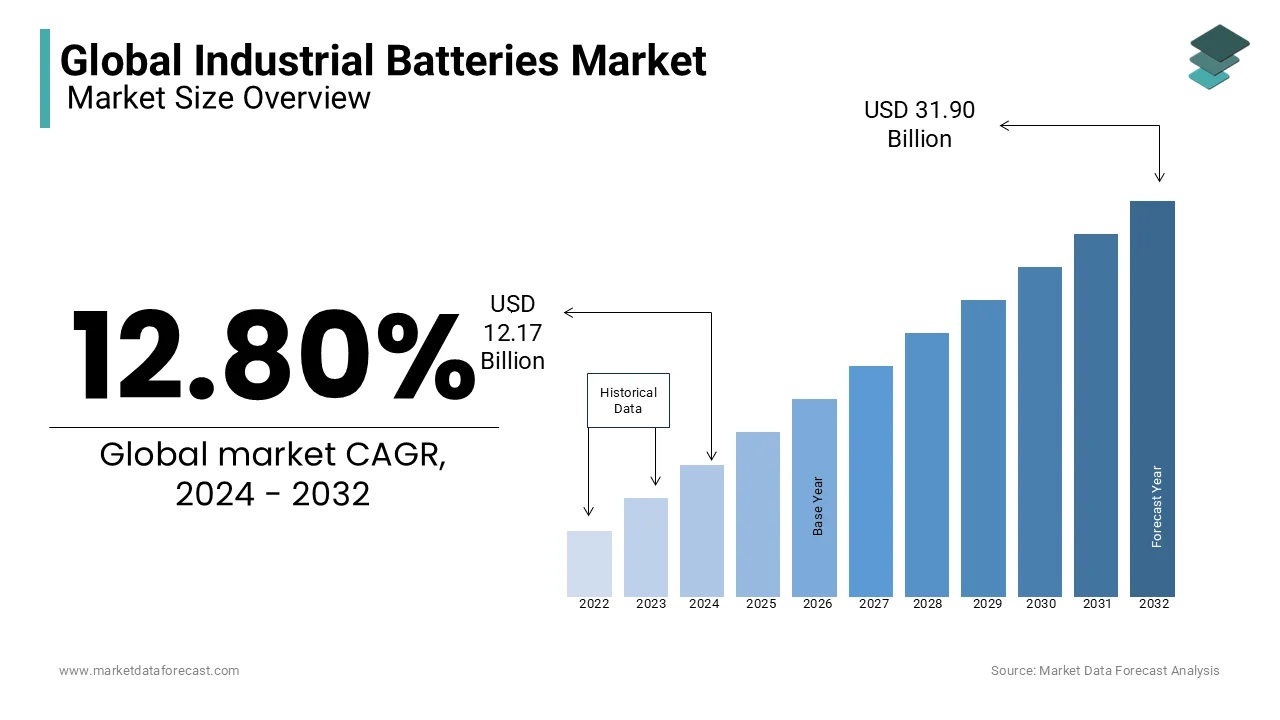
The global industrial batteries market was valued at USD 13.67 billion in 2025 and is anticipated to reach USD 15.42 billion in 2026 from USD 34.58 billion by 2033, growing at a CAGR of 12.80% during the forecast period from 2025 to 2033. The growth of the global industrial batteries market is driven by rapid industrialization, increasing demand for high-capacity energy storage systems, and the growing need for uninterrupted power supply across industrial applications. Expanding deployment of renewable energy projects, increasing adoption of battery energy storage systems (BESS), and rising demand for material handling equipment such as electric forklifts are further accelerating market growth. Moreover, declining lithium-ion battery prices, continuous advancements in battery technologies, and increasing investments in grid modernization and smart energy infrastructure are supporting the expansion of the global industrial batteries market.
Key Market Trends
-
Rising adoption of lithium-ion batteries across industrial energy storage and material handling applications.
-
Increasing deployment of battery energy storage systems (BESS) to support renewable energy integration.
-
Growing demand for industrial batteries in electric forklifts and warehouse automation.
-
Continuous decline in lithium-ion battery prices improving commercial adoption.
-
Increasing investments in smart grids, data centers, and backup power infrastructure worldwide.
Segmental Insights
- Based on type, the lead-acid batteries segment dominated the global industrial batteries market and accounted for over 48% of the market share in 2023. The dominance of the segment is attributed to its low cost, high power density, well-established supply chain, excellent reliability, and widespread use in uninterruptible power supply (UPS) systems, industrial equipment, and electric forklifts. Growing industrialization and expansion of manufacturing facilities continue to strengthen segment growth.
- The lithium-based batteries segment is projected to witness the fastest CAGR during the forecast period owing to increasing adoption in battery energy storage systems, industrial automation, renewable energy storage, and electric material handling equipment. Continuous reductions in battery prices, superior energy density, longer lifecycle, and lower maintenance requirements are further accelerating segment growth.
- Based on end-user, the industrial equipment segment dominated the global industrial batteries market and accounted for over 34% of the market share in 2023. The growth of the segment is driven by rising demand for forklifts, warehouse automation equipment, manufacturing machinery, and material handling systems across industrial facilities. Expanding e-commerce logistics infrastructure and increasing replacement demand for industrial equipment continue to support segment leadership.
- The grid-level energy storage segment is anticipated to register the fastest CAGR of over 10% during the forecast period due to increasing renewable energy integration, rising investments in utility-scale battery storage projects, growing modernization of electricity transmission networks, and expanding deployment of large-scale energy storage systems to improve grid reliability and energy management.
Regional Insights
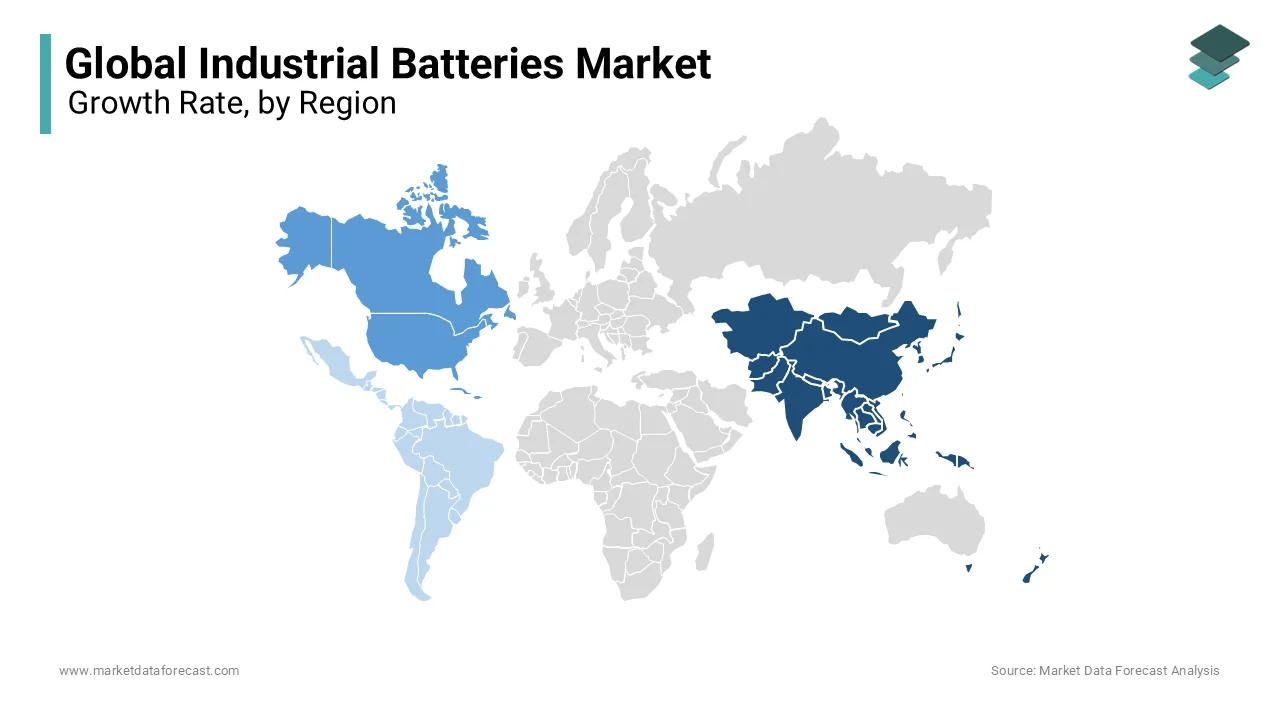
- Asia Pacific dominated the global industrial batteries market in 2023 and is expected to maintain its leadership throughout the forecast period. The region's dominance is driven by rapid industrialization, large-scale renewable energy deployment, expanding battery manufacturing capacity, and growing demand for material handling equipment across China, India, Japan, and South Korea. Strong government support for energy storage and declining battery costs continue to strengthen regional market growth.
- North America held the second-largest share of the global industrial batteries market owing to its advanced manufacturing sector, expanding automotive industry, increasing deployment of battery-powered forklifts, growing investments in renewable energy storage, and rising demand for reliable backup power solutions across data centers and industrial facilities.
- Europe continues to maintain a significant position in the global industrial batteries market due to increasing investments in industrial automation, strong automotive manufacturing presence, expanding renewable energy projects, and growing demand for sustainable battery technologies across Germany, France, Italy, the United Kingdom, Spain, and other European countries.
- Latin America is witnessing steady market growth supported by expanding industrialization, increasing adoption of advanced manufacturing technologies, rising investments in logistics infrastructure, and growing deployment of industrial battery systems across Brazil, Argentina, Colombia, and other developing economies.
- The Middle East & Africa is expected to experience notable growth during the forecast period owing to increasing infrastructure development, expanding renewable energy projects, rising industrial activities, growing investments in telecommunications infrastructure, and increasing demand for uninterrupted backup power systems across commercial and industrial sectors.
Competitive Landscape
The global industrial batteries market is highly competitive and characterized by the presence of multinational battery manufacturers competing through continuous technological innovation, strategic partnerships, manufacturing expansion, and investments in next-generation battery technologies. Leading companies are focusing on improving lithium-ion battery performance, expanding production capacities, developing advanced battery energy storage solutions, and strengthening global distribution networks. Strategic acquisitions, investments in research and development, and growing emphasis on sustainable and recyclable battery technologies continue to strengthen competitive positioning across the global industrial batteries market. The prominent players operating in the global industrial batteries market include Johnson Controls Inc., Exide Technologies Inc., EnerSys Inc., Saft Groupe S.A., GS Yuasa Corporation, Northstar Battery Company LLC, C&D Technologies, Inc., Robert Bosch GmbH, East Penn Manufacturing Company, and Toshiba International Corporation.
Global Industrial Batteries Market Size
The Global Industrial Batteries Market is anticipated to grow from USD 13.67 billion in 2025 to reach a valuation of USD 40.42 billion by 2034 from USD 15.42 billion in 2026 and is predicted to register a CAGR of 12.80% during the forecast period.
Industrial batteries are large format electrochemical energy storage systems utilized across critical infrastructure sectors including telecommunications, grid stabilization, material handling, and uninterruptible power supplies. These robust power sources are engineered to deliver sustained energy output and endure rigorous operational cycles in demanding commercial environments. The foundational necessity for these advanced storage solutions is directly intertwined with the global transition toward decentralized power generation and the rapid expansion of automated logistics networks. According to the International Energy Agency, global electricity consumption will reach a new high of over 29,000 terawatt-hours in 2026, driven by massive industrial digitalization and electrification efforts. Furthermore, the integration of variable renewable energy sources necessitates massive buffering capacity to maintain grid frequency and prevent blackouts. According to the International Renewable Energy Agency, renewable power capacity increased by 692 GW in 2025, reaching a total of 5,149 GW of capacity that requires immediate and reliable backup storage. The World Economic Forum estimates that the global power sector must invest approximately 1,500 billion dollars annually until 2030 to upgrade aging infrastructure and accommodate these new energy paradigms. Consequently, the intersection of massive grid modernization requirements and the relentless pursuit of automated operational efficiency defines the dynamic landscape of this vital energy storage sector across international boundaries.
MARKET DRIVERS
Grid Storage
The massive integration of intermittent renewable energy sources is majorly driving the adoption of large scale grid storage systems and is a major factor propelling the global market growth. Traditional electrical grids were designed for predictable unidirectional power flow from centralized fossil fuel plants, but the modern landscape is dominated by decentralized solar and wind installations that generate electricity unpredictably. According to the International Renewable Energy Agency, the global capacity for solar and wind power continues to reach record highs, creating immense volatility in grid frequency and voltage levels. To prevent catastrophic blackouts and equipment damage, grid operators must continuously deploy advanced battery energy storage systems to absorb excess generation during peak production and discharge it during periods of low renewable output. According to the International Energy Agency, renewable-based power capacity is expected to grow by nearly 4,600 GW from 2025 to 2030. This profound shift necessitates the use of highly sophisticated lithium-ion and flow battery installations to manage the complex interactions between power electronics and the physical grid infrastructure. By testing the grid response to sudden drops in wind speed or cloud cover over solar farms, engineers can design robust control strategies that ensure absolute stability. Consequently, the relentless expansion of clean energy capacity directly mandates the continuous procurement of advanced battery storage platforms to maintain the delicate balance of modern power networks.
Automation and Logistics Demand
The rapid proliferation of automated warehouse systems and electric material handling equipment is further contributing to the expansion of the global industrial batteries market. Modern supply chains are undergoing a massive transformation driven by the exponential growth of electronic commerce which requires unprecedented speed and accuracy in order fulfillment. To meet these demanding logistics requirements, distribution centers are aggressively replacing internal combustion engine forklifts with advanced electric vehicles and autonomous mobile robots. According to the International Federation of Robotics, the global operational stock of industrial robots reached 4.66 million units in 2025, reflecting a massive shift toward fully automated material handling. These electric machines require high capacity and fast charging battery packs to operate continuously across multiple shifts without experiencing performance degradation. The World Bank indicates that global electronic commerce sales recently exceeded 6 trillion dollars, driving immense pressure on logistics providers to maximize warehouse uptime and operational efficiency. Furthermore, the International Energy Agency notes that the electrification of industrial material handling equipment significantly reduces localized carbon emissions and improves indoor air quality for warehouse workers. By providing the essential energy density required for these automated logistics operations, advanced battery systems have become an indispensable component of the modern supply chain ecosystem, guaranteeing sustained and robust demand from global distribution networks.
MARKET RESTRAINTS
Capital Expenditure Challenges
The exorbitant initial capital expenditure required for large scale battery installations severely restricts widespread adoption among smaller industrial facilities, which is significantly hampering the global industrial batteries market growth. Procuring and deploying industrial grade energy storage systems involves more than just the cost of the battery cells themselves as it requires extensive balance of system components including power conversion equipment, thermal management systems, and advanced battery management software. According to the Neeraj Kumar Singal report on BESS manufacturing, grid connection and soft costs can represent a significant barrier, often adding 30% to 70% of costs depending on the complexity of utility demand charges. For regional manufacturing plants and small distribution centers operating on tight profit margins, these upfront financial barriers are often insurmountable without significant government subsidies or favorable financing arrangements. Furthermore, BloombergNEF indicates that while the cost of individual lithium-ion cells has decreased significantly, the balance of system costs and installation labor expenses remain remarkably high and account for nearly 50% of the total project expenditure. Smaller industrial facilities frequently lack the internal financial resources to justify the massive return on investment timeline associated with enterprise grade energy storage solutions. Consequently, the prohibitive costs and the steep learning curve associated with deploying these advanced storage environments act as a substantial bottleneck preventing many smaller grid operators and manufacturers from fully leveraging modern battery technologies.
Environmental and Disposal Hurdles
The escalating environmental scrutiny regarding raw material extraction and the complex regulatory frameworks governing end of life battery disposal significantly hinder market expansion. The production of advanced industrial batteries relies heavily on the mining of critical minerals such as lithium, cobalt, and nickel, which are associated with severe ecological degradation and high carbon emissions. According to the World Bank, the demand for these critical minerals is projected to increase by 500% over the next three decades to meet global energy storage targets, prompting intense environmental pushback from conservation groups. Furthermore, the disposal and recycling of spent industrial batteries present a massive logistical and environmental challenge. According to industry analysis, global electronic waste generation recently surpassed 60 million metric tons annually, with industrial batteries constituting a highly hazardous fraction that requires specialized and expensive recycling infrastructure. The European Environment Agency emphasizes that stringent regional directives mandate the safe recovery of heavy metals and electrolytes, imposing massive compliance costs on battery manufacturers and end users. According to industry data, approximately 40% to 50% of lithium-ion batteries are currently recycled efficiently, with the remainder hindered by the lack of standardized dismantling processes and the high economic cost of recovery. Consequently, this profound environmental burden and the heavy financial penalty of non compliance act as a substantial restraint limiting the unrestricted growth of the industrial battery sector.
MARKET OPPORTUNITIES
Secondary Market Opportunities
The strategic repurposing of retired electric vehicle battery packs for stationary industrial storage presents a highly lucrative avenue for the global industrial batteries market. When electric vehicle batteries degrade to approximately 80% of their original capacity, they are no longer suitable for the demanding acceleration and range requirements of automotive applications, but they retain immense value for stationary industrial energy storage. According to the International Energy Agency, global electric car sales crossed 20 million units in 2025, creating a massive and rapidly growing pipeline of used battery modules entering the secondary market. By integrating these retired automotive batteries into warehouse forklifts or grid stabilization systems, manufacturers can offer industrial storage solutions at a fraction of the cost of new cells. The World Economic Forum emphasizes that developing a circular battery economy through second life applications can reduce the overall lifecycle carbon footprint of energy storage systems by up to 30%. Furthermore, the Global Battery Alliance indicates that repurposing facilities can extend the profitable operational life of lithium-ion assets by an additional 5 to 10 years before final recycling is required. By capitalizing on this abundant secondary supply chain, battery manufacturers can unlock entirely new revenue streams and provide highly affordable storage options to cost sensitive industrial consumers.
Solid State Technology Advancements
The rapid technological maturation and impending commercialization of solid state battery architectures offer a promising opportunity for the industrial batteries market expansion. Traditional lithium-ion batteries utilize highly flammable liquid electrolytes which pose significant thermal runaway risks and require complex and expensive cooling systems in industrial environments. Solid state batteries replace this liquid with a solid material such as ceramics or specialized polymers, completely eliminating the fire hazard and allowing for much denser packing of energy. According to the United States Department of Energy, federal and private investments in solid state battery research and development have exceeded 2 billion dollars recently, accelerating the timeline for mass commercial production. As per the International Energy Agency, solid state technologies can potentially double the energy density of current industrial batteries while simultaneously reducing charging times by over 50%. Furthermore, according to the Global Battery Alliance, the elimination of liquid electrolytes significantly reduces the manufacturing footprint and simplifies the assembly process, lowering long term production costs. By pioneering these advanced solid state chemistries, manufacturers can capture the highly profitable niche of heavy duty industrial applications such as mining equipment and maritime vessels where maximum energy density and absolute safety are non-negotiable requirements.
MARKET CHALLENGES
Geopolitical Supply Chain Risks
The extreme geopolitical concentration and supply chain vulnerabilities associated with critical battery raw materials pose a persistent operational risk to manufacturers, which is one of the major challenges to the industrial batteries market growth. The production of high performance industrial batteries relies heavily on a highly restricted group of critical minerals including lithium, cobalt, nickel, and graphite, which are geographically concentrated in a very small number of countries. According to the World Bank, over 60% of global cobalt production is sourced from a single nation, making the entire industrial battery supply chain highly susceptible to localized political instability and export restrictions. Furthermore, the International Energy Agency indicates that the processing and refining of these critical minerals is heavily dominated by a single regional economy which controls nearly 80% of the global manufacturing capacity for battery grade components. Recent geopolitical tensions and the implementation of aggressive resource nationalism policies have caused severe disruptions in the international trade of battery raw materials, leading to massive price volatility. Securing long term supply agreements for these essential elements requires navigating complex international trade regulations and massive financial hedging strategies. Consequently, this inherent vulnerability to geopolitical shocks and supply chain bottlenecks severely complicates production planning and threatens the long term economic viability of industrial battery manufacturing.
Thermal Management Requirements
The profound sensitivity of advanced battery chemistries to extreme ambient temperatures necessitates expensive and complex thermal management solutions in harsh industrial environments, which is further challenging the global market expansion. High performance lithium-ion batteries operate optimally within a very narrow temperature range and exposure to extreme heat or severe cold drastically accelerates chemical degradation and reduces overall lifespan. According to the International Renewable Energy Agency, operating battery energy storage systems in ambient temperatures exceeding 40 degrees Celsius can reduce the total cycle life of the cells by up to 40% if adequate cooling is not maintained. Extreme heatwaves are becoming significantly more frequent and intense globally, forcing industrial facilities to install massive and energy intensive air conditioning systems just to protect their battery investments. Furthermore, the International Electrotechnical Commission emphasizes that deploying battery systems in remote mining operations or exposed telecommunications towers requires highly ruggedized enclosures and active liquid cooling loops which add substantial weight and cost to the final installation. The parasitic energy load required to run these thermal management systems can consume up to 15% of the total stored energy, significantly reducing the overall round trip efficiency of the storage installation. Consequently, the relentless battle against environmental temperature extremes imposes a heavy financial and operational burden on industrial battery deployments.
REPORT COVERAGE
| REPORT METRIC | DETAILS |
| Market Size Available | 2025 to 2034 |
| Base Year | 2025 |
| Forecast Period | 2026 to 2034 |
| Segments Covered | By Type, End-User, and Region. |
| Various Analyses Covered | Global, Regional, & Country Level Analysis; Segment-Level Analysis, Drivers, Restraints, Opportunities, Challenges, PESTLE Analysis, Porter’s Five Forces Analysis, Competitive Landscape, Analyst Overview of Investment Opportunities |
| Regions Covered | North America, Europe, Asia Pacific, Latin America, Middle East, and Africa |
| Key Market Players | Johnson Controls Inc. (U.S.), Exide Technologies Inc. (India), Enersys Inc. (U.S.), Saft Groupe S.A. (France), GS Yuasa Corporation (Japan), Northstar Battery Company LLC (Sweden), C&D Technologies, Inc. (U.S.), Robert Bosch GmbH (Germany), East Penn Manufacturing Company (U.S.), and Toshiba International Corporation (Japan), and Others. |
SEGMENTAL ANALYSIS
By Type Insights
The lead acid battery segment dominated the market by commanding 54.6% of the global market share in 2025. The dominance of lead acid battery segment in the global market can be credited to its absolute economic advantage and the unparalleled maturity of the global recycling infrastructure. Manufacturing these units requires significantly lower capital expenditure compared to advanced chemistries, making them highly accessible for small and medium enterprises. According to the International Lead Association, the global recycling rate for these specific battery types consistently exceeds 99% in developed economies, creating a highly circular and sustainable material lifecycle. This closed loop system drastically reduces the reliance on virgin raw material extraction and stabilizes long term production costs. Furthermore, the World Bank indicates that the levelized cost of storage for lead acid technologies remains approximately 40% lower than comparable lithium alternatives when evaluated over a standard five year deployment cycle. Industrial facilities operating on tight profit margins heavily favor this predictable financial profile. The International Energy Agency notes that the established global supply chain ensures immediate availability of replacement units, minimizing operational downtime. Consequently, the profound cost efficiency combined with a virtually perfect recycling ecosystem guarantees that this traditional chemistry will maintain its overwhelming market supremacy for the foreseeable future.

However, the lithium-based battery segment is experiencing the fastest expansion and is estimated to witness a CAGR of 12.4% during the forecast period owing to its superior energy density and exponentially longer operational lifespan. Modern automated logistics and advanced manufacturing require power sources that can deliver maximum energy within a minimal physical footprint while enduring thousands of rigorous charge and discharge cycles. According to the International Federation of Robotics, the global installation of automated guided vehicles and autonomous mobile robots in smart factories expanded by over 25% last year, necessitating advanced energy storage solutions. Lithium-based chemistries offer an energy density that is nearly three times greater than traditional alternatives, allowing manufacturers to design lighter and more agile robotic systems. Furthermore, the Global Battery Alliance states that these advanced cells routinely deliver over 5,000 full life cycles before reaching the end of their useful capacity, which is more than triple the lifespan of conventional options. The International Energy Agency notes that this extended longevity drastically reduces the total cost of ownership despite the higher initial purchase price. Consequently, the ability to maximize energy output while minimizing replacement frequency drives the exceptional growth trajectory of this advanced technology segment.
By End-User Insights
The uninterruptible power supply and backup segment led the market by holding 36.5% of the global market share in 2025. The growth of the UPS and backup segment in the global market is majorly driven by the explosive proliferation of hyperscale data centers and the exponential growth of global digital infrastructure. Modern digital economies rely entirely on continuous server availability and the instantaneous processing of massive data streams which cannot tolerate even a millisecond of power disruption. According to industry reports, total electricity demand from global data centers is projected to rise to 3,700 TWh by 2040, requiring colossal investments in localized backup power architectures. To maintain the critical five nines reliability standard of 99.999% uptime, technology giants are deploying massive battery arrays to bridge the gap during grid fluctuations or generator startup sequences. According to the World Economic Forum, the average cost of a single data center outage now exceeds 10 million dollars per hour, driving enterprise clients to procure the most robust and instantaneous backup solutions available. Furthermore, the Global Data Center Alliance notes that the transition toward edge computing requires the deployment of compact and highly reliable backup systems in thousands of decentralized micro facilities. This relentless expansion of the digital landscape guarantees sustained and massive procurement volumes for this critical segment.
However, the grid level energy storage segment is estimated to showcase a promising CGAR of 14.9% during the forecast period in the global market owing to the aggressive global mandate to integrate massive volumes of intermittent renewable energy into the national power grid. Solar and wind generation facilities produce electricity in a highly variable and unpredictable manner, creating severe mismatches between power supply and consumer demand that threaten grid stability. According to the International Renewable Energy Agency, the global capacity of renewable power technologies expanded by a record 50% in the previous year, reaching over 500 gigawatts of new installations that require immediate and massive buffering capacity. To prevent catastrophic blackouts and maintain precise grid frequency, utility operators are deploying colossal battery energy storage systems to absorb excess generation during peak production and discharge it during periods of low renewable output. The International Energy Agency states that variable renewable energy generation will account for nearly 40% of total global electricity production by the end of the decade, necessitating gigawatt scale storage deployments. Furthermore, the Global Energy Monitor indicates that grid level storage is absolutely essential for providing critical ancillary services such as voltage regulation and frequency response. This profound necessity to balance the modern green grid guarantees the fastest expansion rate for this segment.
REGIONAL ANALYSIS
North America Industrial Batteries Market Analysis
North America dominated the market by commanding for 31.3% of the global market share in 2025 and is likely to maintain its market lead through the expansion of data centers and advanced grid modernization initiatives over the next few years. North America maintains a highly dominant position in the global landscape characterized by massive data center expansion and advanced grid modernization programs. The continuous integration of advanced energy storage systems to ensure absolute reliability for hyperscale computing facilities is further boosting the growth of North America in the global market. According to the International Energy Agency, the total electricity demand from global data centers is projected to double by the end of the decade, necessitating colossal investments in localized backup power architectures. The United States Department of Energy indicates that federal initiatives have allocated over 10 billion dollars specifically for upgrading the national electrical grid and deploying large scale battery storage solutions. Furthermore, the World Economic Forum states that the regional industrial sector generates an immense economic output exceeding 15 trillion dollars annually, demonstrating the massive financial scale of operations requiring continuous power stabilization.
Europe Industrial Batteries Market Analysis
Europe is expected to sustain its market position by enforcing stringent environmental regulations and green transition frameworks throughout the coming years. Europe maintains a highly sophisticated position in the regional arena driven by stringent environmental regulations and the massive implementation of green energy transition frameworks. The strict enforcement of advanced battery recycling directives and the aggressive deployment of renewable energy buffering systems are further fuelling the market expansion in Europe. According to the European Commission, the regional green deal initiative requires the installation of over 600 gigawatts of renewable energy capacity by the end of the decade, necessitating massive grid level storage deployments. The International Renewable Energy Agency states that European nations are currently leading the global transition toward decentralized power generation, requiring advanced battery systems to maintain grid frequency and prevent blackouts. Furthermore, Eurostat indicates that the regional manufacturing sector is rapidly transitioning toward zero emission operations, driving immense procurement of electric material handling equipment and advanced backup power solutions.
Asia Pacific Industrial Batteries Market Analysis
Asia Pacific is projected to experience rapid market growth driven by industrialization and expanding telecommunications infrastructure over the next few years. Asia Pacific occupies a highly influential position in the global sector fueled by explosive industrialization and the rapid expansion of telecommunications infrastructure across developing economies. The aggressive procurement of advanced battery systems to support the booming electronic commerce logistics sector and the continuous expansion of mobile networks are also aiding the market expansion in the Asia-pacific region. According to the International Energy Agency, electricity demand in the region is projected to grow by over 4% annually, requiring the addition of hundreds of gigawatts of new generation and storage capacity. The World Bank indicates that regional investments in smart grid infrastructure have surpassed 50 billion dollars recently to accommodate the rapid proliferation of automated manufacturing facilities. Furthermore, the International Telecommunication Union notes that the deployment of over 5 million new telecommunications towers in rural areas requires massive deployments of reliable backup battery systems to ensure continuous connectivity.
Latin America Industrial Batteries Market Analysis
Latin America is anticipated to show steady growth as it modernizes its heavy industrial sectors and enhances remote connectivity over the next few years. Latin America secures a steadily expanding position in the international market supported by abundant natural resources and the ongoing modernization of heavy industrial sectors. The massive extraction of critical minerals and the continuous need for reliable power in geographically challenging terrains is further boosting the market expansion in this region. According to the Economic Commission for Latin America and the Caribbean, the regional mining sector generates over 150 billion dollars in annual export revenue, requiring immense deployments of heavy duty industrial batteries for autonomous haulage and continuous extraction operations. The International Copper Study Group highlights that the global transition toward electrified transport is driving unprecedented demand for regional copper and lithium extraction, necessitating robust power storage solutions in remote sites. Furthermore, the World Bank notes that improving economic stability in key regional economies is accelerating the adoption of advanced telecommunications infrastructure across vast and unconnected rural areas.
Middle East and Africa Industrial Batteries Market Analysis
Middle East and Africa is poised for significant development as transit hub expansions and military modernization drive demand in the near future. The Middle East and Africa holds an emerging position in the global landscape characterized by rapid infrastructure development and the aggressive expansion of off grid energy solutions. The developing industrial base, specific strategic geographic importance, the urgent need to expand telecommunications coverage and provide reliable power to remote industrial operations without relying on fragile central grids are propelling the market growth in this region. According to the International Renewable Energy Agency, the deployment of solar microgrids and standalone battery storage systems in Sub Saharan Africa has increased by over 40% in the last three years, ensuring that critical industrial and commercial facilities maintain continuous operations. The World Bank notes that significant financial investments are currently being made in regional telecommunications infrastructure to bridge the digital divide and connect millions of new users to mobile networks. Furthermore, the African Development Bank emphasizes that the continuous expansion of the regional mining and agricultural processing sectors requires massive deployments of rugged and reliable industrial battery systems.
COMPETITIVE LANDSCAPE
The competition within the global industrial batteries sector is defined by intense rivalry among established multinational corporations and specialized regional manufacturers. Major global brands leverage massive financial resources to dominate original equipment manufacturing channels through aggressive research investments and extensive distribution networks. These industry leaders continuously develop advanced lithium and lead acid chemistries to ensure absolute compliance with stringent international safety regulations. Meanwhile regional players compete fiercely by emphasizing localized manufacturing capabilities and highly cost effective maintenance solutions that resonate deeply with budget constrained commercial facilities. The market also witnesses a surge in strategic mergers and acquisitions as companies seek to consolidate their technological capabilities and acquire emerging recycling startups. Furthermore sustainability initiatives have become a critical competitive differentiator with firms adopting circular economy models to appeal to environmentally aware institutional buyers. Ultimately the competitive environment demands continuous adaptation to rapid technological shifts ensuring that only the most agile and innovative organizations maintain their long term profitability and brand loyalty across all international industrial markets today and tomorrow globally right here and now across the entire continental energy infrastructure network ensuring absolute operational excellence and reliability for all global commercial and industrial clients every single day across the entire globe.
KEY MARKET PLAYERS
Companies playing a promising role in the global industrial batteries market include
- Johnson Controls Inc. (U.S.)
- Exide Technologies Inc. (India)
- EnerSys Inc. (U.S.)
- Saft Groupe S.A. (France)
- GS Yuasa Corporation (Japan)
- NorthStar Battery Company LLC (Sweden)
- C&D Technologies, Inc. (U.S.)
- Robert Bosch GmbH (Germany)
- East Penn Manufacturing Company (U.S.)
- Toshiba International Corporation (Japan)
- Other prominent players
Top Players in the market
EnerSys
EnerSys operates as a monumental force in the global stored energy sector providing exceptional industrial battery solutions to critical infrastructure networks worldwide. The corporation leverages its extensive engineering expertise to develop advanced lithium and lead acid chemistries that significantly enhance operational reliability and extend equipment lifespan. Recently the enterprise launched a comprehensive next generation intelligent battery management system designed to provide real time predictive maintenance and optimize charging cycles across massive industrial fleets. This strategic innovation significantly enhances their product portfolio and deeply resonates with modern industrial expectations for autonomous energy management. By continuously upgrading their manufacturing capabilities the organization successfully reinforces its industry leadership and drives substantial commercial growth across international markets today.
Exide Technologies
Exide Technologies stands as a premier global technology brand actively transforming the industrial power landscape through deep expertise in advanced energy storage and sustainable recycling solutions. The organization focuses heavily on producing highly reliable battery systems that provide uninterrupted power for telecommunications networks and critical data centers. Recently the company completed a massive upgrade to its specialized recycling infrastructure designed to recover and reuse over 95 percent of critical raw materials from spent industrial batteries. This operational enhancement significantly improves supply chain efficiency and guarantees superior environmental compliance for global commercial partners. By prioritizing technological excellence and absolute sustainability the enterprise successfully attracts loyal clients and maintains a highly competitive edge globally.
Samsung SDI functions
Samsung SDI functions as a highly innovative energy solutions company dedicating significant resources toward the development of premium grid scale and industrial storage architectures. The corporation utilizes its advanced research facilities to create unique high density battery modules that perfectly stabilize complex electrical grids and support heavy industrial machinery. In a recent strategic initiative the enterprise introduced a new series of advanced solid state battery prototypes specifically engineered to maintain absolute safety and maximum energy capacity in extreme operational environments. This technological breakthrough enables the brand to capture the critical heavy industry segment without compromising on operational reliability. Through continuous product development the company continues to solidify its formidable presence worldwide.
Top Strategies Used by Key Market Participants
Key players in the market employ several strategic approaches to reinforce their competitive standing and capture evolving technological demands. Strategic partnerships remain central as companies collaborate directly with major utility providers to integrate proprietary energy storage architectures during the initial grid planning phase. Mergers and acquisitions are another common tactic with major firms purchasing specialized recycling startups to instantly acquire advanced material recovery capabilities. Investment in sustainable production methods including the development of closed loop manufacturing processes and water conservation technologies helps meet strict environmental regulations. Geographic expansion particularly into emerging industrial markets across Asia Pacific allows access to new commercial clients and diversified revenue streams. Lastly continuous investment in solid state research ensures that all industrial power networks remain perfectly optimized against evolving operational demands ensuring long term commercial viability.
MARKET SEGMENTATION
This research report on the global industrial batteries market has been segmented and sub-segmented based on type, end-user, and region.
By Type
- Lead-acid Batteries
- Lithium-based Batteries
- Nickel-based Batteries
- Others
By End-User
- Telecom & Data Communication
- Industrial Equipment
- Uninterruptible Power Supply (UPS)/Backup
- Grid-Level Energy Storage
- Others
By Region
- North America
- Latin America
- Europe
- Asia Pacific
- Middle East & Africa