- Product Description Description
- Table of Contents TOC
- List of Table & Figure LOT
- Get Free Sample PDF Sample PDF
Market Size, 2025
$12.76 BnMarket Estimate, 2026
$12.94 BnMarket Forecast, 2034
$19.13 BnCAGR, 2026–2034
4.6%Global Industrial Furnaces Market Size, Growth, Trends & Forecast (2026–2034)
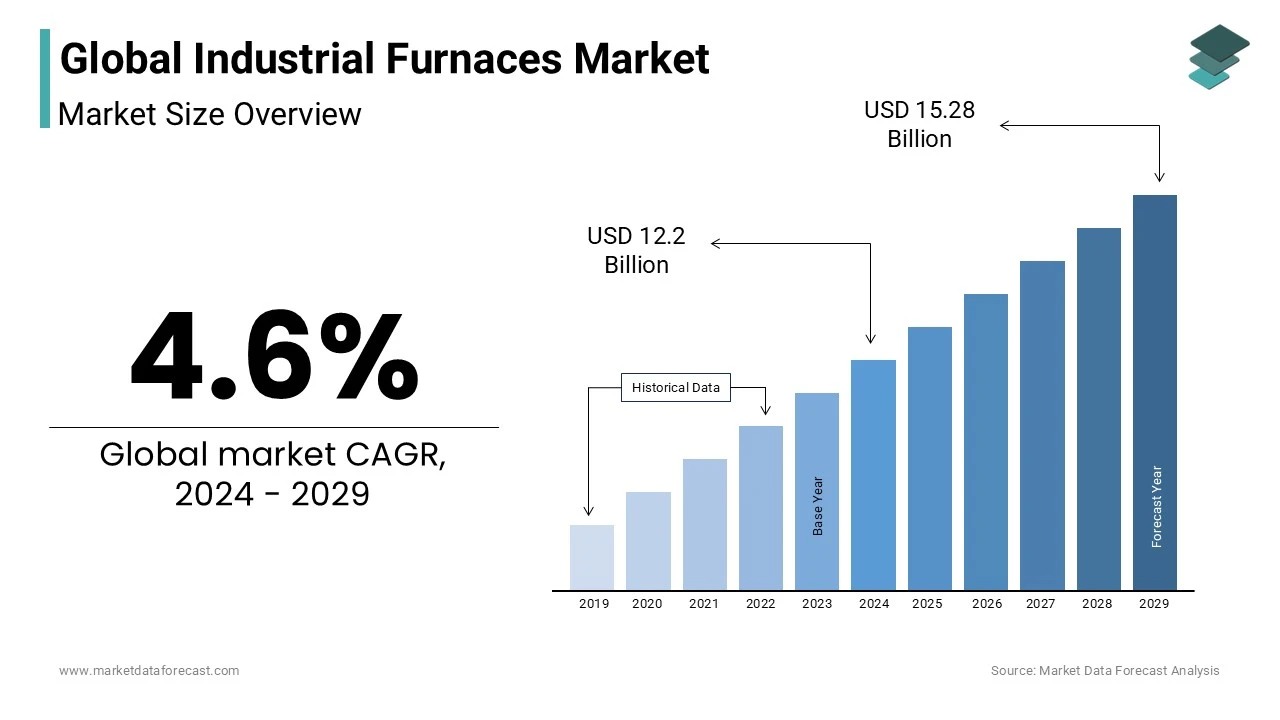
The global industrial furnaces market size was valued at USD 12.76 billion in 2025, is anticipated to reach USD 12.94 billion in 2026, and is projected to scale up to USD 19.13 billion by 2034, registering a compound annual growth rate (CAGR) of 4.6% during the forecast period from 2026 to 2034. Driven by the indispensable role of thermal systems in primary metal production, stringent regulatory pushes for energy efficiency, and ongoing technological integration like digital twins and hydrogen fuel compatibility, the industrial furnaces sector continues to grow steadily worldwide.
Key Executive Metrics (At-a-Glance)
- 2025 Base Valuation: USD 12.76 Billion
- 2026 Current Valuation: USD 12.94 Billion
- 2034 Forecast Valuation: USD 19.13 Billion
- Compound Annual Growth Rate (CAGR): 4.6% (2026–2034)
- Dominant Arrangement Segment: Box-Type (captured 54.4% market share in 2024 due to unmatched versatility in batch processing)
- Fastest-Growing Arrangement Segment: Tube or Clamshell Type (predicted to witness the highest CAGR of 7.3% driven by semiconductor and photovoltaic demands)
- Dominant Operation Segment: Gas or Burner-Operated (prominent due to cost-effective scalability for high-temperature bulk processing)
- Fastest-Growing Operation Segment: Electrically Operated (estimated to register the fastest CAGR of 8.9% fueled by tightening carbon regulations and grid decarbonization)
- Dominant End-User Segment: Steel and Iron Production (led with a 47.6% share in 2024 driven by pyrometallurgical reduction needs)
- Fastest-Growing End-User Segment: Automotive Manufacturing (anticipated to witness the fastest CAGR of 9.4% driven by lightweight alloys and EV powertrains)
- Dominant Region: Asia Pacific (held a commanding 51.7% share in 2024 anchored by heavy metal production and manufacturing infrastructure)
Core Market Drivers
- Indispensable Primary Production: Crucial thermodynamic role in heavy manufacturing industries (steel, aluminum, cement) where no alternative technology can replicate phase transformation kinetics.
- Energy Efficiency Mandates: Global environmental regulations compelling heavy industries to retrofit and modernize aging thermal equipment with high-efficiency burners and waste heat recovery.
- Advanced Material Sintering: Surging demand from electronics, green energy, and aerospace sectors requiring strict atmosphere-controlled or vacuum environments.
Primary Market Restraints & Challenges
- High Capital Intensity: Substantial initial outlays and extended payback periods deterring adoption among small and medium-sized manufacturers.
- Skilled Labor Shortages: Global scarcity of qualified technicians trained in refractory installation, combustion tuning, and specialized furnace maintenance.
- Refractory Degradation: Extreme thermal cycling, chemical corrosion, and mechanical spalling leading to unplanned outages and costly lining replacements.
Global Industrial Furnaces Market Segmentation Breakdown
| Segment Category | Largest Segment | Fastest-Growing Segment |
|---|---|---|
| By Arrangement | Box-Type | Tube or Clamshell Type |
| By Operation | Gas or Burner-Operated | Electrically Operated |
| By End User | Steel and Iron Production | Automotive Manufacturing |
| By Region | Asia Pacific | Europe / North America (High Tech Focus) |
Major Industry Players Profiled
Key enterprises shaping the competitive global industrial furnaces market include Nabertherm, SECO/WARWICK, Inductotherm Group, Epcon Industrial Systems, LP, International Thermal Systems, Industrial Furnace Company, Nutec Bickley, ANDRITZ, SCHMIDT + CLEMENS GMBH + CO. KG, and Carbolite Gero Limited.
Global Industrial Furnaces Market Size
The global industrial furnaces market size was valued at USD 12.76 billion in 2025 and is anticipated to reach a valuation of USD 12.94 billion in 2026 and USD 19.13 billion by 2034, growing at a CAGR of 4.6% during the forecast period from 2026 to 2034.
Industrial furnaces are engineered thermal processing systems designed to generate and sustain elevated temperatures for metallurgical, ceramic, chemical, and materials transformation applications across heavy manufacturing sectors. These systems serve as foundational infrastructure in steelmaking, non-ferrous metal refining, cement calcination, glass melting, and advanced materials sintering, where precise thermal profiles determine product integrity and process efficiency. Unlike commercial or domestic heating appliances, industrial furnaces operate under continuous or batch cycles at temperatures often exceeding 1200 degrees Celsius, demanding robust refractory linings, specialized fuel delivery, and emissions containment. According to the International Energy Agency, global industrial heat demand accounts for a major portion of total final energy consumption in manufacturing, with furnaces representing the dominant thermal conversion technology. As per the World Steel Association, a total of 1.888 billion metric tons of crude steel were produced in 2023, nearly all requiring multiple furnace stages from reheat to annealing. The United Nations Industrial Development Organization (UNIDO) and the IEA emphasize that heat supply remains largely dependent on fossil fuels, with renewables meeting less than a quarter of the global demand (including traditional biomass uses). Despite decarbonization pressures, the physical laws governing material phase transitions ensure that industrial furnaces remain irreplaceable, evolving in efficiency rather than obsolescence.
MARKET DRIVERS
Irreplaceable Role in Primary Material Production Chains
These thermal processing systems remain indispensable in global supply chains for materials like steel, aluminum, and cement to ultimately propel the growth of the global industrial furnaces market. No alternative technology can replicate the precise thermal kinetics required for phase transformation and chemical reduction in these specialty alloys. According to the International Aluminium Institute, over 70 million metric tons of primary aluminum were smelted globally in 2023, all requiring electrolytic reduction in a molten salt bath operating at around 950 degrees Celsius. According to the World Steel Association and related reports from recent years, the basic oxygen furnace (BOF) route (which uses a blast furnace for ironmaking) accounts for the majority of global steel production, around 70% to 75%. The electric arc furnace (EAF) route (primarily using steel scrap) accounts for the remaining 25% to 30%. As per the U.S. Geological Survey, global cement production was approximately 4 billion metric tons in 2023 (China alone produced 2.1 billion tonnes), with clinker production requiring calcination in rotary kilns at temperatures peaking around 1450 degrees Celsius. Even in advanced manufacturing, the production of silicon carbide for semiconductors or sintered tungsten carbide for cutting tools demands vacuum or atmosphere-controlled furnaces unachievable through electrical resistance alone. The persistence of these material flows, driven by urbanization, infrastructure development, and electrification megatrends, ensures furnace demand remains structurally anchored. No digital or mechanical substitute exists for the thermodynamic processes occurring within these chambers, rendering industrial furnaces non-discretionary capital equipment rather than optional process enhancements.
Regulatory Push for Energy Efficiency and Emissions Control
Global environmental mandates are also pushing forward the expansion of the industrial furnaces market. These mandates are compelling industries to retrofit or replace aging thermal systems with modern and high-efficiency furnace technologies capable of reducing fuel consumption and curbing greenhouse gas emissions. Regulatory changes are compelling industrial facilities to adopt stricter standards for thermal efficiency, according to various sources. Also, as per research, facilities are actively upgrading furnace components, such as insulation, burners, and oxygen enrichment systems, to comply with performance benchmarks. Major industrial sectors, including steel and cement production, are undertaking widespread furnace modernization to meet new energy intensity reduction targets. The implementation of state-of-the-art furnace technology is poised to substantially decrease overall industrial energy consumption. These regulatory imperatives are not optional expenditures but compliance necessities, transforming furnace upgrades from capital optimization projects into operational survival strategies. Manufacturers now prioritize modularity, digital temperature zoning, and waste heat recovery integration, ensuring that new furnace installations align with both productivity and planetary boundaries.
MARKET RESTRAINT
Capital Intensity and Extended Payback Periods
The acquisition and installation of modern industrial furnaces entail substantial capital outlays, which impede the growth of the industrial furnaces market. This deters adoption among small and medium-sized manufacturers, particularly in developing economies, where access to affordable financing remains constrained. Small-scale metal processors globally often identify the initial cost of specialized equipment as the primary obstacle to improving their thermal systems. A substantial number of industrial businesses face challenges accessing necessary formal credit for essential modernization efforts, often due to insufficient collateral or a perceived risk associated with new technology. The time required for an investment in high-efficiency equipment to pay for itself is often lengthy, which tends to discourage investment, especially when market prices for raw materials are unpredictable. Many valuable projects aimed at increasing industrial energy efficiency remain without funding because the available loan terms do not align well with the expected financial benefits and timelines of these projects. This financial inertia perpetuates reliance on obsolete and inefficient thermal systems despite their higher operational costs and environmental penalties, which effectively locks in suboptimal performance across entire industrial clusters.
Skilled Labor Shortage for Installation and Maintenance
The global scarcity of technicians trained in furnace engineering, refractory installation, and combustion is also holding back the expansion of the global industrial furnaces market. The shortage severely constrains deployment velocity and operational reliability of advanced thermal systems. According to sources, a significant skills gap exists in manufacturing trades globally. There are not enough skilled professionals available to fill crucial roles in operating and maintaining industrial heating systems. Moreover, apprenticeship programs for furnace technicians are seeing decreased enrollment. This indicates a diminishing pipeline of new, qualified talent entering the field in key industrial regions. In addition, manufacturing facilities are experiencing operational disruptions due to technical skill shortages. Unscheduled downtime of critical equipment is a direct result of maintenance staff lacking specialized expertise in specific system components. Industrial modernization projects are being consistently delayed. The lack of access to sufficiently qualified specialists is causing setbacks in the implementation of vital infrastructure upgrades. Advanced furnaces underperform or fail prematurely without skilled personnel to execute precision alignments, tune air-fuel ratios, and diagnose thermal stress fractures. This human capital bottleneck transforms capital expenditure into stranded assets, undermining the business case for thermal system upgrades regardless of technological merit.
MARKET OPPORTUNITY
Integration of Hydrogen and Renewable Fuels
The global transition toward low-carbon industrial heat is creating new opportunities for manufacturers to decarbonize thermal processes using furnace systems engineered for alternative fuels, which is likely to promote new prospects for the growth of the global industrial furnaces market. These advanced systems are designed to operate effectively with hydrogen, biogas, or synthetic methane without compromising temperature or throughput capabilities. Global testing of hydrogen furnaces is expanding. Numerous industrial pilot projects worldwide have successfully tested hydrogen-fired furnaces, confirming full operational compatibility for applications like steel reheating and glass melting across a range of hydrogen blends, according to research. Hydrogen-based iron production is effective and low-emission. A pilot project for iron ore reduction in Sweden demonstrated productivity nearly matching conventional natural gas furnaces while eliminating significant carbon dioxide emissions. Moreover, emissions reduction in existing facilities is achievable. Documented results in Germany show that retrofitting ceramic kilns with specific burner technology drastically reduced nitrogen oxide emissions, with no negative impact on the manufacturing process. Development of support technology is a priority. Significant funding has been allocated to support the co-development of materials and systems that can withstand and stabilize hydrogen flames in industrial furnace environments. Furnace manufacturers offering fuel-flexible, code-compliant thermal systems that scale up green hydrogen production and leverage expanding carbon pricing will gain a competitive edge as heavy industry decarbonizes.
Digital Twin and Predictive Maintenance Adoption
The convergence of industrial Internet of Things sensors, machine learning algorithms, and real-time thermal modeling is also introducing potential opportunities for the expansion of the global industrial furnaces market. It is enabling furnace operators to optimize energy use, extend refractory life, and preempt catastrophic failures through predictive analytics. Manufacturers are widely deploying digital-twin-enabled furnace systems. These advanced systems help to significantly reduce unplanned downtime and improve energy efficiency in industrial operations. Predictive maintenance algorithms are effectively optimizing furnace upkeep. Using these algorithms substantially decreases how often major components, like refractories in steel reheating furnaces, need to be replaced. According to research, advanced monitoring technologies enable real-time detection of operational issues. Coupling technologies like infrared thermography with intelligent systems such as neural networks allows for the immediate identification of problems, such as burner misalignment, before they cause significant temperature deviations. As per sources, there is growing collaboration to develop open-architecture digital twin platforms. These initiatives focus on creating accessible technology for modernizing existing, older furnace systems with cutting-edge digital capabilities. As manufacturers prioritize operational resilience and energy accountability, furnace providers embedding intelligent diagnostics and adaptive control into their systems will differentiate beyond hardware, transforming thermal equipment into data-driven productivity assets.
MARKET CHALLENGES
Refractory Material Degradation Under Extreme Thermal Cycling
Unscheduled shutdowns, safety hazards, and efficiency losses due to thermal fatigue, chemical corrosion, and mechanical spalling of refractory linings compromise the structural integrity of these furnaces, thereby negatively impacting the global industrial furnaces market. This affects operational economics. Unplanned furnace outages in heavy industries like steel and cement are frequently a direct consequence of refractory material failure. These incidents often result in extended repair durations, causing significant operational downtime. In industrial melting furnaces, rapid temperature changes or thermal shock substantially reduce the service life of refractory linings. Maintaining steady operating temperatures can significantly prolong material durability. In waste incineration and similar harsh environments, chemical attacks from agents like alkali vapors lead to the rapid degradation of high-alumina linings. This type of degradation often forces facilities to perform premature and costly relining procedures. Even highly advanced materials, such as zirconia or silicon carbide composites, are susceptible to damage. They can develop microscopic cracks when exposed to repeated cycles of extreme heat and cooling (thermal stress). The primary operational risk for industries using furnaces is refractory degradation, which leads to hidden costs exceeding the equipment's original price over ten years, unless there are breakthroughs in self-healing ceramics or real-time erosion monitoring.
Regulatory Fragmentation Across Jurisdictions
Industrial furnace operators face an increasingly complex and inconsistent global regulatory landscape governing emissions, energy efficiency, and safety standards, which is another key factor obstructing the expansion of the global industrial furnaces market. This complicates compliance strategies and delays capital investment decisions. According to sources, manufacturers operating across three or more jurisdictions incur higher compliance costs for thermal equipment due to divergent testing protocols and certification requirements. Different countries are implementing stricter limits on industrial emissions, requiring updates to technology like metal furnaces and industrial burners. Localized regulations mean that emission thresholds can vary significantly by region, necessitating customized retrofits and specific equipment adjustments. As per sources, a minority of furnace manufacturers have successfully harmonized their safety certifications across major international markets like North America, Europe, and Asia. This regulatory asymmetry increases engineering overhead, delays project approvals, and fragments supply chains, which effectively taxes innovation and penalizes global scalability in furnace technology deployment.
REPORT COVERAGE
| REPORT METRIC | DETAILS |
| Market Size Available | 2025 to 2034 |
| Base Year | 2025 |
| Forecast Period | 2026 to 2034 |
| CAGR | 4.6% |
| Segments Covered | By Arrangement, Operation, Application, Structure, End User, and Region |
| Various Analyses Covered | Global, Regional & Country Level Analysis, Segment-Level Analysis, DROC, PESTLE Analysis, Porter’s Five Forces Analysis, Competitive Landscape, Analyst Overview on Investment Opportunities |
| Regions Covered | North America, Europe, APAC, Latin America, Middle East & Africa |
| Market Leaders Profiled | Epcon Industrial Systems, LP; International Thermal Systems; Industrial Furnace Company; Nutec Bickley; L&L Special Furnace Co. Inc.; Thermcraft Inc.; SCHMIDT + CLEMENS GMBH + CO. KG; ANDRITZ; LÖCHER Industrieofen; Carbolite Gero Limited |
SEGMENTAL ANALYSIS
By Arrangement Insights
In 2024, the bbox-type furnaces segment captured the majority share of 54.4% of the global industrial furnace market. Unmatched versatility in batch processing applications across metallurgy, aerospace, and tool manufacturing, where uniform temperature distribution and flexible load handling are non-negotiable, has mainly contributed to the supremacy of the box-type furnaces segment. According to sources, a portion of heat-treating shops in North America utilize box furnaces for hardening, annealing, and tempering due to their ability to accommodate irregularly shaped components without fixturing constraints. As per studies, many small to medium steel forges retained box furnaces for pre-rolling reheating due to lower capital cost and faster changeover between product grades. Unlike continuous systems requiring dedicated production lines, box furnaces serve as general-purpose thermal workhorses adaptable to fluctuating order profiles. Their mechanical simplicity also reduces maintenance complexity, making them preferred in regions with limited access to specialized furnace technicians. This operational flexibility, combined with decades of process validation, ensures their continued prevalence even as automation advances.
The tube or clamshell type furnaces segment is predicted to witness the highest CAGR of 7.3% from 2025 to 2033. The rapid growth of the tube or clamshell type furnaces segment is driven by surging demand in semiconductor, photovoltaic, and specialty chemical sectors requiring precisely controlled atmosphere processing under vacuum or inert gas. The industry has widely adopted clamshell furnaces for critical processes like silicon carbide wafer annealing and dopant activation. Clamshell furnaces have demonstrated a significant reduction in processing time for hydrogen annealing cycles in fuel cell bipolar plates compared to conventional designs. There has been a substantial increase in the deployment of clamshell furnaces for manufacturing solid-state battery components, specifically for cathode sintering applications. Their modular architecture also permits stacking for throughput scaling without facility expansion, a critical advantage in land-constrained regions like Taiwan and Singapore. The demand for advanced materials requires tighter process controls and higher purity standards. Consequently, clamshell systems are becoming the preferred architecture for next-generation thermal processing, taking over from older batch and continuous designs in high-value manufacturing.
By Operation Insights
The gas or burner-operated furnaces segment was the prominent segment in the global industrial furnaces market by accounting for a substantial share in 2024. The leading position of the gas or burner-operated furnaces segment is driven by cost-effective scalability for high-temperature bulk processing in steel, cement, glass, and non-ferrous metal industries, where electrical resistance heating remains economically unviable at gigawatt scales. Even in regions with ambitious decarbonization targets, transitional fuels such as biogas and hydrogen blends are being integrated into existing burner architectures rather than replaced outright. The entrenched thermal mass, fuel logistics, and combustion expertise surrounding gas systems render them operationally indispensable despite environmental pressures.
The electrically operated furnaces segment is estimated to register the fastest CAGR of 8.9% between 2025 and 2033. The swift expansion of the electrically operated furnaces segment is credited to tightening carbon regulations, declining renewable electricity costs, and the rise of precision thermal applications in electronics and advanced materials manufacturing. A major European funding body has provided substantial financial backing for projects to upgrade industrial furnaces, specifically targeting the reduction of emissions in key manufacturing processes. A pilot project in a Scandinavian country has proven the effectiveness of using electrically heated iron furnaces to drastically cut carbon dioxide output. In certain regions of a large North American country, the cost of industrial electricity has fallen to very low tariffs. Semiconductor and battery manufacturers increasingly mandate electric furnaces for contamination-free processing. A leading global semiconductor manufacturer now requires the exclusive use of electric thermal systems for certain specialized manufacturing steps in all its advanced facilities. Electric furnaces are becoming mainstream in heavy and high-tech industries, driven by faster grid decarbonization and better thermal control through digitalization.
By End User Insights
The steel and iron production segment led the global industrial furnaces market and occupied a share of 47.6% in 2024. The dominance of the steel and iron production segment is fuelled by the thermodynamic necessity of pyrometallurgical reduction, where temperatures exceeding 1500 degrees Celsius are required to convert iron ore into molten metal, a process fundamentally reliant on large-scale thermal systems. Even as scrap-based electric arc furnaces gain share, they still demand preheating and ladle refining furnaces, ensuring thermal equipment remains embedded in the value chain. No alternative technology exists to replace car bottom or rotary hearth furnaces in scale, temperature, or throughput, making steel and iron not merely a segment but the foundational driver of global furnace demand.
The automotive manufacturing segment is anticipated to witness the fastest CAGR of 9.4% from 2025 to 2033. The proliferation of lightweight alloys, electric vehicle powertrain components, and surface engineering technologies, which require precision heat treatment unavailable through conventional methods, is boosting the expansion of the automotive manufacturing segment. The shift to advanced materials in vehicle manufacturing makes furnace technology a crucial enabler of performance, safety, and electrification, rather than just a supporting element.
REGIONAL ANALYSIS
Asia Pacific Market Analysis
Asia Pacific was the dominant region in the global industrial furnace market, holding a share of 51.7% in 2024. The prominence of the APAC in the global market is primarily attributed to the region's unparalleled concentration of primary metal production, automotive assembly, and electronics manufacturing, all of which require extensive thermal processing infrastructure. Even as environmental regulations tighten, the Asia Pacific’s furnace base grows due to industrial policy prioritizing material sovereignty, export competitiveness, and supply chain resilience. The region’s dominance reflects not just scale but strategic embedding of thermal processing within national manufacturing agendas.
Europe Market Analysis
Europe was the second-largest region in the global industrial furnaces market and accounted for a 24.6% share in 2024. The demand for these furnaces in the European market is driven by high-value manufacturing in automotive, aerospace, and specialty chemicals, where precision thermal processing defines product performance and regulatory compliance. New furnace investments are predominantly directed towards electric or hydrogen-ready systems to comply with carbon border adjustment regulations. There has also been certification of new vacuum sintering furnaces for nuclear fuel pellet production as part of an energy sovereignty initiative. Additionally, the use of atmosphere-controlled furnaces for luxury automotive and motorcycle component hardening has increased. Furthermore, turbine blade coating processes must now employ digitally monitored vacuum furnaces for traceability. Europe leads the way in furnace technology by integrating these systems into sophisticated cyber-physical production networks, even though its overall capacity growth is only modest. Regulatory pressure and premium product mandates ensure that furnace innovation, rather than volume, defines Europe’s market contribution.
North America Market Analysis
North America continues to be a major player in the global industrial furnace market. Its strength lies in aerospace, defense, and electric vehicle supply chains demanding certified, digitally integrated thermal systems for mission-critical components. According to sources, a clear movement within the aerospace industry is the adoption of advanced heat treatment methods. Critical components like turbine disks and landing gear are now routinely processed in specialized vacuum or inert atmosphere furnaces that meet strict industry quality and measurement standards. To support the manufacture of lighter vehicles, there is an increase in the deployment of efficient heating technology. Manufacturers of components like aluminum wheels frequently utilize induction furnaces for casting. New manufacturing facilities are emerging to support regional supply chains. This growth includes the installation of specific types of large industrial furnaces designed for tempering key automotive transmission parts. North America’s furnace market is characterized by high specification, regulatory rigor, and integration with advanced process control, making it a proving ground for next-generation thermal technologies despite slower capacity growth.
Middle East and Africa Market Analysis
The Middle East and Africa region expanded gradually in the global industrial furnace market. The growth of the MEA region is fuelled by mineral processing, oil and gas equipment manufacturing, and localized steel production serving infrastructure megaprojects. New electric arc furnaces are being installed to provide essential materials for the construction of the nation’s large-scale development projects, as per research. The mining sector is utilizing more heat treatment furnaces to support the production and maintenance of heavy machinery parts. Also, an increase in the number of rotary kilns is facilitating the expansion of cement production to support major new infrastructure initiatives. Pilot programs are underway to encourage the local assembly of industrial heating equipment, aiming to decrease reliance on imports. The global furnace market is small, but regional demand depends heavily on national industrialization plans and resource management efforts. Political will, rather than market forces, drives deployment, with national content requirements mandating localized thermal processing even at higher cost.
Latin America Market Analysis
Latin America is likely to grow in the global industrial furnace market between 2025 and 2033 due to automotive supply chains, mining, and regional steel production serving infrastructure and agricultural sectors. Investments in Brazil for new furnaces are predominantly choosing natural gas-fired systems, driven by reliable domestic fuel access and challenges with grid stability. Mexico's automotive manufacturing hubs are commissioning numerous new continuous mesh belt furnaces specifically to support the production needs of electric vehicle motors. Copper producers in Chile are modifying existing reverberatory furnaces by adding oxygen lancing technology to significantly improve overall energy efficiency during the smelting process. Latin America's furnace market prioritizes practical needs like adaptable fuel sources, simple maintenance, and import reliability over high-tech solutions, largely due to limits on capital investment. Its trajectory reflects regional industrial realities rather than global trends.
COMPETITIVE LANDSCAPE
The gasoline fuel additives market is fiercely contested among multinational chemical corporations, specialty formulators, and regional blenders, each vying for dominance through technological differentiation, regulatory compliance, and supply chain agility. Competition centers on performance validation under evolving engine architectures, particularly turbocharged gasoline direct injection systems, where deposit control and octane retention are paramount. Regulatory fragmentation across jurisdictions forces players to maintain parallel product portfolios, increasing R&D and certification costs. Strategic acquisitions of niche additive developers are common, enabling rapid entry into high-growth segments such as biofuel stabilizers or low-sulfur detergent packages. Price competition is tempered by long-term contracts with refiners and OEMs, where technical service and reliability outweigh cost. Innovation cycles are accelerating as electrification pressures compel additive makers to demonstrate tangible fuel economy and emission benefits. Collaborative development with automotive manufacturers shapes next-generation formulations aligned with hybrid engine requirements and carbon intensity scoring. Market leadership is determined not by volume but by technical credibility and regulatory foresight.
KEY MARKET PLAYERS
A few of the market players in the global industrial furnace market include:
- Epcon Industrial Systems
- LP; International Thermal Systems
- Industrial Furnace Company
- Nutec Bickley
- L&L Special Furnace Co. Inc.
- Thermcraft Inc.
- SCHMIDT + CLEMENS GMBH + CO. KG
- ANDRITZ
- LÖCHER Industrieofen
- Carbolite Gero Limited
Top Players In The Market
- Nabertherm has established itself as a global technology leader in laboratory and industrial thermal processing systems, serving aerospace, automotive, and advanced materials sectors with precision-controlled atmosphere and vacuum furnaces. The company’s engineering excellence lies in modular furnace design, enabling rapid reconfiguration for batch and continuous processes. It also expanded its service network across Southeast Asia to support semiconductor and battery material manufacturers requiring certified heat treatment. Nabertherm’s commitment to process traceability and compliance with international aerospace and automotive standards reinforces its position in high-value thermal processing markets.
- SECO/WARWICK specializes in large-scale vacuum and controlled atmosphere furnaces for steel, aluminum, and additive manufacturing applications, with deep expertise in hydrogen and low-carbon fuel integration. The company’s global footprint spans heat treating shops, aerospace forges, and electric vehicle component suppliers. It also partnered with U.S. national laboratories to co-develop ultra-high temperature furnaces for next-generation nuclear fuel cladding. By aligning its R&D with global decarbonization mandates and material innovation trends, SECO/WARWICK ensures its furnace systems remain critical enablers of industrial transformation rather than legacy equipment.
- Inductotherm Group dominates the foundry and metal melting segment with its induction furnace technologies, serving iron, steel, copper, and aluminum producers across six continents. Its systems are renowned for energy efficiency, melt rate consistency, and integration with automated charge handling. The company also established regional refurbishment centers in India and Mexico to extend furnace lifecycle and reduce replacement costs for small and medium foundries. Through continuous innovation in electromagnetic design and operational intelligence, Inductotherm sustains its relevance in both traditional casting and emerging green metal production ecosystems.
Top Strategies Used By Key Market Participants
Leading manufacturers prioritize modular furnace architecture to enable rapid reconfiguration for diverse thermal processes without full system replacement. They embed digital twins and predictive analytics to reduce unplanned downtime and optimize energy consumption per batch. Strategic partnerships with national laboratories and material science institutes ensure alignment with next-generation alloy and semiconductor processing requirements. Companies invest in regional refurbishment and spare part hubs to extend equipment lifecycle and serve cost-constrained markets. Engineering teams focus on fuel flexibility, integrating hydrogen, biogas, and synthetic methane to comply with tightening carbon regulations. Certification under aerospace, automotive, and nuclear standards secures procurement in mission-critical industries. Training academies for furnace operators and maintenance technicians mitigate global skilled labor shortages. Geographic expansion targets emerging industrial clusters in Southeast Asia, Latin America, and Africa. Companies develop AI-driven thermal zoning to improve uniformity and reduce scrap rates. Collaborative R&D with end users co-creates application-specific furnace solutions rather than generic platforms.
MARKET SEGMENTATION
This research report on the global industrial furnaces market has been segmented and sub-segmented based on the arrangement, operation, application, structure, end user, and region.
By Arrangement
- Tube or Clamshell Type
- Box Type
- Car Bottom Type
By Operation
- Gas/Burner Operated
- Electrically Operated
By Application
- Atmosphere
- Vacuum
By Structure
- Batch
- Continuous
By End User
- Automotive Manufacturing
- Oil and Gas
- Metallurgy
- Steel and Iron Production
- Food Processing
By Region
- North America
- Europe
- Asia-Pacific
- Latin America
- The Middle East and Africa