- Product Description Description
- Table of Contents TOC
- List of Table & Figure LOT
- Get Free Sample PDF Sample PDF
Market Size, 2025
$116.78 BnMarket Estimate, 2026
$125.54 BnMarket Forecast, 2034
$223.90 BnCAGR, 2026–2034
7.50%Executive Summary: Industrial Gases Market
- Market Scope: Comprehensive global industrial gases market analysis covering product types, application sectors, distribution modes, country/regional leadership frameworks, and supply chain metrics.
- Market Valuation: Valued at USD 116.78 billion (2025 base year), estimated at USD 125.54 billion (2026), and projected to reach USD 223.90 billion by 2034, registering a steady CAGR of 7.50% (2026–2034).
- Primary Growth Drivers: Industrial expansion, semiconductor demand, green hydrogen infrastructure, and healthcare requirements. Key supply and regional highlights include >30% of the world’s helium supply originating from Qatar and the United States, the Permian Basin featuring ~130 gas-processing plants operated by 25 midstream companies, and Europe hosting >30 large-scale electrolyzer projects under development for green hydrogen.
Key Market Segment Metrics (2026–2034)
| Category | Leading Segment (2025 Position) | Fastest-Growing Segment |
|---|---|---|
| By Product Segment | Nitrogen (dominated product segment with a 58.1% market share in 2025) | Oxygen & Ultra-High-Purity Specialty Gases (oxygen projected at 7.8% CAGR) |
| By Application Sector | Manufacturing (led application segment with a 63.1% share in 2025) | Healthcare & Medical Applications (forecasted at fastest CAGR of 8.3%) |
| By Distribution Mode | Bulk Distribution (commanded 64.7% of the market in 2025) | Cylinder Distribution & On-Site Generation Systems (projected at 6.9% CAGR) |
| By Region / Country | Asia-Pacific (dominated geographically with 38.4% of global market in 2025) | North American & European Clean Energy & Hydrogen Infrastructure Hubs |
Major Market Players & Market Structure
Market Structure: Highly competitive global industrial gas production and distribution landscape featuring major multinational chemical corporations competing intensely on semiconductor-grade purity, hydrogen infrastructure, on-site generation, carbon capture, utilization, and storage (CCUS) applications, and supply chain reliability.
Key Companies: Air Liquide, Air Products Inc., INOX-Air Products Inc., Iwatani Corp., Linde plc, Messer, SOL Group, Strandmøllen A/S, and Taiyo Nippon Sanso Corp.
Global Industrial Gases Market Size
The global industrial gases market size was valued at USD 116.78 billion in 2025 and is anticipated to reach a valuation of USD 125.54 billion in 2026 and USD 223.90 billion by 2034, growing at a CAGR of 7.50% from 2026 to 2034.
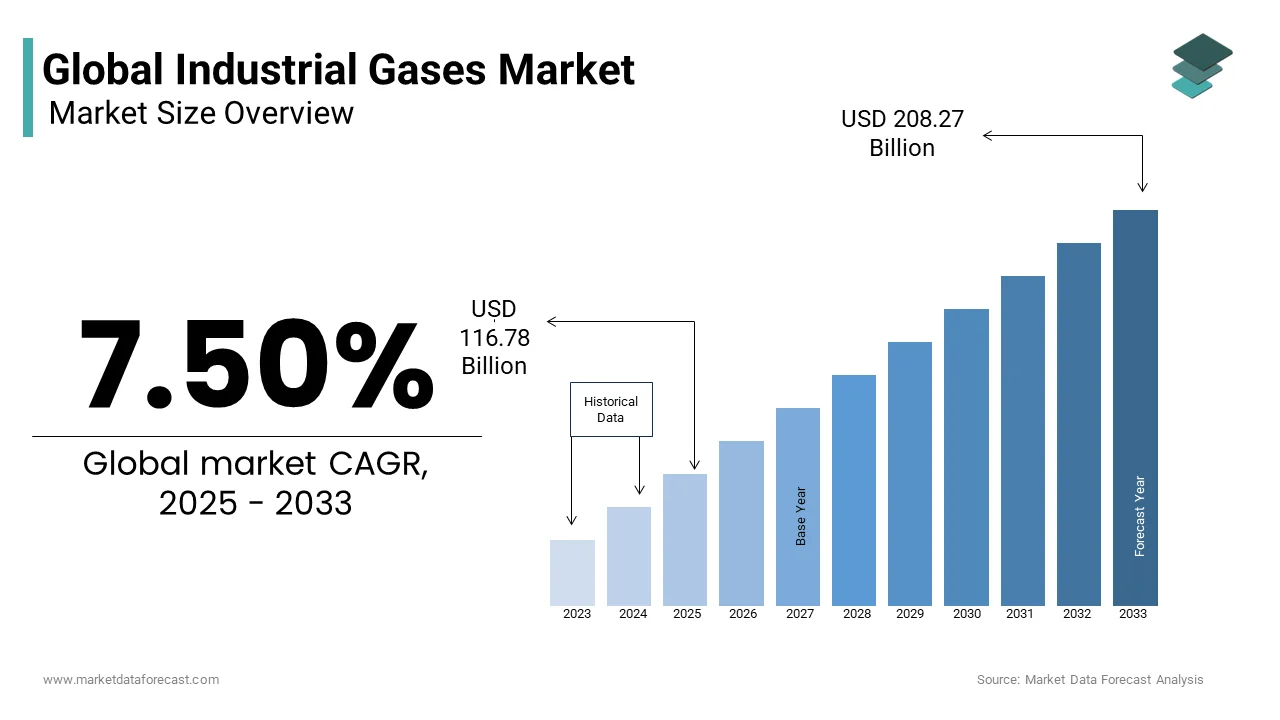
Industrial gases are gases such as oxygen, nitrogen, argon, hydrogen, carbon dioxide, and specialty gases used in manufacturing, healthcare, electronics, and energy sectors. These gases function as essential enablers in processes ranging from metal cutting and welding to semiconductor fabrication and medical therapies. Unlike commodity chemicals, industrial gases are often delivered via on-site generation, pipelines, or cryogenic tankers, which requires complex logistical networks.
MARKET DRIVERS
Expansion of the Electronics and Semiconductor Industry
The semiconductor manufacturing sector is a pivotal driver for the growth of the industrial gases market. It's particularly nitrogen, helium, and specialty gases like silane and phosphine. These gases are indispensable in processes such as chemical vapor deposition, ion implantation, and chamber purging, where even trace impurities can compromise chip yield. As per the research, global semiconductor sales surged notably, with Asia-Pacific accounting for a notable share of production capacity. The construction of new fabrication plants, or fabs, in Taiwan, South Korea, and India, such as Intel’s $19.5 billion facility in India announced in 2025, is significantly increasing demand for ultra-high-purity gases. According to the study, a single advanced fab consumes notable liters of nitrogen per minute during operation.
Rising Demand for Clean Energy Carriers, Particularly Hydrogen
The rising demand for clean energy carriers, particularly hydrogen, is additionally fuelling the growth of the industrial gases market. Hydrogen is emerging as a transformative industrial gas in the global transition toward decarbonized energy systems. The notable gigawatts of electrolyzer capacity are in development globally by 203, aimed at producing green hydrogen through water electrolysis powered by renewables. Industrial applications such as steelmaking via hydrogen direct reduction, pioneered by projects like HYBRIT in Sweden, are eliminating carbon emissions from traditionally coal-intensive processes.
MARKET RESTRAINTS
High Energy Intensity and Carbon Footprint of Gas Production
The high energy intensity and carbon footprint of gas production are restricting the growth of the industrial gases market. The production of industrial gases through air separation units (ASUs) and steam methane reforming (SMR) for hydrogen is inherently energy-intensive, which is contributing significantly to greenhouse gas emissions. Air separation for oxygen and nitrogen can consume notable kWh per ton of liquid oxygen, making operations vulnerable to energy price volatility. In regions with coal-dominated grids, such as parts of India and China, the carbon footprint of gas manufacturing is further amplified. Regulatory pressures under frameworks like the EU Emissions Trading System, which imposes carbon costs increasing per ton of CO₂, are increasing operational expenses.
Geopolitical Vulnerability in the Supply of Gases
The geopolitical instability is affecting the supply of rare and strategic gases like helium and neon, which is also restraining the growth of the Industrial gases market. As per the U.S. Geological Survey, over 30% of the world’s helium supply originates from Qatar and the United States, with production highly concentrated in a few facilities vulnerable to political or logistical disruptions. The closure of a major helium plant in Qatar due to maintenance and export restrictions temporarily reduced global supply, according to the study. Similarly, Ukraine historically supplied a notable share of the world’s semiconductor-grade neon, and the conflict has disrupted purification facilities by forcing manufacturers to seek alternative sources at higher costs. The U.S. National Defense Stockpile lists helium and neon as materials due to their irreplaceable roles in aerospace, defense, and microelectronics. These supply chain fragilities expose the sector to price spikes and operational delays by undermining long-term planning and investment stability.
MARKET OPPORTUNITIES
Growth of On-Site and On-Demand Gas Generation Systems
The shift toward decentralized gas production through on-site generation is likely to pose new opportunities for the growth of the industrial gas market. Companies are increasingly adopting nitrogen and oxygen generators using pressure swing adsorption (PSA) and membrane technologies to reduce dependency on bulk deliveries and enhance operational resilience. As per the research, a portion of new industrial facilities integrate on-site gas systems, driven by logistical challenges and rising transportation costs. In remote mining operations, such as those in Western Australia, on-site oxygen plants have reduced supply chain risks and lowered costs, according to the research.
Integration of Industrial Gases in Carbon Capture, Utilization, and Storage (CCUS)
The integration in Carbon Capture, Utilization, and Storage (CCUS) is expected to enhance the growth of the industrial gases market. Carbon dioxide, once viewed primarily as a byproduct, is being repurposed for enhanced oil recovery (EOR) and synthetic fuel production. There has been an increase in commercial CCUS facilities in operation worldwide by capturing significant tons of CO₂ annually, with plans to scale to several projects by 2030. Besides, companies are developing cryogenic CO₂ purification units to supply food-grade and industrial CO₂ from biogenic sources. The European Commission estimates that CCUS could abate a portion of the EU’s industrial emissions by 2050 by creating a new revenue stream for gas companies while supporting climate targets.
MARKET CHALLENGES
Aging Infrastructure in Developed Markets
The aging gas production and distribution infrastructure is challenging the growth of the industrial gases market. In the United States, portions of the industrial gas pipeline network date back to the mid-20th century, with the American Society of Civil Engineers giving the nation’s energy infrastructure a low grade in its report card, citing corrosion, leaks, and inefficiencies. The U.S. recorded several hazardous liquid pipeline incidents, many involving gas transport systems. In Europe, legacy air separation units are nearing the end of their life, which requires costly retrofits to meet modern efficiency and emissions standards. Replacing these systems demands substantial capital investment and operational downtime. Furthermore, integrating new technologies like hydrogen blending into existing pipelines requires material compatibility upgrades because traditional steel pipes are prone to hydrogen embrittlement.
Regulatory Fragmentation in Gas Safety and Purity Standards
The regulatory fragmentation in gas safety and purity standards is another challenge for the growth of the industrial gases market. The industrial gases sector operates under a complex and inconsistent global regulatory landscape, creating compliance hurdles for multinational suppliers. While organizations like the International Organization for Standardization have established guidelines for gas purity, national implementations vary significantly. In India, the Bureau of Indian Standards requires specific oxygen purity levels for medical use. It differs from U.S. FDA requirements, which complicates cross-border supply. The European Union’s SEVESO III directive imposes stringent controls on gas storage above certain thresholds, whereas ASEAN countries lack harmonized frameworks. Companies must maintain multiple quality assurance systems by reducing operational agility and increasing administrative burden in high-growth emerging markets.
REPORT COVERAGE
| REPORT METRIC | DETAILS |
| Market Size Available | 2025 to 2034 |
| Base Year | 2025 |
| Forecast Period | 2026 to 2034 |
| CAGR | 7.50% |
| Segments Covered | By Product, Application, Distribution, and Region |
| Various Analyses Covered | Global, Regional & Country Level Analysis, Segment-Level Analysis, DROC, PESTLE Analysis, Porter’s Five Forces Analysis, Competitive Landscape, Analyst Overview on Investment Opportunities |
| Regions Covered | North America, Europe, APAC, Latin America, Middle East & Africa |
| Market Leaders Profiled | Air Liquide, Air Products Inc., INOX-Air Products Inc., Iwatani Corp., Linde plc, Messer, SOL Group, Strandmøllen A / S, Taiyo Nippon Sanso Corp |
SEGMENTAL ANALYSIS
By Product Insights
The Nitrogen segment dominated the industrial gases market by capturing a 58.1% share in 2025. The growth of the nitrogen segment is attributed to its inert properties and adaptability across high-demand industrial processes. Its extensive use in chemical and petrochemical manufacturing, where nitrogen serves as a purge gas to prevent explosive atmospheres during reactor startups and shutdowns, is a key driver of this segment. According to the study, a portion of chemical plants in the U.S. utilize continuous nitrogen blanketing, consuming millions of cubic feet daily. In the food and beverage industry, nitrogen is used for modified atmosphere packaging (MAP), extending shelf life. Apart from these, the oil and gas sector injects nitrogen into aging wells to enhance recovery, with the U.S. showing many active nitrogen-assisted EOR projects operate in the Permian Basin alone. This breadth of application cements nitrogen’s position as the most widely consumed industrial gas.
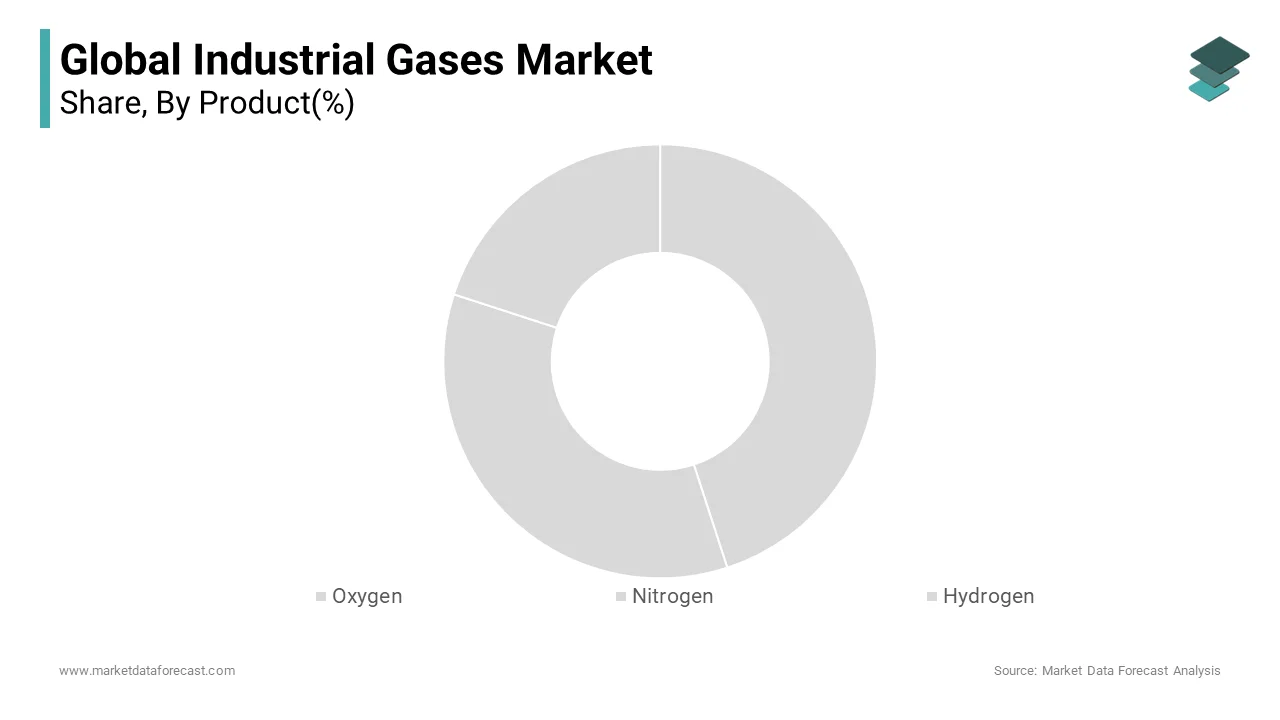
The oxygen segment is estimated to register the fastest CAGR of 7.8% over the forecast period, owing to its role in environmental and energy transition technologies. Its use in wastewater treatment, where pure oxygen is injected to accelerate aerobic digestion, is a major driver of the oxygen segment. According to research, several large-scale wastewater treatment plants globally use pure oxygen systems due to tightening discharge regulations. Coal-to-chemicals and gasification processes, particularly in China, where oxygen is essential for converting coal into syngas, are another key growth factor for this segment. As per the study, oxygen demand in coal gasification rose in China annually, which is driven by energy security policies. Apart from these, oxygen is gaining traction in sustainable steelmaking, with projects using oxygen-based smelting to reduce carbon emissions.
By Application Insights
The manufacturing segment held the leading share of 63.1% of the industrial gases market in 2025. The growth of the segment is driven by the sector’s reliance on gases for metallurgy, chemical synthesis, and advanced fabrication. In steel production, oxygen is injected into basic oxygen furnaces to increase efficiency and reduce processing time. In addition, as per the research, each ton of steel produced requires a specific volume of oxygen, which translates to global demand exceeding millions of tons of oxygen annually. In electronics manufacturing, nitrogen is used in most of the semiconductor fabrication steps, including wafer annealing and chamber purging, as per research. The rise of electric vehicles has further intensified demand, with battery production requiring argon and nitrogen for electrode drying and cell sealing.
The healthcare application segment of the industrial gases market is anticipated to witness the fastest CAGR of 8.3% from 2025 to 2033. The growth of the segment is driven by escalating demand for medical oxygen, particularly in emergency care and chronic respiratory treatment. As per the study, millions of people globally suffer from chronic obstructive pulmonary disease (COPD), and some require long-term oxygen therapy. During the pandemic, global medical oxygen demand spiked significantly, as per the research, which prompted governments to invest in oxygen generation infrastructure. For instance, India installed numerous pressure swing adsorption (PSA) oxygen plants in district hospitals by 2023 under the PM CARES Fund. Apart from these, the expansion of minimally invasive surgeries, which use argon and helium for insufflation, is increasing demand for specialty gases. Hence, medical gas systems are becoming essential infrastructure because of aging populations in Europe and Japan, along with rising healthcare access in Africa and Southeast Asia, which in turn is fueling the growth of the market.
By Distribution Insights
The bulk distribution segment commanded the market by capturing 64.7% share in 2025. Its efficiency and cost-effectiveness for high-volume industrial consumers are primarily driving the growth of the bulk distribution segment in the global market. Large-scale operations such as steel mills, refineries, and chemical plants require a continuous and uninterrupted gas supply, which makes bulk delivery via cryogenic tankers or pipeline networks the most viable option. In the U.S., hundreds of miles of dedicated industrial gas pipelines crisscross the Gulf Coast to supply refineries and petrochemical complexes in Texas and Louisiana, as per the research. In addition, on-site gas generation is often classified under bulk supply and is increasingly adopted. Like, the International Energy Agency (IEA) has pointed out that a much higher percentage of hydrogen used in refineries is already produced on-site. Besides, bulk systems minimize handling hazards and reduce cylinder changeovers by enhancing operational safety.
The cylinder distribution segment is likely to experience an expected CAGR of 6.9% from 2025 to 2033 due to the rising demand from decentralized and small-scale users who lack infrastructure for bulk supply. Small and medium enterprises (SMEs) in metal fabrication, food service, and healthcare rely on gas cylinders for welding, refrigeration, and medical oxygen. According to the research, a substantial number of SMEs operate in the Asia-Pacific region, many in remote or urban areas without access to pipeline networks. Also, in Africa, where grid reliability is low, portable oxygen cylinders are important for clinics. Like, a notable share of medical oxygen in sub-Saharan Africa is delivered via cylinders, particularly in hospitals and facilities that do not have on-site oxygen plants or reliable electricity for oxygen concentrators.
REGIONAL ANALYSIS
Asia-Pacific
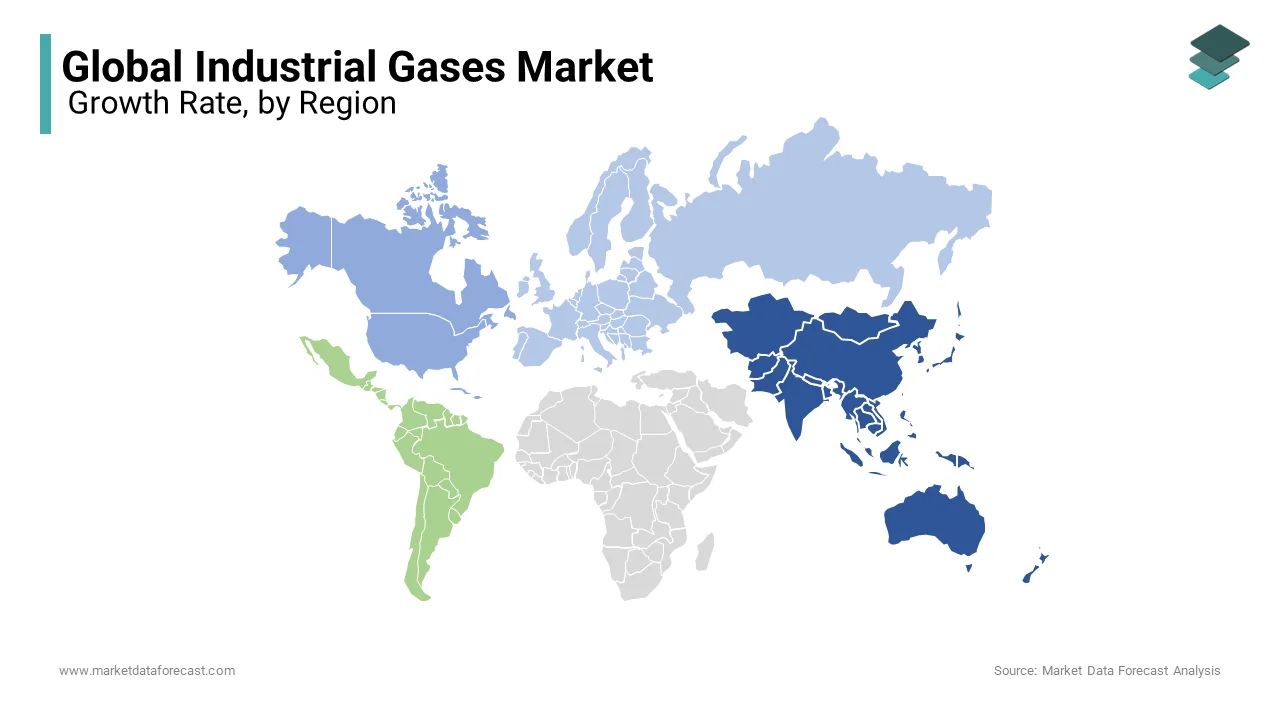
The Asia-Pacific outperformed other regions in the global industrial market in 2025 by accounting for 38.4% of the global market share. China and India are the primary engines of the Asia Pacific market, which is driven by rapid industrialization and government-led infrastructure development. China produces a notable share of the world’s steel and electronics, both highly gas-intensive sectors, as per the study. India's semiconductor mission involves setting up new fabrication plants, or "fabs," which will significantly increase the country's consumption of these gases. The region hosts many new industrial gas projects. Hence, medical gas demand is also surging due to rising urbanization and healthcare access.
North America
North America was positioned second in the global industrial gases market due to its advanced industrial base and regulatory rigor. The U.S. is the largest national market, which is driven by energy-intensive industries such as shale gas, petrochemicals, and aerospace. As per the study, the Permian Basin had approximately 130 gas processing plants operated by 25 midstream companies at the end of 2023. Also, the region leads in innovation, with companies deploying hydrogen fueling stations and carbon-free ammonia projects. The Inflation Reduction Act has spurred investment in clean hydrogen, with a significant amount of tax credits allocated for hydrogen production, per the U.S. Department of the Treasury. Besides, the FDA’s stringent requirements for medical gas purity have elevated quality standards. North America’s integration of digital monitoring and on-site generation systems positions it as a leader in smart, sustainable gas solutions.
Europe
Europe is expected to grow with a prominent CAGR during the forecast period, with a strong focus on decarbonization and regulatory compliance. Germany, France, and the Netherlands are key markets, supported by dense industrial clusters and pipeline infrastructure. The EU’s Green Deal and Fit for 55 package are reshaping demand, with over 30 large-scale electrolyzer projects under development to produce green hydrogen, as per the European Commission. The steel industry is adopting hydrogen-based reduction, with plants in Sweden and Germany consuming notable tons of hydrogen daily. Regulatory frameworks like REACH and SEVESO III enforce strict handling standards, driving investment in safety and automation.
Latin America
Latin America grew steadily in the global industrial gases market, with Brazil and Mexico leading regional demand. Brazil’s industrial sector, particularly mining and food processing, is driving the nitrogen and oxygen consumption. The country produces significant tons of aluminum annually, a process requiring large volumes of inert gases, as per the study. Mexico’s proximity to the U.S. has boosted its role in nearshoring, with the number of new manufacturing facilities established since 2020, according to the research, increasing demand for welding and process gases. Argentina is developing its Vaca Muerta shale formation, requiring nitrogen for well stimulation. In addition, industrial gas demand is expected to grow annually in the coming years due to infrastructure upgrades and foreign investment.
Middle East and Africa
The Middle East and Africa industrial gases market growth is likely to grow, with the Middle East dominating due to its energy-centric economy. Saudi Arabia and the UAE are expanding their petrochemical and refining capacities under economic diversification plans, with a significant amount invested in industrial projects since 2020, according to the research. These facilities require continuous oxygen and nitrogen supply for process stability. The region also hosts a portion of the world’s large-scale desalination plants, which use chlorine and nitrogen for water treatment, as per the study.
KEY MARKET PLAYERS
Air Liquide, Air Products Inc., INOX-Air Products Inc., Iwatani Corp., Linde plc, Messer, SOL Group, Strandmøllen A / S, Taiyo Nippon Sanso Corp. are the market players that are dominating the global industrial gases market.
Top Players In The Market
Linde plc
Linde is a global leader in industrial gases with a strong footprint across the Asia Pacific region. The company operates extensive production facilities and supply networks in countries by supporting industries such as steel, chemicals, electronics, and healthcare. Linde has consistently invested in large-scale air separation units and hydrogen infrastructure to meet growing demand. In recent years, it has focused on sustainability by expanding its clean hydrogen and carbon capture solutions. Linde strengthened its position in the Asia Pacific market through strategic partnerships with local manufacturers and by launching on-site gas supply projects for the semiconductor and renewable energy sectors. Its innovation-driven approach and robust logistics network reinforce its place in high-growth industrial hubs.
Air Liquide
Air Liquide plays a pivotal role in shaping the industrial gases landscape in the Asia Pacific region. The company operates a vast network of production and distribution facilities across China, India, Southeast Asia, and Australia, serving diverse sectors including electronics, healthcare, and petrochemicals. Air Liquide has prioritized low-carbon technologies by investing heavily in hydrogen energy and carbon capture projects. The company also expanded its pipeline supply networks to industrial clusters in India and Vietnam.
Mitsubishi Gas Chemical Company, Inc.
Mitsubishi Gas Chemical is a key player in the Asia Pacific industrial gases market, particularly in Japan and Southeast Asia. The company specializes in high-purity gases, electronic materials, and specialty gases for semiconductor and display manufacturing. It has strengthened its market presence by expanding production capacity in Singapore and Japan to meet rising demand from the tech industry. The company also focuses on R&D to develop advanced gas solutions for next-generation electronics. In 2023, Mitsubishi Gas Chemical launched a new fluorine-based gas purification system, enhancing its offerings for the semiconductor sector.
Top Strategies Used By The Key Market Participants
Key players in the industrial gases market employ several major strategies to maintain and expand their competitive edge. Strategic partnerships and joint ventures enable companies to access new markets and technologies. Long-term supply contracts ensure stable revenue and deepen customer relationships, especially in capital-intensive industries. Geographic expansion, particularly in high-growth regions,a llows for proximity to emerging industrial hubs. Companies are investing in on-site production facilities and pipeline networks to improve efficiency and reliability. Mergers and acquisitions help consolidate capabilities and broaden product portfolios.
COMPETITION OVERVIEW
The industrial gases market is highly competitive, characterized by technological innovation, strategic expansions, and strong regional integration. Leading companies compete on reliability, purity, and customized supply solutions, particularly in high-tech and energy-intensive industries. The Asia Pacific region has emerged as a key battleground due to rapid industrialization, growth in electronics manufacturing, and increasing demand for clean energy solutions. Competition is intensified by the need for large-scale infrastructure investments and long-term customer contracts. Companies differentiate themselves through advanced R&D, sustainability initiatives, and integrated supply networks.
RECENT MARKET NEWS
In January 2023, Air Liquide inaugurated a state-of-the-art electronics gas facility in South Korea to serve the semiconductor industry with ultra-high-purity gases.
MARKET SEGMENTATION
This research report on the global industrial gases market is segmented and sub-segmented into the following categories.
By Product
- Oxygen
- Nitrogen
- Hydrogen
- Carbon dioxide
- Acetylene
- Argon
By Application
- Healthcare
- Manufacturing
- Metallurgy & Glass
- Food & Beverages
- Retail
- Chemicals & Energy
- Others
By Distribution
- On-site
- Bulk (Liquid Gas Transport)
- Cylinder (Merchant)
By Region
- North America
- Europe
- Asia Pacific
- Latin America
- Middle East and Africa