- Product Description Description
- Table of Contents TOC
- List of Table & Figure LOT
- Get Free Sample PDF Sample PDF
Market Size, 2025
$74.69 BnMarket Estimate, 2026
$77.71 BnMarket Forecast, 2034
$106.68 BnCAGR, 2026–2034
4.04%Executive Summary: Global Industrial Lifting Equipment Market
- Market Scope: Comprehensive market evaluation of the global industrial lifting equipment sector, analyzing operating systems (diesel, electric, gasoline & LPG/CNG), equipment classes, applications (manufacturing, wholesale & retail distribution, freight & logistics), types (forklifts, boom lifts, scissor lifts, vertical mast lifts), industry verticals, and regional performance across Asia-Pacific, Europe, North America, Latin America, and the Middle East & Africa.
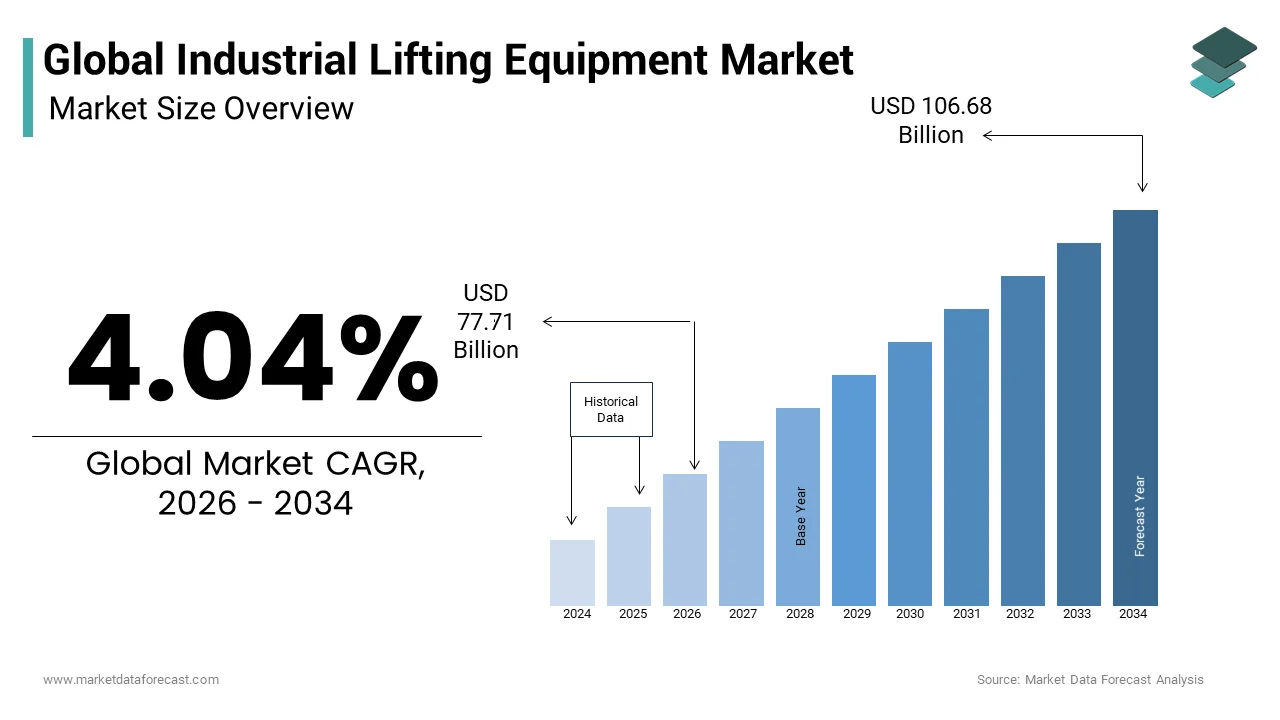
- Market Valuation: Valued at USD 74.69 billion in 2025, reaching USD 77.71 billion in 2026, and projected to scale up to USD 106.68 billion by 2034, registering a steady CAGR of 4.04% throughout the forecast period from 2026 to 2034.
- Primary Growth Drivers: Rapid industrial manufacturing expansion and automation trends, warehouse network growth, increasing domestic and international trade driving material transport, and booming infrastructure and construction activities worldwide.
Key Market Segment Metrics
| Category | Leading Segment (Base Year Position) | Fastest-Growing / High-Impact Segment |
|---|---|---|
| By Type & Application | Forklifts & Construction Application (dominant baseline shares anchored by low noise, high fuel efficiency, eco-friendly operations, and intensive global infrastructure development) | Electric-Powered Lifting Equipment & Warehouse Distribution (high-impact growth segments driven by zero-emission mandates and automated logistics expansion) |
| By Region | Asia-Pacific (leading global market share driven by heavy construction investments, rapid urbanization, and manufacturing hubs in China and India) | Europe and North America (substantial growth regions propelled by advanced warehouse automation, electrification trends, and fleet modernization) |
Major Market Players & Market Structure
Market Structure: Highly competitive global landscape featuring prominent material handling equipment manufacturers, crane specialists, and industrial vehicle giants focusing on fleet electrification, advanced battery integration (such as lithium-ion technologies), and automated assembly solutions.
Key Companies: Toyota Industries, KION Group, Hyster-Yale Material Handling, Oshkosh, Linamar, Konecranes, Cargotec, Terex, Tadano, Liebherr, Manitowoc, Ingersoll Rand, Mammoet, ZPMC, KITO, XCMG, Zoomlion, and Columbus McKinnon.
Global Industrial Lifting Equipment Market Size
The global industrial lifting equipment market size was USD 74.69 billion in 2025 and is anticipated to reach from USD 77.71 billion in 2026 to reach USD 106.68 billion by 2034, growing at a CAGR of 4.04% during the foreseen period 2025 to 2033.
Manufacturing industries have developed very rapidly since the Second Industrial Revolution and the mid-1990s. Industries continually strive to increase their production capacity and emphasize their "everything under one roof" policy. Since the beginning of industrialization, the manufacturer has struggled to cope with handling problems. Handling means moving materials from one location to another, which can include dragging, transporting, or lifting materials. Sometimes lifting materials is a difficult task when the materials are delicate, hot, or very heavy. For this, almost all industries involve the use of lifting equipment. Industrial lifting equipment is special machines or mechanisms that can reduce the human effort to lift something and place it where you'd love it. Industrial lifting equipment can include hoists, hoists, cranes, hook sheaves, lifting positions, complexity, automated or manual systems and others.
MARKET DRIVERS
The industrial lifting equipment market is primarily dependent on industrial growth and the degree of automation.
Companies invest heavily to increase their production and equipment stocks. Efforts to expand its warehouses in different regions to extend its reach everywhere are some of the factors that are expected to drive the market for industrial lifting equipment. Furthermore, the increase in domestic and international trade and flowering material transportation industries means that industrial lifting equipment for loading, unloading, and stacking is also expected to drive the market for industrial lifting equipment.
In addition, the participation of such equipment in the construction sector can also generate demand in the market for industrial lifting equipment. It is desirable that industrial lifting equipment performs its function and is strong enough to lift a wide range of weights. In addition, industrial lifting equipment should take up less space for installation and transportation applications. The expanding interest in lifting loads in the delivery business, the expanding interest for forklifts in the distribution center and logistics fragment, and the expanding interest for cranes and hoists in the mining business are some other major drivers of the industrial lifting equipment market.
MARKET RESTRAINTS
The principal challenge in the industrial lifting equipment market is the absence of administrators. The interest in qualified administrators has been on the ascent for quite a long time. Be that as it may, most enterprises face a deficiency of qualified architects and upkeep workforce to appropriately uphold and look after equipment. Utilizing an enormous number of parts on one crane requires profoundly gifted work to amass segments and wire harnesses and operate different cranes and forklifts to lift and lower objects.
REPORT COVERAGE
| REPORT METRIC | DETAILS |
| Market Size Available | 2025 to 2034 |
| Base Year | 2025 |
| Forecast Period | 2026 to 2034 |
| CAGR | 4.04% |
| Segments Covered | By Operations, Class, Application, Type, Industry, and Region |
|
Various Analyses Covered | Global, Regional & Country Level Analysis, Segment-Level Analysis, DROC, PESTLE Analysis, Porter’s Five Forces Analysis, Competitive Landscape, Analyst Overview on Investment Opportunities |
| Regions Covered | North America, Europe, APAC, Latin America, Middle East & Africa |
| Market Leaders Profiled | Toyota Industries (Japan), KION Group (Germany), Hyster-Yale Material Handling (US), Oshkosh (US), Linamar (Canada), Konecranes (Finland), Cargotec (Finland), Terex (US), Tadano (Japan), Liebherr (Switzerland), Manitowoc (US), Ingersoll Rand (Ireland), Mammoet (Netherlands), ZPMC (China), KITO (Japan), XCMG (China), Zoomlion (China), and Columbus McKinnon (US) and Others. |
SEGMENTAL ANALYSIS
By Application Insights
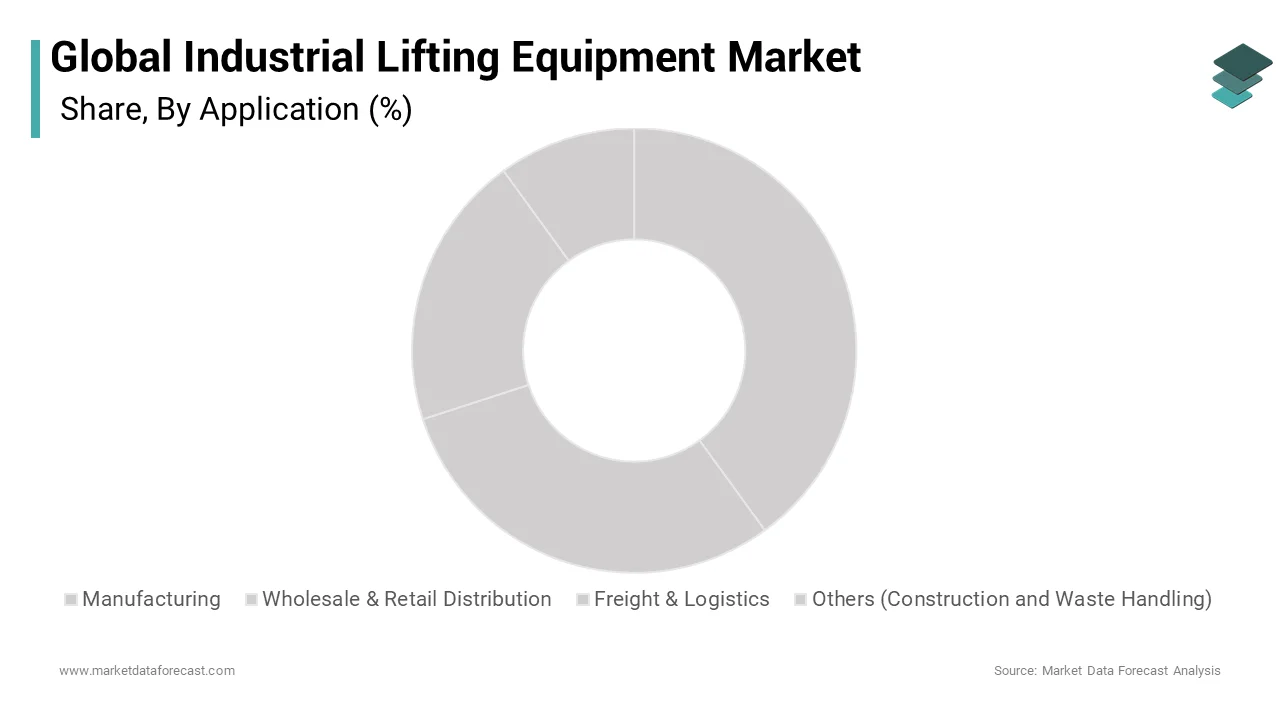
The construction segment is expected to dominate the market during the forecast period, due to rapid infrastructure development and increased construction activity around the world.
By Type Insights
The forklift segment is expected to account for the largest market share during the forecast period, due to the advantages that forklifts offer such as low noise and improved fuel efficiency. The operating cost of forklifts is low and environmentally friendly.
REGIONAL ANALYSIS
Asia-Pacific is estimated to account for the majority of the overall industrial lifting equipment market. However, the European and North American market is expected to experience substantial growth. Asia-Pacific is the most lucrative market for cranes and hoists, due to the large investments made in construction activities in the region. The growing need for infrastructure in developing economies like India and China complements the growth of the market in this region.
KEY MARKET PLAYERS
Companies playing a major role in the global Industrial Lifting Equipment Market include
- Toyota Industries (Japan)
- KION Group (Germany)
- Hyster-Yale Material Handling (US)
- Oshkosh (US)
- Linamar (Canada)
- Konecranes (Finland
- Cargotec (Finland)
- Terex (US)
- Tadano (Japan)
- Liebherr (Switzerland)
- Manitowoc (US)
- Ingersoll Rand (Ireland)
- Mammoet (Netherlands)
- ZPMC (China)
- KITO (Japan)
- XCMG (China)
- Zoomlion (China)
- Columbus McKinnon (US).
RECENT MARKET NEWS
-
JLG Industries' parent company, Oshkosh Corporation, invests in Microvast, a global provider of next-generation battery technologies for commercial and specialty electric vehicles, driving the development of advanced electrified solutions.
-
Consolidated revenues for the fourth quarter of 2020 decreased 13.8% compared to the fourth quarter of 2019 due to lower deliveries because of the persistent effects of very low reserves during the peak period of pandemic closures worldwide, as well as the pace of the subsequent recovery of the forklift market.
-
KION, the world leader in logistics, creates more than 100 additional jobs in Pune. The new factory, which covers approximately 94,000 square meters, is expected to be commissioned in early 2020. It will include a state-of-the-art production facility, research, and development center, a training center for service and space personnel for the future growth from Dematic in India.
-
Toyota Industries North America procured the resources of Hoist Liftruck Mfg.
MARKET SEGMENTATION
This research report on the global industrial lifting equipment market has been segmented and sub-segmented based on operation, class, application, type, industry and region.
By Operations
- Diesel
- Electric
- Gasoline & LPG/CNG
By Class
- Class 1
- Class 2
- Class 3
- Class 4 & 5
By Application
- Manufacturing
- Wholesale & Retail Distribution
- Freight & Logistics
- Others (Construction and Waste Handling)
By Type
- Boom Lifts
- Scissor Lifts
- Vertical Mast Lifts
- Others
By Industry
- Aerospace and Defense
- Automotive & Railway
- Mining
- Construction
- Marine
- Shipping & Material Handling
- Energy & Power
- Others
By Region
-
North America
-
The United States
-
Canada
-
Rest of North America
-
-
Europe
-
The United Kingdom
-
Spain
-
Germany
-
Italy
-
France
-
Rest of Europe
-
-
The Asia Pacific
-
India
-
Japan
-
China
-
Australia
-
Singapore
-
Malaysia
-
South Korea
-
New Zealand
-
Southeast Asia
-
-
Latin America
-
Brazil
-
Argentina
-
Mexico
-
Rest of LATAM
-
-
The Middle East and Africa
-
Saudi Arabia
-
UAE
-
Lebanon
-
Jordan
-
Cyprus
-