Global Industrial Mold Market Size Share, Trends, and Growth Analysis Report, Segmented By Mold, Material, Application & Region (North America, Europe, Latin America, Asia Pacific, Middle East & Africa), Industry Forecast From 2026 to 2034
Market Size, 2025
$59 BnMarket Estimate, 2026
$64.46 BnMarket Forecast, 2034
$130.81 BnCAGR, 2026–2034
9.25%Global Industrial Mold Market Size
The global industrial mold market size was valued at USD 59 billion in 2025 and is anticipated to reach USD 64.46 billion in 2026 and to reach USD 130.81 billion by 2034, growing at a CAGR of 9.25% during the forecast period from 2026 to 2034.

Industrial molds are precision tooling used in the mass production of components across sectors such as automotive, consumer electronics, medical devices, and packaging. These molds, ranging from injection and blow molds to die-casting and compression molds, serve as foundational enablers of high-volume, repeatable manufacturing with tight tolerances. Injection molding is the dominant method for industrial plastic part production. The complexity of modern molds has escalated with advancements in micro-machining and multi-cavity configurations, as evidenced by the fact that Complex automotive molds can be highly intricate and expensive. Furthermore, the global proliferation of smart manufacturing systems has intensified demand for molds integrated with sensors and IoT-enabled monitoring. The adoption of smart, sensor-enabled molds is increasing in Europe.
MARKET DRIVERS
Expansion of the Electric Vehicle (EV) Production Ecosystem
The global surge in electric vehicle manufacturing is significantly amplifying demand for specialized industrial molds used in lightweight components, battery housings, and interior assemblies. Also, Global EV sales are rapidly growing, driving industrial mold demand. Each EV battery enclosure requires large-scale aluminum die-casting molds capable of withstanding high pressures and thermal cycles, with Tesla’s Gigacast process alone reducing underbody parts from 171 to just 2 through advanced mold technology. EVs generally require more molded components for insulation, battery housings, and interiors. EV production growth in China increases demand for industrial molds. This shift is accelerating investment in high-tonnage molding machines and multi-material mold designs.
Rising Demand for Medical Device Miniaturization and Precision Tooling
The medical technology sector’s push toward minimally invasive devices and disposable diagnostics is fueling demand for micro-molding and ultra-precision industrial molds. Injection molding dominates single-use medical device production, with extremely tight tolerances in micro-molding. The global business for micro-molded medical components is expanding, driven by aging populations and the proliferation of point-of-care testing kits. In Japan, firms use Advanced molds for ultra-small medical components. Additionally, the European Commission’s Medical Device Regulation (MDR) mandates batch traceability, prompting mold makers to integrate RFID tags and cavity identification systems directly into tooling. These advancements require advanced materials like hardened stainless steel and electroformed nickel, increasing the technical and capital intensity of mold production.
MARKET RESTRAINTS
Shortage of Skilled Mold Designers and Toolmakers
The industrial mold sector faces a critical shortage of engineers and technicians proficient in advanced CAD/CAM systems, CNC programming, and mold flow analysis, constraining production capacity and innovation. Like, there is a significant shortage of skilled mold makers in the U.S. Also, tool and die apprenticeship completions in Germany have decreased, contributing to workforce challenges. China is a leading mold producer and faces skill gaps in advanced design technologies. This skills gap delays lead times, increases error rates, and limits the adoption of next-generation technologies such as conformal cooling channels and additive manufacturing-integrated molds. The scarcity is further exacerbated by the aging workforce, with experienced molders in Europe and North America nearing retirement.
Volatility in Raw Material Supply and Pricing for Mold Steels
Industrial mold manufacturing is highly dependent on specialty steels, including P20, H13, and stainless grades, whose availability and pricing are subject to global supply chain disruptions and geopolitical factors. Also, Tool-grade steel prices are subject to significant volatility due to global supply and geopolitical factors. Like, premium steel suppliers experienced delivery challenges due to energy and supply disruptions. Domestic supply shortages in India increase reliance on imports and raise costs. Besides, the European Union’s Carbon Border Adjustment Mechanism (CBAM) is expected to increase the cost of imported steel by up to 15% by 2026, according to the European Commission, further pressuring profit margins for mold producers reliant on imported raw materials.
MARKET OPPORTUNITY
Integration of Additive Manufacturing in Mold Fabrication
The adoption of metal 3D printing for conformal cooling channels and lattice-structured inserts is revolutionizing industrial mold performance, enabling faster cycle times and improved part quality. In addition, molds with additively manufactured cooling channels reduce cycle times compared to traditionally drilled designs, significantly boosting productivity. In the automotive sector, BMW has implemented 3D-printed molds for dashboard components, achieving a 35% reduction in cooling time and a 15% improvement in surface finish, as reported by the company’s Additive Manufacturing Campus. The U.S. Department of Defense has funded projects through America Makes to develop hybrid molds combining printed cores with machined shells for missile guidance systems. Additionally, the use of additive manufacturing is expanding in industrial mold production, signaling a structural shift toward hybrid manufacturing models that enhance design flexibility and reduce time-to-market.
Growth in Sustainable and Long-Life Mold Technologies
Environmental regulations and cost pressures are driving demand for durable, recyclable, and energy-efficient molds that extend service life and reduce waste. As per the Ellen MacArthur Foundation, the circular economy model is gaining traction in manufacturing, with mold makers increasingly using reconditioned bases and modular inserts to cut material consumption. Some manufacturers, including Daikin, have developed coatings to extend mold life and reduce maintenance. Sustainable and modular mold designs are increasingly adopted in Western Europe. Furthermore, the adoption of surface treatments like physical vapor deposition (PVD) and laser cladding has reduced wear rates by up to 60%, according to the German Surface Engineering Society. These advancements not only lower lifecycle costs but also align with corporate sustainability goals, particularly in regulated industries such as medical and food packaging, where contamination and downtime must be minimized.
MARKET CHALLENGES
Rapid Technological Obsolescence Due to Digital Advancements
Industrial mold manufacturers face mounting pressure to continuously upgrade design and production systems to remain competitive, as digital tools such as AI-driven mold simulation, cloud-based collaboration platforms, and real-time process monitoring redefine performance benchmarks. Mold design software platforms are being updated more frequently due to digital advancements. Many mold manufacturers in Germany are upgrading CAM systems to support modern machining and digital integration. In China, the Ministry of Industry and Information Technology mandates Industry 4.0 compliance for state-supported manufacturers, pushing smaller mold shops to adopt expensive automation solutions or risk exclusion from public tenders. This accelerating obsolescence disproportionately affects mid-tier firms lacking R&D budgets, threatening market fragmentation and consolidation.
Increasing Complexity of Regulatory Compliance Across Global Markets
Industrial mold producers must navigate a fragmented landscape of international standards governing material safety, product traceability, and environmental impact, complicating design and delivery processes. There is a complex landscape of international mold standards. The U.S. FDA requires full documentation of mold material sourcing and processing for medical-grade tooling, while the EU’s REACH regulation restricts the use of certain coatings and lubricants in molds used for food-contact plastics. EU MDR and other regulations do extend validation timelines. In South Korea, the Ministry of Trade, Industry, and Energy enforces strict localization rules for molds used in defense and semiconductor manufacturing, limiting foreign supplier participation. These overlapping requirements increase administrative burden and delay time-to-market, particularly for exporters serving multiple jurisdictions.
REPORT COVERAGE
| REPORT METRIC | DETAILS |
| Market Size Available | 2025 to 2034 |
| Base Year | 2025 |
| Forecast Period | 2026 to 2034 |
| CAGR | 9.25% |
| Segments Covered | By Mold, Material, Application, and Region |
| Various Analyses Covered | Global, Regional & Country Level Analysis, Segment-Level Analysis, DROC, PESTLE Analysis, Porter’s Five Forces Analysis, Competitive Landscape, Analyst Overview on Investment Opportunities |
| Regions Covered | North America, Europe, APAC, Latin America, Middle East & Africa |
| Market Leaders Profiled | DMTG, Smith Metal Products, ARC Group Worldwide, Indo-MIM, NetShape Technologies, U.S. Industrial Machinery, Amada, DMG Mori, Dynacast International, TRUMPF |
SEGMENT ANALYSIS
By Mold Insights
The Metal Molds segment dominated the landscape due to its critical role in high-volume, precision manufacturing. This segment held a substantial share of the global market. The dominance of metal molds is primarily driven by their superior durability, thermal conductivity, and dimensional stability under high-pressure and high-temperature conditions. Most injection molding operations in these sectors use metal molds. H13 and P20 steels are widely used in German production molds. Additionally, the aerospace industry’s reliance on nickel-based superalloy molds for turbine blade casting, requiring tolerances within ±0.005 mm, further reinforces metal molds’ indispensability in mission-critical applications.
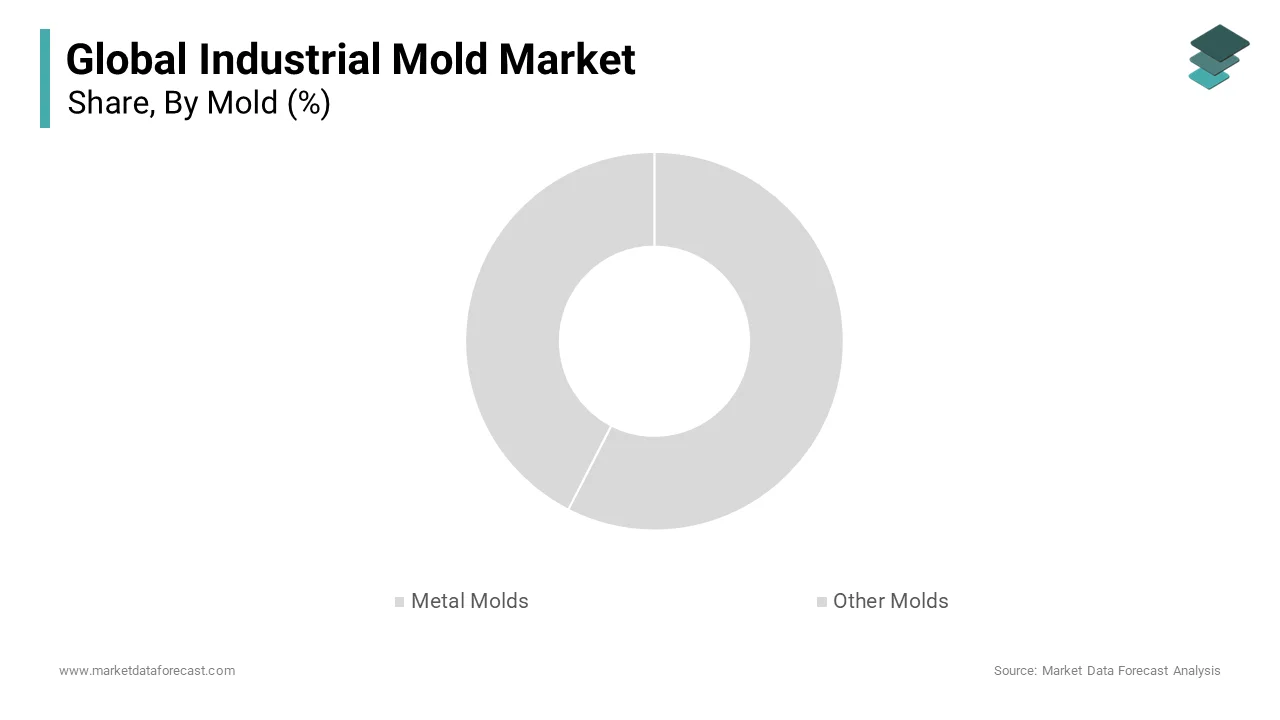
The Other Molds segment, encompassing composite, ceramic, and prototype molds, is emerging as the fastest-growing category, projected to expand at a CAGR of 9.4% from 2023 to 2030, as per the U.S. Department of Commerce’s Advanced Manufacturing Office. This growth is fueled by the rising demand for rapid prototyping, low-volume production, and sustainable mold alternatives. Soft molds are increasingly used in prototyping. In the footwear sector, companies like Adidas and Nike have adopted 3D-printed sand and resin molds for custom midsole production, enabling mass customization. The European Commission’s Circular Economy Action Plan has also encouraged the use of biodegradable mold materials in packaging, with Finland’s Stora Enso pioneering cellulose-based forming tools for food containers. These innovations are expanding the functional scope of non-metal molds beyond traditional limitations.
By Material Insights
The Plastics segment commanded the largest share of total mold demand in 2024. This dominance is rooted in the ubiquity of plastic components across consumer goods, automotive interiors, medical disposables, and electronic housings. Global plastics production is large and largely requires molding. The automotive industry alone consumes a large number of plastic-molded parts annually. China’s mold production centers are highly productive. The shift toward lightweight vehicles has further intensified demand for polypropylene and polycarbonate components, necessitating advanced multi-cavity and gas-assist molds capable of producing complex geometries with minimal flash.
The Glass segment is experiencing the fastest growth within the industrial mold market, with a projected CAGR of 8.7% between 2025 and 2033. This acceleration is driven by increasing demand for precision-molded optical components, pharmaceutical vials, and specialty glassware used in semiconductors and life sciences. Precision glass molding is widely used for diagnostics and vaccine vials. The rise of augmented reality (AR) and lidar systems in autonomous vehicles has created demand for aspherical glass lenses produced via ultra-precision molds, with each unit requiring surface accuracy within λ/4 (wavelength of light), as per the Optical Society of America. In Japan, companies like Ohara and Nikon have developed molds capable of replicating nano-textured surfaces for anti-reflective coatings, enabling mass production of high-performance optics. Additionally, the EU’s Packaging and Packaging Waste Regulation (PPWR) mandates a 90% recycling rate for glass containers by 2030, prompting investment in durable, long-life molds for container forming machines.
By Applications Insights
The Manufacturing segment held the largest share at 53.1% in 2024. This dominance stems from the foundational role of molds in producing standardized parts for appliances, power tools, and industrial enclosures. Many small-to-medium-sized enterprises in the manufacturing sector rely on outsourced mold fabrication for product development. In India, smart home device adoption is rapidly increasing. The proliferation of smart home devices, projected to exceed 1.3 billion units globally by 2025, according to the Consumer Technology Association, has further amplified demand for high-gloss, scratch-resistant plastic molds. These factors collectively position general manufacturing as the most extensive and diversified application domain for industrial molds.
The Automotive segment is the fastest-growing application area, projected to grow at a CAGR of 9.1% from 2023 to 2030, as per the International Energy Agency’s Global EV Outlook 2024. This growth is driven by the sector’s transition toward electric vehicles (EVs), lightweighting, and integrated interior systems, all of which require advanced mold technologies. Modern vehicles are highly molded, and EVs use more plastics. Tesla’s use of gigacasting molds has reduced underbody assembly steps by 70%, while BMW’s adoption of natural fiber-reinforced composites in door panels requires specialized compression molds. EV-related molds form a large share of new tooling. Additionally, China’s EV production, which reached 7.5 million units in 2023, has driven a surge in mold imports from Germany and Japan for high-precision interior trims, reinforcing the sector’s pivotal role in shaping mold market dynamics.
COUNTRY ANALYSIS
Asia Pacific Market Analysis
Asia Pacific dominates global mold production and consumption with a 52.6% share in 2024 and is positioning itself as the epicenter of mold manufacturing and consumption, as reported by the Asian Development Bank. The region’s dominance is anchored in its robust manufacturing infrastructure, particularly in China, Japan, and South Korea, where integrated supply chains support high-volume production. China alone accounts for over 35% of global mold output, with Dongguan designated as the "Mold Capital of the World" due to its concentration of 1,500+ mold enterprises, as per the China National Tooling Association. Japan is a leading exporter of high-precision molds. South Korea’s focus on semiconductor packaging molds has grown in tandem with its memory chip dominance. India is emerging as a secondary hub, with Indian investment in molds growing. The region’s proximity to end-user industries ensures rapid iteration and cost efficiency, solidifying its leadership.

Europe Market Analysis
Europe holds a strong share of the global industrial mold market and is establishing itself as a leader in high-precision, technologically advanced tooling. Germany is the continent’s mold powerhouse, producing 40% of Europe’s total mold output, with a focus on automotive, medical, and aerospace applications, according to the VDMA. Swiss and Austrian firms specialize in micro-molding for medical devices, achieving tolerances below 10 microns. Energy-efficient molds improve productivity. France and Italy maintain strong capabilities in luxury goods and packaging molds, with L’Oréal and Ferrero relying on local suppliers for custom cosmetic and confectionery tooling. Additionally, EU funding supports smart mold innovation.
North America Market Analysis
North America commands a small share of the industrial mold market, with the United States serving as the primary driver of innovation and high-value mold procurement. The country’s mold industry is concentrated in states like Ohio, Michigan, and Wisconsin, where proximity to automotive and medical device manufacturers creates strong demand. U.S. imports are significant. The resurgence of domestic EV production, led by Tesla, Ford, and Rivian, has increased demand for large-format die-casting and battery enclosure molds. Adoption of AI tools is increasing. Additionally, the CHIPS and Science Act has spurred investment in semiconductor packaging molds, with Intel and GlobalFoundries expanding tooling capacity in Arizona and New York.
Latin America Market Analysis
Latin America has a smaller share, with Brazil and Mexico serving as the primary hubs for regional production and assembly, as per the Inter-American Development Bank. Brazil’s automotive sector, centered in São Paulo, generates consistent demand for injection molds used in dashboards, bumpers, and lighting systems. Brazil has a large number of mold shops. Mexico’s proximity to the U.S. has made it a key player in nearshoring strategies. FDI in the Mexican mold industry is growing. However, limited access to premium-grade tool steel and a shortage of skilled technicians continue to constrain scalability, as highlighted by the Organization of American States’ Industrial Competitiveness Report.
Middle East and Africa Market Analysis
Middle East & Africa collectively hold a 4% share of the global industrial mold market, with the Gulf Cooperation Council (GCC) states leading regional development, as per the Gulf Organization for Industrial Consulting. The UAE, particularly Dubai and Abu Dhabi, has emerged as a logistics and light manufacturing hub, hosting over 120 mold fabrication and maintenance facilities, according to the Dubai Industrial Strategy 2030. Saudi investment in mold infrastructure is substantial. South Africa remains the largest mold consumer in sub-Saharan Africa. However, the region faces challenges in raw material sourcing and technical training, with over 60% of high-precision molds still imported from Europe and Asia, according to the African Development Bank. Despite this, growing interest in localized manufacturing is prompting public-private partnerships to build mold design and repair capabilities across the region.
KEY MARKET PLAYERS
These are the market players that are dominating the global industrial mold market
- DMTG
- Smith Metal Products
- ARC Group Worldwide
- Indo-MIM
- NetShape Technologies
- U.S. Industrial Machinery
- Amada
- DMG Mori
- Dynacast International
- TRUMPF
Top Players in the Market
- Hasco has solidified its presence in the Asia Pacific industrial mold sector by delivering standardized mold bases, ejection systems, and temperature control components essential for high-efficiency production. The German company has expanded its regional footprint through technical collaborations with mold makers in China, India, and Thailand, providing modular systems that reduce design-to-production lead times. It also introduced a digital configurator platform tailored for Southeast Asian manufacturers, enabling real-time selection of compliant components. By integrating IoT-enabled sensors into its mold standard parts, Hasco supports predictive maintenance in smart factories across Japan and South Korea. Its focus on interoperability and precision engineering has made it a preferred partner for automotive and consumer electronics molders seeking to enhance repeatability and reduce downtime.
- Mold-Masters (a subsidiary of Husky Technologies) is a leading innovator in hot runner systems and advanced mold technologies, with significant influence across the Asia Pacific’s plastics processing industry. The company has deepened its engagement with injection molding firms in Taiwan, South Korea, and Vietnam by introducing energy-efficient, fully electric hot runner solutions that reduce cycle times and material waste. It has also partnered with Indian automotive suppliers to deploy adaptive control systems that adjust melt flow in real time, improving part consistency. The company’s IntelliMelt™ software, now adopted by over 200 manufacturers in the region, uses machine learning to detect flow imbalances and prevent defects. By aligning its R&D with regional sustainability goals, including reduced energy consumption and recyclability, Mold-Masters has positioned itself at the forefront of intelligent mold technology adoption.
- Yudo has emerged as a dominant force in the hot runner and mold component market, particularly in high-growth economies across Southeast Asia and India. The South Korean firm has leveraged its cost-effective, reliable systems to capture demand from mid-tier manufacturers seeking precision without the premium pricing of European alternatives. Yudo established a manufacturing facility in Batam, Indonesia, in 2023 to serve the ASEAN market with localized production and faster delivery. It also launched a digital twin platform enabling remote monitoring of hot runner performance across Thai and Malaysian factories. The company’s collaboration with Vietnam’s FPT Industrial has integrated AI-driven diagnostics into its control units, reducing unplanned downtime by up to 30%. Yudo’s expansion into India’s auto component sector—supporting over 50 Tier-2 suppliers—has been accelerated by government incentives under the PLI scheme. Its focus on modular design, rapid service response, and digital integration has strengthened its reputation as a technologically agile and regionally responsive mold technology provider.
Top Strategies Used by Key Market Participants
Key players in the industrial mold market are prioritizing technological differentiation, regional localization, and digital integration to strengthen their competitive edge. Companies are investing in smart mold systems embedded with sensors and IoT connectivity to enable real-time process monitoring and predictive maintenance. Strategic partnerships with local manufacturers and research institutions are expanding access to emerging markets in Asia and Latin America. Firms are also adopting hybrid manufacturing models, combining additive and traditional machining to produce molds with conformal cooling channels that enhance efficiency. Expansion of application-specific centers—particularly in medical, automotive, and electronics sectors—allows for tailored solutions and faster customer support. Additionally, players are enhancing software capabilities through AI-driven simulation and digital twin platforms to reduce prototyping cycles. Sustainability initiatives, including energy-efficient hot runners and recyclable mold materials, are increasingly shaping product development and customer engagement strategies across the global supply chain.
COMPETITIVE LANDSCAPE
The industrial mold market is characterized by intense technological rivalry, regional specialization, and a growing divide between high-precision European and Japanese firms and cost-competitive Asian manufacturers. Competition is no longer confined to mold durability or accuracy but extends to digital integration, lifecycle efficiency, and sustainability compliance. German and Swiss companies lead in standardization and automation, while South Korean and Chinese firms are rapidly closing the gap through innovation in smart systems and localized service networks. The rise of electric vehicles and medical miniaturization is driving demand for molds with nanoscale precision, intensifying R&D investments. Independent mold shops face pressure from integrated solution providers offering full-system packages, including controls, software, and maintenance. Intellectual property in mold design and simulation tools has become a key differentiator, with firms increasingly protecting proprietary algorithms and modular architectures to maintain market advantage in this capital-intensive, expertise-driven sector.
RECENT MARKET NEWS
- In March 2024, Hasco launched a digital twin integration platform in collaboration with Siemens Digital Industries, enabling real-time performance tracking of its standardized mold components across smart factories in Japan and South Korea to enhance predictive maintenance and reduce unplanned downtime.
- In January 2024, Mold-Masters opened a new application innovation center in Hanoi, Vietnam, focused on optimizing hot runner systems for electronics and medical molding, supporting regional manufacturers in improving yield rates and energy efficiency in high-volume production environments.
- In October 2023, Yudo acquired a 70% stake in Indonesia’s PT MouldTech Solutions, strengthening its distribution and service network in Southeast Asia and enabling localized production of hot runner systems for the growing plastics processing sector in ASEAN markets.
- In May 2024, Hasco partnered with the National Institute of Foundry and Forge Technology in India to establish a training academy for mold design engineers, aiming to bridge the skills gap and promote advanced manufacturing practices among Indian tooling manufacturers.
- In February 2024, Mold-Masters introduced its IntelliGate™ AI-powered control system in Taiwan, a machine learning-based solution that dynamically adjusts melt pressure and temperature in multi-cavity molds, reducing scrap rates by up to 22% in consumer electronics production.
MARKET SEGMENTATION
This research report on the global industrial mold market is segmented and sub-segmented into the following categories.
By Mold Type
- Metal Molds
- Other Molds
By Material
- Plastics
- Glass
- Rubber
By Applications
- Manufacturing
- Automotive
By Country
- North America
- Asia Pacific
- Europe
- Latin America
- Middle East and Africa
Frequently Asked Questions
What is the Global Industrial Mold Market?
It’s the worldwide industry focused on designing and manufacturing molds used in mass production.
Which industries rely most on industrial molds?
Automotive, electronics, packaging, and consumer goods depend heavily on molds.
What types of molds are most commonly used?
Injection molds for plastic and die-casting molds for metal are the most popular.
Where is the biggest demand for industrial molds?
Asia-Pacific, especially China, leads due to its massive manufacturing base.
What drives growth in this market?
Demand for lightweight, complex parts in cars and electronics fuels mold production.
Are there challenges in the industrial mold industry?
High initial costs and long lead times for mold development can be limiting.
How important is precision in mold making?
Extremely important—modern parts require tight tolerances and flawless finishes.
Is sustainability becoming a focus in mold manufacturing?
Yes, companies are reusing molds and reducing waste in production.
How does technology affect mold production?
CNC machining, 3D printing, and CAD/CAM software have revolutionized mold making.
What’s the future of the industrial mold market?
Growth will continue with rising demand in EVs, medical devices, and smart tech.
Access the study in MULTIPLE FORMATS
Purchase options starting from
$ 2500
Didn’t find what you’re looking for?
TALK TO OUR ANALYST TEAM
Need something within your budget?
NO WORRIES! WE GOT YOU COVERED!
Call us on: +1 888 702 9696 (U.S Toll Free)
Write to us: sales@marketdataforecast.com