Global Infrared Sensors Market Size, Share, Trends & Growth Forecast Report By Wavelength Band, By Technology, By End User Industry, and By Region (North America, Europe, Asia Pacific, Latin America, Middle East & Africa) – Industry Analysis and Forecast, 2026 to 2034
Market Size, 2025
$666.43 MnMarket Estimate, 2026
$767.06 MnMarket Forecast, 2034
$2362.83 MnCAGR, 2026–2034
15.1%Global Infrared Sensors Market Size
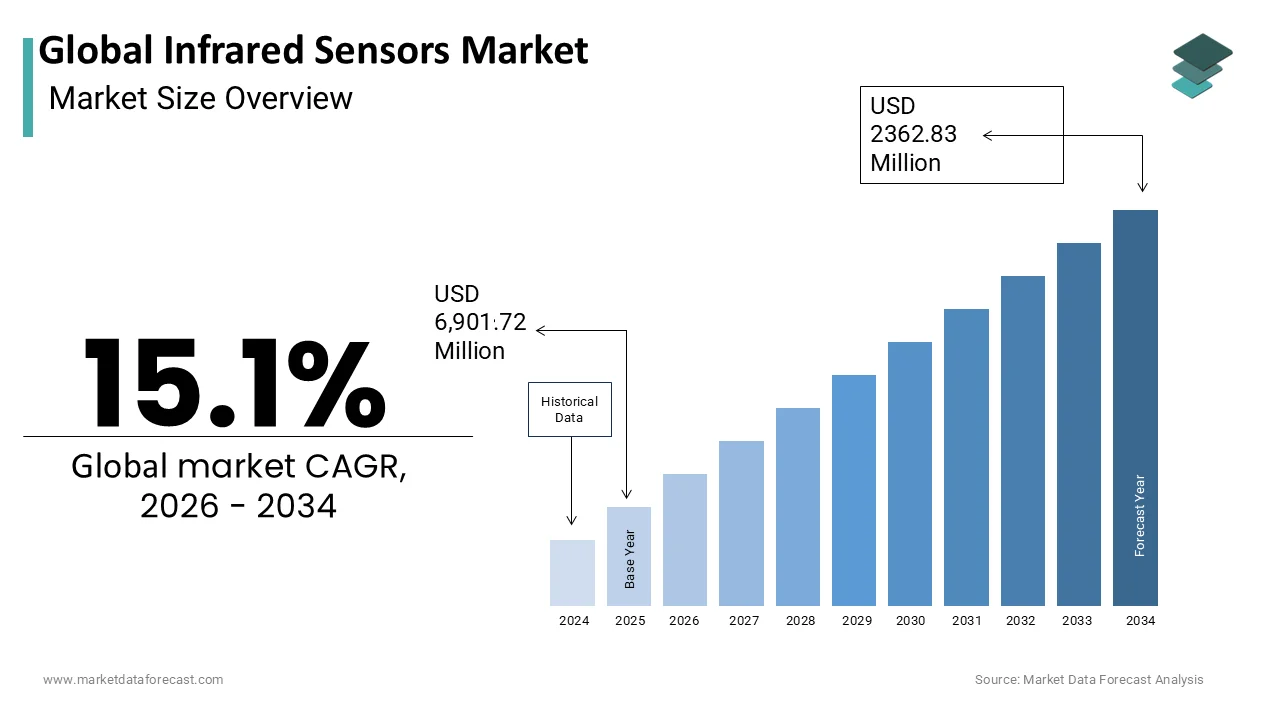
The Global Infrared Sensors Market was valued at USD 666.43 million in 2025 and is anticipated to reach USD 2362.83 million by 2034,, from USD 767.06 million in 2026 and to register a CAGR of 15.1% from 2026 to 2034.
The infrared sensors are detection devices that measure infrared radiation emitted by objects to determine temperature, presence or motion without physical contact. These sensors operate across near mid, and long wave infrared spectrums, enabling applications ranging from industrial process control to consumer electronics and medical diagnostics. This technological shift necessitates precise thermal monitoring solutions capable of operating in harsh environments where traditional contact methods fail. Infrared sensors provide critical data for optimizing combustion processes, heat treatment and energy recovery systems. These networks increasingly integrate infrared capabilities for predictive maintenance and safety monitoring. The regulatory framework established by the European Green Deal mandates strict emissions monitoring requiring continuous thermal surveillance of industrial facilities. This regulatory pressure drives adoption of advanced infrared imaging and point sensors capable of detecting gas leaks and thermal anomalies in real time ensuring compliance with environmental standards while enhancing operational safety across diverse industrial verticals.
MARKET DRIVERS
Industrial Automation and Predictive Maintenance Adoption Accelerates Demand
The widespread implementation of Industry 4.0 principles, as manufacturers seek to minimize unplanned downtime and optimize production efficiency is driving the growth of the infrared sensors market. Predictive maintenance strategies rely heavily on continuous thermal monitoring to detect early signs of equipment failure, such as bearing overheating electrical faults or lubrication deficiencies. Infrared sensors provide the essential data foundation for these programs by offering non-contact temperature measurements that do not interfere with ongoing operations. Siemens reported that its Industrial Edge ecosystem integrated over 2 million infrared sensors in European factories during 2024 enabling real time thermal analytics for rotating machinery and electrical panels. The automotive sector leads this adoption with Volkswagen installing thermal monitoring systems at 15 major European plants to monitor welding robots and paint curing ovens ensuring consistent product quality. Each facility utilizes hundreds of infrared sensors to maintain process parameters within tight tolerances reducing scrap rates and energy waste. The economic incentive is substantial as unplanned downtime costs manufacturers an estimated 800 billion dollars globally each year according to Aberdeen Group research. Infrared sensors offer cost effective solution by identifying thermal anomalies before they cause catastrophic failures allowing scheduled repairs during planned maintenance windows.
Expansion of Automotive Safety and Driver Assistance Systems
The mandatory safety regulations and consumer demand for advanced driver assistance systems is another attribute fuelling the growth of the infrared sensors market. Night vision capabilities enabled by far infrared sensors allow vehicles to detect pedestrians animals and obstacles beyond the range of headlights significantly reducing accident risks in low visibility conditions. Mercedes Benz incorporated far infrared night vision systems in its S Class and E Class models sold in Europe during 2024 achieving pedestrian detection ranges exceeding 300 meters in complete darkness. The technology utilizes microbolometer arrays that detect heat signatures rather than reflected light providing superior contrast in fog rain or glare conditions where visible light cameras struggle. Regulatory bodies are increasingly recognizing these benefits with the European General Safety Regulation mandating advanced emergency braking systems capable of detecting vulnerable road users by 2026. This requirement drives automakers to integrate infrared sensors alongside radar and lidar systems to ensure robust perception capabilities under all weather conditions. Tesla competitor Lucid Motors stated that their DreamDrive Pro system incorporates infrared cameras for enhanced object classification improving autonomous driving reliability. The transition toward higher levels of autonomy requires redundant sensing modalities making infrared an essential component of comprehensive sensor suites. As vehicle electrification progresses, thermal management of battery packs also creates additional demand for infrared monitoring ensuring safe operating temperatures during fast charging and high performance driving cycles.
MARKET RESTRAINTS
High Manufacturing Costs Limit Mass Market Penetration
The substantial production expenses in cost sensitive consumer and commercial applications is restricting the growth of the infrared sensors market. The core components, including specialized optical materials detector arrays and readout integrated circuits require complex fabrication processes involving vacuum deposition lithography and wafer level packaging. This price disparity restricts infrared technology to premium segments where performance justification outweighs cost considerations. Germanium and chalcogenide glasses used for infrared lenses cost 10 to 20 times more than standard optical glass due to limited raw material availability and difficult machining requirements. Small and medium sized enterprises struggle to achieve economies of scale necessary to compete with established players who benefit from vertically integrated supply chains. The complexity of calibration and testing further adds to manufacturing overhead with each sensor requiring individual characterization across temperature ranges to ensure accuracy. These technical challenges discourage new entrants and limit innovation pace as resources focus on cost reduction rather than performance enhancement. Consumer electronics manufacturers hesitate to integrate infrared sensors due to impact on device pricing and form factor constraints.
Technical Limitations in Environmental Interference Scenarios
Infrared sensors face inherent technical constraints when operating in environments with significant atmospheric interference or extreme temperature variations affecting measurement accuracy and reliability. The technical limitations in environmental interference scenarios are additionally declining the growth of the infrared sensors market. Water vapor carbon dioxide and other atmospheric gases absorb specific infrared wavelengths causing signal attenuation that reduces effective detection range and introduces measurement errors. This limitation proves problematic for outdoor security applications and industrial monitoring in tropical or coastal regions where moisture levels fluctuate rapidly. Thermal crossover phenomena occur when target temperatures approach ambient background levels making object detection difficult or impossible without active cooling or sophisticated signal processing. Dust smoke and steam commonly found in industrial settings scatter infrared radiation creating false positives or masking genuine thermal signatures. Honeywell reported that steel mill monitoring systems required frequent recalibration due to airborne particulate accumulation on protective windows degrading signal quality over time. Extreme ambient temperatures also challenge sensor stability with uncooled microbolometers exhibiting drift requiring periodic non uniformity correction that interrupts continuous monitoring. These environmental sensitivities necessitate expensive housing filtration and algorithmic compensation increasing system complexity and total cost of ownership.
MARKET OPPORTUNITIES
Integration with Artificial Intelligence Enhances Analytical Capabilities
The emergence of artificial intelligence algorithms with infrared sensing technology for extracting actionable insights from thermal data beyond simple temperature measurement is specifically to boost the growth of the infrared sensors market. Machine learning models enable pattern recognition anomaly detection and predictive analytics that convert raw thermal images into intelligent decision support tools. This improvement reduces false alarms and enables earlier intervention preventing costly failures. Smart building management systems utilize AI enhanced infrared sensors to optimize heating ventilation and air conditioning operations based on occupancy patterns and thermal comfort metrics. The ability to correlate thermal data with other sensor inputs such as vibration acoustic and visual creates comprehensive digital twins of physical assets enabling holistic health monitoring. Edge computing integration allows local processing of thermal data reducing bandwidth requirements and latency for time critical applications. This evolution opens markets in sectors previously underserved by traditional thermal imaging due to complexity of data interpretation.
Emergence of Wearable Health Monitoring Devices
The miniaturization of infrared sensors enables integration into wearable health devices for continuous non-invasive physiological monitoring outside clinical settings is additionally to promote new opportunities for the growth of the infrared sensors market. Flexible pyroelectric and thermopile sensors can measure skin temperature blood flow and respiratory rate providing valuable health indicators for chronic disease management and fitness tracking. Garmin incorporated infrared heart rate variability sensors in their Fenix 7 series smartwatches launched in 2024 achieving medical grade accuracy for stress and recovery monitoring during daily activities. These sensors detect subtle changes in blood volume beneath the skin using photoplethysmography combined with thermal compensation to eliminate motion artifacts. The COVID 19 pandemic accelerated acceptance of remote health monitoring with European healthcare providers reimbursing patients for wearable devices that transmit vital signs including temperature trends to clinicians. Apple Watch Ultra features dual frequency infrared sensors for enhanced sleep tracking and menstrual cycle prediction demonstrating consumer willingness to pay premiums for advanced health insights. Regulatory approval pathways for wellness devices remain less stringent than medical devices allowing faster market entry and iteration cycles.
MARKET CHALLENGES
Calibration and Standardization Complexities Hinder Interoperability
The lack of universal calibration standards and interoperability protocols for deployment in multi-vendor ecosystems and large scale industrial networks is a huge challenge for the growth of the infrared sensors market. Each manufacturer employs proprietary calibration methods reference sources and correction algorithms resulting in measurement discrepancies that complicate data aggregation and comparative analysis. According to the International Organization for Standardization, existing standards such as ISO 18434 for thermography provide general guidelines but lack specific technical specifications for digital interface compatibility and data formatting. This fragmentation forces end users to invest in specialized software bridges and manual reconciliation processes to integrate sensors from different suppliers into unified monitoring platforms. Calibration drift over time necessitates regular recertification using blackbody references that are expensive and impractical for field deployed sensors. The absence of plug and play compatibility discourages modular system design where users might wish to mix and match best in class components from different vendors. Research institutions struggle to replicate studies when sensor characteristics vary subtly between brands undermining scientific rigor and hindering technology advancement.
Supply Chain Vulnerabilities for Critical Raw Materials
The global supply chain disruptions continue to impact infrared sensor manufacturing for specialized materials required for detector arrays and optical components, which is likely to act as a major barrier for the growth of the infrared sensors market. Vanadium oxide and amorphous silicon used in uncooled microbolometer fabrication face availability constraints due to concentrated production bases and geopolitical tensions affecting trade flows. Logistics challenges persist with shipping costs for sensitive semiconductor materials remaining elevated due to specialized handling requirements and insurance premiums. Component shortages force manufacturers to redesign products using alternative materials requiring extensive requalification testing that delays customer deliveries by three to six months. Labor shortages in semiconductor fabrication facilities exacerbate the situation with major foundries reporting vacancy rates in engineering positions. These systemic vulnerabilities highlight the need for diversified sourcing strategies and increased regional manufacturing capacity to ensure stable infrared sensor supply chains supporting critical infrastructure and defense applications.
REPORT COVERAGE
| REPORT METRIC | DETAILS |
| Market Size Available | 2025 to 2034 |
| Base Year | 2025 |
| Forecast Period | 2026 to 2034 |
| Segments Covered | By Type, Technology, Wavelength, Application, Vertical, and Region. |
| Various Analyses Covered | Global, Regional & Country Level Analysis, Segment-Level Analysis, DROC, PESTLE Analysis, Porter’s Five Forces Analysis, Competitive Landscape, Analyst Overview of Investment Opportunities |
| Regions Covered | North America, Europe, APAC, Latin America, Middle East & Africa |
| Market Leaders Profiled | Texas Instrument, Honeywell International Inc., Infratec GmbH, FLIR Systems, Excelitas Technologies, Teledyne, Hamamatsu Photonic, Murata Manufacturing, Nippon Avionics, Raytheon, and Others. |
SEGMENTAL ANALYSIS
By Wavelength Band Insights
The long wave infrared technology segment was the largest by capturing 45.6% of the global infrared sensors market share in 2025. The growth of the segment is propelling with the wavelengths ranging from 8 to 14 micrometers, which align with the peak thermal radiation emitted by objects at ambient temperatures making it ideal for non-contact temperature measurement and thermal imaging applications. The dominance stems from the widespread adoption of uncooled microbolometer detectors that operate efficiently within this spectral band without requiring cryogenic cooling systems. The technology proves particularly effective for building diagnostics electrical inspections and predictive maintenance where detecting subtle temperature differences is for identifying faults before failure occurs. The maturity of manufacturing processes for vanadium oxide and amorphous silicon microbolomers has significantly reduced unit costs enabling penetration in consumer electronics and automotive safety systems. This accessibility combined with robust performance in low contrast scenarios ensures Long Wave Infrared remains the preferred choice for general purpose thermal sensing across multiple industry verticals including healthcare security and automation.
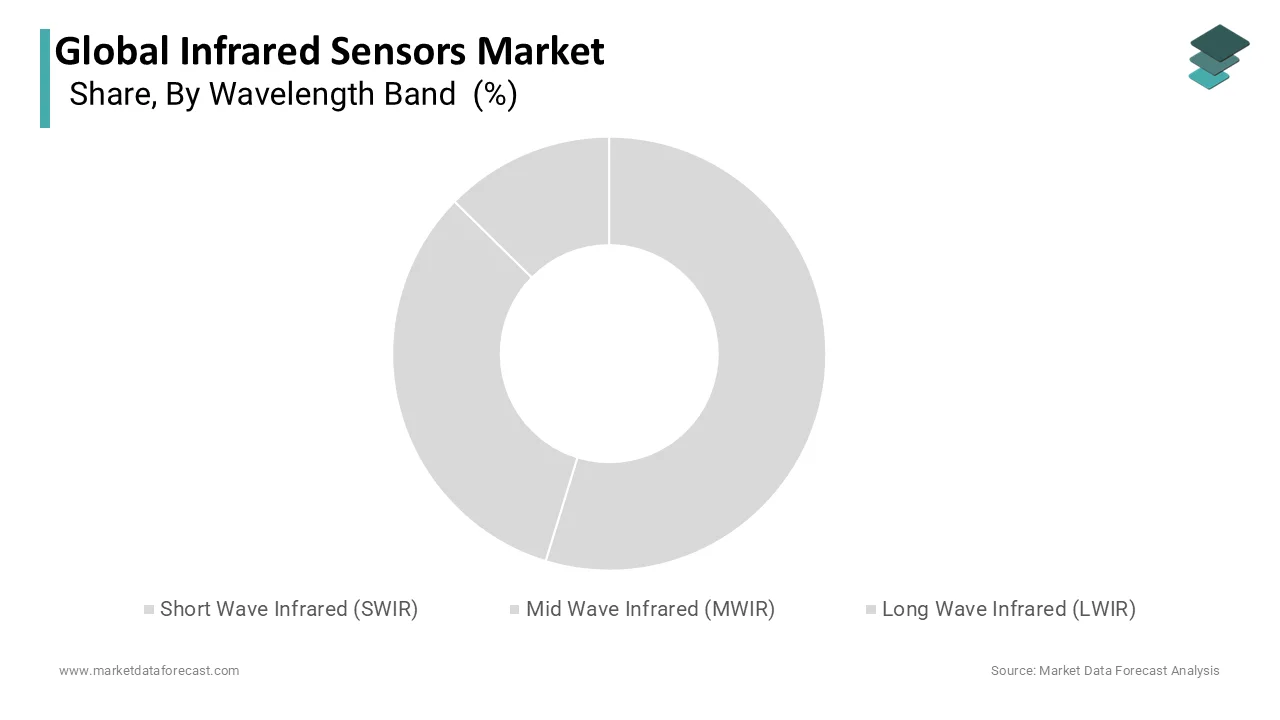
The short wave infrared technology segment is expected to witness a fastest CAGR of 12.8% from 2026 to 2034 with the unique ability of Short Wave Infrared wavelengths between 0.9 and 1.7 micrometers to penetrate certain materials and provide high resolution imaging similar to visible light but with enhanced contrast for specific applications. The increasing adoption in semiconductor manufacturing agriculture and food processing where quality control requirements demand non-destructive testing capabilities. The technology offers superior resolution compared to Long Wave Infrared allowing detection of minute defects in silicon wafers and electronic components. As manufacturing processes become more complex and miniaturized the need for precise internal visualization drives investment in Short Wave Infrared solutions.
By Technology Insights
The uncooled detectors segment was accounted in holding a significant share of the infrared sensors market in 2025 with the significant cost and size advantages of uncooled technology compared to cooled alternatives. Uncooled microbolometers operate at ambient temperatures eliminating the need for bulky and expensive cryogenic coolers, such as Stirling engines or Joule Thomson coolers. The compact form factor of uncooled detectors enables integration into handheld devices smartphones and wearable electronics expanding the addressable market significantly. The reliability of uncooled detectors is superior for continuous operation as they have no moving parts subject to wear and tear unlike mechanical coolers which require periodic maintenance. Bosch Sensortec indicated that their automotive grade uncooled infrared sensors achieved mean time between failures exceeding 100000 hours meeting stringent automotive quality standards. The maturity of wafer level packaging techniques has further reduced manufacturing costs and improved yield rates making uncooled detectors the default choice for high volume applications.
The cooled detectors segment is likely to grow at an anticipated CAGR of 9.5% from 2026 to 2034. While lower in volume compared to uncooled sensors cooled detectors command significantly higher prices due to their superior sensitivity and speed characteristics. Cooled detectors operating at cryogenic temperatures achieve noise equivalent temperature differences below 20 millikelvin enabling detection of faint thermal signatures at long ranges. Lockheed Martin integrated cooled infrared sensors in their F 35 fighter jet distributed aperture system providing 360 degree situational awareness with unprecedented clarity. The growth is also driven by advancements in high temperature superconducting materials and miniature coolers that reduce size weight and power consumption making cooled systems more viable for unmanned aerial vehicles and portable applications.
By End User Industry Insights
The commercial buildings and smart home sector was the largest by holding 35.4% of the infrared sensors market share in 2025 owing to the widespread adoption of building automation systems and energy management solutions that utilize infrared sensors for occupancy detection temperature monitoring and security. According to the International Energy Agency buildings consume 40% of global energy making efficiency improvements a priority for property owners and regulators. Infrared sensors enable intelligent lighting and HVAC control by accurately detecting human presence and activity levels reducing energy waste in unoccupied spaces. Signify reported that their connected lighting systems using infrared occupancy sensors reduced electricity consumption by 30% in office buildings across Europe. The smart home market also contributes significantly with consumers adopting infrared enabled thermostats security cameras and appliance controls for convenience and safety. The integration of infrared sensors into building management platforms allows for data driven optimization of indoor environmental quality enhancing occupant comfort and productivity. The scalability of infrared solutions from single family homes to large commercial complexes ensures broad market applicability. Regulatory incentives for green building certifications such as LEED and BREEAM further encourage installation of advanced sensing technologies.
The oil and gas industry segment is expected to grow at an anticipated CAGR of 11.2% from 2026 to 2034 owing to the stringent safety regulations environmental compliance requirements and the need for predictive maintenance in harsh operating environments. Infrared sensors are critical for detecting gas leaks monitoring pipeline integrity and preventing fires in refineries and offshore platforms. The technology enables rapid scanning of large areas identifying leaks that are invisible to the naked eye reducing risk of explosions and environmental damage. Shell stated that their deployment of fixed mount infrared gas sensors reduced inspection time by 70%, while improving detection accuracy. Offshore platforms benefit from infrared flame and gas detection systems that operate reliably in salty humid conditions where other sensors fail. TechnipF Energies reported that their modular liquefied natural gas plants incorporate hundreds of infrared sensors for continuous process monitoring ensuring safe operation. The oil and gas companies invest in digitalization and automation to optimize remaining assets driving demand for advanced sensing solutions.
COUNTRY LEVEL ANALYSIS
North America Infrared Sensors Market Analysis
North America was the largest contributor of the global infrared sensors market by accounting for 38.3% of share in 2025 through robust industrial base advanced defense spending and early adoption of smart building technologies. United States dominates regional demand driven by strict occupational safety regulations and substantial investment in infrastructure modernization. Canada infrared sensor market growth is driven by its extensive oil and gas sector where infrared sensors are mandatory for leak detection and pipeline monitoring. North American market benefits from presence of major sensor manufacturers including Teledyne FLIR and Honeywell who drive innovation and local supply chain resilience. The region leads in integration of artificial intelligence with infrared data creating advanced analytics platforms for industrial and commercial users.
Europe Infrared Sensors Market Analysis
Europe infrared sensors market was second by holding 20.3% of share in 2025 with the stringent environmental regulations and strong industrial automation sector according to European Association of Automation and Robotics data. The European Green Deal and Fit for 55 package drive demand for energy efficiency monitoring tools, including infrared thermography for building audits and industrial process optimization. Germany leads the growth of the market with its Industry 4.0 initiative promoting smart factory technologies where infrared sensors monitor machine health and product quality. Siemens and Bosch headquartering in Germany drive local innovation and export of advanced thermal sensing solutions. France implements strict methane emission regulations for oil and gas operators requiring regular infrared inspections creating steady demand. United Kingdom focuses on building retrofit programs funded by government grants utilizing infrared cameras to identify thermal inefficiencies in housing stock.
Asia Pacific Infrared Sensors Market Analysis
Asia Pacific infrared sensors market is esteemed to have a prominent growth opportunity in coming years. China dominates regional volume driven by massive manufacturing base and government support for semiconductor and electronics industries. Ministry of Industry and Information Technology stated that China produced 60% of global consumer electronics in 2024 requiring extensive infrared quality control and thermal management solutions. India emerging market shows rapid growth in infrastructure development where infrared sensors monitor power grids and railway tracks for preventive maintenance. Japan and South Korea lead in technological innovation developing advanced cooled detectors for automotive and robotics applications. Sony and Samsung invest heavily in miniaturized infrared sensors for smartphones and wearables expanding consumer market. Southeast Asian countries including Vietnam and Thailand attract manufacturing relocation increasing demand for industrial automation sensors.
Latin America Infrared Sensors Market Analysis
Latin America infrared sensors market growth is likely to have steady growth in next coming years. Brazil leads regional demand driven by its large agricultural and mining sectors where infrared sensors monitor crop health and equipment temperature. Chile and Peru utilize infrared sensors for mining safety monitoring detecting overheating in conveyor belts and crushers to prevent fires. Argentina faces economic challenges but maintains demand for infrared thermography in energy sector for pipeline and refinery maintenance. Lack of local manufacturing capacity results in reliance on imports from North America and Asia creating supply chain vulnerabilities. Government infrastructure projects in transportation and energy provide intermittent demand spikes. Digital literacy gaps slow adoption of advanced analytics features limiting market to basic sensing applications. However, increasing awareness of safety and efficiency benefits drives gradual market expansion. Local distributors partner with global brands to provide training and support overcoming technical barriers.
Middle East and Africa Infrared Sensors Market Analysis
Middle East and Africa infrared sensors market growth is driven by the oil and gas and security sectors. Saudi Arabia and United Arab Emirates lead regional spending driven by mega projects and energy infrastructure modernization. UAE focuses on smart city initiatives in Dubai and Abu Dhabi utilizing infrared sensors for building energy management and traffic monitoring. Qatar employs infrared technology for liquefied natural gas facility safety ensuring compliance with international standards. Anglo American Platinum reported using infrared sensors for conveyor belt monitoring reducing fire risks in deep level mines. Nigeria oil and gas sector utilizes handheld infrared cameras for leak detection though adoption limited by cost and expertise gaps. Political instability in some countries creates deployment risks yet critical infrastructure protection drives consistent demand. Limited local technical support necessitates reliance on international vendors for maintenance and calibration.
COMPETITIVE LANDSCAPE
The competition in the infrared sensors market is characterized by intense rivalry among established multinational corporations and emerging specialized firms focusing on niche applications. Market leaders leverage their extensive research and development capabilities to maintain technological superiority in detector materials and readout integrated circuit design. The barrier to entry remains high due to complex fabrication processes and significant capital requirements for clean room facilities. However, new entrants are disrupting the landscape by offering cost effective uncooled sensors for consumer and commercial use. Companies compete on total cost of ownership providing integrated solutions that combine sensors with cloud platforms and artificial intelligence tools. Strategic alliances with semiconductor foundries ensure secure supply of critical components amidst global shortages. Price competition intensifies in the mass market segment while performance and reliability remain key differentiators in defense and industrial sectors.
KEY MARKET PLAYERS
Some of the companies that are playing a dominating role in the Global Infrared Sensors Market include
- Texas Instruments Incorporated
- Honeywell International Inc.
- InfraTec GmbH
- FLIR Systems, Inc. (Teledyne FLIR)
- Excelitas Technologies Corp.
- Teledyne Technologies Incorporated
- Hamamatsu Photonics K.K.
- Murata Manufacturing Co., Ltd.
- Nippon Avionics Co., Ltd.
- Raytheon Technologies Corporation (RTX Corporation)
TOP LEADING PLAYERS IN THE MARKET
- Teledyne Technologies maintains a dominant position through its comprehensive portfolio of high performance cooled and uncooled infrared detectors. The company actively invests in research and development to enhance sensor sensitivity and resolution for defense and scientific applications. Recent strategic acquisitions have expanded their capabilities in specialized materials and packaging technologies. Teledyne focuses on delivering customized solutions for aerospace and industrial monitoring sectors. Their continuous innovation in mercury cadmium telluride and indium antimonide detectors ensures superior thermal imaging performance. The company collaborates with government agencies to develop next generation surveillance systems.
- FLIR Systems a brand under Teledyne leverages extensive distribution networks to deliver innovative thermal imaging solutions across diverse industries. The company prioritizes miniaturization efforts enabling integration of infrared sensors into consumer electronics and automotive systems. FLIR develops proprietary software platforms that enhance data analytics and predictive maintenance capabilities. Their recent product launches focus on handheld devices for electrical and mechanical inspections. The company emphasizes user friendly interfaces to broaden adoption among non technical users. FLIR collaborates with original equipment manufacturers to embed thermal sensors in smart home devices. They actively participate in standard setting organizations to influence industry regulations.
- Honeywell International utilizes its broad industrial expertise to integrate infrared sensors into comprehensive building management and safety systems. The company focuses on developing ruggedized sensors for harsh environments including oil and gas facilities. Honeywell invests heavily in artificial intelligence algorithms to improve anomaly detection accuracy. Their recent initiatives include wireless sensor networks for real time temperature monitoring. The company partners with cloud platform providers to offer scalable data storage and analysis solutions. Honeywell emphasizes energy efficiency applications helping clients reduce carbon footprints. Their fixed mount gas detection systems utilize infrared technology for reliable leak identification.
TOP STRATEGIES USED BY KEY MARKET PARTICIPANTS
Key players in the infrared sensors market primarily focus on strategic mergers and acquisitions to expand their technological portfolios and geographic reach. Companies actively invest in research and development to enhance detector sensitivity and reduce manufacturing costs through wafer level packaging innovations. Partnerships with original equipment manufacturers enable integration of infrared sensors into consumer electronics and automotive platforms driving volume growth. Firms also prioritize software development to provide advanced analytics and predictive maintenance capabilities adding value beyond hardware sales. Diversification into emerging applications such as autonomous driving and healthcare monitoring helps mitigate reliance on traditional defense sectors. Cost leadership strategies involve optimizing supply chains and localizing production to counter raw material volatility. Customer centric approaches include offering customized solutions and comprehensive training programs to facilitate adoption in industrial settings.
GLOBAL INFRARED SENSORS MARKET NEWS
-
Honeywell International Inc. [HON] stock additionally went down by -1.28% within the period of the seven days, recording a drop in performance by -5.24% within the last 30 days. The yearly more of HON stock is about at 18.39% by far, with shares price recording returns by -0.82% within the latest quarter. Over the past six months, HON shares showcased a 1.97% increase.
-
As of a 29, 2025, by applying its unique micro-electromechanical systems (MEMS) technology, Hamamatsu Photonics has successfully created a Fourier transform infrared spectrometer (FTIR) engine C15511-01", which is of a palm-size and offers high sensitivity to near-infrared light at wavelengths from 1.1 to 2.5 micrometers. This FTIR engine will play a vital role in creating portable handheld FTIR spectrophotometers for analytical applications, including real-time tracking of chemicals on production lines and ingredient analysis of agricultural products within the sector. Hamamatsu Photonics will start accepting product orders from analytical instrument manufacturers from Monday, February 3rd, 2020.
MARKET SEGMENTATION
This research report on the infrared sensors market is segmented and sub-segmented into the following categories.
By Wavelength Band
- Short Wave Infrared (SWIR)
- Mid Wave Infrared (MWIR)
- Long Wave Infrared (LWIR)
By Technology
- Uncooled Detectors
- Cooled Detectors
By End User Industry
- Commercial Buildings & Smart Homes
- Oil & Gas
- Automotive
- Healthcare
- Aerospace & Defense
- Industrial Manufacturing
- Others
By Country
- North America
- Europe
- Asia Pacific
- Latin America
- Middle East & Africa
Access the study in MULTIPLE FORMATS
Purchase options starting from
$ 2500
Didn’t find what you’re looking for?
TALK TO OUR ANALYST TEAM
Need something within your budget?
NO WORRIES! WE GOT YOU COVERED!
Call us on: +1 888 702 9696 (U.S Toll Free)
Write to us: sales@marketdataforecast.com