- Product Description Description
- Table of Contents TOC
- List of Table & Figure LOT
- Get Free Sample PDF Sample PDF
Market Size, 2025
$89.70 BnMarket Estimate, 2026
$110.51 BnMarket Forecast, 2034
$586.53 BnCAGR, 2026–2034
23.2%Global Infrastructure as a Service (IaaS) Market Size, Growth, Trends & Forecast (2026-2034)
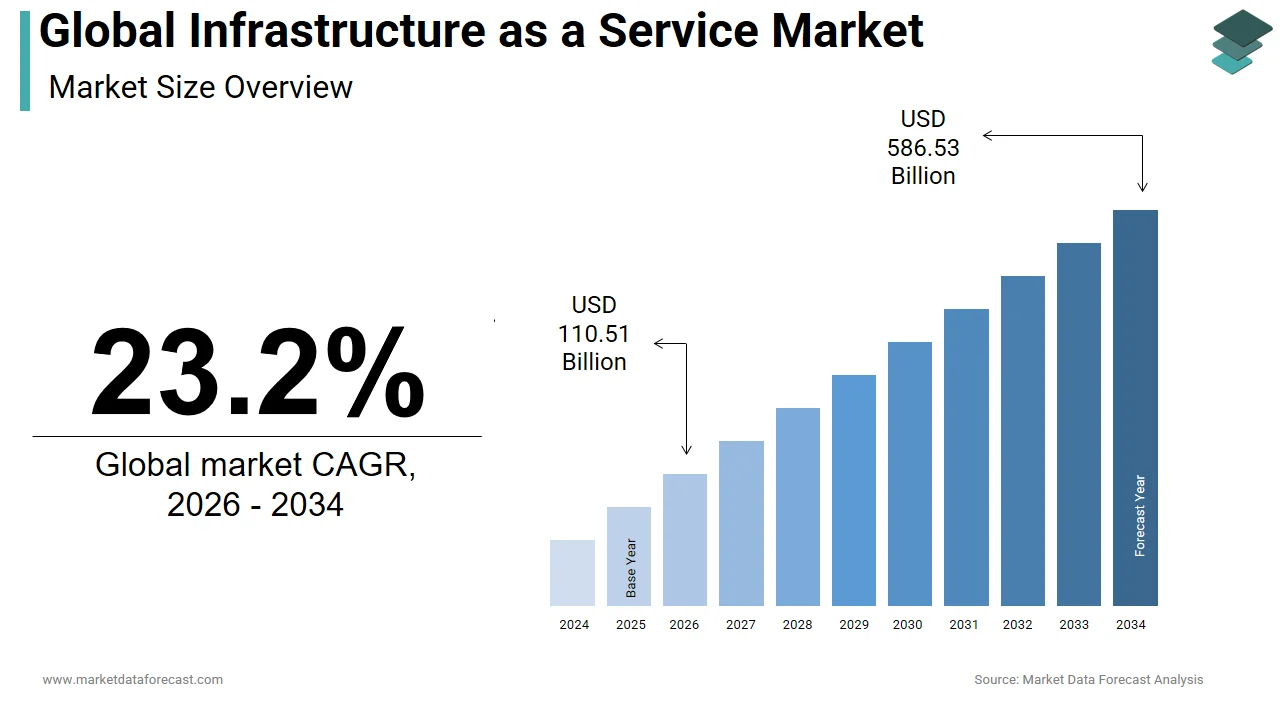
The global infrastructure as a service (IaaS) market was valued at USD 89.70 billion in 2025, is anticipated to reach USD 110.51 billion in 2026, and is projected to scale up to USD 586.53 billion by 2034, registering a compound annual growth rate (CAGR) of 23.2% during the forecast period from 2026 to 2034. Driven by surging enterprise cloud migration, rising demand for cost-effective computing and storage resources among small and medium-sized businesses (SMBs), and widespread organizational digitalization, the market continues to expand aggressively worldwide.
Key Executive Metrics (At-a-Glance)
- 2025 Base Valuation: USD 89.70 Billion
- 2026 Current Valuation: USD 110.51 Billion
- 2034 Forecast Valuation: USD 586.53 Billion
- Compound Annual Growth Rate (CAGR): 23.2% (2026-2034)
- Dominant Solution Segment: Storage as a Service (holding major market share and remaining dominant through the forecast period)
- Dominant Deployment Type: Private Cloud (capturing the largest share due to enhanced security and control requirements)
- Dominant End-User Segment: SMBs (leveraging IaaS to gain enterprise-level computing capabilities while reducing IT and operational overhead)
- Dominant Vertical Segment: IT and Telecom (led by high volumes of business data and stringent security needs)
- Dominant Region: North America (accounting for the major share backed by major IaaS vendors in the US and Canada)
- Second Largest Region: Asia Pacific (growing rapidly owing to accelerated digitalization, internet adoption, and smart device usage)
Core Market Drivers
- SMB Cloud Adoption: Increasing demand from SMBs for scalable, enterprise-level computing resources without the heavy capital expenditure of building physical on-premise data centers.
- Digital Transformation & Cost Reduction: Broad organizational shift toward digital workflows, aiming to lower IT management burdens, decrease capital outlay, and avoid hiring large specialized maintenance teams.
- Government Initiatives & Tech Advancements: Favorable public policies encouraging internet penetration and advanced technologies alongside rapid improvements in scalability, flexibility, and high-performance computing.
Primary Market Restraints & Challenges
- Security & Privacy Concerns: Data protection worries regarding private cloud environments, stringent compliance regulations, and lingering gaps in standardized security frameworks.
Global IaaS Market Segmentation Breakdown
| Segment Category | Leading Sub-Segment | Growth & Trend Highlights |
|---|---|---|
| By Solution | Storage as a Service | Colocation, network management, managed hosting, DRaaS, and content delivery follow closely. |
| By Deployment Type | Private Cloud | Public cloud and hybrid cloud deployments provide flexible scaling alternatives. |
| By End-User | SMBs | Large enterprises also drive substantial public and hybrid cloud infrastructure investments. |
| By Vertical | IT and Telecom | BFSI, healthcare, retail & e-commerce, government & defense, energy, and manufacturing round out adoption. |
| By Region | North America | Asia Pacific is the second largest market, while Europe expands via cost-conscious SMB adoption. |
Major Industry Players Profiled
Key global technology giants and cloud service providers shaping the infrastructure as a service market include Amazon Web Services, Inc. (AWS), Microsoft Corporation, Google LLC, International Business Machines Corporation (IBM), Oracle Corporation, Alibaba Group Holding Limited, Hewlett Packard Enterprise (HPE), Dell EMC, Rackspace Hosting, Inc., Red Hat, Inc., and Redcentric plc.
 Download Free Sample Report
Global Infrastructure As A Service Market Size
The infrastructure as a service market was worth USD 89.70 billion in 2025. The global market is predicted to be USD 110.51 billion in 2026, which is expected to increase to USD 586.53 billion by 2034 with a compound annual growth rate of 23.2% during the forecast period.
It is a cloud computing service where the enterprise lease servers for computing and storage in the cloud. These online services offer high-level APIs such as physical computing resources, location, security and backup, scaling, and data partitioning. By infrastructure as a service, the users can run any type of operating system or application on the leased servers without these servers' operating and maintenance costs.
MARKET DRIVERS
Increasing demand from an increasing number of SMBs, need to deploy enterprise level computing capabilities to compete in the market is one of the major driving factors of infrastructure as a Service market growth rate.
Another major driving factor of the infrastructure as a Service market was increasing digitization among the organizations and economies propels the growth of revenue of infrastructure as a Services market.
Increasing government initiatives to encourage the adoption of the internet and other advanced technologies in the developed economies are some of the growth-supporting factors of the infrastructure market as a Service revenue rate. Another major growth driving factor of the infrastructure as a Service market was the increasing demand for organizations to reduce the IT burden and lower the costs incurred in deploying centers and hiring skilled resources to manage the IT infrastructures.
Technological advancements, ease of deployment, flexibility, scalability of services, an increasing amount of financial and business information, and other critical data in various IT sectors are also some of the major driving factors which promote the growth of the market of infrastructure as a Service revenue rate during the forecast period.
MARKET RESTRAINTS
Data and privacy concerns over the private cloud, deployment is one of the major restraints that hinder the infrastructure's growth as a Service Market. Stringent government regulations are also one of the major restraints that hinder the infrastructure's growth as a Service Market. Another major restraint that affects the growth of the market was the lack of security standards.
REPORT COVERAGE
| REPORT METRIC | DETAILS |
| Market Size Available | 2025 to 2034 |
| Base Year | 2025 |
| Forecast Period | 2026 to 2034 |
| CAGR | 23.2% |
| Segments Covered | By Solution, Deployment Type, End User, Vertical, and Region. |
|
Various Analyses Covered | Global, Regional & Country Level Analysis, Segment-Level Analysis, DROC, PESTLE Analysis, Porter’s Five Forces Analysis, Competitive Landscape, Analyst Overview on Investment Opportunities |
| Regions Covered | North America, Europe, APAC, Latin America, Middle East & Africa |
|
Market Leaders Profiled | International Business Machines Corporation, Microsoft Corporation, Oracle Corporation, Amazon Web Services, Inc., Alibaba Group Holding Limited, Dell EMC, Google LLC, Rackspace Hosting, Inc., Red Hat, Inc., Redcentricplc., and Hewlett Packard Enterprise and Others. |
SEGMENTAL ANALYSIS
By Solution Insights
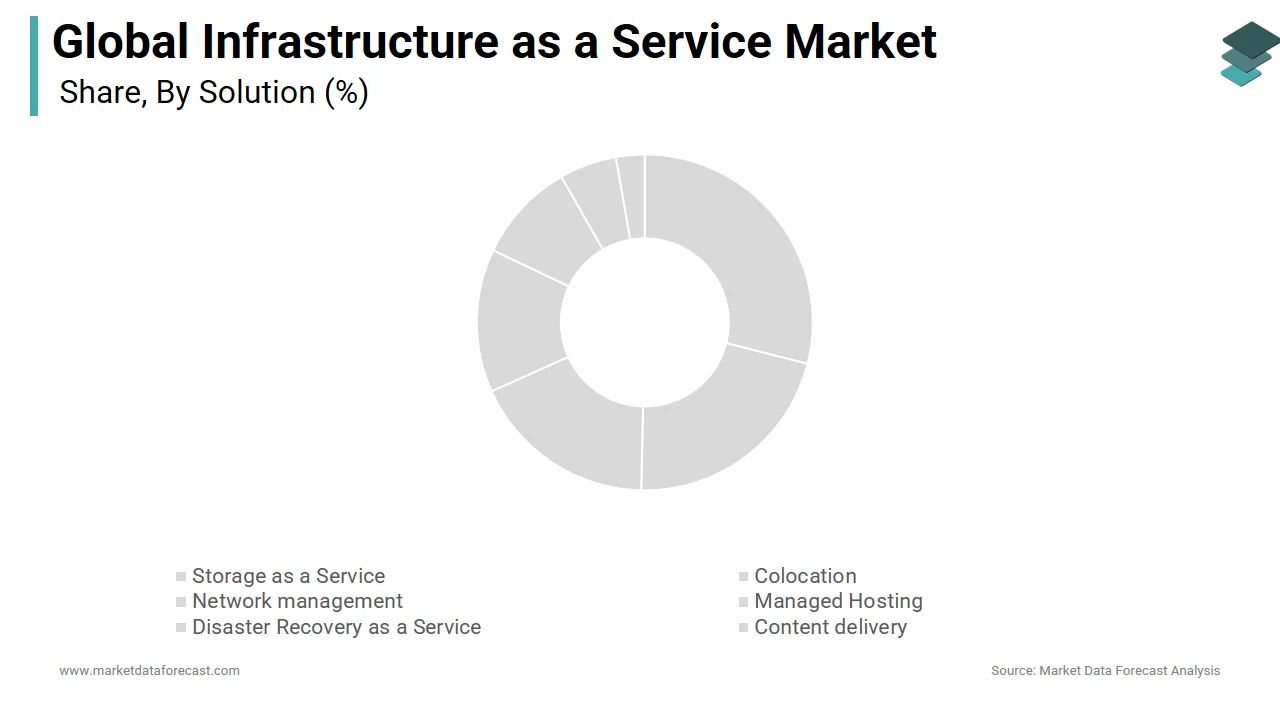
The storage as a service solution segment holds the major share of the market among the others and is expected to hold dominance during the forecast period.
By Deployment Type Insights
The private cloud deployment type segment holds the major share of the market and is expected to hold dominance during the forecast period.
By End-User Insights
the SMBs segment holds the major share of the market since these technologies are supported by IaaS solutions which allow the users to connect from any location and providing many benefits such as increased productivity, reduced IT, operational costs.
By Vertical Insights
The infrastructure as a Service market is segmented into IT and telecom, Banking, Financial Services and Insurance, Healthcare, retail and e-commerce, government and defense, energy and utilities, manufacturing, and other verticals. Among these segments, the IT and telecom segment holds the major share of the market due to the increased volume of business data in such verticals and the concerns related to security.
REGIONAL ANALYSIS
North America region holds the major share of the market due to the factors such as the existence of major infrastructure as a service vendor in developing economies such as the United States, and Canada helps the growth of the market of infrastructure as a Services in North America region. Furthermore, increasing investments by the major key players across the region is also one of the major driving factors that propel the growth of the infrastructure market as a service in the North American region. Therefore, this North American region is expected to hold dominance during the forecast period.
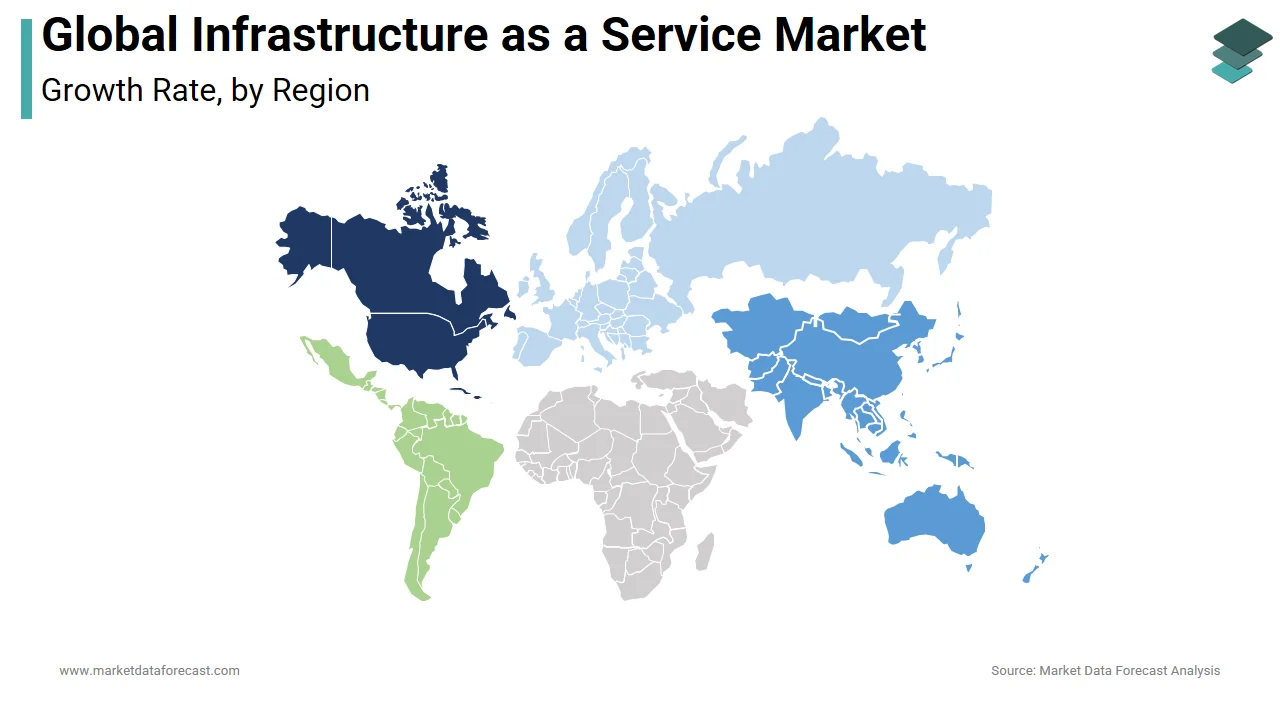
Asia Pacific region holds the second-largest share of the infrastructure market as a Service owing to the increasing of digitalization trends, adoption of the internet, and increasing adoption of smart devices, which is helping the market of infrastructure as a Service to grow further in Asia Pacific region.
Europe region is expected to increase the market value of infrastructure as a Services owing to the increasing number of SMBs demanding enterprise-level computing capabilities at low cost propels the growth of the market in the Europe region.
KEY MARKET PLAYERS
Some of the key market players of infrastructure as a Service market are International Business Machines Corporation, Microsoft Corporation, Oracle Corporation, Amazon Web Services, Inc., Alibaba Group Holding Limited, Dell EMC, Google LLC, Rackspace Hosting, Inc., Red Hat, Inc., Redcentricplc., and Hewlett Packard Enterprise.
MARKET SEGMENTATION
The global infrastructure as a service market is segmented on the basis of solution, deployment type, end-user, vertical, and region.
By Solution
- Storage as a Service
- Colocation
- Network management
- Managed Hosting
- Disaster Recovery as a Service
- Content delivery
- High-Performance Computing as a Service
By Deployment Type
- public cloud
- private cloud
- hybrid cloud
By End-user
- SMBs
- enterprises
By Vertical
- IT and telecom
- Banking, Financial Services, and Insurance
- Healthcare
- retail and e-commerce
- government and defense
- energy and utilities
- manufacturing
By Region
- North America
- Europe
- Asia-Pacific
- Latin America
- The Middle East and Africa