- Product Description Description
- Table of Contents TOC
- List of Table & Figure LOT
- Get Free Sample PDF Sample PDF
Market Size, 2025
$701.14 BnMarket Estimate, 2026
$795.44 BnMarket Forecast, 2034
$2182 BnCAGR, 2026–2034
13.45%Executive Summary: Global Integrated Circuit Market
- Market Scope: Comprehensive global assessment of the integrated circuit (IC) market, evaluating product types (logic, memory, micro, analog), major application verticals, and country-level metrics across North America, Europe, Asia Pacific, Latin America, and the Middle East & Africa.
- Market Valuation: Valued at USD 701.14 billion in 2025, estimated at USD 795.44 billion in 2026, and projected to reach USD 2,182.96 billion by 2034, registering a robust compound annual growth rate (CAGR) of 13.45% from 2026 to 2034.
- Primary Growth Drivers: Exponential rise in artificial intelligence (AI) and high-performance computing (HPC) architectures, widespread expansion of automotive electronics and ADAS, and growing demand for advanced semiconductor packaging technologies.
Key Market Segment Metrics (2026–2034)
| Category | Leading Segment Position | Fastest-Growing / Key Growth Segment |
|---|---|---|
| By Product Type | Logic ICs (captured 38.7% of total market revenue in 2025, driven by data center infrastructure and high-performance AI processors) | Memory ICs (projected to expand at a leading CAGR of 14.2% through 2033, fueled by data generation and HBM3E requirements) |
| By Application | Cellphones & Tablets (represented 32.4% of total IC demand in 2025 due to massive device shipments and rising semiconductor content per unit) | Servers (expanding at the fastest rate with a 16.8% CAGR, fueled by generative AI workloads and hyperscale data center expansions) |
| By Region | Asia Pacific (commanded 61.3% of global manufacturing capacity in 2024, anchored by advanced foundries in Taiwan and South Korea) | North America (leads in high-value IC design, innovation architecture, and domestic fabrication incentives via the CHIPS Act) |
Major Market Players & Market Structure
Market Structure: Highly consolidated and technologically polarized global landscape characterized by extreme barriers to entry, advanced node process leadership (sub-3nm), and regional supply chain localization efforts.
Key Companies: Taiwan Semiconductor Manufacturing Company (TSMC), Samsung Electronics, Intel Corporation, Qualcomm Technologies, Inc., NVIDIA, SK Hynix, Texas Instruments, Micron Technology, Inc., and Broadcom (Avago Technologies).
 Download Free Sample Report
Global Integrated Circuit Market Size
The global integrated circuit market size will reach USD 701.14 billion in 2025 and is anticipated to reach USD 795.44 billion in 2026 to reach USD 2182.96 billion by 2034, growing at a CAGR of 13.45% during the forecast period from 2026 to 2034.
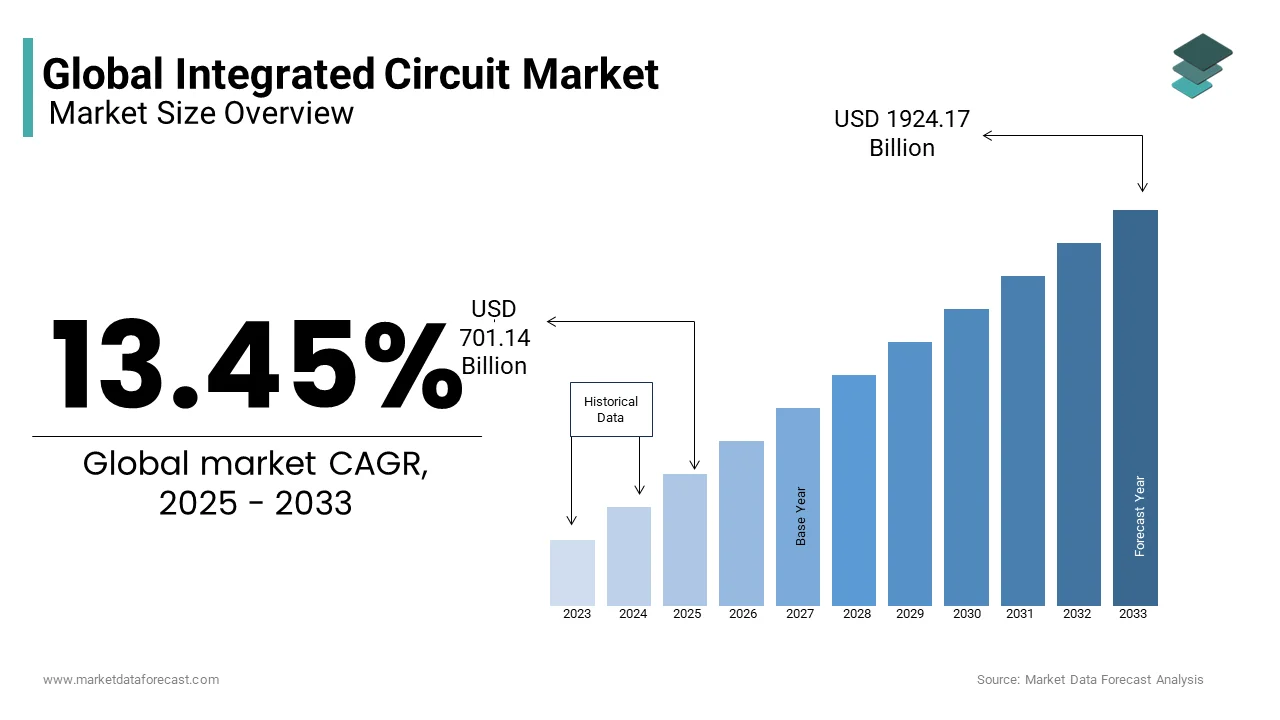
Integrated circuits ICs) are miniaturized electronic circuits embedded on semiconductor substrates, primarily silicon, serving as the foundational components for computing, communication, automation, and consumer electronics. These microchips integrate transistors, resistors, and capacitors into a single chip, enabling complex functionalities in compact form factors. As per the Semiconductor Industry Association (SIA), over 1.5 trillion semiconductor devices were shipped globally in 2023, with integrated circuits representing the vast majority of overall volume. Also, Data centers account for a notable share of global electricity use, with server infrastructure powered by ICs serving as a major contributor. Furthermore, the smartphone contains highly advanced and multifunctional integrated circuits managing functions from signal processing to biometric authentication. This pervasive integration into critical systems illustrates the IC market’s centrality to technological advancement and industrial resilience.
MARKET DRIVERS
Proliferation of Artificial Intelligence and High-Performance Computing Architectures
The surge in artificial intelligence (AI) adoption across industries has become a primary catalyst for advanced integrated circuit demand, particularly in data centers and edge computing systems. As per the Stanford Institute for Human-Centered Artificial Intelligence (HAI), global AI training models increased in computational complexity by 310 times between 2018 and 2023, necessitating specialized ICs such as GPUs, TPUs, and AI accelerators. NVIDIA pointed out in 2023 that its data center segment, driven by AI-optimized chips like the H100 GPU, experienced a 200% year-on-year revenue increase, reflecting the escalating hardware demands of large language models and deep learning frameworks. Additionally, Hyperscale data centers rely on massive deployments of specialized AI chips, each with very high power requirements, underscoring the shift toward performance-intensive IC architectures. This shift toward parallel processing and low-latency inference is driving foundries like TSMC to prioritize 3nm and 2nm node production, as conventional logic chips can no longer meet performance thresholds, fundamentally reshaping IC design and manufacturing priorities.
Expansion of Automotive Electronics and Advanced Driver Assistance Systems (ADAS)
Modern vehicles are evolving into mobile computing platforms, significantly increasing the number and complexity of integrated circuits required per unit. Also, premium vehicles today integrate thousands of chips, covering functions from engine control to advanced driver assistance. The rise of ADAS technologies, such as adaptive cruise control, lane-keeping assist, and automated emergency braking, relies heavily on sensor fusion processors, radar ICs, and vision chips. A significant share of newly sold vehicles now include Level 2 driver assistance features, which depend on multiple dedicated ICs for real-time sensing and control. Moreover, the transition to electric vehicles (EVs) intensifies demand for power management ICs, with each EV containing nearly 2.5 times more semiconductor content than internal combustion engine vehicles, as per McKinsey & Company. This transformation positions the automotive sector as one of the fastest-growing end markets for specialized ICs, particularly those designed for functional safety and high-temperature resilience.
MARKET RESTRAINT
Geopolitical Fragmentation and Export Control Regulations on Semiconductor Technologies
The increasing imposition of technology-specific trade restrictions, particularly between the U.S., China, and allied nations, is a critical impediment to the global integrated circuit market. As per the U.S. Bureau of Industry and Security, export controls introduced in October 2022 restrict the sale of advanced ICs with logic nodes below 16nm and memory chips with 18-layer NAND or higher to Chinese entities, directly affecting over $40 billion in annual semiconductor trade. These regulations have disrupted supply chains, forcing multinational firms to reconfigure design and fabrication strategies. The Netherlands and Japan have since aligned with these controls, limiting access to extreme ultraviolet (EUV) lithography tools essential for sub-7nm production. Also, domestic semiconductor manufacturing in certain countries lags behind global leaders due to restricted access to advanced fabrication technologies, creating a competitive and innovation gap. This geopolitical decoupling not only slows innovation diffusion but also fragments global R&D efforts, undermining economies of scale and increasing development costs across the IC ecosystem.
Escalating Costs and Technical Complexity of Advanced Node Fabrication
The progression toward sub-5nm semiconductor nodes has introduced unprecedented financial and engineering challenges, constraining the number of viable IC manufacturers. As per the International Technology Roadmap for Semiconductors (ITRS), the capital expenditure for a state-of-the-art 3nm fabrication plant exceeds $20 billion, with design costs for a single chip reaching $1.5 billion. Moreover, only three companies, TSMC, Samsung, and Intel, currently possess the capability to produce ICs at 3nm or below, creating oligopolistic dependencies. Additionally, physical limitations such as quantum tunneling and heat dissipation at atomic scales require innovations in materials like high-mobility channel transistors and gate-all-around (GAA) architectures, which are still in early commercialization. Early production of advanced node chips often faces lower yields and higher defect rates, which increases costs and prolongs time-to-market. These barriers limit competition and increase systemic risk in the global IC supply chain.
MARKET OPPORTUNITY
Adoption of Chiplets and Heterogeneous Integration in Next-Generation IC Design
The shift from monolithic dies to modular chiplet-based architectures, enabling performance gains without relying solely on process node scaling, is a transformative opportunity in the integrated circuit market. As per the Defense Advanced Research Projects Agency (DARPA), chiplet designs can reduce development costs by up to 40% while improving yield and thermal management. AMD’s EPYC and Ryzen processors, built using TSMC’s 5nm chiplets, demonstrate a 35% improvement in performance-per-watt compared to traditional monolithic designs, as per AnandTech’s 2023 benchmarking analysis. The U.S. CHIPS and Science Act has allocated $3.1 billion specifically for advancing heterogeneous integration technologies, recognizing their strategic importance. Furthermore, a growing proportion of next-generation data center ICs are expected to adopt modular or heterogeneous architectures to enhance performance and flexibility. This modular approach allows mixing silicon from different process nodes and vendors, accelerating innovation and enabling specialized functions like AI acceleration and secure enclaves within a single package.
Growth of Edge AI and Ultra-Low-Power ICs for IoT and Wearable Devices
The decentralization of AI processing from cloud servers to edge devices is creating robust demand for energy-efficient, application-specific integrated circuits (ASICs) optimized for real-time inference. According to the Internet of Things Journal, the number of connected edge devices surpassed 16 billion in 2023, each requiring low-power ICs capable of local data processing. Google’s Edge TPU and Apple’s Neural Engine are examples of dedicated AI ICs that perform on-device machine learning with power consumption below 2 watts. As per the University of California, Berkeley, ultra-low-power ICs using near-threshold voltage (NTV) design can operate on as little as 10 microwatts, enabling battery-free sensors powered by ambient energy harvesting. Sales growth of AI-focused microcontrollers reflects a broader industry trend toward distributed intelligence and edge computing. This trend is particularly impactful in healthcare wearables, industrial monitoring, and smart infrastructure, where latency, privacy, and power efficiency are paramount.
MARKET CHALLENGES
Vulnerability of Supply Chains to Geopolitical and Natural Disruptions
The integrated circuit market remains highly susceptible to disruptions due to its concentrated and geographically imbalanced supply chain. As per the U.S. Department of Commerce, over 90% of advanced logic ICs are manufactured in Taiwan, South Korea, and the United States, with TSMC alone producing 90% of sub-10nm chips. Natural events and resource constraints in key manufacturing hubs can significantly impact IC production and global supply. Similarly, localized events such as lockdowns can significantly delay IC distribution and impact global supply chains. This concentration creates systemic fragility, compelling governments and firms to invest in regional fabs, though such efforts face long lead times and technical hurdles.
Accelerating Obsolescence and Shortened Product Lifecycles in Consumer Electronics
The rapid pace of innovation in consumer electronics is compressing IC product lifecycles, increasing pressure on design, validation, and inventory management. As per the Consumer Technology Association, the average lifespan of a smartphone has decreased to 2.8 years in 2023, down from 4.1 years in 2015, forcing IC suppliers to accelerate development cycles. Apple’s A-series chips, for instance, undergo a complete architectural redesign every 12 to 18 months, requiring foundries to reallocate capacity frequently. Accelerated obsolescence of electronics contributes to large volumes of e-waste, with ICs being a major component. This trend not only strains R&D resources but also raises sustainability concerns, as recycling technologies for multi-die ICs remain underdeveloped. Manufacturers must now balance performance innovation with lifecycle durability, a challenge exacerbated by competitive market dynamics and consumer expectations for continuous upgrades.
REPORT COVERAGE
| REPORT METRIC | DETAILS |
| Market Size Available | 2025 to 2034 |
| Base Year | 2025 |
| Forecast Period | 2026 to 2034 |
| CAGR | 13.45% |
| Segments Covered | By Product, Application, and Region |
| Various Analyses Covered | Global, Regional & Country Level Analysis, Segment-Level Analysis, DROC, PESTLE Analysis, Porter’s Five Forces Analysis, Competitive Landscape, Analyst Overview on Investment Opportunities |
| Regions Covered | North America, Europe, APAC, Latin America, Middle East & Africa |
| Market Leaders Profiled | SAMSUNG (Suwon-si, South Korea), Intel Corporation (California, U.S.), Qualcomm Technologies, Inc. (California, U.S.), Toshiba Electronic Devices & Storage Corporation (Tokyo, Japan), Texas Instruments (Texas, U.S.), AMI Semiconductor (Idaho, U.S.), SK Hynix (Gyeonggi-do, South Korea), NVIDIA (California, U.S.), Micron Technology, Inc. (Idaho, U.S.), Avago Technologies (Broadcom) (California, U.S.) |
SEGMENTAL ANALYSIS
By Product Insights
The logic IC segment led the global integrated circuit market by capturing 38.7% of total revenue in 2025. This dominance is primarily driven by the escalating demand for high-performance computing and artificial intelligence processing. Logic ICs are energy-intensive components, driving the majority of power consumption in modern data center infrastructure. The proliferation of large language models has intensified computational requirements; OpenAI’s GPT-4 inference operations require a significant number of logic-intensive GPU cores per query batch. Furthermore, TSMC disclosed in 2023 that 75% of its 5nm and 3nm wafer capacity is allocated to logic ICs for clients like NVIDIA, AMD, and Apple. The shift toward parallel processing architectures and domain-specific accelerators has cemented logic ICs as the technological backbone of modern digital infrastructure, reinforcing their market leadership.
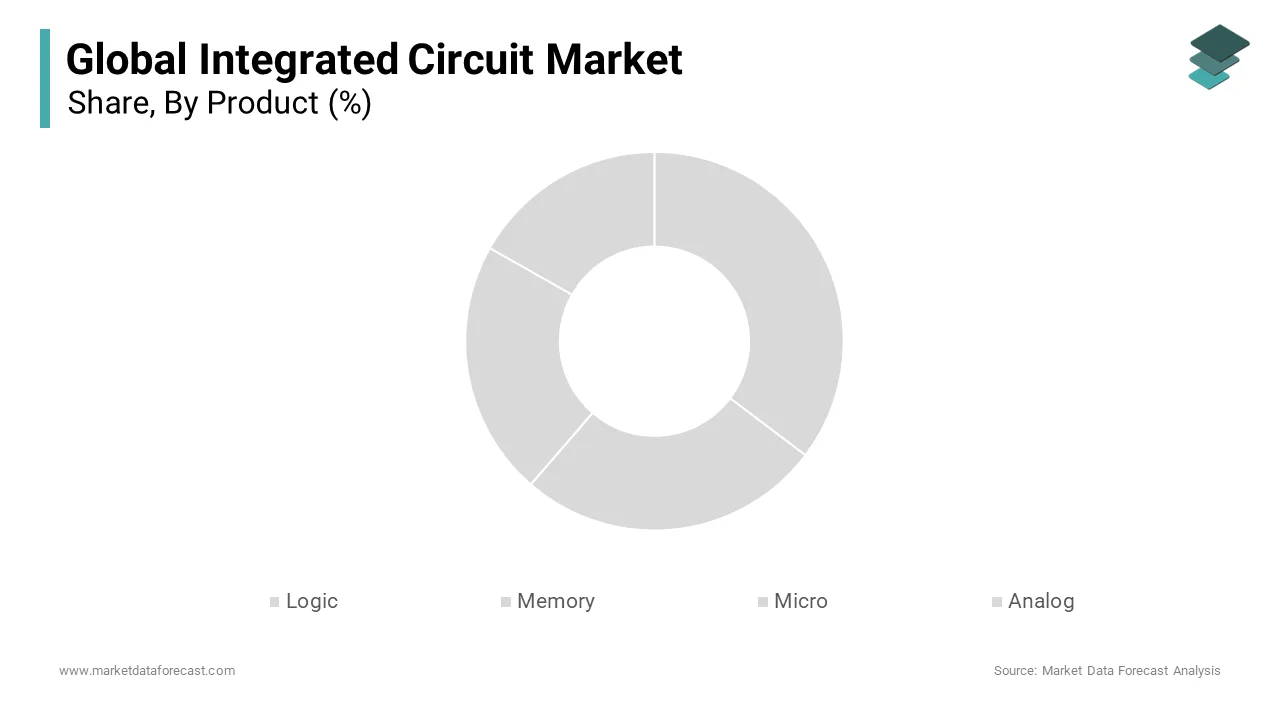
The memory IC segment is the fastest-growing category and is projected to expand at a CAGR of 14.2% from 2025 to 2033. This acceleration is fueled by the exponential growth of data generation and the need for high-speed, high-capacity storage in cloud and edge environments. As per Cisco’s Annual Internet Report, global IP traffic reached 4.8 zettabytes per year in 2023, necessitating vast memory resources in servers and networking equipment. DRAM and NAND flash shipments have surged accordingly; global DRAM bit demand grew, outpacing supply. Additionally, AI training workloads are exceptionally memory-intensive. Meta’s Llama 2 model required 700GB of GPU memory per training run, as documented in its technical whitepaper. The integration of high-bandwidth memory (HBM3E) in AI chips, with bandwidth exceeding 1.2 terabytes per second, has further intensified demand. With data creation doubling every two years, memory ICs are becoming indispensable, driving investment in advanced packaging and 3D-stacked architectures.
By Application Insights
The cellphones and tablets segment dominated the integrated circuit market by application and represented 32.4% of total IC demand in 2025. This lead position is due to the sheer volume of mobile device shipments and the increasing semiconductor content per unit. According to the International Telecommunication Union, over 1.4 billion smartphones were shipped globally in 2023, each incorporating an average of 168 integrated circuits for functions ranging from baseband processing to image signal enhancement. Premium mobile devices increasingly combine a high number of specialized ICs, highlighting design complexity and content per unit. Moreover, 5G adoption has significantly increased IC complexity; Qualcomm reports that 5G-enabled smartphones require 2.3 times more RF and power management ICs than 4G models. The convergence of AI, multi-lens cameras, and augmented reality in mobile platforms continues to expand IC density, ensuring sustained dominance in the application landscape.
The servers segment is expanding at the fastest rate, with a projected CAGR of 16.8% during the forecast period. This surge is directly linked to the rise of generative AI, cloud computing, and hyperscale data centers. Like, global data center investments have been substantial in recent years, with a major share allocated to AI-optimized infrastructure. High-density server systems require thousands of ICs per rack, reflecting rising computational demands. NVIDIA’s DGX H100 systems, for example, integrate 32 H100 GPUs per rack, each consuming 700 watts and requiring advanced thermal and power ICs. IC-intensive servers significantly contribute to rising data center energy consumption. With enterprises and governments rapidly deploying AI workloads, server-grade ICs are experiencing unprecedented demand, particularly for 3nm logic and HBM3 memory, reshaping global foundry priorities.
REGIONAL ANALYSIS
Asia Pacific Market Analysis
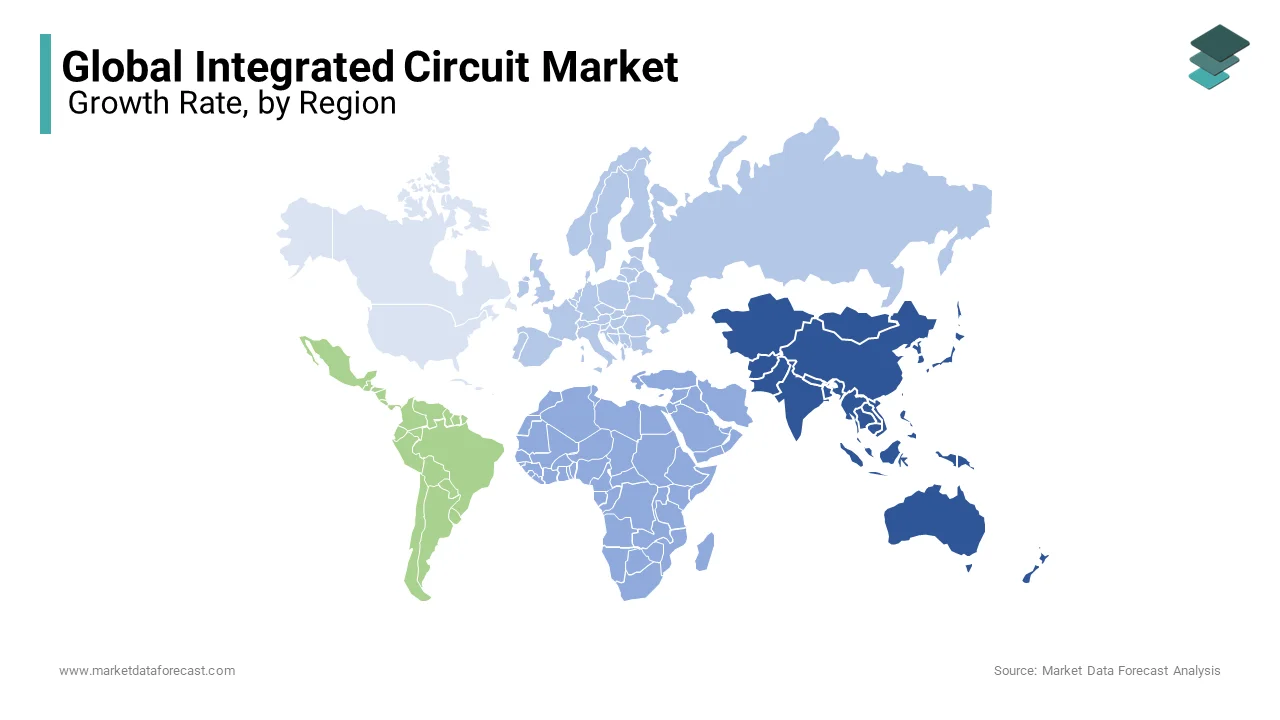
Asia Pacific stood as the dominant force in the global integrated circuit market by commanding 61.3% of total semiconductor manufacturing capacity in 2024. The region’s supremacy is anchored in its concentration of advanced fabrication facilities and end-market electronics production. Taiwan Semiconductor Manufacturing Company (TSMC) alone accounts for 56% of global foundry revenue, with its 3nm and 2nm fabs in Hsinchu and Tainan setting the pace for process innovation. South Korea hosts Samsung and SK Hynix, which together produce over 70% of the world’s DRAM and NAND flash memory, as confirmed by the Korea Electronics Association. China has rapidly expanded its IC design and packaging capabilities, with a year-on-year increase in domestic chip production in 2023. Japan remains a leader in analog and sensor ICs, supplying critical components to automotive and industrial sectors. The region’s integrated ecosystem, from materials to assembly, ensures its central role in global IC supply chains.
North America Market Analysis
North America holds a strategic lead position in IC design and innovation. While the region accounts for only 12% of global wafer fabrication capacity, it dominates in high-value design and architecture development. U.S.-based firms such as NVIDIA, AMD, and Intel are at the forefront of AI, data center, and processor innovation, with NVIDIA’s AI-focused revenue surpassing $40 billion in 2023. The U.S. emphasizes that several advanced military and aerospace ICs originate from American design houses. The CHIPS and Science Act has catalyzed a resurgence in domestic manufacturing, committing $39 billion in incentives to expand fabrication, including Intel’s $20 billion facility in Ohio. Additionally, North America maintains technological leadership via strong research and academic contributions to semiconductors.
Europe Market Analysis
Europe maintains a specialized and technologically advanced presence in the IC market. The region excels in automotive, industrial, and power management ICs, driven by German, French, and Dutch engineering excellence. European IC firms dominate the automotive microcontroller segment, reflecting regional industrial expertise. The Netherlands is home to ASML, the sole producer of extreme ultraviolet (EUV) lithography machines, which are indispensable for sub-7nm chip manufacturing. The European Commission has allocated €14.5 billion under the European Chips Act to boost domestic R&D and pilot lines. Despite limited foundry capacity, Europe’s focus on secure, sustainable, and mission-critical ICs ensures its strategic relevance, particularly in defense, energy, and transportation sectors.
Latin America Market Analysis
Latin America plays a limited but evolving role in the integrated circuit market. The region lacks advanced fabrication infrastructure but serves as a growing market for IC-powered consumer electronics and industrial automation. Brazil accounts for over 40% of regional demand, with its automotive and telecommunications sectors driving IC adoption. Likewise, Brazil reported that domestic electronics production increased in recent years, supported by local assembly of smartphones and networking equipment. However, import dependency remains high; over 95% of ICs used in Latin America are sourced from Asia and North America. Mexico, benefiting from nearshoring trends, has seen increased investment in electronics manufacturing, with Foxconn and Flex expanding operations near the U.S. border. While fabrication remains absent, the region’s integration into North American supply chains offers long-term growth potential.
Middle East and Africa Market Analysis
Middle East & Africa collectively represent a small share of global semiconductor sales and yet exhibit emerging strategic interest in IC technology. The UAE and Saudi Arabia are leading regional investments, driven by economic diversification agendas under Vision 2030 and similar initiatives. The UAE’s Technology Innovation Institute in Abu Dhabi launched its first indigenously designed microcontroller in 2023, marking a symbolic step toward semiconductor self-reliance. South Africa remains the continent’s most advanced electronics market, with the Council for Scientific and Industrial Research (CSIR) developing silicon photonics research capabilities. However, infrastructure gaps persist; only a portion of African households have reliable internet access, limiting end-device demand. Despite minimal current production, sovereign wealth funds from Gulf states are investing in global semiconductor ventures, positioning the region as a financial, if not manufacturing, participant in the IC ecosystem.
COMPETITIVE LANDSCAPE
Competition in the integrated circuit market is characterized by extreme technological polarization, where leadership hinges on process node advancement, design innovation, and supply chain resilience. A handful of firms dominate advanced manufacturing, creating high barriers to entry, while fabless companies rely on foundry access to compete. Geopolitical pressures have intensified regionalization efforts, with the U.S., EU, and China investing heavily in domestic capacity. Differentiation occurs through specialized applications such as AI accelerators, automotive-grade reliability, and ultra-low-power IoT chips. The race to commercialize 2nm and beyond is accelerating, with TSMC, Samsung, and Intel deploying extreme ultraviolet lithography at scale. Additionally, advancements in 3D stacking and chiplet integration are redefining performance benchmarks. With R&D costs exceeding $1 billion per node, collaboration, government support, and intellectual property control have become decisive factors in sustaining competitive positioning across the global IC landscape.
KEY MARKET PLAYERS
These are the market players that are dominating the global integrated circuit market.
- SAMSUNG (Suwon-si, South Korea)
- Intel Corporation (California, U.S.)
- Qualcomm Technologies, Inc. (California, U.S.)
- Toshiba Electronic Devices & Storage Corporation (Tokyo, Japan)
- Texas Instruments (Texas, U.S.)
- AMI Semiconductor (Idaho, U.S.)
- SK Hynix (Gyeonggi-do, South Korea)
- NVIDIA (California, U.S.)
- Micron Technology, Inc. (Idaho, U.S.)
- Avago Technologies (Broadcom) (California, U.S.)
Top Players In The Market
Taiwan Semiconductor Manufacturing Company (TSMC)
TSMC stands as a cornerstone of the global integrated circuit ecosystem, operating the world’s most advanced semiconductor foundries in Hsinchu and Tainan. In the Asia Pacific region, the company drives technological leadership by enabling fabless innovators like NVIDIA, AMD, and Apple to realize cutting-edge chip designs. TSMC pioneered the commercialization of 3nm and is advancing toward 2nm production, setting benchmarks in power efficiency and transistor density. It has also deepened collaborations with regional research institutions, including the Industrial Technology Research Institute, to accelerate materials innovation. Furthermore, TSMC’s investment in sustainable manufacturing, achieving significant kWh of renewable energy procurement in 2023, as per its Sustainability Report, positions it as a leader in environmentally responsible semiconductor production.
Samsung Electronics (Device Solutions Division)
Samsung’s Device Solutions division is a dominant force in both logic and memory ICs, with a significant footprint across the Asia Pacific’s semiconductor value chain. The company operates advanced fabrication lines in Pyeongtaek and Hwaseong, South Korea, producing Exynos processors, 5G modems, and image sensor ICs for global markets. In 2022, Samsung launched its SF3E (3nm Gate-All-Around) process, becoming the first to mass-produce GAA transistors, enhancing performance for AI and mobile applications. It has also expanded its foundry partnerships with Chinese AI startups and Japanese automotive firms, diversifying its client base. To strengthen regional resilience, Samsung established a semiconductor R&D hub in Noida, India, focusing on automotive and industrial ICs. Additionally, the company is investing in advanced packaging technologies like I-Cube and X-Cube to integrate high-bandwidth memory with logic dies, positioning itself at the forefront of heterogeneous integration in the APAC innovation landscape.
Intel Corporation
Intel has intensified its strategic engagement in the Asia Pacific region to reassert its position in the competitive IC landscape, focusing on advanced packaging and foundry expansion. While historically a leader in x86 processor design, Intel has transitioned toward an open foundry model through Intel Foundry Services (IFS), establishing design centers in Bangalore and Shanghai to support regional clients. In 2021, the company unveiled its Intel 18A process, featuring RibbonFET and PowerVia technologies, with pilot production commencing in Oregon and planned expansion. Intel also forged a strategic partnership with Japan’s Rapidus to co-develop 2nm-class chips, enhancing its regional collaboration network. Additionally, the company launched the Intel Innovation Alliance in Singapore, integrating local startups and academic institutions into its semiconductor ecosystem. These initiatives underscore Intel’s commitment to regaining technological parity and expanding its influence in the Asia Pacific’s evolving IC infrastructure.
Top Strategies Used By Key Market Participants
Key players in the integrated circuit market employ a range of sophisticated strategies to maintain competitive advantage amid rising complexity and geopolitical uncertainty. Vertical integration is a prevalent approach, with companies like Intel and Samsung expanding from design into manufacturing and packaging to control quality and timelines. Investment in process node innovation—particularly sub-3nm technologies and gate-all-around (GAA) transistors—is critical for performance leadership. Firms are also adopting chiplet-based architectures to improve yield and enable modular design. Strategic partnerships with regional governments, as seen in TSMC’s collaborations with Japan and Germany, help secure subsidies and expand manufacturing footprints. Additionally, companies are prioritizing sustainable fabrication, reducing water and energy use to meet ESG mandates. Talent acquisition and R&D alliances with universities further strengthen long-term innovation capacity in materials science and packaging technologies.
RECENT MARKET NEWS
- In January 2022, TSMC announced the construction of its first semiconductor fab in Japan, focusing on 12nm and 16nm specialty technologies to serve automotive and industrial clients in the Asia Pacific region.
- In June 2022, Samsung Electronics began mass production of 3nm GAA transistors at its Pyeongtaek facility, becoming the first company globally to commercialize gate-all-around technology for high-performance computing and mobile ICs.
- In February 2024, Intel launched its Intel Foundry Services division in Asia with a new design center in Shanghai, aiming to attract regional fabless companies and expand its open-foundry business model.
- In February 2024, TSMC initiated pilot production of its 2nm process at the P18 fab in Tainan Science Park, marking a critical milestone in next-generation logic IC development and reinforcing its technology roadmap leadership.
MARKET SEGMENTATION
This research report on the integrated circuit market is segmented and sub-segmented into the following categories.
By Product Type
- Logic
- Memory
- Micro
- Analog
By Application
- Standard PCs
- Cellphones/Tablets
- Automotive
- Internet of Things (IoT)
- Servers
- TVs/Set Top Box
- Gaming Consoles
- Others
By Region
- North America
- Europe
- Asia Pacific
- Latin America
- Middle East And Africa