- Product Description Description
- Table of Contents TOC
- List of Table & Figure LOT
- Get Free Sample PDF Sample PDF
Market Size, 2025
$18.62 BnMarket Estimate, 2026
$20.75 BnMarket Forecast, 2034
$49.4 BnCAGR, 2026–2034
11.45%Executive Summary: Global Integrated Vehicle Health Management Market
- Market Scope: Comprehensive market overview covering health management types (Prognostics, Diagnostics), components (Software, Hardware), applications (ECU, TCU, Infotainment, Safety & Security), vehicle classes, and regional distribution.
- Market Valuation: Valued at USD 18.62 billion in 2025, reaching USD 20.75 billion in 2026, and projected to expand to USD 49.40 billion by 2034, scaling at a robust CAGR of 11.45% (2026–2034).
- Primary Growth Drivers: Proliferation of connected cars, rising consumer and regulatory awareness around vehicle safety, and the shift toward cost-efficient proactive maintenance solutions.
Key Market Segment Metrics (2026–2034)
| Category | Leading Segment / Position | Fastest-Growing Segment |
|---|---|---|
| By Health Management Type | Diagnostics & Prognostics (standard deployment across modern vehicle architectures) | Prognostics (expanding rapidly through real-time predictive health arrangements and default features) |
| By Component Type | Hardware & Software Integration | Software (fastest-growing by value, fueled by extensive Electronic Control Unit (ECU) line code expansion) |
| By Vehicle Type | Light-Duty Vehicles (dominant market share via passenger car connected features) | Heavy-Duty & Commercial Fleets (scaling via logistics and supply chain telematics adoption) |
Major Market Players & Market Structure
Market Structure: Highly competitive landscape led by tier-1 automotive suppliers and technology innovators advancing cloud diagnostics, predictive algorithms, and interior monitoring systems.
Key Companies: Continental (Germany), Robert Bosch (Germany), Visteon (US), OnStar (US), Delphi Technologies (UK), Garrett Motion (Switzerland), and others.
Global Integrated Vehicle Health Management Market Size
The global integrated vehicle health management market size will reach USD 18.62 billion in 2025 and is anticipated to reach USD 20.75 billion in 2026 and USD 49.40 billion by 2034, growing at a CAGR of 11.45% during the forecast period 2026 to 2034.
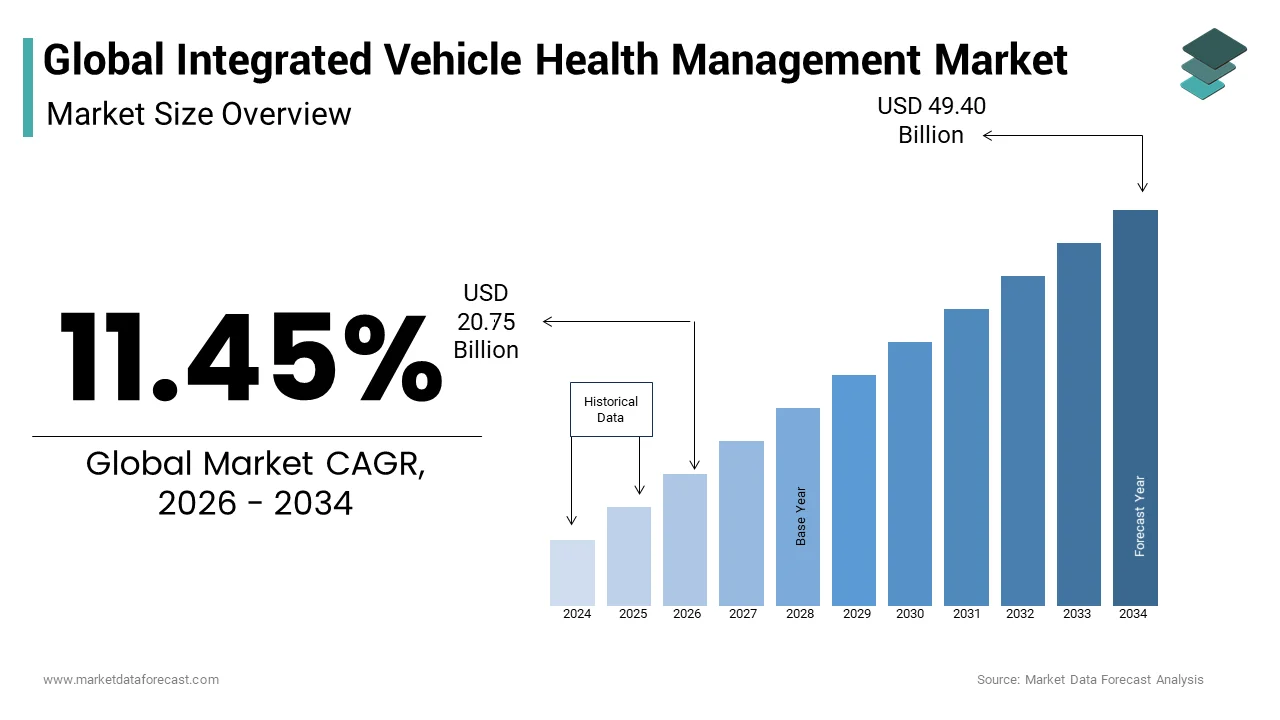
Integrated system health management (ISHM) or Integrated vehicle health management (IVHM) is the incorporation of structures to evaluate the present or future state of the part structure's health and align with the image of system health within a system of practical resources and operational interest. Regarding the engaging frameworks, both model-based and data-driven reasoning have been used in IVHM applications.
The expanding number of connected automobiles and the developing stringency of vehicle emissions and different regulations are driving the market for coordinated vehicle health management. The coordinated automobile health management market has created new opportunities for partners. Automobile health management information would help new plans of action, and OEMs can expand their control over necessary vehicle information by supplanting the OBD port with OEM back-end server centers. An increasing number of coupled vehicles and uncovering issues about vehicle security and health are foreseen to fuel the integrated vehicle health management market in the forecast period.
MARKET DRIVERS
A developing number of coupled vehicles and bringing issues to light about vehicle health and security are anticipated to drive the global integrated vehicle health management market during the estimated time frame. Albeit determined by end-client powers to advance the cost-viability of upkeep and provision exercises, IVHM is, in effect, progressively created as a dangerous proposition for aftercare specialist organizations. An IVHM framework will incorporate a synergistic arrangement of sensor innovations and thinking systems, integrated into the arrangement of proactive decision supportability. It will contain a ready and remote course of action framework and can be applied in a variety of ways. The legislature has diminished the interest in real innovation and put resources into advanced innovation to expand the development of market share during the conjecture downturn.
MARKET RESTRAINTS
Then again, an expansion in the flighty cost of crude material will constrain the development of the coordinated vehicle health management market.
REPORT COVERAGE
| REPORT METRIC | DETAILS |
| Market Size Available | 2025 to 2034 |
| Base Year | 2025 |
| Forecast Period | 2026 to 2034 |
| CAGR | 11.45% |
| Segments Covered | By Health Management Type, Type, Application, Vehicle Type, and Region. |
|
Various Analyses Covered | Global, Regional & Country Level Analysis, Segment-Level Analysis, DROC, PESTLE Analysis, Porter’s Five Forces Analysis, Competitive Landscape, Analyst Overview of Investment Opportunities |
| Regions Covered | North America, Europe, APAC, Latin America, Middle East & Africa |
| Market Leaders Profiled | Continental (Germany), Visteon (US), Robert Bosch (Germany), OnStar (US), Delphi Technologies (UK), Garrett Motion (Switzerland), and Others. |
SEGMENT ANALYSIS
By Health Management Insights
Prognostics is anticipated to be the fastest-growing segment of the coordinated vehicle health management market from 2018 to 2026. The development of this portion can be credited to the advancement of vehicle health management from conventional support to diagnostics and prognostics. Around the globe, they presently offer prognostics arrangements as default or discretionary elements in different vehicle segments. Nonetheless, constant prognostics arrangements are likewise getting a footing. Every one of these elements has added to the improvement of the prognostics section of the coordinated vehicle health management market.
By Type Insights
Software is evaluated to be the quickest developing section, by value, of the integrated vehicle health management market from 2019 to 2027. The development of this portion can be ascribed to the expanding utilization of electronic control units (ECU) inside the vehicle. ECUs are programmed with programming lines of code. The pattern is developing at a noteworthy pace and is driving the market for the software portion of the integrated vehicle health management market.
By Vehicle Insights
Light-duty vehicles are assessed to hold the most significant piece of the overall industry. The rising interest in connected vehicle features in passenger vehicles and the reception of electronically operated cutting-edge innovations are required to drive market development in this sector. OEMs' push towards offering propelled applications and health management solutions to handle powered requests has helped the interest in the integrated vehicle health management business. Expanding manufacturing of the economy and good-sized vehicles is probably going to drive the market for integrated vehicle health management in the automobile sector.
REGIONAL ANALYSIS
The European integrated vehicle health management market is expected to grow at the most elevated CAGR during the forecast period. In the previous sny years, the commitment of Eastern Europe has expanded in the European car industry. Individuals in the European area are progressively requesting continuous arrangements that can monitor, identify, and examine the issues in the vehicle. Nonstop ascent in connected vehicles and vehicle guidelines, for example, NCAP appraisals, emission standards, and gauges on the functional safety of vehicle parts, are a portion of the components driving the market for integrated vehicle health management in Europe. Asia Pacific is anticipated to be the biggest market for integrated vehicle health management in 2027. Expanding deals of average-sized extravagant vehicles and good conditions for developing organizations have prompted the predominance of the Asia Pacific region in the global market. Furthermore, the blast in the on-street supply chain and logistics area has likewise added to the development of the Asia Pacific market.
KEY MARKET PLAYERS
These are the market players dominating the global integrated vehicle health management market.
- Continental (Germany)
- Visteon (US)
- Robert Bosch (Germany)
- OnStar (US)
- Delphi Technologies (UK)
- Garrett Motion (Switzerland)
RECENT MARKET NEWS
-
German technology firm Bosch has recently announced a new interior monitoring system featuring cameras and artificial intelligence which it hopes will improve driver and passenger safety.
- An intelligent transport management system (iTraMS) is a start-to-finish telematics arrangement that gives transportation solutions for OEMs, logistics, fleet, and vehicle owners. iTraMS empowers clients across the portability and transportation sections to profit from the intensity of connected arrangements and the value of bits of knowledge determined to utilize analytics.
- Garrett Motion's vehicle programming experience and forefront innovation will help make it ready for new worldwide benchmarks, and a more extensive selection of Integrated Vehicle Health Management (IVHM) arrangements as the organization fills in as an establishing member of the recently declared Health-Ready Component and Systems (HRCS) Consortium.
- Garrett Motion Inc., a leading, differentiated innovation supplier in the vehicle business, has built up another turbocharger support control programming that can altogether upgrade turbo performance and health and help open improved energy management in hybrid automobiles.
MARKET SEGMENTATION
This research report on the global integrated vehicle management market is segmented and sub-segmented into the following categories.
By Health Management Type
- Prognostics
- Diagnostics
By Type
- Software
- Hardware
By Application
- ECU
- TCU
- Infotainment
- Safety & Security
By Vehicle Type
- Light-Duty Vehicles
- Heavy-Duty Vehicles
By Region
- North America
- Europe
- Asia-Pacific
- Latin America
- Middle East and Africa