- Product Description Description
- Table of Contents TOC
- List of Table & Figure LOT
- Get Free Sample PDF Sample PDF
Market Size, 2025
$13.52 BnMarket Estimate, 2026
$15.34 BnMarket Forecast, 2034
$42.06 BnCAGR, 2026–2034
13.44%Executive Summary: Global Intelligent Agriculture Market
- Market Scope: Comprehensive global intelligent agriculture market analysis covering solution types, deployment offerings, application verticals, regional leadership frameworks, and emerging technology adoption trends.
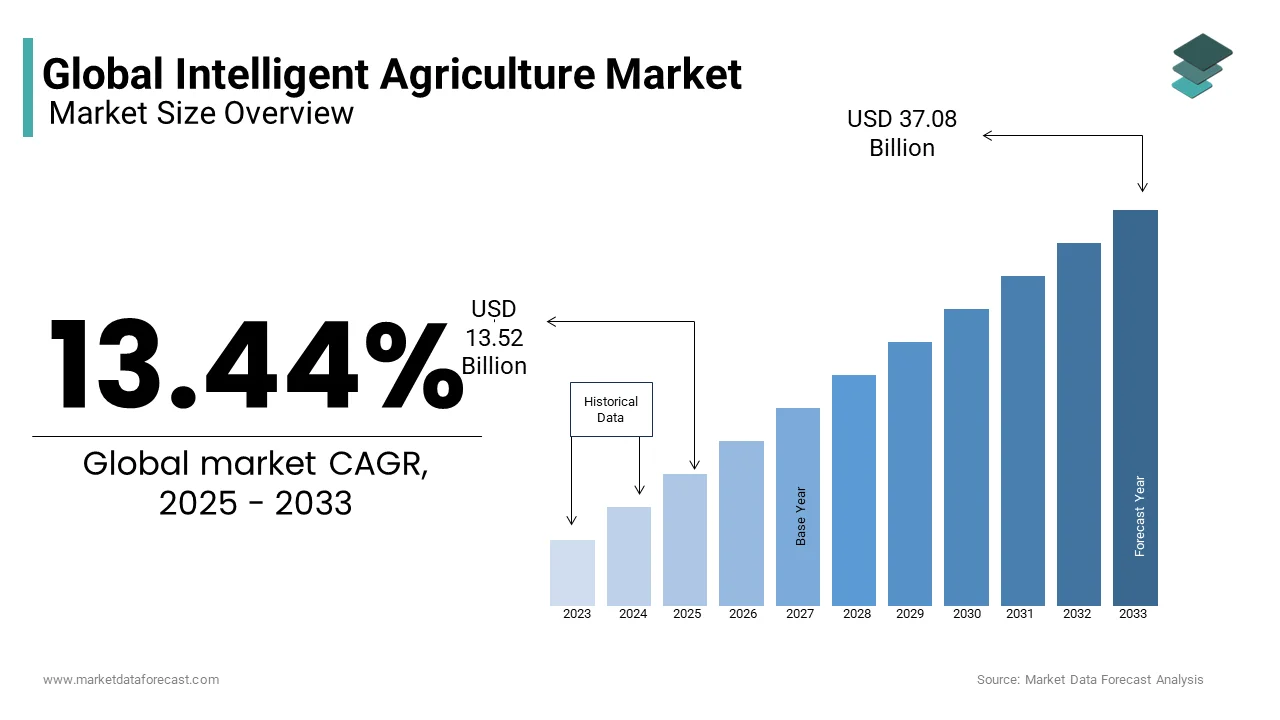
- Market Valuation: Valued at USD 13.52 billion (2025), estimated at USD 15.34 billion (2026), and projected to reach USD 42.06 billion by 2034, registering a robust CAGR of 13.44% (2026–2034).
- Primary Growth Drivers: Increasing integration of advanced technologies into farming, rising demand for precision agriculture, and the need to improve productivity, resource efficiency, and environmental sustainability. Key catalysts include IoT sensors, artificial intelligence, robotics, satellite imagery, data-driven farm management, policy mandates, labor shortages, and cloud-based digital platforms.
Key Market Segment Metrics (2026–2034)
| Category | Leading Segment (2025 Position) | Fastest-Growing Segment |
|---|---|---|
| By Segment / Type | Precision Farming Segment (held the largest share of 38.5% in 2025) | Smart Greenhouses Segment (projected to register the highest CAGR of 14.2%) |
| By Application | Precision Farming Applications (dominated with a 41.6% share) | Smart Greenhouse Applications (expected to record the fastest CAGR of 15.1%) |
| By Offering | Hardware Segment (led the market with a 49.6% share) | Software Segment (anticipated to witness the fastest CAGR of 16.3%) |
| By Region | North America (largest market with a 34.7% share, followed by Europe at 27.1%) | Middle East and Africa (projected to experience strong growth driven by climate and food security initiatives) |
Major Market Players & Market Structure
Market Structure: Highly competitive landscape characterized by intense competition among agribusinesses, machinery manufacturers, software providers, and digital specialists competing through technological innovation, integrated service models, and end-to-end digital farming platforms.
Key Companies: GNSS Agency (GSA), John Deere, Bayer, Trimble Inc., Precision Ag Institute, International Society for Precision Agriculture (ISPA), SPAA Precision Agriculture, CropLife Media Group, Precision Agriculture Association, and Agricultural Research Organization.
Global Intelligent Agriculture Market Size
The global intelligent agriculture market was valued at USD 13.52 billion in 2025 and is anticipated to reach USD 15.34 billion in 2026 from USD 42.06 billion by 2034, growing at a CAGR of 13.44% from 2026 to 2034.
Current Context of the Intelligent Agriculture Market
Intelligent agriculture, also known as smart or digital agriculture, refers to the integration of advanced technologies such as Internet of Things sensors, artificial intelligence, satellite imagery, robotics, and data analytics into farming systems to optimize productivity, resource efficiency, and environmental sustainability. This approach enables real-time monitoring of soil conditions, crop health, weather patterns, and equipment performance, facilitating data-driven decisions across the agricultural value chain. The European Union's agricultural land area has remained relatively consistent in size, while the sector faces growing demands to balance food production needs with significant environmental impact reductions as outlined in the Farm to Fork Strategy. Moreover, the European Commission is increasingly funding initiatives through programs like the Digital Europe Programme to support the development and adoption of modern digital technologies and precision tools across the agricultural sector. Furthermore, the Common Agricultural Policy now includes eco-schemes that incentivize digital record-keeping and variable-rate application technologies. Faced with worsening climate instability and a shrinking workforce, smart farming has shifted from an efficiency tool to a vital strategy for Europe's agricultural resilience and competitiveness.
MARKET DRIVERS
Policy Mandates for Sustainable and Data-Driven Farming Under the EU Green Deal
The European Union’s Green Deal and its Farm to Fork Strategy are primary factors accelerating the growth of the intelligent agriculture market. European policy is shifting toward a low-input agricultural model by mandating significant decreases in chemical inputs and promoting the restoration of natural biodiversity within farming landscapes. Achieving these targets requires granular field-level data and precision application technologies, core components of intelligent agriculture. The Common Agricultural Policy now ties 25 percent of direct payments to eco scheme compliance, with digital record keeping and satellite-based monitoring as eligible practices. In the Netherlands, the pressure to meet stringent nutrient regulations is driving a widespread transition toward precision fertilization systems that utilize real-time soil data and aerial imaging. Similarly, French agricultural regulations now favor the use of electronic tracking for chemical applications, which has made precision-guided machinery a standard requirement for professional operators. Across the European Union, advanced digital farming technologies have evolved from discretionary upgrades into essential tools for maintaining farm eligibility for financial support and legal operation.
Labor Shortages and Aging Farmer Demographics
Persistent agricultural labor shortages and an aging farming population are compelling the regional producers to adopt automation and remote monitoring solutions, which in turn propels expansion of the intelligent agriculture market. The farming population across the European Union is consistently aging, with a disproportionately large number of farm managers approaching retirement age and fewer young people entering the profession. Simultaneously, the European Union's agricultural workforce has experienced a substantial and ongoing decline over the last decade, leading to persistent labor shortages, especially during crucial busy periods like peak harvest seasons. Fruit and vegetable growers in Germany face significant and widespread challenges in recruiting a sufficient number of seasonal workers each year. Intelligent agriculture addresses this gap through autonomous machinery, robotic harvesters, and remote sensing platforms that reduce reliance on manual labor. For example, the adoption of advanced technologies like AI-powered milking robots on Danish dairy farms is leading to notable reductions in the amount of labor required for each cow. In Spain, vineyards deploy drone-based canopy analysis to optimize pruning schedules with minimal staff. Smart technological solutions represent a viable methodology for stabilizing productivity as rural demographic decline persists and the workforce matures.
MARKET RESTRAINTS
High Initial Investment and Fragmented Return on Investment Metrics
The substantial upfront cost of intelligent agriculture systems remains a major barrier to the intelligent agriculture market. This challenge particularly affects small and medium-sized farms, which constitute a significant share of EU holdings, according to sources. The substantial initial investment required for a comprehensive suite of precision farming technology is a significant barrier to its widespread adoption by European farmers. Unlike machinery with immediate output gains, the benefits of digital tools are often incremental and long-term, making ROI difficult to quantify. Accurately measuring and isolating the specific yield benefits of individual digital farming technologies can be complex due to the numerous interacting environmental and operational factors. Furthermore, many subsidies under the Common Agricultural Policy cover equipment but not software subscriptions or data services, creating imbalanced investment incentives. Lacking standardized benchmarks for sustainability and productivity, wary farmers are hesitant to commit, stalling digital progress despite strong policy and environmental incentives.
Interoperability and Data Ownership Ambiguities
The lack of standardized data formats and unresolved ownership rights hinders seamless integration of intelligent agriculture technologies across the region, which poses a serious impediment to the intelligent agriculture market. Most farm equipment and software platforms operate within proprietary ecosystems;s, John Deere’s Operations Center, Claas Telematics, and Bayer’s FieldView do not natively exchange data, forcing farmers to manually reconcile information. Farmers adopting digital technology frequently face significant challenges managing their data due to fragmentation across various platforms and systems. European Union guidelines for sharing agricultural data remain voluntary, and there is no current mandate for technical interoperability between digital platforms, contributing to ongoing data management challenges. Compounding the issue, legal uncertainty persists over who owns farm data: the farmer, the equipment manufacturer, or the service provider, discouraging data sharing for collaborative insights. The European Commission’s proposed Data Act aims to clarify these rights, but implementation remains inconsistent across member states. Integrated, AI-driven farm management will not reach its full potential until open standards, such as AgGateway’s ADAPT framework, see widespread adoption.
MARKET OPPORTUNITIES
Integration of AI and Predictive Analytics for Climate Resilience
The deployment of artificial intelligence for predictive crop and risk modeling offers a major opportunity to enhance climate resilience in European agriculture, which is expected to fuel the growth of the intelligent agriculture market. Machine learning algorithms now analyze decades of satellite imagery, weather forecasts, and soil data to predict pest outbreaks, drought stress, and optimal harvest windows with high accuracy. The European Space Agency and research partners are developing sophisticated AI-driven tools using satellite imagery to enhance the ability to monitor and predict agricultural threats, such as olive fruit fly infestations, thereby guiding more sustainable pest control measures. Similarly, companies, including Taranis, provide AI-powered agricultural platforms that utilize high-resolution imagery and data analytics to accurately identify and track various crop health issues, such as fungal diseases, allowing for timely and targeted interventions by farmers. The European Commission is investing substantial funding through its Horizon Europe research program to support the development and implementation of advanced AI and digital technologies that facilitate climate adaptation strategies within the agricultural sector. Moreover, the growing frequency of extreme weather events emphasizes the necessity of predictive intelligence to mitigate risks and maintain stable yields.
Expansion of Digital Advisory Services for Smallholder Farmers
The rise of subscription-based digital advisory platforms tailored to small and mid-scale farms is opening up inclusive growth in the intelligent agriculture market. Unlike capital-intensive hardware, these services deliver actionable insights via smartphone apps at low monthly fees, democratizing access to precision tools. Agricultural technology adoption is increasing, with a growing number of European farmers utilizing digital tools and applications that leverage data from sources like satellites and weather information to guide farm management decisions. Public and private sector initiatives are encouraging the adoption of new agricultural technologies across Europe to improve efficiency and sustainability, particularly as a way to potentially enhance productivity on smaller holdings. These platforms bridge the knowledge gap by translating complex data into simple instructions, such as “apply 45 kilograms of nitrogen per hectare in Field B”, enabling adoption without technical expertise. The overwhelming majority of farms in the European Union are small, family-run businesses. This prevalent structure is a significant factor in the approach to scaling modern intelligent agriculture practices across the region.
MARKET CHALLENGES
Digital Literacy Gaps and Limited Technical Support in Rural Areas
The uneven digital literacy among farmers and the scarcity of localized technical support in rural regions are significant challenges to the Europe intelligent agriculture market. There is a noticeable trend of lower adoption of digital farm management technologies among older farmers across the European Union, with particularly low levels of usage observed in Southern and Eastern member states. Even when technologies are adopted, a lack of troubleshooting capacity leads to underutilization. In parts of Eastern Europe, such as Romania and Bulgaria, the successful implementation of new agricultural technology is often hindered by practical challenges, including recurring technical problems and connectivity issues. Internet infrastructure remains inadequate; a portion of rural EU areas lack high-speed broadband, according to sources, limiting cloud-based service reliability. The EU funds digital education via CAP rural development programs, but the execution is fragmented, and the content is seldom customized for older people or those with limited technological proficiency. The digital divide in Europe will endure unless targeted upskilling and local support systems are implemented, preventing most farms from fully utilizing the benefits of intelligent agriculture.
Fragmented Subsidy Access and Administrative Complexity
Inconsistent and administratively burdensome subsidy mechanisms across EU member states constrain the expansion of the intelligent agriculture market. While the Common Agricultural Policy includes funding for digitalization under eco schemes and rural development programs, eligibility criteria, application processes, and approval timelines vary widely. In Greece, farmers wait an average of 14 months to receive reimbursement for precision equipment, compared to 5 months in Denmark, as documented by the European Court of Auditors in 2023. Moreover, only a minority of member states explicitly include farm management software or data services in their subsidy lists, excluding critical components of integrated systems. The paperwork required, often including proof of training, system specifications, and usage logs, deters smallholders with limited administrative capacity. European agricultural associations report that the vast majority of farmers are deterred from modernizing their operations due to the overwhelming administrative burden and complexity involved in accessing financial support.
REPORT COVERAGE
| REPORT METRIC | DETAILS |
| Market Size Available | 2025 to 2034 |
| Base Year | 2025 |
| Forecast Period | 2026 to 2034 |
| CAGR | 13.44% |
| Segments Covered | By Agriculture Type, By Application, By Offering, And Region |
| Various Analyses Covered | Global, Regional & Country Level Analysis, Segment-Level Analysis, DROC, PESTLE Analysis, Porter’s Five Forces Analysis, Competitive Landscape, Analyst Overview of Investment Opportunities |
| Regions Covered | North America, Europe, APAC, Latin America, Middle East & Africa |
| Market Leaders Profiled | European GNSS Agency (GSA) (Czech Republic), Precision Ag Institute (U.S.), International Society for Precision Agriculture (ISPA) (U.S.), SPAA Precision Agriculture (Australia), CropLife (CropLife Media Group) (U.S.), Precision Agriculture Association (New Zealand), and Agricultural Research Organization (Israel). |
SEGMENTAL ANALYSIS
By Agriculture Insights
The precision farming segment held the largest share of 38.5% of the intelligent agriculture market estimated in 2024. The leading position of the precision farming segment is attributed to widespread adoption of GPS-guided equipment, variable rate technology, and data-driven agronomic decision making. An additional leading factor is the urgent need to enhance crop yields while minimizing input waste amid rising global food demand. The Food and Agriculture Organization of the United Nations indicates a significant necessary increase in global food production to sustainably meet the needs of a growing global population by the middle of the century, a challenge that is driving innovation and adoption of advanced agricultural practices, including precision agriculture. A further key driver is government support through subsidies and digital farming initiatives. For instance, the European Commission, through its current Common Agricultural Policy framework (2023-2027), provides substantial financial support and incentives for EU farmers to integrate digital tools and precision farming technologies to enhance sustainability and efficiency across the sector. Additionally, decreasing costs of sensor drones and connectivity infrastructure have made precision solutions more accessible to small and medium-scale farms, particularly in North America and parts of Asia.

The smart greenhouses segment is predicted to witness the highest CAGR of 14.2% from 2025 to 2033 due to increasing urbanization and the need for localized year-round food production with minimal land and water use. Vertical farming and greenhouse automation have gained momentum, particularly in regions with limited arable land or harsh climates. Japan has experienced significant growth in smart greenhouse installations, driven by urgent national food security strategies and the pressing demographic challenge of an aging rural population and labor shortages. Moreover, advancements in the Internet of Things enabled climate control systems and AI-based irrigation, which have significantly improved yield predictability and operational efficiency. Extensive research in agricultural science, including work by institutions, confirms that smart greenhouses offer substantial advantages, enabling drastically reduced water consumption while delivering significantly higher yields per square meter compared to conventional open field agriculture. Rising consumer demand for pesticide-free produce and retailer commitments to sustainable sourcing further amplify market momentum.
By Application Insights
The precision farming applications segment dominated the intelligent agriculture market by accounting for a 41.6% share in 2024. The dominance of the precision farming applications segment is credited to the scalability of these tools across cereal grains, ds, ds, and row crops, which constitute a significant share of global cultivated land, according to research. These applications include yield monitoring,g soil mapping, automated steering, and crop health analytics powered by satellite and drone imagery. Farmers increasingly rely on real-time field insights to optimize fertilizer and pesticide application, thereby cutting costs and environmental impact. The adoption of various precision agriculture technologies on corn and soybean acres in the United States has shown a clear and consistent upward trend in recent years, as reported by the Department of Agriculture. Additionally, private sector investment accelerates adoption. Leading agricultural technology companies, including John Deere and Trimble, are making substantial and increasing investments in research and development to advance integrated farm management platforms and data synthesis for actionable intelligence.
The smart greenhouse applications segment is estimated to register the fastest CAGR of 15.1% during the forecast period, owing to technological convergence,e where AI climate algorithms, IoT sensors, rs and automated nutrient delivery systems create hyper-controlled environments that maximize productivity. The Netherlands maintains its position as a major global exporter of agricultural products, leveraging its advanced greenhouse infrastructure to produce high volumes of food efficiently. This success model is being replicated in the Middle East and North Africa, where water scarcity and extreme temperatures make traditional farming unsustainable. For example, the United Arab Emirates is aggressively pursuing enhanced domestic food security and resilience through substantial government investment and the widespread adoption of advanced, climate-smart agricultural technologies such as high-tech greenhouses and vertical farms. Furthermore, rising venture capital interest in agri tech startups specializing in greenhouse robotics anenergy-efficientnt lighting is accelerating commercial deployment worldwide.
By Offering Insights
The hardware segment led the intelligent agriculture market by capturing a 49.6% share in 2024. Moreover, the hardware segment leads because physical components are the foundational layer required to collect data and execute actions in the field. This includes GPS devices, drones, sensors, automated irrigation systems,s and robotic harvesters. Software and services cannot function operationally without the necessary physical hardware components. The widespread global use and operation of agricultural drones grew substantially in 2023, reflecting robust hardware deployment and rapid adoption of the technology in farming practices. Government procurement programs also boost hardware adoption. The Indian government significantly expanded financial assistance through the Pradhan Mantri Krishi Sinchayee Yojana to promote the widespread adoption of efficient, modern micro-irrigation systems among farmers. Besides, declining costs of semiconductors and battery technologies have made hardware more affordable. The cost of drone technology, while still a significant investment for many farmers, has become more accessible over time, enabling increased use for crop monitoring in various regions.
The software segment is anticipated to witness the fastest CAGR of 16.3% from 2025 to 2033. The rapid growth of the software segment is propelled by the increasing reliance on data analytics, farm management platforms ancloud-baseded decision support systems. Unlike hardware, software scales efficiently across geographies with minimal incremental cost. Digital agriculture platforms are experiencing widespread and continually expanding global adoption, providing extensive real-time data and recommendations for key farming decisions like planting and pest management. Regulatory pressures also accelerate software adoption. European Union agricultural policy shifts continue to encourage significant reductions in chemical pesticide use, driving farmers to increasingly adopt advanced digital scouting and spray optimization tools to enhance sustainability. Moreover, integration with financial services is emerging as a key trend. The Brazilian agricultural sector is showing a significant emerging trend where digital farm performance metrics are increasingly integrated into software contracts to help farmers access financial services, such as insurance and credit.
REGION ANALYSIS
North America Market Analysis
North America was the top performer in intelligent agriculture by accounting for a 34.7% in 2024. The United States is the primary driver, thanks to large-scale commercial farming, extensive broadband coverage,e and strong private investment in agri innovation. Large U.S. farms are widely adopting a variety of intelligent agriculture technologies to enhance efficiency and productivity. U.S. government conservation programs are providing substantial financial support for agricultural producers to implement precision irrigation and improve soil health practices. Additionally, U.S.-based agtech startups continue to attract significant venture capital investment, maintaining the country's position as a leading hub for agricultural innovation.
Europe Market Analysis
Europe was the second-largest region in the intelligent agriculture market by holding a 27.1% share in 2024. The growth of the European market is fuelled bypolicy driven digital transformation, particularly under the EU’s Farm to Fork Strategy,y which aims to make food systems fair,ir healthy, and environmentally friendly. Countries like the Netherlands, Germany, and France lead in adoption. A significant majority of large farms across the Netherlands, Germany, and France are adopting digital agricultural technologies. The Common Agricultural Policy is increasingly allocating substantial funds from its budget toward encouraging more environmentally sustainable farming practices. Moreover, Europe hosts a notable number of agri-tech startups focused on data analytics and automation.
Asia Pacific Market Analysis
Asia Pacific is another key player in the global intelligent agriculture market. China and India are the dominant contributors, driven by national food security agendas and rural digitization initiatives. China is actively promoting the modernization of its agriculture sector through substantial policy support and the widespread integration of advanced technologies like satellite monitoring, drones, and AI-driven precision farming, as outlined in its national action plans. India has launched a significant national mission under the Ministry of Agriculture & Farmers' Welfare to create a comprehensive digital ecosystem for farmers, developing a Digital Public Infrastructure (DPI) to provide data-driven services, improve efficiency, and enhance transparency in the sector. Rising smartphone penetration and mobile-based advisory services are accelerating grassroots adoption across smallholder communities.
Latin America Market Analysis
Latin America expanded moderately in the intelligent agriculture market. Brazil is the regional leader with intelligent agriculture adoption concentrated in the soybean, corn,n and sugarcane sectors. Commercial farms in Brazil are increasingly adopting precision agriculture techniques such as precision planting and variable rate fertilization, driving increased productivity and sustainability across the sector. The Brazilian government has made expanding internet access to rural areas a priority through partnerships and various national strategies, aiming to bridge the digital divide and bring new opportunities to remote communities. In additionexport-orienteded farming operations are under increasing pressure from global buyers to demonstrate sustainability through traceability systems, which drives investment in digital monitoring tools.
Middle East and Africa Market Analysis
The Middle East and Africaares predicted to grow in the intelligent agriculture market from 2025 to 2033. Despite modest current penetration, the region exhibits high growth potential due to extreme climate challenges and food import dependency. As part of its Vision 2030 initiative, Saudi Arabia is actively prioritizing the development of innovative agricultural technologies, such as AI-driven irrigation, to enable sustainable local food production and reduce reliance on imports in its challenging desert environment. Mobile-based agricultural services are widely used by a significant number of smallholder farmers in Kenya, leveraging the nation's extensive mobile network infrastructure to provide accessible information and services. Water efficiency and yield stability remain the primary catalysts for technology adoption across arid and semi-arid zones.
COMPETITIVE LANDSCAPE
The intelligent agriculture market features intense competition driven by rapid technological innovation and diverse participant profiles,les including agribusiness giants, machinery manufacturers,s software startups, and telecom firms. Established players leverage their hardware ecosystems and global distribution networks to embed digital solutions,s while agile startups focus on niche applications such as pest prediction or carbon accounting. Competitive differentiation hinges on data accuracy,cy system interoperability,ity and actionable insights rather than just hardware sales. Regulatory shifts toward sustainable farming and consumer demand for traceability are reshaping value propositions. Companies increasingly compete on integrated service models that combine equipment connectivity,vity analytics,ytic,s, and agronomic support. This dynamic landscape fosters continuous collaboration and consolidation as firms seek to offer end-to-end digital farming platforms that address productivity, environmental, and economic challenges across global supply chains.
KEY MARKET PLAYERS
A few of the market players in the global intelligent agriculture market include
- GNSS Agency (GSA) (Czech Republic)
- John Deere
- Bayer
- Trimble Inc
- Precision Ag Institute (U.S.)
- International Society for Precision Agriculture (ISPA) (U.S.)
- SPAA Precision Agriculture (Australia)
- CropLife (CropLife Media Group) (U.S.)
- Precision Agriculture Association (New Zealand)
- Agricultural Research Organization (Israel).
Top Players In The Market
- John Deere is a global leader in intelligent agriculture through its integration of precision farming technologies across machinery and digital platforms. The company offers advanced solutions such as automated guidance systems, ms real-time kinematic GS,anAI-powereddd analytics via its Operations Center platform. These moves enhance its ability to deliver end-to-end smart farming ecosystems that connect equipment data and agronomic insights for improved field efficiency and sustainability.
- Trimble Inc plays a pivotal role in the intelligent agriculture market by providing high-precision positioning and data management solutions. Its portfolio includes GNSS receivers, field application software,e and connectivity platforms that enable variable rate applications and yield monitoring. Additionally, the company continues to invest in cloud infrastructure to support scalable farm data analytics and interoperability with third-party tools.
- Bayer leverages its Crop Science division to drive digital innovation in agriculture through its Climate FieldView platform. This digital farming tool collects and analyzes field data to support decisions on planting, nutrient management, and pest control. Bayer has recently expanded FieldView’s capabilities by incorporating satellite imagery and carbon credit tracking features address climate-smart farming demands.
Top Strategies Used By Key Market Participants
Key players in the intelligent agriculture market primarily focus on strategic acquisitions to integrate complementary technologies and expand solution portfolios. They invest heavily in research and development to enhance AI and machine learning capabilities for predictive analytics. Partnerships with equipment manufacturers, telecomprovidersr,s, and agronomic institutions enable seamless data interoperability and field deployment. Companies also prioritize cloud infrastructure development to support scalable and secure farm data management. Geographic expansion, particularly in emerging markets, through localized digital advisory services, is another critical strategy. Continuous user experience improvements via mobile applications and multilingual support further strengthen customer retention and adoption.
MARKET SEGMENTATION
This research report on the global intelligent agriculture market is segmented and sub-segmented based on Agriculture Type, Application, Offering, and Region.
By Agriculture Type
- livestock monitoring
- Precision farming
- Smart greenhouses
- Fish farming
- Others
By Application
- livestock monitoring applications
- Feeding Management
- Heat Stress Management
- Milk Harvesting
- Breeding Management
- Animal Comfort Management
- Behavior Monitoring & Management
- others
- Precision farming application
- Yield Monitoring
- Field Mapping
- Crop Scouting
- Weather Tracking & Forecasting
- Irrigation Management
- Inventory Management
- Farm Labor Management
- Financial Management
- others
- Fish farming applications
- Fish Tracking & Fleet Navigation
- Feeding Management
- Water Quality Management
- others
- Smart greenhouse applications
- HVAC Management
- Yield Monitoring
- Water & Fertilizer Management
- others
By Offering
- Hardware
- Hardware for Precision Farming
- Hardware for Livestock Monitoring
- Hardware for Fish Farming
- Software
- Local/Web-Based
- Cloud-Based
- Services
- System Integration and Consulting
- Managed Services
- Connectivity Services
- Assisted Professional Services aMaintenancecee and Support
By Region
- North America
- Europe
- Asia-Pacific
- Latin America
- The Middle East and Africa