- Product Description Description
- Table of Contents TOC
- List of Table & Figure LOT
- Get Free Sample PDF Sample PDF
Market Size, 2025
$56.21 BnMarket Estimate, 2026
$60.20 BnMarket Forecast, 2034
$104.21 BnCAGR, 2026–2034
7.10%Global Intelligent Transportation System (ITS) Market Size
The global intelligent transportation system (ITS) market size was valued at USD 56.21 billion in 2025 and is anticipated to reach USD 60.20 billion in 2026, to reach USD 104.21 billion by 2034, and is predicted to register a CAGR of 7.10% during the forecast period from 2026 to 2034.
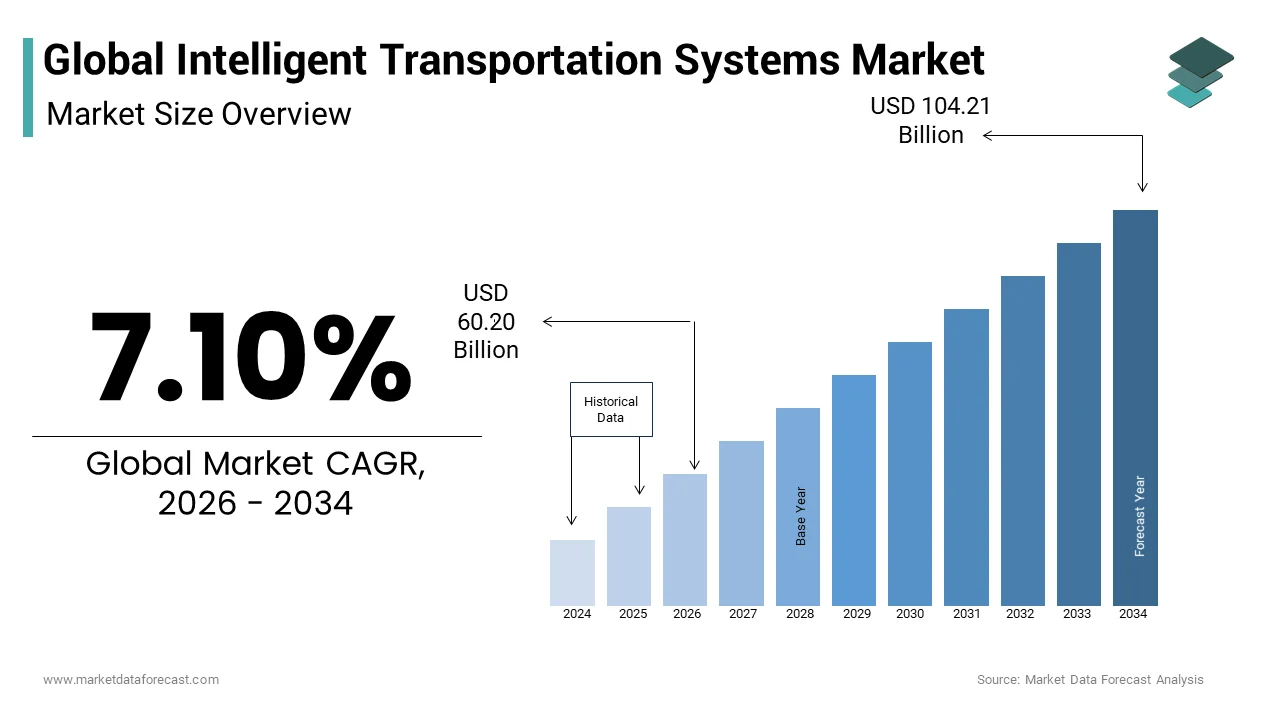
Intelligent Transportation System (ITS) includes the patch-up of generally speaking innovative angles, such as GPS, Carrier Access for Land Mobiles (CALM), Dedicated Short Range Communication (DSRC), and so on ITS framework comprises both street transport and a productive metro/underground rail framework. All around, the concerned government divisions comprehend the significance of actualizing a proficient ITS framework, which is a significant driving component for market development. In this manner, these departments are defining explicit projects and taking actions to actualize the framework.
The intelligent transportation framework market is likely to display a quickened development over the forecast period of an expansion increase in the selection of smart transportation to diminish traffic congestion and good government activities that will encourage the improvemedevelopmentransportationrt foundatioinfrastructuresolidates different sorts of cutting-edge communications and data innovations to frame a system of frameworks that help with overseeing traffic and change the way clients, organizations, and governments manage transportation. It is planned for offerto offer types of assistance to different transportation modes and traffic management arrangements, for example, smart assistance, fleet management, intelligent traffic management, smart ticketing arrangements, traveler data arrangement, security and observation, and mobility services. Different government activities for smart city improvement have likewise set off the selection of solutions to upgrade transport connectivity.
MARKET DRIVERS
Changing customary urban areas into smart urban communities by conveying cutting-edge technologies in all the potential segments, for example, industrial, transport, and medical, is fundamentally affecting the global ITS market. In savvy urban communities, offering powerful, minimal-effort, and energy-efficient vehicle services is a fundamental factor that is likely to characterize their viability. In this way, the idea of ITSs has been proposed and praised as a creative and promising solution for the up-and-coming age of transport systems. Moreover, the usage of ITS over the vehicle foundation of a smart city is relied upexpecteden the development and advancement of a locale as it is equipped for dealitowimanageproficient movement of individuals, products, and services throughout the city. ITS related wis is ith consistent highlights, for example, public transportation management, accessibility of route data, security, and vehicle control, electronic timetable and elec,,tronic payment framework, and acknowledgment of single toll card, is probably going to drive its development and quicken its adoption all through the gauge timforecast period
MARKET RESTRAINTS
In any case, the significant limitation for the market growth is the moderate development of infrastructure, particularly in the emerging locales of the world because o, because of the significant expense of the establishment. Another key limitation of the boom of the market is the absence of measures and poor interoperability between the different methods of transport and advancements.
REPORT COVERAGE
| REPORT METRIC | DETAILS |
| Market Size Available | 2025 to 2034 |
| Base Year | 2025 |
| Forecast Period | 2026 to 2034 |
| CAGR | 7.10% |
| Segments Covered | By Offering, System, Application, and Region. |
|
Various Analyses Covered | Global, Regional & Country Level Analysis, Segment-Level Analysis, DROC, PESTLE Analysis, Porter’s Five Forces Analysis, Competitive Landscape, Analyst Overview on Investment Opportunities |
| Regions Covered | North America, Europe, APAC, Latin America, Middle East & Africa |
| Market Leaders Profiled | Affiliated Computer Services, Inc., Denso Corporation, Agero, Inc., Addco LLC, Lanner Electronics, Inc., Nuance Communications, Inc., Ricardo Plc, Sensys Networks, Inc., Telenav, Inc., Efkon AG, Thales Group, and Others. |
SEGMENT ANALYSIS
By Offering Insights
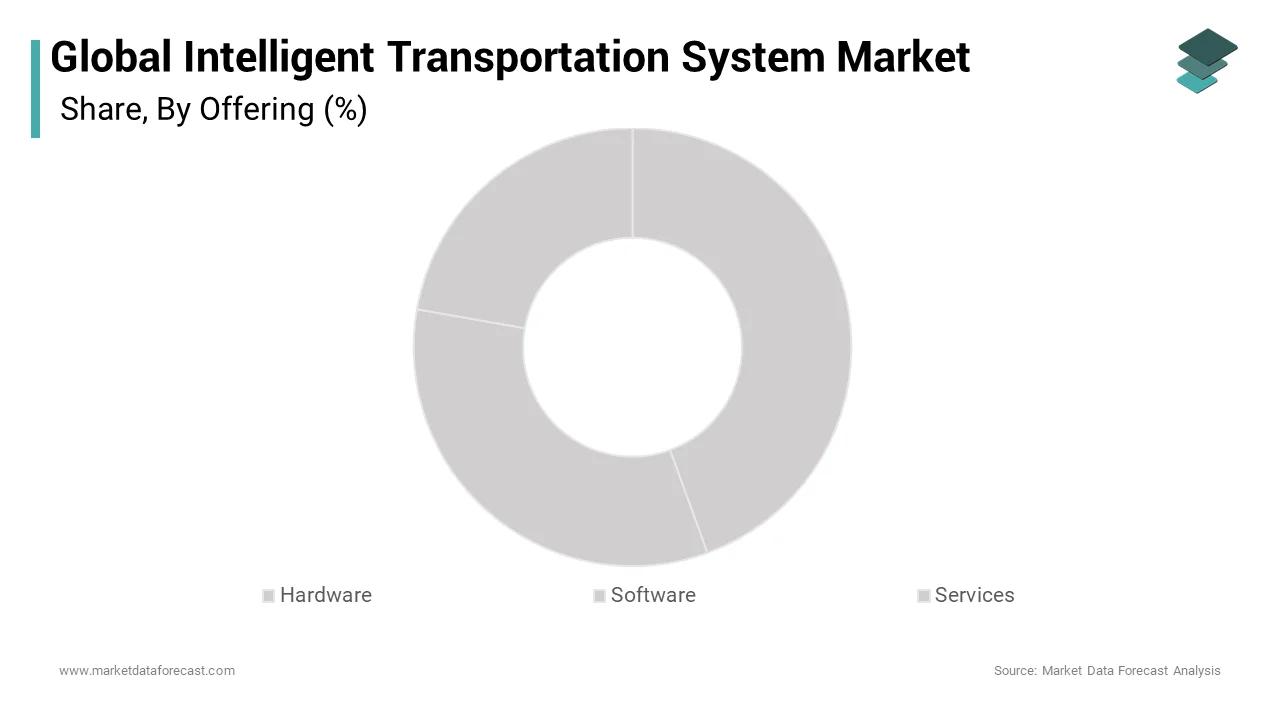
The hardware intelligent transportation framework market is expected to hold a larger part of this market share in 2025. The hardware portion, for the most part, contains different sensors, indicators, cameras, and telecom systems to assemble data related to the vehicle and its surroundings. The utilization of IoT sensors and propelled communication enables the real-time assortment and collection of informatidatatraffic experts to make decisions, based on traffic. The execution of these gadgets to help the shrewd vehicle infrastructure is expected to rely on the interest in demandware parts.
By System Insights
In the roadways, the ITS market, the ATIS section is expected to show the most elevated development rate of over 6% from 2019 to 2025. These frameworks give continuous data to travelers with respect to course direction, traffic guidelines, security, and warning and advisory messages. As these frameworks depend on continuous data to give up-to-date and exact data to suburbanites, interest in these frameworks will rise.
Deployment of ATMS in urban street systems improves the effectiveness of traffic streams on the street. ATMS lessens the weight on transportation specialists and governments by decreasing the fundamental investments required in road network extensions for congestion control. This advantage fuels the interest in traffic management arrangements around the world. Aggressive interest in traffic management arrangements is normal in developing nations, for example, India, China, and Brazil, because of the rapidly developing traffic congestion in major urban areas.
By Application Insights
An Intelligent traffic control application includes a lot of closer collaboration between all of its segments: drivers, walkers, public transportation, and traffic management frameworks. Versatile signal frameworks, driver warnings, course planning, and mechanized vehicles are a portion of the objectives set up to expand the productivity of actual frameworks.
REGIONAL ANALYSIS
North America leads the global intelligent transportation framework market. Solid government support, investigation activities, and public-private associations planned for improving the transportation network are key components driving the regional intelligent transportation system market.
KEY MARKET PLAYERS
These are the market players that dominate the global intelligent transportation system (ITS) market.
- Affiliated Computer Services, Inc
- Denso Corporation
- Agero, Inc.
- Addco LLC
- Lanner Electronics, Inc
- Nuance Communications, Inc
- Ricardo Plc
- Sensys Networks, Inc.
- Telenav, Inc.
- Efkon AG
- Thales Group
RECENT MARKET NEWS
- DENSO will include a space with just 1 lux of light, or supposed "moonlight darkness," in which guests can encounter the exhibition of DENSO image sensors and millimeter wave radars utilizing projections and minicars.
- Lanner has devoted itself to providing the all-in-one, tough vehicle/rail PC conveyed in different travel bus, fleet truck, and rolling stock settings. These rugged PCs are explicitly planned as in-vehicle/rail entryways for armada fleet, in-vehicle NVR/DVR for portable observation, and rail communication for train control, monitoring, and infotainment.
- To help improve the traffic stream, Lanner will exhibit its full intelligent traffic management frameworks and strong in-vehicle processing item line-up. There will be finished scope of rugged IPCs intended for wayside control, high-intermediate portable surveillance, and rolling stock correspondences.
MARKET SEGMENTATION
This research report on the global intelligent transportation system market is segmented and sub-segmented into the following categories.
By Offering
- Hardware
- Software
- Services
By System
- Advanced Traffic Management System
- Advanced Traveler Information System
- ITS-Enabled Transportation Pricing System
- Advanced Public Transportation System
- Commercial Vehicle Operation
By Application
- Fleet Management and Asset Monitoring
- Intelligent Traffic Control
- Collision Avoidance
- Parking Management
- Passenger Information Management
- Ticketing Management
- Emergency Vehicle Notification
- Automotive Telematics
By Region
- North America
- Europe
- Asia Pacific
- Latin America
- Middle East and Africa