- Product Description Description
- Table of Contents TOC
- List of Table & Figure LOT
- Get Free Sample PDF Sample PDF
Market Size, 2025
$4.21 BnMarket Estimate, 2026
$4.52 BnMarket Forecast, 2034
$7.97 BnCAGR, 2026–2034
7.34%Global Ion Exchange Resin Market Size
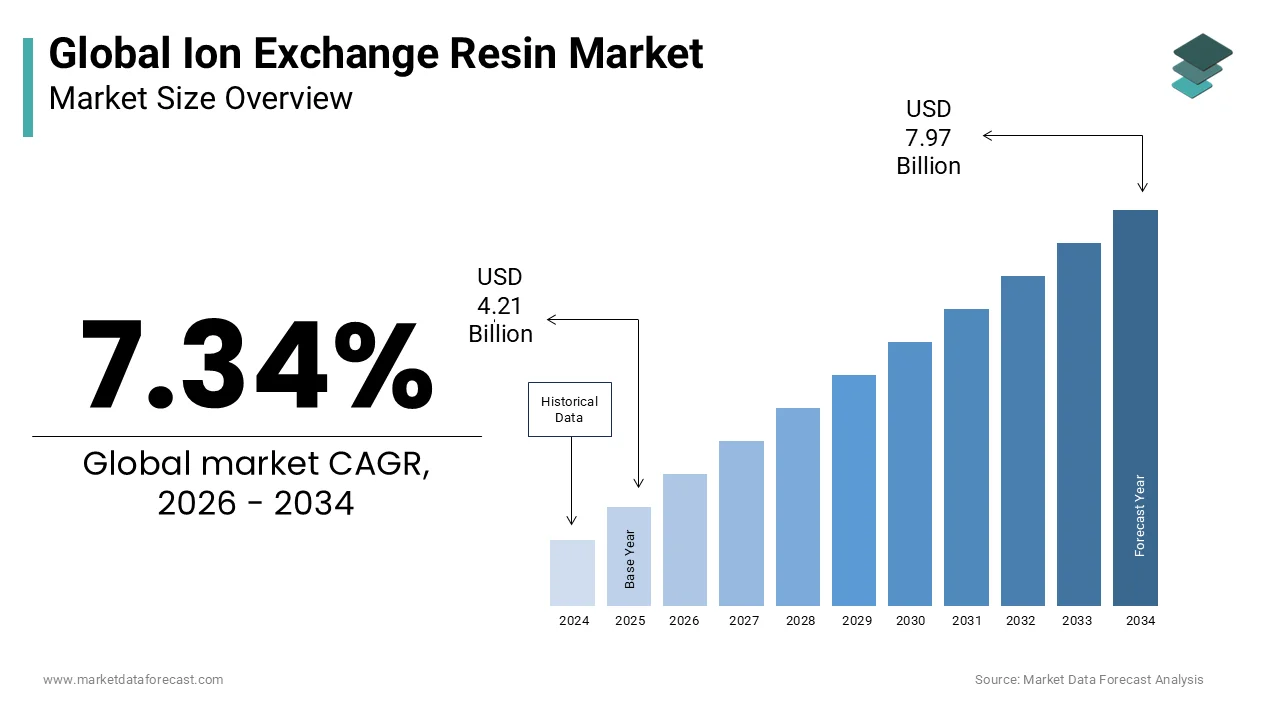
The global ion exchange resin market size was valued at USD 4.21 billion in 2025, and is projected to reach USD 7.97 billion by 2034 from USD 4.52 billion in 2026, growing at a CAGR of 7.34%.
Ion exchange resins are considered light and permeable solids, which are often created in the form of granules, beads, or sheets. When immersed in a solution, the resin sucks up the solution and swells. Ion exchange resins are a kind of polymers and insoluble matrices that can exchange particular ions in the polymer with those available in the solution. This exchange of ions is taken place without any substitution made to the material. Some of the natural things, like cellulose, soil particles, proteins, and living cells, show the features of ion exchange. Ion exchange resins take place in the form of small, white, or yellowish microbeads. These polymers are highly employed for so many procedures like decontamination, separation, and purification.
MARKET DRIVERS
The global ion exchange resins industry is estimated to rise at an average pace due to the strict rules related to safe drinking water across the world. The worldwide industry is estimated to showcase high expansion over the foreseen period. The expansion in the industry is propelled by an escalating call for nuclear power generation. The increasing environmental apprehensions over power generation through traditional means have guided the government jurisdiction to focus on the untraditional mode of power generation. Well-known strategies affected by mature market players in the worldwide ion exchange resin industry are an expansion of current capacities, the advancement of products through research, and enhancement of geological routes, hence assisting to fuel the industry by improving urbanization and industrialization. Gradual urbanization is providing a significant requirement for treating large quantities of sewage water since water with high quality is compulsory to fulfil the light to heavy industries’ requirements for several industrial processes.
The global Ion Exchange Resin Market is majorly affected by the increasing call for nuclear energy employment for electricity generation in rising economies. Increasing population and fast urbanization across the world are leading to more food and water resources that are safe for consumption. This, in turn, is driving the call for ion exchange resin as they are broadly employed in Industrial water treatment so as to take out dissolved ionic impurities from water.
In addition, the escalating requirement for innovations in the worldwide ion exchange resin industry is capable of serving applications in a good way. Continuous optimization of the portfolio is another significant factor to remain competitive in the worldwide ion exchange resin industry. There has been a fast escalation in the use of ion exchange resins for water treatment due to the availability of different contaminants like pollutants, factory impurities, and pathogenic microorganisms in drinking water. This is also among the major aspects fuelling the development of the global ion exchange resin industry. In addition to that, different measures are being taken into consideration to control air pollution on account of escalating industrialization that has contributed to the propelled call for ion exchange resins across the world. This has highly impacted the expansion of the industry. The increasing call for nuclear power generation is probable to fuel the worldwide ion exchange resin industry. In addition to that, increasing consciousness toward water softening and purification in industrial applications is estimated to fuel the call for ion exchange resins.
MARKET CHALLENGES
On the other side, the worldwide industry is highly impacted by the high price of ion exchange resins. Fluctuating costs of raw materials and increasing reverse osmosis membrane competition, especially in the demineralization employment are other major factors restraining the worldwide ion exchange resins industry. Nevertheless, technological developments and constant R&D in the field of ion exchange resins are estimated to decrease price-related problems and make ion exchange resins more feasible in the future.
REPORT COVERAGE
| REPORT METRIC | DETAILS |
| Market Size Available | 2025 to 2034 |
| Base Year | 2025 |
| Forecast Period | 2026 to 2034 |
| CAGR | 7.34% |
| Segments Covered | By Product Type, Application, End Use Industry, and Region |
| Various Analyses Covered | Global, Regional & Country Level Analysis, Segment-Level Analysis, DROC, PESTLE Analysis, Porter’s Five Forces Analysis, Competitive Landscape, Analyst Overview of Investment Opportunities |
| Regions Covered | North America, Europe, Asia Pacific, Latin America, Middle East and Africa |
| Market Leaders Profiled | DuPont de Nemours, Inc., (US), Lanxess (Germany), Purolite Corporation (US), Mitsubishi Chemical Corporation (Japan), Thermax Limited (India), Ion Exchange (India) Ltd. (India), Novasep Holding (France), Samyang Corporation (South Korea), ResinTech Inc., (US), Sunresin New Materials Co., Ltd (China), and Bio-Rad Laboratories, Inc. (US)., and Others. |
REGIONAL ANALYSIS
The Asia Pacific (APAC) Ion Exchange Resin Market industry is envisioned to account for the most noteworthy share and showcase the highest growth rate over the foreseen period. The continual rise in ion exchange resin making for usage and exports drives their call in the area. Moreover, the escalating population and increasing end-use businesses have led to innovation and advancement, making APAC a significant industrial hub, worldwide. Escalated innovation along with industry consolidations are estimated to result in too high an expansion of the industry in the region. Growing nations like China, Malaysia, India, and Saudi Arabia, offer tremendous expansion prospects for the ion exchange resins business, attributed to the surging need for clean water in these localities.
Increasing usage of ion exchange resins, particularly in some African nations, is determined to accelerate this industry boom over the calculated period. MEA, Eastern Europe, and Latin America are likely to rise at robust CAGR and can be called growing regions in this industry over the calculated period. The rest of the Middle East and African countries like Turkey, Israel, and North African countries are deemed to drive expansion in the consumption of ion exchange resins in the locale throughout the foreseen period.
KEY MARKET PLAYERS
DuPont de Nemours, Inc., (US), Lanxess (Germany), Purolite Corporation (US), Mitsubishi Chemical Corporation (Japan), Thermax Limited (India), Ion Exchange (India) Ltd. (India), Novasep Holding (France), Samyang Corporation (South Korea), ResinTech Inc., (US), Sunresin New Materials Co., Ltd (China), Bio-Rad Laboratories, Inc. (US) are some of the notable companies in the global Ion Exchange Resin market.
RECENT HAPPENINGS IN THE MARKET
- Lanxess starts up the latest industry for ion exchange resins in India. Specialty chemicals group LANXESS has initiated Asia’s highly advanced industry for ion exchange resins in India.
- The latest industry was built over two years in the new chemical park in Jhagadia in the Indian state of Gujarat.
MARKET SEGMENTATION
This research report on the global ion exchange resin market has been segmented and sub-segmented based on product type, application, end use industry, and region.
By Product Type
- Cationic Resins
- Anionic Resins
- Others (Mixed Bed Resins, Chelating Resins, etc.)
By Application
- Water Treatment
- Water Softening
- Demineralization
- Wastewater Treatment
- Power Generation
- Chemical & Petrochemical
- Food & Beverage
- Pharmaceuticals
- Mining & Metallurgy
- Electrical & Electronics
- Others
By End-Use Industry
- Power Industry
- Chemical & Petrochemical Industry
- Water & Wastewater Treatment Plants
- Food & Beverage Industry
- Pharmaceutical Industry
- Electrical & Electronics Industry
- Metal & Mining Industry
- Others
By Region
- North America
- Europe
- Asia Pacific
- Latin America
- Middle East and Africa