- Product Description Description
- Table of Contents TOC
- List of Table & Figure LOT
- Get Free Sample PDF Sample PDF
Market Size, 2025
$3.84 BnMarket Estimate, 2026
$4.15 BnMarket Forecast, 2034
$7.74 BnCAGR, 2026–2034
8.1%Latin America Commercial Amino Acids Market Size, Growth, Trends & Forecast (2026–2034)
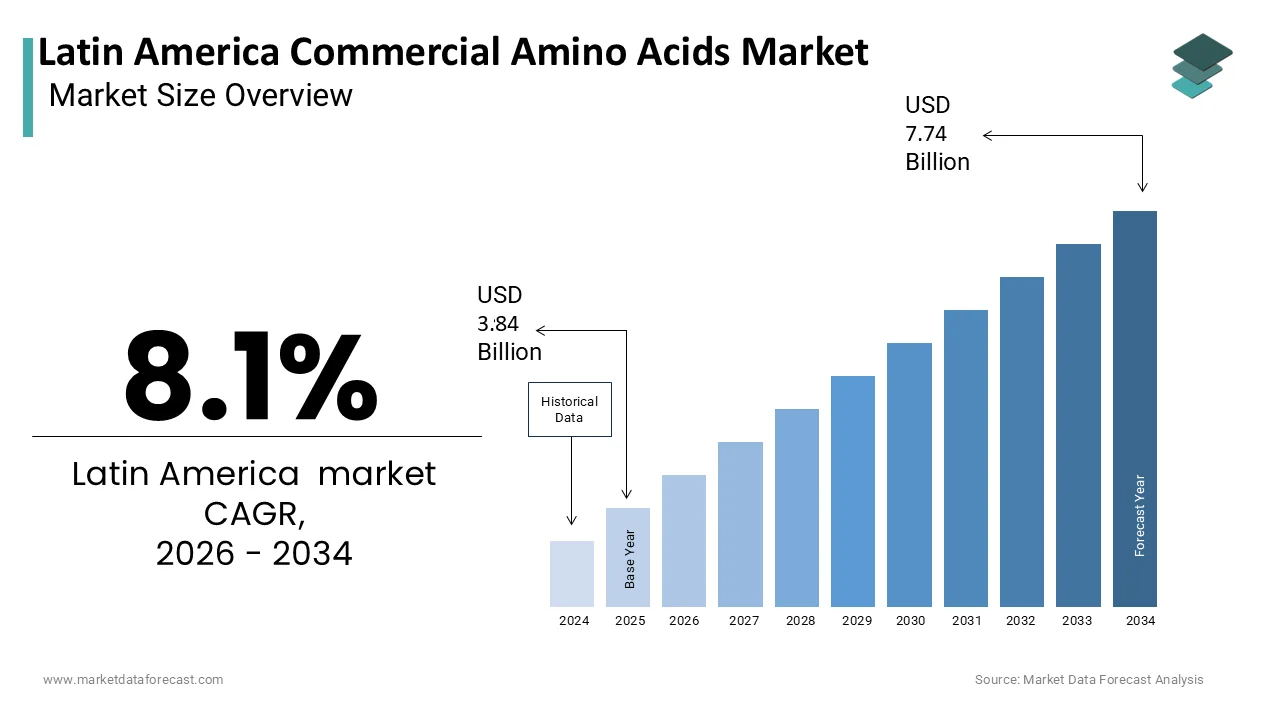
The Latin America commercial amino acids market size was valued at USD 3.84 billion in 2025, is anticipated to reach USD 4.15 billion in 2026, and is projected to scale up to USD 7.74 billion by 2034, registering a compound annual growth rate (CAGR) of 8.1% during the forecast period from 2026 to 2034. Driven by the expansion of industrial livestock operations, rising healthcare public health burdens, and a strong agro-industrial base, the region continues to experience steady commercial integration.
Key Executive Metrics (At-a-Glance)
- 2025 Base Valuation: USD 3.84 Billion
- 2026 Current Valuation: USD 4.15 Billion
- 2034 Forecast Valuation: USD 7.74 Billion
- Compound Annual Growth Rate (CAGR): 8.1% (2026–2034)
- Dominant Application Segment: Food, Dietary Supplements & Animal Feed (holding primary volume share led by industrial livestock requirements)
- Fastest-Growing Segment / Application: Pharmaceuticals (projected at a high CAGR of 13.3%) & Human Food (CAGR of 11.8%)
- Dominant Country Market: Brazil (holding a leading 42.1% market share in 2025, supported by a world-class agro-industrial complex)
- Key Country Growth Leaders: Mexico (24.5% market share in 2025), Argentina, and Chile (expanding aquaculture and high-value niches)
Core Market Drivers
- Industrial Livestock Intensification: Shift toward intensive poultry and swine production models requiring synthetic lysine, methionine, and threonine as essential feed additives.
- Nutritional & Public Health Demand: Escalating malnutrition rates, metabolic disorders, and rising middle-class health consciousness fueling pharmaceutical and fortification-grade demand.
Primary Market Restraints & Challenges
- Currency Volatility & Import Dependency: Exchange rate instabilities inflating costs for non-commodity specialty amino acids.
- Infrastructure & Technical Workforce Deficits: Transportation bottlenecks, logistics delays, and shortages in advanced bioprocessing skills limiting local value-addition.
Latin America Commercial Amino Acids Market Segmentation Breakdown
| Segment Category | Leading Sub-Segment (2025 Base) | Fastest-Growing Sub-Segment (2026–2034) |
|---|---|---|
| By Type / Use | Animal Feed (dominant volume leader due to regional protein export demands) | Human Food & Fortification (projected at an 11.8% CAGR) |
| By Application | Food and Dietary Supplements (driven by sports nutrition and wellness demographics) | Pharmaceuticals (projected at the highest CAGR of 13.3%) |
| By Country | Brazil (42.1% share in 2025) & Mexico (24.5% share in 2025) | Chile & Regional Emerging Hubs |
Major Industry Players Profiled
Key enterprises shaping the competitive Latin American commercial amino acids market include Ajinomoto Co., Inc., CJ Bio Brasil Ltda, Evonik Nutrition & Care GmbH, RSP Amino Acids, Biaffin GmbH & Co. KG, AnaSpec, Inc., ChemPep Inc., IRIS Biotech GmbH, PepTech Corporation, and Synthetech, Inc.
Latin America Commercial Amino Acids Market Size
The Latin America Commercial Amino Acids Market is projected to grow from USD 3.84 billion in 2025 to USD 4.15 billion in 2026 and reach USD 7.74 billion by 2034, registering a CAGR of 8.1% during the forecast period from 2026 to 2034.
Commercial amino acids are mass-produced chemical compounds made via fermentation or chemical synthesis. Industries produce them on a large scale for use in animal feed, human food flavorings, dietary supplements, and medical treatments. This market is intrinsically linked to the region’s status as a global agricultural powerhouse where amino acids like lysine, methionine, threonine, and tryptophan function as critical feed additives to optimize protein synthesis in livestock production. According to the Food and Agriculture Organization, regional agricultural production across Latin America and the Caribbean is expanding by over 14% to capture a larger share of international commodity trade. As per the Inter-American Development Bank, domestic agricultural producers are boosting the export volumes of grains to capitalize on shifting international trade flows. The market definition extends beyond bulk commodities to include high-value specialty amino acids for human health, driven by evolving regulatory frameworks in countries like Brazil and Mexico that mandate specific nutritional standards. This ecosystem operates at the intersection of massive agro-industrial capacity and growing biotechnological capabilities, distinguishing it from other global regions through its unique dual role as both a primary raw material supplier and an expanding consumer market for value-added nutritional solutions.
MARKET DRIVERS
Expansion of Industrial Livestock Production Systems: Intensification of Poultry and Swine Farming Accelerates Feed Additive Consumption
The structural transformation of regional animal protein sectors toward intensive industrial models, particularly regarding synthetic lysine and methionine, is the main factor behind the growth of the Latin American commercial amino acids market. According to the USDA Foreign Agricultural Service, regional poultry operations are expanding production capacities and optimizing standard feed supplementation strategies to safeguard bird health and performance metrics. As per the Ministry of Agriculture and Rural Development of Mexico, domestic commercial swine operations are adopting technified management structures to improve regional herd genetics and overall meat processing efficiencies. Unlike extensive grazing systems prevalent in previous decades, these industrial operations cannot achieve economic viability without synthetic amino acid optimization. The correlation between export-oriented protein production and amino acid consumption creates a demand floor independent of domestic economic volatility, ensuring sustained market velocity even during periods of regional currency fluctuation or consumer spending contraction.
Rising Prevalence of Nutritional Deficiencies and Chronic Disease Public Health Burdens Drive Pharmaceutical and Fortification Grade Demand
Escalating rates of malnutrition, sarcopenia, and metabolic disorders across the region generate substantial demand for pharmaceutical and food-grade amino acids distinct from feed applications, which in turn fuels the expansion of the Latin America commercial amino acids market. As per the Pan American Health Organization, regional community healthcare programs are strengthening targeted nutrition interventions to reduce severe growth deficiencies in early childhood cohorts. According to the Pan American Health Organization, regional clinical centers are expanding treatment services to mitigate the metabolic impacts of non-communicable diseases among vulnerable adult communities. As per the Economic Commission for Latin America and the Caribbean, shifting regional population demographics are driving long-term healthcare networks to modify standard social protection programs for older adult demographics. The epidemiological transition transforms amino acids from purely industrial inputs into essential public health tools, diversifying demand streams beyond agriculture and creating resilience against commodity cycle downturns while addressing genuine demographic health needs.
MARKET RESTRAINTS
Currency Volatility and Import Dependency for Specialty Variants: Exchange Rate Instability Inflates Costs for Non-Commodity Amino Acids
Persistent currency depreciation and foreign exchange controls across major regional economies create significant cost barriers for importing specialty amino acids not produced domestically, which restricts the growth of the Latin America commercial amino acids market. According to the Central Bank of Argentina, structural macroeconomic adjustments and foreign exchange shifts are driving domestic pharmaceutical operations to update asset management protocols to secure vital active chemical imports. As per the Central Bank of Venezuela, domestic inflationary variations are prompting regional distributors to restructure high-purity medical supply networks to maintain therapeutic product distribution channels. The dependency exposes downstream manufacturers to unpredictable input costs that cannot be fully passed through to price-sensitive healthcare systems or consumers. Currency hedging instruments remain inaccessible to small and medium enterprises, forcing them to absorb margin compression or reduce product specifications, thereby constraining market development in high-value segments despite underlying demand.
Regulatory Fragmentation Across National Jurisdictions: Divergent Approval Standards Delay Regional Product Harmonization
Absence of unified regulatory frameworks across nations in the region hampers the expansion of the Latin America commercial amino acids market. This creates compliance complexity that stifles cross-border trade and delays new amino acid product introductions. According to the Pan American Health Organization, member countries are intensifying regulatory convergence frameworks to accelerate the mutual recognition of essential technical documentation across regional trade zones. As per ANVISA, national sanitary inspection models are introducing optimized facility assessment guidelines to integrate domestic validation standards with global health safety benchmarks. According to the National Food and Drug Surveillance Institute of Colombia, commercial food processors are harmonizing product labeling systems with subregional Andean Community trade directives to simplify border-crossing requirements. As per the Public Health Institute of Chile, localized safety assessment protocols are modifying bioequivalence validation methodologies to maintain the clinical verification of therapeutic agents. These regulatory divergences split a large market into isolated national silos. They raise compliance costs and stop smaller innovators from entering multiple areas at once.
MARKET OPPORTUNITIES
Valorization of Regional Agro-Industrial Byproducts: Sugarcane and Cassava Residues Enable Sustainable Domestic Production
The region’s vast agro-industrial waste streams offer untapped opportunities for cost-competitive domestic amino acid production through circular economy biorefinery models, which is anticipated to drive the growth of the Latin American commercial amino acids market. According to the Brazilian Sugarcane and Bioenergy Industry Association, national milling facilities are optimizing ethanol and bioelectricity processing volumes to broaden clean energy grid utilization. As per the Alliance of Bioversity International and CIAT, domestic cassava breeding initiatives are introducing stress-resilient crop genotypes to optimize yield stability across regional agricultural zones. According to the National Chamber of the Sugar and Alcohol Industries of Mexico, national mill networks are updating crushing schedules to stabilize global export deliveries and satisfy internal domestic balance sheets. Unlike grain-based production competing with food security priorities, these second-generation feedstocks avoid ethical concerns and benefit from negative-cost economics where waste disposal expenses become revenue streams. Commercializing this potential reduces import dependency, lowers carbon footprints versus conventional routes according to studies, and creates rural employment while strengthening regional supply chain resilience against geopolitical disruptions.
Expansion of Personalized Nutrition and Sports Supplementation: Middle-Class Health Consciousness Drives Premium Retail Segment Growth
Growing health awareness among the region’s expanding middle class is creating premium retail opportunities for branded amino acid supplements targeting fitness, beauty, and wellness applications, which is expected to accelerate the expansion of the Latin American commercial amino acids market. As per the Ministry of Social Development and Family of Chile, shifting household earning patterns are directly altering retail expenditure categories within modern consumer groups. According to the National Health Surveillance Agency of Brazil, federal food regulation updates are modifying strict chemical limit registers and permitted labeling claims for domestic commercial dietary items. As per the Ministry of Economy of Mexico, regional health brand operators are restructuring digital commerce distribution networks to capture broad sports nutrition consumer segments. Retail pharmacy chains expanded supplement shelf space responding to consumer pull. This segment commands margins higher than bulk feed grades while building brand loyalty less susceptible to commodity price cycles. Digital direct-to-consumer channels bypass traditional distribution inefficiencies, enabling niche players to achieve profitability at lower volumes than mass-market alternatives.
MARKET CHALLENGES
Infrastructure Deficits and Logistics Bottlenecks: Transportation Inefficiencies Erode Competitiveness Against Global Suppliers
Inadequate transportation infrastructure and port congestion impose hidden costs that undermine the competitiveness of the Latin American commercial amino acid market. This occurs despite favorable raw material endowments. According to the World Bank, regional transport infrastructure constraints are prompting logistics networks to optimize supply chain tracking metrics across developing trade corridors. As per the Brazilian National Confederation of Transport, national cargo haulers are adjusting fleet operations to counteract heavy operational dependency on overland highways. According to the Inter-American Development Bank, regional maritime networks are integrating advanced multimodal corridors to reduce structural delays at major Pacific and Atlantic freight terminals. Road infrastructure deterioration in a few countries forces reliance on slower rail networks lacking refrigerated capacity for sensitive products. These systemic inefficiencies negate labor and feedstock advantages, making exported Latin American amino acids more expensive at destination than Asian competitors despite lower production costs. Addressing these bottlenecks requires multi-decade infrastructure investment beyond individual company control, perpetuating structural disadvantage in global markets.
Technical Workforce Gaps in Advanced Bioprocessing Skills Shortages Limit Value Addition Beyond Commodity Production
Insufficient specialized talent in fermentation, purification, and quality analytics holds the region back, which inhibits the expansion of the Latin American commercial amino acids market. As a result, local industries cannot advance past bulk amino acid production into higher-margin specialties. As per the UNESCO Institute for Statistics, localized higher education systems are expanding technical training enrollments to strengthen national industrial competitiveness in emerging engineering fields. According to the Ministry of Development, Industry, Trade and Services of Brazil, commercial bioprocess entities are restructuring internal talent acquisition pipelines to meet technical facility specifications. Vocational training programs lack modern equipment mirroring industrial-scale bioreactors, leaving graduates unprepared for operational realities. These human capital deficits force companies to expatriate technical staff at premium costs or accept suboptimal yields, slowing technology adoption and limiting progression up value chains despite available physical infrastructure and raw materials.
REPORT COVERAGE
| REPORT METRIC | DETAILS |
| Market Size Available | 2025 to 2034 |
| Base Year | 2025 |
| Forecast Period | 2026 to 2034 |
| Segments Covered | By Type, Application, and Region. |
| Various Analyses Covered | Global, Regional, and Country-Level Analysis, Segment-Level Analysis, Drivers, Restraints, Opportunities, Challenges; PESTLE Analysis; Porter’s Five Forces Analysis, Competitive Landscape, Analyst Overview of Investment Opportunities |
| Countries Covered | Mexico, Brazil, Argentina, Chile, Rest of Latin America |
| Market Leaders Profiled |
|
SEGMENTAL ANALYSIS
By Type Insights
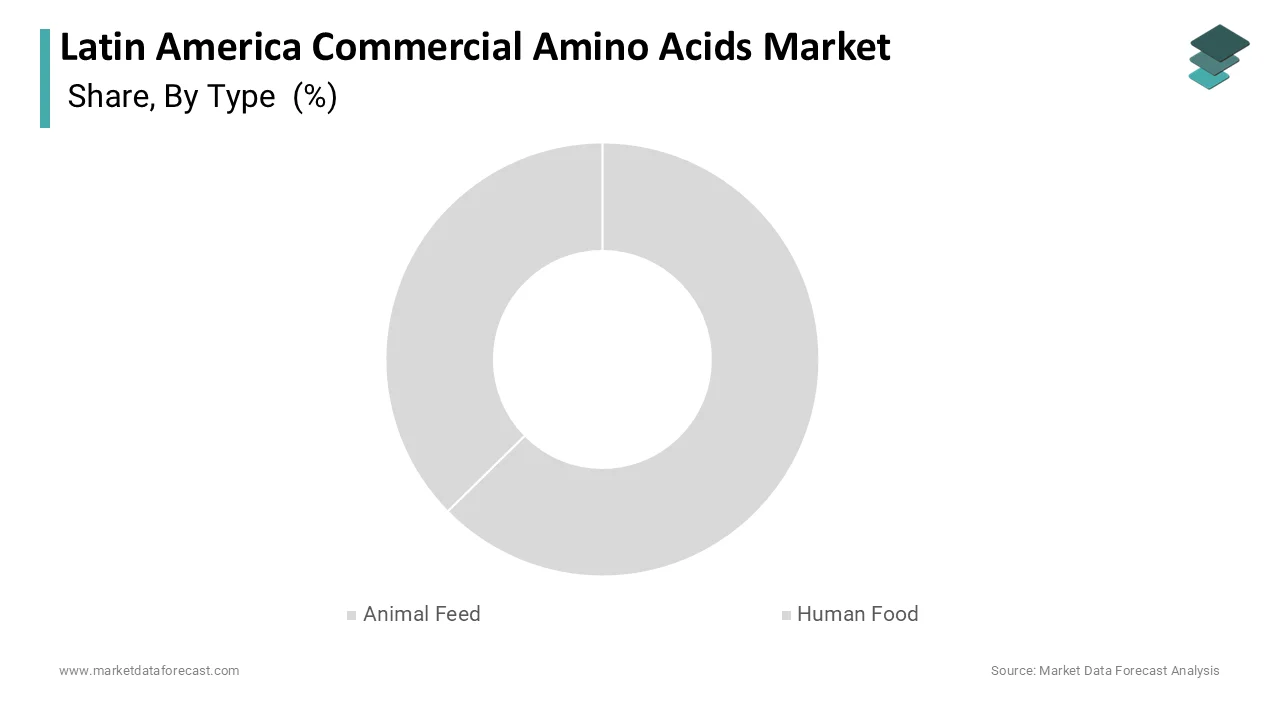
The animal feed segment maintained dominance in the Latin America commercial amino acids market and accounted for a substantial share in 2025. This dominance of the segment was driven by the region’s structural role as a global protein exporter requiring massive volumes of synthetic lysine, methionine, and threonine for efficient livestock production. According to the USDA Foreign Agricultural Service, national poultry integrators across South America are driving up feed efficiency and total volume throughput to maintain localized meat shipping channels. As per the Ministry of Agriculture and Rural Development of Mexico, domestic commercial swine operations are advancing compound precision feed formulations to lower baseline mortality rates and protect production margins. Unlike human food applications where amino acid usage is measured in grams per unit, feed applications consume kilograms per ton of ration, creating volume differentials of three orders of magnitude. This industrial-scale demand is structurally embedded in export-oriented protein value chains where amino acid optimization directly determines profitability and international competitiveness, ensuring sustained segment leadership independent of domestic consumer spending fluctuations or economic volatility.
Persistent volatility in soybean meal and fishmeal prices creates continuous economic incentives for livestock producers to substitute expensive protein sources with synthetic amino acids, reinforcing feed segment dominance. According to the World Bank, continuous global protein meal price fluctuations are driving major livestock operators to alter traditional ration compositions using industrial alternative inputs. As per the Ministry of Agriculture, Livestock and Supply of Brazil, domestic commercial feed manufacturers are implementing amino acid substitutes to insulate animal nutrition chains from international commodity grain shocks. Environmental regulations in certain countries now incentivize reduced nitrogen excretion through precision amino acid balancing, further accelerating adoption beyond pure economics. These converging cost and regulatory pressures transform synthetic amino acids from optional supplements into mandatory inputs for economically viable livestock production, ensuring the feed segment maintains overwhelming volume leadership through structural necessity rather than discretionary choice.
The human food segment is expected to exhibit a noteworthy CAGR of 11.8% from 2026 to 2034 due to government-mandated fortification programs addressing widespread micronutrient deficiencies across Latin America. As per the Pan American Health Organization, regional state healthcare administrations are scaling up targeted food fortification standards to counter widespread early childhood development deficiencies. According to the Federal Commission for the Protection against Sanitary Risks, regional food processing brands are modifying baseline ingredients to achieve strict compliance under updated statutory labeling mandates. The public health interventions create non-discretionary demand streams insulated from consumer purchasing power fluctuations, explaining superior growth velocity versus the mature feed segment tied to commodity cycles.
Consumer preference for recognizable ingredients and reduced additive lists drives food manufacturers to replace synthetic preservatives and flavor enhancers with natural amino acids, accelerating premium segment expansion. As per the National Health Surveillance Agency of Brazil, consumer packaged goods networks are adjusting retail product labeling strategies to capture local updates in voluntary dietary wellness definitions. According to the Federal Commission for the Protection against Sanitary Risks, domestic snack and baking processors are modernizing commercial formulations to integrate stable flavor-enhancing components across product line offerings. The consumer pull through retail channels creates value-driven growth distinct from volume-driven feed markets, enabling higher margins and innovation investment that sustains an accelerated expansion trajectory through the forecast period.
By Application Insights
The food and dietary supplements segment led the Latin America commercial amino acids market and captured a significant share in 2025. This leading position of the segment was attributed to mainstream adoption of sports nutrition products beyond elite athlete niches into general wellness demographics. According to the National Health Surveillance Agency of Brazil, commercial dietary supplement providers are modifying product labels to comply with updated federal ingredient frameworks and permitted health claims. As per the Ministry of Economy of Mexico, digital commerce networks are expanding access to commercial wellness and fitness formulations across secondary municipal trade zones. Social media influencer marketing has normalized daily amino acid supplementation among women aged 25 to 40, expanding the addressable market beyond the traditional male bodybuilder demographic. This cultural shift transforms supplements from specialty products into routine wellness consumables, creating stable recurring demand that anchors segment leadership despite emerging pharmaceutical competition.
Digital retail infrastructure development across Latin America removes traditional distribution barriers, enabling amino acid supplement brands to achieve nationwide reach without physical store networks. According to the Economic Commission for Latin America and the Caribbean, regional digital commerce channels are expanding rapidly within personal care sectors to capture shifting consumer buying preferences. As per the Ministry of Development, Industry, Trade and Services of Brazil, digital marketplace operators are diversifying active stock-keeping units to enhance commercial variety for domestic buyers. Subscription models offering discounts for recurring deliveries have achieved notable retention rates among amino acid supplement users, according to internal platform data, creating predictable revenue streams. This digital democratization enables niche brands to achieve profitability at lower volumes than mass retail requires, fragmenting market leadership but expanding the total addressable base through accessibility improvements unavailable in brick-and-mortar constrained environments.
The pharmaceuticals segment is predicted to witness the highest CAGR of 13.3% during the forecast period owing to expanding hospital intensive care capacity and home parenteral nutrition programs across Latin America. According to the Pan American Health Organization, regional clinical facilities are optimizing critical care bed allocations and patient care protocols to manage evolving therapeutic requirements. As per ANVISA, national pharmaceutical production metrics indicate a rise in injectable therapy registrations to stabilize domestic hospital chemical supply chains. According to the United Nations Population Division, shifting regional demographics are prompting healthcare systems to modify long-term clinical and nutritional care programs for older generations. This convergence of healthcare capacity expansion, policy coverage extensions, and demographic aging creates structural growth drivers exceeding supplement segment maturity.
Progress toward mutual recognition of pharmaceutical approvals across Latin American jurisdictions reduces time to market for amino acid-based medicines, accelerating segment growth velocity. As per the Pan American Health Organization, regional sanitary authorities are advancing joint validation programs to streamline multi-country active pharmaceutical ingredient audits. According to the Andean Community Secretariat, subregional technical boards are executing harmonized quality standards for commercial medicinal components to simplify cross-border registration dossiers. As per ANVISA, bilateral sanitary cooperation agreements are expanding technical data sharing to enhance the integration of regional active ingredient supply networks. The regulatory efficiencies reduce compliance costs, according to studies, making smaller-volume pharmaceutical amino acids economically viable for regional manufacturers previously focused solely on bulk feed grades. Reduced fragmentation enables pan-regional clinical trials, generating Latin America-specific evidence supporting formulary inclusion and reimbursement decisions that sustain pharmaceutical segment acceleration.
COUNTRY LEVEL ANALYSIS
Brazil Commercial Amino Acids Market Analysis
Brazil was the top performer in the Latin America commercial amino acids market and held a 42.1% share in 2025. This prominence of the Brazilian market was driven by a world-class agro-industrial complex. According to CONAB, domestic agricultural operations recorded unprecedented crop sizes during the 2022/23 cycle, positioning the nation as a primary global supplier of foundational grain substrates. As per the Ministry of Agriculture, Livestock and Supply of Brazil, industrial animal nutrition facilities are modernizing bulk feed operations to maximize domestic distribution efficiency. According to the Ministry of Agriculture, Livestock and Supply of Brazil, export-oriented livestock processors are steadily driving up demand for compound feeds and standard nutritional formulations. As per ANVISA, national health regulatory systems are modifying the official register of active ingredients to streamline compliance pathways for domestic manufacturing enterprises. This confluence of scale, vertical integration, regulatory advancement, and policy support creates a self-reinforcing ecosystem maintaining Brazilian market primacy despite currency headwinds.
Mexico Commercial Amino Acids Market Analysis
Mexico followed closely behind in the Latin America commercial amino acids market and occupied a 24.5% share in 2025. The country’s market is known for its proximity to North American supply chains and diversified demand across feed, food, and pharmaceutical segments. As per the Ministry of Agriculture and Rural Development of Mexico, localized livestock and meat processing operations are expanding total yields to meet growing commercial supply mandates. According to the National Institute of Statistics and Geography, domestic healthcare networks are accelerating the acquisition of specialized medical supplies to broaden universal patient care coverage. Mexico City and Guadalajara have emerged as sports nutrition innovation hubs. As per the Federal Commission for the Protection against Sanitary Risks, regional dietary supplement suppliers are increasing product variety to capture localized shifts in health and fitness consumption. According to the Ministry of Economy of Mexico, international industrial groups are multiplying cross-border investments to anchor high-capacity manufacturing infrastructure near major supply chain channels. COFEPRIS regulatory alignment with FDA standards facilitates rapid approval of novel amino acid applications, accelerating time to market versus other Latin American jurisdictions. This strategic positioning, combining geographic advantage, regulatory harmonization, and manufacturing diversification, sustains Mexican market strength independent of commodity price cycles affecting agricultural exporters.
Argentina Commercial Amino Acids Market Analysis
Argentina contributes notably to the Latin American commercial amino acids market due to a strong agricultural base, but it is constrained by macroeconomic instability limiting value-added processing development. According to the Buenos Aires Grain Exchange, regional agricultural operations are altering their seasonal crop rotations to maximize grain yields amid shifting local weather patterns. As per the Argentine Industrial Chamber of Pharmaceutical Laboratories, local manufacturing facilities are adjusting active pharmaceutical ingredient sourcing channels to maintain domestic product availability. According to the Chamber of Poultry Processors of Argentina, commercial livestock producers are expanding broiler output to fulfill rising internal consumer meat demand. As per the Secretariat of Agriculture, Livestock and Fisheries of Argentina, regional biomanufacturing initiatives are introducing modified processing frameworks to scale up industrial value-added bioeconomy outputs. The tension between resource endowment and policy environment creates volatile market dynamics requiring adaptive strategies balancing opportunity with operational risk management unique to the Argentine context.
Chile Commercial Amino Acids Market Analysis
Chile is likely to grow significantly in the Latin American commercial amino acids market during the forecast period, owing to an advanced aquaculture sector and a progressive regulatory framework supporting high-value applications. According to the National Fisheries and Aquaculture Service of Chile, regional salmon farming companies are refining precision feed formulations to improve marine nutrient retention ratios. As per the Public Health Institute of Chile, national health authorities are digitalizing sanitary registration procedures to accelerate evaluation windows for commercial product entries. According to the Ministry of Social Development and Family of Chile, evolving household income categories are directly reshaping consumer retail spending models across urban trade centers. As per the Ministry of Science, Technology, Knowledge and Innovation of Chile, domestic academic institutions are expanding industrial pilot partnerships to explore sustainable marine resource alternative uses. Free trade agreements withthe US, EU, and Asia Pacific nations facilitate both the import of specialty amino acids and the export of value-added aquaculture products, integrating Chile into global value chains. This combination of niche specialization, regulatory efficiency, and research capacity enables outsized influence relative to market size, particularly in high-margin aquatic nutrition segments.
COMPETITIVE LANDSCAPE
Competition within the Latin America commercial amino acids market exhibits moderate intensity, characterized by an oligopolistic structure among three dominant multinational fermenters alongside emerging domestic producers and import-dependent traders. Barriers to entry remain substantial due to capital-intensive fermentation infrastructure, technical expertise requirements, and regulatory approval timelines, limiting new entrant threats despite favorable raw material endowments. Incumbents differentiate through integrated value chains, technical service capabilities, multi-segment portfolios, and local manufacturing presence rather than price competition alone, preserving margins in specialty categories. Import-dependent players face structural disadvantages from currency volatility, logistics bottlenecks, and tariff changes, creating natural moats for domestically positioned manufacturers. Regional market fragmentation prevents true pan-Latin American competition, requiring country-specific strategies and local relationships, increasing operational complexity versus consolidated global markets. Customer concentration in large integrated protein companies enhances buyer leverage in the feed segment, but pharmaceutical and retail segments remain more fragmented, supporting premium pricing for differentiated offerings. Competitive intensity varies significantly by application,n with bulk feed amino acids experiencing cost-based rivalry while pharmaceutical and specialty food segments compete on quality, reliability, and regulatory compliance. This bifurcated landscape rewards companies balancing local operational excellence with global technology access while punishing those unable to adapt to Latin America’s unique combination of resource abundance and institutional constraints shaping competitive dynamics through 2030.
KEY MARKET PLAYERS
Some of the companies that are playing a dominating role in the Latin America Commercial Amino Acids Market include
- Ajinomoto Co., Inc.
- RSP Amino Acids
- Biaffin GmbH & Co. KG
- AnaSpec, Inc.
- ChemPep Inc.
- IRIS Biotech GmbH
- PepTech Corporation
- Synthetech, Inc.
TOP LEADING PLAYERS IN THE MARKET
- CJ Bio Brasil Ltda maintains significant influence across the Latin American commercial amino acids landscape through its integrated fermentation facility in São Paulo state, producing lysine and tryptophan for regional feed markets. The company contributes extensively by supplying domestic poultry and swine producers, thereby reducing import dependency on Asian suppliers while leveraging Brazilian sugarcane molasses as a cost-competitive carbon substrate. Their investment in wastewater treatment and biogas cogeneration aligns with Brazilian sustainability regulations,s enhancing operational resilience against environmental compliance risks. Strategic partnerships with molasses assets secure long term feedstock supply agreements, stabilizing production costs amid agricultural commodity volatility. Technical service teams provide formulation optimization support to medium-sized integrators previously underserved by multinational competitors. These initiatives reinforce supply security and customer loyalty without relying on market share metrics to demonstrate sustained competitive advantage throughout volatile Latin American agribusiness environments.
- Evonik Nutrition Animal Health Ltda plays a pivotal role in the Latin American amino acids ecosystem through specialized methionine and threonine production serving precision nutrition requirements across poultry, swine,e and aquaculture sectors. The company contributes regionally by operating a MetAMINO production facility in Brazil and maintaining technical application centers in Mexico and Chile, supporting species-specific formulation development. Their digital platform AMINONIR provides real-time amino acid digestibility predictions, enabling customers to optimize rations using locally variable ingredient compositions,s reducing waste and cost. Collaboration with Universidad de São Paulo and Universidad Nacional Autónoma de México generates region-specific research validating product efficacy under tropical production conditions. Supply chain diversification, including compositional investments at Santo,s reduces logistics bottlenecks affecting import-dependent competitors. These technology-driven strategies differentiate offerings through value-added services beyond commodity pricing, strengthening long-term positioning across diverse Latin American protein value chains.
- Ajinomoto do Brasil has established a substantial presence in Latin America through a comprehensive amino acid portfolio spanning feed, food, pharmaceutical c, al and cosmetic applications,ons leveraging a century-long regional operational history. The company contributes uniquely by operating multiple fermentation facilities in São Paulo, producing glutamic acid, lysine, and specialty amino acids for both domestic consumption and export markets across Mercosur. Their JINOX brand sports nutrition line expanded distribution through pharmacy chains and e-commerce platforms, capturing premium retail segment growth among health-conscious urban consumers. Research collaboration with EMBRAPA explores second-generation feedstocks from cassava and sugarcane bagasse, positioning the company for a circular economy transition aligned with Brazilian bioeconomy policy. Integrated quality management systems meet ANVISA, FFDADA, and EU standards, facilitating cross-border trade within a fragmented regulatory landscape. This multi-segment diversification creates resilience against commodity cycle volatility while building brand equity across consumer and industrial channels, distinct from single-focus competitors.
TOP STRATEGIES USED BY KEY MARKET PARTICIPANTS
Key players in the Latin America commercial amino acids market employ multifaceted strategic approaches to navigate currency volatility, infrastructure deficits,s and regulatory fragmentation across diverse national contexts. Vertical integration into local feedstock sourcing through long term agreements with sugarcane mills, ls corn processors,ors and cassava growers insulates production from commodity price swings and currency depreciation affecting imported inputs. Geographic diversification across multiple countries mitigates single-market political risk while enabling cross-border supply optimization through Mercosur and Pacific Alliance trade preferences. Portfolio expansion beyond bulk feed grades into pharmaceutical food and specialty segments captures higher margins and reduces exposure to livestock cycle downturns through demand stream diversification. Technical service differentiation through formulation software, species-specific research, and on-farm consulting creates switching costs independent of price competition, particularly valuable in markets where buyers prioritize reliability over lowest cost. Digital channel development via e-commerce platforms and direct-to-consumer brands bypasses traditional distribution inefficiencies, reaching underserved tier-two cities and younger demographics. Strategic partnerships with universities, research institutes, and government agencies build local innovation ecosystems, mitigating brain drain impacts while generating region-specific evidence supporting regulatory approvals and customer adoption. These interconnected strategies collectively address fundamental Latin American market dynamics where operational resilience, relationship management, and adaptive flexibility determine competitive success more than global scale advantages alone.
MARKET SEGMENTATION
This research report on the Latin American commercial amino acids market has been segmented and sub-segmented into the following categories.
By Type
- Animal Feed
- Human Food
By Application
- Food & Dietary Supplement
- Pharmaceuticals
- Chemical industries
By Country
- Mexico
- Brazil
- Argentina
- Chile
- Rest of Latin America