- Product Description Description
- Table of Contents TOC
- List of Table & Figure LOT
- Get Free Sample PDF Sample PDF
Market Size, 2025
$65.56 BnMarket Estimate, 2026
$69.81 BnMarket Forecast, 2034
$115.46 BnCAGR, 2026–2034
6.49%Latin America Gibberellins Market Summary
The Latin America gibberellins market was estimated at USD 65.56 billion in 2025 and is projected to reach USD 69.81 billion in 2026 to USD 115.46 billion by 2034, growing at a CAGR of 6.49% during the forecast period from 2026 to 2034.
Key Market Trends & Insights
- Brazil led the Latin American Gibberellins Market in 2025
- Argentina is expected to showcase strong growth throughout the forecast period.
- Based on the manufacturing Method, the MEP Pathway segment held a dominant share in 2025
- Based on Shape, the liquid form segment was leading the segment in 2025
Market Size & Forecast
2025 Market Size: USD 65.56 Billion
2034 projected Market Size: USD 115.46 Billion
CAGR (2026 to 2034): 6.49%
Brazil: Largest Market in 2025
Argentina: Strongest Growth Region
 Download Free Sample Report
Latin America Gibberellins Market Size
The Latin America gibberellins market size was valued at USD 61.55 billion in 2025 and is anticipated to reach a valuation of USD 69.81 billion in 2026 to USD 115.46 billion by 2034, growing at a CAGR of 6.49%, from 2026 to 2034.
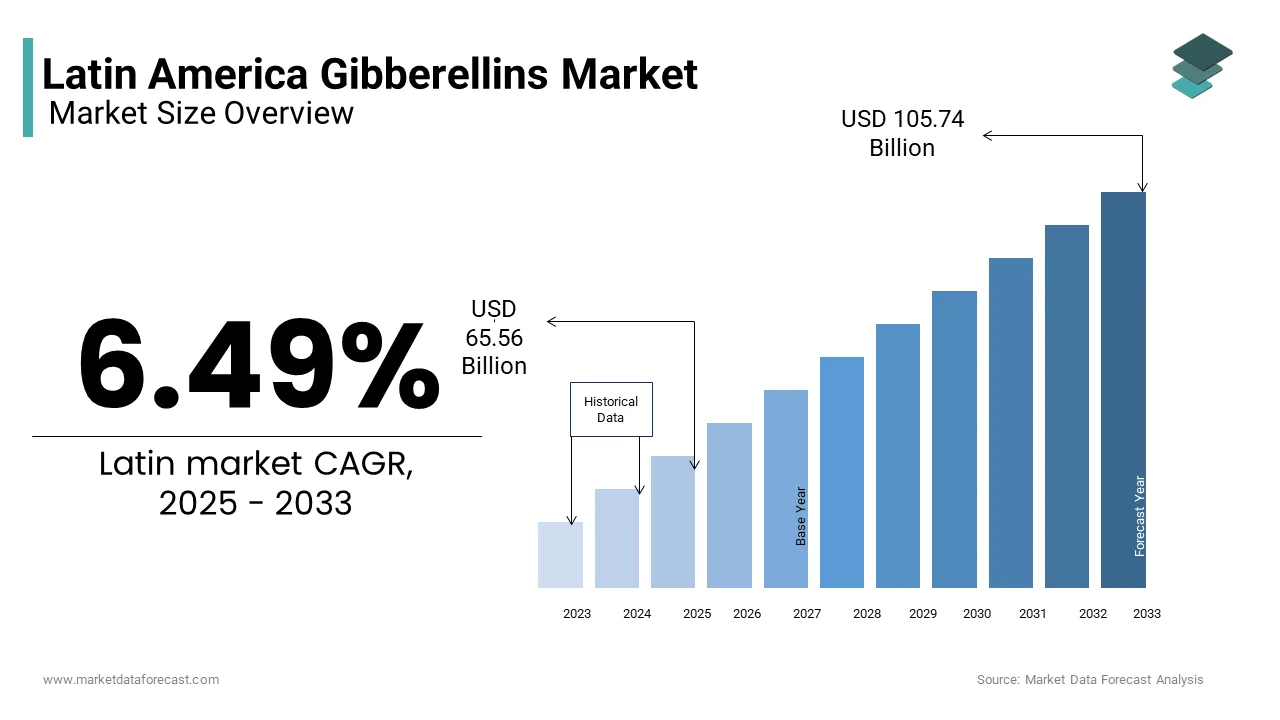
Gibberellins are naturally occurring plant hormones that regulate key physiological processes such as stem elongation, seed germination, flowering, and fruit development. These phytohormones have become essential tools in modern agriculture for improving crop yield and quality, particularly in high-value crops such as fruits, vegetables, and sugarcane. The Latin American Gibberellins Market is gaining momentum due to increasing demand for advanced agricultural inputs that enhance productivity while addressing climate-induced challenges such as erratic rainfall and soil degradation. Brazil, the largest agricultural producer in the region, has been at the forefront of adopting gibberellins in sugarcane, citrus, and coffee cultivation.
MARKET DRIVERS
Expansion of High-Value Horticulture and Specialty Crops
The rapid expansion of high-value horticulture and specialty crops in countries like Chile, Peru, and Colombia is driving the growth of the Latin American Gibberellins Market. These nations have seen a surge in the export of fruits, berries, and exotic vegetables, which require precise growth regulation to meet international quality standards. Gibberellins play a crucial role in enhancing fruit set, improving size, and delaying senescence, making them indispensable in export-oriented farming. According to the International Trade Centre (ITC), Latin America’s fruit and vegetable exports grew by 14% between 2020 and 2023, with Peru alone exporting over 2.5 million tons of fresh produce annually. In Chile, which is a major exporter of grapes and blueberries, gibberellins are widely used to regulate flowering and enhance berry size, ensuring compliance with stringent export specifications. The Chilean Agricultural Service (SAG) reported that over 70% of commercial grape growers in the Central Valley use gibberellin-based treatments to improve bunch uniformity and marketability.
Adoption of Gibberellins in Sugarcane Cultivation
The widespread adoption of gibberellins in sugarcane cultivation in Brazil, with the world’s largest producer of sugar and ethanol, is accelerating the growth of the Latin American Gibberellins Market. Gibberellins are extensively used in this sector to promote internode elongation, increase cane length, and enhance sugar content, all of which directly impact yield and profitability. In addition to yield enhancement, gibberellins are used to synchronize flowering in sugarcane, which is important for hybrid seed production and genetic improvement programs. The Brazilian Agricultural Research Corporation (EMBRAPA) has been actively promoting the use of gibberellins in sugarcane breeding, citing a 12% improvement in flowering synchronization in treated fields. Moreover, in countries like Colombia and Mexico, where sugarcane is a major cash crop, agricultural extension services have been encouraging farmers to adopt gibberellin-based treatments to mitigate the impact of climate variability on crop cycles.
MARKET RESTRAINTS
Limited Access to Technical Knowledge and Extension Services
The limited access to technical knowledge and extension services among smallholder farmers is restricting the growth of the Americanmerica Gibberellins Market. According to the Inter-American Institute for Cooperation on Agriculture (IICA), less than 30% of smallholder farmers in Central America receive formal training on the use of plant growth regulators, including gibberellins.
In countries like Bolivia, Ecuador, and parts of Central America, the absence of robust agricultural extension networks hampers the dissemination of best practices for gibberellin use. The Food and Agriculture Organization (FAO) reported that only 15% of farmers in these regions have regular access to technical advisors, leading to underutilization or improper application of plant growth regulators. Additionally, misinformation and reliance on informal advice from agrochemical retailers contribute to inconsistent usage patterns.
Regulatory and Environmental Concerns
The growing regulatory scrutiny and environmental concerns surrounding the use of plant growth regulators are limiting the growth of the Latin American Gibberellins Market. While gibberellins are naturally derived, their synthetic analogs and excessive use can have unintended effects on soil health and aquatic ecosystems. In response, regulatory bodies in several Latin American countries have introduced stricter guidelines for the registration and application of agricultural biostimulants. In Brazil, the Ministry of the Environment has been reviewing the long-term ecological impact of plant growth regulators, including gibberellins, in major agricultural zones. The Brazilian Institute of Environment and Renewable Natural Resources (IBAMA) has raised concerns about residues in water bodies near sugarcane plantations, prompting calls for more sustainable application practices.
MARKET OPPORTUNITIES
Integration of Gibberellins into Organic and Sustainable Farming Systems
The integration of gibberellins into organic and sustainable farming systems is creating new opportunities for the growth of the Latin American Gibberellins Market. As consumer demand for organic produce continues to rise globally, Latin American farmers are increasingly adopting certified organic practices to access premium markets in North America and Europe. Gibberellins, being naturally occurring or bio-fermented compounds, are well-suited for inclusion in organic farming protocols. In Argentina, the National Institute of Agricultural Technology (INTA) has included gibberellins in its list of approved inputs for organic grape and citrus production, encouraging their use among certified organic growers. Similarly, in Peru, the Ministry of Agriculture and Irrigation has been promoting the use of gibberellins in organic avocado and quinoa farming to improve flowering and yield without synthetic chemicals.
Technological Advancements in Biostimulant Formulations
The technological advancements in biostimulant formulation are also expanding the growth of the Latin American Gibberellins Market. Innovations in formulation technologies, such as microencapsulation, controlled-release systems, and nano-based delivery mechanisms, are enhancing the efficacy and application efficiency of gibberellins in agriculture. These advanced formulations allow for targeted delivery, improved stability, and reduced environmental impact, making gibberellins more attractive to both commercial and smallholder farmers. In Brazil, companies like Biogene and Atanor are investing in R&D to develop next-generation gibberellin-based biostimulants that can be integrated into precision agriculture systems. The Brazilian Agricultural Research Corporation (EMBRAPA) reported that the adoption of nano-formulated plant growth regulators has contributed to a 10% increase in vegetable yield in controlled environments. These technological developments are opening new avenues for market growth and enhancing the competitiveness of gibberellins in the evolving agricultural input landscape.
MARKET CHALLENGES
Price Volatility and Supply Chain Constraints
The price volatility and supply chain constraints for raw materials used in the production of gibberellins are also hampering the growth of the Latin American Gibberellins Market. The synthesis of gibberellins involves fermentation processes using specific fungal strains, primarily Gibberella fujikuri, and any disruptions in the availability of these biological inputs can affect production timelines and costs. Moreover, the market is heavily dependent on imports of fermentation-based agricultural inputs from Asia and Europe, making it vulnerable to geopolitical and logistical disruptions. For example, in 2022, a temporary shortage of key fermentation strains from China led to a 20% price increase in gibberellin products across Brazil and Argentina.
Limited Financial Access for Smallholder Farmers
The limited financial access for smallholder farmers, which restricts their ability to invest in advanced agricultural inputs like gibberellins is also restricts the growth of the LatinAmericana Gibberellins Market. Despite the growing awareness of plant growth regulators, many small-scale farmers lack access to credit, insurance, and financial services that would enable them to adopt these technologies. According to the International Fund for Agricultural Development (IFAD), only 35% of smallholder farmers in Latin America have access to formal credit, limiting their capacity to invest in high-value inputs. In countries like Honduras, Guatemala, and Paraguay, where small-scale farming is predominant, the lack of financing options hampers the adoption of gibberellin-based solutions. The World Bank reported that financial inclusion in the agricultural sector remains low, with less than 20% of rural farmers benefiting from government or private-sector credit programs. Additionally, the absence of crop insurance schemes that cover biostimulant applications further discourages investment in gibberellins.
REPORT COVERAGE
| REPORT METRIC | DETAILS |
| Market Size Available | 2025 to 2034 |
| Base Year | 2025 |
| Forecast Period | 2026 to 2034 |
| CAGR | 6.49% |
| Segments Covered | By Manufacturing Method, Type, Shape, and Region. |
| Various Analyses Covered | Global, Regional & Country Level Analysis, Segment-Level Analysis, DROC, PESTLE Analysis, Porter’s Five Forces Analysis, Competitive Landscape, Analyst Overview on Investment Opportunities |
| Regions Covered | Brazil, Mexico, Argentina, Chile, Etc. |
| Market Leaders Profiled | Zhejiang Qianjiang Biochemical Co., Ltd., Shanghai Pengteng Fine Chemical Co., and Jiangsu Fengyuan Bioengineering Co |
SEGMENTAL ANALYSIS
By Manufacturing Method Insights
The MEP Pathway segment held a dominant share of the Latin America Gibberellins market in 2025 due to its widespread use in commercial gibberellin synthesis, particularly in Brazil and Argentina, where large-scale agricultural operations demand high-volume production. According to the Brazilian Agricultural Research Corporation (EMBRAPA), over 75% of gibberellin production in Brazil is based on the MEP Pathway due to its efficiency in synthesizing GA3, the most commonly used gibberellin in sugarcane and fruit cultivation. Additionally, the pathway’s ability to yield multiple gibberellin isoforms enhances its versatility across various crop types, making it a preferred choice among manufacturers. Another contributing factor is the availability of fermentation infrastructure in Latin America, especially in Brazil, which has a well-established agrochemical and biotechnology sector.
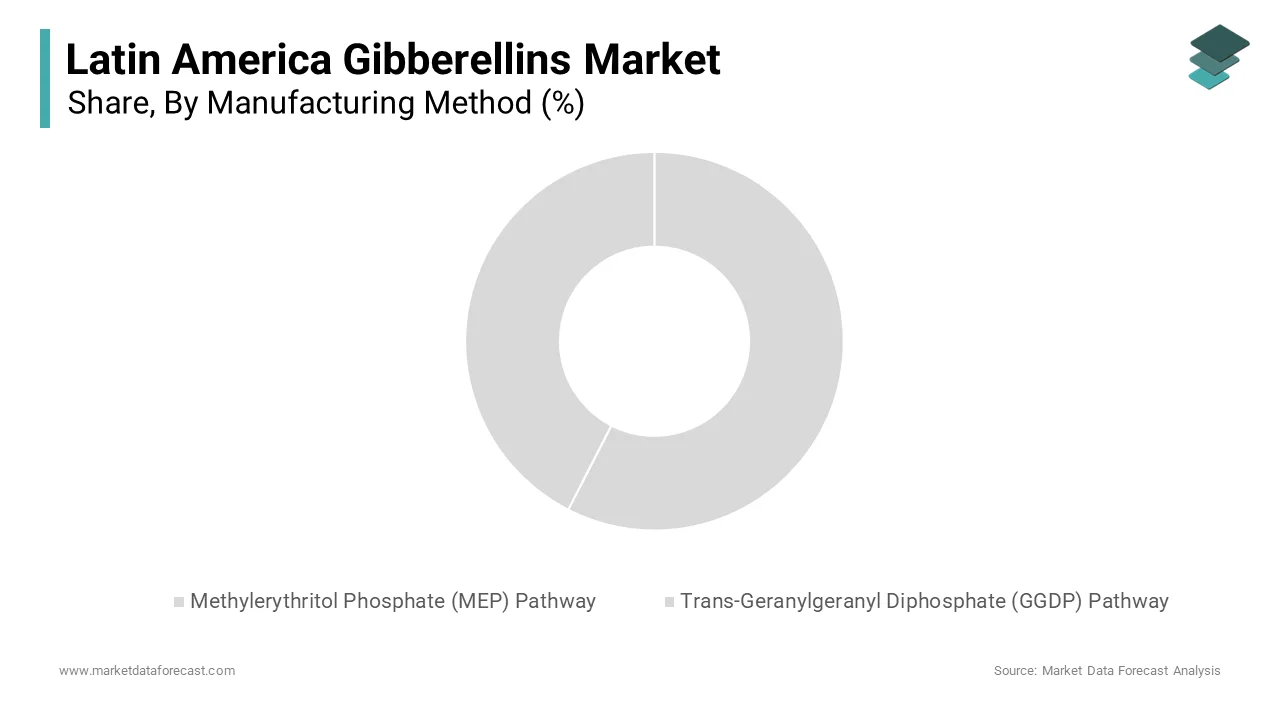
The GGDP Pathway is projected to grow with a CAGR of 9.8% from 2025 to 2033 with the GGDP Pathway is its higher specificity in synthesizing precise gibberellin compounds, which is particularly valuable in controlled-environment agriculture and tissue culture applications. According to the National Institute of Agricultural Technology (INTA) in Argentina, the use of GGDP-derived gibberellins in grape and citrus orchards has increased by 23% in recent years, driven by their ability to regulate flowering and fruit set with minimal side effects. Additionally, the rise in biotechnological research and development across Latin America is propelling the GGDP Pathway’s adoption. For instance, in Chile, the Agricultural Research Institute (INIA) has funded multiple projects aimed at optimizing GGDP-based gibberellin synthesis for use in berry and avocado farming.
By Shape Insights
The liquid form segment was the largest and held 52.3% of the Latin Gibberellins Market share in 2025 due to the high solubility and ease of application of liquid gibberellin formulations in foliar sprays, seed treatments, and fertigation systems widely used in intensive farming practices. According to the Mexican National Institute for Forestry, Agricultural and Livestock Research (INIFAP), over 60% of commercial growers in Mexico prefer liquid formulations for their ease of mixing with other agrochemicals and uniform application across large fields. Another key driver is the increased adoption of liquid gibberellins in controlled-environment agriculture, particularly in Chile and Peru. As per the Peruvian Agricultural Society, liquid formulations accounted for 70% of all plant growth regulator applications in greenhouse and hydroponic systems in 2023, due to their rapid absorption and minimal residue.
The granules segment is expected to grow with a CAGR of 10.5% from 2025 to 2033, with the increasing demand for user-friendly and safe application methods in rural farming communities. In countries like Colombia, Ecuador, and Paraguay, granular formulations are preferred due to their low handling complexity and reduced risk of phytotoxicity compared to liquid sprays. Additionally, the rise of bio-fortified and slow-release fertilizers in the region is driving the integration of gibberellin granules into composite agricultural inputs. As per the Latin American Fertilizer Association, granule-based plant growth regulators are now being included in over 30% of organic fertilizer blends distributed under government agricultural programs in Central America.
COUNTRY-LEVEL ANALYSIS
Brazil
Brazil was the largest contributor in the Latin American Gibberellins Market by accounting for 35.3% the share in 2025. Brazil is the government’s push toward modernizing agriculture through the use of biostimulants and plant growth regulators. According to the Brazilian Agricultural Research Corporation (EMBRAPA), the adoption of gibberellin-based products in commercial farming increased by 17% between 2020 and 2023, with over 65% of large-scale sugarcane plantations using these regulators for improved internode elongation and sugar content. Additionally, the presence of domestic manufacturers like Atanor and Biogene has facilitated the local production and affordability of gibberellins.
Argentina
Argentina Gibberellins Market held 20.3% of the share in 2025, owing to the rising adoption of Gibberellin vineyardswhere they are used to regulate flowering and improve bunch uniformity. According to the National Institute of Agricultural Technology (INTA), over 80% of commercial grape growers in Mendoza now use gibberellin-based treatments, which contribute to a 12% increase in bunch weight and quality on average. Moreover, the National Ministry of Agriculture has been promoting the use of plant growth regulators as part of its climate-resilient farming initiatives. As per INTA, the use of gibberellins in citrus and stone fruit cultivation increased by 18% during the last five years, driven by government-backed extension programs and farmer training initiatives.
Chile
Chile Gibberellins Market growth is driven by its high-value export-oriented agriculture in berries, grapes, and avocados. Chile is the expansion of precision farming systems, where gibberellins are used to regulate plant growth under varying climatic conditions. According to the Agricultural Research Institute (INIA), over 65% of commercial berry producers use gibberellins to enhance flowering and fruit size, ensuring compliance with international quality standards. The Chilean Agricultural Service (SAG) reported that gibberellin-based formulations accounted for 35% of all plant growth regulator applications in the export fruit sector in 2023.
Mexico
Mexico Gibberellins Market growth is steadily growing with its focus on specialty crops and export-oriented horticulture. The country’s limited arable land and high labor costs have led to the adoption of intensive farming technologies, where gibberellins play a crucial role in optimizing plant growth and productivity. Additionally, the integration of gibberellins into precision agriculture systems has gained momentum in recent years.
Colombia
Colombia Gibberellins Market growth is with the expanding export agriculture sector and increasing emphasis on high-value crops such as bananas, avocados, and cut flowers. The country’s diverse agro-climatic zones make it ideal for year-round production, which is driving the need for plant growth regulators like gibberellins. Additionally, the Colombian government has been promoting the use of biostimulants as part of its national agricultural modernization strategy. As per the ICA, gibberellin-based products are now used in 30% of certified organic banana and avocado farms, which is contributing to Colombia’s growing role in the regional gibberellins market.
KEY MARKET PLAYERS
Zhejiang Qianjiang Biochemical Co., Ltd., Shanghai Pengteng Fine Chemical Co., and Jiangsu Fengyuan Bioengineering Co. are the leaders in the Latin American Gibberellins market.
Top Players In The Market
One of the leading players in the Latin American Gibberellins Market is BASF SE, a global leader in agricultural inputs and biostimulants. The company has a strong presence across the region, offering a wide range of plant growth regulators, including gibberellin-based formulations. BASF focuses on developing innovative, sustainable agricultural solutions tailored to regional crop needs, particularly in high-value fruits and sugarcane. Its commitment to R&D and strategic partnerships with local agricultural institutions has enabled it to maintain a competitive edge in the Latin American market.
Another key player is UPL Limited, which is one of the largest agrochemical companies globally and a major supplier in Latin America. UPL has significantly expanded its portfolio of biostimulants and plant growth regulators, promoting the use of gibberellins in high-value crops such as fruits, vegetables, and sugarcane. The company emphasizes sustainable agricultural practices and has been actively involved in training programs and farmer education to enhance product adoption across the region.
Corteva Agriscience is also a major participant, known for its advanced agricultural biotechnology solutions. Corteva has integrated gibberellins into several of its crop enhancement product lines, focusing on precision agriculture and digital farming tools. The company’s strong distribution network and localized product development strategies have helped it build a solid presence in Latin America, which is supporting farmer adoption of gibberellin-based applications.
Top Strategies Used By Key Market Participants
One of the primary strategies adopted by key players in the Latin American Gibberellins Market is product innovation and investment in R&D. Companies are continuously developing new formulations and application methods to improve the efficacy and sustainability of gibberellin-based products. These innovations help meet the evolving needs of modern agriculture in precision and export-oriented farming.
Another key strategy is strategic partnerships and collaborations with research institutions, agricultural cooperatives, and government bodies. These alliances help companies gain insights into regional crop requirements and facilitate the adoption of gibberellins through training and demonstration programs. Such collaborations also aid in regulatory approvals and market penetration.
The market expansion through localized distribution networks is a major focus for leading players. By strengthening their presence in rural and emerging agricultural markets, companies ensure better accessibility and affordability of gibberellin-based solutions. This approach supports widespread adoption and long-term market growth across Latin America.
COMPETITIVE LANDSCAPE
The Latin American Gibberellins Market is marked by a competitive environment shaped by the presence of both global agrochemical leaders and regional specialty chemical companies. The market dynamics are driven by continuous product innovation, strategic collaborations, and efforts to expand into high-growth agricultural regions. As demand for sustainable and high-yield farming practices rises, companies are intensifying their focus on developing more effective and environmentally friendly gibberellin formulations. The competition is further intensified by the growing influence of biotechnology firms integrating gibberellins into advanced plant growth solutions. With regulatory frameworks varying across countries, market participants are adapting their strategies to align with local compliance standards while enhancing supply chain efficiencies. Additionally, the increasing emphasis on farmer education and technical support is playing a crucial role in shaping market positioning.
RECENT HAPPENINGS IN THE MARKET
- In February 202, BASF SE launched a new line of gibberellin-based biostimulant products tailored for tropical fruit cultivation in Brazil. The launch was aimed at supporting improved flowering and fruit development in mango and papaya farms, aligning with the country’s expanding export-oriented horticulture sector.
- In June 2023, UPL Limited formed a strategic alliance with a leading agricultural research institute in Argentina to develop region-specific gibberellin formulations for grape and citrus growers. This initiative was designed to enhance product efficacy and support sustainable viticulture and orchard farming.
- In October 2023, Corteva Agriscience introduced a farmer advisory program in Chile, integrating digital tools with gibberellin application recommendations. The program was aimed at improving precision in berry and avocado farming, where gibberellins play a key role in enhancing yield and quality.
- In December 2023, a major Brazilian agrochemical firm expanded its gibberellin production capacity by commissioning a new fermentation unit in São Paulo. The expansion was intended to meet rising domestic and regional demand, particularly from sugarcane and fruit plantations.
- In August 2023, a Peruvian biotech startup partnered with a Colombian agribusiness to integrate gibberellin-based growth regulators into automated greenhouse systems. The collaboration focused on optimizing flowering and fruiting cycles in high-value export crops like blueberries and avocados.
MARKET SEGMENTATION
This research report on the Latin American gibberellins market is segmented and sub-segmented into the following categories.
By Manufacturing Method
- Methylerythritol Phosphate (MEP) Pathway
- Trans-Geranylgeranyl Diphosphate (GGDP) Pathway
By Type
- 19-Carbon Gibberellins
- 20-Carbon Gibberellins
By Shape
- Powder
- Granules and Liquid
By Country
- Brazil
- Mexico
- Argentina