- Product Description Description
- Table of Contents TOC
- List of Table & Figure LOT
- Get Free Sample PDF Sample PDF
Market Size, 2025
$0.13 BnMarket Estimate, 2026
$0.14 BnMarket Forecast, 2034
$0.19 BnCAGR, 2026–2034
4.55%Executive Summary: Latin America Industrial Vegetation Management Market
- Market Scope: Comprehensive Latin American industrial vegetation management market analysis covering application sectors, product types, country-level insights, regulatory frameworks, and precision technologies.
- Market Valuation: Valued at USD 0.13 billion (2025), estimated at USD 0.14 billion (2026), and projected to reach USD 0.19 billion by 2034, registering a robust CAGR of 4.55% (2026–2034).
- Primary Growth Drivers: Expansion of energy infrastructure and power transmission networks, stringent regulatory compliance and environmental safety standards, rising adoption of renewable energy corridors, and integration of precision technologies like drones and GIS-based monitoring.
Key Market Segment Metrics (2026–2034)
| Category | Leading Segment (2025 Position) | Fastest-Growing Segment |
|---|---|---|
| By Application | Electric Utilities and Pipelines (accounted for 36.5% of the market share in 2025, driven by rights-of-way maintenance) | Railroads (projected to grow with a CAGR of 8.9% driven by modernization projects and advanced IVM strategies) |
| By Product | Herbicides (largest segment, capturing 58.4% of the market share in 2025 due to cost-effective large-scale control) | Plant Growth Regulators (PGRs) (growing at a CAGR of 10.2% as a sustainable alternative in sensitive ecosystems) |
| By Country | Brazil (top performer with a 34.3% market share in 2025, supported by a vast electrical transmission grid and agricultural industries) | Argentina / Chile (rapidly expanding markets driven by agricultural modernization, renewable infrastructure, and strict environmental frameworks) |
Major Market Players & Market Structure
Market Structure: Highly competitive landscape featuring global agrochemical giants and regional specialists competing on product diversification, sustainable formulations, precision application technologies, and strategic partnerships with infrastructure operators.
Key Companies: Dow AgroSciences (Corteva Agriscience), Monsanto, DuPont, BASF SE, Nufarm Limited, Arysta LifeScience (UPL Corporation), Makhteshim Agan, Boultbee Vegetation Management, Helena, Dbi Services, FMC Corporation, and Cetech Co., Ltd.
 Download Free Sample Report
Latin America Industrial Vegetation Management Market Size
The Latin American industrial vegetation management market size was valued at USD 0.13 billion in 2025 and is anticipated to reach USD 0.14 billion in 2026 and USD 0.19 by 2034, growing at a CAGR of 4.55% from 2026 to 2034.
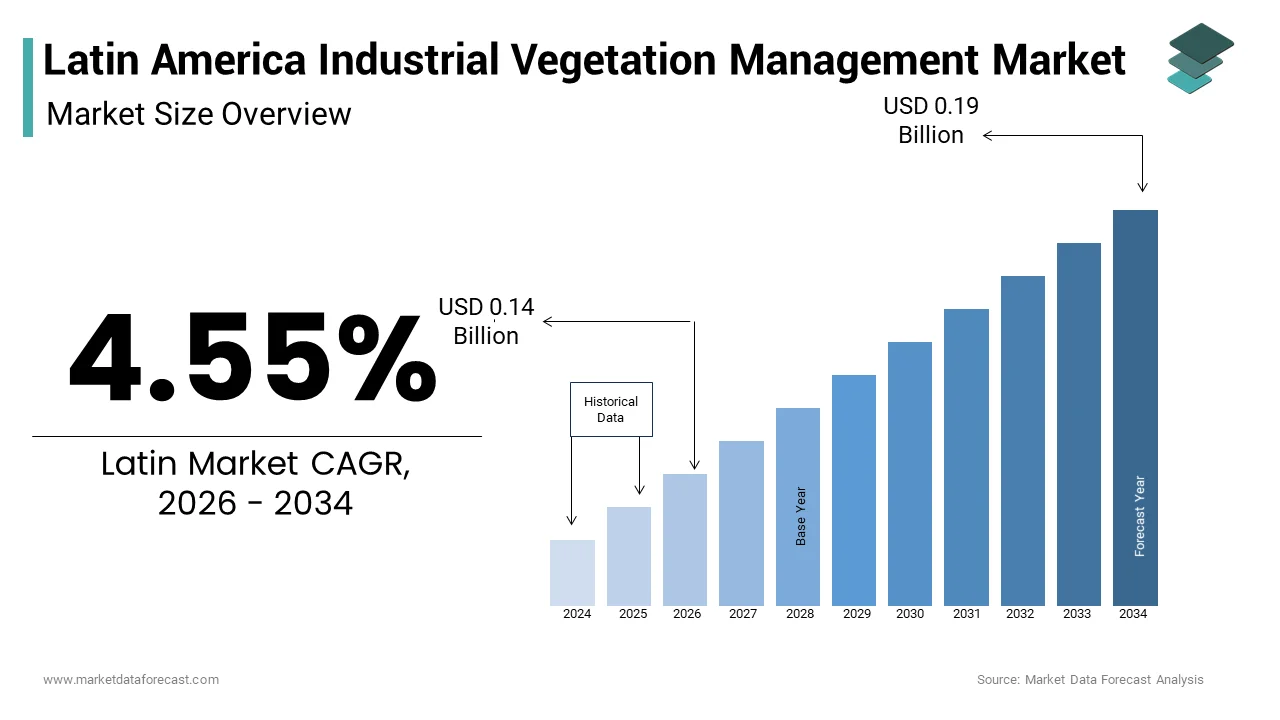
Industrial vegetation management is a range of practices and technologies aimed at controlling, maintaining, and managing plant growth in industrial settings such as utility corridors, railways, pipelines, mining sites, and agricultural perimeters. These services are crucial for ensuring operational safety, preventing infrastructure damage, reducing fire risks, and complying with environmental regulations. Industrial vegetation management involves mechanical clearing, chemical herbicide application, biological control methods, and increasingly, precision technologies like drones and GIS-based monitoring systems. According to the Food and Agriculture Organization (FAO), unplanned vegetation encroachment contributes to over 20% of power outages in rural Latin American regions the necessity proactive vegetation control near electrical transmission lines.
MARKET DRIVERS
Expansion of Energy Infrastructure and Power Transmission Networks
The ongoing expansion of energy infrastructure and power transmission networks across the region is a key factor propelling the growth of the Latin American Industrial Vegetation Management Market. According to the International Energy Agency (IEA), Latin America added over 40 gigawatts of new power generation capacity between 2018 and 2023, much of it connected through extensive high-voltage transmission lines. In Brazil, which leads the region in installed transmission infrastructure, the National Electric Energy Agency (ANEEL) mandates periodic vegetation clearance along utility corridors to ensure grid reliability. Additionally, the rise of solar and wind farms, often located in remote areas surrounded by dense vegetation, has further increased the demand for specialized vegetation management services.
Regulatory Compliance and Environmental Safety Standards
The tightening of regulatory compliance and environmental safety standards imposed by national and regional authorities is additionally to fuel the growth of the Latin America Industrial Vegetation Management Market. Governments across the region are increasingly mandating responsible vegetation control practices to mitigate ecological harm while ensuring industrial operations remain safe and functional. As per the United Nations Environment Programme (UNEP), several Latin American countries have introduced policies requiring utility companies and infrastructure operators to adopt integrated vegetation management (IVM) techniques that minimize soil erosion, protect biodiversity, and avoid excessive chemical use. For instance, in Colombia, the National Authority of Environmental Licenses (ANLA) requires all pipeline and power corridor operators to submit detailed vegetation management plans before project approval. Non-compliance can result in fines or operational suspensions, compelling companies to invest in certified and sustainable vegetation control services.
MARKET RESTRAINTS
High Operational Costs and Limited Budget Allocations
The high cost of implementing and maintaining effective vegetation control programs for smaller utilities and infrastructure operators is impeding the growth of the Latin American Industrial Vegetation Management Market. Comprehensive vegetation management involves recurring expenses related to labor, equipment, chemical treatments, and advanced monitoring technologies by making it a significant financial burden.
According to the World Bank, many municipalities and state-owned enterprises in Central and South America operate under constrained budgets, often prioritizing immediate infrastructure repairs over long-term vegetation maintenance. This results in inconsistent or delayed vegetation control activities, increasing the risk of service disruptions and environmental hazards. In Ecuador and Bolivia, for example, limited government funding has led to outdated vegetation management practices, with reliance on manual cutting rather than more efficient mechanized or chemical solutions. Furthermore, the rising costs of environmentally compliant herbicides and the need for trained personnel add to the financial strain.
Public Opposition and Environmental Concerns Over Herbicide Use
Public opposition and environmental concerns surrounding the use of chemical herbicides are expected to restrict the growth of the Latin American Industrial Vegetation Management Market. While herbicides offer an efficient means of large-scale vegetation control, their potential impact on water sources, biodiversity, and human health has sparked resistance from local communities and environmental groups. According to Greenpeace Latin America, several protests and legal actions have been initiated against utility and railway companies in Brazil and Peru due to allegations of groundwater contamination linked to glyphosate-based herbicides. In response, regulators in countries like Chile and Costa Rica have imposed stricter guidelines on herbicide use, requiring comprehensive environmental impact assessments before approval. Additionally, misinformation and lack of awareness among rural populations about the controlled and targeted nature of industrial herbicide applications contribute to negative perceptions.
MARKET OPPORTUNITIES
Adoption of Precision Technologies and Digital Monitoring Systems
The growing adoption of precision technologies and digital monitoring systems for vegetation control is substantially to create new opportunities for the Latin American Industrial Vegetation Management Market. The integration of artificial intelligence, satellite imaging, drones, and geographic information systems (GIS) enables more accurate, real-time vegetation tracking and targeted interventions. According to McKinsey & Company, the use of drone-based surveillance and AI-powered analytics can reduce vegetation management costs by up to 30% while improving compliance and operational efficiency. Companies are increasingly deploying aerial drones equipped with multispectral cameras to assess vegetation density, identify encroaching species, and plan precise treatment schedules.
Growth of Renewable Energy Corridors Requiring Continuous Vegetation Control
The rapid expansion of renewable energy infrastructure, particularly wind and solar farms, which require dedicated transmission corridors and consistent vegetation management, is eventually to amplify the growth of the Latin America Industrial Vegetation Management Market in the coming years. According to the International Renewable Energy Agency (IRENA), Latin America added over 25 GW of renewable energy capacity between 2020 and 2023, with Brazil, Chile, and Mexico leading the transition. These projects often span vast, undeveloped landscapes where natural vegetation grows rapidly, posing persistent challenges for site access, panel efficiency, and grid connectivity.
Solar farms, for example, require frequent clearing of ground-level vegetation to maintain optimal sunlight absorption and prevent overheating. Wind farms situated in remote grasslands face similar issues, with tall vegetation obstructing airflow and increasing maintenance risks.
MARKET CHALLENGES
Fragmented Regulations and Lack of Standardized Guidelines
The fragmented regulatory landscape and lack of standardized guidelines across countries a huge challenging factors for the Latin America Industrial Vegetation Management Market key players. In countries like Peru and Guatemala, local governments impose additional restrictions beyond federal regulations, further complicating vegetation management planning. This regulatory dissonance discourages investment from global vegetation management firms, which prefer markets with uniform policies and predictable enforcement.
Seasonal Variability and Climate-Related Disruptions
Seasonal variability and climate-related disruptions pose a significant challenge to the Latin American Industrial Vegetation Management Market. The region experiences diverse climatic conditions, including prolonged rainy seasons, droughts, and extreme weather events that affect vegetation growth rates and accessibility to infrastructure corridors. According to the Intergovernmental Panel on Climate Change (IPCC), rainfall patterns in parts of Brazil, Colombia, and Ecuador have become increasingly unpredictable, which is leading to faster-than-expected regrowth of vegetation and higher maintenance frequency. In Argentina and Chile, extended dry periods followed by sudden bursts of rain accelerate weed proliferation, requiring more frequent and intensive vegetation control measures. Additionally, hurricanes and floods in Central America often wash away previously treated areas, necessitating reapplication and increasing overall operational costs. These climatic fluctuations complicate scheduling and resource allocation, making long-term vegetation management planning more challenging.
REPORT COVERAGE
| REPORT METRIC | DETAILS |
| Market Size Available | 2025 to 2034 |
| Base Year | 2025 |
| Forecast Period | 2026 to 2034 |
| CAGR | 4.55% |
| Segments Covered | By Application, Product, and Region. |
| Various Analyses Covered | Global, Regional, and Country-Level Analysis, Segment-Level Analysis, DROC, PESTLE Analysis, Porter’s Five Forces Analysis, Competitive Landscape, Analyst Overview of Investment Opportunities |
| Regions Covered | Brazil, Chile, Argentina, Chile, Mexico |
| Market Leaders Profiled | Dow AgroSciences, Monsanto, DuPont, BASF, Nufarm, Makhteshim Agan, Boultbee Vegetation Management, Helena, and Dbi Services. |
SEGMENTAL ANALYSIS
By Application Insights
The Electric Utilities and Pipelines segment accounted in holding 36.5% of the Latin America Industrial Vegetation Management Market share in 2025. The growth in this segment is attributed to be driven by the need to maintain clear rights-of-way along power transmission lines and oil and gas pipelines to prevent service disruptions and ensure operational safety. According to the International Energy Agency (IEA), Brazil alone operates over 1 million kilometers of electricity transmission lines, many of which traverse forested or rural landscapes where vegetation encroachment poses a persistent risk. The National Electric Energy Agency (ANEEL) mandates regular vegetation clearance to reduce outage risks caused by tree growth near high-voltage infrastructure.

The Railroads segment is projected to grow with a CAGR of 8.9% during the forecast period. This rapid expansion is attributed to ongoing railway modernization projects and the need for consistent vegetation control along rail corridors to ensure safe and uninterrupted train operations. Additionally, the use of advanced vegetation management techniques such as drone surveillance and precision herbicide application is gaining traction in railroad operations. Companies like América Latina Logística (ALL) in Brazil are adopting integrated vegetation management (IVM) strategies that balance ecological concerns with operational efficiency. Furthermore, increased cargo movement across borders and the revival of mining railways in Argentina and Bolivia are driving sustained demand for vegetation control services.
By Product Insights
The herbicides segment was the largest by capturing 58.4% of the Latin America Industrial Vegetation Management Market share in 2025 due to their widespread adoption in large-scale vegetation control applications along utility corridors, roadways, and agricultural perimeters.
According to the Food and Agriculture Organization (FAO), herbicides offer a cost-effective and efficient means of managing unwanted plant growth without the labor-intensive nature of mechanical cutting. Their selective action allows for the targeted elimination of invasive species while preserving desirable ground cover, which makes them ideal for an integrated vegetation management (IVM) program. In Brazil and Argentina, glyphosate-based formulations remain widely used for clearing roadside and transmission line vegetation. Moreover, government-backed agricultural and infrastructure agencies continue to support herbicide-based vegetation control as part of sustainable land management practices.
The Plant Growth Regulators (PGRs) segment is likely to grow with an expected CAGR of 10.2% during the forecast period. These biologically active compounds inhibit excessive plant growth without killing vegetation entirely, offering a sustainable alternative to traditional herbicides. According to the Inter-American Institute for Cooperation on Agriculture (IICA), PGRs are increasingly being adopted in sensitive ecosystems where complete vegetation removal is neither feasible nor desirable. Their ability to suppress woody species and promote grass-dominated landscapes makes them ideal for utility corridors, rangelands, and conservation buffer zones. In Chile and Costa Rica, utility companies are integrating PGRs into their vegetation management strategies to align with stricter environmental regulations and community concerns over chemical runoff. Additionally, research conducted by the University of São Paulo demonstrated that PGR-treated areas showed a 40% reduction in reapplication frequency compared to conventional herbicide treatments.
COUNTRY-LEVEL ANALYSIS
Brazil
Brazil was the top performer in the Latin American Industrial Vegetation Management Market with a 34.3% share in 2025. The country’s vast electrical grid spanning over 1 million kilometers of transmission lines requires continuous vegetation management to prevent outages and wildfires. According to the National Electric Energy Agency (ANEEL), unplanned vegetation-related disruptions account for nearly one-third of all power failures in rural regions, with the importance of proactive management strategies. In addition, Brazil's expanding ethanol and soybean industries rely heavily on controlled vegetation management to protect agricultural infrastructure from invasive species and pest infestations. Government-led initiatives promoting integrated vegetation management (IVM) have further encouraged the adoption of precision tools and environmentally friendly herbicides.
Mexico
Mexico was positioned second with 22.3% of the Latin American Industrial Vegetation Management Market share in 2025. The presence of an extensive power grid and cross-border oil pipelines requires regular maintenance to prevent service interruptions is prompting the growth of the Latin America Industrial Vegetation Management Market. According to the Federal Electricity Commission (CFE), over 80% of unplanned power outages in northern states are attributed to vegetation overgrowth near transmission lines. In response, regulatory bodies have mandated more frequent vegetation assessments and the adoption of low-impact control methods.
Argentina
Argentina's industrial vegetation management market is likely to grow with a CAGR during the forecast period, with a well-established agricultural sector and a growing emphasis on infrastructure modernization, both of which drive demand for professional vegetation management services. The Ministry of Environment and Sustainable Development has introduced guidelines mandating the use of non-persistent herbicides and biological alternatives to minimize groundwater contamination. Moreover, Argentina’s expanding natural gas and petroleum pipeline networks require consistent vegetation monitoring to prevent root penetration and corrosion risks. State-owned YPF and private energy firms have increasingly engaged specialized vegetation contractors to ensure compliance and operational reliability. Universities and research institutions are also collaborating with international partners to develop localized vegetation control methodologies tailored to native flora.
Chile
Chile industrial vegetation management market is swiftly emerging with strong regulatory frameworks and environmental consciousness. Positioned as a leader in sustainable development, Chile integrates vegetation management into its broader climate resilience strategy. According to the Chilean National Forestry Corporation (CONAF), unplanned vegetation growth along utility corridors contributes significantly to seasonal wildfire outbreaks in central and southern regions. In response, authorities have mandated year-round vegetation control measures using a combination of herbicides, controlled burns, and mechanical mowing. Additionally, Chilean railway operators have begun deploying drone-assisted vegetation mapping to optimize maintenance schedules and improve safety.
Colombia
Colombia Industrial Vegetation Management Market growth is influenced by a strategic transit hub; Colombia’s expanding transportation and energy corridors require robust vegetation control mechanisms. According to the National Infrastructure Agency (ANI), over 60% of the country’s highways pass through dense tropical zones where vegetation grows rapidly, posing frequent maintenance challenges. Urbanization trends and foreign investment in logistics and mining sectors are further fueling demand for sustainable vegetation solutions.
KEY MARKET PLAYERS
The market is dominated by companies like Dow AgroSciences, Monsanto, DuPont, BASF, Nufarm, Makhteshim Agan, Boultbee Vegetation Management, Helena, and Dbi Services. Are the market players that are dominating the Latin American industrial vegetation management market?
Top Players In The Market
Arysta LifeScience (UPL Corporation)
Global Presence with Strong Regional Footprint Arysta LifeScience, now part of UPL Corporation, is a leading agrochemical and vegetation management solutions provider with significant influence across Latin America. The company offers a comprehensive portfolio of herbicides, bio-based plant growth regulators, and integrated vegetation management (IVM) programs tailored for utility corridors, railways, and pipeline operators.
Its strategic presence in Brazil, Argentina, and Mexico has enabled it to build strong partnerships with government agencies and private infrastructure developers. Arysta’s focus on sustainable formulations and precision application technologies has contributed to its reputation as a reliable partner in industrial vegetation control.
BASF SE
Germany-Based Multinational with Regional Partnerships
BASF, one of the world's largest chemical producers, plays a crucial role in the Latin American Industrial Vegetation Management Market through its advanced herbicide formulations and digital agricultural tools. The company supplies key active ingredients used in selective and non-selective vegetation control products, supporting large-scale infrastructure maintenance operations.
BASF collaborates with regional distributors and vegetation management service providers to ensure product availability and technical support across diverse ecosystems in Latin America. Its commitment to innovation includes developing low-impact herbicides that align with evolving environmental regulations. Additionally, BASF engages in training programs and sustainability initiatives aimed at improving vegetation management practices while minimizing ecological disruption.
Nufarm Limited – Australia-Based Agrochemical Company Active in Latin America
Nufarm has established a growing presence in the Latin American vegetation management sector by supplying high-performance herbicides and offering customized vegetation control strategies for electric utilities, railroads, and roadways. The company adapts its global expertise to suit local conditions, particularly in Brazil and Argentina, where vegetation pressure is intense due to tropical and subtropical climates. Nufarm works closely with contractors, government bodies, and industry associations to promote best practices in vegetation management. Its emphasis on technical support, formulation flexibility, and responsible use protocols has made it a trusted brand among regional stakeholders.
Top Strategies Used By Key Market Participants
One major strategy employed by key players in the Latin American Industrial Vegetation Management Market is product diversification and formulation adaptation, wherein companies develop herbicides, plant growth regulators, and biological agents tailored to regional flora and climatic conditions. This approach ensures higher efficacy and regulatory compliance across different countries.
The strategic partnerships with local applicators and infrastructure operators allow multinational firms to navigate complex regulatory landscapes and deliver targeted vegetation management services. Collaborations with railway companies, utility providers, and pipeline operators enhance market penetration and service customization.
Investment in education and awareness campaigns has become essential for building trust and promoting sustainable vegetation control practices. Companies conduct field demonstrations, training workshops, and stakeholder engagement programs to educate users on best practices, safety protocols, and environmental considerations.
COMPETITION OVERVIEW
The Latin American Industrial Vegetation Management Market features a mix of global agrochemical giants and emerging regional players competing on product innovation, sustainability, and service delivery. While multinational corporations like BASF, UPL, and Nufarm bring extensive R&D capabilities and established supply chains, local firms are increasingly gaining traction by offering cost-effective and climate-specific vegetation control solutions.
Competition is intensifying as governments impose stricter environmental regulations and industries demand more precise, data-driven vegetation management approaches. Companies are differentiating themselves not only through product quality but also via integrated service models that include drone monitoring, predictive analytics, and compliance consulting.
Market participants are also responding to rising public scrutiny around chemical usage by emphasizing eco-friendly alternatives such as plant growth regulators and mechanical clearing techniques. The convergence of technology, environmental responsibility, and industrial growth continues to attract investment and innovation are shaping a dynamic and evolving competitive environment in the Latin American market.
RECENT HAPPENINGS IN THE MARKET
- In January 2024, UPL Corporation launched a new line of environmentally friendly herbicides specifically formulated for tropical vegetation types found in Brazil and Colombia by aiming to meet stricter pesticide regulations while maintaining high efficacy in powerline and pipeline corridor management.
- In March 2024, BASF partnered with a leading Brazilian drone technology firm to integrate aerial surveillance with targeted herbicide application by enhancing precision and reducing environmental impact in large-scale vegetation control projects across South America.
- In June 2024, Nufarm expanded its technical advisory team in Argentina and Chile to provide on-site consultation and training for utility and railway operators, which is strengthening its regional client relationships and improving the adoption of sustainable vegetation management practices.
- In September 2024, a subsidiary of Corteva Agriscience introduced a mobile vegetation management platform in Mexico, enabling real-time monitoring, reporting, and planning of roadside and transmission line clearance activities to improve operational efficiency and regulatory compliance.
- In November 2024, FMC Corporation collaborated with Chilean renewable energy firms to implement vegetation suppression programs around solar farms using selective herbicides and growth inhibitors by ensuring long-term site accessibility and equipment protection without harming surrounding ecosystems.
MARKET SEGMENTATION
This research report on the Latin American industrial vegetation management market is segmented and sub-segmented into the following categories.
By Application
- Forestry
- Rangeland
- Pastureland
- Railroads
- Roadways
- Electric Utilities
- Pipelines
- Aquatic Areas
By Products
- Forestry
- Roadways
By Country
- Mexico
- Brazil
- Argentina