- Product Description Description
- Table of Contents TOC
- List of Table & Figure LOT
- Get Free Sample PDF Sample PDF
Market Size, 2025
$4.25 BnMarket Estimate, 2026
$4.49 BnMarket Forecast, 2034
$7.03 BnCAGR, 2026–2034
5.75%Executive Summary: Latin America Planting Equipment Market Analysis & Forecast (2026–2034)
- Market Scope: Comprehensive market analysis of the Latin American planting equipment industry covering machinery types (seed drills, air seeders, planters), design models (mechanical vs. automatic), crop categories, and key country-level markets (Brazil, Argentina, Chile, Mexico, Peru).
- Market Valuation: Valued at USD 4.25 billion in 2025, estimated at USD 4.49 billion in 2026, and projected to reach USD 7.03 billion by 2034, registering a compound annual growth rate (CAGR) of 5.75% (2026–2034).
- Primary Growth Drivers: Expansion of large-scale commercial farming in Brazil and Argentina, government initiatives promoting agricultural mechanization and rural credit, and the rapid rise of precision agriculture and digital farming tools.
Key Market Segment Metrics (2026–2034)
| Category | Leading Segment (2025 Position) | Fastest-Growing Segment |
|---|---|---|
| By Type | Seed Drills (accounted for 36.3% of total demand in 2025) | Air Seeders (projected at a CAGR of 7.5%) |
| By Design | Mechanical Planting Equipment (led with 54.6% sales share in 2025) | Automatic Planting Equipment (projected at a rapid CAGR of 8.2%) |
| By Crop Type | Cereals & Grains (commanded 45.3% share in 2025) | Fruits & Vegetables (projected at a CAGR of 6.4%) |
| By Region / Country | Brazil (estimated at 33.5% market share; leading grain exporter) | Chile & Mexico (driven by export-oriented specialty crops and agri-tech adoption) |
Major Market Players & Industry Structure
Market Structure: Highly competitive landscape comprising global machinery powerhouses and nimble regional manufacturers focusing on localized product design, expanded dealership networks, and smart agriculture integrations.
Key Companies: Deere & Company, AGCO Corporation, CNH Industrial N.V. (Case IH, New Holland), Stara, Buhler Industries, Kinze Manufacturing, SeedMaster Manufacturing, and Kverneland Group.
Latin America Planting Equipment Market Size
The Latin America planting equipment market size was valued at USD 4.25 billion in 2025 and is anticipated to reach a valuation of USD 4.49 billion in 2026 and USD 7.03 billion by 2034, growing at a CAGR of 5.75%, from 2026 to 2034.
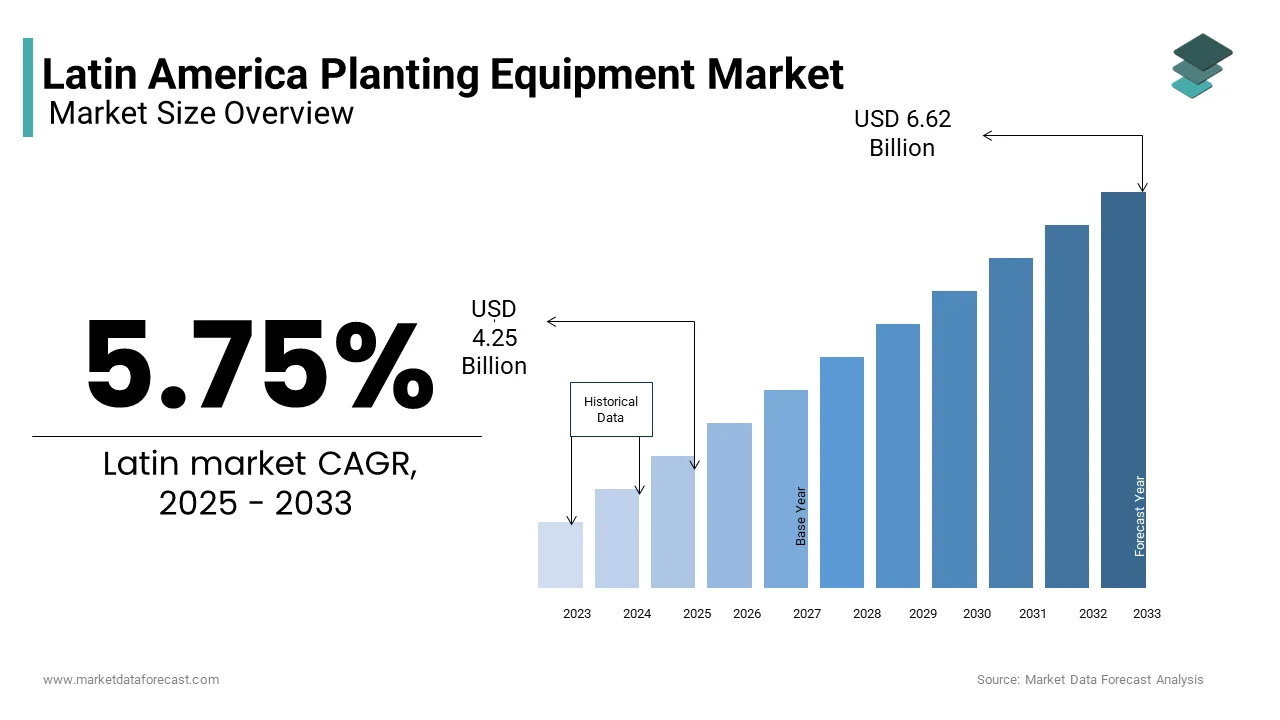
The Latin American planting equipment market encompasses a wide range of machinery designed for efficient seed placement in agricultural operations, including planters, seed drills, air seeders, and transplanters. This sector is increasingly shaped by the region’s growing emphasis on mechanization, food security, and sustainable farming practices. Agriculture remains a cornerstone of several economies in the region, particularly in Brazil, Argentina, and Paraguay, where large-scale commercial farming dominates. As per the Economic Commission for Latin America and the Caribbean (ECLAC), the agricultural sector contributes approximately 6% to the regional GDP, underscoring its economic significance. In recent years, there has been a gradual shift from traditional manual sowing techniques toward modern planting systems that improve efficiency and yield consistency. The integration of precision agriculture technologies into planting equipment is also gaining traction, especially in countries with strong export-oriented agribusinesses.
MARKET DRIVERS
Expansion of Large-Scale Commercial Farming Operations
The expansion of large-scale commercial farming, particularly in grain and oilseed production,n is one of the primary drivers of the Latin American planting equipment market. Countries like Brazil, Argentina, and Paraguay have seen a steady increase in the adoption of mechanized planting systems due to the growing size of farmland and rising labor costs. To meet the demand efficiently, farmers are investing in high-capacity planters and air seeders capable of covering vast areas quickly. With increasing exports of agricultural commodities, particularly to Asia and Europe, the need for advanced planting solutions continues to rise, reinforcing the growth trajectory of the market.
Government Initiatives Promoting Agricultural Mechanization
The implementation of government policies aimed at promoting agricultural mechanization and rural development is another key driver influencing the Latin American planting equipment market. Several national governments have introduced financial incentives, low-interest loans, and subsidies to encourage farmers to adopt modern planting technologies. The initiatives are particularly impactful in countries such as Peru and Ecuador, where mechanization levels remain relatively low compared to their Southern Cone counterparts. Also, increased public investment in rural infrastructure and digital extension services has further supported the adoption of modern planting equipment across the region.
MARKET RESTRAINTS
Limited Access to Financing for Smallholder Farmers
The limited access to financing options for smallholder farmers, who constitute a significant portion of the agricultural workforce, is a major restraint affecting the LaAmericanrica planting equipment market. Despite government-backed credit programs, many independent growers struggle to secure affordable loans due to high interest rates, stringent collateral requirements, and a lack of formal banking relationships. Additionally, the financial gap restricts the ability of smaller farms to invest in advanced planting equipment, limiting overall market penetration.
Underdeveloped Distribution and After-Sales Service Infrastructure
The underdeveloped distribution and after-sales service infrastructure, particularly in remote and rural areas, is another critical constraint in the Latin American planting equipment market. While multinational manufacturers have established a presence in major agricultural hubs, service networks often remain inadequate outside these zones, leading to prolonged equipment downtime and reduced customer satisfaction. Besides, in countries like Honduras and Nicaragua, where road infrastructure is poor and supply chains are fragmented, accessing maintenance services remains a persistent issue. This lack of reliable post-purchase support discourages potential buyers from investing in technologically advanced planting systems, thereby slowing market expansion.
MARKET OPPORTUNITY
Rise of Precision Agriculture and Digital Farming Tools
The rapid adoption of precision agriculture and digital farming tools is an emerging opportunity for the Latin American planting equipment market. As connectivity improves and mobile-based agritech platforms gain traction, farmers are increasingly seeking data-driven planting solutions that optimize seed placement, fertilizer usage, and soil health monitoring. In Brazil, companies like Stara and AGCO have introduced GPS-guided planters integrated with real-time analytics, enabling more efficient crop establishment. Apart from these, pilot projects involving autonomous planting drones have already begun in Argentina and Chile, demonstrating the region’s openness to innovation. With expanding internet access and increasing smartphone penetration, particularly in rural areas, the integration of digital tools into planting equipment presents a substantial growth avenue for manufacturers operating in Latin America.
Growth of Export-Oriented Specialty Crops
The expansion of export-oriented specialty crops such as fruits, vegetables, coffee, and quinoa is another promising opportunity within the Latin American planting equipment market. Unlike staple grains, which dominate the region’s agricultural landscape, specialty crops require precise and controlled planting techniques to ensure high yields and premium quality. This trend has spurred demand for specialized transplanters and precision seeders suited for high-value horticultural crops. Further, equipment manufacturers are responding by introducing modular and compact planting systems tailored for diverse terrains and smaller field sizes, opening new market segments across the region.
MARKET CHALLENGES
Volatility in Currency Exchange Rates Affects Equipment Imports
The volatility in currency exchange rates, which significantly impacts the cost of imported machinery and components, is one of the most pressing challenges facing the Latin American planting equipment market. Many of the region’s top-tier planting equipment brands originate from North America and Europe, making local prices highly susceptible to fluctuations in foreign exchange markets. For instance, inflation-linked currency instability has made long-term equipment procurement planning difficult for agribusinesses. These financial pressures are compounded by import duties and tariffs, which vary widely across countries and further inflate equipment costs. As a result, even when demand exists, affordability becomes a barrier, slowing down the adoption of modern planting technologies in key agricultural markets across Latin America.
Climate Variability and Seasonal Uncertainty Impacting Farming Cycles
Climate variability and seasonal uncertainty pose a significant challenge to the Latin American planting equipment market, as unpredictable weather patterns disrupt traditional sowing cycles and affect farmer confidence in long-term investments. The region has experienced an increasing frequency of extreme weather events such as droughts, floods, and unseasonal frosts, all of which impact planting decisions and equipment utilization. Additionally, irregular rainfall patterns in the Cerrado region have forced many farmers to reevaluate their planting strategies, sometimes opting for lower-cost manual alternatives instead of investing in high-tech equipment. These climatic uncertainties not only affect immediate planting schedules but also create hesitancy among farmers regarding capital expenditures, ultimately influencing the pace of market growth.
REPORT COVERAGE
| REPORT METRIC | DETAILS |
| Market Size Available | 2025 to 2034 |
| Base Year | 2025 |
| Forecast Period | 2026 to 2034 |
| CAGR | 5.75% |
| Segments Covered | By Type, Design, Crop, and Region. |
| Various Analyses Covered | Global, Regional, and Country Level Analysis, Segment-Level Analysis, DROC, PESTLE Analysis, Porter’s Five Forces Analysis, Competitive Landscape, Analyst Overview of Investment Opportunities |
| Regions Covered | Brazil, Chile, Argentina, Mexico, and Colombia, etc |
| Market Leaders Profiled | Deere & Company, AGCO Corporation, Buhler Industries, Inc., Kinze Manufacturing, Inc., SeedMaster Manufacturing Ltd., and Morris Industries Ltd. |
SEGMENTAL ANALYSIS
By Type Insights
Seed Drills
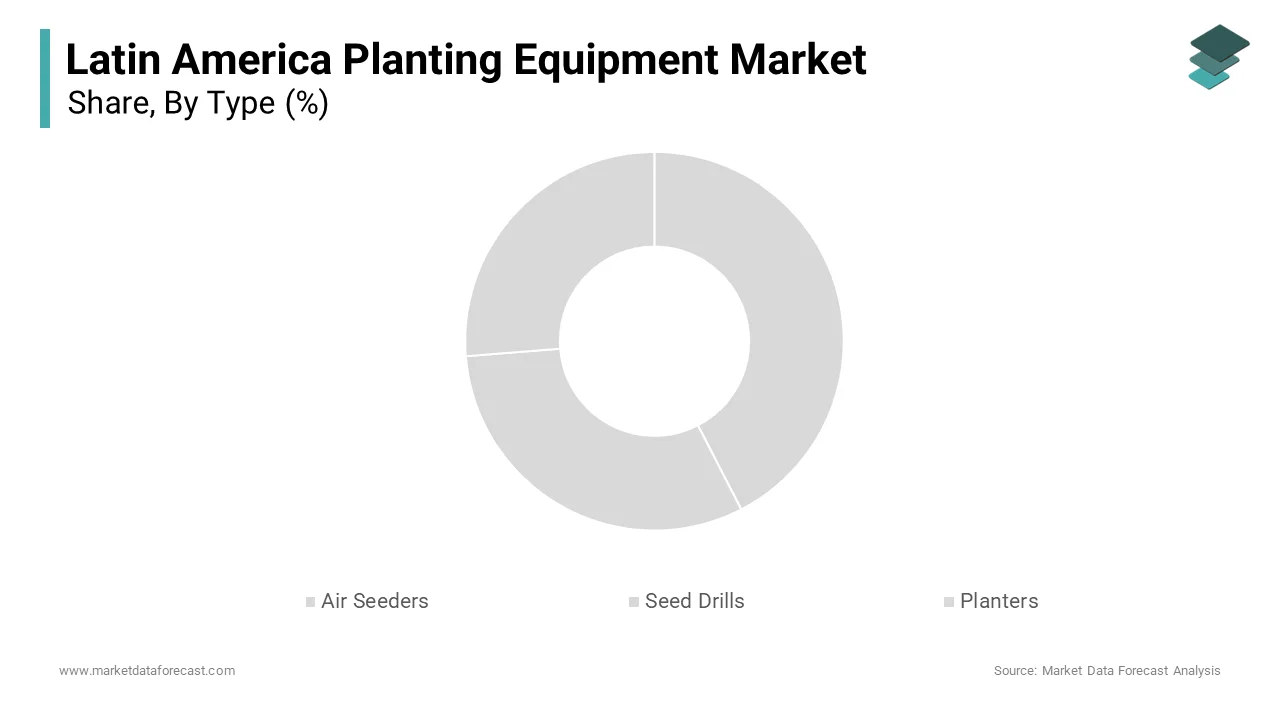
The seed drills segment represented the largest type in the Latin America planting equipment market by accounting for 36.3% of total demand in 2025. Their widespread use in cereal and grain farming, which constitutes a significant portion of agricultural activity across the region, is driving the growth of this segment. Countries such as Brazil, Argentina, and Paraguay rely heavily on seed drills for sowing maize, wheat, and soybeans—key crops that support both domestic consumption and international exports. The efficiency of seed drills in ensuring uniform seeding depth, optimal spacing, and improved germination rates makes them indispensable for large-scale commercial farms.
Air Seeders
The Air seeders segment is emerging as the fastest-growing in the Latin America planting equipment market and is projected to expand at a CAGR of 7.5% from 2025 to 2033. Increasing adoption of bulk seeding techniques among large-scale grain producers, particularly in Brazil and Argentina, is propelling the rise of this segment. These machines offer high-efficiency sowing capabilities, allowing farmers to cover vast areas quickly while reducing labor dependency. The expansion necessitates scalable planting solutions like air seeders, which can handle multiple rows simultaneously and integrate with GPS guidance systems for precision agriculture. Manufacturers such as AGCO and CNH Industrial have introduced region-specific models tailored for local soil conditions, further accelerating market penetration.
By Design Insights
Mechanical Planting Equipment
The mechanical planting equipment segment led the Latin America planting equipment market by capturing 54.6% of total sales in 2025. This segment includes traditional planters, seed drills, and row units that operate without electronic or automated controls. Its dominance is due to its affordability and suitability for small- to medium-sized farms, which constitute the majority of agricultural holdings in the region. Additionally, local manufacturers such as Stara and Agrale continue to innovate within this segment, offering lightweight, adaptable models suited for diverse terrain types. Despite growing interest in automation, mechanical planting equipment remains the backbone of regional agricultural operations.
Automatic Planting Equipment
The Automatic planting equipment segment is experiencing the highest growth rate in the Latin American planting equipment market, with a projected CAGR of 8.2%. This surge is fueled by increasing investments in smart farming technologies, government-backed digitalization initiatives, and the rising adoption of precision agriculture practices. Countries like Brazil and Chile are leading the transition, where large agribusinesses are integrating GPS-guided and variable-rate planting systems into their operations. Major global players such as John Deere and AGCO have expanded their distribution networks across the region, introducing autonomous-ready planting models designed for Latin American conditions. These developments indicate a broader shift toward technology-enabled farming across the continent.
By Crop Insights
Cereals & Grains
The cereals & grains segment commanded the Latin America planting equipment market with 45.3% share in 2025, which reflects the dominance of staple crop production in the region. Maize, wheat, and rice are extensively cultivated across major agricultural economies such as Brazil, Argentina, and Mexico. Government subsidies under national rural development programs have also encouraged the adoption of advanced seeding technologies, especially in Argentina and Paraguay, where export-oriented grain farming is prevalent.
Fruits & Vegetables
The fruits & vegetables segment is witnessing the fastest growth in the Latin America planting equipment market, projected to expand at a CAGR of 6.4% from 2025 to 2033. The acceleration of this segment is driven by rising global demand for fresh produce, expanding greenhouse farming, and increasing investments in horticultural infrastructure. To meet the demand efficiently, growers are adopting specialized transplanters and plug seeders that enhance planting accuracy and reduce labor costs. In addition, companies like Kverneland and Vaderstad have introduced compact, modular planting systems tailored for smaller field sizes and diverse terrains. These innovations are expected to drive continued expansion in the fruits & vegetables planting equipment sector.
COUNTRY-LEVEL ANALYSIS
Brazil
Brazil led the Latin American planting equipment market, estimated at 33.5%, owing to its vast agricultural sector and status as one of the world's top grain exporters. The country's expansive farmland, covering over 70 million hectares under soybean, corn, and sugarcane cultivation, necessitates large-scale mechanized planting solutions. The government supports this transition through policies such as the "ABC Program" (Low Carbon Agriculture), which encourages sustainable farming practices and provides financing for machinery upgrades. With strong export markets and increasing farm mechanization rates, Brazil continues to dominate the Latin American planting equipment landscape.
Mexico
Mexico saw significant growth in the Latin American planting equipment market, which is driven by a combination of traditional farming methods and gradual mechanization efforts. The country is a major producer of maize, beans, and vegetables. Smallholder farming remains predominant, but there is a growing trend toward adopting mechanized planting equipment, particularly in states like Sinaloa and Jalisco, known for intensive vegetable and grain production. With increasing foreign direct investment in agri-tech and expanding export markets, Mexico is steadily strengthening its position in the regional planting equipment industry.
Argentina
Argentina captures a notable share of the LatinAmericana planting equipment market, largely due to its strong presence in global grain exports and a well-established agribusiness sector. The country is one of the world’s top producers of soybeans, maize, and sunflower seeds. The Pampas region, known for its fertile soils and large-scale commercial farming, drives demand for high-capacity planting equipment such as air seeders and GPS-guided planters. Domestic manufacturers and multinational firms alike have expanded their presence in the country, capitalizing on favorable government policies and rural credit programs. With ongoing investments in precision agriculture and export infrastructure, Argentina remains a key player in shaping planting equipment trends in Latin America.
Chile
Chile holds a considerable share of the Latin American planting equipment market, with a unique focus on specialty crops such as grapes, avocados, blueberries, and stone fruits. Unlike other regional markets dominated by cereals and grains, Chile’s agricultural strength lies in high-value export-oriented produce, particularly to North America and Asia. The country’s relatively stable economy and supportive regulatory environment have attracted investments from global machinery manufacturers looking to cater to niche markets. With increasing adoption of greenhouse farming and climate-resilient planting systems, Chile is positioning itself as a leader in technologically advanced planting solutions in Latin America.
Rest of Latin America
The remaining Latin American countries collectively account for a decent share of the planting equipment market, with varying levels of mechanization and agricultural modernization. Countries such as Colombia, Peru, Ecuador, and Bolivia are gradually transitioning from manual sowing methods to mechanized planting solutions, supported by government incentives and improved rural infrastructure. While adoption rates remain lower compared to Brazil and Argentina, the region is showing steady progress, particularly in high-value horticulture and coffee farming. Companies are tailoring entry-level and mid-range planting equipment to suit local conditions, ensuring broader market reach across this diverse and evolving segment.
Top Players In The Market
AGCO Corporation
AGCO is a major global player with a strong presence in Latin America through its well-known brands such as Massey Ferguson and Fendt. The company offers a comprehensive range of planting equipment tailored to suit both large-scale commercial farms and smaller operations. AGCO focuses on innovation, sustainability, and localized product development, ensuring that its machinery aligns with regional agricultural practices. Its commitment to after-sales service and dealer networks across key markets like Brazil and Argentina has reinforced its competitive edge in the region.
CNH Industrial N.V.
CNH Industrial plays a crucial role in the Latin American planting equipment landscape through its leading brands C, Case IH, and New Holland Agriculture. Known for durable and high-performance machinery, the company provides technologically advanced planting solutions designed for diverse climatic and soil conditions. CNH Industrial emphasizes precision agriculture and digital integration, supporting farmers in improving efficiency and productivity. Its strategic partnerships and distribution channels have helped maintain a consistent market presence across the region.
John Deere
John Deere is a globally recognized leader in agricultural machinery, including planting equipment. In Latin America, it delivers highly efficient and adaptable planters and seed drills that cater to the needs of export-oriented agribusinesses. The company invests heavily in smart farming technologies, offering connected planting systems that enhance decision-making and operational efficiency. With a robust dealer network and customer support infrastructure, John Deere continues to strengthen its foothold in the Latin American market.
Top Strategies Used By Key Market Participants
One of the primary strategies employed by leading players in the Latin America planting equipment market is localized product development, where manufacturers design machinery specifically suited to regional soil types, crop patterns, and climate conditions. This approach ensures better performance and higher adoption rates among local farmers who require tailored solutions. Another key strategy is expanding distribution and after-sales service networks, which helps build long-term customer relationships and ensures timely maintenance and spare parts availability. Companies are investing in dealership training and mobile service units to reach remote agricultural areas more effectively. Additionally, collaboration with agritech startups and government initiatives has become increasingly important, allowing manufacturers to integrate smart technologies into their equipment while leveraging subsidies and rural financing programs to promote equipment adoption across small and medium-sized farms.
COMPETITION LANDSCAPE
The competition in the Latin American equipment market is shaped by a mix of multinational corporations and domestic manufacturers striving to capture market share through innovation, pricing strategies, and customer engagement. While global players dominate the high-end segment with advanced precision planting technologies, regional manufacturers focus on cost-effective and locally adapted solutions that cater to small and mid-sized farms. The market is witnessing increased collaboration between equipment makers and agritech firms to integrate digital tools, such as GPS guidance and IoT-enabled monitoring systems, into planting equipment. At the same time, government policies promoting agricultural modernization and access to credit are influencing purchasing behaviors. Competition is further intensified by the entry of new players offering modular and compact planting machines suited for specialty crops. As demand for mechanization grows, especially in Brazil, Argentina, and Chile, companies are expanding their dealer networks and enhancing after-sales services to maintain a strong market presence and differentiate themselves in an evolving industry.
RECENT HAPPENINGS IN THE MARKET
- In January 2024, AGCO launched a new line of region-specific air seeders designed for Brazil’s tropical soils and large-scale grain production. These models were developed in collaboration with local agronomists to optimize performance under challenging field conditions, reinforcing AGCO's commitment to tailored agricultural solutions.
- In March 2024, CNH Industrial expanded its authorized dealership network in Argentina, opening over 15 new service centers across the Pampas region. This initiative aimed at improving accessibility and after-sales support for farmers using Case IH and New Holland planting equipment, thereby strengthening brand loyalty.
- In June 2024, John Deere partnered with a Brazilian agritech startup specializing in AI-based planting analytics to integrate real-time data insights into its planter lineup. This move was intended to provide Latin American farmers with smarter, more adaptive planting options aligned with precision agriculture trends.
- In August 2024, Stara, a leading domestic manufacturer based in Brazil, introduced a new series of mechanical seed drills optimized for smallholder farms in Central America. Designed for affordability and durability, these models target emerging markets where full automation is not yet widely adopted.
- In November 2024, Kverneland Group announced a joint venture with a Mexican distributor to localize the assembly of its planting equipment in Guanajuato. This step was aimed at reducing import costs, improving supply chain efficiency, and accelerating market penetration in Mexico’s growing agricultural sector.
MARKET SEGMENTATION
This research report on the Latin American planting equipment market is segmented and sub-segmented into the following categories.
By Type
- Air Seeders
- Seed Drills
- Planters
By Design
- Automatic and Mechanical
By Crop Type
- Cereals & Grains
- Oilseeds & Pulses
- Fruits & Vegetables
By Country
- Brazil
- Argentina
- Chile
- Peru