- Product Description Description
- Table of Contents TOC
- List of Table & Figure LOT
- Get Free Sample PDF Sample PDF
Market Size, 2025
$368.6 MnMarket Estimate, 2026
$389.98 MnMarket Forecast, 2034
$612.25 MnCAGR, 2026–2034
5.80%Executive Summary: Latin America Agriculture Anti-Transpirant Market
- Market Scope: Comprehensive market assessment of the Latin American agriculture anti-transpirant sector covering product types, end-use applications, and country-level performance.
- Market Valuation: Valued at USD 368.6 million in 2025, estimated at USD 389.98 million in 2026, and projected to reach USD 612.25 million by 2034, expanding at a compound annual growth rate (CAGR) of 5.0% during the forecast period from 2026 to 2034.
- Primary Growth Drivers: Escalating frequency and intensity of droughts caused by climate variability and El Niño events, nearly 40% of cultivated land experiencing periodic water stress, rising adoption of precision agriculture, and government-backed climate-smart farming initiatives.
Key Market Segment Metrics (2026–2034)
| Category | Leading Segment Focus | Fastest-Growing / High-Impact Segment |
|---|---|---|
| By Type | Film-Forming Type (dominant in broad-acre crops like soybeans and corn) | Reflectance Type (projected at an 11.3% CAGR) |
| By Application | Crops (staple grains and cash crops like soybeans, wheat, and corn) | Ornamental / Floriculture (projected at a 12.3% CAGR) |
| By Country | Brazil (leading market with 30.2% share in 2025) | Argentina & Chile (expanding water-saving initiatives) |
Major Market Players & Market Structure
Market Structure: Highly competitive landscape led by multinational agrochemical giants alongside specialized regional firms focusing on localized formulations, bio-based options, and digital agronomic advisory services.
Key Companies: BASF SE, Syngenta AG, UPL Limited, Miller Chemical & Fertilizer, Beijing Shenlanlin, Coastal AgroBusiness, Wilt-Pruf Products, Sumi Agro, PBI-Gordon Corporation, Bonide, Aquatrols, and Shanghai Zhilv.
Latin America Agriculture Anti-Transpirant Market Size
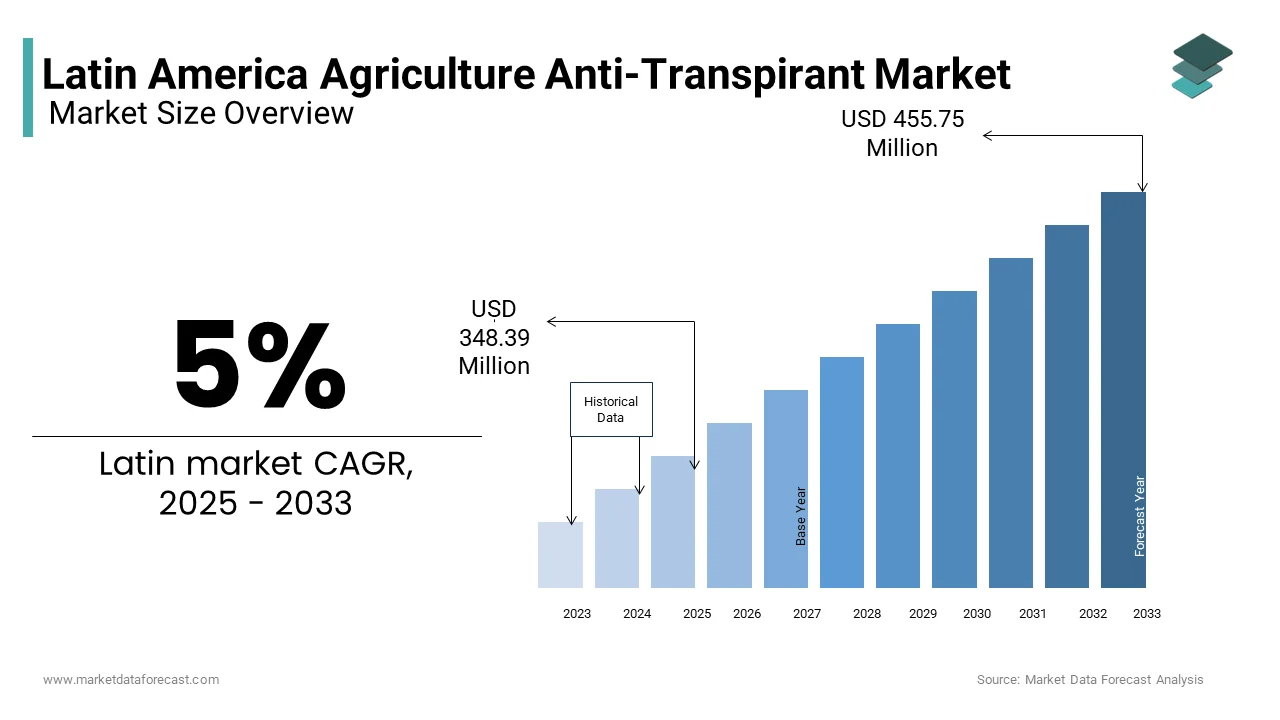
The Latin American agriculture anti-transpirant market size was valued at USD 368.6 million in 2025 and is anticipated to reach a valuation of USD 389.98 million in 2026 and USD 612.25 million by 2034, growing at a CAGR of 5% from 2026 to 2034.
The Agriculture Anti-Transpirant is used to reduce excessive water loss in plants through transpiration, particularly under drought or high-temperature conditions. These products are increasingly relevant in Latin America, where climate variability and irregular rainfall patterns have posed significant challenges to crop productivity. Anti-transpirants function by either closing stomata, forming a thin protective film on leaf surfaces, or reflecting solar radiation to lower plant temperature. In countries like Brazil, Argentina, and Mexico, where agriculture is a major contributor to GDP, these solutions are gaining traction among large-scale farmers and agribusinesses. According to the Food and Agriculture Organization (FAO), nearly 40% of cultivated land in Latin America experiences periodic drought stress, highlighting the need for moisture-conserving technologies.
MARKET DRIVERS
The increasing frequency and intensity of droughts across key agricultural regions are propelling the growth of the Latin American Agriculture Anti-Transpirant Market. Countries such as Brazil, Argentina, and Chile have experienced prolonged dry spells and declining rainfall levels due to shifting climatic patterns, including El Niño events. According to the World Meteorological Organization, South America has witnessed a 15–20% decline in average precipitation over the past decade, particularly affecting major crop-producing zones. This trend has heightened the risk of soil moisture depletion and crop failure, compelling farmers to adopt adaptive measures such as anti-transpirant application. As per the National Institute for Space Research (INPE) in Brazil, soybean and corn yields in the Cerrado region dropped by up to 30% during recent drought cycles, underscoring the economic necessity of water-saving interventions. Additionally, the International Center for Tropical Agriculture (CIAT) reports that smallholder farmers are gradually adopting agritech solutions to mitigate yield losses, further boosting demand for anti-transpirants.
The growing adoption of precision agriculture and smart farming technologies is prompting the growth of the Latin American Agriculture Anti-Transpirant Market. Farmers and agribusinesses are increasingly integrating digital tools, sensors, and targeted chemical applications to optimize resource use and improve yield efficiency. Furthermore, organizations like the International Maize and Wheat Improvement Center (CIMMYT) have been actively promoting the use of water-stress mitigation products among Latin American producers. Government-backed initiatives, such as Mexico’s Programa de Desarrollo Rural Sustentable, also encourage the use of sustainable agricultural inputs, including biostimulants and anti-transpirants.
MARKET RESTRAINTS
The limited awareness and understanding of anti-transpirant benefits among smallholder farmers are limiting the growth of the Latin American Agriculture Anti-Transpirant Market. Many rural producers remain unfamiliar with the role of anti-transpirants in conserving plant moisture and improving crop survival during dry periods. According to the United Nations Development Programme (UNDP), approximately 70% of agricultural labor in Latin America is conducted by small-scale farmers who often rely on traditional methods and may be hesitant to adopt new technologies without direct evidence of effectiveness. As per the Pan-American Agricultural School (EPA), extension programs aimed at educating farmers about advanced agronomic inputs face logistical and financial constraints, limiting their reach. Additionally, misinformation or skepticism regarding product efficacy can deter adoption in areas with limited access to technical expertise. The lack of localized field trials and demonstrable case studies further hinders widespread acceptance.
The high cost of premium anti-transpirant formulations and limited access to financing options for independent growers are also hindering the growth of the Latin American Agriculture Anti-Transpirant Market. While some products offer proven benefits in reducing water stress, their relatively high price compared to conventional agricultural inputs makes them inaccessible to budget-conscious farmers. According to the International Fund for Agricultural Development (IFAD), over 60% of small-scale farmers in Latin America operate without formal credit access, restricting their ability to invest in innovative crop protection solutions. As per the National Confederation of Agricultural Cooperatives (CONCCA) in Argentina, the average cost of applying anti-transpirants can increase input expenses by up to 15%, which many independent producers find difficult to justify without guaranteed returns. Additionally, the absence of government subsidies specifically targeting anti-transpirant use further discourages adoption. Unlike fertilizers or pesticides, which often benefit from established subsidy frameworks, anti-transpirants remain largely excluded from policy-driven financial incentives.
MARKET OPPORTUNITIES
The integration of anti-transpirants with organic and regenerative farming practices is creating new opportunities for the growth of the Latin American Agriculture Anti-Transpirant Market. The farmers are increasingly adopting organic cultivation methods that emphasize environmental stewardship and reduced chemical dependency. According to the Research Institute of Organic Agriculture (FiBL), the area under organic agriculture in Latin America has expanded significantly, with countries like Argentina, Brazil, and Peru leading in certified organic farmland. As per the Latin American Network of Organic Agriculture (Red Latinoamericana de Agricultura Orgánica), there is growing interest in bio-based crop protection solutions that align with organic certification standards. Several anti-transpirant manufacturers have responded by developing plant-derived formulations using natural polymers and waxes that meet organic compliance requirements.
The expansion of public-private partnerships aimed at promoting climate-smart agriculture is enhancing the growth of the Latin American Agriculture Anti-Transpirant Market. Governments, international agencies, and private agribusinesses are increasingly collaborating to develop and deploy technologies that enhance agricultural resilience in the face of climate change. According to the Food and Agriculture Organization (FAO), Latin America has seen a surge in climate adaptation projects supported by multilateral funding institutions such as the Green Climate Fund and the Global Environment Facility. As per the Inter-American Development Bank (IDB), several national agricultural ministries are launching pilot programs that incorporate anti-transpirants into drought mitigation strategies, offering subsidized access to smallholder farmers. Additionally, organizations like the International Center for Tropical Agriculture (CIAT) are working with local cooperatives to demonstrate the effectiveness of anti-transpirants in real-world conditions. These initiatives not only build credibility but also create distribution networks that facilitate broader adoption.
MARKET CHALLENGES
The lack of standardized regulations and inconsistent product registration processes across countries is a big challenge for the growth of the Latin American Agriculture Anti-Transpirant Market. Unlike other agricultural inputs such as fertilizers and pesticides, anti-transpirants often fall into a regulatory gray area, making it difficult for manufacturers to navigate approval requirements. According to the Pan American Health Organization (PAHO), pesticide and agrochemical regulations vary significantly between Latin American nations, complicating market entry for new products. As per the Brazilian Ministry of Agriculture (MAPA), registration timelines for novel agricultural inputs can extend beyond two years, deterring smaller companies from introducing innovative anti-transpirant formulations. Additionally, the absence of uniform testing protocols means that products approved in one country may not be automatically recognized elsewhere, leading to fragmented market access.
The limited availability of localized research and field trial data to validate product performance under regional climatic and soil conditions is additionally hindering the growth of the Latin American Agriculture Anti-Transpirant Market. Many anti-transpirant formulations are developed based on studies conducted in temperate climates, which may not accurately reflect their efficacy in tropical or semi-arid environments prevalent in Latin America. According to the International Center for Tropical Agriculture (CIAT), there is a notable gap in empirical data demonstrating how different anti-transpirant types perform across diverse crops such as maize, soybeans, coffee, and sugarcane. As per the Argentine Agrarian Society (Sociedad Rural Argentina), field trials assessing the impact of anti-transpirants on yield preservation under drought conditions remain scarce outside of corporate R&D departments. Additionally, academic institutions and government research bodies often lack the resources to conduct extensive on-farm evaluations.
REPORT COVERAGE
| REPORT METRIC | DETAILS |
| Market Size Available | 2025 to 2034 |
| Base Year | 2025 |
| Forecast Period | 2026 to 2034 |
| CAGR | 5% |
| Segments Covered | By Type, Application, and Region. |
| Various Analyses Covered | Global, Regional and Country Level Analysis, Segment-Level Analysis, DROC, PESTLE Analysis, Porter’s Five Forces Analysis, Competitive Landscape, Analyst Overview of Investment Opportunities |
| Regions Covered | U.K,. France, Germany, Spain, Italy, Sweden, Russia and Denmark, Switzerland, the Netherlands, Turkey, the Czech Republic, and the Rest of Europe |
| Market Leaders Profiled | Miller Chemical & Fertilizer, Beijing Shenlanlin, Coastal AgroBusiness, Wilt-Pruf Products, Sumi Agro, PBI-Gordon Corporation, Bonide, Aquatrols, and Shanghai Zhilv. |
SEGMENT ANALYSIS
By Type Insights
Tfilm-forminging segment accounted in holding a dominant share of the Latin American Agriculture Anti-Transpirant Market due to its widespread use in broad-acre crops such as soybeans, corn, and wheat, where moisture conservation is critical during prolonged dry spells. According to the Food and Agriculture Organization (FAO), more than 40% of cultivated land in Latin America experiences periodic drought stress, making film-forming anti-transpirants a preferred solution due to their ability to create a thin, hydrophobic layer on leaf surfaces that minimizes water loss without interfering with photosynthesis. As per the Brazilian Agricultural Research Corporation (EMBRAPA), field trials have demonstrated that film-forming products can reduce transpiration by up to 25% while maintaining acceptable yield levels under water-limited conditions. Additionally, this category includes both synthetic polymers and natural waxes, offering flexibility in formulation for different climatic zones and crop types.

The reflectance segment is likely to grow with an expected CAGR of 11.3% in the coming years, owing to the increasing awareness of solar radiation management as a key strategy for reducing plant temperature and conserving soil moisture. Unlike other types that focus solely on stomatal closure or physical barriers, reflectance-based anti-transpirants work by reflecting a portion of incoming sunlight, thereby lowering canopy temperatures and minimizing evaporative stress. According to the International Center for Tropical Agriculture (CIAT), excessive solar exposure can elevate leaf temperatures by up to 6°C, leading to accelerated water loss and reduced photosynthetic efficiency. As per the National Institute for Space Research (INPE) in Brazil, climate models indicate rising solar intensity in equatorial regions, reinforcing the need for adaptive solutions like reflective foliar coatings. Additionally, organizations such as the Pan-American Agricultural School (EPA) have reported growing interest from coffee and citrus growers in Mexico and Colombia, where high-altitude sun exposure exacerbates water stress.
By Application Insights
The crops segment accounted for holding a dominant share of the Latin America Agriculture Anti-Transpirant Market, with the essential role of anti-transpirants in safeguarding staple and cash crops against drought-induced yield losses. Countries like Brazil, Argentina, and Paraguay rely heavily on large-scale grain production, particularly soybeans, corn, and wheat, which are highly susceptible to water stress during critical growth stages. According to the United Nations Economic Commission for Latin America and the Caribbean (ECLAC), nearly 70% of regional agricultural GDP comes from crop farming, highlighting the economic importance of yield protection strategies.
The ornamental segment is expected to grow with a CAGR of 12.3% in the coming years, with the growing floriculture industry, particularly in countries like Colombia and Ecuador, which are major global exporters of cut flowers. According to the Colombian Association of Flower Exporters (ASCOPEL), the country supplies over 70% of roses sold in the U.S. market, necessitating advanced crop protection strategies to maintain quality under fluctuating weather conditions. As per the Ministry of Agriculture and Livestock of Ecuador, ornamental crops require precise water management to prevent wilting and ensure long shelf life, making anti-transpirants an attractive option for greenhouse and open-field producers.
COUNTRY ANALYSIS
Brazil was the top performer in the Latin American Agriculture Anti-Transpirant Market with 30.2% of the share in 2025. Brazil plays a central role in shaping the adoption trends of moisture-conserving technologies, particularly in large-scale commodity crops such as soybeans, corn, and sugarcane. According to the Brazilian Agricultural Research Corporation (EMBRAPA), over 70 million hectares of farmland in Brazil face seasonal water deficits, necessitating strategic interventions to sustain productivity. As per the National Institute for Space Research (INPE), prolonged drought cycles in the Cerrado and southern regions have led to significant yield fluctuations, which is prompting agribusinesses to integrate anti-transpirants into farm management practices.
Argentina Agriculture Anti-Transpirant Market growth is expected to grow in the coming years. The country's agricultural sector in the Pampas region is highly dependent on soybean, corn, and wheat production, all of which are vulnerable to periodic droughts and heat waves. According to the Argentine Agrarian Society (Sociedad Rural Argentina), nearly 45% of cultivated land experienced moderate to severe drought conditions in recent years, prompting farmers to seek alternative solutions for moisture retention. As per the National Institute of Agricultural Technology (INTA), field studies have shown that anti-transpirants can help mitigate yield losses by up to 20% in water-stressed environments. Additionally, the Ministry of Agroindustry of Argentina has introduced policy incentives to promote sustainable farming practices, including subsidies for climate-resilient inputs.
Mexico Agriculture Anti-Transpirant Market growth is driven by the country's diverse agricultural landscape, ranging from temperate highlands to arid northern regions, which presents varying degrees of water stress, making anti-transpirants an increasingly relevant solution. According to the Secretariat of Agriculture and Rural Development (SADER), over 60% of Mexican farmland relies on rain-fed irrigation, exposing crops to seasonal rainfall variability and drought risks. As per the International Center for Tropical Agriculture (CIAT), climate projections indicate rising temperatures and irregular precipitation patterns, particularly in central and northern states, intensifying pressure on farmers to adopt adaptive measures. The Mexican Agency for International Development Cooperation (AMEXCID) has been supporting pilot projects that demonstrate the effectiveness of anti-transpirants in maize and chili cultivation, encouraging broader uptake among smallholder producers.
Chile's agricultural anti-transpirant market is growing with the expanding agricultural sector in the Central Valley, faces increasing water scarcity due to declining snowpack in the Andes Mountains, and prolonged dry seasons. According to the Chilean National Institute of Agricultural Development (INDAP), over 80% of irrigated farmland depends on surface water sources, which are becoming less reliable due to climate change. The Ministry of Agriculture has initiated several climate adaptation programs that include anti-transpirant trials in avocado and grapevine cultivation, demonstrating measurable improvements in plant hydration and fruit quality. Additionally, the International Water Management Institute (IWMI) notes that Chilean wine producers are exploring sustainable viticulture practices, including foliar treatments that reduce evapotranspiration without compromising flavor profiles.
While individually smaller in scale compared to Brazil, Argentina, and Mexico, these countries collectively represent a dynamic and evolving market shaped by diverse climatic conditions and agricultural priorities. According to the Inter-American Development Bank, investment in climate-resilient agriculture has risen significantly in recent years, with governments and development agencies promoting water-saving technologies in response to erratic rainfall patterns. In Colombia, the Ministry of Agriculture and Rural Development has launched initiatives targeting coffee and cacao growers, who are increasingly adopting anti-transpirants to combat the effects of prolonged dry periods. As per the International Center for Tropical Agriculture (CIAT), field trials in Ecuador have demonstrated the efficacy of anti-transpirants in banana and floral crops, enhancing post-harvest longevity and marketability. Additionally, the Food and Agriculture Organization (FAO) reports that Central American countries such as Guatemala and Honduras are integrating anti-transpirants into drought mitigation strategies for staple crops like maize and beans.
KEY MARKET PLAYERS
Miller Chemical & Fertilizer, Beijing Shenlanlin, Coastal AgroBusiness, Wilt-Pruf Products, Sumi Agro, PBI-Gordon Corporation, Bonide, Aquatrols, and Shanghai Zhilv. Are the market players that are dominating the Latin American anti-transpirant market?.
Top Players In The Market
BASF SE
BASF is a leading global chemical company with a strong presence in the Latin American agriculture sector, offering a wide range of crop protection and plant health solutions, including anti-transpirants. The company contributes significantly to the regional market by introducing advanced formulations that enhance plant resilience under drought conditions. Its commitment to sustainable agriculture and collaboration with local agritech partners enables widespread distribution and adoption of anti-transpirant technologies, which is reinforcing its leadership position.
Syngenta AG
Syngenta plays a pivotal role in promoting water-efficient farming practices in Latin America through its portfolio of biostimulants and anti-transpirant products. The company integrates these solutions into comprehensive crop management programs designed to improve yield stability in drought-prone regions. Syngenta’s strong technical support system and farmer education initiatives have been instrumental in increasing awareness and acceptance of anti-transpirants among large-scale and cooperative farmers. Its strategic partnerships with research institutions and government agencies further strengthen its market influence and contribute to the broader adoption of climate-smart agricultural inputs across the region.
UPL Limited
UPL has established itself as a key player in the Latin American anti-transpirant market by offering cost-effective and eco-friendly formulations tailored for smallholder and commercial farms. The company emphasizes affordability and accessibility, ensuring that its products reach diverse farming communities across the region. UPL’s focus on bio-based ingredients aligns with the growing demand for sustainable agricultural inputs, making its anti-transpirants a preferred choice among organic and regenerative farming practitioners. UPL continues to expand its footprint in Latin America's evolving agritech landscape by leveraging its extensive distribution network and localized product development strategy.
Top Strategies Used By Key Market Participants
Leading players in the Latin American Agriculture Anti-Transpirant Market employ several strategic approaches to reinforce their market positions. One major strategy is localized product development, where companies tailor formulations to suit regional climatic conditions and specific crop needs, enhancing effectiveness and farmer adoption. Another critical approach involves collaborations with agricultural extension services and research institutions by allowing firms to generate field data, conduct trials, and build credibility among growers. The educational campaigns and farmer training programs are widely used to increase awareness about the benefits of anti-transpirants among small-scale producers who may be unfamiliar with such technologies. These strategies collectively help companies expand their reach and drive sustained market growth.
COMPETITION OVERVIEW
The Latin American Agriculture Anti-Transpirant Market is marked by a competitive landscape driven by rising demand for drought mitigation solutions and increasing investments in sustainable farming technologies. While multinational agrochemical giants like BASF, Syngenta, and UPL dominate due to their strong R&D capabilities and extensive distribution networks, regional players and emerging startups are also gaining traction by offering cost-effective, locally adapted products. The competition revolves around product innovation, formulation efficiency, and application compatibility across different crops and environmental conditions. Companies are increasingly focusing on bio-based and organic-certified anti-transpirants to align with shifting consumer preferences and regulatory trends favoring sustainable agriculture. Additionally, market participants are investing in demonstration projects, field trials, and digital advisory platforms to enhance farmer engagement and promote product adoption.
RECENT HAPPENINGS IN THE MARKET
- In March 2024, BASF launched a new line of foliar anti-transpirant sprays specifically formulated for tropical climates, targeting soybean and corn producers in Brazil and Argentina. This product rollout was supported by on-ground agronomic support teams to facilitate farmer adoption.
- In January 2024, Syngenta expanded its partnership with the International Center for Tropical Agriculture (CIAT) to conduct localized field trials on anti-transpirant efficacy in coffee and cassava crops, aiming to validate performance under Latin American growing conditions.
- In August 2023, UPL initiated a direct-to-farmer outreach campaign in Mexico and Colombia, distributing sample kits and organizing demonstration days to educate smallholder farmers on the benefits of anti-transpirant use during dry seasons.
- In November 2023, a consortium of Latin American agritech firms collaborated with regional governments to develop a digital platform that provides real-time recommendations on anti-transpirant application based on weather forecasts and soil moisture levels.
- In May 2024, a European-based biostimulant manufacturer entered the Brazilian market through a joint venture with a local distributor, which is aiming to scale up sales of reflective-type anti-transpirants for high-value horticultural crops.
MARKET SEGMENTATION
This research report on the Latin American Agriculture Anti-Transpirant market is segmented and sub-segmented into the following categories.
By Type
- Stomatal Closing Type
- Film Forming Type
- Reflectance Type
- Growth retardant
By Application
- Crops
- Garden
- Turf and Ornamental
By Country
- Mexico
- Argentina
- Brazil
- Chile
- Rest Of Latin America