- Product Description Description
- Table of Contents TOC
- List of Table & Figure LOT
- Get Free Sample PDF Sample PDF
Market Size, 2025
$20.21 BnMarket Estimate, 2026
$21.09 BnMarket Forecast, 2034
$29.65 BnCAGR, 2026–2034
4.35%Latin America Agrochemical and Pesticide Market Size, Share, Trends & Forecast (2026–2034)
- Market Scope: Comprehensive regional analysis of the Latin American agrochemicals and pesticides market covering application types, formulation categories, country-level market dynamics, and regional agricultural drivers.
- Market Valuation: Valued at USD 20.21 billion (2025), estimated at USD 21.09 billion (2026), and projected to reach USD 29.65 billion by 2034, growing at a compound annual growth rate (CAGR) of 4.35% (2026–2034).
- Primary Growth Drivers: Rapid expansion of commercial agriculture and export-oriented farming in countries like Brazil and Argentina, widespread adoption of genetically modified (GM) crops, and the integration of precision agriculture and digital spraying technologies.
Latin America Agrochemical and Pesticide Market Segment Metrics (2026–2034)
| Category | Leading Segment (2025 Position) | Fastest-Growing Segment |
|---|---|---|
| By Application | Agricultural Application (dominant market share anchored by large-scale commercial commodity production) | Garden & Other Applications (projected at a 7.3% CAGR driven by urban gardening and horticulture) |
| By Type | Herbicides (capturing 48.1% of total consumption, driven by glyphosate-tolerant crop management) | Insecticides (projected at a 7.6% CAGR propelled by secondary pest outbreaks and climate shifts) |
| By Country / Region | Brazil (holding 49.7% market share, backed by massive soy, corn, and sugarcane output) | Mexico & Argentina (expanding through modern export-oriented farming and tech adoption) |
Major Industry Players & Market Structure
Market Structure: Highly competitive landscape featuring global life-science leaders and regional formulators prioritizing product innovation, bio-pesticide integration, and digital stewardship programs.
Key Companies: Bayer, Syngenta, BASF, Dow AgroSciences, Monsanto, Adama, Nufarm, DuPont, Albaugh, and Gharda.
Latin America Agrochemical and Pesticide Market Size
The Latin American agrochemical and pesticide market size was valued at USD 20.21 billion in 2025 and is anticipated to reach USD 21.09 billion in 2026 and USD 29.65 billion by 2034, growing at a CAGR of 4.35% during the forecast period from 2026 to 2034.
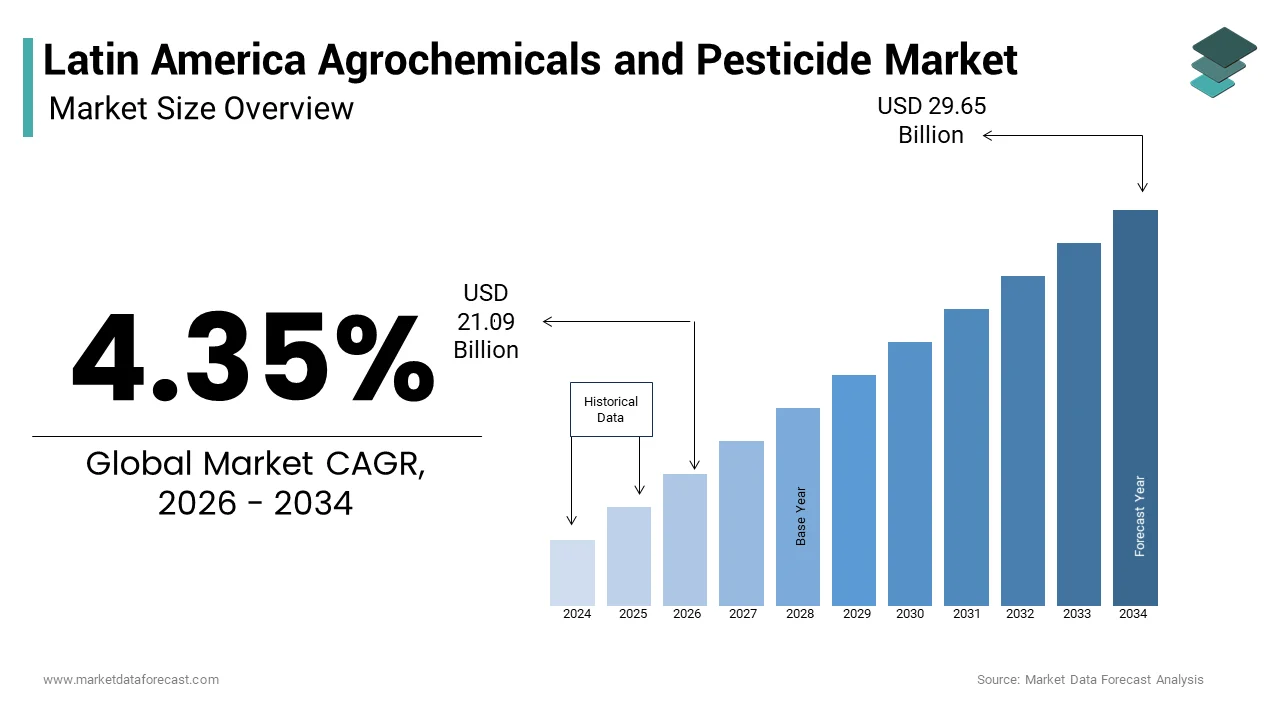
The Latin American agrochemical and pesticide market covers different chemical and biological products that are used to enhance agricultural productivity by managing pests, weeds, and diseases. This includes herbicides, insecticides, fungicides, and biopesticides that play a crucial role in modern farming systems across the region. Also, the market is driven by the need to meet rising food demand, improve crop yields, and protect harvests from biotic stressors in diverse agro-climatic conditions.
Like, according to the Food and Agriculture Organization (FAO), agriculture contributes significantly to the economies of several Latin American countries, with Brazil alone being one of the world’s largest producers and exporters of soybeans, corn, and sugarcane. Also, as per data from the Inter-American Development Bank, over 30% of the region's labor force is engaged in agriculture, highlighting its socioeconomic importance.
Moreover, the increasing adoption of genetically modified crops, expansion of export-oriented farming, and integration of precision agriculture technologies have further intensified the demand for agrochemicals.
In addition, shifting climatic patterns and the emergence of resistant pest strains are prompting farmers to rely on more advanced and targeted pesticide solutions. These factors collectively underline the strategic relevance of the agrochemical and pesticide industry in shaping the agricultural landscape of Latin America.
MARKET DRIVERS
Expansion of Commercial Agriculture and Export-Oriented Farming
A key factor propelling the Latin American agrochemical and pesticide market is the rapid expansion of commercial agriculture and export-oriented farming practices. Countries such as Brazil, Argentina, and Paraguay have emerged as global leaders in the production of soybeans, maize, cotton, and sugarcane—crops that require extensive use of herbicides, insecticides, and fungicides to ensure high yields and quality standards demanded by international markets.
Similarly, according to the United States Department of Agriculture (USDA), Brazil alone accounted for nearly 40% of global soybean exports in 2023, reinforcing its status as a key player in agrochemical consumption. Large-scale farming operations in these regions rely heavily on chemical inputs to maintain productivity and remain competitive in global trade.
Moreover, as per the International Trade Centre (ITC), Latin American exports of fruits, vegetables, and oilseeds have grown steadily, necessitating increased investments in crop protection to meet phytosanitary requirements imposed by importing nations. This export dependency has led to greater adoption of both conventional and integrated pest management strategies, driving sustained demand for agrochemicals across the region.
Adoption of Genetically Modified (GM) Crops and Integrated Weed Management
One more significant driver fueling the growth of the Latin American agrochemical and pesticide market is the widespread adoption of genetically modified (GM) crops, particularly those engineered for herbicide tolerance and insect resistance. Countries like Brazil and Argentina have embraced biotech seeds at a remarkable pace, leading to increased demand for compatible herbicides and insecticides.
According to Embrapa (Brazilian Agricultural Research Corporation), by 2023, over 95% of Brazilian soybean acreage was planted with GM varieties, primarily glyphosate-tolerant and Bt-traited hybrids. This shift has reinforced the need for post-emergence herbicides such as glyphosate and dicamba, as well as insecticides targeting secondary pests that thrive in reduced-chemical environments.
Apart from these, the evolution of weed resistance has prompted farmers to integrate multiple modes of action into their weed management programs, including residual herbicides and tank mixes. As per the Weed Science Society of the Americas, reports of glyphosate-resistant weeds in major soybean-producing regions have surged since 2015, compelling growers to adopt diversified chemical strategies.
This technological shift toward trait-based seed systems and complex application protocols has significantly influenced the regional agrochemical market, ensuring continued growth despite regulatory and environmental scrutiny.
MARKET RESTRAINTS
Environmental and Health Concerns Associated with Chemical Pesticides
A serious restraint for the Latin American agrochemical and pesticide market is the growing concern over the environmental and health impacts associated with synthetic pesticide usage. Reports linking certain chemicals to water contamination, soil degradation, and biodiversity loss have spurred regulatory scrutiny and public backlash, particularly in ecologically sensitive regions such as the Amazon basin and Andean ecosystems.
Like, as per the Pan American Health Organization (PAHO), pesticide-related poisoning incidents in Latin America have been consistently reported, especially among smallholder farmers with limited access to protective equipment and training. In Ecuador and Colombia, studies conducted by national health authorities found elevated levels of pesticide residues in drinking water sources near intensive agricultural zones.
Moreover, non-governmental organizations and environmental advocacy groups have raised alarms about the long-term effects of persistent organic pollutants (POPs) such as endosulfan and chlorpyrifos, some of which have already been banned or restricted in several countries.
As per the Secretariat of Environment and Natural Resources of Mexico, regulatory reforms introduced in recent years have sought to phase out highly hazardous pesticides and promote safer alternatives. These developments pose compliance challenges for manufacturers and distributors while influencing farmer adoption behaviors, thereby acting as a drag on market expansion.
Regulatory Restrictions and Policy Uncertainty
Regulatory restrictions and policy uncertainty present another critical challenge for the Latin American agrochemical and pesticide market. Governments across the region have implemented varying degrees of oversight regarding pesticide registration, importation, and application, often leading to inconsistent enforcement and delayed approvals.
Likewise, regulatory frameworks in countries such as Peru, Bolivia, and Ecuador are still evolving, with frequent changes in permitted substances and labeling requirements, according to the Latin American Network for the Rational Use of Agrochemicals (RedLAR). This inconsistency creates operational complexities for multinational agrochemical companies seeking to standardize product offerings across borders.
In Brazil, despite being a major consumer of agrochemicals, the approval process for new active ingredients remains lengthy and opaque. Also, over 200 pesticide formulations were pending regulatory review in 2023, causing delays in market entry for innovative products.
Moreover, political shifts and changing government priorities can lead to abrupt policy reversals. For instance, Argentina experienced fluctuating policies on pesticide taxation and export controls under successive administrations, impacting supply chain stability and pricing mechanisms.
Hence, these regulatory hurdles contribute to market fragmentation and discourage investment in research and development, ultimately constraining the growth potential of the agrochemical sector in Latin America.
MARKET OPPORTUNITY
Growth of Biopesticides and Sustainable Crop Protection Solutions
A potential opportunity emerging in the Latin American agrochemical and pesticide market is the increasing adoption of biopesticides and sustainable crop protection solutions. As concerns over chemical residues and environmental impact grow, farmers, regulators, and consumers are showing greater interest in biological alternatives that offer effective pest control with lower ecological footprints.
According to the International Biocontrol Manufacturers Association (IBMA), biopesticide sales in Latin America grew at an annual rate exceeding 12% between 2018 and 2023, driven by supportive government policies and expanding research initiatives. Countries like Brazil and Chile have introduced incentive programs encouraging the use of microbial agents, botanical extracts, and semiochemicals in place of conventional synthetic pesticides.
As per the research conducted by the Brazilian Agricultural Research Corporation (Embrapa), biopesticides are increasingly being integrated into Integrated Pest Management (IPM) systems, particularly in high-value horticultural and organic farming sectors. Universities and private firms are investing in local strain development to enhance efficacy under tropical conditions.
Furthermore, according to the Latin American and Caribbean Network for the Promotion of Ecological Agriculture (REDES), consumer demand for residue-free produce is rising, particularly in export markets such as the European Union and North America. This trend is pushing agribusinesses to adopt cleaner input profiles, positioning biopesticides as a key growth avenue in the regional agrochemical market.
MARKET OPPORTUNITY
Digitalization and Precision Agriculture Technologies
The integration of digitalization and precision agriculture technologies represents a transformative opportunity for the Latin American agrochemical and pesticide market. Advances in remote sensing, drone-based spraying, satellite mapping, and AI-driven decision support tools are enabling farmers to apply agrochemicals more efficiently, reducing waste and optimizing input use. These technologies allow for real-time monitoring of pest pressure, disease outbreaks, and soil conditions, facilitating targeted interventions.
Startups and agritech firms across the region are developing mobile applications and cloud-based platforms that provide customized pesticide recommendations based on field-specific data. As per a report published by the Inter-American Development Bank, digital advisory services have improved yield outcomes by up to 20% in pilot projects conducted in Paraguay and Uruguay.
Moreover, multinational agrochemical companies are partnering with tech providers to embed smart application systems into their product portfolios. With rising connectivity and smartphone penetration in rural areas, the convergence of digital tools and agrochemical delivery presents a substantial opportunity for market expansion and sustainability improvement.
MARKET CHALLENGES
Climate Variability and Its Impact on Pest Dynamics
One of the foremost challenges confronting the Latin American agrochemical and pesticide market is the increasing unpredictability of climate patterns, which directly affects pest dynamics and crop protection strategies. Rising temperatures, erratic rainfall, and prolonged droughts have altered the life cycles and distribution of pests, making traditional chemical application schedules less effective.
According to the Intergovernmental Panel on Climate Change (IPCC), Latin America has experienced a noticeable increase in extreme weather events over the past decade, contributing to shifts in pest migration and outbreak frequency. In Brazil, for example, warmer winters have allowed fall armyworm populations to persist year-round, requiring more frequent pesticide applications.
Also, changing humidity levels have influenced fungal disease prevalence, necessitating adjustments in fungicide use patterns. As per the Latin American Plant Protection Organization, outbreaks of rust diseases in coffee and soybean crops have become more severe in recent years due to favorable microclimates created by shifting precipitation trends.
Farmers and agronomists must continuously adapt to these evolving threats, often leading to increased chemical usage and higher costs. However, this also raises concerns about resistance development and environmental sustainability, forcing stakeholders to seek more resilient and adaptive pest management approaches.
Counterfeit and Unregulated Pesticide Trade
Another pressing challenge facing the Latin American agrochemical and pesticide market is the proliferation of counterfeit and unregulated pesticide products, which undermine legitimate businesses and pose serious risks to human health and the environment. Due to weak enforcement mechanisms and gaps in regulatory oversight, substandard and illegal formulations frequently enter the market, particularly in rural and underserved regions.
According to the Latin American Network for the Rational Use of Agrochemicals (RedLAR), counterfeit pesticides account for an estimated 20–30% of total agrochemical sales in several Latin American countries, including Bolivia, Ecuador, and parts of Central America. These products often contain incorrect concentrations of active ingredients, leading to poor performance, crop damage, and increased resistance development.
In addition, informal cross-border trade complicates tracking and regulation, allowing banned or restricted substances to re-enter circulation. As per the Pan American Health Organization (PAHO), exposure to unauthorized pesticides has been linked to acute poisoning cases among farm workers and nearby communities.
Efforts to combat this issue include enhanced border inspections, stricter licensing requirements, and awareness campaigns aimed at educating farmers about the dangers of unverified products. However, until stronger enforcement measures and traceability systems are implemented, the illicit pesticide trade will continue to hinder market integrity and sustainable agricultural progress.
REPORT COVERAGE
| REPORT METRIC | DETAILS |
| Market Size Available | 2025 to 2034 |
| Base Year | 2025 |
| Forecast Period | 2026 to 2034 |
| CAGR | 4.35% |
| Segments Covered | By Application, Type, and Region. |
| Various Analyses Covered | Global, Regional, and Country-Level Analysis, Segment-Level Analysis, DROC, PESTLE Analysis, Porter’s Five Forces Analysis, Competitive Landscape, Analyst Overview of Investment Opportunities |
| Regions Covered | Brazil, Chile, Argentina, Mexico, and Colo,mbia etc |
| Market Leaders Profiled | Bayer, Dow AgroSciences, Monsanto, BASF, Adama, Nufarm, Syngenta, DuPont, Qingdao Kyx Chemical, Jiangsu Huangma Agrochemicals, Jiangsu Changqing Agrochemical, Albaugh, Gharda, Jiangsu, Yangnong Chemical Group, Nanjing Red Sun, Jiangsu Changlong Agrochemical, Yancheng Limin Chemical, KWIN Joint-stock, Jiangsu Pesticide Research Institute Company, Hubei Sanonda, Zhejiang Hisun Chemical, Bailing Agrochemical, Hailir Pesticides and Chemicals, Jiangsu Fengshan Group, Hebei Yetian Agrochemicals, Xinyi Zhongkai Agro-chemical Industry, Shandong Qilin Agrochemical |
SEGMENTAL ANALYSIS
By Application Insights
Agricultural Application
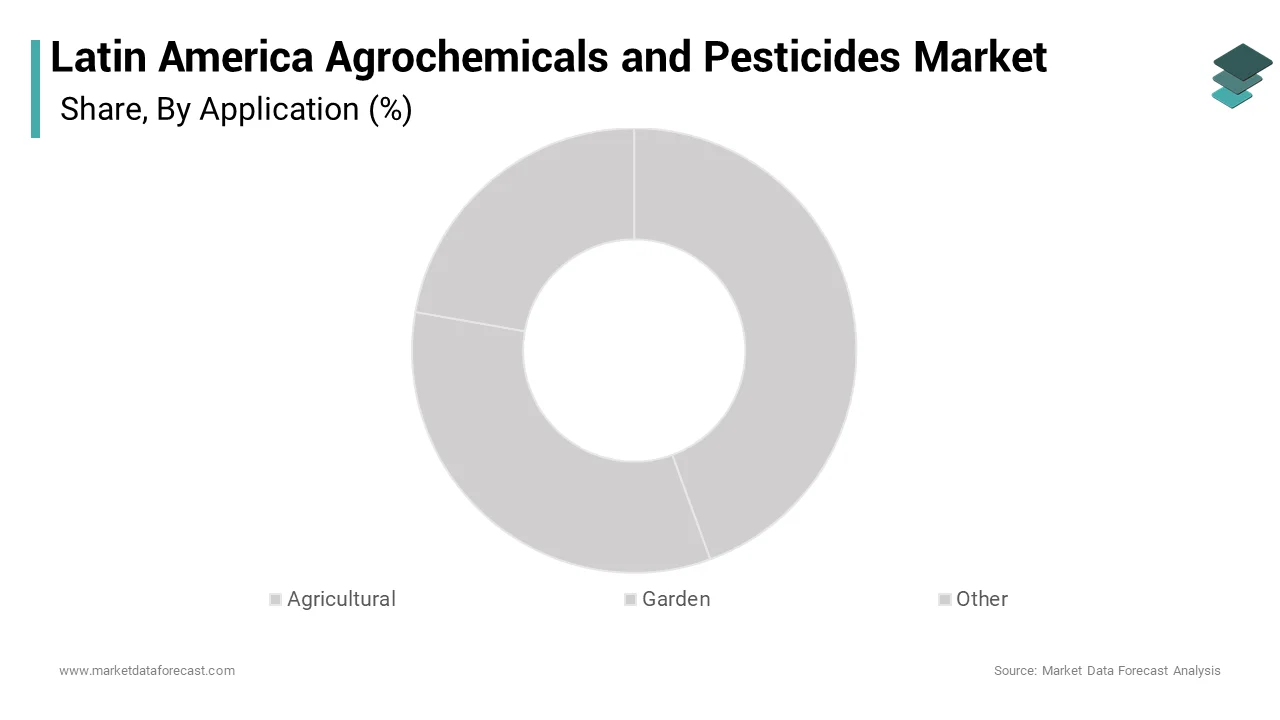
Agricultural application dominated the Latin American agrochemical and pesticide market in 2024, accounting for a substantial share of total usage. This segment encompasses large-scale crop production, including staple commodities such as soybeans, maize, sugarcane, cotton, and coffee, many of which are major export crops for the region.
Similarly, according to the Food and Agriculture Organization (FAO), Latin America contributes significantly to global agricultural output, with Brazil alone producing over 120 million metric tons of soybeans annually. These high-yield farming systems rely heavily on herbicides, insecticides, and fungicides to manage pest pressure and maintain productivity in tropical and subtropical climates.
The Inter-American Development Bank reports that mechanized agriculture has expanded across the region, particularly in Brazil, Argentina, and Paraguay, where monoculture farming practices have intensified chemical use.
Also, government support for agribusiness expansion, coupled with increasing land under cultivation, reinforces the dominance of agricultural applications. With continued investment in export-oriented farming and integrated pest management strategies, this segment remains central to the regional agrochemical market.
Garden and Other Applications
Garden and other applications represented the fastest-growing segment within the Latin America agrochemical and pesticide market, projected to expand at a CAGR of 7.3% through 2033. This growth is driven by rising urban gardening trends, increased home landscaping activities, and the expansion of smallholder horticulture operations catering to local and niche markets.
Homeowners and community gardeners increasingly rely on consumer-grade pesticides and biocontrol agents to protect ornamental plants, vegetables, and fruit-bearing trees from common pests and fungal diseases.
Moreover, the rise of organic and backyard farming initiatives supported by municipal programs has spurred demand for both conventional and biological agrochemicals tailored for smaller-scale use.
Retail availability through hardware stores, online platforms, and cooperative extension services has further facilitated access. With growing environmental awareness and expanding green spaces in urban centers, the garden and other applications segment is positioned for sustained growth in the regional market.
By Type Insights
Herbicides
Herbicides constituted the strongest segment in the Latin American agrochemical and pesticide market in 2024, capturing 48.1% of total consumption. This is attributed to the extensive use of herbicidal products in large-scale commercial farming, particularly in glyphosate-tolerant soybean, corn, and cotton fields.
According to the Weed Science Society of the Americas, herbicide use in Latin America has surged due to the proliferation of glyphosate-resistant weeds, necessitating more complex weed management strategies that include multiple modes of action. In Brazil alone, over 60% of all agrochemical expenditures are allocated to herbicides, reflecting their critical role in maintaining yield potential.
Embrapa’s research indicates that post-emergence herbicides such as dicamba, 2,4-D, and glufosinate have gained traction as part of integrated weed control programs aimed at mitigating resistance development. Besides, residual herbicides are being increasingly adopted to provide season-long weed suppression in no-till and reduced-tillage systems.
Furthermore, regulatory reforms have encouraged the registration of new herbicidal active ingredients, expanding farmer options. These factors collectively sustain the herbicide segment’s leadership position in the Latin American agrochemical market.
Insecticides
Insecticides are the booming type segment in the Latin American agrochemical and pesticide market, projected to expand at a CAGR of 7.6% through 2033. This progress is attributed to increasing infestations of secondary pests in genetically modified crops, climate-induced pest migration, and the expansion of high-value horticultural production systems.
Also, insect pest outbreaks in Latin American farms have risen sharply in recent years, particularly in soybean, cotton, and vegetable fields. Fall armyworm and soybean looper infestations have become more frequent, prompting higher insecticide usage across Brazil, Colombia, and Peru.
As per the Latin American Plant Protection Organization, synthetic pyrethroids, neonicotinoids, and newer bioinsecticides are gaining traction among growers seeking effective pest control solutions with lower environmental impact.
Moreover, the adoption of precision application technologies—such as drone-based spraying and pheromone traps—is enhancing insecticide efficacy while reducing off-target effects. With ongoing investments in pest monitoring systems and integrated pest management (IPM) programs, the insecticide segment is poised for accelerated growth in the regional agrochemical market.
COUNTRY-LEVEL ANALYSIS
Brazil Market Analysis
Brazil held the largest share of the Latin American agrochemical and pesticide market in 2024, accounting for 49.7% of total consumption. As one of the world’s top agricultural producers and exporters, Brazil relies heavily on chemical inputs to sustain high yields in soybeans, corn, sugarcane, and cotton. Also, the country’s widespread adoption of genetically modified (GM) crops has reinforced demand for compatible agrochemical formulations.
Regulatory developments under the Ministry of Agriculture and IBAMA continue to shape market dynamics, with increasing scrutiny on product approvals and environmental compliance. However, industry stakeholders report that digital farming tools and biopesticide integration are gaining momentum, signaling a shift toward sustainable input use.
With its vast agricultural footprint and evolving policy landscape, Brazil remains the cornerstone of the Latin American agrochemical and pesticide market.
Argentina Market Analysis
Argentina is a major agrochemical consumer in the Latin American agrochemical and pesticide market, positioning it as the second-largest consumer in the region. The country’s agrochemical demand is largely driven by its robust soybean and corn production, which forms the backbone of its agro-export economy.
Moreover, the widespread use of biotech seeds has further reinforced the need for targeted pesticide applications to manage resistant weeds and secondary pests.
The Argentine government has implemented periodic restrictions on certain agrochemicals due to environmental concerns, yet enforcement remains inconsistent. Despite economic volatility and fluctuating currency policies, Argentina continues to play a pivotal role in shaping the regional agrochemical market, particularly in South America's Southern Cone.
Mexico Market Analysis
Mexico is a developing region in the Latin American agrochemical and pesticide market, driven by its diverse agricultural landscape, ranging from staple grains to high-value fruits and vegetables. The country’s proximity to North American markets and integration into trade agreements such as USMCA have reinforced the need for quality-assured crop protection solutions.
According to the Mexican Ministry of Agriculture (SADER), national pesticide consumption has steadily increased, particularly in the Bajío and Sinaloa regions known for intensive corn, tomato, and chili pepper cultivation. The use of insecticides and fungicides has seen notable growth due to rising pest pressure linked to warmer temperatures and changing rainfall patterns.
However, recent regulatory changes—including proposed restrictions on glyphosate and chlorpyrifos—have introduced uncertainty in the market. Despite these challenges, Mexico remains a key player in the regional agrochemical market, with ongoing investments in modernization and sustainable input use.
COMPETITIVE LANDSCAPE
The Latin American agrochemical and pesticide market is highly competitive, shaped by a mix of multinational corporations, regional manufacturers, and emerging biopesticide innovators. Established global players dominate due to their extensive R&D capabilities, brand recognition, and well-established distribution networks. However, increasing demand for sustainable alternatives and shifting regulatory landscapes have opened opportunities for smaller, agile firms specializing in biocontrol agents and digital agriculture solutions. Competition extends beyond pricing to include technological differentiation, environmental responsibility, and farmer education initiatives aimed at promoting best practices in chemical use. Companies are also adapting to fluctuating government policies and rising concerns over pesticide residues by investing in safer, more targeted formulations. Additionally, the expansion of e-commerce platforms and direct-to-farmer sales models is altering traditional supply chain dynamics, intensifying rivalry among industry participants. As the region continues to modernize its agricultural practices, competition will remain fierce, driven by the need to balance productivity with sustainability and regulatory compliance.
KEY MARKET PLAYERS
A few of the market players in the LAmericanerica agrochemicals and pesticides market include
- Bayer
- Dow AgroSciences
- Monsanto
- BASF
- Adama
- Nufarm
- Syngenta
- DuPont
- Qingdao Kyx Chemical
- Jiangsu Huangma Agrochemicals
- Jiangsu Changqing Agrochemical
- Albaugh
- Gharda
- Jiangsu
- Yangnong Chemical Group
- Nanjing Red Sun
- Jiangsu Changlong Agrochemical
- Yancheng Limin Chemical
- KWIN Joint-stock
- Jiangsu Pesticide Research Institute Company
- Hubei Sanonda
- Zhejiang Hisun Chemical
- Bailing Agrochemical
- Hailir Pesticides and Chemicals
- Jiangsu Fengshan Group
- Hebei Yetian Agrochemicals
- Xinyi Zhongkai Agro-chemical Industry
- Shandong Qilin Agrochemical
Top Players In The Market
- Bayer CropScience plays a dominant role in the Latin American agrochemical and pesticide market through its comprehensive portfolio of herbicides, insecticides, and seed treatment solutions. The company is known for its innovation in crop protection technologies, including digital farming tools that enhance precision application. Bayer’s strong presence in Brazil and Argentina supports large-scale agricultural production, particularly in soybean and corn cultivation. Its commitment to sustainable agriculture and integrated pest management has positioned it as a key influencer in shaping regulatory and environmental standards across the region.
- Syngenta is a major player in the Latin American agrochemical sector, offering a broad range of crop protection products tailored to tropical and subtropical growing conditions. The company's focus on research-driven formulations and biological alternatives has strengthened its relevance among both commercial farmers and smallholders. Syngenta actively collaborates with local extension services to promote responsible pesticide use and improve yield outcomes. With an emphasis on farmer education and supply chain integration, Syngenta continues to expand its influence in key markets such as Brazil, Mexico, and Colombia.
- BASF Agricultural Solutions contributes significantly to the Latin American agrochemical and pesticide market by delivering advanced formulation technologies and adjuvant systems that enhance product performance. The company invests heavily in developing localized solutions that address regional pest pressures and climatic challenges. BASF’s strategic partnerships with biotech firms and digital agriculture platforms support its growth in precision farming applications. By emphasizing sustainability, stewardship programs, and product training, BASF maintains a strong foothold in the region’s evolving agricultural landscape.
Top Strategies Used By Key Market Participants
Product Innovation and Formulation Enhancement
Leading companies are continuously investing in R&D to develop next-generation agrochemicals with improved efficacy, reduced environmental impact, and resistance management capabilities. These innovations include new active ingredients, bio-based pesticides, and enhanced delivery systems that cater to diverse farming conditions across Latin America.
Strategic Partnerships and Local Collaborations
To strengthen market penetration, agrochemical giants are forming alliances with local distributors, cooperatives, and agritech startups. These collaborations help tailor product offerings to regional needs while improving access to remote farming communities and enhancing technical support networks.
Digital Agriculture Integration
Major players are integrating digital tools—such as AI-driven pest forecasting, drone-based spraying, and mobile advisory platforms—into their service portfolios. This approach enables more precise pesticide application, optimizes input use efficiency, and enhances farmer engagement through data-driven decision-making.
RECENT MARKET NEWS
- In February 2023, Bayer launched a regional digital advisory platform designed to provide real-time pest monitoring and pesticide recommendation tools tailored for Brazilian soybean and cotton growers, enhancing precision application strategies.
- In June 2023, Syngenta expanded its biopesticide production facility in Argentina, aiming to increase supply capacity for microbial and botanical-based crop protection solutions amid growing demand for sustainable inputs.
- In October 2023, BASF partnered with a leading Mexican agritech startup to integrate drone-based spraying technology into its existing crop protection offerings, targeting high-value fruit and vegetable producers.
- In January 2024, Bayer initiated a farmer training initiative in Colombia, focusing on responsible pesticide use, resistance management, and safety protocols, reinforcing its commitment to product stewardship in Latin America.
- In May 2024, Syngenta introduced a new line of low-drift herbicide formulations in Brazil, specifically designed to comply with evolving environmental regulations while maintaining high efficacy against glyphosate-resistant weeds.
MARKET SEGMENTATION
This research report on the Latin American agrochemicals market is segmented and sub-segmented into the following categories.
By Application
- Agricultural
- Garden
- Other
By Type
- Insecticides
- Antiseptics
- Herbicides
- Others
By Country
- Argentina
- Brazil
- Mexico