- Product Description Description
- Table of Contents TOC
- List of Table & Figure LOT
- Get Free Sample PDF Sample PDF
Market Size, 2025
$8.65 BnMarket Estimate, 2026
$9.11 BnMarket Forecast, 2034
$13.80 BnCAGR, 2026–2034
5.33%Latin America Biodiesel Market Size, Growth, Trends & Forecast (2026–2034)
The Latin America biodiesel market size was calculated to be USD 8.65 billion in 2025, is anticipated to be worth USD 9.11 billion in 2026, and is projected to reach USD 13.80 billion by 2034, registering a compound annual growth rate (CAGR) of 5.33% during the forecast period from 2026 to 2034. Driven by supportive government blending mandates, abundant agricultural feedstock availability, and an expanding clean energy transition, the regional market continues to expand steadily.
Key Executive Metrics (At-a-Glance)
- 2025 Base Valuation: USD 8.65 Billion
- 2026 Current Valuation: USD 9.11 Billion
- 2034 Forecast Valuation: USD 13.80 Billion
- Compound Annual Growth Rate (CAGR): 5.33% (2026–2034)
- Dominant Feedstock Segment: Vegetable Oils (constituting the largest feedstock share in 2025)
- Fastest-Growing Feedstock Segment: Animal Fats (projected to expand at a CAGR of 9.6%)
- Dominant Application Segment: Fuel (commanding the market due to mandatory blending policies)
- Fastest-Growing Application Segment: Power Generation (expanding at a CAGR of 10.8%)
- Regional Highlights: Brazil leads the market, accounting for 54.6% of total regional production in 2025, supported by robust agro-industrial resources and the PNPB program.
Core Market Drivers
- Government Mandates: Implementation of strict national blending policies (such as Brazil's B12 mandate) ensuring stable, guaranteed demand.
- Abundant Agricultural Base: High regional production of oilseeds like soybean, palm, and sunflower providing cost-effective raw materials.
- Clean Energy Transition: Growing regional commitments to reducing carbon emissions and promoting sustainable transportation fuels.
Primary Market Restraints & Challenges
- Feedstock Price Volatility: Unpredictable fluctuations in agricultural commodity prices impacting production margins.
- Fossil Fuel Competition: Continued reliance on subsidized petroleum diesel posing price competition.
- Distribution Bottlenecks: Lack of adequate retail-level infrastructure for higher biodiesel blends beyond centralized refineries.
Latin America Biodiesel Market Segmentation Breakdown
| Segment Category | Sub-Segments Covered | Largest Segment | Fastest-Growing Segment |
|---|---|---|---|
| By Feedstock | Vegetable Oils, Animal Fats | Vegetable Oils | Animal Fats (9.6% CAGR) |
| By Application | Fuel, Power Generation | Fuel | Power Generation (10.8% CAGR) |
| By Region | Brazil, Mexico, Argentina, Chile, Rest of Latin America | Brazil (54.6%) | Chile & Colombia (Driven by clean energy & green mobility initiatives) |
Major Industry Players Profiled
Key prominent companies operating in the Latin American biodiesel market include Cargill, Bunge Limited, ADM (Archer Daniels Midland), Petrobras, Biosev, GranBio, Cosan, Ecodiesel Colombia S.A., Agrosuper, and Grupo Palmas.
Latin America Biodiesel Market Size
The Latin America biodiesel market size was calculated to be USD 8.65 billion in 2025 and is anticipated to be worth USD 13.80 billion by 2034, from USD 9.11 billion in 2026, growing at a CAGR of 5.33% during the forecast period.
The Latin America biodiesel market consists of the production, distribution, and consumption of biodiesel fuel derived from renewable sources such as soybean oil, palm oil, animal fats, and used cooking oil. Biodiesel serves as a sustainable alternative to conventional diesel, primarily used in transportation and industrial applications across the region. It is often blended with petroleum-based diesel in varying proportions—most commonly as B5, B10, or B30—to reduce greenhouse gas emissions and dependence on fossil fuels.
According to the Economic Commission for Latin America and the Caribbean (ECLAC), the region has seen increasing policy support for biofuels due to its abundant agricultural resources and commitment to climate goals under international agreements such as the Paris Agreement. Brazil, one of the prime producers in the region, has been at the forefront of integrating biodiesel into national energy strategies. The region’s strong agro-industrial base provides a competitive advantage for feedstock availability, positioning Latin America as a key player in the global biofuel landscape. Apart from these, rising urbanization, stricter emission norms, and growing public awareness about environmental sustainability are shaping the regional biodiesel industry into a critical component of Latin America's clean energy transition.
MARKET DRIVERS
Government Mandates and Renewable Energy Policies
A main driver of the Latin American biodiesel market is the implementation of government mandates and supportive renewable energy policies aimed at reducing carbon emissions and promoting cleaner transportation fuels. Several countries in the region have introduced blending mandates that require a minimum percentage of biodiesel to be mixed with conventional diesel. According to the Inter-American Development Bank (IDB), Brazil enforces a mandatory B12 biodiesel blend, which is among the highest in the world. This mandate is backed by the National Biodiesel Production and Use Program (PNPB), which ensures a stable demand for biodiesel producers. These policies not only create a guaranteed market for biodiesel but also encourage investment in production facilities and supply chain infrastructure. Also, these mandates have helped reduce annual CO₂ emissions significantly.
Abundant Agricultural Feedstock and Rural Development Incentives
Another significant driver of the Latin America biodiesel market is the region’s vast availability of agricultural feedstocks such as soybean, palm oil, and sunflower oil, which are essential for biodiesel production. Countries like Brazil, Argentina, and Paraguay rank among the top global producers of these crops, providing a natural advantage for large-scale biodiesel manufacturing. According to the study, Brazil produced over 150 million metric tons of soybeans in 2023, making it the world’s leading exporter. A portion of this output is directed toward domestic biodiesel production, ensuring a stable and cost-effective raw material supply. In addition to economic benefits, biodiesel production supports rural development by generating employment opportunities and stabilizing farm incomes. As per Brazil’s National Supply Company (CONAB), the biodiesel sector provides direct and indirect employment to over 100,000 people, particularly in smallholder farming communities.
MARKET RESTRAINTS
Volatility in Feedstock Prices and Supply Chain Constraints
A major restraint affecting the Latin American biodiesel market is the volatility in feedstock prices, which significantly impacts production costs and profitability for biodiesel manufacturers. Since biodiesel is primarily derived from agricultural commodities such as soybean oil, palm oil, and animal fats, fluctuations in crop yields, weather conditions, and global commodity markets can lead to unpredictable input costs. According to the United Nations Conference on Trade and Development (UNCTAD), agricultural commodity prices in Latin America experienced significant swings between 2022 and 2025 due to extreme weather events, export restrictions, and geopolitical tensions. For instance, in Brazil, the Brazilian Institute of Geography and Statistics (IBGE) reported that soybean prices increased in 2023 due to drought-related yield losses, raising concerns among biodiesel producers about margin compression. Additionally, supply chain inefficiencies such as inadequate storage infrastructure, logistical bottlenecks, and inconsistent transport networks further exacerbate price instability.
Competition from Fossil Fuels and Inconsistent Policy Enforcement
Another significant constraint impeding the Latin American biodiesel market is the continued dominance of fossil fuels and the inconsistent enforcement of renewable energy policies across the region. Despite regulatory mandates promoting biodiesel blends, the availability of subsidized petroleum-based diesel continues to make conventional fuels more attractive to consumers and fleet operators, particularly during periods of low crude oil prices. According to the International Energy Agency (IEA), fossil diesel remains cheaper than biodiesel in several Latin American countries due to government subsidies and tax incentives favoring traditional energy sources. In Mexico, for example, state-owned Pemex maintains control over fuel pricing, often undercutting biodiesel alternatives despite federal blending requirements. Furthermore, policy enforcement varies widely across the region. While Brazil and Argentina have robust regulatory frameworks, other countries struggle with weak compliance mechanisms and intermittent enforcement of blending mandates. Like, some governments have delayed implementing higher biodiesel blends due to lobbying from petroleum industry stakeholders.
MARKET OPPORTUNITIES
Expansion of Biofuel Blending Targets and Carbon Credit Mechanisms
A key opportunity shaping the Latin America biodiesel market is the potential expansion of biofuel blending targets and the introduction of carbon credit mechanisms designed to incentivize cleaner energy use. Several governments in the region are exploring ways to increase the share of renewables in the transportation sector, aligning with global decarbonization efforts. According to the Economic Commission for Latin America and the Caribbean (ECLAC), discussions are underway in Brazil to raise the national biodiesel blend from B12 to B15 within the next five years. If implemented, this change would significantly boost domestic biodiesel demand and encourage additional investments in production capacity. Similarly, Argentina is evaluating the integration of carbon trading schemes, where biodiesel producers could earn tradable credits based on their emissions reductions. Moreover, Colombia has initiated a voluntary carbon offset platform, allowing companies to invest in certified biodiesel projects to meet sustainability goals.
Technological Advancements in Advanced Biodiesel and Waste-to-Energy Solutions
A promising avenue for the Latin American market lies in the advancement of second and third-generation biodiesel technologies that utilize non-food feedstocks and waste materials. Innovations such as hydrotreated vegetable oil (HVO), algae-based biodiesel, and waste cooking oil recycling offer improved efficiency, reduced emissions, and greater feedstock flexibility compared to traditional transesterification processes. According to the International Renewable Energy Agency (IRENA), research institutions and private enterprises in Brazil and Chile have made significant strides in developing advanced biofuels using agricultural residues and municipal waste streams. In 2025, Brazil’s National Council for Scientific and Technological Development (CNPq) funded multiple pilot projects focused on converting sugarcane bagasse and used frying oil into high-quality biodiesel. Also, Argentina has begun encouraging the adoption of HVO technology, which allows for higher blending ratios without engine modifications.
MARKET CHALLENGES
Limited Infrastructure for Biodiesel Distribution and Refueling Stations
An enduring challenge in the Latin American biodiesel market is the lack of adequate infrastructure for biodiesel distribution and refueling stations, which limits widespread adoption beyond mandated blending levels. Unlike in Europe and North America, where dedicated biodiesel pumps and transport logistics are more developed, many Latin American countries still rely on centralized blending systems rather than retail-level availability of higher biodiesel blends. In Brazil, despite having the largest biodiesel production capacity in Latin America, only a fraction of service stations provide higher blends such as B30, largely confined to urban centers. Argentina faces similar limitations, with most biodieselbeings blended at refineries before being distributed as standard diesel, preventing end-users from choosing higher renewable content. This lack of visibility and accessibility discourages fleet operators and environmentally conscious consumers from adopting biodiesel more actively.
Public and Industry Misconceptions About Biodiesel Performance and Cost
A persistent challenge confronting the Latin American biodiesel market is the prevailing misconception among both the general public and industry stakeholders regarding the performance, reliability, and cost-effectiveness of biodiesel compared to conventional diesel. Despite extensive scientific validation of biodiesel’s environmental and operational benefits, skepticism remains among vehicle owners, fleet managers, and policymakers. Also, misinformation persists around perceived cost disadvantages. Although biodiesel production costs have declined due to economies of scale and improved refining techniques, outdated perceptions about higher fuel prices continue to deter wider adoption. As per the Brazilian Association of Biodiesel Producers (ABIOVE), industry education campaigns have struggled to reach smaller transport firms and independent drivers who rely heavily on fuel affordability.
REPORT COVERAGE
| REPORT METRIC | DETAILS |
| Market Size Available | 2025 to 2034 |
| Base Year | 2025 |
| Forecast Period | 2026 to 2034 |
| CAGR | 5.33% |
| Segments Covered | By Feed Stock, Application, and Region |
| Various Analyses Covered | Global, Regional & Country Level Analysis; Segment-Level Analysis; DROC, PESTLE Analysis; Porter’s Five Forces Analysis; Competitive Landscape; Analyst Overview of Investment Opportunities |
| Regions Covered | Brazil, Mexico, Argentina, Chile and Rest Of Latin America |
| Market Leaders Profiled | Cargill, Bunge Limited, ADM (Archer Daniels Midland), Petrobras, Biosev, GranBio, Cosan, Ecodiesel Colombia S.A., Agrosuper, Grupo Palmas. |
SEGMENTAL ANALYSIS
By Feedstock Insights
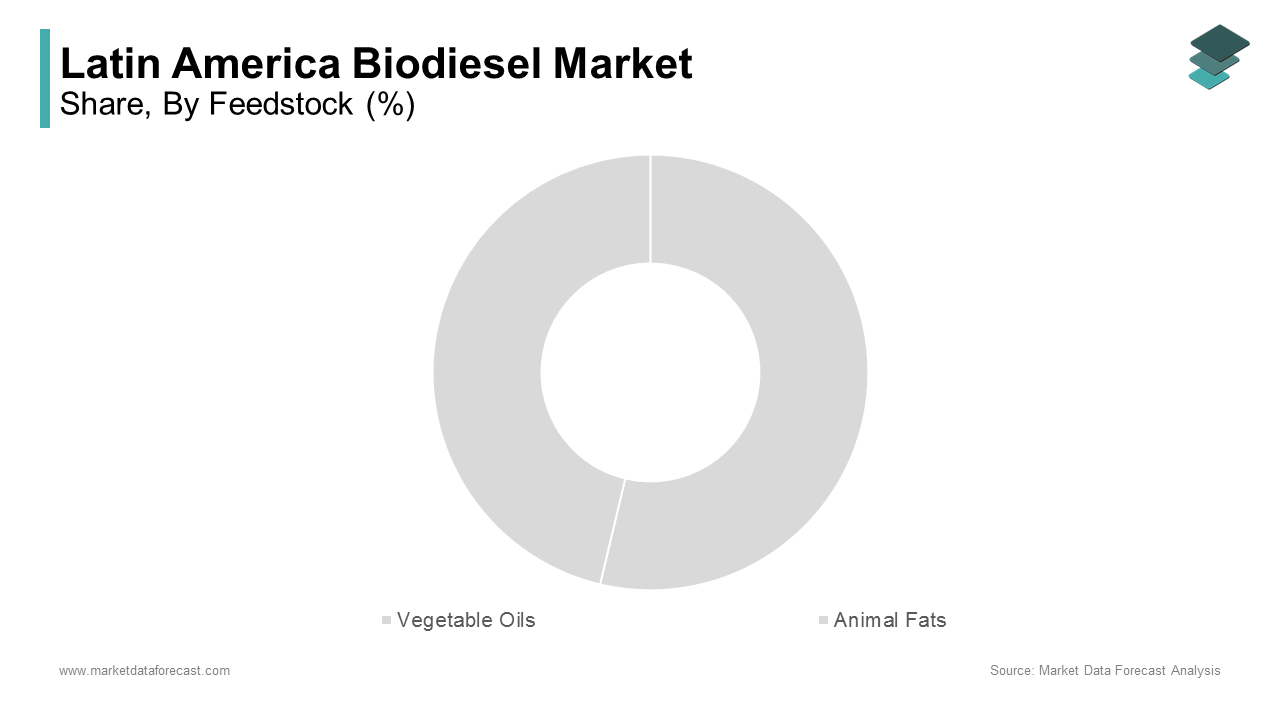
Vegetable oils constituted the largest feedstock segment in the Latin America biodiesel market in 2025. This dominance is primarily attributed to the region’s vast agricultural resources and well-established supply chains for oilseed crops such as soybean, palm, and sunflower. According to the Food and Agriculture Organization (FAO), Brazil produced over 150 million metric tons of soybeans in 2023, making it the world’s leading exporter. A significant portion of this output is directed toward domestic biodiesel manufacturing, ensuring a stable and cost-effective raw material supply. Similarly, Argentina is one of the top producers of soybean oil globally. In addition to economic benefits, vegetable oil-based biodiesel supports rural development by generating employment opportunities and stabilizing farm incomes. Government mandates in countries like Colombia and Paraguay also favor vegetable oil feedstocks due to their scalability and compatibility with existing refining infrastructure.
Animal fats are coming out as the fastest-growing feedstock segment within the Latin America biodiesel market, projected to expand at a CAGR of 9.6% from 2026 to 2034. This growth is driven by the increasing availability of waste animal fat sources and rising interest in sustainable, non-food-based feedstocks that do not compete with food supply chains. A main driver is the expansion of the meat processing industry across the region. According to the Economic Commission for Latin America and the Caribbean (ECLAC), Brazil alone produces over 7 million metric tons of beef annually, generating substantial volumes of tallow suitable for biodiesel production. Additionally, environmental regulations promoting circular economy practices are encouraging biodiesel producers to utilize waste-derived feedstocks. As governments and private stakeholders seek alternatives to first-generation biofuels, animal fats offer a promising solution that aligns with sustainability goals while leveraging existing industrial byproducts, contributing to the accelerated growth of this segment across Latin America.
By Application Insights
The fuel application segment commanded the Latin American biodiesel market in 2025. This overwhelming share is primarily driven by government-mandated blending policies that require biodiesel to be mixed with petroleum diesel to reduce greenhouse gas emissions and promote cleaner transportation fuels. According to the Inter-American Development Bank (IDB), Brazil enforces a mandatory B12 biodiesel blend, one of the highest in the world. This mandate ensures consistent demand for biodiesel in the transportation sector, particularly in heavy-duty vehicles and public transport systems. These policies not only create a guaranteed market for biodiesel but also encourage investment in production facilities and supply chain infrastructure.
Power generation is the rapidly advancing application segment in the Latin American biodiesel market, expanding at a CAGR of approximately 10.8%. This quick growth is fueled by increasing demand for renewable energy solutions in off-grid and remote areas where access to conventional electricity is limited or unreliable. Biodiesel-powered generators are increasingly being used in agricultural zones, mining operations, and isolated communities where grid connectivity is weak. So, with a growing emphasis on clean energy transitions and rural electrification, power generation is emerging as a strategic growth avenue for the Latin American biodiesel industry.
REGIONAL ANALYSIS
Brazil possessed the largest share of the LatinAmericana biodiesel market accounting for 54.6% of total regional production in 2025. The country's expansion is attributed to its abundant agricultural resources, well-developed agro-industrial sector, and strong government support through national biofuel policies. The National Biodiesel Production and Use Program (PNPB) has played a crucial role in integrating smallholder farmers into the supply chain, promoting social inclusion and rural development. With ongoing investments in advanced biofuels and carbon reduction initiatives, Brazil continues to serve as the cornerstone of the Latin American biodiesel landscape.
Argentina benefits from a robust agro-industrial base, particularly in soybean cultivation, which supplies a significant portion of the feedstock for biodiesel manufacturing. According to the Argentine Chamber of Vegetable Oils (CIARA), Argentina produced over 4 million metric tons of soybean oil in 2023, with nearly 15% directed toward biodiesel production. Additionally, Argentina has been actively exploring carbon credit mechanisms to further incentivize biodiesel adoption. Despite economic volatility and currency fluctuations, Argentina remains a key player in the regional biodiesel market, leveraging its agricultural strengths and policy frameworks to maintain steady production levels and international competitiveness.
Mexico is positioning itself as a growing player in the regional industry. The country’s market is driven by increasing awareness of renewable energy benefits and gradual policy developments aimed at reducing fossil fuel dependence. According to the International Energy Agency (IEA), Mexico has faced challenges in implementing consistent biodiesel mandates due to state-owned Pemex’s dominance in the fuel sector. Additionally, interest in biodiesel for power generation and niche transport applications is rising, particularly in regions with limited grid access. Private sector participation is also growing, with several local and international firms investing in production capacity and distribution networks.
Chile is distinguished by its progressive approach to sustainability and renewable energy integration. Although not a major producer, Chile has been actively incorporating biodiesel into its broader climate action strategy. The country also emphasizes the use of waste-based feedstocks, aligning with circular economy principles. With strong regulatory backing and a focus on green mobility, Chile is steadily strengthening its position in the Latin American biodiesel market despite its relatively modest production scale.
The remaining Latin American countries include Colombia, Paraguay, Ecuador, Peru, and Central American nations, where biodiesel demand is growing due to increasing policy alignment with global climate goals and rising agricultural output. Also, Colombia has made notable progress in expanding its biodiesel program. Paraguay has also emerged as a minor exporter, with favorable tax incentives for biodiesel producers. Despite varying levels of policy maturity, the rest of Latin America presents diverse opportunities for biodiesel expansion, driven by improving regulatory environments and increasing rural engagement in feedstock production.
LEADING PLAYERS IN THE LATIN AMERICA BIODIESEL MARKET
Petrobras (Brazil)
Petrobras plays a pivotal role in Brazil’s biodiesel market through its integration of renewable fuels into the national diesel supply chain. As a state-controlled energy company, it collaborates with independent biodiesel producers to meet government-mandated blending targets. While traditionally focused on petroleum, Petrobras supports the regional biofuel industry by facilitating large-scale distribution and refining infrastructure. Its involvement ensures regulatory compliance and market stability, reinforcing Brazil’s position as a leading biodiesel producer globally.
Oleofina (Argentina)
Oleofina is one of Argentina’s largest biodiesel producers, contributing significantly to both domestic consumption and international exports. The company specializes in soybean oil-based biodiesel, aligning with Argentina’s strong agro-industrial base. By adhering to European quality standards, Oleofina enhances Argentina’s presence in global markets, particularly in Europe and neighboring Latin American countries. Its production capacity and export expertise make it a key player in shaping the region’s biofuel trade dynamics and sustainability initiatives.
Biocombustibles S.A. (Colombia)
Biocombustibles S.A. is a leading force in Colombia’s biodiesel sector, supporting national blending mandates through palm oil-based fuel production. The company contributes to rural development and environmental sustainability by sourcing raw materials from local farmers. Its adherence to international certification systems strengthens Colombia’s credibility in global biofuel markets. Biocombustibles S.A. plays a crucial role in advancing cleaner transport solutions across Latin America.
TOP STRATEGIES USED BY KEY MARKET PARTICIPANTS
One major strategy employed by key players in the Latin America biodiesel market is feedstock diversification, where companies invest in alternative raw materials such as used cooking oil, animal fats, and non-food crops. This approach helps mitigate price volatility and reduces reliance on traditional vegetable oils while enhancing sustainability credentials and aligning with circular economy principles.
Another key tactic is expanding downstream integration, where biodiesel producers collaborate with fuel distributors and refineries to ensure seamless blending and retail-level availability. These partnerships improve supply chain efficiency and guarantee compliance with national mandates, strengthening market access and operational resilience for industry players.
Lastly, advocacy for stronger policy frameworks is a growing trend among industry leaders. Companies actively engage with policymakers to secure long-term blending targets, financial incentives, and carbon credit mechanisms that support market stability and attract investment into renewable fuel infrastructure across Latin America.
KEY MARKET PLAYERS AND COMPETITIVE OVERVIEW
Major Players in the Latin America Biodiesel market include Cargill, Bunge Limited, ADM (Archer Daniels Midland), Petrobras, Biosev, GranBio, Cosan, Eco diesel Colombia S.A., Agrosuper, Grupo Palmas.
The Latin American biodiesel market is characterized by a dynamic competitive landscape shaped by a mix of state-backed energy firms, large agribusinesses, and independent biofuel producers. Brazil dominates the sector due to its well-established regulatory framework and abundant agricultural feedstocks, positioning it as a global leader in sustainable fuel production. Argentina follows closely, leveraging its soybean industry to maintain a strong export-oriented biodiesel business.
Multinational corporations and domestic players navigate challenges related to fluctuating commodity prices, inconsistent policy enforcement, and evolving sustainability standards. While some firms utilize vertical integration to control costs and ensure feedstock security, others focus on innovation and green certifications to differentiate themselves in an increasingly eco-conscious market.
Private-sector participation is expanding, especially in Colombia and Chile, where companies are capitalizing on emerging government incentives and climate commitments. However, the market remains fragmented, with disparities in production capacity and regulatory clarity affecting overall competitiveness across countries. As demand for cleaner energy rises, competition will intensify, favoring those who can adapt quickly and advocate effectively for favorable policies.
RECENT HAPPENINGS IN THE MARKET
- In January 2025, Petrobras announced an expansion of its biodiesel co-processing units in refineries across Brazil. This move aimed at integrating higher volumes of domestically produced biodiesel into the national fuel supply chain, reinforcing Petrobras’ commitment to renewable energy and compliance with Brazil’s B12 blending mandate.
- In March 2025, Oleofina of Argentina launched a new facility in Santa Fe province dedicated to producing HVO-grade biodiesel from soybean oil. This initiative was intended to meet European market specifications and boost Argentina’s export potential in the global biofuel trade.
- In May 2025, Biocombustibles S.A. of Colombia secured a long-term supply agreement with Ecopetrol to support nationwide biodiesel blending efforts. The partnership aimed at strengthening Colombia’s domestic fuel security and advancing the country’s transition toward cleaner energy sources.
- In July 2025, Neste, a global leader in renewable fuels, expanded its collaboration with Brazilian agribusinesses to source certified waste-based feedstock for advanced biodiesel production. This initiative was designed to support circular economy principles and facilitate cleaner fuel adoption in Latin America.
- In September 2025, Chile’s Enap partnered with local cooperatives to pilot biodiesel-fueled microgrid projects in remote regions. The project aimed at enhancing rural electrification while promoting the use of renewable fuels in off-grid applications, marking a strategic step toward broader biodiesel utilization in the country.
MARKET SEGMENTATION
This research report on the Latin America Biodiesel Market has been segmented and sub-segmented based on feedstock, application, and region.
By Feedstock
- Vegetable Oils
- Animal Fats
By Application
- Fuel
- Power Generation
By Region
- Brazil
- Mexico
- Argentina
- Chile
- Rest of Latin America