- Product Description Description
- Table of Contents TOC
- List of Table & Figure LOT
- Get Free Sample PDF Sample PDF
Market Size, 2025
$258.5 MnMarket Estimate, 2026
$275.1 MnMarket Forecast, 2034
$453.7 MnCAGR, 2026–2034
6.45%Executive Summary: Latin America Chocolate-Based Spreads Market
- Market Scope: Comprehensive market overview of the Latin America chocolate-based spreads industry, covering product types, sales frequencies, distribution channels, key regional markets (Brazil, Argentina, Chile, Peru), and prominent industry participants.
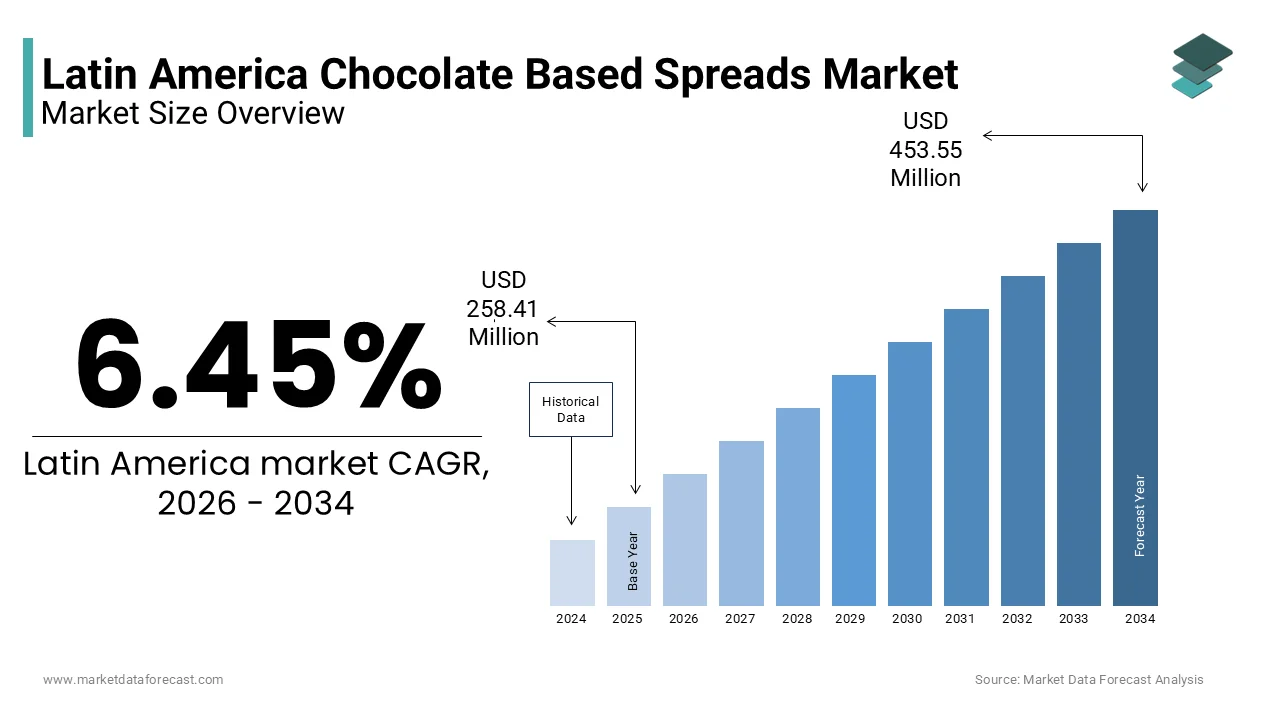
- Market Valuation: Valued at USD 258.51 million (2025), estimated at USD 275.18 million (2026), and projected to reach USD 453.71 million by 2034, registering a steady CAGR of 6.45% across the forecast period.
- Primary Growth Drivers: Shifting consumer taste preferences, increasing disposable spending on chocolate and confectionery treats, rapid urbanization, widespread retail accessibility, and rising health awareness regarding cocoa derivatives. Chief restraints include economic volatility in cocoa supply chains driving up retail prices.
Key Market Segment Metrics
| Category | Leading / Highlighted Segments | Strategic Overview |
|---|---|---|
| By Type | Milk Chocolate, Dark Chocolate, White Chocolate | Milk and hazelnut-infused chocolate pastes dominate household demand, while dark chocolate variants see rising uptake among health-conscious consumers. |
| By Frequency of Sale | Premium Chocolate, Daily Chocolate, Seasonal Chocolate | Daily consumption formats drive high-volume turnover, complemented by premium and seasonal gifting spikes. |
| By Distribution Channel | Supermarkets, Hypermarkets, Grocery Stores, Specialty Stores, Online Retail | Supermarkets and hypermarkets account for the largest retail volume, with online retail expanding rapidly. |
| Regional Analysis | Brazil, Argentina, Chile, Peru | Brazil acts as the primary revenue engine for the region, supported by Argentina and Chile's growing confectionery retail sectors. |
Major Market Players & Market Structure
Market Structure: Competitive landscape characterized by major multinational food corporations and confectionery giants leveraging extensive supply chain networks, aggressive retail placement, and localized flavor variations.
Key Companies: J.M. Smucker, Kraft Foods, Unilever Group, ConAgra Foods Inc., Ferrero Group, Hershey Co., B & G Foods Inc., Nestle, Wellness Foods, and Premier Foods.
Latin America Chocolate Based Spreads Market Size
The Latin America chocolate based spreads market size was valued at USD 258.51 million in 2025 and is expected to reach USD 453.71 million by 2034 from USD 275.18 million in 2026. The market is projected to grow at a CAGR of 6.45%.
Chocolate spread is a sweet chocolate-flavored paste that is eaten mostly spread on toast and bread or similar grain products such as waffles, muffins, pancakes, and pitas. Although chocolate spreads taste, smell, and look like chocolate, they do not solidify, even at room temperature. The paste typically contains cocoa and palm or vegetable oil, and is also likely to contain sugar, milk and additional flavors. At times, it also includes nuts such as ground hazelnuts or honey. Chocolate spread is normally sold in plastic tubs or glass jars.The key driving factors of Latin America Chocolate Based Spreads market are shifting consumer taste preferences and growing spending on chocolate and other confectionary products. Growing urbanization, widespread availability of chocolate and growing awareness about the various health benefits which can be obtained from the consumption of chocolate and derived products will remain another key factor fuelling the market for chocolate based spreads Latin Americaly. The chief constraint of the market is uncertain economy of the cocoa supply which is likely to raise chocolate prices.
MARKET SEGMENTATION
This research report on the Latin America chocolate based spreads market has been segmented and sub-segmented into the following categories.
By Type
- Milk Chocolate
- Dark Chocolate
- White Chocolate
By Frequency of Sale
- Premium Chocolate
- Daily Chocolate
- Seasonal Chocolate
by Distribution Channel
- Supermarkets
- Hypermarkets
- Grocery Stores
- Speciality Stores
- Online Retail
Regional Analysis
- Brazil
- Argentina
- Chile
- Peru
KEY MARKET PLAYERS
- J.M. Smucker
- Kraft Foods
- Unilever Group
- ConAgra Foods Inc.
- Ferrero Group
- Hershey Co.,
- B & G Foods Inc.
- Nestle, Wellness Foods
- Premier Foods