Latin America Color Concentrates Market Research Report - Segmented By Type (solid, liquid), By end-use industry (Consumer Goods, Packaging, Construction, Automotive), And Region (Mexico, Argentina, Brazil and the rest of Latin America) - Industry Analysis, Size, Share, Growth, Trends, and Forecast Report to (2026 to 2034)
Latin America Color Concentrates Market Size
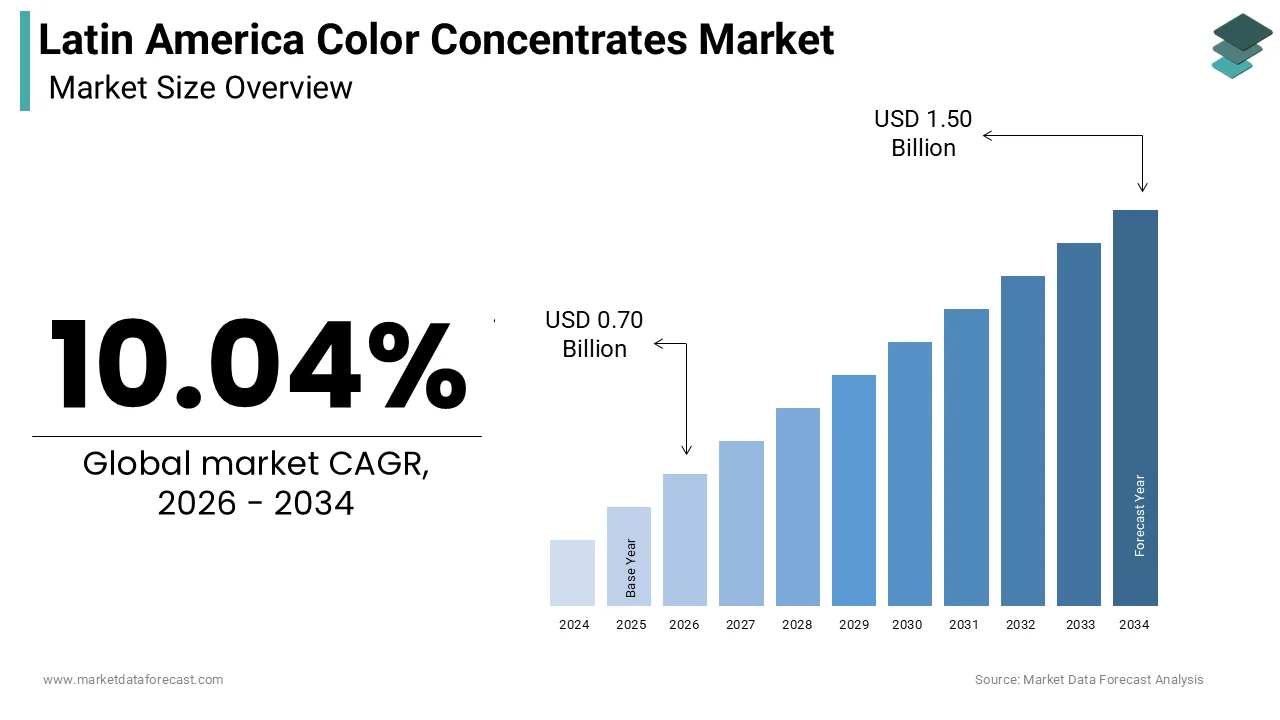
The Latin America Color Concentrates Market size was calculated to be USD 0.64 billion in 2025 and is anticipated to be worth USD 1.50 billion by 2034, growing from USD 0.70 billion in 2026 at a CAGR of 10.04% during the forecast period.
The color concentrates market in Latin America is poised for steady expansion over the next few years as regional manufacturing industries continue to modernize and increase their output. In 2023, Brazil accounted for the largest share of the regional market, driven by its well-established plastics and packaging industries. According to the Brazilian Plastics Industry Association (ABIPLAST), the country produced over 7 million metric tons of plastic goods annually, with colorants playing a crucial role in product differentiation and branding. Meanwhile, Mexico has also emerged as a key player, supported by its proximity to North American supply chains and growing automotive production. As per the Mexican Association of the Plastics Industry (AIMPLAS), the plastics sector contributed significantly to the national GDP, reinforcing the importance of color concentrates in industrial output. These developments highlight the strategic relevance of color concentrate applications in shaping the region’s manufacturing landscape.
MARKET DRIVERS
Expansion of the Packaging Industry
The rapid expansion of the packaging industry, particularly in countries like Brazil, Mexico, and Colombia, is majorly propelling the Latin American color concentrates market growth. Packaging is a major consumer of plastic resins, and the demand for vibrant, branded, and sustainable packaging solutions has surged in recent years. For instance, the rigid bulk packaging in Latin America is projected to grow significantly, with plastics accounting for a significant portion of total packaging materials. This growth is largely attributed to rising consumer preference for convenience packaging, increasing e-commerce activities, and stringent food safety regulations that favor plastic packaging for hygiene and durability. Color concentrates play a critical role in this sector by enabling manufacturers to produce visually appealing, brand-specific packaging with minimal pigment waste and consistent color dispersion. In Brazil alone, over 1 million metric tons of plastic packaging materials are produced annually, as reported by ABIPLAST. The growing demand for multi-coloured and custom-colored packaging in food and beverage, personal care, and pharmaceutical industries has further boosted the consumption of color concentrates. Additionally, the rise in bioplastic packaging adoption has introduced new formulations and applications for colorants. For instance, the demand for bioplastics is expected to grow exponentially in the coming years and necessitate compatible color concentrate solutions. This dynamic expansion of the packaging industry is a key growth catalyst for the color concentrates market in Latin America.
Growth in the Automotive Sector
The steady growth of the automotive manufacturing sector, particularly in Brazil and Mexico, is further boosting the Latin American color concentrates market expansion. The automotive industry is a major consumer of plastic components, many of which require precise and durable coloration for both interior and exterior parts. According to the International Organization of Motor Vehicle Manufacturers (OICA), Latin America produced over 4 million vehicles in 2023, with Brazil and Mexico accounting for nearly 70% of total regional output. The increasing localization of automotive production has led to a surge in demand for color concentrates used in plastic components such as dashboards, bumpers, trims, and interior panels. Plastic parts in the automotive industry are preferred for their lightweight properties, cost efficiency, and design flexibility. However, they require high-performance colorants that can withstand extreme temperatures, UV exposure, and mechanical stress. In Brazil, industry reports suggest that over 85% of automotive plastic components incorporate color concentrates to meet aesthetic and functional requirements. The growing adoption of electric vehicles (EVs) in the region has further intensified the demand for colorants. EV manufacturers are increasingly using plastic components to reduce vehicle weight and improve energy efficiency, which in turn enhances the need for color concentrates. This shift is expected to sustain and amplify the demand for color concentrates in the automotive sector across Latin America.
MARKET RESTRAINTS
Volatility in Raw Material Prices
One of the major restraints affecting the Latin America Color Concentrates Market is the volatility in raw material prices, particularly for base polymers and pigment chemicals. The production of color concentrates relies heavily on raw materials such as polyethylene, polypropylene, and synthetic pigments, all of which are subject to fluctuating global commodity prices. According to the Latin American Chemical Council (CLALQ), the price of polymers and chemical additives is highly sensitive to supply chain disruptions and crude oil pricing. This has significantly impacted production costs for color concentrate manufacturers in the region, particularly in countries like Argentina and Colombia, where import dependency is high. Moreover, geopolitical tensions and trade policies have further exacerbated the price instability of raw materials. Industry data suggests that costs for imported pigments can fluctuate significantly due to currency depreciation and tariffs on chemical imports. This has led to margin compression for small and medium-sized enterprises operating in the market. These challenges have made it difficult for manufacturers to maintain stable pricing for their products, thereby affecting market growth. Additionally, environmental regulations in some countries have restricted the use of certain petroleum-based raw materials, pushing manufacturers to explore alternative, often more expensive, feedstocks. These combined factors of price volatility, supply chain constraints, and regulatory pressures are significant restraints to the sustained growth of the color concentrates market in the region.
Regulatory and Environmental Compliance Challenges
The increasing stringency of environmental and regulatory standards governing the use of chemical substances in industrial applications is further impeding the Latin American market growth. Governments across the region have been tightening regulations on the use of hazardous pigments, heavy metals, and volatile organic compounds (VOCs) in manufacturing processes. For instance, Brazil’s National Environmental Council (CONAMA) has introduced restrictions on the use of cadmium and lead-based pigments in plastic products intended for food contact and children’s toys. Similarly, environmental ministries in the region have enforced stricter emissions standards for chemical manufacturing facilities, leading to higher compliance costs for color concentrate producers. International bodies like the European Chemicals Agency (ECHA) have also influenced Latin American regulatory frameworks through trade agreements and environmental cooperation programs. As a result, several Latin American manufacturers exporting to global markets have had to reformulate their color concentrate products to meet strict compliance standards. Smaller companies, in particular, struggle with the financial burden of reformulating products and acquiring certifications, limiting their market competitiveness. Additionally, growing consumer awareness regarding sustainability and environmental impact has led to increased demand for eco-friendly colorants. However, the transition to bio-based or low-VOC color concentrates requires significant investment in research and development. This regulatory and compliance burden poses a major challenge to market expansion, especially for companies lacking the resources to adapt quickly to evolving environmental standards.
MARKET OPPORTUNITIES
Rising Demand for Sustainable and Bio-Based Colorants
A significant opportunity emerging in the Latin America Color Concentrates Market is the rising demand for sustainable and bio-based colorants, driven by increasing environmental awareness and regulatory pressures. Governments and consumers across the region are prioritizing eco-friendly materials, leading to a shift away from traditional petroleum-based colorants. According to market research, the demand for sustainable and bio-based masterbatches is growing as countries implement policies promoting biodegradable plastics and circular economy initiatives. This shift is supported by national policies that encourage the use of sustainable materials in packaging and consumer goods. The expansion of bioplastics production in Latin America has further fueled the demand for bio-based colorants. Industry reports indicate that the region’s bioplastics production capacity is increasing, with Argentina and Colombia witnessing rapid growth in biopolymer manufacturing. This expansion has created a strong demand for colorants compatible with bio-based resins, prompting manufacturers to invest in research and development for sustainable pigment alternatives. Moreover, multinational brands operating in Latin America are increasingly sourcing sustainable packaging materials, further boosting the market for bio-based colorants. This shift presents a strategic growth opportunity for local and international color concentrate suppliers to expand their product portfolios and capture a growing segment of the sustainable plastics market.
Expansion of the Construction and Infrastructure Sector
The ongoing expansion of the construction and infrastructure sector is driving increased demand for colored plastic materials in applications such as piping, insulation, roofing, and architectural components, which is another prominent opportunity in the Latin American market. Governments across the region have been investing heavily in urban development, housing projects, and public infrastructure, boosting the consumption of plastic-based construction materials that require colorants for identification, aesthetics, and functional purposes. According to the Latin American Construction Industry Federation (FICEM), infrastructure investments in the region remain a key driver of industrial material demand. The use of color-coded plastic pipes and cables has become standard practice in construction and electrical installations, enhancing safety and ease of maintenance. In Brazil, technical standards often mandate the use of specific color codes for water, gas, and electrical conduits, which has increased the demand for high-performance color concentrates. Similarly, other countries in the region are reporting steady growth in the use of colored plastic components in residential and commercial construction projects. Additionally, the trend toward energy-efficient and aesthetically appealing buildings has led to the increased use of colored plastic panels, insulation materials, and window profiles. This growing application scope presents a strong opportunity for color concentrate manufacturers to develop specialized formulations that meet the durability and UV resistance requirements of the construction industry.
MARKET CHALLENGES
Limited Availability of High-Quality Pigments
One of the key challenges facing the Latin American Color Concentrates Market is the limited availability of high-quality pigments that meet the technical and regulatory demands of modern manufacturing applications. While the region has a growing plastics industry, the domestic production of high-performance pigments remains limited, forcing manufacturers to rely heavily on imports from Europe, China, and the United States. Industry reports suggest that a large percentage of pigments used in color concentrate production in Latin America are imported, exposing the market to supply chain disruptions and fluctuating exchange rates. The reliance on imported pigments has been exacerbated by geopolitical tensions and trade restrictions, which have led to delays and increased costs for manufacturers. Furthermore, currency depreciation against the US dollar frequently squeezes profit margins for smaller manufacturers. Moreover, the quality inconsistency of imported pigments poses another challenge. Some suppliers, particularly from low-cost markets, provide pigments that do not meet the required performance standards for UV resistance, thermal stability, or color consistency. This lack of reliable pigment supply hampers the ability of color concentrate producers to ensure consistent product performance and meet the growing expectations of end-users in industries such as automotive and packaging.
Technological Gaps and R&D Limitations
A major challenge in the Latin American Color Concentrates Market is the technological gap and limited investment in research and development (R&D), which hinders innovation and product differentiation. While global markets in North America and Europe have advanced formulation technologies and digital color-matching systems, many Latin American manufacturers still rely on conventional production methods and outdated pigment dispersion techniques. Industry analysis indicates that the percentage of total industry revenue allocated to R&D in the region remains lower than that of developed markets. This disparity limits the ability of local manufacturers to develop high-performance, specialty colorants that meet evolving industry standards. The lack of skilled technical personnel and access to cutting-edge equipment further compounds this issue. Most small and medium-sized enterprises (SMEs) lack the financial resources to invest in automation and digital color management systems, putting them at a disadvantage against larger multinational suppliers. Additionally, collaboration between academia and industry remains limited, slowing the commercialization of new pigment technologies. This lack of innovation infrastructure restricts the market’s ability to respond to emerging trends such as bio-based colorants, high-performance additives, and smart color-changing materials. Addressing these technological and R&D limitations is crucial for the long-term competitiveness of the Latin America Color Concentrates Market.
REPORT COVERAGE
| REPORT METRIC | DETAILS |
| Market Size Available | 2025 to 2034 |
| Base Year | 2025 |
| Forecast Period | 2026 to 2034 |
| CAGR | 10.04% |
| Segments Covered | By Type, End Use, and Region |
| Various Analyses Covered | Global, Regional & Country Level Analysis; Segment-Level Analysis; DROC, PESTLE Analysis; Porter’s Five Forces Analysis; Competitive Landscape; Analyst Overview of Investment Opportunities |
| Regions Covered | Mexico, Argentina, Brazil, and the rest of Latin America |
| Market Leaders Profiled | Ampacet Corporation, Ferro Corporation, A. Schulman, Inc, Penn Color, Inc, And PolyOne Corporation |
SEGMENTAL ANALYSIS
By Type Insights
The solid segment led the market by accounting for 65.5% of the regional market share in 2025. The dominance of solid segment in the Latin American market is driven by the widespread use of solid color concentrates in pellet form across major industries such as packaging, construction, and consumer goods. Solid concentrates offer advantages such as ease of handling, longer shelf life, and compatibility with existing extrusion and injection molding processes. Industry associations in the region indicate that a vast majority of plastic converters prefer solid masterbatches due to their efficiency in achieving uniform color dispersion and cost-effectiveness in high-volume production. One of the key drivers of this segment is the robust growth of the packaging industry, particularly in Brazil and Mexico, where solid colorants are extensively used in food packaging, beverage bottles, and flexible packaging films. Additionally, the construction sector in Argentina and Colombia has also contributed to the demand for solid concentrates used in PVC pipes, fittings, and insulation materials. These factors collectively reinforce the solid segment’s leading position in the market.
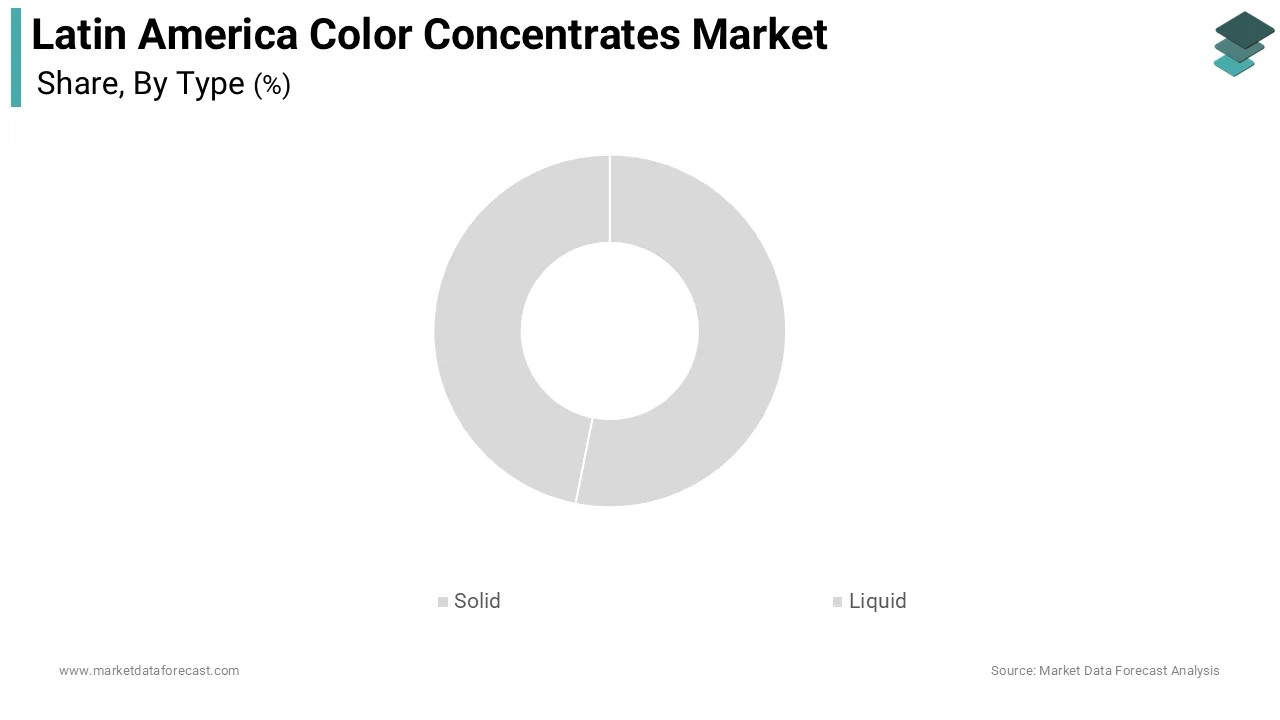
On the other hand, the liquid segment is promising and is anticipated to record a CAGR of 8.5% during the forecast period in the Latin American market, owing to the increasing adoption of liquid colorants in niche applications such as blow molding, fiber spinning, and thin-wall packaging, where precise dosing and rapid dispersion are critical. Unlike solid concentrates, liquid colorants can be easily integrated into existing production lines without requiring additional compounding steps, making them ideal for just-in-time manufacturing processes. One of the primary growth drivers is the rise in demand for high-performance colorants in the automotive and textile industries. In Mexico, the use of liquid concentrates in automotive plastic components has surged due to their ability to provide consistent coloration even in complex geometries. Additionally, the textile industry in Brazil has seen a shift toward liquid colorants for synthetic fiber dyeing, offering energy savings and reduced water usage. These developments are fueling the rapid expansion of the liquid segment across Latin America.
By End Use Industry Insights
The packaging segment was the largest end-use segment in the Latin America Color Concentrates Market and held 39.3% of the regional market share in 2025. This dominance is driven by the extensive use of colored plastics in food and beverage packaging, personal care products, and pharmaceuticals, where branding and product differentiation are crucial. Industry data shows that the region’s packaging industry is a massive market, with plastic packaging representing a significant percentage of total packaging materials. One of the key factors driving the dominance of this segment is the growing demand for lightweight, durable, and visually appealing packaging solutions. In Brazil, the use of colorants in flexible packaging has shown consistent growth, with food packaging being the primary application. The expansion of e-commerce has further intensified the need for branded and colorful packaging to enhance shelf appeal and consumer engagement. Additionally, the rise in single-use packaging and ready-to-eat food products has boosted plastic packaging consumption, particularly in urban centers across Mexico and Colombia. These trends underline the critical role of color concentrates in shaping the packaging landscape across Latin America.
On the other side, the automotive segment is the fastest-growing end-use segment in the Latin America Color Concentrates Market and is projected to grow at a CAGR of 8.2% over the forecast period due to the increasing production of vehicles in the region and the rising demand for customized, lightweight, and aesthetically pleasing plastic components. One of the key growth drivers is the rising adoption of plastic components in automotive interiors and exteriors to reduce vehicle weight and improve fuel efficiency. In Brazil, a high percentage of interior automotive plastic parts used color concentrates in 2023 to meet design and durability standards. Additionally, the surge in electric vehicle (EV) production has further boosted the demand for colorants, as EV manufacturers prioritize lightweight materials and aesthetic customization. Regional electric mobility data shows significant growth in EV sales, contributing to higher demand for color-matched plastic components. In Mexico, industry associations have noted a substantial increase in the use of colorants in automotive plastic parts in recent years. These factors collectively drive the rapid expansion of the automotive segment in the color concentrates market.
REGIONAL ANALYSIS
Brazil Color Concentrates Market Analysis
Brazil held 37.2% of the Latin American market share in 2025 and is expected to witness steady market growth over the next few years as it maintains its role as a regional manufacturing hub. The country’s well-established plastics industry, supported by a strong manufacturing base in packaging, automotive, and construction, drives the demand for colorants. One of the key factors contributing to Brazil’s market leadership is the rapid expansion of the packaging sector, which accounts for a large portion of plastic resin consumption in the country. The growing demand for food and beverage packaging, coupled with the rise of e-commerce, has intensified the need for vibrant and durable colorants. Additionally, the automotive industry remains a significant consumer of color concentrates, with a vast majority of plastic components in Brazilian-made vehicles incorporating colorants for interior and exterior applications. The country’s commitment to sustainable manufacturing has also led to increased adoption of bio-based colorants. These factors collectively reinforce Brazil’s dominant position in the regional market.
Mexico Color Concentrates Market Analysis
Mexico is likely to experience robust growth in the coming years due to its deep integration with North American supply chains. The country’s strategic location, strong industrial infrastructure, and integration with North American supply chains make it a key player in the plastics and automotive industries. One of the primary drivers of Mexico’s market position is its robust automotive industry, which is among the top vehicle producers globally. A significant portion of the country's vehicle production incorporates plastic components that require colorants for both aesthetic and functional purposes. The electronics and packaging sectors also contribute significantly to the demand for these materials. Moreover, the country’s proximity to the U.S. allows for rapid adoption of advanced colorant technologies, including high-performance and sustainable formulations. Mexico’s industrial focus on innovation and sustainability projects continues to support the growth of high-quality color concentrate applications across key sectors.
Argentina Color Concentrates Market Analysis
Argentina is expected to see a gradual recovery and positive growth trajectory over the next few years as domestic manufacturing adapts to new economic conditions. Despite economic volatility, the country’s manufacturing sector, particularly in packaging and construction, has shown resilience and increasing demand for colorants. A key driver of Argentina’s market growth is the expansion of the packaging industry, which has benefited from rising domestic consumption and export demand. Additionally, the construction sector has been a consistent consumer of colorants, particularly for PVC and insulation materials. Moreover, Argentina’s push toward sustainable materials has led to increased interest in bio-based colorants, with growing bioplastic production in the country. These developments indicate a positive trajectory for Argentina’s color concentrates market despite macroeconomic challenges.
COMPETITIVE OVERVIEW
The Latin America Color Concentrates Market is characterized by a mix of global and regional players, fostering a competitive environment driven by innovation, customization, and strategic expansion. While multinational corporations dominate due to their advanced technologies and extensive distribution networks, local manufacturers are gaining traction by offering cost-effective and region-specific solutions. The market is witnessing increased competition as companies strive to meet the evolving demands of end-use industries such as packaging, automotive, and construction. Product differentiation through sustainable formulations, performance-enhancing additives, and specialized color-matching services has become a key battleground. Additionally, the growing emphasis on compliance with environmental regulations and the need for high-quality, consistent colorants is pushing firms to invest in R&D and process optimization. As a result, companies are continuously adapting their strategies to strengthen market positioning and capture a larger share of this dynamic and expanding industry.
KEY MARKET PLAYERS
A few major players of the Latin American color concentrates market include
- Ampacet Corporation
- Ferro Corporation
- A. Schulman, Inc
- Penn Color, Inc
- PolyOne Corporation
Top Strategies Used by Key Market Participants
One of the primary strategies employed by key players in the Latin America Color Concentrates Market is product innovation and development of sustainable solutions. Companies are increasingly investing in research to create bio-based, recyclable, and low-emission colorants that align with evolving environmental regulations and consumer preferences. This strategy allows manufacturers to differentiate their offerings and cater to the growing demand for eco-friendly materials in industries such as packaging and consumer goods. Another major strategy is expanding production capacities and establishing localized manufacturing facilities. By setting up or upgrading production units within the region, companies can reduce lead times, lower logistics costs, and better serve regional clients. This approach also enables firms to comply with local regulatory standards and adapt formulations to meet specific industry needs, strengthening their competitive edge. Lastly, strategic partnerships, mergers, and acquisitions are frequently used to enhance market presence and diversify product portfolios. Companies are forming alliances with regional distributors, raw material suppliers, and technology providers to improve supply chain efficiency and expand their customer base. These collaborations help firms maintain a strong foothold in the Latin American market while adapting to changing industry dynamics.
Leading Players in the Latin America Color Concentrates Market
- One of the leading companies in the Latin Americanolor Concentrates Market is Clariant AG, a Swiss specialty chemicals company with a strong regional presence. Clariant offers a wide range of color masterbatches and additives tailored for the plastics industry. The company’s focus on sustainable solutions, such as its “Earth Colors” line, has positioned it as an innovator in the region. Clariant’s strong distribution network and technical support services have enabled it to serve diverse industries, including packaging, automotive, and consumer goods.
- Another key player is Ampacet Corporation, a global leader in color and additive masterbatch solutions. With a significant footprint in Latin America, Ampacet has built a reputation for delivering high-performance colorants that meet industry-specific requirements. The company’s localized production facilities and customer-centric approach have strengthened its market position. Ampacet’s commitment to sustainability and innovation has made it a preferred partner for manufacturers seeking customized color solutions across multiple sectors.
- PolyOne Corporation, now part of Avient Corporation, has also played a crucial role in shaping the Latin America Color Concentrates Market. Known for its advanced color technologies and high-quality masterbatch solutions, Avient (formerly PolyOne) serves a broad spectrum of industries, including healthcare, packaging, and construction. The company’s strategic investments in R&D and customer collaboration have reinforced its leadership in the region, making it a key contributor to the development of performance-driven color concentrate applications.
Market Segmentation
This research report on the Latin America color concentrates market has been segmented and sub-segmented based on type, end use, and region.
By Type
- Solid
- Liquid
By End-Use
- Consumer goods
- Packaging
- Construction
- Automotive sectors
By Region
- Mexico
- Argentina
- Brazil
Frequently Asked Questions
1. What is driving the growth of the Latin America color concentrates market?
Rising demand from the packaging, automotive, consumer goods, and construction industries is driving market growth, along with increasing plastic manufacturing across the region.
2. What are the major types of color concentrates?
The market is primarily segmented into solid color concentrates and liquid color concentrates.
3. Which end-use industry accounts for the largest market share?
The packaging industry holds the largest share because of the extensive use of colored plastic packaging for food, beverages, personal care, and consumer products.
4. Why are color concentrates preferred over traditional pigments?
They provide better color consistency, easier processing, reduced material waste, and improved production efficiency.
5. What are the latest trends in the Latin America color concentrates market?
Growing demand for sustainable color solutions, recyclable plastics, bio-based polymers, and customized color formulations are key market trends
6. What challenges does the market face?
Raw material price volatility, environmental regulations on plastics, and fluctuating petrochemical costs remain major challenges.
7. Which distribution channels are commonly used?
Manufacturers primarily supply directly to plastic processors, injection molders, extrusion companies, and industrial distributors.
8. How is technological innovation shaping the market?
Advanced dispersion technologies, high-performance pigments, digital color matching, and customized masterbatch formulations are improving product quality and manufacturing efficiency.
9. What is the future outlook for the Latin America color concentrates market?
The market is expected to experience steady growth, supported by expanding plastics processing industries, increasing packaging demand, and ongoing product innovation across Latin America
10. How is the packaging sector influencing market growth?
Increasing demand for attractive, durable, and brand-specific packaging continues to boost the adoption of color concentrates across food, beverage, and consumer goods industries.
Access the study in MULTIPLE FORMATS
Purchase options starting from
$ 1600
Didn’t find what you’re looking for?
TALK TO OUR ANALYST TEAM
Need something within your budget?
NO WORRIES! WE GOT YOU COVERED!
Call us on: +1 888 702 9696 (U.S Toll Free)
Write to us: sales@marketdataforecast.com