- Product Description Description
- Table of Contents TOC
- List of Table & Figure LOT
- Get Free Sample PDF Sample PDF
Market Size, 2025
$4.43 BnMarket Estimate, 2026
$4.6 BnMarket Forecast, 2034
$6.23 BnCAGR, 2026–2034
3.87%Executive Summary: Latin America Combine Harvester Market
- Market Scope: Regional assessment of mechanized equipment designed to efficiently harvest crops such as wheat, corn, soybeans, and rice through integrated cutting, threshing, and grain collection.
- Market Valuation: Valued at USD 4.43 billion in 2025, reaching USD 4.60 billion in 2026, and projected to expand to USD 6.23 billion by 2034, registering a compound annual growth rate (CAGR) of 3.87% from 2026 to 2034.
- Primary Growth Drivers: Increasing demand for agricultural mechanization to counter rural labor shortages, rising commercial farming expansion, and the proliferation of large-scale cultivation areas for export-oriented crops.
Key Market Segment Metrics (2026–2034)
| Category | Leading Segment / Core Focus | Fastest-Growing / Key Segments |
|---|---|---|
| By Product / Type | Self-Propelled Combine Harvesters (dominated by accounting for 65.8% of total unit sales in 2025 driven by large-scale commercial farming autonomy and high capacity) | Tractor-Pulled Combine Harvesters (projected to register the highest CAGR of 9.8% anchored by medium and smallholder adoption seeking cost-effective solutions) |
| By Class | Classes 6 & 7 (commanded the largest market share, collectively accounting for 40.9% in 2025 due to an optimal balance of cutting width, power, and tank capacity) | Classes 9 & 10 (expected to grow at the fastest CAGR of 11.2% driven by ultra-high-capacity demands for export-oriented corporate agribusinesses) |
| By Country | Brazil (dominant regional market capturing 45.4% of total sales in 2025 anchored by robust soybean/corn exports and favorable financing via BNDES) | Colombia & Argentina (Colombia emerging rapidly via government modernization support; Argentina maintaining a strong export-oriented agricultural presence) |
Major Market Players & Industry Landscape
Competitive Structure: Intense competitive environment featuring global Original Equipment Manufacturers (OEMs) and regional players vying for market share through technological innovations, precision farming integration, and expanded after-sales networks.
Key Companies Profiled: Deere & Company (John Deere), CNH Industrial (Case IH, New Holland Agriculture), AGCO Corporation (Massey Ferguson, Fendt), CLAAS, Kubota Agricultural Machinery, Kuhn Group, Dewulf, Lely Group, Lovol Heavy Industry, Ploeger, Pottinger, Preet Group, SDF, and Sampo Rosenlew.
Latin America Combine Harvester Market Size
The Latin America Combine Harvester market size was valued at USD 4.43 billion in 2025 and is anticipated to reach a valuation of USD 4.60 billion in 2026 and USD 6.23 billion by 2034, growing at a CAGR of 3.87%, from 2026 to 2034.
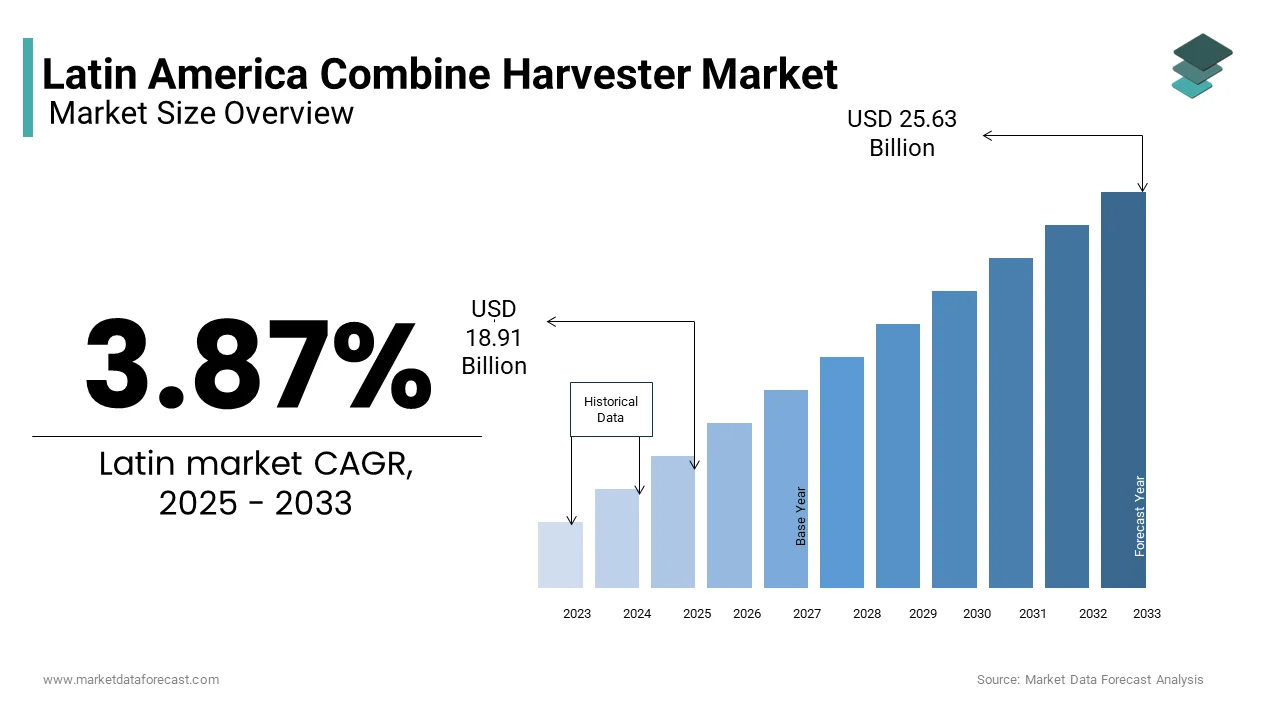
The Latin America Combine Harvester Market covers the sale, distribution, and usage of mechanized equipment designed to efficiently harvest crops such as wheat, corn, soybeans, and rice in a single operation. These machines streamline the harvesting process by integrating cutting, threshing, and grain collection mechanisms, significantly reducing labor dependency and increasing agricultural productivity. The market spans across key countries including Brazil, Argentina, Mexico, Colombia, and Peru, where agriculture remains a pivotal contributor to GDP and employment.
In recent years, the region has witnessed a gradual shift from traditional manual harvesting techniques toward mechanized solutions, driven by rising labor shortages and the need for higher operational efficiency.
MARKET DRIVERS
Increasing Demand for Agricultural Mechanization
Agricultural mechanization is gaining momentum across Latin America due to growing pressure to enhance crop yields and reduce labor dependency. Traditional farming methods are becoming less viable due to rural labor shortages, which have been exacerbated by urban migration trends.
As per the International Labour Organization (ILO), the share of the labor force engaged in agriculture has declined notably over the past two decades in major producing countries like Brazil and Argentina. This decline necessitates the adoption of advanced machinery such as combine harvesters to maintain productivity levels.
Moreover, government initiatives aimed at modernizing the agricultural sector are accelerating the uptake of mechanized equipment. Combine harvesters play a crucial role in this transformation by enabling faster harvesting cycles, minimizing post-harvest losses, and improving overall efficiency. According to AgroTech Insights, the use of combine harvesters can reduce harvesting time compared to manual methods, making them indispensable for commercial farming enterprises. With the region's expanding agribusiness sector and rising land consolidation trends, the demand for efficient harvesting solutions is expected to continue surging.
Expansion of Commercial Farming and Large-Scale Cultivation
The proliferation of commercial farming and the expansion of large-scale cultivation areas are fueling the demand for combine harvesters across Latin America. Countries like Argentina, Brazil, and Paraguay have seen significant growth in export-oriented crops such as soybeans, maize, and sugarcane. This surge in production volume necessitates efficient harvesting technologies to meet processing and export deadlines.
Large-scale farms benefit immensely from mechanized harvesting due to their vast acreage and the need for timely operations. Data from the Brazilian Institute of Geography and Statistics (IBGE) indicates that a notable share of cultivated land in Brazil is managed through large agribusiness entities, many of which have adopted combine harvesters to optimize yield recovery and reduce labor costs.
As global demand for Latin American agricultural commodities continues to rise, the reliance on high-capacity combine harvesters is expected to grow correspondingly.
MARKET RESTRAINTS
High Initial Investment and Financial Constraints
One of the most significant restraints in the Latin American combine Harvester Market is the high initial cost associated with purchasing these machines.
Like small and medium-sized farmers, who constitute a majority of the agricultural workforce, e—often lack access to sufficient capital or credit facilities to afford such expensive equipment. Only a small portion of smallholder farmers in the region have formal access to agricultural financing, limiting their ability to invest in mechanization.
Additionally, economic volatility in several Latin American countries further complicates investment decisions. Currency fluctuations and inflationary pressures make long-term planning difficult for farmers. For example, in Argentina, where annual inflation crossed 90% in 2023, purchasing power has been severely eroded, deterring investments in costly machinery. As per the Economic Commission for Latin America and the Caribbean (ECLAC), a notable portion of agricultural producers operate under financial constraints that prevent them from upgrading to modern harvesting technologies.
Limited After-Sales Support and Technical Expertise
An additional critical restraint affecting the Latin America Combine Harvester Market is the lack of robust after-sales service networks and skilled technical personnel for maintenance and repair. Modern combine harvesters are technologically advanced machines requiring regular servicing, spare parts availability, and trained technicians for troubleshooting. However,
This deficiency leads to prolonged downtime during peak harvesting seasons, directly impacting productivity and profitability. For instance, in Mexico, where combine harvester usage is relatively higher than in other countries in the region, nearly 25% of machine downtime is attributed to delayed spare part deliveries and inadequate local technician support, as noted by the Mexican Agricultural Machinery Federation (FEMAM). Moreover, the shortage of training programs for technical staff further exacerbates the issue. This lack of infrastructure and expertise hampers both new purchases and the effective utilization of existing combine harvesters, acting as a major barrier to market growth.
MARKET OPPORTUNITY
Growing Adoption of Precision Farming Technologies
The integration of precision farming technologies into combine harvesters presents a significant growth opportunity for the Latin American combine Harvester Market. Modern combine harvesters are increasingly equipped with GPS guidance systems, automated controls, and real-time data analytics tools that enable farmers to optimize harvesting efficiency and minimize grain loss. According to the Latin American Smart Agriculture Forum (LASAF), precision agriculture adoption in the region has grown notably since 2020, driven by improved connectivity and digital infrastructure in rural areas.
Brazil, Argentina, and Chile are leading this transition, with major agribusinesses investing in smart harvesting equipment to improve yield monitoring and field mapping capabilities. As per the Brazilian Agricultural Research Corporation (EMBRAPA), farms using GPS-enabled combines have reported an increase in harvesting accuracy and a reduction in fuel consumption.
Furthermore, companies such as John Deere and CNH Industrial have expanded their digital platforms in Latin America, offering cloud-based analytics that allow farmers to track performance metrics remotely. With governments and private investors increasingly supporting digitization in agriculture, the convergence of precision technology with combine harvesting is expected to unlock new efficiencies and drive market expansion across the region.
Expansion of Rental and Shared Equipment Models
The emergence of rental and shared equipment models is creating new opportunities for the broader adoption of combine harvesters in Latin America, especially among small and medium-sized farmers. Traditionally, high upfront costs have restricted access to these machines, but innovative business models are now allowing farmers to rent combine harvesters on a seasonal or per-acre basis.
In Brazil, for example, companies like AGCO and local cooperatives have introduced flexible leasing options that cater to mid-sized farms. As per the Brazilian Agricultural Machinery Association (ABIMAQ), over 30% of combine harvester usage in the 2023 harvest season came from rented or shared units, particularly in states like Mato Grosso and Paraná. This model not only reduces financial burden but also ensures access to the latest technology without long-term commitments.
Also, digital platforms such as Agrivi and Agrofy have facilitated peer-to-peer equipment sharing, connecting machine owners with farmers in need. As digital adoption increases and cooperative farming structures expand, these alternative ownership models are poised to significantly influence the growth trajectory of the Latin American combine Harvester Market.
MARKET CHALLENGES
Inconsistent Government Policies and Regulatory Hurdles
One of the foremost challenges facing the Latin American combine Harvester Market is the inconsistency in government policies and regulatory frameworks across the region. Agricultural subsidies, import duties, and environmental regulations vary widely between countries, creating an unpredictable environment for manufacturers and distributors.
For example, according to the Latin American Trade Policy Observatory (LATPO), tariffs on imported agricultural machinery in some countries significantly inflate the cost of combine harvesters and discourage imports.
In addition, frequent policy shifts and bureaucratic delays hinder the smooth entry of new technologies into the market. This administrative inefficiency affects supply chain timelines and discourages foreign investment. Moreover, inconsistent subsidy programs—such as those in Argentina and Ecuador—create uncertainty for farmers seeking financial assistance for machinery purchases.
Climate Variability and Its Impact on Harvesting Cycles
Climate variability poses a significant challenge to the Latin American combine Harvester Market, as unpredictable weather patterns affect harvesting schedules and machine utilization. The region has experienced increased frequency of extreme weather events such as droughts, floods, and unseasonal rainfall, all of which disrupt planting and harvesting calendars.
For instance, in Brazil’s central-west region, excessive rainfall during the 2023 harvest season led to delays in soybean and corn harvesting, reducing the optimal window for combine harvester usage. As per EMBRAPA, these delays resulted in a 10% decrease in machine utilization efficiency among large-scale farms.
Similarly, prolonged drought conditions in northern Argentina have forced farmers to delay planting, thereby compressing the harvesting period and increasing pressure on available machinery. Such climatic unpredictability not only affects short-term demand for combine harvesters but also influences long-term investment decisions by farmers and agribusinesses.
REPORT COVERAGE
| REPORT METRIC | DETAILS |
| Market Size Available | 2025 to 2034 |
| Base Year | 2025 |
| Forecast Period | 2026 to 2034 |
| CAGR | 3.87% |
| Segments Covered | By Type, Application, Form, Function, and By Country |
| Various Analyses Covered | Global, Regional & Country Level Analysis, Segment-Level Analysis, DROC, PESTLE Analysis, Porter’s Five Forces Analysis, Competitive Landscape, Analyst Overview on Investment Opportunities |
| Regions Covered | Brazil, Argentina, Chile, Mexico, Rest of Latin America, and Country |
| Market Leaders Profiled | AGCO, CLAAS, CNH Industrial, Deere & Company, Dewulf, Kubota Agricultural Machinery, Kuhn Group, Lely Group, Lovol Heavy Industry, Ploeger, Pottinger, Preet Group, SDF, Sampo Rosenlew. |
SEGMENTAL ANALYSIS
By Product Insights
Self-Propelled Combine Harvesters
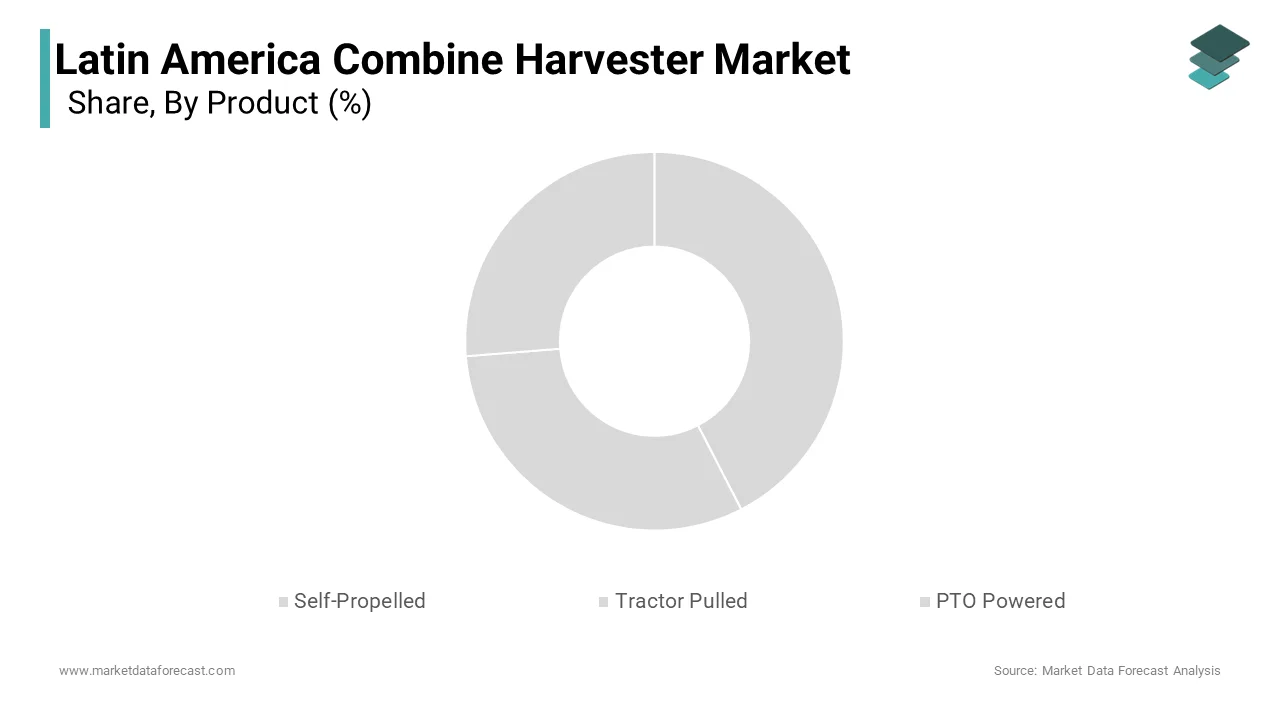
The self-propelled combine harvester segment dominated the Latin American market, accounting for 65.8% of total unit sales in 2025. This dominance is primarily attributed to the efficiency and productivity advantages these machines offer over tractor-pulled or PTO-powered models.
As per data from the Brazilian Agricultural Machinery Association (ABIMAQ), self-propelled units represented nearly 70% of all combine harvesters sold in Brazil alone during the last harvesting season.
One key driver of this segment’s leadership is the expansion of large-scale commercial farming operations across the region. Countries like Argentina and Paraguay have seen a surge in soybean and maize cultivation on vast tracts of land, where self-propelled machines provide faster turnaround times and greater operational autonomy.
According to the International Food Policy Research Institute (IFPRI), farms larger than 100 hectares account for a significant percentage of arable land in Brazil, reinforcing demand for high-capacity machinery.
Besides, technological advancements such as automated guidance systems and fuel-efficient engines have made self-propelled harvesters more attractive to agribusinesses aiming for precision and cost optimization, further solidifying their position as the preferred choice.
Tractor-Pulled Combine Harvesters
The tractor-pulled combine harvesters are projected to register the highest CAGR of 9.8%. This rapid growth is largely driven by increasing adoption among medium and smallholder farmers who seek cost-effective mechanization solutions without compromising on functionality. These machines offer flexibility, especially in regions where multi-crop farming is prevalent and full-size self-propelled harvesters may be impractical due to terrain or field size limitations.
Moreover, rising government support for farm mechanization programs has enabled wider access to tractor-based equipment. With continued rural electrification and improved financing options, this segment is poised for accelerated expansion.
By Class Insights
Class 6 and Class 7 Combine Harvesters
Class 6 and Class 7 combine harvesters commanded the largest share of the Latin American market, collectively accounting for 40.9% of total machine deployments in 2025. These classes are widely used in mid to large-scale agricultural operations due to their optimal balance between cutting width, engine power, and grain tank capacity.
A major factor contributing to the dominance of this segment is the increasing consolidation of farmland and the need for machines that can handle moderate to high acreage efficiently.
In addition, manufacturers such as AGCO and John Deere have focused on enhancing the fuel efficiency and automation features of Class 6 and 7 harvesters, making them more appealing to cost-conscious yet technologically inclined farmers. The availability of financing schemes tailored to these models has further reinforced their market leadership.
Class 9 and Class 10 Combine Harvesters
Class 9 and Class 10 combine harvesters are expected to grow at the fastest CAGR of 11.2% over the forecast period, reflecting the rising demand for ultra-high-capacity machines suited for large-scale agribusiness operations. These machines, typically equipped with advanced telemetry, GPS integration, and high-throughput threshing systems, are increasingly favored by corporate farming entities and export-oriented producers.
Brazil and Argentina are leading this shift, where large-scale monoculture farming of soybeans and corn has intensified over the past decade.
According to the Argentine Rural Society (Sociedad Rural Argentina), over 60% of soybean production in the country now comes from farms exceeding 500 hectares, necessitating the use of high-performance harvesting equipment.
In addition, the growing preference for precision agriculture practices is pushing operators to adopt top-tier combine models that can deliver real-time yield data and optimize post-harvest logistics. With ongoing investment in agro-industrial infrastructure, this segment is set to experience sustained momentum.
COUNTRY ANALYSIS
Brazil
Brazil had the dominant position in the Latin American Combine Harvester Market, capturing 45.4% of total regional sales in 2025. As the world's largest exporter of soybeans and a major producer of corn and sugarcane, Brazil's agribusiness sector heavily relies on mechanized harvesting to maintain efficiency and meet global demand.
A primary growth driver in Brazil is the expansion of large-scale farming enterprises, particularly in the Cerrado and Mato Grosso regions.
Additionally, favorable credit policies through institutions like BNDES have facilitated easier access to capital for purchasing modern harvesting equipment. The presence of local manufacturing hubs and after-sales service networks from global brands such as John Deere and CNH Industrial further supports market growth, reinforcing Brazil’s leadership in the regional combine harvester landscape.
Argentina
Argentina is one of the world's top exporters of soybean meal and oil, and its reliance on mechanized harvesting is crucial for maintaining processing timelines and export competitiveness.
One of the key drivers behind Argentina’s strong market position is the prevalence of large-scale, export-oriented farms, particularly in the Pampas region. Furthermore, government-backed initiatives such as tax incentives for agricultural machinery imports have boosted the adoption of modern combine harvesters. The country also benefits from a well-established network of equipment dealers and repair services, which enhances machine utilization and longevity. These factors contribute to Argentina’s robust position in the regional market.
Mexico
Mexico is among the top players in the Latin American Combine Harvester Market. The country's growing dependence on mechanized harvesting is primarily driven by its expanding maize production, which remains a staple crop for both domestic consumption and industrial use.
A key growth factor in Mexico is the increasing adoption of combine harvesters in both commercial and cooperative farming models. Additionally, the government's Procampo program, though recently phased out, had historically supported farm mechanization through direct subsidies. Private leasing companies have since stepped in to fill the gap, offering flexible payment plans that make combine harvesters more accessible to medium-sized producers, thereby accelerating market penetration.
Chile - Niche but High-Value Market Driven by Precision Farming
Chile plays a relatively smaller but strategically important role in the Latin American Combine Harvester Market. While not a major grain exporter, Chile’s agricultural sector is highly specialized in fruit, wine grape, and vegetable production, where precision harvesting is essential. As per the Chilean Agricultural Research Institute (INIA), the country dedicates nearly 1.5 million hectares to high-value crops, many of which require advanced harvesting technologies for quality preservation.
The key growth driver in Chile is the increasing integration of smart farming technologies, including GPS-guided combine harvesters and automated yield monitoring systems.
In addition, Chile’s stable economy and strong trade relationships with North America and Europe have attracted foreign investments in agro-processing infrastructure, further stimulating demand for high-efficiency harvesting solutions. Despite its modest size, Chile serves as a technology benchmark for the broader Latin American region.
Colombia - Rapidly Evolving Market with Government Support
Colombia holds a growing position in the Latin American combine Harvester Market. The country’s agricultural sector has undergone significant modernization in recent years, particularly in the production of rice, maize, and palm oil, where mechanized harvesting is becoming increasingly necessary to improve yields and reduce losses.
One of the primary drivers in Colombia is the government’s push toward agricultural modernization through targeted subsidy programs and rural development initiatives. Additionally, the rise of agro-industrial zones and the expansion of export-oriented farming have prompted greater investment in combine harvesters. With improving financial accessibility and expanding dealer networks, Colombia is emerging as a key growth market within Latin America.
KEY MARKET PLAYERS
AGCO, CLAAS, CNH Industrial, Deere & Company, Dewulf, Kubota Agricultural Machinery, Kuhn Group, Lely Group, Lovol Heavy Industry, Ploeger, Pottinger, Preet Group, SDF, Sampo Rosenlew, are the market players that are dominating the North America combine harvester market.
Top Players in the Market
John Deere
John Deere holds a prominent position in the Latin American combine Harvester Market due to its strong brand reputation, technological innovation, and extensive dealer network. The company offers a wide range of self-propelled and high-capacity combine harvesters tailored to meet the needs of large-scale commercial farms. In Latin America, it is particularly dominant in Brazil and Argentina, where it supports agribusinesses with advanced harvesting solutions. Its commitment to precision agriculture and after-sales service has made it a preferred choice among farmers seeking efficiency and reliability.
CNH Industrial
CNH Industrial is a major player in the Latin American combine Harvester Market through its brands, Case IH and New Holland Agriculture. The company provides technologically advanced and durable harvesting equipment designed for diverse crop conditions across the region. With localized manufacturing units and a robust distribution system, CNH Industrial ensures accessibility and timely support to farmers. Its focus on digital farming tools and automation has enhanced its market presence, making it a key competitor alongside global peers.
AGCO Corporation
AGCO Corporation plays a vital role in the Latin American combine harvester landscape through its Massey Ferguson and Fendt brands. The company emphasizes adaptability by offering models suited for both large estates and medium-sized farms. AGCO’s strategy of providing cost-effective yet high-performance machines aligns well with regional agricultural dynamics. It also invests in training programs and customer engagement initiatives, strengthening its foothold in markets like Brazil, Chile, and Colombia.
Top Strategies Used by Key Market Participants
One of the primary strategies employed by leading companies in the Latin American combine Harvester Market is product localization, wherein manufacturers tailor their machinery to suit regional soil conditions, crop types, and farm sizes. This approach enhances usability and ensures better performance in local settings. Another key strategy is expanding after-sales service networks, which include setting up authorized repair centers, spare parts warehouses, and mobile servicing units to improve customer satisfaction and machine uptime. Lastly, companies are increasingly focusing on technology integration, incorporating PS guidance systems, real-time monitoring, and automated controls into combine harvesters to meet the rising demand for precision farming solutions in the region.
COMPETITION OVERVIEW
The Latin American combinevester Market is characterized by intense competition driven by a mix of global OEMs and regional players vying for dominance through innovation and strategic partnerships. Established multinational corporations leverage their technological expertise and strong distribution networks to maintain leadership positions, while emerging local manufacturers attempt to capture market share with cost-effective alternatives. The competitive landscape is further shaped by evolving farmer preferences toward smart, efficient, and sustainable harvesting solutions. Companies are investing heavily in R&D to develop machines that offer higher productivity and lower operational costs. Additionally, the growing emphasis on after-sales services and digital integration is redefining brand loyalty and influencing purchasing decisions. As a result, the market remains dynamic, with firms continuously adapting their offerings to align with regional agricultural demands and economic conditions.
RECENT HAPPENINGS IN THE MARKET
- In February 2023, John Deere expanded its manufacturing facility in Montenegro, Brazil, to increase production capacity for its latest line of high-capacity combine harvesters tailored for soybean and corn farms in South America.
- In July 2023, CNH Industrial launched an exclusive digital platform in Argentina that allows farmers to remotely monitor harvester performance, schedule maintenance, and access real-time agronomic insights to optimize harvesting operations.
- In November 2023, AGCO Corporation partnered with a local financial institution in Colombia to introduce flexible leasing options for combine harvesters, making advanced machinery more accessible to small and medium-scale farmers.
- In March 2024, Claas do Brasil introduced a new after-sales mobile service unit that travels directly to farms in Mato Grosso and Paraná, offering on-site diagnostics, repairs, and spare parts delivery to reduce machine downtime.
- In September 2024, Kubota announced the opening of a dedicated training center in Santiago, Chile, aimed at educating dealers and farmers on the operation, maintenance, and digital features of modern combine harvesters.
MARKET SEGMENTATION
This research report on the North American combine harvester market is segmented and sub-segmented into the following categories.
By Product
- Self-Propelled
- Tractor Pulled
- PTO Powered
By Class
- Classes 4 and 5
- Class 6
- Class 7
- Class 8
- Class 9
- Class 10
By Country
- Brazil
- Argentina
- Chile
- Mexico
- Colombia