- Product Description Description
- Table of Contents TOC
- List of Table & Figure LOT
- Get Free Sample PDF Sample PDF
Market Size, 2025
$2,769.04 MnMarket Estimate, 2026
$2,949.03 MnMarket Forecast, 2034
$4,880.63 MnCAGR, 2026–2034
6.50%Executive Summary: Latin American Contraceptives Market
- Market Scope: Comprehensive regional analysis of the Latin American contraceptives market covering drug types, medical devices, end-user channels, and country-level frameworks.
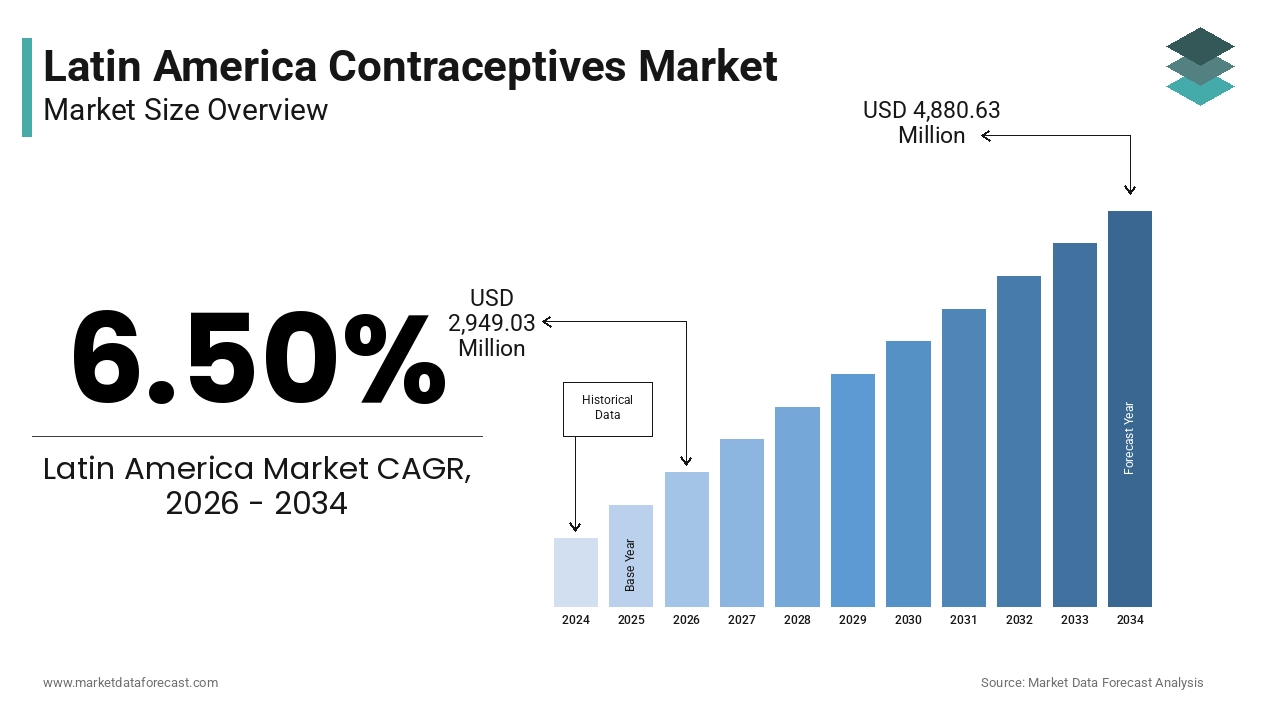
- Market Valuation: Valued at USD 2,769.04 million (2025), estimated at USD 2,949.03 million (2026), and projected to reach USD 4,880.63 million by 2034, registering a CAGR of 6.50% (2026–2034).
- Primary Growth Drivers: Massive untapped market opportunities, ongoing economic development, continually improving healthcare infrastructure, rising patient awareness, and increasing family planning initiatives from governments and NGOs.
Key Market Segment Metrics (2026–2034)
| Category | Leading Segment (2025 Position) | Fastest-Growing Segment |
|---|---|---|
| By Drug Type | Contraceptive Pills (led consumption due to high accessibility and widespread adoption) | Contraceptive Injectables & Topical Formulations |
| By Medical Devices | Male Contraceptive Devices / Condoms (accounted for the largest share in barrier protection) | Subdermal Contraceptive Implants & Long-Acting Reversible Contraceptives |
| By End User | Hospitals & Clinics (primary settings for clinical consultations and specialized device insertions) | Home Care & Retail Outlets (driven by over-the-counter availability) |
| By Country | Brazil & Mexico (dominating the regional market share due to larger populations and robust healthcare access) | Argentina & Chile (accelerating via expanding reproductive health programs) |
Major Market Players & Market Structure
Market Structure: Highly competitive pharmaceutical and medical device landscape featuring leading global and regional life science corporations competing on product innovation, accessibility, affordability, and strategic distribution partnerships.
Key Companies: Bayer HealthCare AG, Teva Pharmaceutical Industries Limited, Medisafe Distribution Inc, Pace Pharmaceuticals Inc., Medicines360, Church & Dwight Co., Inc., Actavis, Inc., CooperSurgical, Inc., Merck & Co., Inc., Reckitt Benckiser plc, Mayer Laboratories, Inc., and Pfizer, Inc.
 Download Free Sample Report
Latin American Contraceptives Market Size
The Latin American Contraceptives Market is projected to grow from USD 2,769.04 million in 2025 to USD 2,949.03 million in 2026 and reach USD 4,880.63 million by 2034, registering a CAGR of 6.50% from 2026 to 2034.
The contraceptives market covers sales of drugs and devices used to prevent pregnancy, including reversible and emergency contraception. The market is valued at the manufacturer level in USD and includes sales through private retail, institutional and public programme channels.
Oral contraceptive pills are counted regardless of approved indication, including pills approved for dysmenorrhea (such as low-dose estrogen-progestin, or LEP, products in Japan).
MARKET DRIVERS
Government Initiatives and Public Health Programs
Strong government commitment to reproductive health is boosting the expansion of the Latin America contraceptives market. This upward trend is further sustained by robust policy support and widespread public distribution networks. According to research, Brazil's Unified Health System (SUS) provides free access to a variety of contraceptive methods to reproductive-aged women across the country. This substantial public investment reduces financial barriers and encourages consistent use among low-income populations who might otherwise lack access. According to sources, regional healthcare networks distribute various short-term and hormonal family planning options through their local clinics. These government-led initiatives normalise contraceptive use and integrate it into routine primary care services. Public awareness campaigns funded by state agencies educate citizens about available options and correct usage methods, reducing misinformation. The alignment of national health goals with international reproductive rights standards drives continuous funding and resource allocation. Healthcare providers in public clinics are trained to offer counselling on various methods, ensuring informed decision-making. This systemic support creates a stable and growing demand for contraceptives supported by public procurement contracts. The reliability of government supply chains ensures consistent availability of essential products across urban and rural areas.
Increasing Female Labour Force Participation
The rising participation of women in the workforce fundamentally accelerates the growth of the Latin American contraceptives market. This expansion occurs as career-oriented individuals seek reliable family planning to balance professional and personal lives. According to the International Labour Organisation and World Bank data, female labour force participation rates exceed 50% in the Latin America and Caribbean region. Working women often delay childbirth and prefer smaller family sizes to focus on career advancement and financial stability. Employers are increasingly offering health benefits that include coverage for reproductive health services, making contraceptives more affordable for insured employees. The need for predictable and effective methods such as long-acting reversible contraceptives appeals to professionals who cannot afford unexpected interruptions. Social norms are evolving to support women's autonomy over their reproductive choices. This economic empowerment translates into greater purchasing power and demand for premium contraceptive options. The trend towards dual-income households further reinforces the preference for planned parenthood.
MARKET RESTRAINTS
Cultural and Religious Barriers
Deep-rooted cultural and religious beliefs significantly hamper the widespread adoption of contraceptives in the Latin American market. These traditional views restrict growth by heavily influencing personal choices and community attitudes. The Catholic Church remains a dominant social institution in many Latin American countries, and its teachings often discourage the use of artificial contraception. According to research, 60% of adults in Colombia and 67% of adults in Peru identify as Catholic. This religious influence can create stigma around contraceptive use, particularly among conservative communities. As per studies, gender norms and social expectations regarding male authority can impact contraceptive choices in certain regional communities. These social pressures lead to underreporting of contraceptive use and reliance on less effective traditional methods. Healthcare providers may face resistance when recommending certain methods due to moral objections from patients or community leaders. Educational programs often struggle to overcome entrenched beliefs that view large families as a blessing or status symbol. The lack of open dialogue about sexual health in conservative households further hinders knowledge dissemination. This cultural friction slows down the acceptance of modern contraceptive technologies despite their availability.
Limited Access in Rural and Underserved Areas
Geographic disparities in healthcare infrastructure further limit the growth of the Latin American contraceptives market. This restricts access for populations in remote and rural regions. According to World Bank data, the rural population of Latin America and the Caribbean stands at an average of 18%. This logistical challenge makes it difficult for residents to obtain regular supplies of contraceptives such as pills or injectables. As per research, stock-outs of essential medicines occur in various regional clinics due to supply chain complexities. Women in these areas often rely on irregular access to methods, leading to inconsistent use and higher rates of unintended pregnancy. Transportation costs and distance to the nearest health centre serve as additional barriers for low-income families. Lack of trained healthcare personnel in remote areas means that complex methods like intrauterine device insertion are rarely available. Digital health solutions are not yet widespread enough to bridge this gap effectively. The disparity between urban and rural access creates unequal health outcomes and limits market penetration. Manufacturers and distributors face higher costs and logistical complexities in reaching these fragmented markets.
MARKET OPPORTUNITIES
Expansion of Long-Acting Reversible Contraceptives
The growing preference for long-acting reversible contraceptives offers a substantial opportunity for the Latin American contraceptives market. This potential is realised by addressing the need for highly effective and low-maintenance methods. According to the Society for Family Planning, long-acting reversible contraceptives (LARCs) have perfect and typical use failure rates of less than 1%, making them user-independent and significantly more reliable than short-term methods like oral contraceptive pills or condoms. This superior efficacy appeals to women who desire prolonged protection without daily adherence requirements. As per research, the adoption and usage of long-acting reversible contraceptives, including intrauterine devices and implants, have shown upward trends in various regions, driven by increased awareness of their high efficacy and satisfaction rates. Healthcare providers are increasingly trained in insertion techniques, expanding the availability of these methods in public and private clinics. Insurance providers are beginning to cover the higher upfront cost of long-acting methods, recognising their long-term cost-effectiveness. Young women and adolescents benefit from the discretion and convenience of these options, which do not require daily action. Pharmaceutical companies are introducing new variants with longer durations and fewer side effects to attract more users. Public health campaigns are highlighting the reversibility and safety of these methods to counter misconceptions. This shift towards sustained protection drives demand for advanced contraceptive technologies.
Digital Health and Telemedicine Integration
The integration of digital health platforms and telemedicine services paves the way for the expansion of the Latin American contraceptives market. This technological shift accelerates growth by improving access and convenience for users. According to the Inter-American Development Bank and related studies, internet penetration has reached 71% among the urban population in Latin America and the Caribbean, though a significant digital divide remains, with only 37% connectivity in rural areas. Telemedicine allows women to consult with healthcare providers remotely and receive prescriptions for contraceptives without visiting a clinic. As per sources, digital health interventions and subscription-based reproductive tracking applications have expanded globally, offering users digital methods for contraception planning and information delivery. This model enhances privacy and reduces the stigma associated with purchasing contraceptives in person. Mobile applications provide reminders for pill intake and track menstrual cycles, improving adherence and user engagement. Digital education campaigns reach younger demographics effectively through social media channels. Partnerships between tech companies and pharmaceutical manufacturers facilitate seamless ordering and home delivery services. Regulatory frameworks are evolving to support telehealth prescriptions for reproductive health. This technological convergence expands the addressable market beyond traditional clinical settings.
MARKET CHALLENGES
Supply Chain Inefficiencies and Stockouts
Inconsistent supply chains are a major hindrance to the Latin American contraceptives market. This causes frequent stockouts and disrupts continuous access to essential methods. According to reviews, supply chain weaknesses can cause temporary shortages of key reproductive health commodities in some facilities. These interruptions force users to switch methods or discontinue use entirely, increasing the risk of unintended pregnancy. According to other sources, proper inventory monitoring and procurement updates help mitigate irregular availability of medical supplies. Rural areas are disproportionately affected due to longer distribution routes and limited storage capacity. Manufacturers face difficulties in forecasting demand accurately due to fluctuating public sector orders. Economic instability and currency fluctuations in some countries further complicate importation and pricing strategies. Healthcare providers lose patient trust when they cannot provide promised supplies consistently. The lack of integrated digital tracking systems hinders real-time visibility of stock levels across the network. Addressing these logistical bottlenecks requires significant investment in infrastructure and coordination. Until supply chains are stabilised, market growth will remain uneven and unreliable.
Regulatory Hurdles and Approval Delays
Complex and varied regulatory environments across countries in the region challenge the Latin American contraceptives market. This delays the introduction of new products and innovations. According to studies, typical review timelines for drug registration at major Latin American regulators like Brazil's ANVISA run between 12 and 24 months. This inconsistency prevents manufacturers from launching new technologies simultaneously across the region. As per the National Agency for Health Surveillance in Brazil, stringent clinical data requirements and local testing mandates increase the cost and time required for market entry. Smaller companies often lack the resources to navigate these bureaucratic processes effectively. Changes in political leadership can lead to shifts in health policies affecting the approval status of certain contraceptives. Harmonisation of regulations among Mercosur countries is progressing but remains incomplete. Delayed approvals mean that patients in Latin America may wait years longer than those in North America or Europe to access advanced options. This regulatory fragmentation increases operational complexity for multinational corporations. Uncertainty surrounding policy changes discourages investment in regional research and development. Streamlining these processes is essential for accelerating innovation and improving access.
REPORT COVERAGE
| REPORT METRIC | DETAILS |
| Market Size Available | 2025 to 2034 |
| Base Year | 2025 |
| Forecast Period | 2026 to 2034 |
| Segments Covered | By Product, By Prescription Status, By Category, Distribution Channel, By Region |
| Various Analyses Covered | Global, Regional,l and Country-Level Analysis, Segment-Level Analysis, Drivers, Restraints, Opportunities, Challenges; PESTLE Analysis; Porter’s Five Forces Analysis, Competitive Landscape, Analyst Overview of Investment Opportunities |
| Countries Covered | Mexico, Brazil, Argentina, Chile, and the Rest of Latin America. |
| Market Leaders Profiled | Bayer AG |
SEGMENTAL ANALYSIS
By Drug Type Insights
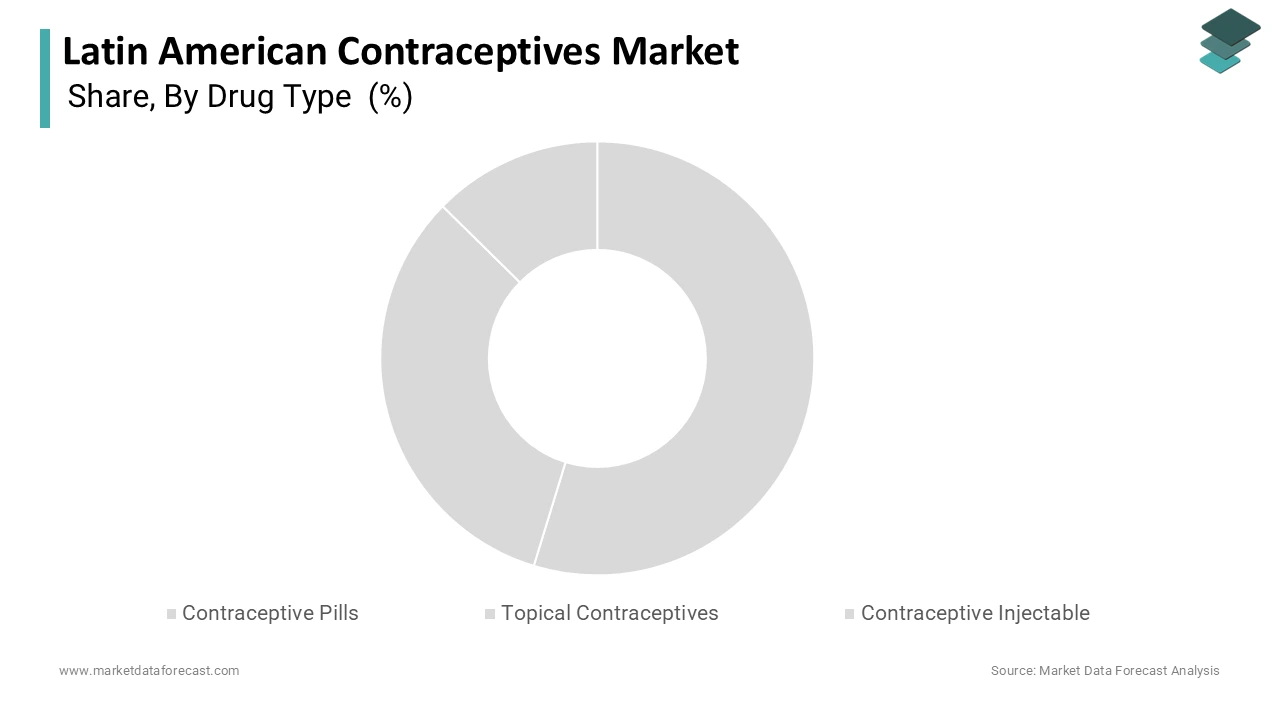
The contraceptive pills segment dominated the Latin American contraceptives market and accounted for a substantial share in 2025. Its widespread availability, affordability, and familiarity among women of reproductive age contributed to the dominance of this segment. According to studies, oral contraceptive pills remain one of the most widely recognised and utilised modern methods of family planning across Latin America and the Caribbean, with prevalence varying significantly by country. This high usage rate is driven by the ease of access through public health programs and private pharmacies across urban and semi-urban areas. According to sources, oral contraceptives are distributed extensively through public health systems in Brazil, serving millions of women as a primary method of birth control. The low cost of generic pills makes them accessible to low-income populations who form a significant portion of the demographic. Healthcare providers frequently prescribe pills as a first-line option due to their reversibility and non-invasive nature. Cultural acceptance of daily medication routines further supports consistent use among educated and working women. Pharmaceutical companies maintain strong marketing efforts to promote new formulations with fewer side effects. The established supply chain ensures minimal stockouts compared to other methods. This combination of accessibility, cultural norms, and medical endorsement secures the leading position of contraceptive pills in the regional market.
The extensive availability of contraceptive pills through public health systems significantly drives their market dominance by removing financial barriers for millions of women. According to research, out-of-pocket spending and public sector distribution frameworks heavily influence the procurement and availability of oral contraceptives across Latin American nations. This substantial government support enables consistent access even in economically challenging times. According to studies, Mexico's public health institutions provide family planning services and dispense various contraceptive methods to support reproductive health goals nationwide. The integration of oral contraceptives into national essential medicines lists guarantees priority in procurement and distribution. Women in rural areas benefit from mobile health units that distribute pills during community outreach programs. The simplicity of storage and transport compared to devices like intrauterine systems makes pills ideal for remote distribution. Pharmacists in local communities often serve as key points of access, providing counselling and refills without requiring a doctor visit. This decentralised access model enhances convenience and adherence. The reliability of public supply chains builds trust in the method among users. These structural advantages ensure that contraceptive pills remain the most utilised drug type in the region.
The contraceptive injectables segment is on the rise and is expected to be the fastest-growing segment in the market, witnessing a CAGR of 6.8% between 2026 and 2034. This surge is propelled by the demand for discreet and low-maintenance methods. According to the World Health Organisation guidelines, adolescents often prefer discreet or concealed contraceptive methods, such as injectables, implants, or intrauterine devices, because they can be used without drawing attention, require fewer health facility visits, and address significant concerns regarding privacy and confidentiality. This discretion is crucial in conservative communities where contraceptive use may be stigmatised. According to sources, injectable contraceptives are utilised within public health strategies in Colombia to expand contraceptive choice and support adolescent pregnancy prevention programs. The convenience of administration every three months appeals to women with irregular schedules or limited access to daily pills. Public health programs are expanding training for nurses to administer injectables in community settings, improving accessibility. The method does not require partner cooperation, which empowers women to manage their reproductive health independently. Pharmaceutical manufacturers are introducing lower-dose formulations to reduce side effects such as weight gain and mood changes. Insurance coverage for injectables is improving in private healthcare plans. This combination of privacy, convenience, and improved safety profiles fuels the rapid expansion of the injectable segment.
The strong desire for privacy and discretion among young women accelerates the growth of the contraceptive injectable segment by offering a method that leaves no physical evidence at home. According to research, social, cultural, and interpersonal factors, including relationship dynamics and partner approval, can serve as substantial barriers or facilitators to consistent contraceptive use. Injectables eliminate this risk as they leave no packaging or pills to be found. As per studies, the desire for confidentiality and methods that do not require daily adherence strongly influence an adolescent's choice of contraceptive methods over short-acting alternatives like daily pills. This autonomy is critical for maintaining consistent use and preventing unintended pregnancies. Community health workers are trained to provide confidential services, including injectable administration, in private settings. The method allows women to control their reproductive health without negotiating with partners. Schools and youth centres are increasingly offering discreet sexual health services that include injectables. The reduction in daily hassle appeals to busy students and young professionals. This emphasis on privacy and independence drives the aggressive adoption of injectable contraceptives.
By Medical Devices Insights
The male contraceptive devices segment led the Latin America contraceptives market and captured a significant share in 2025. Factors such as their dual protection against pregnancy and sexually transmitted infections strengthened the position of this segment. This segment is predominantly driven by condoms. According to the Centers for Disease Control and Prevention, while correct and consistent use of condoms helps significantly reduce the risk of transmission, condoms are not the "only" prevention method, as pre-exposure prophylaxis (PrEP) and other biomedical approaches are also highly effective at preventing HIV. This unique benefit drives consistent demand from both men and women who prioritise sexual health safety. As per the Brazilian Ministry of Health, over 500 million condoms are distributed annually through public health programs, ensuring widespread availability and affordability. The low cost and non-prescription status make condoms accessible to all demographics, including adolescents and unmarried individuals. Cultural campaigns promoting safe sex have normalised condom use as a responsible behaviour. Hotels, bars, and clubs often provide free condoms, increasing accessibility in social settings. The lack of hormonal side effects appeals to users who cannot or prefer not to use hormonal methods. Manufacturers continuously innovate with thinner materials and varied textures to enhance user experience. This combination of health protection, accessibility, and cultural promotion secures the dominance of male contraceptive devices.
The critical role of condoms in preventing sexually transmitted infections alongside pregnancy fundamentally drives their market leadership by addressing two major health concerns simultaneously. The World Health Organisation notes that Latin America has seen a rise in sexually transmitted infections, including syphilis and gonorrhoea, necessitating barrier methods for safe sexual practices. This health reality makes condoms an essential tool for public health strategies. As per the Pan American Health Organisation, condom use is strongly recommended in national guidelines for HIV prevention, particularly among high-risk groups such as sex workers and men who have sex with men. Public health campaigns emphasise the dual benefit, encouraging consistent use even among those using other contraceptive methods for pregnancy prevention. The availability of free condoms in clinics and community centres reinforces their importance. Education programs in schools teach condom use as part of comprehensive sexual health curricula. The non-invasive nature and immediate effectiveness appeal to casual partners who may not trust other methods. This multifaceted health benefit ensures that condoms remain a staple in the contraceptive landscape.
The subdermal contraceptive implants segment is likely to experience the fastest CAGR of 7.5% over the forecast period, owing to the shift towards long-acting reversible contraceptives. According to the World Health Organisation and related clinical guidelines, subdermal contraceptive implants provide over 99% contraceptive efficacy but are typically approved for three to five years, depending on the specific implant type (such as Nexplanon or Jadelle). This superior effectiveness addresses the high rates of unintended pregnancy associated with inconsistent use of short-term methods. As per research, the expanded integration of subdermal implants into national health systems depends heavily on active healthcare provider training programs and clinical resource distribution. Governments are prioritising implants in family planning budgets due to their cost-effectiveness over time. Young women and postpartum mothers are key adopters who value the convenience and discretion of the method. The reversibility of implants appeals to those who plan to have children in the future but want to delay pregnancy now. Pharmaceutical companies are launching single rod implants that are easier to insert and remove. This focus on long-term reliability and convenience fuels the rapid expansion of the implant segment.
The exceptional efficacy and long duration of action of subdermal implants accelerate their growth by providing a hassle-free solution for women who struggle with daily adherence. According to sources, typical use failure rates for long-acting reversible implants are less than 1%, offering significantly higher reliability in preventing unintended pregnancy than short-acting methods like oral contraceptive pills, which carry a typical failure rate of around 9%. This reliability is crucial for women who cannot afford the consequences of contraceptive failure. As per studies, long-acting reversible contraceptives generally achieve much higher continuation rates after one year than user-dependent methods like oral pills or quarterly injections. Women appreciate not having to remember a daily routine or schedule regular clinic visits for injections. The method is particularly beneficial for adolescents who may have irregular lifestyles. Healthcare providers recommend implants for women who have experienced failure with other methods. The long-term protection reduces anxiety about accidental pregnancy. This peace of mind drives strong word-of-mouth recommendations and increased demand.
By End User Insights
The clinics segment was the largest in the Latin America Contraceptives Market in 2025. This prominence was credited to its role as the primary point of contact for reproductive health services, especially in public health systems. According to research, primary care networks serve as a critical foundation for family planning infrastructure by facilitating contraceptive consultations and method distribution. These facilities are strategically located in communities, making them accessible to large populations. As per the Brazilian Family Health Strategy, thousands of community clinics provide free contraceptives and counselling to millions of women annually, ensuring broad reach. Clinics offer a range of methods, including pills, injectables, and implants, allowing for personalised care. Healthcare providers in clinics are trained to offer comprehensive sexual health education. The trust established between patients and local clinic staff encourages consistent use and follow-up. Public funding supports the operation of these clinics, ensuring services remain free or low-cost. The integration of contraceptive services with maternal and child health programs enhances utilisation. This central role in healthcare delivery secures the dominance of clinics as the primary end-user channel.
The integral position of clinics in public health systems significantly drives their market leadership by providing standardised and accessible reproductive care to the masses. According to the World Health Organisation, primary healthcare clinics are the main delivery channel for government-funded family planning programs in Latin America, ensuring equitable access. This structural advantage allows for mass distribution of contraceptives to diverse demographic groups. As per the Mexican Ministry of Health, public clinics are mandated to offer a full range of contraceptive methods, ensuring that no woman is denied choice due to facility limitations. The proximity of clinics to residential areas reduces transportation barriers for patients. Regular operating hours and walk-in availability enhance convenience for working women. Electronic health records in clinics help track patient usage and remind them of refills. The professional environment provides privacy and confidentiality, which is essential for sensitive health discussions. This robust infrastructure ensures that clinics remain the go-to destination for contraceptive needs.
The home care segment is expected to exhibit a noteworthy CAGR of 8.2% from 2026 to 2034 due to the rise of digital health platforms and telemedicine services. As per the Inter-American Development Bank, internet penetration in Latin America has enabled the growth of online pharmacies and subscription services that deliver contraceptives directly to homes. This convenience appeals to young urban professionals who value privacy and time efficiency. As per studies, online sales of health products like oral contraceptives and barrier methods have grown steadily in South America due to increasing e-commerce integration. Telemedicine consultations allow women to obtain prescriptions without visiting a clinic, reducing stigma and wait times. Subscription models ensure automatic replenishment of supplies, preventing gaps in protection. Mobile apps provide reminders and tracking features that enhance adherence. The discretion of home delivery avoids the potential embarrassment of purchasing contraceptives in person. This shift towards digital and direct-to-consumer models is reshaping the market landscape.
The rapid expansion of e-commerce and digital health platforms accelerates the growth of the home care segment by making contraceptives easily accessible from the comfort of home. According to reports, health and wellness sectors across Latin America have seen a major upswing in digital transactions reflecting changing consumer behaviours. This trend allows users to browse, compare, and purchase contraceptives with ease. As per the Brazilian E-commerce Bureau, online pharmacies offer discreet packaging and fast delivery, which appeals to privacy-conscious consumers. The ability to read reviews and access detailed product information online aids decision-making. Subscription services automate the purchasing process, ensuring continuous supply. Digital platforms often offer competitive pricing and promotions that attract cost-sensitive buyers. The integration of telehealth services allows for seamless prescription and delivery workflows. This digital ecosystem removes traditional barriers to access. The convenience and privacy offered by online channels drive strong adoption among tech-savvy demographics.
COUNTRY LEVEL ANALYSIS
Mexico Contraceptives Market Analysis
Mexico displays sustained expansion in the Latin American contraceptives market. This position is supported by a large population and robust public health infrastructure. According to sources, the Mexican Social Security Institute (IMSS) operates as a primary healthcare provider offering family planning services and a diverse range of modern contraceptive methods, such as pills, condoms, and injections, across its beneficiary networks. This extensive coverage supports high utilisation rates across socioeconomic groups. As per research, the Total Fertility Rate (TFR) in Mexico has declined over recent decades, reaching approximately 1.6 births per woman according to recent National Survey of Demographic Dynamics (ENADID) reports from the National Institute of Statistics and Geography (INEGI). Government campaigns focus on reducing adolescent pregnancy, which drives demand for long-acting methods. Private insurance markets are growing, offering premium contraceptive options to middle-class consumers. The presence of local manufacturing facilities reduces costs and ensures supply stability. Regulatory approvals for new devices are streamlined, facilitating market entry. Urban centres like Mexico City lead in the adoption of digital health solutions for contraceptive access. Rural areas benefit from mobile health units that distribute supplies. This combination of public support, demographic trends, and private sector growth sustains Mexico's strong market position.
Brazil Contraceptives Market Analysis
Brazil remained prominent as well as the fastest-growing region in the Latin American contraceptives market and held the largest share in 2025. This dominance was driven by a comprehensive public health system and high awareness levels. The Brazilian Ministry of Health states that the national family planning program distributes millions of contraceptive units annually, reaching even remote communities. This massive scale of distribution ensures that cost is not a barrier for the majority of the population. According to the Brazilian Institute of Geography and Statistics (IBGE) and health surveys, over 80% of Brazilian women of reproductive age use some form of contraception, with oral contraceptive pills and surgical sterilisation traditionally making up the vast majority of the modern method mix. The prevalence of oral pills remains high due to cultural familiarity and ease of access. Recent initiatives focus on expanding access to long-acting reversible contraceptives to reduce unintended pregnancies. Private healthcare providers offer advanced options such as hormonal IUDs and implants to insured patients. The pharmaceutical industry in Brazil is well developed, supporting local production and innovation. Digital health startups are emerging to offer telemedicine and delivery services. The large and diverse population provides a vast addressable market for various contraceptive methods.
Argentina Contraceptives Market Analysis
Argentina is expanding moderately in the Latin American contraceptives market due to strong legal frameworks protecting reproductive rights and universal healthcare coverage. According to the Argentine Ministry of Health, the National Law on Sexual Health and Responsible Procreation guarantees free access to all contraceptive methods in public facilities. This legal backing ensures consistent funding and availability of a wide range of options. As per the Encuesta Nacional sobre Salud Sexual y Reproductiva (ENSSyR 2013), approximately 80% (8 out of 10) of reproductive-age individuals or their partners reported using contraception in general at the time of assessment. There is a growing preference for long-acting methods among younger women who seek greater autonomy. Private insurance plans cover premium contraceptives, encouraging uptake of newer technologies. Buenos Aires serves as a hub for medical innovation and digital health services. Economic challenges sometimes impact importation of specialised devices, but local production mitigates some risks. Educational programs in schools promote early awareness and responsible use. The strong emphasis on rights and access maintains steady demand for diverse contraceptive solutions.
Chile Contraceptives Market Analysis
Chile is a mature contraceptive market, owing to high-quality healthcare services and effective public policies. The Chilean Ministry of Health states that the national sexual health program provides free contraceptives to all women regardless of insurance status, ensuring equitable access. This inclusive approach has led to high satisfaction rates and consistent usage. As per the National Institute of Statistics, the adolescent birth rate in Chile has decreased significantly due to targeted interventions and improved access to emergency contraception. There is a strong trend towards the adoption of long-acting reversible contraceptives such as implants and IUDs. Private clinics offer personalised counselling and advanced options for those seeking premium care. The country has a high level of health literacy, which supports informed decision-making. Digital health platforms are gaining traction for prescription refills and consultations. Regulatory standards are strict, ensuring high quality and safety of products. The stable economic environment supports consistent investment in healthcare infrastructure.
COMPETITIVE LANDSCAPE
The competition in the Latin America Contraceptives Market is characterized by intense rivalry among multinational pharmaceutical giants and regional generic manufacturers striving for accessibility and trust. Major corporations leverage their extensive portfolios of branded hormonal methods and long-acting devices to dominate public sector tenders and private insurance formularies. These leading firms continuously engage in strategic collaborations with governments and non-governmental organizations to subsidize costs and expand distribution networks in underserved areas. Regional generic producers compete aggressively on price and local manufacturing agility, capturing significant volume in cost-sensitive public procurement cycles. The regulatory landscape varies significantly across countries, requiring substantial investment in local compliance and registration, which favors established entities with deep regional expertise. Competition is also shaped by cultural acceptance and provider preference, influencing the mix of methods beyond mere price considerations. Market participants differentiate themselves through comprehensive training programs for healthcare workers and patient education campaigns that build brand loyalty and clinical confidence. The rise of digital health platforms introduces new competitive dynamics as tech-enabled services disrupt traditional distribution channels. This dynamic environment drives continuous adaptation as companies seek to balance commercial objectives with public health imperatives in a diverse and evolving regional landscape.
KEY MARKET PLAYERS
Some of the companies that are playing a dominant role in the Latin America Contraceptives Market include:
- Bayer AG
- Organon & Co.
- Gedeon Richter Plc
- Exeltis (Insud Pharma)
- Pfizer Inc.
- Teva Pharmaceutical Industries Ltd.
- Viatris Inc.
- Aché Laboratórios Farmacêuticos
- EMS S/A
- Eurofarma
- Reckitt Benckiser Group plc
- Church & Dwight Co., Inc.
TOP LEADING PLAYERS IN THE MARKET
- Bayer AG significantly influences the Latin America Contraceptives Market through its extensive portfolio of hormonal contraceptives, including widely recognized oral pills and intrauterine systems. The company actively drives innovation by introducing next-generation levonorgestrel-releasing intrauterine systems designed for improved patient comfort and easier insertion. Bayer recently expanded its educational initiatives across Brazil and Mexico to train healthcare providers on long-acting reversible contraceptive methods, ensuring proper clinical adoption. Their strategic focus on public-private partnerships facilitates broader access to premium contraceptive technologies within government health programs. The firm continuously invests in local manufacturing capabilities to ensure consistent supply and affordability for diverse socioeconomic groups. This commitment to clinical education and accessible innovation solidifies its reputation as a trusted partner for reproductive health solutions across the region.
- Merck & Co. Inc. plays a pivotal role in the market by providing essential contraceptive implants and injectables that address critical family planning needs in underserved communities. The company strengthens its position through collaborative agreements with international health organizations to subsidize etonogestrel implants for low-income populations in Latin America. Merck recently enhanced its supply chain resilience by establishing regional distribution hubs to prevent stockouts of essential medicines. Their dedication to capacity building includes training thousands of nurses in safe insertion and removal techniques for subdermal implants. The firm prioritizes sustainable access programs that align with national reproductive health goals. This holistic approach to equitable access and technical support enhances its standing as a leader in social impact-driven contraceptive care.
- Pfizer Inc. contributes substantially to the Latin America Contraceptives Market through its robust portfolio of injectable contraceptives and oral pills that serve millions of women annually. The company reinforces its market presence by launching updated formulations of depot medroxyprogesterone acetate with improved safety profiles and reduced side effects. Pfizer recently partnered with digital health platforms in Chile and Colombia to facilitate telemedicine consultations and home delivery of contraceptives. Their strategic investments in local regulatory affairs teams accelerate approval timelines for new products across diverse national markets. The firm actively supports sexual health education campaigns targeting adolescents to promote informed decision-making. This focus on digital integration and youth engagement ensures their continued leadership in adapting to evolving consumer preferences and healthcare delivery models.
TOP STRATEGIES USED BY KEY MARKET PARTICIPANTS
Key players in the Latin America Contraceptives Market primarily employ strategic public-private partnerships to expand access and secure government procurement contracts for essential medicines. Companies actively invest in localized manufacturing and supply chain optimization to mitigate import dependencies and ensure product availability during economic fluctuations. Innovation in long-acting reversible contraceptives remains a central strategy as firms develop easier-to-use devices that require less clinical training. Digital health integration is increasingly adopted to offer telemedicine consultations and direct-to-consumer delivery services, enhancing privacy and convenience. Educational initiatives targeting healthcare providers and adolescents are crucial for driving adoption of newer methods and combating misinformation. Pricing strategies are carefully tiered to balance profitability in private markets with affordability in public sector tenders. Regulatory engagement teams work closely with national health authorities to streamline approvals and maintain compliance. These multifaceted approaches enable market leaders to navigate complex socioeconomic landscapes while addressing unmet reproductive health needs across diverse Latin American populations effectively and sustainably.
MARKET SEGMENTATION
This research report on the Latin American contraceptives market has been segmented & sub-segmented into the following categories
By Product
- Contraceptive Drugs
- Oral Contraceptive Pills
- Combined Oral Contraceptives
- Progestin-Only Pills
- Emergency Contraceptive Pills
- Others (including non-hormonal pills)
- Injectable Contraceptives
- Topical Contraceptives (Transdermal Patches, Spermicides)
- Oral Contraceptive Pills
- Contraceptive Devices
- Condoms (Male, Female)
- Intrauterine Devices (Copper, Hormonal)
- Subdermal Implants
- Vaginal Rings
- Others (Diaphragms, Cervical Caps, Sponges)
By Prescription Status (Oral Contraceptive Pills)
- Prescription
- Over-the-Counter (OTC)
By Category (Contraceptive Drugs)
- Branded
- Generic
By Distribution Channel
- Hospital & Clinic Pharmacies
- Retail Pharmacies & Drug Stores
- Supermarkets, Hypermarkets & Convenience Stores
- Online Channels
- Public Health Programmes & NGOs
By Country
- Mexico
- Brazil
- Argentina
- Chile
- Rest of Latin America