- Product Description Description
- Table of Contents TOC
- List of Table & Figure LOT
- Get Free Sample PDF Sample PDF
Market Size, 2025
$3.36 BnMarket Estimate, 2026
$3.55 BnMarket Forecast, 2034
$5.50 BnCAGR, 2026–2034
5.63%Latin America Feed Amino Acids Market Size, Growth, Trends & Forecast (2026–2034)
The Latin America feed amino acids market size was valued at USD 3.36 billion in 2025, is estimated to reach USD 3.55 billion in 2026, and is anticipated to be worth USD 5.50 billion by the end of 2034, registering a compound annual growth rate (CAGR) of 5.63% during the forecast period from 2026 to 2034. Driven by the expansion of the animal meat market, industrialization of livestock farming, and increasing demand for animal-derived products across key regional economies like Brazil and Mexico, the Latin American sector continues to record solid structural growth.
Key Executive Metrics (At-a-Glance)
- 2025 Base Valuation: USD 3.36 Billion
- 2026 Current Valuation: USD 3.55 Billion
- 2034 Forecast Valuation: USD 5.50 Billion
- Compound Annual Growth Rate (CAGR): 5.63% (2026–2034)
- Largest Livestock Segment: Poultry (highest share due to intensive farming adoption)
- Largest Amino Acid Segment: Lysine
- Leading Regional Country: Brazil
Core Market Drivers
- Rising Meat & Dairy Demand: Growing regional and export appetite for animal protein compelling breeders to utilize performance-enhancing nutritional additives.
- Industrialization of Livestock: Modernization of intensive farming systems across South America increasing operational focus on profitability and feed efficiency.
Primary Market Restraints & Challenges
- Agri-Commodity Price Volatility: Fluctuations in raw material costs and intense competition for resources with other industrial sectors.
- Alternative Sources & Frameworks: Market constraints stemming from alternative plant protein options and complex regulatory frameworks.
Latin America Feed Amino Acids Market Segmentation Breakdown
| Segment Category | Key Covered Segments | Market Focus |
|---|---|---|
| By Livestock | Cattle, Poultry, Swine, Aquaculture, Other livestock | Poultry leads via intensive farming systems |
| By Amino Acids | Lysine, Threonine, Tryptophan, Methionine, Others | Lysine accounts for the largest market share |
| By Country | Brazil, Mexico, Chile, Argentina, Rest of Latin America | Brazil anchors major regional consumption volume |
Major Industry Players Profiled
Key enterprises shaping the Latin American feed amino acids market include Cheil Jedang, Cargill Inc., Archer Daniels Midland Company, Novus International Inc., Royal DSM N.V., Adisseo France SAS, Ajinomoto Co. Inc., PHW Group, Kemin Europa, Evonik Industries AG, BASF SE, and Beneo Group.
Latin America Feed Amino Acids Market Size
The Latin America feed amino acids market size was valued at USD 3.36 billion in 2025 and is anticipated to reach USD 3.55 billion in 2026 to reach USD 5.50 billion by 2034, growing at a CAGR of 5.63% from 2026 to 2034.
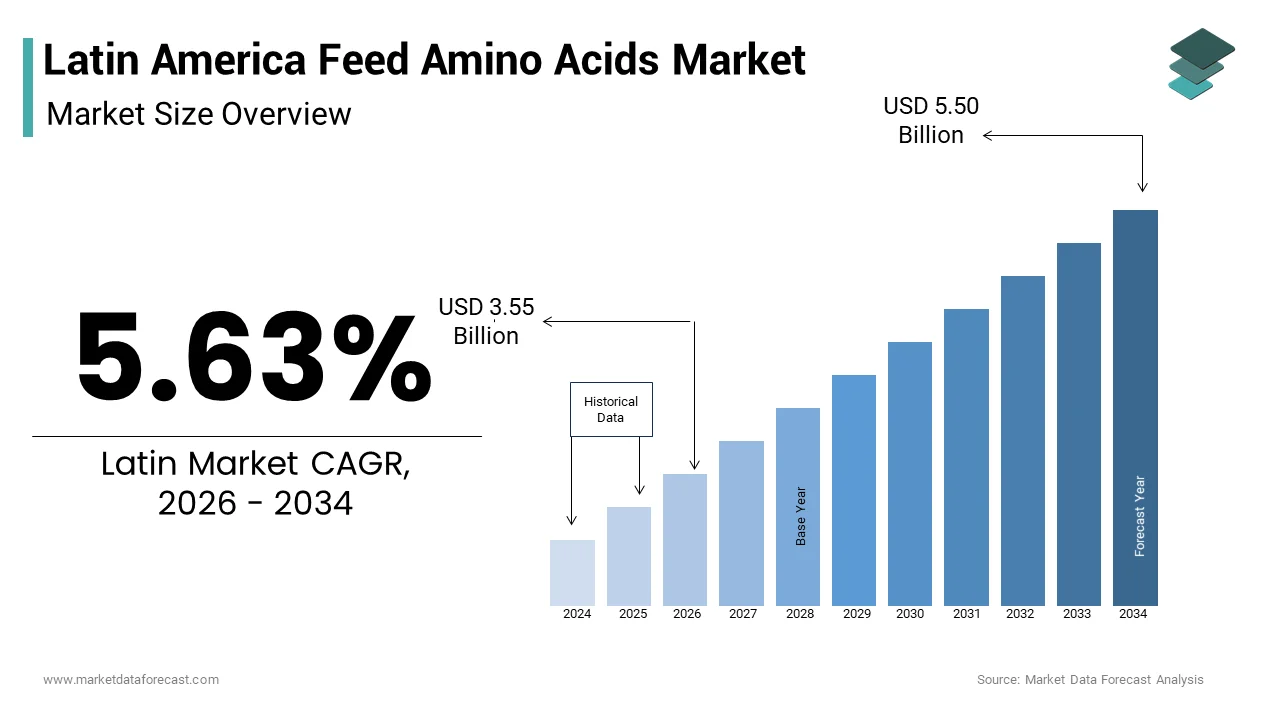
The Latin American feed amino acids market continues to rise with the increase in demand for animal-derived products. The breeders have been taking more interest in the market, and their willingness to increase profits has led the market to exhibit significant growth iin nthee years to come.
Feed amino acids are used as additives in feed for various types of livestock. They have been used to increase the productivity of livestock and to meet the rising demand for animal products. The nutritional value of Amino Acids acts as a precaution against health problems like allergies, fatigue, autism, dermatitis, etc.
Further, the rise in the demand for dairy and meat products and the increase in feed costs have lifted the growth of the Latin American feed amino acids market size. Other factors driving the feed amino acids market include the expansion of the animal meat market in the Latin America region, Industrialization of the livestock industry, changing demographics in South America, and other outbreaks of livestock diseases. Besides these, the market faces some restraints and challenges as well, some of them are the availability of alternative protein sources, price volatility of Agri-commodities, competition for raw materials with other industries, and the Regulatory framework. These few factors have been responsible for holding back the Latin American feed amino acids market.
REPORT COVERAGE
| REPORT METRIC | DETAILS |
| Market Size Available | 2025 to 2034 |
| Base Year | 2025 |
| Forecast Period | 2026 to 2034 |
| CAGR | 5.63% |
| Segments Covered | By Livestock, Amino Acids, Country |
| Various Analyses Covered | Global, Regional and Country Level Analysis; Segment-Level Analysis; DROC; PESTLE Analysis; Porter’s Five Forces Analysis; Competitive Landscape; Analyst Overview of Investment Opportunities |
| Regions Covered | Brazil, Mexico, Argentina, Chile, Rest of Latin America |
| Market Leaders Profiled | BASF SE, Royal DSM, and CHR. Hansen A/S, Cargill Incorporated, Kemin Industries Inc., E. I. Du Pont De Nemours and Company, Behn Meyer Group, Novus International Inc., Beneo Group. |
SEGMENT ANALYSIS
By Amino Acids Insights
Lysine holds the largest market share in the amino acids segmentation and is expected to stay the same in the coming years. Under livestock segmentation, poultry accounts for the highest share in the Latin America Feed Amino Acids Market due to the adoption of intensive farming systems more than in any other segment.
KEY MARKET PLAYERS
Some of the major players in the Latin America Feed Amino Acids Market include
- Cheil Jedang
- Cargill Inc.
- Archer Daniels Midland Company
- Novus International Inc.
- Royal DDSMN.V.
- Adisseo France SAS
- Ajinomoto Co. Inc.
- PHW Group
- Kemin Europa
- Evonik Industries AG.
MARKET SEGMENTATION
This research report on the Latin American feed amino acids is segmented and sub-segmented into the following categories.
By Livestock
- cattle
- poultry
- swine
- aquaculture
- other livestock
By Amino Acids
- lysine
- Threonine
- Tryptophan
- Methionine
- others
By Country
- Brazil
- Mexico
- Chile
- Argentina
- Rest of Latin America