Latin America Membrane Bioreactor (MBR) Market Research Report – Segmented By Product Type (Hollow Fiber Membranes, Flat Sheet Membranes), Configuration, Application & Country (Mexico, Brazil, Argentina, Chile and Rest of Latin America) - Industry Analysis From 2026 to 2034
Market Size, 2025
$0.29 BnMarket Estimate, 2026
$0.31 BnMarket Forecast, 2034
$0.57 BnCAGR, 2026–2034
7.90%Latin America Membrane Bioreactor (MBR) Market Size
The Latin America Membrane Bioreactor (MBR) Market was worth USD 0.29 billion in 2025. The Latin American market is expected to reach USD 0.57 billion by 2034 from USD 0.31 billion in 2026, rising at a CAGR of 7.90% from 2026 to 2034.
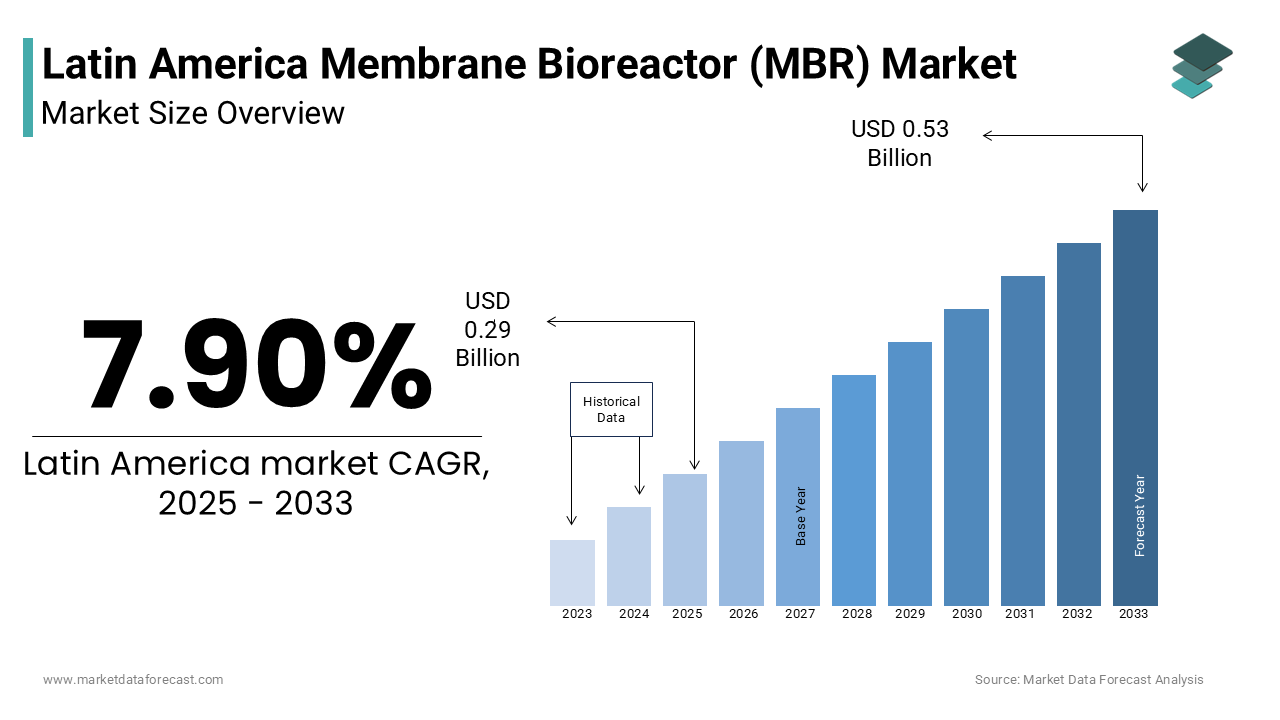
The Latin America membrane bioreactor (MBR) market incorporates advanced wastewater treatment systems that integrate biological processes with membrane filtration to achieve high-quality effluent suitable for reuse. MBR technology is increasingly adopted in municipal, industrial, and commercial applications due to its ability to deliver compact solutions, superior effluent quality, and compliance with stringent environmental regulations. As water scarcity becomes a pressing concern across several countries in the region, demand for efficient water recycling and reclamation technologies has grown significantly. According to the Economic Commission for Latin America and the Caribbean (ECLAC), a significant portion of people in Latin America lack access to safely managed sanitation services, prompting governments and private entities to invest in modern wastewater infrastructure. In Brazil, the National Water Agency (ANA) reported that only 50% of collected sewage undergoes proper treatment, highlighting a critical gap that MBR systems can help address. Similarly, in Mexico, the Federal Electricity Commission (CFE) emphasized the need for water reuse in energy-intensive industries, encouraging the adoption of MBR-based treatment plants.
MARKET DRIVERS
Increasing Urbanization and Municipal Wastewater Treatment Needs
One of the primary drivers fueling the Latin America membrane bioreactor (MBR) market is the rapid pace of urbanization and the corresponding increase in municipal wastewater generation. According to the United Nations Department of Economic and Social Affairs (UN DESA), Latin America’s urban population is expected to reach 82% by 2030, up from 79% in 2020. This demographic shift has placed immense pressure on existing sewage infrastructure, particularly in rapidly expanding metropolitan areas such as São Paulo, Mexico City, and Bogotá. The Brazilian National Water Agency (ANA) reported that only 50% of collected sewage undergoes proper treatment nationwide, underscoring the urgent need for more effective wastewater solutions. In response, several cities have implemented MBR technology to enhance treatment efficiency and reclaim water for non-potable uses such as irrigation and industrial cooling. Similarly, in Mexico, the Federal Electricity Commission (CFE) highlighted the importance of treated wastewater in power plant operations, reinforcing the case for decentralized MBR installations. Also, Colombia’s Ministry of Environment mandated higher discharge standards under Resolution 0631 of 2022, requiring municipalities to adopt advanced treatment methods like MBRs to meet effluent quality requirements.
Stringent Environmental Regulations and Industrial Water Reuse Mandates
Stringent environmental regulations and mandatory industrial water reuse policies represent another significant driver of the Latin America membrane bioreactor (MBR) market. Governments across the region are implementing stricter wastewater discharge norms to protect water bodies and promote circular water use in manufacturing, food processing, and mining sectors. Similarly, According to the Organization for Economic Co-operation and Development (OECD), industrial water reuse rates in Latin America remain below 20%, indicating substantial room for growth. In Brazil, Petrobras launched an initiative in 2023 to integrate MBR technology into offshore oil production platforms for produced water treatment, aligning with corporate sustainability goals. Additionally, in Peru, the Ministry of Energy and Mines required mining operations in water-stressed regions to implement closed-loop water systems incorporating MBR units.
MARKET RESTRAINTS
High Capital and Operational Costs
A major restraint affecting the Latin America membrane bioreactor (MBR) market is the high capital expenditure and ongoing operational costs associated with these advanced wastewater treatment systems. Compared to conventional activated sludge processes, MBR technology requires significant initial investment in membranes, aeration systems, and automation controls, which can be prohibitive for municipalities and small-scale industrial operators. Like, the average capital cost of an MBR facility is approximately 2–3 times higher than that of traditional wastewater treatment plants of similar capacity. Additionally, the ongoing maintenance, membrane replacement, and energy consumption further elevate lifecycle expenses. These financial barriers hinder widespread deployment, particularly in economically constrained regions where affordability remains a key challenge.
Limited Technical Expertise and Maintenance Capabilities
Limited technical expertise and inadequate maintenance capabilities pose a persistent challenge to the Latin America membrane bioreactor (MBR) market. The complexity of MBR systems necessitates specialized knowledge in process engineering, membrane handling, and system optimization—skills that are often lacking in local workforce capacities. Also, identified a shortage of trained technicians as a key obstacle to sustaining MBR performance, with reports of frequent system downtime due to improper operation. Similarly, many industrial facilities lacked in-house expertise to manage membrane integrity and fouling issues effectively. Additionally, inconsistent after-sales support from equipment suppliers further complicates long-term MBR system reliability.
MARKET OPPORTUNITIES
Expansion of Decentralized Wastewater Treatment Systems
The expansion of decentralized wastewater treatment systems presents a significant opportunity for the Latin America membrane bioreactor (MBR) market. As urban sprawl and industrial activity extend beyond centralized sewer networks, the need for localized, modular treatment solutions has grown substantially. Like, a significant share of Latin American populations reside in peri-urban and rural zones with limited or no access to centralized wastewater infrastructure. In response, governments and private developers are investing in decentralized MBR-based treatment units to serve residential complexes, industrial parks, and tourism facilities. Similarly, some nations have also promoted off-grid MBR installations in remote agricultural zones to prevent groundwater contamination from untreated discharges. So, with increasing emphasis on site-specific wastewater management and water reuse, decentralized MBR deployments are emerging as a strategic alternative to conventional treatment infrastructure, offering scalable and adaptable solutions across Latin America.
Integration of MBR Technology in Industrial Sectors with High Water Demand
The integration of membrane bioreactor (MBR) technology in high-water-demand industrial sectors is opening new avenues for the Latin America MBR market. Industries such as food and beverage, textiles, pharmaceuticals, and mining require large volumes of water and generate complex effluents that conventional treatment systems cannot adequately manage. Like, industrial water reuse rates in the region remain below 20%, indicating strong potential for advanced treatment technologies like MBRs. The Mexican Automotive Industry Association (AMIA) also reported increased interest from automotive manufacturers seeking MBR-based solutions for paint shop and cooling tower water recycling. Additionally, Argentina’s National Institute of Industrial Technology (INTI) encouraged textile and food processing firms to adopt MBR technology for zero-liquid discharge (ZLD) compliance.
MARKET CHALLENGES
Volatility in Raw Material and Equipment Supply Chains
Supply chain volatility represents a major challenge for the Latin America membrane bioreactor (MBR) market, as most components—including membranes, pumps, and control systems—are sourced internationally. Countries in the region rely heavily on imports from North America and Asia, exposing them to delays caused by global logistics disruptions and fluctuating trade policies. According to the World Bank Logistics Performance Index (LPI), several Latin American nations rank below global averages in customs efficiency and infrastructure reliability. These inefficiencies not only inflate capital expenditures but also create inconsistencies in supply, making it difficult for stakeholders to maintain steady procurement and execution schedules for MBR-based wastewater treatment projects.
Regulatory Uncertainty and Policy Instability
Regulatory uncertainty and policy instability pose ongoing challenges for the Latin America membrane bioreactor (MBR) market, as inconsistent government directives and shifting environmental mandates complicate long-term planning and investment decisions. In several countries, frequent revisions to wastewater discharge limits and permitting procedures create confusion among industry players. For instance, in Argentina, the Central Bank imposed multiple foreign exchange controls in 2023, complicating the import of MBR modules and spare parts for ongoing projects. According to the International Trade Centre (ITC), Argentina’s import licensing system for environmental equipment underwent three major revisions between 2021 and 2023, adding administrative complexity. Similarly, in Mexico, recent amendments to water management laws have affected how industries report and monitor their wastewater treatment processes, increasing compliance costs for MBR system operators. In addition, political transitions in countries like Peru and Chile have resulted in abrupt shifts in water infrastructure priorities, delaying approvals for new MBR-based wastewater projects.
SEGMENTAL ANALYSIS
By Product Type Insights
Hollow fiber membranes predominated in the Latin America membrane bioreactor (MBR) market by securing 58.9% of total consumption in 2024. This segment's lead position is primarily attributed to its superior surface area-to-volume ratio, energy efficiency, and compatibility with both municipal and industrial MBR systems. Also, hollow fiber configurations are preferred due to their modular scalability and ease of integration into compact treatment plants, making them ideal for densely populated urban areas like São Paulo and Mexico City. Similarly, in Mexico, the National Water Commission (CONAGUA) endorsed hollow fiber technology for decentralized wastewater treatment units due to its low footprint and high flux performance. Apart from these, Chile’s Ministry of Public Works mandated the use of hollow fiber-based MBR systems in arid regions where water reuse is critical for agricultural irrigation.
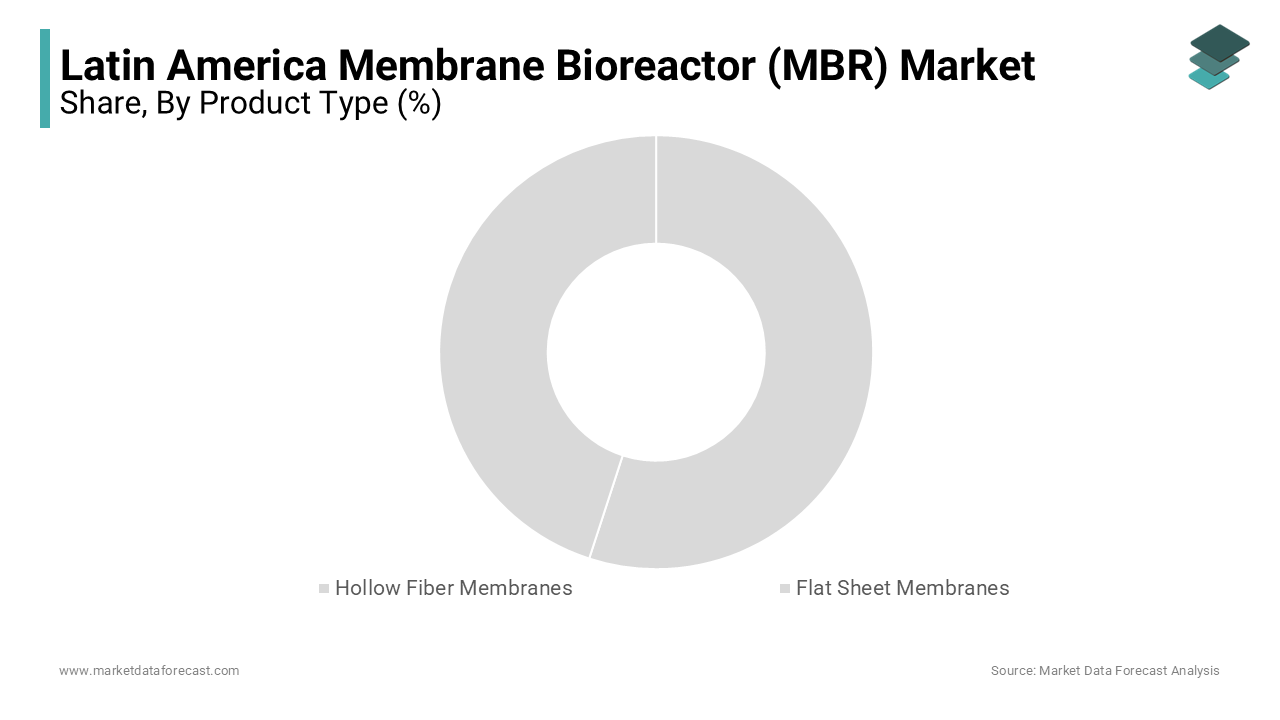
Flat sheet membranes are emerging as the fastest-growing segment in the Latin America MBR market, projected to expand at a CAGR of approximately 9.4% from 2025 to 2033. This rapid expansion is driven by increasing adoption in industrial applications, particularly in food processing, pharmaceuticals, and textile manufacturing, where chemical resistance and mechanical durability are essential. According to many studies, flat sheet membranes offer better tolerance to fluctuating pH levels and higher solids content, making them suitable for treating complex effluents from sugar mills, dairy plants, and dyeing facilities. Also, flat sheet membranes require less frequent replacement and demonstrate improved resistance to biofouling under variable operating conditions, enhancing their appeal among industrial end-users.
By Configuration Insights
The submerged membrane bioreactor configuration had the largest share of the Latin America MBR market, i.e. 63.9% of total installations in 2024. This dominance is due to its widespread use in municipal wastewater treatment plants due to lower energy consumption and simplified hydraulic design. Like, submerged MBR systems have become the preferred choice for small to mid-sized municipalities seeking cost-effective solutions without compromising effluent quality. In Brazil, the Ministry of Regional Development reported that over 70% of new decentralized wastewater treatment projects implemented since 2021 adopted submerged MBR units, highlighting their adaptability to space-constrained environments and intermittent operation cycles.
The side stream MBR configuration is witnessing the highest growth within the Latin American MBR market, expanding at a CAGR of approximately 8.2%. This growth is fueled by rising demand in industries requiring robust filtration capabilities, such as pulp and paper, textiles, and petrochemicals, where high solids loading and fluctuating influent characteristics necessitate advanced hydraulic designs. With ongoing advancements in hybrid system integration and process automation, side stream MBRs are gaining momentum across Latin America’s industrial wastewater sector.
By Application Insights
Municipal wastewater treatment remained the biggest application segment in the Latin America MBR market by contributing 59% of total installations in 2024. This control is primarily driven by government-led initiatives aimed at improving sanitation coverage and meeting regulatory discharge standards. Similarly, in Mexico, CONAGUA promoted the use of MBR systems in informal settlements lacking centralized sewer access, emphasizing their ability to generate reusable effluent for irrigation and toilet flushing. Chile’s Ministry of Public Works also mandated MBR adoption in coastal cities to prevent marine pollution from untreated discharges.
Industrial wastewater treatment is the booming segment in the Latin America MBR market, projected to expand at a CAGR of approximately 9.1%. This quick expansion is driven by stringent discharge regulations, increasing water reuse mandates, and the need for closed-loop water management in high-water-consuming sectors. According to the Latin American Water Sustainability Council (LAWSC), industrial water reuse rates in the region remain below 20%, indicating strong potential for MBR adoption. Argentina’s INTI also encouraged textile and food processing firms to adopt MBR technology for zero-liquid discharge (ZLD) compliance.
REGIONAL ANALYSIS
Brazil had the dominant position in the Latin America membrane bioreactor (MBR) market by contributing 36.8% of total regional installations in 2024. As the continent’s largest economy and most populous nation, Brazil faces significant challenges in managing wastewater from rapidly expanding urban centers and industrial zones. The Ministry of Regional Development reported that over 100 decentralized MBR projects were initiated between 2021 and 2023, targeting unsewered communities and peri-urban settlements. Petrobras also integrated MBR technology into offshore oil production platforms to treat produced water, aligning with IBAMA’s environmental directives.
Mexico is another key player in the Latin America MBR market. The country benefits from a structured national sanitation strategy led by which promotes decentralized MBR solutions in remote and semi-arid regions. In addition, CONAGUA promoted off-grid MBR installations in rural agricultural zones to prevent groundwater contamination from untreated discharges. With increasing urbanization and industrial expansion, Mexico remains a key driver of MBR growth in Latin America, supported by regulatory enforcement and cross-sectoral investment in sustainable water management.
Argentina contributes a notable share to the Latin America MBR market which is driven by targeted investments in municipal and industrial wastewater treatment. Local authorities saw the deployment of multiple MBR-based treatment units to support sanitation infrastructure along high-density transit zones. In Córdoba and Santa Fe, local governments partnered with international technology providers to install MBR units in hospitals and educational institutions, ensuring safe effluent discharge and reuse for irrigation. The National Institute of Industrial Technology (INTI) emphasized the role of MBR in achieving zero-liquid discharge (ZLD) goals, particularly in the food processing sector where organic load variability requires stable biological treatment. Despite economic instability, Argentina maintains a stable presence in the Latin American MBR market, supported by policy-driven sanitation upgrades and industrial compliance mandates.
Chile is driven by strategic investments in water-scarce regions and compliance with stringent environmental regulations. According to the Ministry of Public Works, Chile’s Atacama and Coquimbo regions face acute water shortages, prompting the deployment of MBR systems in mining operations, desalination plants, and tourism facilities. Also, municipal authorities integrated MBR-based treatment units in high-rise residential complexes and commercial developments to meet decentralized water reuse targets.
The remaining Latin American countries collectively are playing pivotal roles in shaping demand patterns. Colombia stands out as a key market, with the mandating of MBR technology in new wastewater permits for industrial parks and tourist resorts. Ecuador’s Ministry of Environment, Water, and Ecological Transition promoted MBR adoption in Quito and Guayaquil to meet Andean Community sanitation standards.
KEY MARKET PLAYERS AND COMPETITIVE LANDSCAPE
SUEZ Water Technologies & Solutions, Veolia Water Technologies, Evoqua Water Technologies, Kubota Corporation, Toray Industries, Inc., Pentair plc, Mitsubishi Chemical Aqua Solutions Co., Ltd., Koch Membrane Systems, Inc., Alfa Laval AB, and Aquatech International LLC are some of the key market players in the Latin America membrane bioreactor (MBR) market.
The Latin America membrane bioreactor (MBR) market features a competitive landscape shaped by the coexistence of global multinationals and emerging regional specialists, each striving to gain a stronger foothold through differentiated offerings and strategic initiatives. Global leaders such as Veolia, Suez, and Kubota dominate due to their extensive product portfolios, technological expertise, and established project execution capabilities. However, smaller regional players and local engineering firms are gaining traction by offering cost-effective, modular MBR solutions tailored to specific municipal and industrial needs. The competition intensifies in countries like Brazil and Mexico, where government funding and regulatory mandates drive consistent demand for advanced wastewater treatment technologies. Product differentiation remains a key battleground, with companies striving to develop more energy-efficient, low-maintenance, and digitally integrated MBR systems that align with evolving sustainability goals and operational demands. Additionally, after-sales service, financing models, and turnkey project delivery play crucial roles in setting market participants apart. As demand diversifies across municipal, industrial, and decentralized applications, companies must continuously adapt to shifting dynamics, ensuring agility in technology development, customer engagement, and operational efficiency to maintain and expand their market presence. Regulatory pressures, supply chain volatility, and financial constraints further shape competitive behavior, compelling firms to innovate and invest strategically in resilient and adaptable business models.
Top Players in the Latin America Membrane Bioreactor (MBR) Market
Veolia Water Technologies
Veolia Water Technologies is a leading global provider of membrane bioreactor systems and holds a strong presence in the Latin America MBR market. The company offers end-to-end water and wastewater treatment solutions tailored for municipal and industrial applications. In Latin America, Veolia has been instrumental in deploying advanced MBR technology to address sanitation challenges and support sustainable water reuse initiatives. Its regional projects emphasize innovation, energy efficiency, and compliance with environmental regulations. Veolia’s extensive engineering expertise and after-sales service network enable efficient system integration and long-term performance optimization.
Suez Water Technologies & Solutions
Suez Water Technologies & Solutions plays a pivotal role in shaping the Latin America MBR market by providing high-performance membrane systems designed for complex wastewater streams. The company has strategically expanded its footprint through collaborations with local engineering firms and public utilities, ensuring reliable access to customized MBR solutions. In Latin America, Suez emphasizes product durability, process efficiency, and environmental compliance, positioning itself as a preferred supplier in both municipal and industrial sectors. Its commitment to research and development supports long-term growth, particularly in regions facing water scarcity and stringent discharge standards. With a strong brand reputation and focus on application-specific innovation, Suez strengthens its position as a technology-driven leader in the region.
Kubota Corporation
Kubota Corporation is a major contributor to the Latin America MBR market, known for its durable and compact membrane modules used in decentralized wastewater treatment. The company integrates advanced materials science with practical engineering, enabling performance improvements across various sectors. In Latin America, Kubota emphasizes customization, adapting MBR systems to meet regional climatic conditions and infrastructure needs. Its robust brand reputation and long-standing partnerships with local distributors enhance market penetration. By focusing on sustainable production and technical collaboration, Kubota strengthens its position as a key player in the region. The company’s ability to align with global trends while addressing localized wastewater challenges makes it a significant force in the Latin American MBR landscape.
Top Strategies Used by Key Market Participants
One of the primary strategies adopted by leading players in the Latin America MBR market is technology localization and product adaptation. Companies are investing in R&D to develop MBR systems that cater specifically to regional conditions such as variable influent quality, space constraints, and climate-related challenges. This enables better performance, longer membrane life, and reduced maintenance requirements.
Another critical strategy involves expanding local partnerships and distribution networks. By forming alliances with engineering firms, construction companies, and government agencies, MBR suppliers can improve project execution and after-sales support. These collaborations also facilitate faster deployment and greater trust among public and private sector clients.
Lastly, firms are increasingly engaging in integrated solution offerings, where MBR systems are bundled with digital monitoring tools, automation platforms, and lifecycle maintenance services. This approach enhances operational efficiency and provides added value to customers seeking smart, data-driven wastewater management solutions. Such comprehensive offerings help reinforce market leadership and customer retention in competitive environments.
RECENT MARKET DEVELOPMENTS
- In January 2023, Veolia launched a new line of compact MBR units specifically designed for small-scale municipal wastewater treatment in remote communities across Latin America, responding to increasing demand for decentralized sanitation solutions.
- In May 2023, Suez Water Technologies opened a new technical service center in São Paulo, Brazil, aimed at enhancing local engineering support and accelerating project implementation for MBR-based wastewater treatment plants.
- In September 2023, Kubota Corporation partnered with a Mexican water technology firm to distribute its flat sheet MBR membranes across Central and South America, targeting industrial clients requiring high-efficiency water reclamation solutions.
- In February 2024, Xylem Inc. entered into a joint venture with a Chilean engineering company to deploy AI-integrated MBR systems in mining operations, strengthening its market presence and expanding service capabilities in water-stressed regions.
- In June 2024, Evoqua Water Technologies acquired a Brazilian MBR component supplier specializing in submerged membrane modules, allowing for localized production and faster delivery times across Andean and Amazonian markets.
MARKET SEGMENTATION
This research report on the Latin America membrane bioreactor (MBR) market is segmented and sub-segmented into the following categories.
By Product Type
- Hollow Fiber Membranes
- Flat Sheet Membranes
By Configuration
- Submerged MBR Configuration
- Side Stream MBR Configuration
By Application
- Municipal Wastewater Treatment
- Industrial Wastewater Treatment
By Country
- Mexico
- Brazil
- Argentina
- Chile
- Rest of Latin America
Frequently Asked Questions
What is the current market trend for MBR technology in Latin America?
As of 2025, the Latin American MBR market is gaining traction due to increasing concerns over water scarcity, stricter environmental regulations, and growing investments in sustainable wastewater treatment technologies.
What is the outlook for the MBR market in Latin America from 2025 to 2033?
The MBR market in Latin America is projected to grow steadily, driven by environmental sustainability goals, government support for wastewater reuse, and the modernization of existing water infrastructure.
Access the study in MULTIPLE FORMATS
Purchase options starting from
$ 1600
Didn’t find what you’re looking for?
TALK TO OUR ANALYST TEAM
Need something within your budget?
NO WORRIES! WE GOT YOU COVERED!
Call us on: +1 888 702 9696 (U.S Toll Free)
Write to us: sales@marketdataforecast.com