- Product Description Description
- Table of Contents TOC
- List of Table & Figure LOT
- Get Free Sample PDF Sample PDF
Market Size, 2025
$1.21 BnMarket Estimate, 2026
$1.42 BnMarket Forecast, 2034
$5.15 BnCAGR, 2026–2034
17.45%Executive Summary: Latin America Micro Irrigation Systems Market
- Market Scope: Comprehensive regional micro irrigation systems market analysis covering technology types, application verticals, end-user tiers, regional leadership frameworks, and adoption metrics.
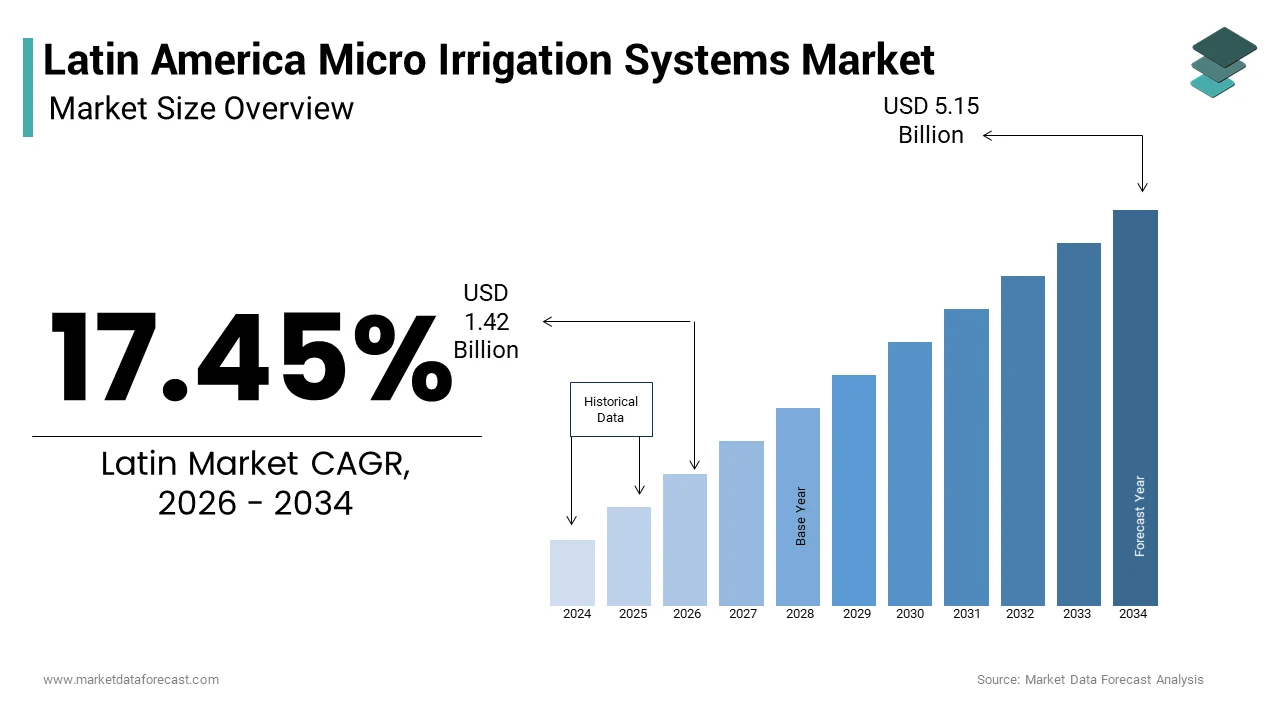
- Market Valuation: Valued at USD 1.21 billion (2025), estimated at USD 1.42 billion (2026), and projected to reach USD 5.15 billion by 2034, registering a robust CAGR of 17.45% (2026–2034).
- Primary Growth Drivers: Increasing water scarcity and climate variability necessitating efficient irrigation, alongside the rapid expansion of high-value crop cultivation such as fruits, vegetables, and nuts for export markets. Key trends include the integration of smart irrigation and IoT technologies for precision water management and government subsidies supporting sustainable agriculture, though high initial capital costs, limited technical expertise, and infrastructure deficiencies present ongoing challenges to widespread adoption.
Key Market Segment Metrics (2026–2034)
| Category | Leading Segment (2025 Position) | Fastest-Growing Segment |
|---|---|---|
| By Technology | Drip Irrigation Systems (dominated the technology segment due to superior water efficiency achieving up to 90%) | Subsurface Drip Irrigation (SDI) (projected to grow at a CAGR of 9.2%) |
| By Application | Orchard Crops and Vineyards (held the largest application share) | Greenhouse Crops (anticipated to register a 10.4% CAGR) |
| By End User | Industrial Growers (accounted for the leading end-user share) | Small and Medium-sized Farmers (expected to achieve an 8.2% CAGR supported by government subsidies) |
| By Region / Country | Brazil (led the regional market with the highest share in 2025, driven by extensive irrigated agriculture in the Cerrado region) | Expanding agricultural export territories across Latin America |
Major Market Players & Market Structure
Market Structure: Highly competitive Latin American agricultural technology landscape shaped by strategic regional expansions and partnerships, including Netafim expanding local manufacturing in Brazil and Mexico, Rivulis strengthening distribution in Argentina and Chile, and Jain Irrigation establishing joint ventures for smallholder solutions.
Key Companies: Netafim Ltd, Rivulis Irrigation LP, Jain Irrigation Systems Ltd, Lindsay Corporation, Nelson Irrigation Corporation, The Toro Company, EPC Industries Limited, Valmont Industries Inc., and T-L Irrigation.
Latin America Micro Irrigation Systems Market Size
The Latin American micro irrigation systems market was valued at USD 1.21 billion in 2025 and is anticipated to be USD 1.42 billion by 2026 from USD 5.15 billion by 2034, growing at a CAGR of 17.45% from 2026 to 2034. With a shortage of land and water, growing importance is being put on the support of advanced technologies that can help enhance crop output.
According to the Food and Agriculture Organization of the United Nations, agriculture in Latin America accounts for approximately 70% of total freshwater withdrawals, highlighting the critical need for efficient water management practices. The region is characterized by diverse climatic conditions ranging from arid zones in northern Mexico and north-eastern Brazil to humid tropical areas, necessitating tailored irrigation solutions. According to the Inter-American Development Bank, climate change projections indicate increased frequency of droughts and irregular rainfall patterns across the continent, driving the urgency for adoption of water saving technologies. The regulatory landscape varies significantly, with countries like Chile and Israel influenced policies in neighboring nations promoting sustainable water use. Government initiatives in Brazil and Mexico are increasingly supporting modernization of agricultural infrastructure through subsidies and technical assistance programs. The market is also influenced by the expansion of high value crops such as fruits, vegetables, and nuts, which require precise water application to ensure quality and yield. This sector operates at the intersection of agricultural productivity and environmental sustainability, addressing the dual challenge of feeding a growing population while conserving scarce water resources.
MARKET DRIVERS
Increasing Water Scarcity and Climate Variability
The rising issue of water scarcity and climate variability is one of the major factors driving the growth of the Latin American micro irrigation systems market. Latin America has experienced significant shifts in precipitation patterns with prolonged dry spells affecting major agricultural hubs. According to the United Nations Economic Commission for Latin America and the Caribbean, approximately 60% of the land area in South America is susceptible to desertification and soil degradation. Traditional irrigation methods often result in substantial water loss through evaporation and percolation, exacerbating the strain on limited freshwater resources. Micro irrigation systems offer a solution by delivering water directly to the plant root zone, achieving efficiency rates of up to 90% compared to 50% to 60% for conventional methods. According to the World Bank, agricultural productivity in water stressed regions can be significantly enhanced through the adoption of precision irrigation technologies. Farmers in arid regions such as the Peruvian coast and northern Chile are increasingly turning to drip irrigation to maintain crop yields despite reduced water availability. The economic imperative to secure water rights and ensure consistent production drives investment in these systems. Furthermore, international climate agreements and national sustainability goals are pushing governments to incentivize water efficient practices. This environmental pressure creates a structural demand for micro irrigation as a critical tool for climate resilience in agriculture.
Expansion of High Value Crop Cultivation
The rapid expansion of high value crop cultivation including fruits, vegetables, nuts and flowers significantly propels the Latin American micro irrigation systems market expansion. These crops require precise water and nutrient management to achieve optimal quality and marketability, which traditional irrigation methods cannot provide. According to the United States Department of Agriculture, Latin America and the Caribbean exported over $60 billion in agricultural products to the United States in 2024, including avocados, berries, and citrus. High value crops are sensitive to water stress and excessive moisture, which can lead to disease and reduced shelf life. Micro irrigation allows for fertigation, the simultaneous application of water and fertilizers, ensuring uniform nutrient distribution and improved crop health. According to the World Bank, the region accounts for 14% of global food production and 23% of global agricultural and fish exports. The shift from subsistence farming to commercial agriculture in countries like Colombia and Ecuador further accelerates this trend. Large scale agribusinesses recognize that micro irrigation not only conserves water but also enhances labor efficiency and reduces weed growth. The economic benefits of higher yields and superior product quality justify the initial capital expenditure. This transition toward high value agriculture establishes a robust foundation for sustained market growth as producers seek competitive advantages in global markets.
MARKET RESTRAINTS
High Initial Capital Investment and Financing Barriers
The high initial capital investment required for micro irrigation systems is hampering the Latin American micro irrigation systems market expansion. Installing drip or micro sprinkler systems involves costs for pipes, emitters, pumps, filters, and control units, which can be prohibitive for operators with limited financial resources. According to the World Bank, about 70% of the 15 million smallholder farms in Latin America and the Caribbean lack access to formal credit. Although micro irrigation offers long term savings on water and labor, the upfront cost creates a barrier to entry for many potential users. According to agricultural economic studies, the payback period for micro irrigation systems can range from two to five years depending on crop type and scale, which may be too long for cash constrained farmers. Government subsidy programs exist in countries like Brazil and Mexico, but they often suffer from bureaucratic delays and limited coverage, leaving many farmers without support. The lack of affordable financing options restricts market penetration to large commercial enterprises, excluding a vast segment of the agricultural community. This financial constraint slows the overall adoption rate and limits the potential impact of micro irrigation on regional water conservation efforts. Until more accessible financial mechanisms are developed, the high cost will remain a persistent hurdle.
Lack of Technical Knowledge and Maintenance Expertise
The lack of technical knowledge and maintenance expertise among farmers is further hindering the growth of the Latin American market. Proper design, installation, and operation of these systems require specialized skills that are not widely available in rural areas. According to the Inter American Institute for Cooperation on Agriculture, nearly 80% of agricultural producers in the region are family farmers who often face limited access to technical extension services. Issues such as emitter clogging due to sediment or biological growth, improper pressure regulation, and inadequate filtration can severely compromise system performance if not addressed correctly. According to field surveys, a considerable number of installed systems fall into disrepair within a few years due to poor maintenance practices and lack of spare parts availability. Farmers often revert to traditional methods when faced with technical difficulties, undermining the potential benefits of the technology. The complexity of integrating micro irrigation with fertigation and automation adds another layer of difficulty, requiring ongoing technical support. The absence of localized training programs and reliable after sales service networks hinders user confidence and adoption in this region. Manufacturers and distributors face the challenge of educating a diverse and dispersed customer base. Without adequate capacity building initiatives, the full potential of micro irrigation systems remains unrealized, limiting market growth and sustainability.
MARKET OPPORTUNITIES
Integration of Smart Irrigation and IoT Technologies
The integration of smart irrigation and Internet of Things (IoT) technologies is a lucrative opportunity for the growth in the Latin America micro irrigation systems market. Smart systems utilize sensors to monitor soil moisture, weather conditions, and plant status, enabling real time data driven decision making for precise water application. According to the Global System for Mobile Communications Association, 5G connections in Latin America are expected to reach 15% of total connections by 2030, facilitating the adoption of digital agricultural solutions. IoT enabled irrigation controllers allow farmers to automate watering schedules, adjust flow rates remotely, and receive alerts for system malfunctions, optimizing water use and reducing labor costs. According to the Inter-American Development Bank, the adoption of digital agriculture could increase agricultural value added in the region by 15% annually. The ability to integrate micro irrigation with farm management software provides comprehensive insights into crop health and resource utilization. This technological advancement appeals to modern agribusinesses aiming to maximize productivity while minimizing environmental impact. Governments and private sectors are increasingly investing in digital infrastructure to support smart farming initiatives. The potential for data analytics to predict water needs and prevent stress further enhances the value proposition. By embracing smart technologies, manufacturers can differentiate their offerings and capture a premium segment of the market. This convergence of irrigation and digital technology opens new avenues for service based business models and long term customer engagement.
Government Subsidies and Sustainable Agriculture Initiatives
Government subsidies and sustainable agriculture initiatives offer significant opportunities for the Latin American micro irrigation systems market. Recognizing the critical importance of water conservation, many governments in the region are implementing policies and financial incentives to promote the adoption of efficient irrigation technologies. According to the Inter-American Development Bank, the bank approved approximately $12.5 billion in climate related financing for the region in 2023, supporting modernization programs. These initiatives aim to modernize the agricultural sector, improve food security, and mitigate the impacts of climate change. According to the policy reports, public private partnerships are increasingly being formed to deliver technical assistance and training alongside financial support. The alignment of these programs with international sustainability goals attracts funding from global organizations and development banks. The emphasis on sustainable practices encourages large exporters to adopt micro irrigation to comply with environmental standards required by international markets. This regulatory and financial support lowers the barrier to entry for farmers and stimulates market demand. Manufacturers can leverage these programs by collaborating with government agencies to offer compliant and subsidized solutions. The growing political will to address water scarcity ensures a favorable environment for market expansion. This supportive policy landscape creates a stable foundation for long term growth and widespread adoption.
MARKET CHALLENGES
Infrastructure Deficiencies and Supply Chain Constraints
Infrastructure deficiencies and supply chain constraints is one of the significant challenges to the Latin American micro irrigation systems market. Many rural areas lack reliable electricity, roads, and communication networks, which are essential for the operation and maintenance of advanced irrigation systems. According to the World Bank, Latin America and the Caribbean must invest 3.12% of its GDP annually until 2030 to meet infrastructure goals. This unpredictability disrupts installation schedules and complicates after sales support, leading to customer dissatisfaction. According to the Inter American Development Bank, the region loses approximately 15% of its food production due to logistical inefficiencies and poor transport infrastructure. Trade barriers and tariffs in certain countries further inflate costs and limit product availability. The fragmented nature of the supply chain with multiple intermediaries adds complexity and reduces transparency. Manufacturers face the challenge of establishing robust distribution networks that can reach distant agricultural zones efficiently. The lack of local manufacturing capabilities for key components exacerbates dependency on imports. Addressing these infrastructure gaps requires significant investment and coordination between public and private sectors. Until logistics and infrastructure improve, the market will struggle to achieve its full potential. These operational hurdles hinder scalability and limit the accessibility of micro irrigation solutions for many farmers.
Competition from Traditional Irrigation Methods
Competition from traditional irrigation methods such as flood and furrow irrigation is another significant challenge to expansion of the micro irrigation systems market in Latin America. Despite the inefficiencies of traditional methods, they remain deeply entrenched in agricultural practices due to their low initial cost and simplicity. According to the Food and Agriculture Organization of the United Nations, nearly 85% of the irrigated land in the region is still managed using surface irrigation methods. Farmers accustomed to these methods are often resistant to change due to perceived risks and the learning curve associated with new technologies. According to sociological studies, cultural factors and traditional knowledge play a strong role in farming decisions, making it difficult to shift behaviors without compelling evidence of benefits. The immediate economic burden of transitioning to micro irrigation outweighs the long term savings for many smallholders who prioritize short term survival. Additionally, the abundance of water in certain regions reduces the immediate urgency to adopt efficient systems. Overcoming this inertia requires extensive demonstration projects and success stories to prove the viability of micro irrigation. Manufacturers must invest in education and advocacy to change perceptions and highlight the economic and environmental advantages. This cultural and economic resistance slows market penetration and requires sustained effort to overcome.
REPORT COVERAGE
| REPORT METRIC | DETAILS |
| Market Size Available | 2025 to 2034 |
| Base Year | 2025 |
| Forecast Period | 2026 to 2034 |
| CAGR | 17.45% |
| Segments Covered | By Irrigation Technology, Application, End-user and Country. |
| Various Analyses Covered | Global, Regional, and Country Analysis, Segment-Level Analysis, DROC, PESTLE Analysis, Porter’s Five Forces Analysis, Competitive Landscape, Analyst Overview of Investment Opportunities |
| Regions Covered | Brazil, Mexico, Argentina, Rest of Latin America |
| Market Leaders Profiled | Jain Irrigation Systems Ltd., Lindsay Corporation, Nelson Irrigation Corporation, The Toro Company, EPC Industries Limited, Valmont Industries Inc., and T-L Irrigation. |
SEGMENTAL ANALYSIS
By Irrigation Technology Insights
The drip irrigation systems segment captured the largest share of the Latin American micro irrigation systems market in 2025. The dominance of drip irrigation systems segment in the Latin American market is driven by their superior water use efficiency, which is critical in arid and semi-arid regions of Latin America where water scarcity is a pressing concern. According to the Food and Agriculture Organization of the United Nations, drip irrigation achieves efficiencies of up to 90%, whereas surface irrigation typically ranges between 30% and 50%. This high efficiency is particularly valuable in countries like Chile and northern Mexico, where prolonged droughts and limited freshwater resources threaten agricultural productivity. According to the Inter-American Development Bank, implementing efficient irrigation in the region can reduce water use per hectare by up to 40% while increasing yields. The ability to precisely control water application minimizes evaporation and runoff, ensuring that every drop contributes to plant growth. This technological advantage aligns with national sustainability goals and regulatory pressures to conserve water resources. Farmers recognize that drip irrigation not only saves water but also reduces energy costs associated with pumping. The economic and environmental benefits drive widespread adoption across diverse crop types. The proven track record of drip systems in enhancing resilience against climate variability solidifies their position as the leading technology in the market.
On the other hand, the subsurface drip irrigation (SDI) systems segment is predicted to expand at a CAGR of 9.2% during the forecast period owing to its ability to maximize land utilization and facilitate mechanization, which is increasingly important for large scale farming operations in Latin America. By burying the irrigation lines, SDI eliminates surface obstacles, allowing for unrestricted movement of machinery during planting, harvesting, and other field operations. According to agronomic studies, this feature is particularly beneficial for row crops such as corn, soybeans, and sugarcane, which dominate the agricultural landscape in Brazil and Argentina. According to the Brazilian Agricultural Research Corporation, Brazil has over 8.2 million hectares of irrigated land, with SDI becoming a key technology for large scale grain production. The absence of surface pipes also reduces the risk of damage from farm equipment and animal activity, lowering maintenance costs. Furthermore, SDI prevents surface evaporation and weed growth by keeping the soil surface dry, creating a more favorable environment for crop development. The integration of SDI with precision agriculture technologies allows for real time monitoring and control, enhancing overall farm efficiency. As labor costs rise and the need for operational efficiency grows, SDI offers a compelling solution for modern agribusinesses. This operational advantage drives the accelerated adoption of SDI systems among progressive farmers seeking to optimize land and resource use.
By Application Insights
The orchard crops and vineyards segment led the market by holding the leading share of the Latin American micro irrigation systems market in 2025. The growth of the orchid crops and vineyards segment in the regional market is attributed to their high economic value and strong orientation toward export markets, which demand consistent quality and yield. Latin America is a major global supplier of fruits and wine, with countries like Chile, Argentina, and Brazil exporting billions of dollars worth of produce annually. According to the United States Department of Agriculture, U.S. imports of fresh fruits from Latin America and the Caribbean grew to $19.3 billion in 2023. To meet strict international standards for size, color, and sweetness, growers must ensure optimal water and nutrient conditions throughout the growing season. Micro irrigation systems provide the precision necessary to achieve these quality metrics. According to industry analyses, the return on investment for micro irrigation in orchards is high due to the premium prices commanded by high quality produce. The perennial nature of these crops also justifies the long term investment in durable irrigation infrastructure. Growers are willing to pay for advanced systems that protect their assets and maximize profitability. The economic imperative to maintain competitiveness in global markets drives continuous adoption of micro irrigation. This financial motivation ensures that orchard crops and vineyards remain the primary application segment.
On the other end, the greenhouse crops segment is projected to record a CAGR of 10.4% during the forecast period in the Latin American market owing to the intensification of protected agriculture and the rising demand for year round production of high value vegetables and flowers. The rapid expansion of the greenhouse crops segment is primarily fueled by the intensification of protected agriculture in response to climate variability and market demand for off season produce. Greenhouses allow for controlled environment agriculture, enabling year round production regardless of external weather conditions. According to the Inter American Institute for Cooperation on Agriculture, Mexico has one of the world's largest areas of protected agriculture, exceeding 50,000 hectares. Micro irrigation is essential in greenhouses to manage the high plant density and precise water requirements of crops such as tomatoes, peppers, cucumbers, and ornamental flowers. According to industry reports, drip and mist systems are widely used to maintain optimal humidity and soil moisture levels, preventing stress and maximizing yield. The controlled environment also facilitates the integration of automated irrigation systems with climate control technologies, enhancing efficiency. The high value nature of greenhouse produce justifies the investment in advanced irrigation infrastructure. The shift toward intensive farming practices to maximize land productivity drives the adoption of micro irrigation. This trend toward protected agriculture ensures sustained growth for the greenhouse segment.
By End User Insights
The industrial growers segment held the leading position in the Latin America micro irrigation market by end user in 2025. The growth of the industrial growers segment in this Latin American market is attributed to their access to capital and the ability to achieve economies of scale, which make the high initial investment in micro irrigation systems feasible. Large agribusinesses can spread the fixed costs of irrigation infrastructure over vast areas, reducing the per hectare cost. According to the World Bank, the average farm size for large scale operations in the region is over 1,000 hectares, compared to less than 5 hectares for smallholders. According to economic analyses, the return on investment for micro irrigation is realized more quickly on large scales due to higher total output and efficiency gains. Industrial growers also have the technical expertise and management capacity to operate and maintain complex irrigation systems effectively. The professionalization of agriculture in the region has led to the consolidation of land holdings, favoring large operators. These entities are driven by the need to optimize inputs and maximize profits in competitive global markets. The ability to implement precision agriculture technologies across large areas further enhances productivity. This financial and operational advantage ensures that industrial growers remain the primary adopters of micro irrigation. The continued expansion of large scale commercial agriculture sustains the leadership of this segment.
However, the small and medium sized farmers segment is predicted to register a CAGR of 8.2% during the forecast period in the Latin American market owing to the government subsidies and support programs aimed at modernizing small scale agriculture. Governments in countries like Brazil, Mexico, and Chile have launched initiatives to provide financial assistance and technical training for smallholders adopting micro irrigation. According to the Inter-American Development Bank, smallholder farmers represent over 60% of the total food production in some regional countries, making them a target for development funding. According to policy reports, subsidies can cover up to 50% of the installation costs, making micro irrigation accessible to farmers with limited resources. Technical assistance programs help farmers design, install, and maintain systems correctly, addressing the knowledge gap. The success of pilot projects has demonstrated the economic benefits of micro irrigation, encouraging wider adoption. The political will to support rural development drives the expansion of these programs. The increasing availability of low cost and simplified micro irrigation kits also facilitates adoption. This supportive policy environment empowers smallholders to invest in technology. The democratization of irrigation technology ensures sustained growth for the farmer segment.
COUNTRY ANALYSIS
Brazil Micro Irrigation Market Analysis
Brazil is expected to expand its dominant position in the regional micro irrigation market over the next few years and accounted for the highest share of the regional market in 2025. As the largest agricultural producer in the region, Brazil exhibits a mature and dynamic market characterized by extensive adoption of micro irrigation in high value crops and large scale commodity production. The Brazil market is fundamentally driven by the expansion of irrigated agriculture in the Cerrado region, which has become a major frontier for soybean, corn, and cotton production. According to the Brazilian Institute of Geography and Statistics, Brazil’s total irrigated area is expected to reach 10 million hectares by 2030. According to the National Water Agency, the use of localized irrigation, including drip and micro-sprinkler, has grown by nearly 50% in the last decade. The adoption of center pivot and drip systems has enabled farmers to cultivate previously marginal lands. The economic importance of agribusiness to the national economy drives continuous investment in technology. Government policies supporting water resource management also encourage efficient irrigation practices. The presence of large agribusinesses with capital for investment accelerates adoption. The scale of production in Brazil ensures sustained demand for micro irrigation systems. This agricultural expansion solidifies Brazil’s leadership in the regional market.
Argentina Micro Irrigation Market Analysis
Argentina is likely to maintain a strong growth trajectory in its micro irrigation market for the next few years due to the adoption of micro irrigation in high value fruit and vegetable production, particularly in the Cuyo and Patagonia regions. The Argentina market is fundamentally driven by the focus on high value export crops such as grapes, olives, and fruits, which require precise water management. According to the United States Department of Agriculture, Argentina remains the largest producer of lemons and the seventh largest wine producer globally. According to industry reports, drip irrigation is widely used in vineyards and orchards to optimize quality and yield. The economic reliance on agricultural exports incentivizes investment in technology. Water scarcity in western regions further necessitates efficient irrigation practices. The professionalization of the wine industry drives adoption of advanced systems. The export orientation ensures sustained demand for micro irrigation. This focus on quality and efficiency supports market growth. Economic volatility presents challenges, but the long term value of irrigation drives investment. According to the World Bank, agriculture contributes approximately 6% of Argentina's total GDP. The resilience of the agricultural sector supports steady adoption. The focus on export earnings mitigates economic risks. This dynamic shapes the market trajectory in Argentina.
Mexico Micro Irrigation Market Analysis
Mexico is anticipated to see robust expansion in its micro irrigation infrastructure through the next few years owing to the intensive micro irrigation use in vegetable and fruit production for both domestic and US markets. According to the Office of the United States Trade Representative, Mexico was the largest supplier of agricultural imports to the United States in 2023, totaling $44.8 billion. According to industry data, the area under protected agriculture in Mexico has increased at an average rate of 10% annually. The demand for year round supply drives investment in controlled environments. Water scarcity in northern regions also promotes efficient irrigation. The integration with US supply chains encourages adoption of advanced technologies. This market access sustains demand for micro irrigation. Government support for water efficiency enhances market growth. According to the National Water Commission, the country faces high water stress in 15 of its 31 states, necessitating efficient irrigation. Subsidies and technical assistance facilitate adoption. The regulatory focus on sustainability drives investment. This support framework supports market expansion in Mexico.
Chile Micro Irrigation Market Analysis
Chile is projected to strengthen its position as a high-tech hub for efficient irrigation over the next few years due to the severe water scarcity and the export orientation of its agriculture. According to the United Nations Economic Commission for Latin America and the Caribbean, Chile has faced a "mega-drought" for over 13 years, significantly impacting agricultural yields. According to industry reports, approximately 75% of Chile’s total fruit growing area is under efficient irrigation systems. The economic necessity of water conservation drives universal adoption.
COMPETITIVE LANDSCAPE
The competitive landscape of the Latin America Micro Irrigation Systems Market is characterized by the presence of global leaders and emerging regional manufacturers who compete on technology price and service quality. Incumbent players leverage strong brand recognition extensive distribution networks and advanced research capabilities to maintain dominance. However the market is becoming increasingly fragmented as local companies offer affordable alternatives tailored to specific regional needs. Competition is driven by the need for water efficient solutions that address climate change and resource scarcity. Price sensitivity remains a significant factor particularly among smallholder farmers prompting companies to offer tiered product portfolios. Innovation in smart irrigation and digital farming technologies serves as a key differentiator. Strategic collaborations with government agencies and agricultural cooperatives enhance market penetration. Regulatory compliance and sustainability credentials influence purchasing decisions. The rise of protected agriculture and high value crop cultivation creates niche opportunities. Overall the market favors companies that can balance technological advancement with affordability and local responsiveness while navigating economic and logistical challenges in the region.
KEY MARKET PARTICIPANTS
The major companies dominating the micro irrigation systems market in this region are
- Jain Irrigation Systems Ltd.
- Lindsay Corporation
- Netafim Ltd
- Jain Irrigation Systems Ltd
- Rivulis Irrigation LP
- Nelson Irrigation Corporation
- The Toro Company
- EPC Industries Limited
- Valmont Industries Inc.
- T-L Irrigation.
Top Players In The Market
- Netafim Ltd is a global pioneer in micro irrigation solutions with a strong and established presence across Latin America. The company provides comprehensive drip and micro sprinkler systems tailored to the diverse climatic conditions of the region. Recent strategic initiatives include expanding its local manufacturing facilities in Brazil and Mexico to reduce lead times and enhance supply chain resilience. Netafim has invested heavily in digital agriculture platforms offering smart irrigation solutions that integrate sensors and data analytics for precise water management. By collaborating with local agronomists and distributors Netafim ensures technical support and customized solutions for farmers. These efforts aim to solidify its leadership position by addressing the specific needs of high value crops and large scale agribusinesses in Latin America while promoting sustainable water usage practices.
- Rivulis Irrigation LP contributes significantly to the Latin America market through its extensive portfolio of drip irrigation tapes emitters and micro sprinklers. The company focuses on delivering cost effective and reliable solutions for both smallholder farmers and large commercial operations. Recent actions involve strengthening its distribution network in key markets such as Argentina and Chile to improve product accessibility. Rivulis has launched innovative water saving technologies designed to withstand the harsh environmental conditions prevalent in the region. The organization emphasizes sustainability by promoting efficient water use and reducing environmental impact. By leveraging its global expertise and local partnerships Rivulis maintains a competitive edge. These strategies enable the company to capture a broad customer base and drive growth in the rapidly evolving Latin American micro irrigation sector.
- Jain Irrigation Systems Ltd plays a pivotal role in the Latin America micro irrigation market with its wide range of plastic piping and irrigation systems. The company offers integrated solutions including drip irrigation sprinklers and fertigation systems catering to various crop types. Recent strategic moves include establishing joint ventures and partnerships with local entities in Brazil and Mexico to enhance market penetration. Jain Irrigation has focused on providing affordable and durable irrigation solutions suitable for small and medium sized farmers. The organization invests in training programs to educate farmers on efficient water management practices. By combining product innovation with community engagement Jain Irrigation builds strong brand loyalty. These initiatives help the company expand its footprint and contribute to the modernization of agriculture in Latin America.
Top Strategies Used By Key Market Participants
Key players in the Latin America Micro Irrigation Systems Market primarily employ localization and digital integration strategies to sustain growth. Companies are increasingly establishing local manufacturing and assembly units to reduce costs and improve supply chain efficiency. This approach allows them to offer competitive pricing and faster delivery to customers. Another major strategy involves integrating smart technologies such as IoT sensors and automated control systems into irrigation solutions. Manufacturers invest in research and development to create water efficient products that address regional scarcity issues. Strategic partnerships with local distributors and agronomic experts enhance market reach and technical support. Educational initiatives and farmer training programs build trust and promote adoption. By balancing technological innovation with localized service key participants strengthen their market positions and adapt to evolving agricultural needs effectively.
MARKET SEGMENTATION
This research report on the Latin American micro irrigation systems market is segmented and sub-segmented into irrigation technology, application, end-user and country.
By Irrigation Technology
- Drip Irrigation System
- Backflow Preventers
- Filters
- Drip Tubes
- Valves
- Pressure Regulators
- Emitters
- Others
- Sprinkler Irrigation System
- Tubing
- Sprinkler Heads
- Pumping Units
- Couplers
- Fittings & Accessories
- Others
- Center Pivot Irrigation System
- Pipelines
- System Control Towers
- Water Emitters
- Central Towers
- Lateral Move Irrigation System
- Pipelines
- Sprinkler Heads
- Drive Mechanisms
- Control Panels
- Water Distribution Units
- Subsurface Drip Irrigation (SDI) Systems
- Tubing
- Pressure Regulators
- Water Filtration Units
- Drip Emitters
- Boom Irrigation Systems
- Overhead Booms
- Nozzles
- Water Pumps
By Application
- Plantation Crops
- Orchard Crops & Vineyards
- Field Crops
- Forage & Turf Grasses
- Greenhouse Crops
- Others
By End User
- Farmers
- Industrial Growers
- Others
By Country
- Brazil
- Mexico
- Argentina
- Chile
- Rest of Latin America