- Product Description Description
- Table of Contents TOC
- List of Table & Figure LOT
- Get Free Sample PDF Sample PDF
Market Size, 2025
$25.22 BnMarket Estimate, 2026
$28.78 BnMarket Forecast, 2034
$82.66 BnCAGR, 2026–2034
14.1%Latin America Nanomedicine Market Size, Growth, Trends & Forecast (2026–2034)
The Latin America nanomedicine market was valued at USD 25.22 billion in 2025, is estimated to reach USD 28.78 billion in 2026, and is projected to scale up to USD 82.66 billion by 2034, registering a compound annual growth rate (CAGR) of 14.1% during the forecast period from 2026 to 2034. Driven by the rising prevalence of chronic illnesses (such as cancers, cardiovascular, and neurological disorders), growing investments in regenerative and personalized medicines, and rapid technological advancements in drug delivery systems, the market continues to experience robust expansion.
Key Executive Metrics (At-a-Glance)
- 2025 Base Valuation: USD 25.22 Billion
- 2026 Current Valuation: USD 28.78 Billion
- 2034 Forecast Valuation: USD 82.66 Billion
- Compound Annual Growth Rate (CAGR): 14.1% (2026–2034)
- Dominant Product Segment: Drug Delivery (holding the major market share due to targeted therapies and enhanced pharmacokinetic profiles)
- Fastest-Growing Product Segment: Regenerative Medicine & Diagnostic Imaging (expanding rapidly driven by personalized care and early disease detection needs)
- Dominant Disease Type Segment: Oncological & Cardiovascular Diseases (holding major market shares due to high regional mortality rates and advanced therapeutic applications)
- Dominant Nanomolecule Type: Nanoparticles (holding the primary market share backed by versatility in drug carriage and formulation)
- Dominant Country: Brazil (holding the major regional share supported by higher healthcare expenditures and advanced clinical infrastructure)
Core Market Drivers
- Rise in Chronic Diseases: Escalating burdens of diabetes, cancers, cardiovascular disorders, and neurological conditions requiring advanced therapeutic interventions.
- Shift Toward Precision & Regenerative Medicine: Growing adoption of personalized healthcare, health check-ups, and cost-effective macromolecular drugs with fewer side effects.
- Public-Private R&D Investments: Government support, public awareness initiatives, and funding from major health organizations fostering innovative nanomedicine discovery.
Primary Market Restraints & Challenges
- Stringent Regulations & Quality Control: Rigorous FDA-like regulatory approval pathways and high standards for pharmaceutical machinery and equipment testing.
- Resource & Labor Deficits: Raw material shortages, additive availability constraints, and a shortage of skilled pharmacy professionals and specialized scientific staff.
Latin America Nanomedicine Market Segmentation Breakdown
| Segment Category | Leading Sub-Segment (2025 Base) | Fastest-Growing Sub-Segment (2026–2034) |
|---|---|---|
| By Product | Drug Delivery (dominant segment focused on targeted nanoscale therapeutic delivery systems) | Regenerative Medicine & Diagnostic Imaging (fastest-growing categories driven by precision healthcare) |
| By Disease Type | Oncological & Cardiovascular Diseases (dominant indications accounting for largest treatment demand) | Neurological & Infectious Diseases (fastest-growing indications leveraging advanced crossing of biological barriers) |
| By Nanomolecule Type | Nanoparticles (dominant molecular structure utilized widely across diagnostics and therapeutics) | Nanodevices & Nanoshells (fastest-growing structural innovations for localized thermal and targeted treatments) |
| By Country | Brazil (dominant regional market holder with high healthcare expenditure and clinical infrastructure) | Mexico (fastest-growing regional market driven by expanding healthcare investments and tech adoption) |
Major Industry Players Profiled
Key enterprises shaping the Latin America nanomedicine market include Johnson & Johnson, Merck & Co, Pfizer, Abbott Laboratories, GE Healthcare, Celgene Corporation, Nanosphere, Inc, Gilead Sciences, Hoffmann-La Roche, Nanospectra Biosciences, and Arrowhead Pharmaceuticals.
 Download Free Sample Report
Latin America Nanomedicine Market Size
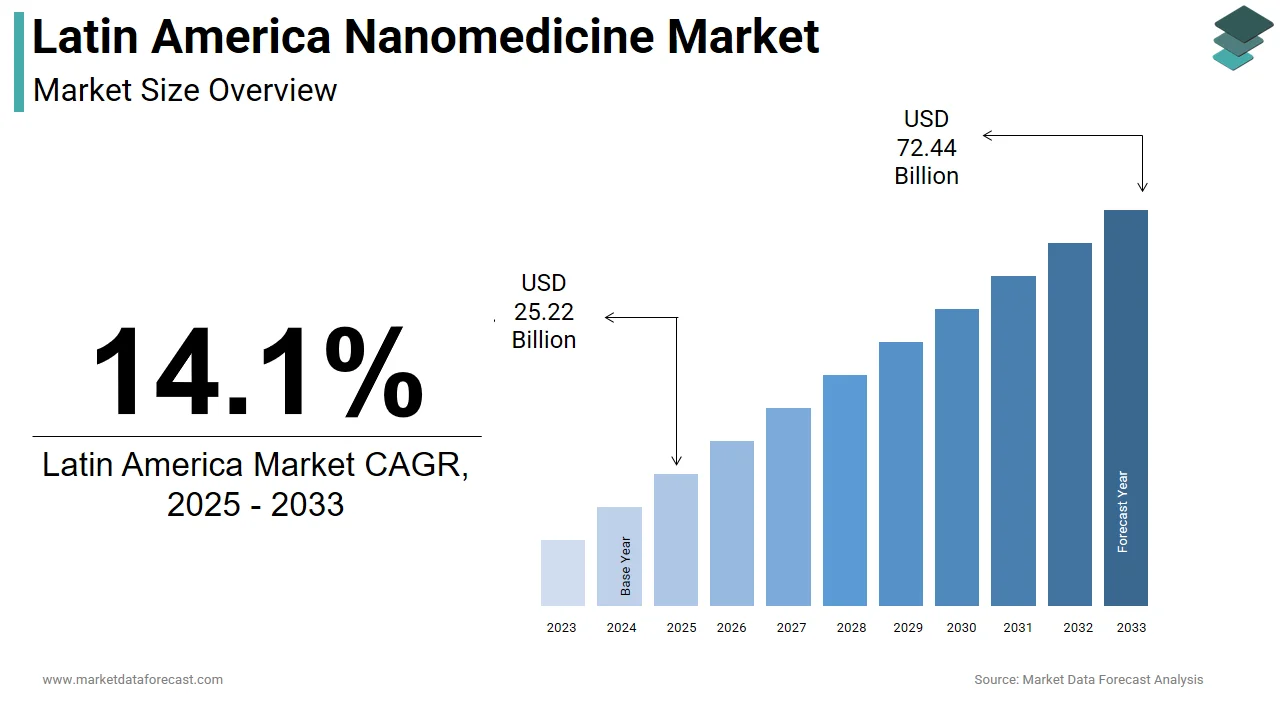
The size of the Latin America nanomedicine market was valued at USD 25.22 billion in 2025. This market is expected to grow at a CAGR of 14.1% from 2026 to 2034 and be worth USD 82.66 billion by 2034, up from USD 28.78 billion in 2026.
MARKET DRIVERS
Rising Chronic Illnesses, R&D Investments, and Tech Advancements Fuel Nanomedicine Demand
Nanomedicine is a Nanotechnology branch that utilizes nanoscale materials for various diagnostics, monitoring, and treatment of diseases. Factors such as increasing adaption to regenerative medicines, personalized medicines, health check-ups, increased population growth, and increased prevalence of chronic illnesses such as diabetes, cancers, digestive tract issues, liver disorders, cardiovascular disorders, and brain disorders boost the market growth. In addition, improved technology and advancements, well-developed regulatory authorities, and developed drug discovery procedures boost the market growth.
The macromolecules and micromolecules market growth also increases the Nanomedicine market value. These medicines are considered as cost-effective with fewer side effects. Hence, the various benefits and applications help this region's market growth. The presence of many investors, which are public and private bodies, critical players in this region for the Nanomedicine market fuels the market growth. In addition, government initiative for supporting, funding, and creating awareness in public about nanomedicines drives the market growth.
MARKET RESTRAINTS
Strict Regulations, Raw Material Shortage, and Skilled Labor Deficit Hamper Growth
Many additives, substitutes, preservatives, and other pharmaceutical ingredients hamper the market growth. All the materials required in bulk for this market are not readily available. The stringent regulatory bodies like the FDA (Food and Drug Administration) for drug approval make this market goal harder to achieve. The quality check for this machinery and equipment in pharmaceuticals used in drug development and formulation procedures must be checked per standards and protocols. For this, many skilled staff and pharmacy professionals are required. Lack of staff and skilled workers restricts this market growth.
REPORT COVERAGE
| REPORT METRIC | DETAILS |
| Market Size Available | 2025 to 2034 |
| Base Year | 2025 |
| Forecast Period | 2026 to 2034 |
| Segments Covered | By Product, Disease Type, Nanomolecule Type, and Country. |
| Various Analyses Covered | Global, Regional and Country-Level Analysis, Segment-Level Analysis, Drivers, Restraints, Opportunities, Challenges; PESTLE Analysis; Porter’s Five Forces Analysis, Competitive Landscape, Analyst Overview of Investment Opportunities |
| Countries Covered | UK, France, Spain, Germany, Italy, Russia, Sweden, Denmark, Switzerland, Netherlands, Turkey, Czech Republic & Rest of Europe. |
| Market Leaders Profiled | Johnson & Johnson, Merck & Co, Pfizer, Abbott Laboratories, GE Healthcare, Celgene Corporation, Nanosphere, Inc, Gilead Sciences, Hoffmann-La Roche, Nanospectra Biosciences, and Arrowhead Pharmaceuticals |
COUNTRY LEVEL ANALYSIS
The Latin America Nanomedicine market accounted for a moderate share of the worldwide market in 2025 and is predicted to grow at a steady CAGR during the forecast period. Mexico and Brazil are the most revenue holders for the Latin American nanomedicine market as healthcare expenditures and spending are more.
In Brazilian nanomedicine market held the major share of the Latin American market during the forecast period owing to factors such as increasing adaption to regenerative medicines, personalized medicines, health check-ups, increased population growth, increased prevalence of chronic illnesses such as diabetes, cancers, digestive tract issues, liver disorders, cardiovascular disorders, and brain disorders boosts up market growth.
KEY MARKET PLAYERS
Johnson & Johnson, Merck & Co, Pfizer, Abbott Laboratories, GE Healthcare, Celgene Corporation, Nanosphere, Inc, Gilead Sciences, Hoffmann-La Roche, Nanospectra Biosciences, and Arrowhead Pharmaceuticals are some of the promising players in the Latin American nanomedicine market.
MARKET SEGMENTATION
This Latin America nanomedicine market research report is segmented and sub-segmented into the following categories.
By Product
- Diagnostic Imaging
- Regenerative Medicine
- Drug Delivery
- Implants
- Vaccines
- Others
By Disease Type
- Cardiovascular Diseases
- Neurological Diseases
- Ophthalmological Diseases
- Infectious Diseases
- Immunological Diseases
- Orthopedic Disorders
- Oncological Diseases
- Others
By Nanomolecule Type
- Nanotubes
- Nanoparticles
- Nanodevices
- Nanoshells
- Others
By Country
- Brazil
- Mexico
- Argentina
- Chile
- Rest of Latin America