- Product Description Description
- Table of Contents TOC
- List of Table & Figure LOT
- Get Free Sample PDF Sample PDF
Market Size, 2025
$0.67 BnMarket Estimate, 2026
$0.70 BnMarket Forecast, 2034
$1.03 BnCAGR, 2026–2034
4.92%Executive Summary: Latin America Organophosphate Pesticides Market
- Market Scope: Comprehensive Latin America organophosphate pesticides market analysis covering ingredient classes, product types, application verticals, and country-level leadership frameworks.
- Market Valuation: Valued at USD 0.67 billion (2025), estimated at USD 0.70 billion (2026), and projected to reach USD 1.03 billion by 2034, registering a solid CAGR of 4.92% (2026–2034).
- Primary Growth Drivers: Commercial agriculture expansion, export-oriented farming, demand for pest management in soybeans, sugarcane, coffee, and corn, and preference for cost-effective broad-spectrum insecticides. Key challenges include strict regulations, health/environmental concerns, pest resistance, and supply chain disruptions.
Key Market Segment Metrics (2026–2034)
| Category | Leading Segment (2025 Position) | Fastest-Growing Segment |
|---|---|---|
| By Ingredients | Chlorpyrifos, Malathion, and Glyphosate (command dominant volume shares in broad-spectrum agricultural protection) | Reduced-risk and lower-toxicity microencapsulated formulations |
| By Type | Insecticide (led regional demand due to high efficacy against chewing and sucking pests) | Herbicide and specialized integrated crop protection blends |
| By Application | Crop-Based / Oil Seeds & Grains (primary application driver across commercial farming of soybeans and corn) | Fruits & Vegetables and export cash crops (coffee and sugarcane) |
| By Country | Brazil (accounted for 45.3% of the regional market in 2025, supported by extensive commercial agriculture) | Argentina, Mexico, and Chile (expanding modern agricultural and export-oriented sectors) |
Major Market Players & Market Structure
Market Structure: Highly competitive Latin American agrochemical landscape featuring multinational companies and regional suppliers competing intensely on safer formulations, product innovation, distribution network expansion, and digital precision agriculture integration.
Key Companies: Monsanto, Dow AgroSciences LLC, Bayer CropScience, Syngenta AG, BASF, DuPont, American Vanguard Corp, FMC Corporation, ADAMA Agricultural Solutions Ltd., and Nufarm.
Latin America Organophosphate Pesticides Market Size
The Latin America Organophosphate pesticides market size was valued at USD 0.67 billion in 2025 and is anticipated to reach a valuation of USD 0.70 billion in 2026 and USD 1.03 billion by 2034, growing at a CAGR of 4.92% from 2026 to 2034.
Organophosphate pesticides are a class of synthetic chemicals widely used in agriculture for controlling pests such as insects, mites, and nematodes. These compounds act by inhibiting acetylcholinesterase, an enzyme essential for nerve function in pests, making them effective insecticides. Despite global concerns regarding their toxicity, organophosphates remain integral to pest management strategies in many agricultural systems due to their broad-spectrum efficacy and relatively low cost.
In Latin America, the reliance on organophosphate pesticides is particularly pronounced in major agro-exporting countries such as Brazil, Argentina, and Colombia, where large-scale monoculture farming of crops like soybean, sugarcane, and coffee necessitates robust pest control measures. According to the Food and Agriculture Organization (FAO), Latin America contributes over 20% of the world’s soybean production, with Brazil being the largest producer globally. The region's expanding agricultural output has been accompanied by increased pesticide use, including organophosphates. As per data from the Brazilian Ministry of Agriculture, pesticide consumption in Brazil rose by more than 6% annually between 2015 and 2023, driven by intensification in crop production and growing export demand.
MARKET DRIVERS
Expansion of Commercial Agriculture and Export-Oriented Farming
The rapid expansion of commercial agriculture and the increasing focus on export-oriented farming a key drivers of the Latin America organophosphate pesticides market. Countries like Brazil, Argentina, and Paraguay have seen significant growth in large-scale monoculture plantations, particularly for commodities such as soybeans, corn, cotton, and coffee. These crops are highly susceptible to pest infestations, necessitating the extensive use of insecticides to ensure high yields and meet international quality standards.
According to the Food and Agriculture Organization (FAO), Brazil alone accounts for a significant portion of global soybean exports, with production exceeding 150 million metric tons in 2023 This massive scale of cultivation requires intensive pest management, making organophosphate insecticides a preferred choice due to their effectiveness against a wide range of pests, including aphids, beetles, and caterpillars. The need to maintain high-quality produce free from pest damage drives continued demand for these chemicals despite regulatory scrutiny and calls for safer alternatives.
Limited Availability and High Cost of Alternatives
The limited availability and high cost of alternative pest control solutions, particularly in rural and smallholder farming communities, are other significant factors driving the organophosphate pesticides market in Latin America. While integrated pest management (IPM) practices and biopesticides offer safer and more sustainable options, their adoption remains constrained due to financial, technical, and logistical barriers. According to the International Centre of Insect Physiology and Ecology (ICIPE), biopesticide penetration in Latin America remains below 1%, largely due to higher upfront costs and perceived lower efficacy compared to conventional chemical insecticides. Also, the lack of extension services and technical support for advanced pest management techniques limits the transition away from traditional chemical controls. As per a 2023 report by the Pan American Health Organization (PAHO), only 15% of farmers in Bolivia and Ecuador received formal training on alternative pest control methods, reinforcing dependence on established organophosphate products.
MARKET RESTRAINTS
Regulatory Restrictions and Growing Health Concerns
The increasing regulatory scrutiny and public concern regarding their adverse effects on human health and the environment are one of the primary restraints affecting the Latin American organophosphate pesticides market. Organophosphates are known neurotoxins, and prolonged exposure, particularly among farm workers, has been linked to severe neurological and developmental disorders. Also, several countries have implemented stricter regulations governing the sale and application of these chemicals. For instance, in 2023, the Chilean Agricultural and Livestock Service (SAG) banned the use of chlorpyrifos, a widely used organophosphate insecticide, citing risks to children's cognitive development.
Similarly, Mexico’s Federal Commission for the Protection Against Sanitary Risk (COFEPRIS) has initiated restrictions on certain organophosphate formulations, urging a shift toward safer alternatives. In Brazil, although outright bans remain rare, the Ministry of Health has intensified monitoring of pesticide-related illnesses, leading to increased pressure on manufacturers and regulators to reassess product registrations. These developments are posing a significant challenge to the continued dominance of organophosphate insecticides in Latin America.
Environmental Impact and Ecosystem Contamination
The growing awareness of their environmental consequences, particularly concerning water contamination, soil degradation, and harm to non-target species, is another critical restraint impacting the Latin American organophosphate pesticides market. Organophosphates are highly soluble in water, making them prone to runoff into rivers, lakes, and groundwater reservoirs, where they can accumulate and disrupt aquatic ecosystems.
According to the United Nations Environment Programme (UNEP), organophosphate residues have been detected in over 40% of surface water samples tested in agricultural regions of Argentina and Brazil, raising concerns about long-term ecological damage. In addition, as per the Amazon Environmental Research Institute (IPAM), contamination from agricultural chemicals, including organophosphates, has affected biodiversity in the riparian zone, threatening fish populations and other aquatic life crucial to local communities. As environmental advocacy groups and scientific institutions continue to highlight these risks, governments and industry stakeholders face increasing pressure to adopt sustainable pest management practices.
MARKET OPPORTUNITY
Development of Safer Formulations and Reduced-Risk Products
The development and commercialization of safer, reduced-risk formulations that retain the efficacy of traditional organophosphates while minimizing environmental and health hazards is a significant opportunity emerging in the Latin American organophosphate pesticides market. Several agrochemical companies are investing in reformulating existing active ingredients to enhance biodegradability and reduce toxicity without compromising pest control performance. According to the International Union of Pure and Applied Chemistry (IUPAC), advancements in molecular modification have enabled the creation of low-residue organophosphate analogs that break down more rapidly in soil and water, reducing their persistence in ecosystems. Furthermore, multinational agrochemical firms such as Syngenta and BASF have introduced low-dose organophosphate mixtures combined with synergists that enhance effectiveness while reducing overall chemical load. These innovations align with evolving regulatory expectations and consumer preferences for safer agricultural inputs.
Integration with Digital Farming Technologies
The integration of organophosphate pesticide applications with digital farming technologies represents a growing opportunity for market players in Latin America. As precision agriculture gains traction, there is increasing potential to optimize pesticide use through real-time monitoring, predictive analytics, and automated application systems that enhance efficiency while reducing waste and environmental impact. According to the International Food Policy Research Institute (IFPRI), adoption of digital tools in Latin American agriculture has grown by more than 15% annually since 2020, driven by investments in satellite imaging, drone-based spraying, and smart irrigation systems. In Brazil, Embrapa, the country’s agricultural research corporation, has launched initiatives promoting precision pesticide application using GPS-guided drones, which allow for targeted delivery of organophosphate insecticides only where needed. These digital interventions not only improve application accuracy but also help in complying with increasingly stringent pesticide regulations.
MARKET CHALLENGES
Herbicide and Insecticide Resistance Development
The emergence of resistance among target pest populations, diminishing the effectiveness of these insecticides and forcing growers to increase application rates or switch to alternative chemistry, is one of the foremost challenges confronting the Latin American organophosphate pesticides market. Over decades of continuous use, many insect species have developed biochemical mechanisms to detoxify or tolerate organophosphate compounds, rendering them less effective. According to the Global Insecticide Resistance Action Committee (IRAC), more than 500 arthropod species worldwide have developed resistance to one or more insecticide classes, with organophosphates being among the most affected. In Argentina, as per the National Institute of Agricultural Technology (INTA), whitefly and aphid populations in cotton-growing regions have shown increasing tolerance to malathion and dimethoate, two commonly used organophosphates. This resistance development forces farmers to apply higher doses or combine treatments with other insecticides, increasing both input costs and environmental burden.
Supply Chain Disruptions and Raw Material Constraints
The volatility in raw material supply and logistical disruptions that impact production timelines and pricing stability are another significant challenge affecting the Latin American organophosphate pesticides market. The synthesis of organophosphate insecticides relies on specific chemical intermediates such as phosphorus pentasulfide, chlorinated hydrocarbons, and alcohols, many of which are sourced from a limited number of global suppliers. Apart from these, freight delays caused by port congestion and geopolitical tensions have contributed to extended lead times and inventory shortages. These supply chain pressures have forced formulators and distributors to seek alternative sourcing strategies, sometimes at higher costs.
REPORT COVERAGE
| REPORT METRIC | DETAILS |
| Market Size Available | 2025 to 2034 |
| Base Year | 2025 |
| Forecast Period | 2026 to 2034 |
| CAGR | 4.92% |
| Segments Covered | By Ingredients, Type, Application, and Region. |
| Various Analyses Covered | Global, Regional and Country Level Analysis, Segment-Level Analysis, DROC, PESTLE Analysis, Porter’s Five Forces Analysis, Competitive Landscape, Analyst Overview of Investment Opportunities |
| Regions Covered | Brazil, Chile, Argentina, Mexico, and Colombia, etc |
| Market Leaders Profiled | Monsanto, DOW Agriscience LLC, BayerCropScience, Syngenta AG, BASF, DuPont, American Vanguard Corp, FMC Corporation, Adama Agricultural Solutions Ltd, and Nufarm. |
SEGMENTAL ANALYSIS
By Ingredients Insights
Chlorpyrifos
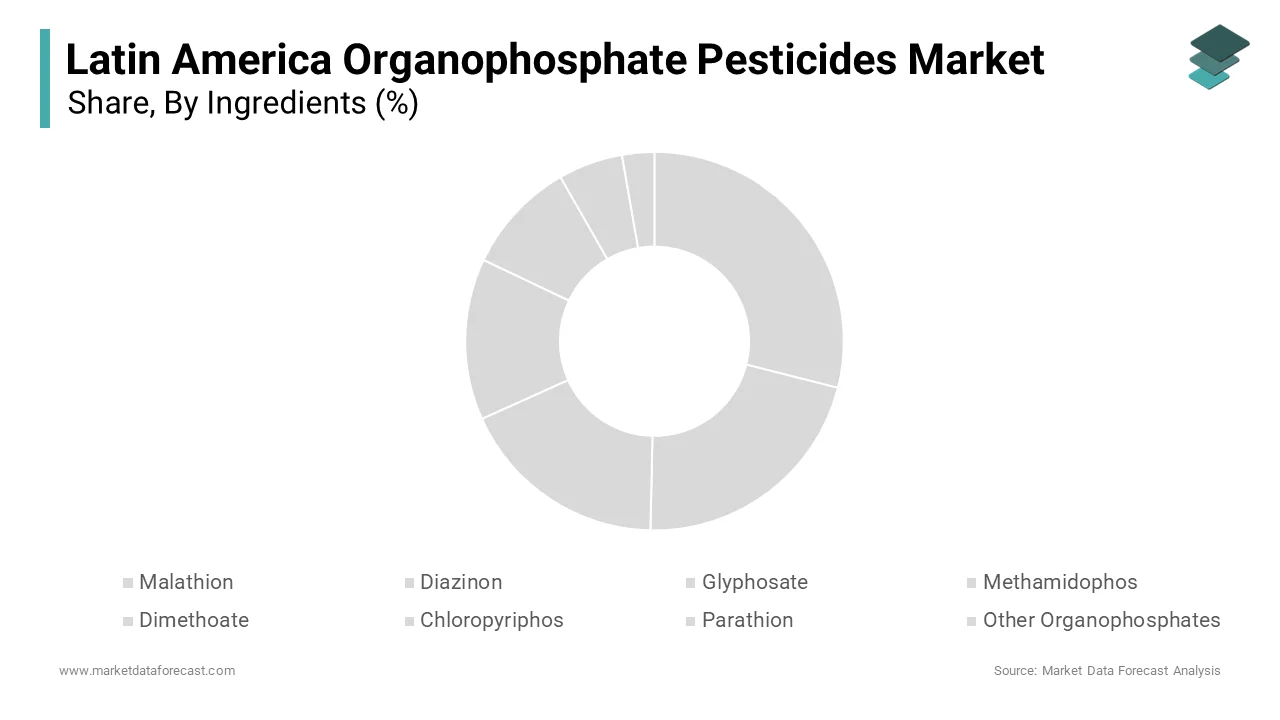
The chlorpyrifos segment held the largest share of the Latin America organophosphate pesticides market by accounting for 28.3% of total consumption in 2025. The growth of the chlorpyrifos segment is primarily due to its widespread application in major agricultural commodities such as soybean, corn, sugarcane, and cotton, where it effectively controls a broad spectrum of insect pests, including aphids, mites, and beetles. In Argentina, the National Institute of Agricultural Technology (INTA) confirmed that chlorpyrifos applications increased by 5% in 2025, especially in maize and wheat fields affected by growing resistance to pyrethroid-based insecticides. Despite regulatory restrictions in some regions, chlorpyrifos continues to be widely utilized due to its cost-effectiveness and residual activity. Furthermore, as per the Pan American Health Organization (PAHO), smallholder farmers across Central America still rely heavily on chlorpyrifos, despite health concerns, due to limited access to safer alternatives.
Malathion
The malathion segment is projected to grow at the highest CAGR of 6.9% during the forecast period. The increasing demand in both the agricultural and public health sectors is driving the growth of the malathion segment. Unlike other organophosphates facing stricter regulations, malathion is considered relatively less toxic and is often used in mosquito control programs and fruit and vegetable crop protection. With dual utility in agriculture and disease prevention, malathion is emerging as one of the fastest-growing segments in the Latin American organophosphate pesticides market.
By Type Insights
Insecticides
The insecticides segment represented the prominent category in the Latin America organophosphate pesticides market by contributing 65.5% of total product sales in 2025. This dominance of insecticides segment the persistent need for effective pest control in high-value crops such as soybean, cotton, coffee, and vegetables, where insect infestations can lead to significant yield losses. According to the Food and Agriculture Organization (FAO), Latin America produces over 20% of global soybeans, with Brazil and Argentina accounting for the majority. As per the Brazilian Ministry of Agriculture, insecticide use in soybean cultivation increased by 7% in 2023, largely due to outbreaks of fall armyworm and stink bugs, which are traditionally managed using organophosphate compounds. In Argentina, according to the National Institute of Agricultural Technology (INTA), over 80% of maize producers rely on organophosphate insecticides for early-season pest control, reinforcing the sector’s dependence on these chemicals.
Herbicides
The herbicides segment is expected to expand at the fastest CAGR of 7.3% in the coming years. The growth of the herbicides segment is driven by increasing adoption in large-scale row crops such as soybean, corn, and sugarcane, where weed competition significantly impacts productivity. Although herbicidal organophosphates are fewer in number compared to insecticides, select compounds like glyphosate and certain phosphonate derivatives are gaining traction. In Mexico, as per the National Institute of Forestry, Agricultural and Livestock Research (INIFAP), there is a 12% increase in herbicide applications in sugarcane plantations, where organophosphate derivatives are used in combination with glyphosate to manage resistant grasses and broadleaf weeds.
By Application Insights
Crop-Based Applications
The crop-based applications segment dominated the Latin America organophosphate pesticides market by capturing a substantial share of total volume in 2025. The superiority of the crop-based applications segment is attributed to the region’s heavy reliance on intensive agriculture, particularly in export-oriented commodity crops such as soybean, corn, cotton, sugarcane, and coffee.
According to the Food and Agriculture Organization (FAO), Latin America contributes over 20% of global soybean production, with Brazil being the world’s largest exporter. Also, as per the Brazilian Ministry of Agriculture, soybean acreage expanded by 5% in 2023, necessitating increased pesticide use to protect yields from pests like aphids, caterpillars, and whiteflies.
Non-Crop Based Applications
The non-crop-based applications segment is anticipated to grow at the highest CAGR of 8.1% during the forecast period. The growth of the non-crop-based applications segment is fueled by increasing use in public health initiatives, urban pest control, and industrial settings. Unlike traditional agricultural uses, which face tightening regulations, non-crop applications are often deemed essential for disease prevention and infrastructure maintenance. According to the World Health Organization (WHO), several Latin American countries have intensified vector control measures to combat mosquito-borne diseases like dengue, chikungunya, and Zika.
COUNTRY-LEVEL ANALYSIS
Brazil
Brazil held the top position in the Latin American organophosphate pesticides market by accounting for 45.3% of regional consumption in 2025. As the world's largest producer of soybeans and a major exporter of corn, cotton, and sugarcane, Brazil relies heavily on chemical pest control to sustain high yields and meet international quality standards. Despite growing environmental concerns and calls for sustainable alternatives, the lack of affordable biopesticides and technical support limits the transition away from conventional chemical controls.
Argentina
Argentina is a major contributor to the Latin American organophosphate pesticides market. The growth of this country is driven by its extensive use in large-scale grain and oilseed production. It’s well-established no-till farming system, particularly in the Pampas region, has reinforced the demand for effective pest control solutions. Moreover, the Ministry of Environment and Sustainable Development has been reviewing pesticide regulations, but enforcement remains inconsistent, allowing continued use of several organophosphate compounds. As per the Inter-American Institute for Cooperation on Agriculture (IICA), extension services promoting responsible pesticide use have expanded, though adoption among smallholders remains uneven.
Mexico
Mexico accounts for a notable share of the Latin American organophosphate pesticides market, with increasing demand driven by both staple crops and high-value horticultural production. The country’s diverse agricultural landscape, ranging from maize and sorghum fields to avocado and chili orchards, necessitates a wide range of pest control solutions. According to the National Institute of Forestry, Agricultural and Livestock Research (INIFAP), organophosphate insecticides are commonly used in vegetable and fruit production, particularly in Michoacán and Sinaloa, where pests like leafminers and fruit flies pose significant threats.
Chile
Chile is distinguished by its focus on high-value export crops such as grapes, berries, avocados, and nuts. While pesticide regulations in Chile are relatively stringent compared to other regional markets, organophosphate insecticides remain in use due to their effectiveness against specific pests affecting these crops. Also, pesticide residues are closely monitored to meet European Union and U.S. import standards, prompting formulators to develop lower-risk organophosphate formulations. Moreover, the Ministry of Health has implemented restrictions on certain high-risk organophosphate compounds, pushing manufacturers toward safer alternatives.
Colombia
Colombia is reflecting steady growth in herbicide and insecticide applications across a range of crops, including coffee, bananas, cacao, and palm oil. As the country continues to expand its agro-export sector, effective pest control remains a priority for maintaining yield and quality standards. According to the International Center for Tropical Agriculture (CIAT) noted that smallholder coffee growers are increasingly adopting chemical pest control methods due to labor shortages and rising export targets. Furthermore, the Ministry of Agriculture and Rural Development launched initiatives aimed at improving responsible pesticide use and extension services, encouraging farmers to adopt integrated pest management practices. Thee Inter-American Institute for Cooperation on Agriculture (IICA) confirmed that training programs have reached over 50,000 farmers in 2023, promoting safer handling and application techniques.
KEY MARKET PLAYERS
Monsanto, DOW AgroSciences LLC, Bayer CropScience,s, Syngenta AG, BASFDuPontnt, American Vanguard Corp, FMC Corporation, Adama Agricultural Solutions Ltd, and Nufarm. Are the market players that are dominating the Latin American organophosphate pesticides market?
Top Players In The Market
Syngenta AG
Syngenta is a global leader in crop protection and plays a significant role in the Latin American organophosphate pesticides market. The company offers a broad portfolio of insecticides and herbicides tailored for key crops such as soybean, corn, cotton, and coffee. With a strong presence in Brazil and Argentina, Syngenta contributes to sustainable pest management by promoting responsible use and integrated approaches. Its research-driven formulations and extensive farmer outreach programs support improved agricultural productivity while addressing environmental concerns.
BASF SE
BASF is a major player in the Latin American agrochemicals sector, offering advanced organophosphate-based pesticide solutions suited for diverse cropping systems. The company emphasizes innovation through formulation development and partnerships with regional agricultural institutions. In countries like Argentina and Mexico, BASF supports farmers with technical guidance and training initiatives aimed at optimizing pesticide application. Its commitment to product stewardship and regulatory compliance strengthens its position in a market increasingly influenced by health and environmental considerations.
UPL Limited
UPL Limited has a substantial footprint in Latin America, particularly in Brazil and Colombia, where it supplies cost-effective and reliable organophosphate pesticide formulations. Known for its broad product range and farmer-centric approach, UPL supports smallholder and commercial growers alike through extension services and localized distribution networks. The company also promotes integrated pest management practices to balance efficacy with sustainability. Its strategic acquisitions and partnerships further enhance its ability to meet evolving market demands across the region.
Top Strategies Used By Key Market Participants
One of the primary strategies employed by leading players in the Latin American organophosphate pesticides market is formulation innovation and product differentiation. Companies are investing in developing safer, more biodegradable variants that maintain efficacy while reducing toxicity and environmental impact. These efforts aim to align with evolving regulatory standards and consumer expectations.
Another key strategy involves expanding agronomic advisory services and farmer education programs. Major agrochemical firms are engaging directly with growers through training sessions, field demonstrations, and digital tools to promote responsible pesticide use, improve application techniques, and mitigate resistance development.
Lastly, companies are focusing on strengthening regional partnerships and local collaborations with government agencies, research institutions, and distributors. These alliances help tailor products to regional needs, streamline regulatory approvals, and enhance market access, particularly in emerging agricultural markets within Latin America.
COMPETITION OVERVIEW
The competitive landscape of the Latin American organophosphate pesticides market is shaped by a combination of global agrochemical giants and domestic manufacturers striving to maintain relevance amid increasing regulatory scrutiny and shifting agricultural practices. Multinational corporations dominate due to their extensive R&D capabilities, brand recognition, and established distribution networks, but regional players continue to compete effectively by offering cost-competitive formulations and localized service models. The market is characterized by intense competition not only in pricing but also in innovation, technical support, and sustainability messaging. As governments and consumers demand safer and more environmentally friendly agricultural inputs, companies must differentiate themselves through responsible product stewardship and integrated pest management solutions. The growing emphasis on precision agriculture and digital farming technologies is also influencing competitive positioning, with leading firms integrating data-driven tools to optimize pesticide applications. Despite mounting challenges related to health concerns, environmental impact, and regulatory restrictions, the organophosphate pesticides market remains resilient, with industry participants adapting through reformulations, partnerships, and enhanced farmer engagement to sustain growth in the region.
RECENT HAPPENINGS IN THE MARKET
- In February 2023, Syngenta launched a new line of reduced-risk organophosphate insecticides in Brazil designed for improved biodegradability and lower toxicity profiles. This initiative was aimed at aligning with evolving regulatory expectations while maintaining pest control efficacy for large-scale soybean and corn producers.
- In June 2023, BASF partnered with the National Institute of Agricultural Technology (INTA) in Argentina to conduct field trials assessing the performance of next-generation organophosphate formulations in maize and wheat rotations. The collaboration focused on optimizing application rates and reducing environmental impact.
- In November 2023, Netafim introduced an integrated pest management solution in Mexico that combined drip irrigation with targeted organophosphate delivery to enhance efficiency and reduce chemical runoff. This innovation supported precision agriculture practices in chili and tomato production zones.
- In March 2024, UPL Limited expanded its distribution network in Colombia to improve access to organophosphate-based products for coffee and banana growers. The company also initiated training programs to educate farmers on safe handling and application techniques in partnership with local cooperatives.
- In August 2024, Corteva Agriscience collaborated with Embrapa to develop microencapsulated organophosphate formulations tailored for Brazilian tropical conditions. This advancement aimed to enhance pest control duration while minimizing drift and off-target effects in sugarcane and cotton plantations.
MARKET SEGMENTATION
The Latin America Organophosphate Pesticides Market is segmented and sub-segmented into the following categories.
By Ingredients
- Malathion
- Diazinon
- Glyphosate
- Methamidophos
- Dimethoate
- Chloropyriphos
- Parathion
- Other Organophosphates
By Type
- Herbicide
- Fungicide
- Insecticide
- Others
By Application
- Crop Based
- Oilseeds
- Fruits & Vegetables
- Grains & Cereals
- Non-Crop Based
- Turf & Ornamental Grass
- others
By Country
- Mexico
- Brazil
- Argentina
- Chile
- Rest of Latin America