- Product Description Description
- Table of Contents TOC
- List of Table & Figure LOT
- Get Free Sample PDF Sample PDF
Market Size, 2025
$360.23 MnMarket Estimate, 2026
$375.94 MnMarket Forecast, 2034
$528.92 MnCAGR, 2026–2034
4.36%.Latin America Pallet Market Size, Growth, Trends & Forecast (2026–2034)
The Latin America pallet market size was valued at USD 360.23 million in 2025, is estimated at USD 375.94 million in 2026, and is expected to reach USD 528.92 million by 2034, expanding at a compound annual growth rate (CAGR) of 4.36% during the forecast period from 2026 to 2034. Market growth is driven by the rapid expansion of e-commerce, last-mile delivery networks, cold chain infrastructure development, and a rising corporate focus on sustainable and reusable logistics solutions.
Key Executive Metrics (At-a-Glance)
- 2025 Base Valuation: USD 360.23 Million
- 2026 Current Valuation: USD 375.94 Million
- 2034 Forecast Valuation: USD 528.92 Million
- Compound Annual Growth Rate (CAGR): 4.36% (2026–2034)
- Key Geographic Footprint: Brazil, Argentina, Mexico, and Rest of Latin America
Latin America Pallet Market Segmentation Breakdown
| Segment Category | Largest Segment | Fastest-Growing Segment |
|---|---|---|
| By Type | Wood (62.6% share in 2025) | Plastic (9.8% CAGR) |
| By Application | Food and Beverages (38.6% share in 2025) | Chemicals and Pharmaceuticals (10.2% CAGR) |
| By Structural Design | Block (54% share in 2025) | Stringer (8.6% CAGR) |
| By Region | Brazil (35.5% share in 2025) | Brazil (Dominant regional consumption) |
Major Industry Players Profiled
Key market participants shaping the Latin America pallet landscape include Brambles Limited (CHEP), Conitex Sonoco, Smurfit Kappa, Milwood, Spanco Enterprises, DS Smith, KRAFTPAL Technologies, PGS Group, Kamps Pallets, Rehrig Pacific Company, Schoeller Allibert, LOSCAM, CABKA Group, and PECO Pallet.
Latin America Pallet Market Size
The Latin America pallet market size was valued at USD 360.23 million in 2025, and the market size is expected to reach USD 528.92 million by 2034 from USD 375.94 million in 2026. The market's promising CAGR for the predicted period is 4.36%.
The Latin America pallet market covers the production, distribution, and utilization of pallets—flat transport structures that support goods in a stable manner during material handling. These platforms are essential for facilitating efficient storage, transportation, and movement of products across industries such as food & beverage, pharmaceuticals, logistics, automotive, and retail. While wooden pallets remain dominant due to their cost-effectiveness and availability, there is growing adoption of plastic and metal alternatives, particularly in sectors requiring hygiene compliance and durability. 
MARKET DRIVERS
Growth in E-commerce and Last-Mile Delivery Networks
The rapid expansion of e-commerce in Latin America has become a key driver for the pallet market. This growth necessitates streamlined supply chains where pallets play a critical role in inventory management, order fulfillment, and logistics optimization. The rise in cross-border transactions and domestic online marketplaces has prompted major logistics players like Loggi and Correios to expand their warehouse capacities. Moreover, Mexico's e-commerce sector has been experiencing significant growth, and online retail sales reached a substantial amount in 2023. This surge in digital commerce has amplified the demand for durable, standardized pallets that can integrate seamlessly into sorting hubs and last-mile delivery networks. As companies invest in optimizing logistics operations, the reliance on pallets—especially plastic and composite variants known for their longevity and compatibility with automation—is increasing.
Expansion of Cold Chain Infrastructure in Agriculture and Food Exports
Latin America is one of the world’s leading exporters of agricultural commodities, with countries like Argentina, Brazil, and Chile playing pivotal roles in global food supply chains. The need for temperature-controlled logistics to preserve perishable goods has led to significant investments in cold chain infrastructure, directly boosting the demand for specialized pallets that comply with hygiene and safety standards. A large portion of these exports requires refrigerated transport, where plastic and composite pallets are preferred over wood due to their resistance to moisture and ease of sanitation. Chile, another major exporter of fruits and seafood, has seen cold storage capacity increase. These developments require compatible pallet systems that support seamless integration with automated cold storage systems and maintain product integrity. The rising preference for hygienic, non-porous pallet materials in these environments is driving innovation and investment in the Latin America pallet market, making cold chain expansion a critical growth enabler.
MARKET RESTRAINTS
High Cost of Alternative Material Pallets
Despite growing awareness and adoption of alternative material pallets—such as plastic, metal, and composite—their high initial costs compared to traditional wooden pallets remain a significant restraint in the Latin America pallet market. Many small and medium-sized enterprises (SMEs) in the region operate under tight budget constraints, favoring cost-effective solutions even if they offer lower durability or longer-term value. According to the International Trade Centre, SMEs account for a large share of businesses in Latin America, contributing significantly to manufacturing and logistics activities. Additionally, the lack of established recycling infrastructure for plastic pallets in many parts of the region limits their lifecycle cost benefits. Although these alternatives offer advantages such as reusability, resistance to pests, and compliance with international phytosanitary regulations, the initial capital outlay discourages widespread adoption. This financial barrier is particularly pronounced in countries like Peru and Bolivia, where formal logistics budgets are limited and informal distribution channels dominate.
Regulatory Fragmentation Across Countries
The Latin America pallet market faces challenges due to inconsistent regulatory frameworks governing materials, dimensions, and phytosanitary requirements across different countries. Unlike the ISO-standardized pallet sizes used globally, Latin American nations often follow disparate specifications, complicating intermodal transport and cross-border logistics. Also, this inconsistency increases handling inefficiencies at border crossings and transshipment points. Furthermore, varying ISPM-15 (International Standards for Phytosanitary Measures No. 15) compliance requirements complicate the use of wooden pallets in international trade. Some countries mandate heat treatment certification, while others accept chemical treatments, leading to confusion among exporters. These discrepancies raise compliance costs and discourage the adoption of standardized pallet systems across the region. Additionally, the absence of a unified customs protocol within Mercosur hampers the seamless movement of palletized cargo, reducing overall supply chain efficiency.
MARKET OPPORTUNITIES
Rising Demand for Sustainable and Reusable Pallet Solutions
A growing emphasis on sustainability and environmental responsibility is opening new avenues for the Latin America pallet market, particularly in the reusable and eco-friendly pallet segment. Governments, industry bodies, and multinational corporations operating in the region are increasingly prioritizing circular economy principles, prompting a shift away from single-use wooden pallets toward recyclable and durable alternatives.
In Brazil, the National Solid Waste Policy mandates that companies involved in packaging must ensure post-consumer waste recovery, pushing manufacturers to adopt reusable plastic pallets. ABIPLAST reports that the country recycled over 3 million tons of plastics in 2023, with a growing share attributed to industrial packaging applications. Additionally, Chile introduced extended producer responsibility (EPR) laws in 2022, compelling logistics providers to adopt sustainable transport solutions. Moreover, multinational retailers such as Walmart and Carrefour, which operate extensively in Latin America, have committed to achieving zero waste goals, influencing their suppliers to adopt reusable pallet systems. Also, companies using plastic pallets experienced a key reduction in logistics waste and a notable improvement in asset tracking efficiency.
Integration of Smart Pallet Technologies in Supply Chains
The adoption of smart technologies in logistics is emerging as a transformative opportunity for the Latin America pallet market. Innovations such as RFID-enabled pallets, IoT-integrated tracking systems, and sensor-equipped load carriers are gaining traction, especially in high-value sectors like pharmaceuticals, perishables, and electronics. Several companies are integrating smart pallets equipped with real-time monitoring sensors to comply with stringent regulatory requirements. Companies like Grupo Antolin and Magna International have incorporated RFID-tagged pallets to streamline component tracking and reduce handling errors. As connectivity improves and logistics operators seek greater operational efficiency, the integration of smart pallet technologies is set to redefine the Latin America pallet market landscape.
MARKET CHALLENGES
Limited Adoption of Standardized Pallet Systems in Informal Distribution Channels
One of the most pressing challenges facing the Latin America pallet market is the low level of standardization in informal distribution networks, which constitute a substantial portion of the region’s logistics ecosystem. Unlike formal supply chains that utilize standardized pallet sizes and handling equipment, informal markets—particularly in rural and peri-urban areas—rely on makeshift wooden crates, repurposed containers, and manually handled loads, bypassing conventional pallet systems. In countries like Bolivia, Guatemala, and Honduras, informal traders manage a significant share of local goods movement, often without access to mechanized handling equipment. As a result, pallets are either discarded upon arrival or modified to fit irregular transport methods, reducing their utility and economic viability. Furthermore, a 2023 study by the Latin American Transport Research Group found that only 38% of micro-distribution centers in Central America use standardized pallets, citing cost and compatibility issues as primary barriers. This fragmentation impedes economies of scale and discourages investment in pallet-based logistics solutions.
Vulnerability to Raw Material Price Fluctuations
The Latin America pallet market is highly susceptible to volatility in raw material prices, particularly for timber, plastics, and metals, all of which are subject to global commodity cycles and regional supply disruptions. Wood, being the most used material, is affected by deforestation regulations, seasonal harvesting cycles, and export tariffs, creating price instability. Simultaneously, resin prices—a key input for plastic pallets—rose following supply chain bottlenecks caused by reduced imports from Asia. In addition, metal-based pallet manufacturers in Mexico encountered cost pressures due to fluctuating steel prices, which increased. These fluctuations make it difficult for producers to maintain consistent pricing models and profit margins, discouraging investment in capacity expansion and product innovation. Given that many pallet consumers in Latin America operate on thin margins, especially in the agricultural and textile sectors, sudden cost surges lead to procurement delays or shifts toward cheaper, substandard alternatives.
REPORT COVERAGE
| REPORT METRIC | DETAILS |
| Market Size Available | 2025 to 2034 |
| Base Year | 2025 |
| Forecast Period | 2026 to 2034 |
| CAGR | 4.36% |
| Segments Covered | By Type, Application, Structural Design, and Region |
|
Various Analyses Covered | Regional & Country Level Analysis, Segment-Level Analysis, DROC, PESTLE Analysis, Porter’s Five Forces Analysis, Competitive Landscape, Analyst Overview on Investment Opportunities |
| Regions Covered | Latin America include Brazil, Argentina, Mexico, and the Rest of Latin America |
| Market Leaders Profiled | Brambles Limited (operating through the CHEP brand), Conitex Sonoco, Smurfit Kappa, Milwood, Spanco Enterprises, DS Smith, KRAFTPAL Technologies, PGS Group, Kamps Pallets, Rehrig Pacific Company, Schoeller Allibert, LOSCAM, CABKA Group, PECO Pallet, and others |
SEGMENTAL ANALYSIS
By Type Insights
The wooden pallets segment dominated the Latin America pallet market by accounting for a 62.6% of total consumption in 2025. This segment’s dominance is primarily attributed to its widespread availability, cost-effectiveness, and compatibility with traditional logistics systems. In Brazil alone, where wood-based pallets constitute over 70% of industrial usage, the forestry industry supplies more than 45 million cubic meters of timber annually for packaging applications, as reported by IBÁ (Brazilian Tree Industry). Besides, the prevalence of informal trade networks and small-scale producers in countries like Peru, Bolivia, and Ecuador further reinforces reliance on wooden pallets. These markets often lack access to standardized handling equipment required for plastic or metal alternatives. Moreover, regulatory leniency regarding phytosanitary compliance in certain regions allows untreated wooden pallets to remain in circulation despite global standards such as ISPM-15.
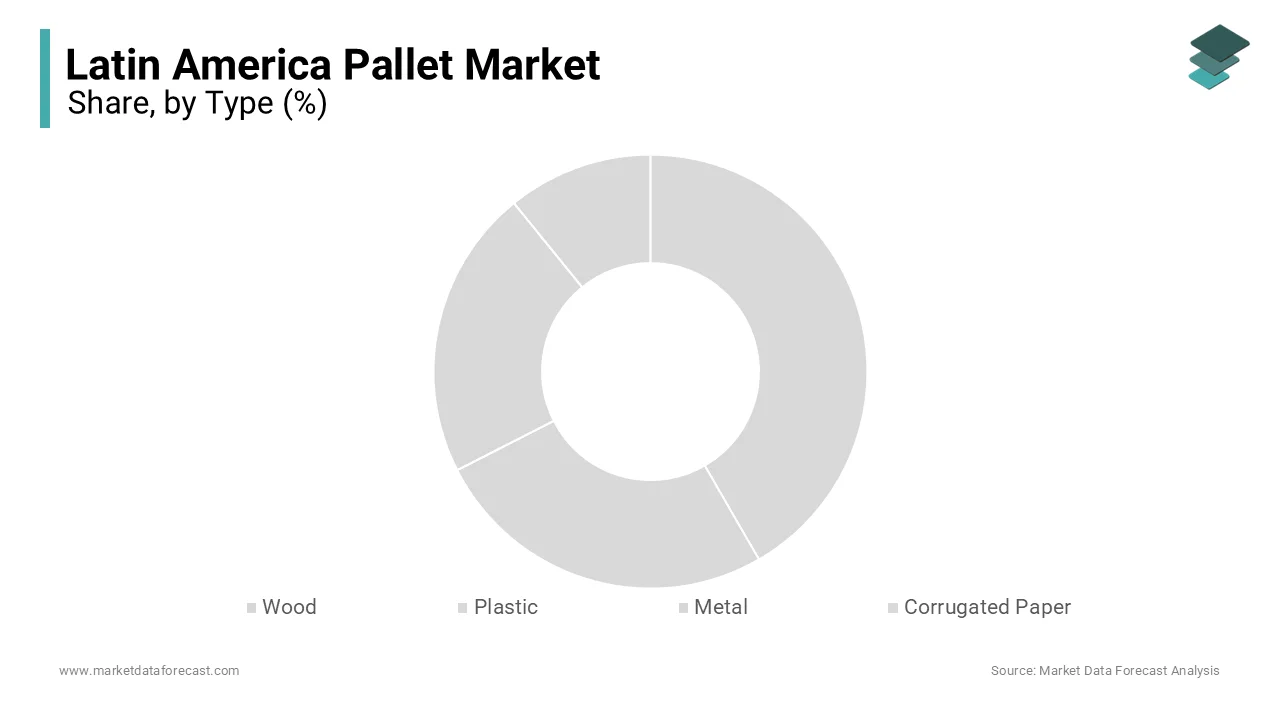
The plastic pallets segment are emerging as the fastest-growing segment in the Latin America pallet market, projected to expand at a CAGR of 9.8%. This progress is driven by increasing demand from industries that prioritize hygiene, durability, and compatibility with automated material handling systems. Simultaneously, the pharmaceutical industry in Mexico has seen a surge in plastic pallet adoption due to stringent GMP (Good Manufacturing Practice) requirements. A study by the Mexican Institute of Packaging Technology revealed that 27% of pharmaceutical logistics providers have transitioned entirely to plastic pallets since 2021 to enhance traceability and reduce cross-contamination risks. Government initiatives promoting sustainable waste management are also fueling this shift.
By Application Insights
The food and beverage sector represented the largest application segment in the Latin America pallet market, holding an estimated market share of 38.6% in 2025. This influence over the market is due to the region’s strong agricultural exports and growing domestic consumption of packaged foods, both of which necessitate efficient and compliant logistics solutions. Brazil, the largest exporter of poultry and beef in Latin America, shipped over USD 20 billion worth of meat products in 2023, as reported by MAPA (Brazilian Ministry of Agriculture). A significant portion of these goods moves through temperature-controlled supply chains, where plastic and composite pallets are increasingly favored for their hygiene and moisture resistance. Similarly, Argentina exported USD 96 billion in agricultural commodities, including grains and wine, many of which require palletization for containerized shipping, as per the Argentine Ministry of Agroindustry. In addition to exports, urbanization and rising disposable incomes are driving packaged food consumption across the region. To meet the demands of modern retail and e-commerce, food processors are adopting standardized pallets compatible with warehouse automation and just-in-time delivery systems.
The chemicals and pharmaceuticals segment is projected to advance at the highest CAGR of 10.2% between 2026 and 2034, making it the fastest-expanding application area in the Latin America pallet market. This rapid development is fueled by stricter regulatory compliance, increased investment in healthcare infrastructure, and rising demand for sterile and traceable logistics solutions. The need for temperature-controlled storage and contamination-free transport has led major drug manufacturers and distributors to adopt plastic and RFID-enabled pallets. A report by the Brazilian Pharmaceutical Logistics Forum indicates that 24% of pharmaceutical firms have implemented smart pallet tracking systems to improve supply chain visibility and compliance with GDP (Good Distribution Practices). Export-oriented chemical producers require durable and chemically inert pallets that can withstand exposure to solvents and corrosive substances. Additionally, Chile’s lithium export sector relies heavily on specialized pallets for transporting battery-grade materials used in electric vehicles.
By Structural Design Insights
Block pallets exhibited the top performing structural design segment in the Latin America pallet market by capturing an estimated market share of 54% in 2025. Their control over the market is attributed to superior load stability, multi-directional entry capability for forklifts, and enhanced stacking efficiency, which align well with the region’s diverse industrial and logistics requirements. In Brazil, where block pallets are extensively used in agro-industrial exports, the preference for four-way entry pallets has grown significantly. Another key driver is the increasing adoption of automated warehouses and robotic handling systems, particularly in Mexico’s automotive and electronics sectors. With continued investments in logistics infrastructure and adherence to global pallet exchange protocols, block pallets maintain a strong foothold in Latin America, outperforming other structural designs in terms of market penetration and utility.
Stringer pallets are gaining traction as the fastest-growing structural design segment, with a projected CAGR of 8.6%. This growth is driven by their cost-efficiency, lightweight construction, and suitability for manual handling, making them ideal for small businesses and informal logistics channels. Additionally, the construction sector in Chile has witnessed a surge in stringer pallet adoption for transporting cement bags, steel rods, and pre-fabricated components. Furthermore, e-commerce fulfillment centers in Brazil and Mexico are leveraging stringer pallets for last-mile operations, where quick unloading and reconfiguration are essential.
REGIONAL ANALYSIS
Brazil prevailed in the Latin America pallet market by accounting for a 35.5% of regional consumption in 2025. As the region’s largest economy and a global leader in agricultural exports, Brazil’s demand for pallets is driven by its extensive logistics infrastructure and manufacturing base. Additionally, Brazil’s automotive sector relies heavily on standardized pallets for component movement across assembly lines. Government initiatives such as the National Cold Chain Development Plan. With ongoing investments in logistics parks and digital supply chain solutions, Brazil continues to lead the Latin America pallet market.
Mexico is contributing majorly to total regional consumption in 2025. Its strategic location, integration with North American supply chains, and strong manufacturing base underpin the demand for standardized pallet systems. The automotive industry, a cornerstone of Mexico’s economy. This sector heavily utilizes pallets for just-in-time inventory management, especially among Tier 1 suppliers such as Magna International and Grupo Antolin. Moreover, Mexico’s electronics manufacturing sector requires precision pallets that support anti-static and shock-absorbent properties. With increasing foreign direct investment in nearshoring logistics and warehousing, Mexico’s pallet market is poised for sustained growth.
Argentina market is driven primarily by its booming agri-export sector and investments in cold chain infrastructure. These shipments rely on standardized pallets for containerized transport and compliance with international phytosanitary regulations. The cold chain logistics sector has also expanded significantly, with cold storage capacity increasing annually over the past three years which tracks regional trade flows. This expansion has spurred demand for plastic and composite pallets that resist moisture and maintain hygiene in refrigerated environments. This initiative is expected to boost the adoption of durable, reusable pallets in perishable goods logistics, reinforcing Argentina’s role as a key player in the Latin America pallet market.
Chile is one of the world’s largest copper producers. The mining industry uses heavy-duty wooden and metal pallets for transporting machinery parts and chemical agents used in extraction processes. Simultaneously, Chile’s fruit exports necessitating extensive use of pallets in cold storage and air cargo logistics. Additionally, Chile’s environmental policies promote the use of recyclable plastic pallets. With continued emphasis on green logistics and mineral exports, Chile remains a key contributor to the Latin America pallet market.
The Rest of Latin America exhibits diversified growth driven by expanding manufacturing sectors, agricultural output, and infrastructure development. Colombia’s logistics sector saw a key year-on-year increase in freight volume, boosting demand for standardized pallets in intermodal transport. Meanwhile, Peru’s mining industry relies on wooden and metal pallets for moving heavy equipment and raw materials. In Central America, countries like Guatemala and Honduras are witnessing growth in textile and food processing industries, both of which depend on pallets for internal logistics and export packaging.
KEY MARKET PLAYERS AND COMPETITIVE LANDSCAPE
Key players in the Latin America pallet market are Brambles Limited (operating through the CHEP brand), Conitex Sonoco, Smurfit Kappa, Milwood, Spanco Enterprises, DS Smith, KRAFTPAL Technologies, PGS Group, Kamps Pallets, Rehrig Pacific Company, Schoeller Allibert, LOSCAM, CABKA Group, PECO Pallet, PalletOne, Inc., and Jabil Packaging Solutions, In
The Latin America pallet market exhibits a competitive landscape characterized by the coexistence of global leaders and regional manufacturers. Multinational firms leverage their established brand recognition, technological expertise, and standardized product offerings to maintain dominance, particularly in formal industrial and export-oriented sectors. At the same time, numerous local and mid-sized enterprises cater to niche markets, informal trade networks, and price-sensitive customers, creating a fragmented yet dynamic environment. Companies differentiate themselves through material innovation, sustainability initiatives, and tailored logistics solutions that align with regional industry requirements. As demand grows across food and beverage, pharmaceuticals, and e-commerce, competition intensifies not only on pricing but also on durability, hygiene compliance, and adaptability to automation. Strategic investments in production facilities, supply chain integration, and digital pallet tracking further define the competitive positioning of key players in the Latin America pallet market.
TOP PLAYERS IN THE MARKET
CHEP (Brambles Limited)
CHEP, a subsidiary of Australia-based Brambles Limited, is a dominant force in the Latin America pallet market. The company specializes in pallet and container pooling services, offering a shared model that enhances supply chain efficiency. In Latin America, CHEP plays a crucial role in standardizing pallet exchange across industries such as food and beverage, retail, and pharmaceuticals. Its presence supports sustainability initiatives by promoting reusable wooden pallet systems. CHEP’s extensive distribution network ensures consistent availability of pallets, making it a preferred partner for multinational corporations operating in the region.
Pallecon Resources Ltd.
Pallecon Resources Ltd. has established itself as a key player in the Latin America pallet market with its innovative plastic pallet solutions. The company focuses on manufacturing lightweight, durable, and hygienic pallets suited for cold chain logistics and export-oriented sectors. In Latin America, Pallecon has gained traction among food processors and pharmaceutical companies due to its compliance with international safety standards. Its products are particularly favored in countries with growing e-commerce and temperature-sensitive cargo movement. Pallecon’s emphasis on recyclability and long-term cost-efficiency strengthens its competitive edge in the regional market.
Loscam Limited
Loscam Limited operates as a leading provider of pallet and container management services across Latin America. The company offers a comprehensive pallet exchange system that reduces operational costs for businesses engaged in domestic and international trade. In Latin America, Loscam supports large-scale agro-industrial exporters by ensuring the availability of standardized wooden pallets compliant with ISPM-15 regulations. Its service model promotes circular economy principles through reuse and repair programs. Loscam's strategic partnerships with logistics providers and manufacturers enhance its footprint in the region, reinforcing its position as a major contributor to the Latin American pallet market.
TOP STRATEGIES USED BY KEY PLAYERS
Key players in the Latin America pallet market employ several strategic initiatives to consolidate their positions and expand market reach. One major approach is product innovation , where companies focus on developing sustainable and application-specific pallet designs tailored to industry needs such as pharmaceuticals, perishables, and automotive logistics. These innovations often incorporate RFID tracking, antimicrobial treatments, and lightweight materials to meet evolving regulatory and operational demands.
Another widely adopted strategy is strategic partnerships and collaborations with logistics providers, freight forwarders, and packaging distributors. By aligning with regional stakeholders, pallet manufacturers and service providers can better understand local demand patterns and streamline supply chain integration.
Lastly, expansion through localized manufacturing and service centers allows companies to reduce lead times, comply with regional standards, and offer customized support. Establishing regional hubs enables efficient distribution and after-sales services, enhancing customer retention and strengthening market presence across Latin America.
RECENT HAPPENINGS IN THE MARKET
- In January 2025, CHEP expanded its service network in Brazil by establishing two new pallet repair and redistribution centers in São Paulo and Rio Grande do Sul. This move aimed at enhancing supply chain efficiency for food and beverage clients by ensuring timely availability of standardized pallets.
- In March 2025, Pallecon Resources Ltd. launched a dedicated customer support hub in Mexico City to assist regional clients in transitioning from wooden to plastic pallets. The initiative was designed to address technical inquiries and provide training on handling and storage best practices.
- In May 2025, Loscam Limited partnered with a leading cold storage logistics provider in Argentina to introduce a specialized pallet exchange program for meat exporters. The collaboration focused on improving hygiene compliance and reducing cross-border shipment rejections.
- In July 2025, a prominent regional manufacturer based in Colombia entered into a joint venture with an international pallet technology firm to develop smart pallet solutions integrated with IoT-based tracking capabilities tailored for pharmaceutical logistics.
- In September 2025, a Brazilian wood pallet association, backed by several member companies, initiated a certification program to ensure all export-grade wooden pallets met ISPM-15 compliance, reinforcing trust among international buyers and strengthening market credibility.
MARKET SEGMENTATION
This research report on the Latin America pallet market has been segmented and sub-segmented based on the following categories.
By Type
- Wood
- Plastic
- Metal
- Corrugated Paper
By Application
- Food and Beverages
- Chemicals and Pharmaceuticals
- Machinery and Metal
- Construction
- Others
By Structural Design
- Block
- Stringer
- Others
By Country
- Brazil
- Argentina
- Mexico
- Rest of Latin America