- Product Description Description
- Table of Contents TOC
- List of Table & Figure LOT
- Get Free Sample PDF Sample PDF
Market Size, 2025
$2.15 BnMarket Estimate, 2026
$2.48 BnMarket Forecast, 2034
$7.80 BnCAGR, 2026–2034
15.4%Latin America Precision Agriculture Market Size, Share, Trends & Forecast (2026–2034)
- Market Scope: Comprehensive Latin American precision agriculture market analysis covering hardware/software offerings, modern technologies, applications, country frameworks (Brazil, Argentina, Mexico, Chile, and Rest of Latin America), and growth dynamics.
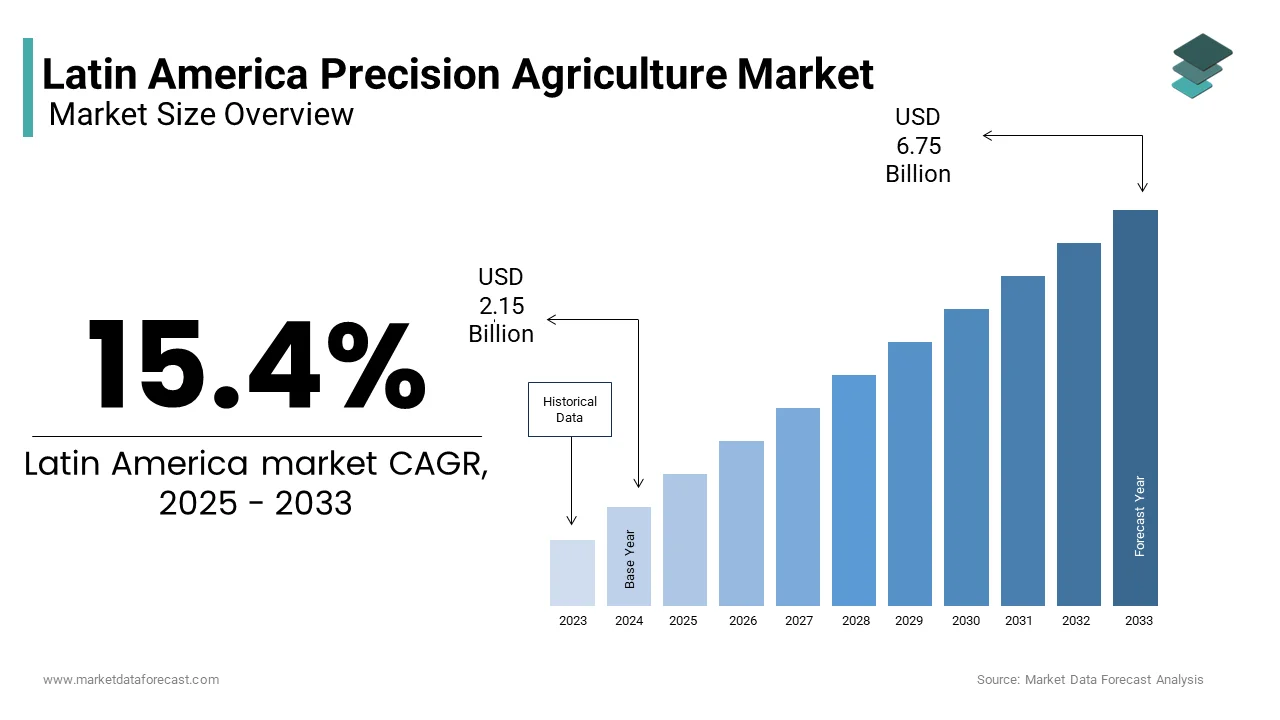
- Market Valuation: Valued at USD 2.15 billion (2025), estimated at USD 2.48 billion in 2026, and projected to reach USD 7.80 billion by 2034, registering a strong CAGR of 15.4% (2026–2034).
- Primary Growth Drivers: Escalating demand for food security and export competitiveness across major commodity sectors (soybeans, corn, coffee, and sugarcane), government sustainability initiatives (like Brazil's Low Carbon Agriculture Plan), and rising climate variability risks.
Key Latin America Precision Agriculture Segment Metrics (2026–2034)
| Category | Leading Segment (2025 Position) | Fastest-Growing Segment |
|---|---|---|
| By Offering | Hardware (dominant share driven by GPS receivers, soil sensors, and automated machinery) | Software (scaling rapidly via affordable cloud-based platforms and mobile apps) |
| By Technology | Guidance systems (held leading share in 2025 for auto-steering and operational efficiency) | Variable Rate Technology (VRT) (projected at a 12.2% CAGR for site-specific input management) |
| By Application | Yield monitoring (accounted for leading share in 2025 for financial planning and performance assessment) | Irrigation management (growing at a 13.3% CAGR to counter increasing water stress and drought) |
| By Country / Region | Brazil (holds ~45% regional market share as the leading agricultural commodity producer) | Mexico and Argentina (expanding rapidly through high-value export crops and mature no-till grain systems) |
Major Market Players, Structure & Strategic Landscape
Market Structure: Intense regional competition between global machinery giants and local agritech startups competing on ruggedized hardware solutions, localized Spanish/Portuguese software platforms, and sustainable compliance.
Key Companies: Trimble, Inc., Deere & Company, AgSmarts Inc., AJ Junction, Inc., CropMetrics LLC, Leica Geosystems, Monsanto Company, and Dickey-John Corporation.
 Download Free Sample Report
Latin America Precision Agriculture Market Size
The Latin American precision agriculture market size was valued at USD 2.15 billion in 2025 and is anticipated to reach USD 2.48 billion in 2026 and USD 7.80 billion by 2034, growing at a CAGR of 15.4% during the forecast period from 2026 to 2034.
Latin America serves as a global powerhouse for commodity production, particularly in soybeans, corn, coffee, and sugarcane, which necessitates efficient management of vast land areas. According to the Food and Agriculture Organization of the United Nations, Latin America holds approximately 25% of the world's arable land, yet faces increasing pressure to enhance productivity without expanding into fragile ecosystems like the Amazon rainforest. Climate variability poses significant risks. According to the Economic Commission for Latin America and the Caribbean, extreme weather events have caused agricultural losses exceeding 10 billion dollars annually in recent years. These environmental challenges drive the adoption of precision tools that monitor microclimates and soil moisture levels in real time. Furthermore, according to the United Nations, the regional population is projected to reach 700 million by 2030, requiring a substantial increase in food production. Government initiatives promoting sustainable farming and digital inclusion are gradually reshaping the agricultural landscape. The convergence of technological accessibility and urgent sustainability goals defines the current trajectory of this evolving market segment across the continent.
MARKET DRIVERS
Escalating Demand for Food Security and Export Competitiveness
The imperative to ensure national food security, while maintaining competitive positions in global export markets, which is a key factor propelling the Latin American precision agriculture market growth. The region is a critical supplier of essential commodities to Asia, Europe, and North America, requiring consistent, high-quality outputs to meet international standards. As per the Inter-American Institute for Cooperation on Agriculture, smallholder farmers produce up to 80% of the food consumed in developing countries, yet often suffer from low productivity due to inefficient resource use. Precision technologies enable these producers to optimize input usage, such as fertilizers and pesticides, thereby reducing costs and increasing profit margins. As per the Brazilian Agricultural Research Corporation, Brazil alone accounts for over 40% of global soybean exports, which is creating immense pressure to maximize yield per hectare. The volatility of global commodity prices forces farmers to seek operational efficiencies that only data-driven insights can provide. By utilizing variable rate technology, farmers can apply nutrients precisely where needed, preventing waste and environmental degradation. This efficiency is crucial for maintaining competitiveness against other major exporters like the United States. Additionally, domestic urbanization rates are rising. According to the World Bank, over 80% of Latin Americans now live in cities, increasing demand for reliable food supplies. Precision agriculture offers the scalability required to feed growing urban populations while sustaining rural livelihoods through improved productivity and reduced operational risks.
Government Initiatives Promoting Sustainable Farming Practices
Strong governmental support and regulatory frameworks aimed at promoting sustainable agricultural practices significantly accelerate the uptake of precision farming technologies across Latin America, which is further boosting the global market expansion. Countries like Brazil, Argentina, and Chile have implemented policies that incentivize the adoption of environmentally friendly farming methods to combat deforestation and soil degradation. As per the Brazilian Ministry of Agriculture, Livestock and Supply, the Low Carbon Agriculture Plan provides billions of dollars in credit lines specifically for farmers who adopt technologies that reduce greenhouse gas emissions. These financial incentives lower the barrier to entry for expensive precision equipment, such as GPS-guided tractors and automated irrigation systems. The European Union’s stringent import regulations regarding deforestation-free products also compel Latin American exporters to implement traceability and monitoring systems enabled by precision agriculture. According to the Economic Commission for Latin America and the Caribbean, several nations have integrated digital agriculture into their national development strategies, recognizing its role in achieving climate goals. Programs offering technical training and subsidies for smart sensors and drones help bridge the knowledge gap among rural communities. Furthermore, public-private partnerships are emerging to develop localized solutions that address specific regional challenges, such as water scarcity in northern Mexico or soil acidity in the Cerrado region. These coordinated efforts create a favorable ecosystem for technology providers and encourage widespread adoption among both large agribusinesses and cooperative groups seeking compliance with international sustainability standards.
MARKET RESTRAINTS AND CHALLENGES
High Initial Investment Costs and Limited Access to Credit
The substantial capital expenditure required for acquiring precision agriculture hardware and software serves as a significant restraint, which is limiting widespread adoption, particularly among small and medium-sized farmers and hampering the expansion of the Latin American precision agriculture market. Advanced equipment, such as autonomous tractors, multispectral drones, and sophisticated soil analysis tools, often cost tens of thousands of dollars, which is prohibitive for many agricultural operators. As per the Inter-American Development Bank, access to formal credit remains a critical challenge in rural Latin America, with interest rates frequently exceeding 20% in countries like Brazil and Argentina. This high cost of borrowing discourages investment in long-term technological upgrades, despite their potential for return on investment. Smallholder farmers, who constitute the majority of the agricultural workforce, often lack the collateral required to secure loans for such assets. According to the Food and Agriculture Organization, nearly 60% of rural households in the region do not have access to adequate financial services. The fragmented nature of land ownership further complicates the economic viability of precision tools, which are most effective on larger contiguous plots. Without affordable financing options or leasing models, many farmers continue to rely on traditional methods that are less efficient but require lower upfront costs. The risk aversion prevalent in the sector due to climate and market uncertainties also makes farmers hesitant to commit significant resources to unproven technologies. This financial barrier creates a digital divide where only large agribusinesses can afford to benefit from precision agriculture, leaving smaller producers behind.
Inadequate Rural Digital Infrastructure and Connectivity Issues
The lack of robust digital infrastructure and reliable internet connectivity in rural areas are further hindering the Latin American precision agriculture market expansion. Many precision farming technologies rely on real-time data transmission, cloud computing, and remote monitoring, which require stable, high-speed internet connections. As per the International Telecommunication Union, only 45% of the rural population in Latin America has access to the internet, compared to over 80% in urban areas. This digital divide prevents farmers from utilizing cloud-based analytics platforms and receiving timely alerts regarding weather, pests, or soil conditions. In remote regions of the Amazon basin and the Andes mountains, cellular coverage is sparse or non-existent, rendering connected devices ineffective. According to the World Bank, poor infrastructure increases the operational costs for technology providers, who must invest in offline capabilities or satellite communication alternatives. The latency issues associated with weak networks can disrupt the functionality of autonomous machinery and real-time guidance systems. Furthermore, the lack of electricity grid stability in certain areas complicates the charging and operation of electronic sensors and drones. Without foundational digital infrastructure, the full potential of precision agriculture cannot be realized. Governments and private sector players face significant logistical and financial hurdles in extending broadband networks to sparsely populated agricultural zones. This infrastructural deficit slows down the digitization of the sector and limits the scalability of data-driven farming practices across the continent.
MARKET OPPORTUNITIES
Expansion of Drone Technology for Crop Monitoring and Spraying
The rapid advancement and decreasing cost of unmanned aerial vehicles present a substantial opportunity for the Latin American precision agriculture market. Drones equipped with multispectral cameras and spraying mechanisms offer a cost-effective alternative to satellite imagery and manned aircraft for small to medium-sized farms. As per the Association for Unmanned Vehicle Systems International, the agricultural drone market is experiencing double-digit growth globally, with Latin America emerging as a key adoption zone due to its vast farmlands. In Brazil and Argentina, large-scale soybean and corn producers are increasingly using drones to detect early signs of pest infestations and nutrient deficiencies. This early detection allows for targeted interventions, reducing chemical usage by up to 30%, as indicated by field studies conducted by local agricultural universities. The ability to cover difficult terrain quickly makes drones ideal for monitoring plantations in hilly regions of Colombia and Central America. Regulatory frameworks in countries like Mexico are evolving to facilitate the commercial use of agricultural drones, providing a clearer path for service providers. Local startups are developing customized drone solutions that cater to specific crops, such as coffee and sugarcane, creating niche market opportunities. The integration of artificial intelligence with drone data enables predictive analytics for yield estimation and harvest planning. As battery life improves and payload capacities increase, drones will become indispensable tools for optimizing farm operations and reducing labor dependencies in the region.
Growth of Digital Platforms and Farm Management Software
The proliferation of digital platforms and farm management software offers significant opportunities for the Latin American precision agriculture market. These software solutions integrate data from various sources, including weather stations, soil sensors, and machinery, to provide actionable insights via user-friendly mobile applications. The number of smartphone users in Latin America is expected to exceed 400 million by 2025, creating a vast base of potential users for mobile agritech solutions. Startups in countries like Chile and Uruguay are developing localized platforms that offer advice on planting schedules, irrigation needs, and market prices in local languages. These platforms democratize access to expert knowledge, allowing even smallholder farmers to make informed decisions. According to the global system for mobile communications association, mobile internet adoption in the region is driving digital inclusion in rural areas. Partnerships between telecom companies and agritech firms are bundling data plans with software subscriptions, making these tools more affordable. The ability to track supply chain logistics and connect directly with buyers through these platforms enhances transparency and reduces post-harvest losses. Furthermore, digital record-keeping helps farmers comply with certification requirements for export markets. As trust in digital tools grows, the subscription-based model for farm management software is gaining traction, providing recurring revenue streams for developers and continuous value for users seeking to optimize their agricultural enterprises.
MARKET CHALLENGES
Shortage of Skilled Technical Workforce and Digital Literacy
A critical shortage of professionals trained in agronomy, data science, and precision technology operations is a significant challenge to the Latin American precision agriculture market growth. The successful implementation of precision agriculture requires a workforce capable of interpreting complex datasets, operating sophisticated machinery, and troubleshooting technical issues. As per the International Labour Organization, there is a significant skills mismatch in the agricultural sector, with many workers lacking the digital literacy required for modern farming techniques. Educational institutions in the region have been slow to update curricula to include modules on smart farming technologies, resulting in a pipeline gap. According to the Organisation for Economic Co-operation and Development, fewer than 30% of STEM graduates in Latin America specialize in fields relevant to agricultural technology. This scarcity forces companies to invest heavily in training programs, which increases operational costs and delays project timelines. Older farmers who are resistant to change may struggle to adapt to new interfaces and workflows, leading to underutilization of purchased technologies. The rural brain drain, where young educated individuals migrate to cities, further exacerbates the talent shortage in agricultural communities. Without a competent workforce to manage and analyze data, the benefits of precision tools remain unrealized. Addressing this human capital challenge requires collaborative efforts between governments, universities, and private companies to create vocational training programs and incentivize careers in agritech. Until this skills gap is bridged, the full potential of precision agriculture will remain constrained.
Fragmented Land Ownership and Smallholder Scalability Issues
The prevalence of small and fragmented land holdings across much of Latin America is another major challenge to the expansion of the Latin American precision agriculture market. While large agribusinesses in Brazil and Argentina can easily justify the investment in precision tools, millions of smallholder farmers operate on plots too small to achieve economies of scale. As per the Food and Agriculture Organization, family farms account for approximately 80% of all farms in the region, but manage only a fraction of the total agricultural land. Precision agriculture equipment, such as GPS-guided tractors and automated irrigation systems, is often designed for large contiguous fields, making it inefficient and costly for small plots. The heterogeneity of crop types and farming practices among smallholders further complicates the standardization of technological solutions. According to the Inter-American Institute for Cooperation on Agriculture, coordinating technology adoption among dispersed small farmers requires significant organizational effort and collective action. Cooperative models exist, but often lack the managerial capacity and financial resources to invest in shared precision assets. The logistical complexity of providing technical support and maintenance to thousands of scattered small farms deters technology providers from entering these segments. Consequently, a dualistic market emerges where large exporters benefit from high-tech efficiencies while smallholders remain trapped in low-productivity cycles. Bridging this divide requires innovative business models, such as service-based offerings or community-shared resources, which are still in nascent stages of development in the region.
REPORT COVERAGE
| REPORT METRIC | DETAILS |
| Market Size Available | 2025 to 2034 |
| Base Year | 2025 |
| Forecast Period | 2026 to 2034 |
| CAGR | 15.4% |
| Segments Covered | By Offering, Application, Technology, and Region. |
| Various Analyses Covered | Global, Regional & Country Level Analysis, Segment-Level Analysis, DROC, PESTLE Analysis, Porter’s Five Forces Analysis, Competitive Landscape, Analyst Overview of Investment Opportunities |
| Regions Covered | Brazil, Mexico, Argentina, Chile, Etc. |
| Market Leaders Profiled | Trimble, Inc. (U.S.), Deere & Company (U.S.), AgSmarts Inc, AJ Junction, Inc. (U.S.), CropMetrics LLC, Leica Geosystems (Switzerland), Monsanto Company, Dickey-John Corporation. |
SEGMENTAL ANALYSIS
By Offering Insights
The hardware segment dominated the market by holding the leading share of the Latin American precision agriculture market in 2025 due to the foundational requirement of physical devices for data collection and field operations. Farmers must first acquire tangible assets, such as GPS receivers, soil sensors, and drones, before they can leverage software or services. As per the Food and Agriculture Organization of the United Nations, the mechanization rate in major agricultural economies like Brazil and Argentina has increased significantly, with over 60% of large-scale farms now utilizing some form of automated machinery. The vast expanse of arable land in the region necessitates robust hardware solutions that can withstand harsh environmental conditions while providing accurate real-time data. According to the Brazilian Agricultural Research Corporation, the adoption of GPS-guided tractors has grown by 15% annually as farmers seek to reduce fuel consumption and optimize planting patterns. The initial capital investment in hardware is often supported by government subsidies and credit lines, making it more accessible than recurring software subscriptions. Furthermore, hardware serves as the entry point for digital transformation, allowing farmers to gradually integrate advanced analytics once the physical infrastructure is in place. The durability and longevity of hardware assets provide a perceived higher value proposition compared to intangible services. Manufacturers continuously innovate with ruggedized designs and modular components that cater to diverse crop types and terrain challenges across the continent. This tangible nature of hardware, combined with its critical role in enabling precision practices, ensures its dominance in the regional market landscape.
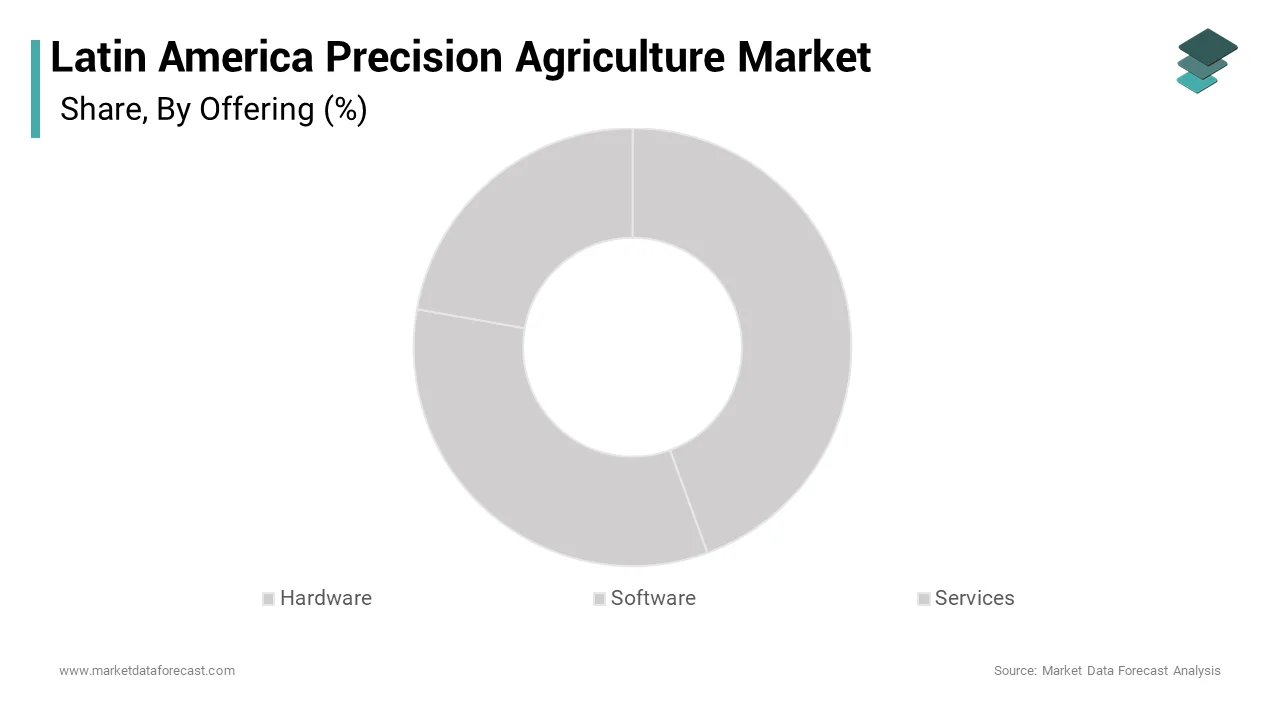
On the other side, the software segment is estimated to witness a prominent CAGR in the Latin American market during the forecast period owing to the increasing availability of affordable cloud-based platforms and mobile applications. The smartphone penetration in Latin America has surpassed 70%, enabling widespread access to farm management apps that offer insights on weather, pest control, and market prices. The shift from ownership to service models allows smallholder farmers to access sophisticated analytical tools without heavy upfront investments in IT infrastructure. According to the Inter-American Development Bank, digital literacy programs have empowered thousands of rural users to adopt software solutions that improve productivity and sustainability. Cloud-based platforms facilitate seamless integration of data from various hardware sources, providing a holistic view of farm operations. The ability to share data with agronomists and buyers enhances supply chain transparency and trust. Local startups are developing user-friendly interfaces in Spanish and Portuguese, lowering the barrier to entry for non-technical users. The scalability of software solutions allows them to adapt to farms of all sizes, making them attractive to a broad demographic. As internet connectivity improves in rural areas, the reliance on software for optimizing inputs and maximizing yields will continue to accelerate, driving rapid market expansion.
By Technology Insights
The guidance systems segment led the market by capturing the major share of the Latin American market in 2025 due to their proven ability to enhance operational efficiency and reduce input waste. These systems enable precise navigation of machinery, ensuring optimal overlap and coverage during planting, spraying, and harvesting. As per the International Society of Precision Agriculture, guidance technologies can reduce fuel consumption by up to 10% and fertilizer usage by 15%, which is crucial for cost-sensitive farmers in the region. In Brazil, the adoption of auto-steering systems has become standard practice among large soybean and corn producers who manage thousands of hectares. According to the National Supply Company of Brazil, over 40% of new tractors sold in the country are equipped with integrated guidance systems, reflecting high market penetration. The technology minimizes operator fatigue, allowing for longer working hours and increased productivity during critical planting windows. Guidance systems also contribute to soil conservation by reducing compaction through controlled traffic farming practices. The return on investment for guidance technology is typically realized within two to three seasons, making it an attractive option for commercial farmers. Regulatory pressures to minimize environmental impact further drive adoption, as precise application reduces chemical runoff. The maturity of this technology and its compatibility with existing machinery ensure its continued leadership in the regional market. Manufacturers offer various levels of accuracy, from sub-meter to centimeter-level precision, catering to different budget constraints and crop requirements.
However, the variable rate technology segment is the fastest-growing segment in the Latin America precision agriculture market and is estimated to register a CAGR of 12.2% during the forecast period owing to the rising need for site-specific management of inputs to maximize yield potential. As per the International Plant Nutrition Institute, variable rate application of fertilizers can increase crop yields by 5 to 10% while reducing environmental footprint. In Argentina, the adoption of variable rate seeding has gained traction among wheat and soybean growers who utilize soil mapping data to adjust planting density based on field variability. According to the Argentine No-Till Farmers Association, the use of prescription maps generated from soil samples has improved resource use efficiency significantly. The technology allows farmers to apply higher rates of inputs in productive zones and lower rates in less fertile areas, optimizing overall profitability. Advances in sensor technology and data analytics have made variable rate systems more accurate and easier to implement. Government incentives promoting sustainable agriculture encourage the use of technologies that minimize chemical leaching and greenhouse gas emissions. The integration of variable rate technology with guidance systems creates a synergistic effect, enhancing overall farm performance. As data availability improves and costs decrease, more medium-sized farms are adopting this technology, driving rapid growth in the sector.
By Application Insights
The yield monitoring segment accounted for the leading share of the Latin American precision agriculture market in 2025 due to its direct impact on financial planning and operational assessment. Accurate yield data allows farmers to evaluate the performance of different field zones, varieties, and management practices, enabling informed decisions for subsequent seasons. As per the American Society of Agricultural and Biological Engineers, yield monitors provide granular data that helps identify productivity gaps and opportunities for improvement. In Brazil, large-scale grain producers rely heavily on yield mapping to assess the effectiveness of fertilization and irrigation strategies. According to the Brazilian Association of Machinery Manufacturers, the installation of yield monitors on combine harvesters has become increasingly common, with over 30% of new harvesters featuring integrated monitoring systems. This application serves as the foundation for other precision practices, such as variable rate application and soil sampling. The ability to quantify output precisely helps farmers negotiate better prices with buyers and secure financing based on proven production records. Yield monitoring also facilitates compliance with sustainability certifications that require detailed production data. The technology has matured significantly, offering high accuracy and ease of use, which encourages widespread adoption. As farmers seek to maximize profitability in volatile commodity markets, yield monitoring remains an essential tool for benchmarking and continuous improvement. Its central role in the data ecosystem of modern farming ensures its continued dominance in the regional market.
However, the irrigation management segment is estimated to grow at a prominent CAGR of 13.3% during the forecast period in the Latin American market owing to the increasing water scarcity and the need for efficient resource utilization. As per the World Resources Institute, several countries in Latin America, including Mexico and Chile, face high water stress levels, necessitating precise irrigation practices. Precision irrigation systems using soil moisture sensors and weather data allow farmers to apply water only when and where it is needed, reducing waste by up to 30%. According to the Chilean Ministry of Agriculture, the adoption of smart irrigation technologies in the fruit and wine sectors has increased significantly to maintain export quality amidst drought conditions. The technology integrates with automated valves and pumps, enabling remote control and scheduling via mobile devices. This level of control helps prevent overwatering, which can lead to root diseases and nutrient leaching. Government programs promoting water conservation provide financial support for installing efficient irrigation systems. The rising cost of energy for pumping water further incentivizes the adoption of precision management tools. As water becomes a more constrained resource, the economic and environmental benefits of precision irrigation will drive accelerated growth in this application segment across the continent.
COUNTRY-LEVEL ANALYSIS
Brazil Precision Agriculture Market Analysis
Brazil had the leading share of the Latin American market in 2025 and is expected to maintain its dominance in the regional market over the next few years as it continues to integrate advanced technologies into its large-scale farming operations. Brazil holds the largest share of the Latin America precision agriculture market, accounting for approximately 45% of regional volume as per data from the Brazilian Agricultural Research Corporation. The country’s status as a global leader in soybean, corn, and sugarcane production drives substantial investment in advanced farming technologies. Large-scale agribusinesses in states like Mato Grosso and Goiás are early adopters of GPS guidance, drones, and variable rate applicators to manage vast estates efficiently. According to the National Supply Company, Brazil produces over 120 million tons of soybeans annually, requiring precise management to maintain competitiveness. The presence of local manufacturers and international tech companies fosters a competitive ecosystem offering diverse solutions. Government initiatives such as the Low Carbon Agriculture Plan provide credit lines for sustainable technologies, encouraging adoption. The extensive use of no-till farming practices complements precision agriculture by preserving soil structure and enhancing data accuracy. High internet penetration in rural areas, facilitated by private telecom investments, supports the use of cloud-based platforms. Challenges remain regarding connectivity in remote Amazonian regions, but ongoing infrastructure projects aim to bridge this gap. The strong cooperative movement also facilitates knowledge sharing and collective purchasing of precision tools among smaller producers. Brazil’s commitment to increasing productivity while reducing environmental impact ensures its continued leadership in the regional precision agriculture landscape.
Argentina Precision Agriculture Market Analysis
Argentina is likely to experience steady growth in its precision agriculture sector over the next few years by focusing on further digitalizing its already mature grain production systems. Argentina represents a significant and mature market in the Latin America precision agriculture sector, characterized by high adoption rates among grain producers. The country accounts for roughly 25% of the regional market share, as per insights from the Argentine No-Till Farmers Association. The widespread practice of no-till farming has created a culture of innovation and data-driven decision-making among Argentine farmers. According to the Ministry of Agriculture, Livestock and Fisheries, Argentina is a top exporter of soybean meal and oil, relying on precision technologies to optimize yields. The use of satellite imagery and soil mapping is prevalent in the Pampas region, where large farms utilize variable rate seeding and fertilization. Economic volatility and inflation drive farmers to seek efficiencies that reduce input costs and maximize returns. Local agritech startups are developing innovative software solutions tailored to Spanish-speaking users and local crop conditions. The strong network of agricultural consultants and service providers facilitates the implementation of complex precision systems. Despite economic challenges, the sector remains resilient due to the critical importance of agricultural exports to the national economy. Infrastructure limitations in rural connectivity pose challenges, but mobile-based solutions are helping to overcome these barriers. Argentina’s focus on sustainable intensification and technological adaptation positions it as a key player in the regional market.
Mexico Precision Agriculture Market Analysis
Mexico is poised to expand its precision agriculture footprint in the coming years by increasingly applying high-tech solutions to its diverse and export-oriented fruit and vegetable sectors. Mexico serves as a dynamic and diverse market in the Latin America precision agriculture landscape, driven by its varied climate and crop portfolio. The country holds approximately 15% of the regional market share, as per data from the Secretariat of Agriculture and Rural Development. Precision agriculture is gaining traction in high-value export crops, such as avocados, berries, and vegetables, where quality and consistency are paramount. According to the National Institute of Statistics and Geography, Mexico is the world’s largest avocado exporter, requiring precise irrigation and nutrient management to meet international standards. Smallholder farmers are increasingly adopting mobile apps and low-cost sensors to improve productivity and access markets. Government programs aimed at modernizing the agricultural sector provide training and subsidies for technology adoption. The proximity to the United States facilitates technology transfer and investment from North American agritech companies. Water scarcity in northern states drives the adoption of smart irrigation systems to conserve limited resources. The growth of protected agriculture, such as greenhouses, creates opportunities for automated climate control and monitoring solutions. Challenges include fragmented land ownership and limited access to credit for small farmers, but cooperative models are emerging to address these issues. Mexico’s strategic location and diverse agricultural base offer unique opportunities for precision technology providers.
COMPETITIVE LANDSCAPE
The competitive landscape of the Latin America precision agriculture market is characterized by intense rivalry between global giants and emerging local agritech startups. Multinational corporations leverage their extensive resources and established dealer networks to dominate the high end segment with advanced machinery and integrated software solutions. Local players compete by offering cost effective customized applications and specialized services that address specific regional crop requirements. The market is fragmented with numerous small technology providers focusing on niche areas such as drone spraying or soil sensing. Competition drives continuous innovation in data analytics connectivity and automation features. Price sensitivity remains a critical factor particularly among smallholder farmers forcing companies to develop tiered pricing models. Strategic alliances between hardware manufacturers and software developers are common to create comprehensive ecosystems. Regulatory variations across countries influence market entry strategies and compliance costs. The race to capture data value leads to aggressive marketing and customer acquisition tactics. As digital infrastructure improves the barrier to entry lowers attracting new entrants and intensifying competition. Companies must balance technological sophistication with affordability and usability to succeed in this dynamic environment.
KEY MARKET PLAYERS
A few of the market players in the Latin American precision agriculture market
- Trimble, Inc. (U.S.)
- Deere & Company (U.S.)
- AgSmarts Inc
- AGCO Corporation
- AJ Junction, Inc. (U.S.)
- CropMetrics LLC
- Leica Geosystems (Switzerland)
- Monsanto Company
- Dickey-John Corporation.
Top Players In The Market
- Deere & Company maintains a formidable presence in the Latin America precision agriculture sector through its integrated suite of smart farming technologies and machinery. The company leverages its John Deere Operations Center to provide farmers with centralized data management and actionable insights for optimized field operations. Recent strategic initiatives include expanding local manufacturing capabilities in Brazil to reduce costs and improve supply chain resilience. Deere has also introduced advanced autonomous solutions and see and spray technology tailored for regional crops like soybeans and corn. By partnering with local agronomists and dealers the company ensures robust technical support and training for users. Their focus on sustainability aligns with regional government incentives promoting low carbon agriculture. Continuous innovation in connectivity and machine learning enhances equipment efficiency driving adoption among large scale agribusinesses across the continent.
- Trimble Inc serves as a critical technology provider in the Latin America precision agriculture market offering comprehensive hardware and software solutions for guidance and variable rate application. The company collaborates extensively with original equipment manufacturers to integrate its precision ag technologies into various machinery brands popular in the region. Recent actions involve launching cloud based platforms that enable real time monitoring and decision making for farmers in remote areas. Trimble has strengthened its distribution network in Argentina and Mexico to ensure timely access to spare parts and technical assistance. The introduction of affordable satellite correction services has lowered barriers to entry for small and medium sized farms. By focusing on interoperability and ease of use Trimble empowers farmers to maximize yields while minimizing input waste. Their commitment to open architecture allows seamless integration with third party applications enhancing overall farm management efficiency.
- AGCO Corporation plays a pivotal role in the Latin America precision agriculture landscape through its diverse portfolio of brands including Massey Ferguson and Valtra. The company focuses on delivering scalable precision solutions that cater to both large commercial farms and family owned operations. Recent strategic moves include investing in digital farming hubs in Brazil to provide hands on training and demonstration of smart technologies. AGCO has enhanced its Fuse connected services platform to offer better data analytics and machine performance monitoring. Partnerships with local financial institutions facilitate easier access to credit for purchasing precision equipped machinery. The company actively participates in regional agricultural fairs to showcase innovations and engage directly with farmers. By prioritizing customer education and after sales support AGCO builds long term trust and loyalty. Their adaptable product designs address specific regional challenges such as varied terrain and crop types ensuring widespread relevance and adoption.
Top Strategies Used By Key Market Participants
Key players in the Latin America precision agriculture market predominantly employ localization strategies to tailor products and services to regional needs. Companies invest in local manufacturing and assembly plants to reduce costs and mitigate currency fluctuations. Strategic partnerships with local distributors and agronomic consultants ensure effective market penetration and user support. Developing affordable and scalable solutions allows providers to reach smallholder farmers who constitute a significant portion of the agricultural base. Emphasis on digital literacy programs and training workshops helps overcome skills gaps and encourages technology adoption. Integrating mobile friendly platforms caters to high smartphone usage rates in rural areas. Collaborations with financial institutions offer leasing and credit options to ease upfront investment burdens. Focus on interoperability ensures compatibility with existing machinery from various brands. These approaches enable companies to build strong brand loyalty and navigate complex regulatory and economic landscapes effectively.
MARKET SEGMENTATION
This research report on the Latin American precision agriculture market is segmented and sub-segmented into the following categories.
By Offering
- Hardware
- Automation & control system
- Display
- Guidance & Steering
- GPS
- Drones
- Mobile devices
- flow & application control devices
- Sensing & Monitoring devices
- Yield Monitors
- Water sensors
- Soil Sensors
- climate sensors
- Automation & control system
- Software
- Web-based
- cloud-based software
- Services
By Technology
- Guidance system
- Variable rate technology
- remote sensing
By Application
- Field Mapping
- Crop Scouting
- Weather Tracking & Forecasting
- Inventory Management
- Yield Monitoring
- Irrigation Management
- Farm Labor Management
- Financial Management
By Country
- Brazil
- Mexico
- Argentina
- Rest of Latin America