- Product Description Description
- Table of Contents TOC
- List of Table & Figure LOT
- Get Free Sample PDF Sample PDF
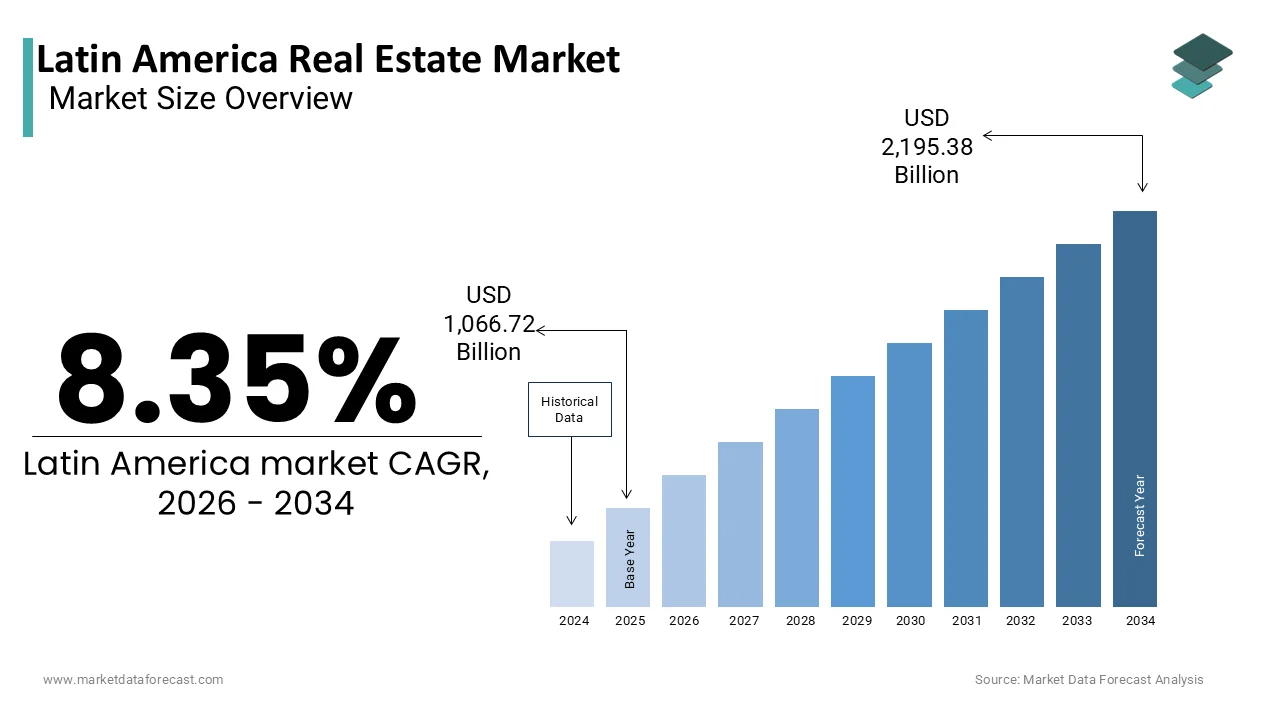
Market Size, 2025
$1,066.72 BnMarket Estimate, 2026
$1,155.79 BnMarket Forecast, 2034
$2,195.38 BnCAGR, 2026–2034
8.35%Executive Summary: Latin America Real Estate Market
- Market Scope: Comprehensive analysis of the Latin American real estate industry covering property transaction types (Apartments & Condominiums, Landed Houses, Villas), and country-level dynamics across Brazil, Mexico, Argentina, and the Rest of Latin America.
- Market Valuation: Valued at USD 1,066.72 billion in 2025, estimated at USD 1,155.79 billion in 2026, and projected to reach USD 2,195.38 billion by 2034, registering a solid CAGR of 8.35% (2026–2034).
- Primary Growth Drivers: Accelerated urban population growth exceeding 80% across the region, robust foreign direct investment (FDI) in prime commercial and residential sectors, and expanding government-backed affordable housing initiatives like "Minha Casa Minha Vida" and "Mi Casa Ya".
Key Market Segment Metrics (2026–2034)
| Category | Leading Segment / Position | Fastest-Growing Segment |
|---|---|---|
| By Property Type | Apartments and Condominiums (holding 52.3% share in 2024 via high-density urban migration) | Villas (projected at a rapid 7.4% CAGR driven by suburban relocation and foreign vacation home demand) |
| By Country / Region | Brazil (Leading market with 30.2% share in 2024 backed by massive social housing programs) | Argentina & Mexico (Expanding rapidly via dollar-denominated preservation and nearshoring logistics hubs) |
Major Market Players & Market Structure
Market Structure: A highly fragmented landscape featuring institutional-grade developers in structured economies like Chile and Mexico, alongside informal/private equity-backed entities operating in inflationary markets.
Key Companies: Cyrela Brazil Realty, Gafisa S.A., Lendlease Corporation, Keller Williams Realty, Inc., Simon Property Group, RE/MAX, Colliers, Coldwell Banker, Brookfield Asset Management, Prologis, CBRE Group Inc Class A, and others.
Latin America Real Estate Market Size
The Latin America real estate market was valued at USD 1,066.72 billion in 2025, is estimated to reach USD 1,155.79 billion in 2026, and is projected to reach USD 2,195.38 billion by 2034, growing at a CAGR of 8.35% from 2026 to 2034.
The real estate is residential, commercial, industrial, and retail property transactions. According to the Economic Commission for Latin America and the Caribbean (ECLAC), real estate contributes significantly to GDP in several countries, with construction and housing playing a pivotal role in urban expansion and infrastructure modernization. Moreover, international investors are showing renewed interest in Latin American real estate, especially in major metropolitan areas like São Paulo, Bogotá, and Santiago. According to the United Nations Human Settlements Programme (UN-Habitat), rapid urbanization is driving demand for affordable housing and sustainable development projects, which is shaping the long-term trajectory of the region’s real estate landscape.
MARKET DRIVERS
Urbanization and Population Growth
The sustained pace of urbanization and population growth in large metropolitan centers is a major factor propelling the growth of the Latin America real estate market. According to the United Nations Department of Economic and Social Affairs (UN DESA), over 80% of Latin Americans now reside in urban areas, which is a figure expected to rise steadily through the decade. In Brazil, where cities like São Paulo and Rio de Janeiro continue to attract migrants from rural regions, the Brazilian Institute of Geography and Statistics (IBGE) reported that urban population growth exceeded 1.2% annually between 2020 and 2023 by placing pressure on existing housing stock and public services. Additionally, government-led housing programs have played a crucial role in expanding access to affordable homes.
Foreign Investment and Global Real Estate Integration
Foreign direct investment (FDI) is another key factor for the Latin America real estate market growth in prime commercial and residential segments. Mexico has emerged as a top destination for international capital due to its strategic proximity to North America and strong logistics infrastructure. Chile has seen increased participation from European and U.S.-based funds seeking stable returns in Santiago’s upscale residential and office markets.
MARKET RESTRAINTS
Economic Instability and Currency Fluctuations
Economic instability is one of the major restraints for the Latin America real estate market in countries such as Argentina, Venezuela, and parts of Central America, where inflationary pressures and currency fluctuations hinder property transactions and investor confidence. According to the International Monetary Fund (IMF), Argentina experienced an annual inflation rate of over 94% in 2023, which is severely impacting purchasing power and discouraging long-term real estate commitments. Currency devaluation further exacerbates affordability challenges for imported construction materials and mortgage-backed financing.
Regulatory Complexity and Bureaucratic Delays
Regulatory complexity and bureaucratic inefficiencies pose significant challenges to the Latin America real estate market by limiting transparency, slowing down project approvals, and discouraging foreign investment. According to the World Bank’s Doing Business Report 2023, property registration in countries like Bolivia, Ecuador, and Nicaragua can take more than 60 days, involving multiple layers of documentation and government coordination. In contrast, similar processes in OECD nations typically take less than two weeks. Additionally, inconsistent zoning laws and land tenure issues persist in several regions, particularly in rural and peri-urban areas. The United Nations Human Settlements Programme (UN-Habitat) notes that informal settlements account for over 30% of urban housing in parts of Peru, Colombia, and Brazil, which are creating legal ambiguities and complicating formal real estate development.
MARKET OPPORTUNITIES
Affordable Housing Programs and Government Initiatives
Latin America real estate market is the expansion of affordable housing programs backed by national governments and multilateral institutions. Several countries in the region are implementing policies and financial mechanisms aimed at increasing homeownership rates among lower- and middle-income populations, thereby stimulating demand for mass-market residential properties. Brazil has been at the forefront of this initiative through the "Minha Casa Minha Vida" (My House My Life) program, which provides subsidized mortgages and tax incentives for first-time homebuyers. According to the Brazilian Ministry of Regional Development, in 2023, the program facilitated over 200,000 new housing units in underserved urban areas by contributing to both economic stimulus and social inclusion. In Colombia, the government launched the "Mi Casa Ya" initiative, offering interest rate subsidies and direct grants to qualifying buyers. The National Planning Department (DNP) estimates that in 2023, over 50,000 affordable homes were delivered under the program, which is reinforcing the role of public-private collaboration in addressing housing shortages.
Rise of Mixed-Use and Smart City Developments
The growing adoption of mixed-use and smart city developments represents a compelling opportunity for the Latin America real estate market. With rapid urbanization, sustainability goals, and changing consumer preferences, developers are likely to showcase huge growth opportunities for the Latin American real estate market. Colombia has emerged as a leader in this trend, with Bogotá and Medellín witnessing a surge in integrated urban projects designed to optimize space and reduce commuting times. Moreover, governments and private stakeholders are investing in sustainable urban ecosystems, including green buildings and renewable energy-powered complexes.
MARKET CHALLENGES
Limited Access to Mortgage Financing and Credit Constraints
The limited access to mortgage financing among lower- and middle-income populations is restraining the growth of the Latin America real estate market. According to the World Bank, less than 20% of the adult population in Latin America has access to traditional mortgage loans, compared to over 70% in developed economies. This disparity is particularly pronounced in countries like Peru, Bolivia, and Ecuador, where banking penetration and credit history databases remain underdeveloped. Moreover, high interest rates and stringent lending criteria further restrict affordability. Efforts to expand alternative financing models, such as cooperative housing schemes and microfinance-based home loans, have had limited success.
Infrastructure Deficits and Urban Congestion
Infrastructure deficits and urban congestion also to pose significant challenges to the Latin America real estate market growth. According to the World Bank’s Logistics Performance Index 2023, only three Latin American countries, Chile, Mexico, and Panama, ranked within the top 50 globally for infrastructure quality withthe disparities that exist across the region. Poor road connectivity, insufficient public transit options, and inadequate utility coverage increase the cost of living and reduce the attractiveness of certain real estate developments. Furthermore, the lack of coordinated urban planning often results in unplanned settlements and informal housing, which lack basic amenities and legal recognition. The United Nations Human Settlements Programme (UN-Habitat) indicates that in 2023, over 110 million people in Latin America lived in slums or substandard housing conditio, ns with the urgency of infrastructure-led interventions. Governments and private developers are increasingly recognizing the need for integrated urban development strategies.
REPORT COVERAGE
| REPORT METRIC | DETAILS |
| Market Size Available | 2025 to 2034 |
| Base Year | 2025 |
| Forecast Period | 2026 to 2034 |
| Segments Covered | By Type and Region |
| Various Analyses Covered | Global, Regional, & Country Level Analysis; Segment-Level Analysis; DROC; PESTLE Analysis; Porter’s Five Forces Analysis; Competitive Landscape; Analyst Overview of Investment Opportunities |
| Regions Covered | Latin America includes Brazil, Argentina, Mexico, and the Rest of LatinAmerica.a |
|
Market Leaders Profiled | Keller Williams Realty, Inc., Simon Property Group, RE/MAX, Colliers, Coldwell Banker, Brookfield Asset Management, Prologis, CBRE Group Inc Class A, and others. |
SEGMENTAL ANALYSIS
By Type Insights
The apartments and condominiums segments accounted in holding 52.3% of the Latin America real estate market share in 2024, with the migration of rural populations to urban centers, where space constraints make high-density housing more viable. According to the United Nations Department of Economic and Social Affairs (UN DESA), over 80% of Latin Americans now reside in cities, leading to a surge in demand for vertical housing solutions in São Paulo, Mexico City, Bogotá, and Santiago. Additionally, developers are increasingly focusing on mid- and high-rise apartment complexes equipped with modern amenities such as gyms, co-working spaces, and security features, making them attractive to young professionals and small families. Moreover, government-backed affordable housing programs have facilitated access to ownership models in this segment.
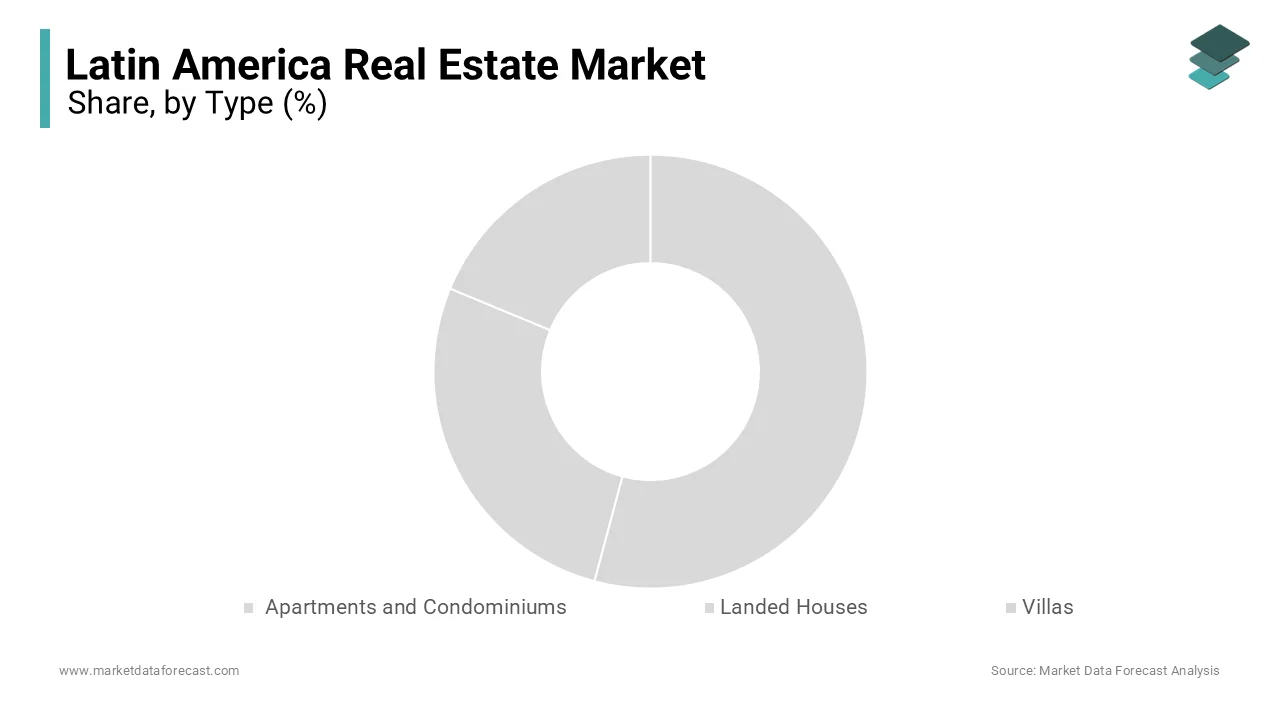
The villas segment is swiftly growing with an expected CAGR of 7.4% in the next few years. One of the primary growth catalysts is the rising demand for suburban and semi-rural properties among professionals relocating from congested city centers in search of larger, self-contained living spaces. In countries like Colombia and Chile, gated villa communities offering enhanced privacy and recreational facilities have become increasingly popular. Another key driver is the influx of foreign investors seeking vacation homes or permanent residences in scenic locations. Furthermore, real estate developers are capitalizing on this trend by launching integrated villa projects featuring smart home technologies, green building certifications, and concierge services.
REGIONAL ANALYSIS
Brazil
Brazil accounted in holding 30.2% of the Latin American real estate market share in 2024. A key growth enabler is the “Minha Casa Minha Vida” (My House My Life) program, which has significantly expanded access to affordable housing since its inception. The Ministry of Regional Development reported that in 2023, over 180,000 new housing units were delivered under this initiative ,primarily in underserved urban and semi-urban areas. Additionally, Brazil’s expanding middle class continues to drive demand for both apartments and landed houses. The Getulio Vargas Foundation (FGV) indicated that in 2023, household incomes in the upper-middle-income bracket rose by 6%, supporting stronger purchasing power for real estate assets. Moreover, São Paulo and Rio de Janeiro remain focal points for international investment in commercial and luxury residential segments.
Mexico
Mexico was ranked second in the Latin American real estate market with 25.3% of the share in 2024, with the expansion of nearshoring-related industrial and logistics real estate, spurred by global companies relocating manufacturing operations closer to North American markets. In addition, Mexico’s residential market has seen heightened demand for apartments and gated communities, especially among expatriates and retirees drawn to coastal and border regions. AMPI noted that in 2023, foreign buyers contributed to over 25% of all luxury home sales, which is prompting the appeal of Mexican real estate to international investors.
Argentina
AArgentina'sreal estate market growth is anticipated to have a significant CAGR in the coming years. Buenos Aires remains a key real estate hotspot for high-net-worth individuals and foreign investors seeking undervalued properties. A defining feature of Argentina’s market is the growing demand for dollar-denominated property transactions, as buyers seek to hedge against peso depreciation. According to the Buenos Aires Property Exchange (BAPEX) in 2023, over 40% of premium residential deals involved foreign currency payments, indicating a shift toward asset-based wealth preservation strategies. Additionally, government initiatives aimed at revitalizing the housing finance system have shown early signs of progress by signaling potential for long-term recovery in the Argentine real estate sector.
Chile
ChChile'seal estate market growth is likely to have a steady pace throughout the forecast period with the integration of green building standards and energy-efficient housing developments, particularly in Santiago and Valparaíso. As per the Canadian Green Building Council (CGBC) in 2023, LEED-certified real estate projects surpassed 1.2 million square meters with both private developers and public-private partnerships. Moreover, Chile’s banking sector offers relatively accessible mortgage financing options compared to other Latin American countries. The Central Bank of Chile noted that in 2023, mortgage loan approvals increased by 12% year-on-year, supported by low default rates and improved credit scoring mechanisms.
KEY MARKET PLAYERS AND COMPETITIVE LANDSCAPE
Keller Williams Realty, Inc., Simon Property Group, RE/MAX, Colliers, Coldwell Banker, Brookfield Asset Management, Prologis, and CBRE Group Inc Class A are the key players in the Latin America real estate market.
The competition in theLatin Americann real estate market is marked by a diverse mix of domestic developers, multinational firms, and emerging private equity-backed entities striving to capture market share in a rapidly evolving sector. While traditional players maintain dominance in core markets such as São Paulo, Mexico City, and Santiago, new entrants are increasingly challenging them by leveraging technology, sustainability, and innovative financing models. The market remains highly fragmented, with varying levels of regulatory maturity, economic stability, and consumer confidence influencing competitiveness across countries.
In more developed economies like Chile and Mexico, institutional-grade real estate firms dominate with professionally managed portfolios, structured financing, and transparent transaction processes. In contrast, in markets like Argentina and parts of Central America, informal transactions and limited mortgage accessibility create barriers for formal developers, forcing them to adopt alternative business models. Additionally, foreign investment plays a crucial role in shaping competitive dynamics, particularly in the luxury and commercial real estate segments.
The level of competition is expected to intensify as urbanization accelerates and consumer expectations shift toward integrated, eco-friendly, and digitally enabled properties. Companies that can adapt swiftly to regulatory changes, embrace technological advancements, and offer flexible ownership models will be best positioned to thrive in this complex yet promising regional market.
TOP PLAYERS IN THE MARKET
Cyrela Brazil Realty
Cyrela is one of the most prominent real estate developers in Brazil and a key player across Latin America. Known for its focus on residential high-rise developments, the company has played a major role in shaping urban landscapes in São Paulo, Rio de Janeiro, and other major Brazilian cities. Cyrela emphasizes design innovation, sustainability, and customer-centric development strategies, which are making it a benchmark in the region’s residential real estate sector.
Gafisa S.A.
Gafisa is another leading Brazilian real estate company with a strong presence in both residential and commercial property development. The company has been instrumental in expanding access to affordable housing through large-scale projects that integrate infrastructure and community planning. Gafisa continues to influence the regional real estate landscape by adapting to evolving consumer preferences and leveraging strategic partnerships.
Lendlease Corporation (Latin America Division)
Although an Australian multinational, Lendlease has established a significant footprint in Latin America in Mexico and Colombia. The company is known for developing mixed-use and sustainable urban projects that blend residential, retail, and commercial components. Its global expertise combined with localized execution has made Lendlease a preferred partner for large-scale developments in growing metropolitan areas across the region.
TOP STRATEGIES USED BY THE KEY MARKET PLAYERS
Key players in the LatinAmericana real estate market are adopting several strategic initiatives to strengthen their competitive positioning and navigate regional complexities. One of the most prevalent strategies is localized development planning, where companies tailor their real estate offerings to match local demand patterns, regulatory environments, and cultural preferences. This approach enhances market acceptance and ensures better alignment with buyer expectations.
The strategic partnerships and joint venturesallowg firms to pool resources, reduce financial risk, and accelerate project execution. These collaborations often involve local governments, construction firms, or international investors to facilitate smoother approvals, land acquisition, and financing arrangements.
The technology integration and digital transformation are becoming increasingly important. Developers are leveraging digital marketing, virtual property tours, smart home technologies, and data-driven customer engagement tools to enhance transparency, improve sales efficiency, and attract a broader demographic.
RECENT HAPPENINGS IN THE MARKET
- In February 2023, Cyrela Brazil Realty launched a new line of eco-friendly residential towers in São Paulo, which incorporates energy-efficient designs and green certifications to align with rising sustainability trends and attract environmentally conscious buyers.
- In July 2023, Gafisa S.A. partnered with a leading Brazilian fintech firm to introduce a digital mortgage platform that aimed at streamlining home loan approvals and increasing access to first-time homebuyers, especially in underbanked regions.
- In November 2023, Lendlease Corporation announced a joint venture with a Mexican infrastructure fund to develop a large-scale mixed-use project in Monterrey, combining residential, retail, and logistics spaces to cater to growing urban demand.
- In March 2024, BR Malls, a major Brazilian retail real estate developer, rebranded and expanded into experiential commercial hubs by integrating co-working spaces, entertainment zones, and tech-enabled retail experiences to meet changing consumer behavior.
- In August 2024, a consortium led by Colombian developer Corficolombiana acquired a major land parcel in Bogotá to launch a sustainable urban district featuring smart infrastructure, renewable energy sources, and integrated mobility solutions, which is signaling a shift toward future-ready real estate development.
MARKET SEGMENTATION
This research report on the Latin American real estate market is segmented and sub-segmented into the following categories.
By Type
- Apartments and Condominiums
- Landed Houses
- Villas
By Country
- Brazil
- Argentina
- Mexico
- Rest of Latin America