- Product Description Description
- Table of Contents TOC
- List of Table & Figure LOT
- Get Free Sample PDF Sample PDF
Market Size, 2025
$207.71 MnMarket Estimate, 2026
$243.23 MnMarket Forecast, 2034
$859.94 MnCAGR, 2026–2034
17.1%Latin America Smart Irrigation Market Size, Growth, Trends & Forecast (2026–2034)
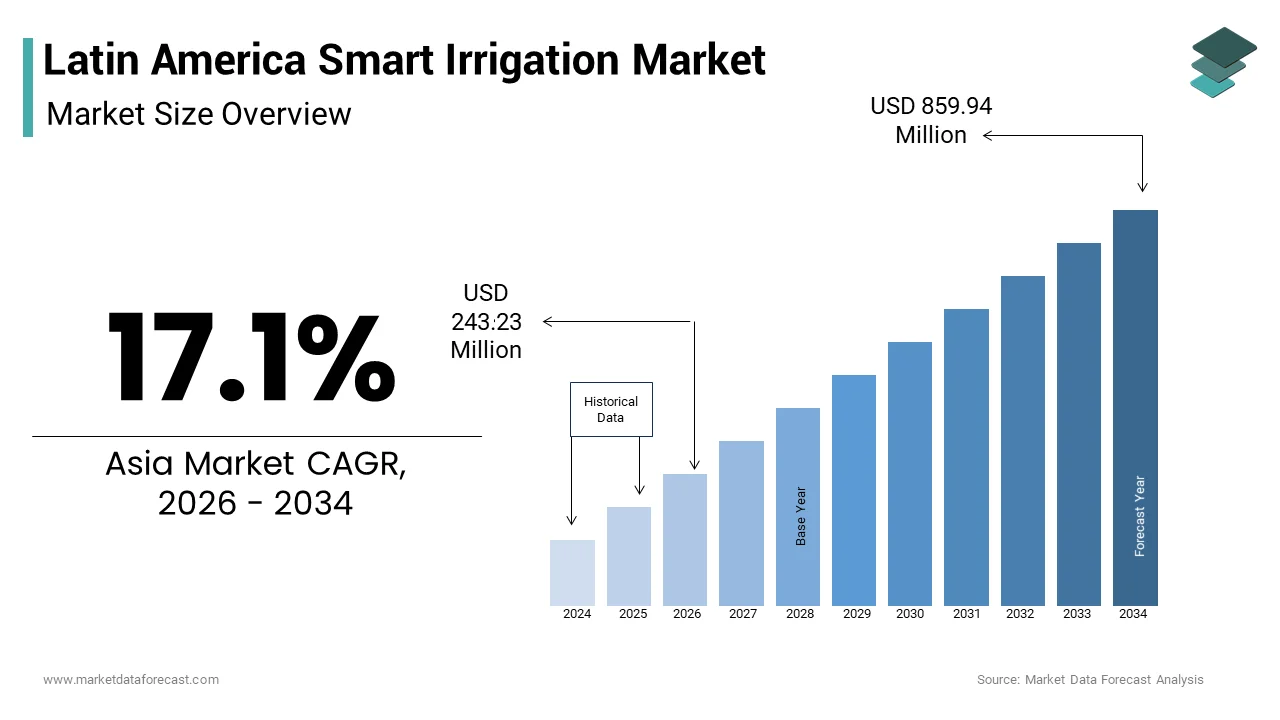
The Latin America smart irrigation market size was valued at USD 207.71 million in 2025, is anticipated to reach USD 243.23 million in 2026, and is projected to scale up to USD 859.94 million by 2034, registering a compound annual growth rate (CAGR) of 17.1% from 2026 to 2034. Growth is primarily propelled by export-oriented high-value crop expansion, climate variability and drought intensification, and the digital transformation of agricultural productivity.
Key Executive Metrics (At-a-Glance)
- 2025 Base Valuation: USD 207.71 Million
- 2026 Current Valuation: USD 243.23 Million
- 2034 Forecast Valuation: USD 859.94 Million
- Compound Annual Growth Rate (CAGR): 17.1% (2026–2034)
- Dominant Irrigation Controller Segment: Weather-based controllers
- Fastest-Growing Irrigation Controller Segment: Sensor-based controllers (18.4% CAGR)
- Dominant Hardware Segment: Sensors
- Fastest-Growing Hardware Segment: Smart detection systems (21.7% CAGR)
- Dominant Application Segment: Agriculture
- Fastest-Growing Application Segment: Non-agriculture (16.8% CAGR)
- Leading Country Markets: Brazil (38.7% share in 2025) and Mexico (22.5% share in 2025)
Core Market Drivers & Restraints
- Key Drivers: Export-oriented high-value crop expansion, climate variability and drought intensification, and increasing integration with fintech platforms.
- Market Restraints: Rural connectivity infrastructure deficits, technical skills gaps, currency volatility, and land tenure informality.
Latin America Smart Irrigation Market Segmentation Breakdown
| Segment Category | Largest / Leading Segment | Fastest-Growing Segment |
|---|---|---|
| By Irrigation Controller | Weather-based controllers | Sensor-based controllers (18.4% CAGR) |
| By Hardware & Network Component | Sensors | Smart detection systems (21.7% CAGR) |
| By Application | Agriculture | Non-agriculture (16.8% CAGR) |
Major Industry Players Profiled
Key market leaders shaping the Latin American smart irrigation landscape include Hunter Industries, Rain Bird Corporation, Netafim, HydroPoint Data Systems, Inc., Rachio Inc., The Toro Company, Calsense, Galcon, Blossom, and Green Electronics LLC (RainMachine).
Latin America Smart Irrigation Market Size
The Latin America smart irrigation market size was valued at USD 207.71 million in 2025 and is anticipated to reach USD 243.23 million in 2026 to reach USD 859.94 million by 2034, growing at a CAGR of 17.1% from 2026 to 2034.
Smart irrigation is an advanced watering system that uses real-time data from soil sensors and local weather updates to automatically give plants the exact amount of water they need, rather than using fixed schedules. It helps save water, reduces waste, and keeps plants healthy. This domain is distinct from conventional irrigation modernization because it integrates real time environmental feedback loops with actuation mechanisms to achieve precision resource management rather than simple mechanization. According to the Food and Agriculture Organization, global agricultural irrigation continues to expand sharply, representing approximately 72 percent of total worldwide freshwater withdrawals. As per the World Bank, climate-induced hydrological shifts are triggering acute temporal distribution mismatches across regional infrastructure, forcing public and private operators to rapidly accelerate smart water grid investments. According to the Inter-American Development Bank, agricultural operations throughout Latin America are rapidly accelerating capital transitions away from traditional gravity-fed methods into high-efficiency localized drip and micro-sprinkler installations. Furthermore, as per the United Nations Economic Commission for Latin America and the Caribbean, rising frequencies of intense hydrological shocks are driving regional agribusinesses to integrate real-time automated data networks for climate adaptation. This market is thus defined by the intersection of abundant but unevenly distributed water endowments, climate adaptation imperatives, and digital transformation of agricultural productivity.
MARKET DRIVERS
Export Oriented High Value Crop Expansion
Premium Market Access Requirements Mandate Precision Water Management
The expansion of export-oriented horticulture and fruit production is accelerating the growth of the Latin America smart irrigation market. This is because international buyers increasingly require documented sustainability metrics and consistent quality standards achievable only through precision water control. According to the Food and Agriculture Organization, agricultural commodities exported from Latin America and the Caribbean continue to expand significantly, cementing the region's position as the world's leading supplier of net agricultural exports to international retail markets. As per the Food and Agriculture Organization, high-value crop producers throughout key regional export corridors are accelerating transitions toward localized pressurized drip systems and water management software to safeguard yield quality against severe environmental variability. According to Mexico Business News, commercial avocado producers in Mexico are steadily accelerating the integration of pressurized irrigation networks across orchards to optimize nutritional distribution and bolster export supply chain resilience. This commercial imperative transforms smart irrigation from optional efficiency tool into non negotiable supply chain requirement for maintaining export competitiveness.
Climate Variability and Drought Intensification
Hydrological Uncertainty Necessitates Adaptive Real Time Response Systems
Accelerating climate change impacts across the region create structural demand for these irrigation systems, which contributes to the expansion of the Latin America smart irrigation market. These systems dynamically adjust to unpredictable precipitation patterns and temperature extremes that render historical scheduling obsolete. According to the World Meteorological Organization, global mean surface temperature trends are consistently moving toward critical thresholds, amplifying regional climate vulnerabilities and compounding hydrological constraints on primary production zones. As per the World Bank, climate-induced hydrometeorological shocks and severe drought periods are intensifying across Latin America and the Caribbean, causing substantial agricultural disruptions and threatening critical economic activities reliant on stable water cycles. According to the Inter-American Development Bank, regional agricultural operations are striving to deploy climate risk management methodologies, though many local producers require expanded financial services to fully absorb private resilience and automated technologies. The climate volatility converts smart irrigation from productivity enhancement to risk management infrastructure essential for business continuity.
MARKET RESTRAINTS
Rural Connectivity Infrastructure Deficits
Network Coverage Gaps Prevent Reliable Data Transmission in Key Agricultural Zones
Inadequate telecommunications infrastructure across the rural region fundamentally constrains the deployment of these advanced watering systems in the Latin America smart irrigation market. This deficit prevents the reliable connectivity required for cloud-based analytics and remote system control. According to the International Telecommunication Union, persistent infrastructure gaps and digital divide fragmentation continue to isolate remote rural farming communities across Latin America, impeding the seamless expansion of connected digital infrastructure. As per the Inter-American Development Bank, rural production zones in Brazil require substantial, targeted capital investments to deploy robust data coverage networks capable of supporting automated high-tech agricultural operations. According to the World Bank, structural issues and inadequate system integration represent significant barriers to the sustainable adoption and long-term durability of precision irrigation management frameworks. This infrastructure deficit creates geographic limitations that prevent market penetration precisely in regions where water stress and modernization needs are greatest.
Technical Skills Gap and Extension Service Limitations
Human Capital Deficits Undermine System Utilization and Maintenance Capacity
Widespread shortage of technicians and agronomists trained in digital irrigation management prevents effective system operation and maintenance, which hinders the expansion of the Latin America smart irrigation market. These hurdles cause suboptimal performance and high failure rates across the region. According to the Food and Agriculture Organization, institutional agricultural extension services across regional corridors lack comprehensive digital training networks, which significantly increases dependency on localized vendor infrastructure and self-directed experimentation. As per the Inter-American Development Bank, a shortage of specialized operator training programs across Andean agricultural hubs restricts the operational efficiencies of modern localized drip and pressurized irrigation facilities. According to the World Bank, standard public technical and vocational institutional pipelines across the region lack cohesive modern curricula addressing precision agricultural hydraulics or digital sensor installation. This human capital constraint means technology availability does not translate to successful deployment, suppressing realized benefits regardless of hardware sophistication.
MARKET OPPORTUNITIES
Integration with Fintech and Agricultural Credit Platforms
Digital Financial Services Enable Pay As You Go Models for Smallholders
The proliferation of digital financial platforms across the region creates opportunities for the Latin America smart irrigation market. This growth happens by embedding financing within existing fintech ecosystems that smallholder farmers already trust and use daily. According to the World Bank, the rapid acceleration of fast digital payment infrastructure and mobile networks across Latin America is driving widespread financial inclusion, enabling rural commercial networks to deploy modern cloud-based application software. As per the Inter-American Development Bank, regional public-private financial frameworks are testing performance-based credit models to reward commercial operators for expanding climate-smart water infrastructure assets. According to the United Nations Economic Commission for Latin America and the Caribbean, regional authorities are introducing coordinated institutional financing frameworks for sustainable water security to systematically scale up private capital deployment in vulnerable production zones. This fintech convergence transforms smart irrigation from capital intensive purchase to operational expense aligned with seasonal cash flows.
Regenerative Agriculture and Carbon Credit Monetization
Water Efficiency Verification Creates New Revenue Streams Beyond Crop Sales
Growing corporate and regulatory focus on regenerative agriculture creates new growth avenues for the Latin America smart irrigation market. These avenues monetize smart irrigation water savings and soil health improvements through carbon credits and ecosystem service payments. According to the World Bank, carbon credit mechanisms are operating as strategic financial instruments within the regional agriculture, forest, and land-use sectors to catalyze investments in sustainable water and soil resource management. As per the Inter-American Development Bank, agricultural production cooperatives are utilizing specialized low-emission management models to satisfy the environmental compliance standards of high-value international retail supply chains. According to the United Nations Environment Programme, sustainable capital networks across South America are experiencing an expansion of thematic green bond listings and preferential financing frameworks dedicated to local watershed preservation. This ecosystem service monetization diversifies revenue streams beyond crop sales, improving smart irrigation economics during commodity price downturns.
MARKET CHALLENGES
Currency Volatility and Import Dependency for Technology Components
Exchange Rate Fluctuations Erode Affordability and Investment Predictability
Heavy reliance on imported smart irrigation components, combined with chronic currency instability across the region, slows down the growth of the Latin America smart irrigation market. This dependence creates pricing unpredictability that undermines long-term investment planning and affordability for domestic farmers. According to the United Nations Economic Commission for Latin America and the Caribbean, intense macroeconomic volatility and persistent currency fluctuations directly inflate the import costs of specialized electronic hardware and localized digital sensor assets. As per the World Bank, high currency devaluations and structural import barriers trigger steep price adjustments for precision agricultural technology across key wine-producing and high-value crop zones. According to the Inter-American Development Bank, complex regional tariff frameworks and secondary import taxes compound base component costs, making technical agricultural components substantially more expensive for regional consumers than equivalent systems in developed markets. This macroeconomic vulnerability means smart irrigation adoption depends as much on central bank policy as agronomic need, creating boom bust cycles disconnected from underlying demand fundamentals.
Land Tenure Informality and Property Rights Ambiguity
Unclear Ownership Discourages Long Term Infrastructure Investment
Widespread informal land tenure and unresolved property rights in the region create fundamental disincentives for fixed infrastructure investments, which obstruct the expansion of the Latin America smart irrigation market. These smart irrigation systems require multi-year payback periods. According to the World Bank, a large share of agricultural land across Latin America and the Caribbean lacks formal title registration, which limits smallholders' legal security and dampens their willingness to invest in fixed physical infrastructure assets. As per the Inter-American Development Bank, modern agricultural infrastructure adoption scales up prominently on parcels backed by secure legal titles, highlighting a direct correlation between property rights clarity and long-term capital investments. According to the United Nations Human Settlements Programme, traditional communal governance structures and indigenous territory arrangements often intersect with individual credit prerequisites, restricting access to conventional private agricultural financing pools. This institutional barrier suppresses addressable market regardless of technical suitability or economic returns.
REPORT COVERAGE
| REPORT METRIC | DETAILS |
| Market Size Available | 2025 to 2034 |
| Base Year | 2025 |
| Forecast Period | 2026 to 2034 |
| CAGR | 17.1% |
| Segments Covered | By Irrigation Controller, Hardware and Network Component, Application, and Region. |
| Various Analyses Covered | Global, Regional, and Country Level Analysis; Segment-Level Analysis, DROC; PESTLE Analysis; Porter’s Five Forces Analysis; Competitive Landscape; Analyst Overview of Investment Opportunities |
| Regions Covered | Mexico, Brazil, Argentina, Chile, and the Rest of Latin America |
| Market Leaders Profiled | Hunter Industries, Rain Bird Corporation, Netafim, HydroPoint Data Systems, Inc., Rachio Inc., The Toro Company, Calsense, Galcon, Blossom, a nd Green Electronics LLC (Rain Machine). |
SEGMENTAL ANALYSIS
By Irrigation Controller Insights
Weather Based Controllers
The weather-based controllers segment dominated the Latin America smart irrigation market and accounted for a substantial share in 2025. They address extreme spatial and temporal climate variability without needing dense field sensor networks that risk theft or connectivity failures. According to the World Meteorological Organization, public hydrometeorological networks and automated monitoring stations are expanding across regional corridors to improve agricultural early warning capabilities and climate data exchange. As per the Inter-American Development Bank, soybean and corn operations within highly vulnerable ecosystems are increasingly deploying localized water management technologies to hedge against severe hydrological volatility. According to the Food and Agriculture Organization, high-value agricultural exporters are prioritizing integrated agroclimatic data frameworks to refine scheduling efficiencies and reduce exposure to private technical infrastructure overheads. This reliance on public climate infrastructure makes weather based controllers the default entry point for smart irrigation across vast agricultural frontiers where individual farm instrumentation remains economically unviable.
The leading position of this segment is bolstered by their alignment with basin level water allocation frameworks that mandate standardized reference evapotranspiration calculations for permit compliance and reporting. According to the World Bank, regulatory water monitoring initiatives and volumetric compliance rules are prompting large-scale commercial farming networks to standardize digital accounting infrastructure. As per the National Water Commission of Mexico, public water management administrators implement standard mathematical reference models to track regional water balance calculations and counter aquifer overexploitation in vulnerable basins. According to the Inter-American Development Bank, environmental oversight networks are modernizing resource verification protocols, encouraging agricultural organizations to systematically log and digitize operational performance histories. This regulatory embedding transforms weather based controllers from optional efficiency tools into mandatory compliance infrastructure for maintaining legal water access.
Sensor Based Controllers
The sensor based controllers segment is on the rise and is expected to be the fastest growing segment in the market by witnessing a CAGR of 18.4% from 2026 to 2034 due to expanding high value export horticulture that demands root zone precision unachievable through weather based methods alone. As per the Inter-American Development Bank, Peruvian blueberry and avocado production shows robust export volume expansion, prompting local commercial growers to upgrade technical post-harvest systems to preserve export quality. According to the Food and Agriculture Organization, Chilean table grape production faces rising structural export competition, driving continuous farm-level adjustments in irrigation efficiency and crop yield management. According to the World Bank, commercial high-value fruit producers are scaling up technical capital investments to satisfy the increasingly rigorous supply-chain sustainability guidelines mandated by global distribution platforms. This crop specific precision imperative creates demand dynamics decoupled from broader commodity agriculture trends.
The swift expansion of this segment gains further momentum from the increasing integration of irrigation with nutrient delivery systems, where real-time soil feedback enables synchronized water and fertilizer application. According to the International Fertilizer Association, severe global import constraints and pricing volatility are pushing commercial agronomists to adopt automated precision input distribution frameworks to retain profit margins. As per the Inter-American Development Bank, pairing micro-irrigation lines with electronic soil sensors significantly cuts nutrient leaching rates while maintaining high crop output. These nutrient management synergies transform sensor based controllers from water saving devices into integrated crop nutrition platforms, expanding value propositions beyond irrigation optimization.
By Hardware and Network Component Insights
Sensors
The sensors segment led the Latin America smart irrigation market and captured a significant share in 2025. These devices provide the core data layer for all automation and analytics, making up the largest part of every installation. According to the Food and Agriculture Organization, field-level implementations of electronic soil moisture sensors require tailored spatial density configurations across tropical zones to accurately capture diverse subterranean hydraulic property behaviors. As per the Food and Agriculture Organization, aggressive field exposure, elevated soil salinity, and moisture stress generate continuous wear on deployed tracking components, prompting regular equipment upgrades across regional farming zones. This combination of high unit density, replacement demand, and affordability ensures sensor segment maintains hardware leadership.
The prominence of this segment is further reinforced by the exceptional spatial variability of Latin American soils and microclimates that necessitates dense monitoring networks to generate actionable data. According to the Food and Agriculture Organization, regional geography features deep textural diversity and varying hydrological characteristics, which limits the reliability of uncalibrated single-point subterranean field readouts. As per the Inter-American Development Bank, large-scale grain producers in major agricultural plains are adopting high-resolution spatial mapping models to refine input applications across wide physical zones. This environmental complexity transforms sensors from optional accessories into mandatory infrastructure for any credible smart irrigation implementation.
Smart Detection Systems
The smart detection systems segment is likely to experience the fastest CAGR of 21.7% during the forecast period, owing to an urgent need to identify leaks, breaks, and unauthorized diversions in aging pressurized networks. According to the World Bank, physical transmission losses within outdated utility networks remain high, motivating public and private operators to expand localized acoustic, electronic, and pressure-based alert frameworks. As per the Inter-American Development Bank, ongoing irrigation district upgrades and technical modernization projects are designed to lower non-revenue distribution losses and safeguard water resources amid fiscal constraints. This infrastructure rehabilitation imperative creates growth dynamics tied to asset preservation rather than new installation cycles.
The fast development of this segment is driven by the escalating problem of unauthorized water abstraction and tampering in water-scarce basins, where allocation enforcement remains weak. According to the World Bank, unmonitored extractions and unauthorized diversions strain critical aquifer reserves, creating friction within local agricultural user blocks and threatening long-term supply stability. As per the Inter-American Development Bank, commercial agricultural valley districts are scaling up localized valve surveillance and digital flow arrays to curb unaccounted usage and stabilize district-wide revenue collection. This security and governance dimension expands smart detection applications beyond technical loss prevention into institutional capacity building for water resource management.
By Application Insights
Agriculture
In 2025, the agriculture segment held the majority share in the Latin America smart irrigation market because of the sector’s overwhelming economic importance and direct linkage to national development strategies. According to the Food and Agriculture Organization, regional agricultural networks and high-value commodity sectors are scaling up the integration of precision agricultural technologies to safeguard long-term economic stability and bolster domestic product revenues. As per the Economic Commission for Latin America and the Caribbean, agricultural commodities represent more than 25 percent of total export revenue for numerous regional nations, tying fiscal health deeply to trade-dependent primary sectors. According to the Food and Agriculture Organization, agricultural productivity transitions across regional rural corridors depend heavily on capital-intensive tech infrastructure upgrades and modern, integrated land-use practices. This macroeconomic centrality ensures agricultural smart irrigation receives policy priority and capital allocation disproportionate to other sectors.
The foremost factor securing this segment's leading position is the large scale mechanized nature of Latin American commodity production that creates natural compatibility with automated irrigation systems. As per the World Bank, the massive physical footprint and large scale of commercial grain installations facilitate the rapid amortization of automated tech capital overheads. According to the Food and Agriculture Organization, field crop operations are systematically integrating mechanized, pressurized distribution lines with advanced data infrastructure to boost yield efficiencies. Additionally, as per the United States Department of Agriculture, major corporate agribusiness networks utilize highly standardized and unified hardware arrays to ensure continuous year-round supply chains. This structural alignment between existing farm scale, mechanization levels, and smart technology requirements creates self reinforcing adoption dynamics unique to agricultural segment.
Non Agriculture
The non agricultural applications segment is expected to exhibit a noteworthy CAGR of 16.8% between 2026 and 2034. This swift expansion of the segment is fuelled by severe urban water stress and municipal mandates for public space irrigation efficiency. According to the United Nations Human Settlements Programme, intense urbanization constraints and persistent water supply tensions are accelerating municipal requirements for high-efficiency commercial landscape water monitoring tools. As per the Inter-American Development Bank, municipalities are updating conservation bylaws for urban green spaces, pushing public and private operators to replace legacy infrastructure with targeted automated irrigation grids. According to the World Bank, urban water utilities are combining tariff-based pricing mechanisms with fiscal rebates to accelerate tech adoption within overexploited aquifers. This convergence of urban crisis, regulatory mandate, and tourism economics creates growth dynamics decoupled from agricultural commodity cycles.
Growth in this segment is propelled by the expansion of urban green infrastructure policies that link smart irrigation to climate adaptation and public health objectives. According to the United Nations Environment Programme, urban centers are increasing capital deployment into localized forestry and micro-greening networks to mitigate severe climate-induced heat challenges under growing water scarcity constraints. As per the Inter-American Development Bank, large-scale urban green corridors leverage synchronized landscape engineering to lower localized surface temperatures and support biodiversity. According to the World Bank, municipal modernization plans are merging green infrastructure assets with smart drainage arrays to access international climate adaptation financing lines. These policy integrations expand non agricultural smart irrigation from discretionary landscaping expense into essential urban resilience infrastructure with diversified funding sources.
COUNTRY LEVEL ANALYSIS
Brazil Smart Irrigation Market Analysis
Brazil was the top performer in the Latin America smart irrigation market and accounted for a 38.7% share in 2025. This supremacy of the Brazilian market was propelled by its vast irrigated frontier, advanced agribusiness sector, and strong policy support for sustainable intensification. According to the National Water Agency, Brazil's total equipped area for agricultural irrigation has expanded to encompass approximately 8.5 million hectares, with capital updates concentrating heavily across the center-west and frontier agricultural zones. As per the Ministry of Agriculture and Livestock, national agroclimatic sustainability guidelines prioritize the expansion of resource-saving irrigation systems to boost yield resilience while lowering long-term volumetric water overheads. According to the LAVCA association for private capital investment, venture capital deployment for Brazilian technology startups remains highly dynamic, driving early-stage capital injections into innovative agri-food software and climate-adaptation platforms. This combination of scale, policy, and innovation ecosystem establishes Brazil as undisputed regional leader whose technology trajectories shape continental standards.
Mexico Smart Irrigation Market Analysis
Mexico followed closely behind in the Latin America smart irrigation market and secured a share of 22.5% in 2025. The country is known for its proximity to the US market, severe aquifer overdraft crises, and strong export-oriented horticulture sector. According to the National Water Commission, approximately 105 of the 653 aquifers in Mexico are facing severe overexploitation constraints, compounding groundwater deficits and accelerating the urgency for localized micro-irrigation hardware in northern basins. As per the Inter-American Development Bank, the rapid expansion of high-value fresh fruit and vegetable exports to North American distribution nodes is motivating private producers to scale up digital field-monitoring instrumentation. According to the World Bank, public infrastructure funding mechanisms and agricultural irrigation modernization strategies aim to lower non-revenue delivery losses within major transmission lines. This combination of regulatory pressure, export linkage, and binational cooperation creates distinctive market dynamics where smart irrigation serves as survival mechanism for water stressed export agriculture.
Chile Smart Irrigation Market Analysis
Chile occupies a major position in the Latin America smart irrigation market due to extreme water scarcity, a sophisticated fruit export industry, and advanced water market institutions. According to NASA Science, central Chile is confronting its longest and most intense multi-year megadrought of the millennium, accelerating severe regional hydrological constraints and forcing high-value agricultural sectors to scale up precision water-saving infrastructure. As per the Chilean Fruit Exporters Association, commercial agricultural operations are driving massive capital investments into localized micro-irrigation systems to secure export crop yields and preserve strict quality parameters amid declining water allocations. According to the World Bank, structural updates within complex water rights regimes and regional regulatory frameworks provide core financial motives for commercial growers to adopt localized data-driven efficiency assets. This convergence of existential water stress, market based incentives, and innovation support creates premium market environment where technology sophistication outweighs cost considerations.
Argentina Smart Irrigation Market Analysis
Argentina is also a key player in the Latin American smart irrigation market owing to the scale of the Pampas grain belt, the precision needs of the Mendoza wine region, and recent policy shifts toward agricultural modernization. According to the Inter-American Development Bank, commercial high-value agricultural operations and viticulture developments in semi-arid environments like Mendoza rely heavily on specialized pressurized infrastructure upgrades to maintain crop productivity under desert-like conditions. As per the World Bank, the Permitting Renewable Energy for Rural Areas Project expands modern clean power assets across isolated regions to remove technical utility constraints and strengthen localized agricultural pumping operations. Furthermore, according to the Food and Agriculture Organization, extensive mechanized cropping networks and shared service infrastructure throughout prime grain-producing zones accelerate the assimilation of digitized management software and unified data analytics platforms. This combination of regional specialization, energy policy integration, and conservation agriculture alignment creates heterogeneous demand patterns requiring segmented engagement strategies.
COMPETITIVE LANDSCAPE
Competition in the Latin America smart irrigation market features intense rivalry between multinational irrigation specialists, regional agtech startups, and diversified industrial conglomerates vying for position across fragmented national markets with distinct regulatory and infrastructural characteristics. Global leaders compete on technological sophistication and export certification alignment while regional players leverage local manufacturing, cultural familiarity, and distribution networks to defend niches in price-sensitive segments. Differentiation increasingly occurs through agronomic localization, financing integration, and after-sales support rather than hardware specifications alone due to commoditization of basic sensor and controller functionalities. Government subsidy programs and development bank projects create winner-take-all dynamics in public procurement where compliance capabilities and political relationships matter as much as technical merit. Market consolidation continues as scale economies become necessary to fund R&D for tropical adaptation and regulatory navigation exceeding smaller player capacities. New entrants face significant barriers including currency hedging complexity, service network establishment costs, and entrenched distributor relationships built over decades. Cross-border competition remains limited by heterogeneous standards and import regulations despite regional trade agreements. Ultimately sustainable advantage derives from balancing global technology resources with deep local embeddedness and macroeconomic resilience in this uniquely complex environment characterized by simultaneous growth opportunities and systemic operational challenges.
KEY MARKET PLAYERS
Some of the prominent vendors in the smart irrigation market include
- Hunter Industries
- Rain Bird Corporation
- Netafim
- Jain Irrigation Systems
- Hunter Industries
- HydroPoint Data Systems, Inc.
- Rachio Inc.
- The Toro Company
- Calsense
- Galcon
- Blossom
- Green Electronics LLC (RainMachine).
Top Players In The Market
- Netafim maintains extensive involvement across the Latin America smart irrigation market through integrated drip irrigation and digital farming solutions tailored for tropical and subtropical cropping systems. The company recently strengthened its regional position by launching NetBeat, an AI-driven irrigation controller with local agronomic models calibrated for Brazilian sugarcane and Mexican berries. Netafim expanded manufacturing capacity in Brazil and Mexico to reduce import dependency and currency exposure while improving service response times. Their partnership with fintech platforms enables pay-as-you-go financing for smallholders, addressing capital barriers that previously limited technology adoption. These strategic initiatives demonstrate commitment to adapting global precision irrigation expertise for Latin American environmental and economic realities while building sustainable ecosystems essential for long-term customer retention and market development across diverse agricultural contexts throughout the region.
- Jain Irrigation Systems contributes significantly to the Latin America smart irrigation landscape through affordable sensor-based controllers and micro-irrigation products designed for emerging market conditions. The company recently established technical training centers in Colombia and Peru to address operator skill gaps that cause widespread system underperformance and abandonment. Jain launched solar-powered smart irrigation kits specifically validated for off-grid Andean and Central American farms, expanding addressable markets beyond electrified zones. Their collaboration with national agricultural research institutes enables cultivar-specific irrigation protocols that improve adoption confidence among risk-averse farmers. These actions reinforce Jain’s positioning as accessible technology provider balancing advanced functionality with affordability and local capacity building essential for navigating fragmented Latin American markets characterized by infrastructure deficits and workforce constraints affecting consistent technology utilization.
- Hunter Industries serves the Latin America smart irrigation market through weather-based controllers and professional-grade components targeting municipal, golf, and high-value horticulture applications. The company recently partnered with Chilean and Argentine water utilities to integrate Hydrawise platform with public meteorological networks, reducing private infrastructure costs for end users. Hunter introduced Spanish and Portuguese language interfaces with local crop libraries addressing usability barriers that previously limited adoption beyond English-speaking export operations. Their distributor certification programs build authorized service networks ensuring proper installation and maintenance across remote areas lacking factory-trained technicians. These targeted adaptations demonstrate Hunter’s strategy of institutional integration and localization rather than standardized global product deployment, enabling relevance in regulatory-driven non-agricultural segments and premium export agriculture where compliance and reliability outweigh lowest-cost considerations.
Top Strategies Used By Key Market Participants
Key players in the Latin America smart irrigation market prioritize localization strategies including regional manufacturing, technical training programs, and agronomic model calibration to overcome infrastructure deficits and skills gaps unique to the region. Companies establish local production facilities to mitigate currency volatility and import tariff impacts while improving supply chain resilience against global disruptions. Strategic partnerships with fintech platforms and development banks enable innovative financing models aligned with seasonal cash flows rather than requiring upfront capital expenditure. Product portfolios are adapted for tropical soils, extreme climate variability, and connectivity constraints through ruggedized hardware and offline-capable software. Distributor and technician certification programs build after-sales service networks essential for system longevity in regions lacking formal vocational training. Integration with public weather stations and government digital agriculture platforms reduces private infrastructure costs while ensuring regulatory compliance. Engagement with export certification bodies aligns product features with international buyer sustainability requirements creating demand pull from market access imperatives. These multifaceted strategies reflect adaptation to uniquely Latin American combination of macroeconomic instability, environmental heterogeneity, and institutional fragmentation requiring balanced approaches to technology transfer and commercial sustainability simultaneously.
MARKET SEGMENTATION
This research report on the Latin American smart irrigation market is segmented and sub-segmented into the following categories.
By Irrigation Controller
- Weather-based controllers
- Sensor-based controllers
By Hardware and Network component
- Sensor
- Water/flow meter
- Smart detection system
By Application
- Agriculture
- Non-agriculture
By Country
- Argentina
- Brazil
- Mexico