- Product Description Description
- Table of Contents TOC
- List of Table & Figure LOT
- Get Free Sample PDF Sample PDF
Market Size, 2025
$873.8 MnMarket Estimate, 2026
$923.7 MnMarket Forecast, 2034
$1,439.2 MnCAGR, 2026–2034
5.70%Latin America Snack Pellets Market Size, Growth, Trends & Forecast (2026–2034)
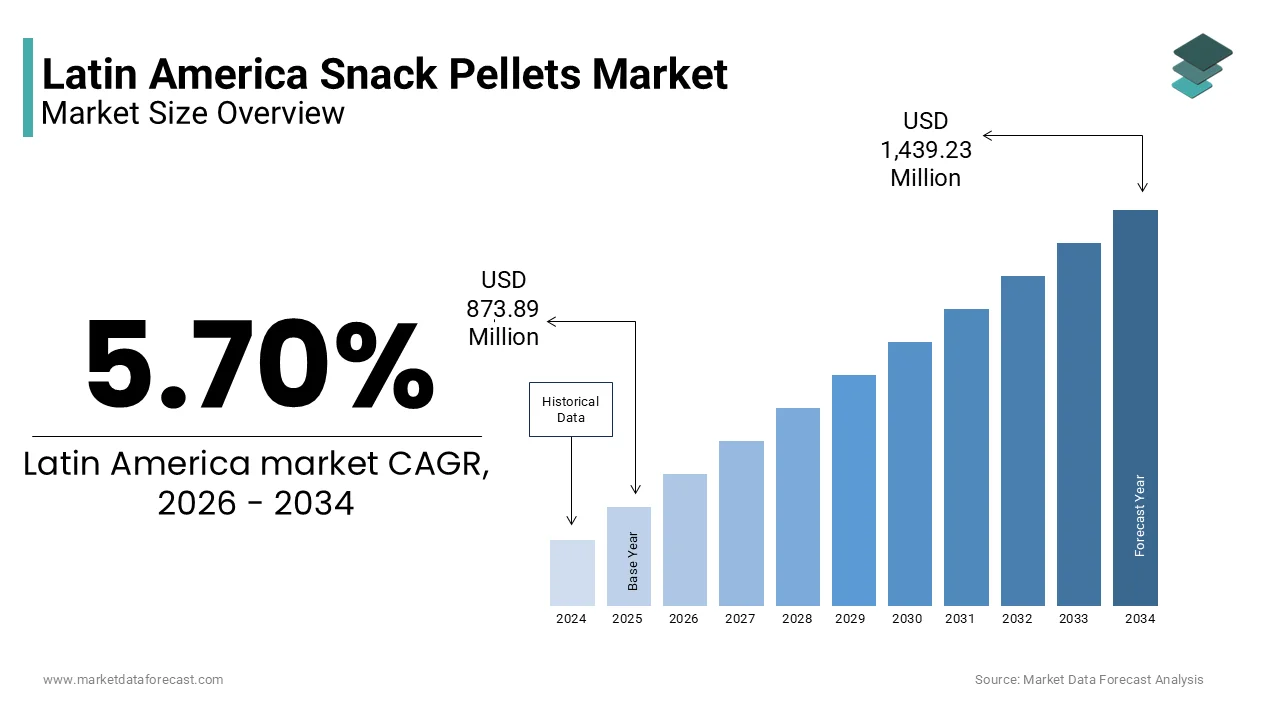
The Latin America snack pellets market size was valued at USD 873.89 million in 2025, is estimated at USD 923.70 million in 2026, and is projected to scale up to USD 1,439.23 million by 2034, expanding at a compound annual growth rate (CAGR) of 5.70% during the forecast period from 2026 to 2034. Growth is driven by rapid urbanization, changing consumer lifestyles favoring ready-to-eat convenience foods, and the expansion of quick-service restaurant and street food networks.
Key Executive Metrics (At-a-Glance)
- 2025 Base Valuation: USD 873.89 Million
- 2026 Current Valuation: USD 923.70 Million
- 2034 Forecast Valuation: USD 1,439.23 Million
- Compound Annual Growth Rate (CAGR): 5.70% (2026–2034)
- Dominant Type Segment: Corn (holding commanding market share due to abundant local maize production and cost-effectiveness)
- Fastest-Growing Type Segment: Multigrain (projected at a 14.2% CAGR driven by health-conscious consumer shifts)
- Dominant Form Segment: Die-Face (holding the majority share due to simplicity, versatility, and uniform extrusion)
- Fastest-Growing Form Segment: Tridimensional (projected at a 12.8% CAGR driven by novelty textures and premium snacking)
- Dominant Equipment Segment: Single-Screw Extruders (dominating through affordability and small-scale manufacturing utility)
- Fastest-Growing Equipment Segment: Twin-Screw Extruders (projected at a 15.5% CAGR driven by complex and functional product formulations)
- Dominant Country Market: Brazil (holding a 35.7% regional market share backed by massive agricultural output)
- Fastest-Growing Country Market: Mexico and Argentina (accelerating via export orientation and modern extrusion tech adoption)
Core Market Drivers
- Rapid Urbanization: Over 81% of the regional population living in urban areas, fueling a surge in dual-income households and on-the-go food demand.
- QSR & Street Food Network Expansion: Widespread utility of semi-finished snack pellets among street vendors and food service operators to reduce preparation waste and ensure consistency.
Primary Market Restraints & Challenges
- Health Consciousness & Regulation: Stricter food labeling laws, front-of-package warning systems, and rising anti-obesity policies restricting high-calorie processed snack sales.
- Raw Material Price Volatility: Climate phenomena like El Niño creating supply chain bottlenecks, crop yield reductions, and agricultural input cost swings.
Latin America Snack Pellets Market Segmentation Breakdown
| Segment Category | Leading Sub-Segment | High-Growth Sub-Segment |
|---|---|---|
| By Type | Corn (Commanding Share) | Multigrain (14.2% CAGR) |
| By Form | Die-Face (Majority Share) | Tridimensional (12.8% CAGR) |
| By Equipment | Single-Screw Extruders | Twin-Screw Extruders (15.5% CAGR) |
| By Country | Brazil (35.7% Share) | Mexico & Argentina |
Major Industry Players Profiled
Key agro-industrial corporations and market participants leading the Latin America snack pellets landscape include Intersnack Group GmBH & Co. KG, J.R. Short Milling Company, Quality Pellets A/S, Balance Foods Inc., Dalmaza Food Industries Co., Grupo Industrial Michel, PepsiCo, Kellogg Company, and Grupo Bimbo.
 Download Free Sample Report
Latin America Snack Pellets Market Size
The Latin America snack pellets market size was valued at USD 873.89 million in 2025, and is expected to reach USD 1,439.23 million by 2034 from USD 923.70 million in 2026. The market is growing at a CAGR of 5.70%.
Snack pellets are pre-formed, semi-finished food intermediates. They are made by extruding a mix of starches (like potato starch, rice flour, or corn flour) into compact, dried, and non-expanded pieces. These pellets are typically made from corn potato rice or wheat flour and require a final frying or baking step by food service operators or industrial manufacturers to achieve the desired texture and volume. This market serves as a critical backbone for the ready to eat snack industry allowing brands to maintain consistency while reducing operational complexity. According to data from the Food and Agriculture Organization (FAO), Latin America and the Caribbean's annual maize production is projected to exceed 233 million metric tons, cementing the region as a primary global supplier of agricultural commodities. As per studies, rapid urbanization in Latin America has driven a steep increase in the market share and consumption of ultra-processed foods. The Brazilian Food Processors' Association (ABIA) indicates that the country's food processing sector generates over USD 248 billion in annual revenues, with snacks remaining a key growth segment among its main processing divisions. Regulatory bodies such as the National Health Surveillance Agency in Brazil have established strict standards for food additives and processing aids ensuring product safety. The shift toward convenient meal solutions among working populations further propels the need for efficient snack production methods. Manufacturers are increasingly focusing on clean label ingredients to meet evolving consumer preferences for healthier options. This dynamic environment fosters innovation in flavor profiles and nutritional enhancements positioning snack pellets as a vital component of the regional food processing landscape.
MARKET DRIVERS
Rapid Urbanization and Changing Consumer Lifestyles
The accelerating pace of urbanization across the region has fundamentally altered consumer eating habits, which is driving the growth of the Latin America snack pellets market. This shift propels the demand for convenient and ready-to-eat snack options. Regional demographic profiles compiled by the United Nations Department of Economic and Social Affairs (UN DESA) show that over 81% of Latin America's population lives in urban environments, driving structural shifts in lifestyle and food consumption patterns. This demographic shift has led to a surge in the consumption of on the go food items including expanded snacks made from pellets. The dual income household trend further exacerbates this demand as families prioritize convenience without compromising on taste. Snack pellets enable manufacturers to produce consistent high quality products at scale meeting the needs of busy urbanites. Street vendors and small food outlets also rely on these semi finished products to offer freshly fried snacks with minimal preparation time. The affordability of pellet based snacks makes them accessible to a broad socioeconomic spectrum ensuring widespread adoption. Additionally the proliferation of modern retail channels such as supermarkets and convenience stores facilitates easy access to packaged snacks. This structural change in living patterns creates a sustained demand pipeline for snack pellet producers who can deliver efficient and scalable solutions.
Expansion of Quick Service Restaurant and Street Food Networks
The extensive growth of quick service restaurant chains and informal street food networks fuels the expansion of the Latin America snack pellets market. In addition, the National Restaurant Association of Mexico (CANIRAC) validates that the commercial food service industry is a key pillar of Mexico's economy, expanding menu items to tap into evolving consumer convenience trends. Street food vendors who form the backbone of culinary culture in countries like Peru Colombia and Brazil utilize snack pellets to prepare popular items such as churros cheese puffs and corn chips efficiently. The World Bank Group demonstrate that the informal labor market commands a large share of the regional economy, serving as a vital channel for the distribution of low-cost consumer goods These semi finished products allow vendors to maintain consistent quality and reduce waste by frying only what is needed. The ability to customize flavors and shapes enables restaurants to differentiate their offerings and attract diverse customer bases. Furthermore the rise of food delivery platforms has increased the visibility and accessibility of these snack items driving higher order volumes. Manufacturers benefit from long term supply contracts with large chains ensuring stable revenue streams. The versatility of snack pellets allows for innovation in menu development keeping consumer interest high. This symbiotic relationship between the food service industry and pellet producers drives continuous market expansion and product diversification.
MARKET RESTRAINTS
Health Consciousness and Regulatory Pressure on Processed Foods
Growing health awareness among consumers and stringent government regulations targeting processed foods hinder the growth of the Latin America snack pellets market. According to the Pan American Health Organization obesity rates in Latin America have reached epidemic levels with over 60 percent of adults classified as overweight prompting authorities to implement restrictive policies. Countries such as Chile Mexico and Peru have introduced front of package warning labels and taxes on high calorie low nutrient snacks which negatively impact consumer perception. The Chilean Law of Food Labeling and Advertising confirm that the policy package successfully dropped household purchases of high-sweetened beverages by nearly 24%. Consumers are increasingly scrutinizing ingredient lists avoiding products with artificial additives preservatives and high sodium content often associated with pellet based snacks. This shift forces manufacturers to reformulate products using cleaner ingredients which can increase production costs and alter texture. The negative publicity surrounding ultra processed foods discourages some retailers from prominently displaying these items. Additionally parents are becoming more selective about snacks for children preferring fresh fruits and vegetables over expanded starches. These behavioral changes reduce the frequency of purchase and limit market growth potential. Manufacturers must invest heavily in research and development to create healthier alternatives that comply with regulations while maintaining appeal. Failure to adapt to these health trends risks long term viability in an increasingly conscious market.
Volatility in Raw Material Prices and Supply Chain Disruptions
High vulnerability to supply chain disruptions and price volatility hampers the expansion of the Latin America snack pellets market. This stems from a structural dependency on staple agricultural commodities, including corn, potato, and wheat. According to the Economic Commission for Latin America and the Caribbean climate change events such as El Niño have caused erratic rainfall patterns leading to reduced crop yields in key producing regions. The fluctuations directly impact production costs for pellet manufacturers who operate on thin margins. Supply chain disruptions exacerbated by logistical bottlenecks and fuel price increases further complicate procurement processes. In countries with less developed infrastructure transporting raw materials from rural farms to processing plants incurs high costs and delays. Currency devaluation in nations like Argentina and Brazil also affects the cost of imported machinery and packaging materials increasing overall operational expenses. Small and medium sized producers are particularly vulnerable to these shocks as they lack the financial reserves to absorb sudden cost spikes. This instability leads to inconsistent pricing for end users and can disrupt production schedules. Manufacturers struggle to maintain profitability while keeping products affordable for price sensitive consumers. Without stable raw material supplies and predictable costs, market expansion remains constrained. This is primarily due to ongoing economic uncertainties.
MARKET OPPORTUNITIES
Development of Healthy and Functional Snack Alternatives
The rising demand for nutritious and functional food products offers a substantial opportunity for innovation in the Latin America snack pellets market. Moreover, the Global Wellness Institute (GWI) documents that Latin America's collective wellness economy has surpassed USD $370 billion, reflecting a massive consumer base prioritizing health, wellness, and self-care modifications. Manufacturers can capitalize on this trend by developing pellets made from alternative grains such as quinoa amaranth and legumes which offer higher protein and fiber content. Incorporating natural flavors and colors derived from fruits and vegetables enhances the appeal of these healthier variants. Fortifying pellets with essential vitamins and minerals addresses micronutrient deficiencies prevalent in certain populations adding value to the product. Partnerships with health organizations and nutritionists can validate claims and build consumer trust. Retailers are increasingly dedicating shelf space to healthy snacks creating new distribution channels for innovative pellet products. The premium pricing associated with functional ingredients allows for higher profit margins offsetting production costs. By aligning with global health trends manufacturers can differentiate their offerings and capture a loyal customer base willing to pay for quality. This strategic pivot transforms snack pellets from a commodity into a value added health solution.
Export Potential to Global Markets Seeking Diversified Flavors
The region is home to unique indigenous ingredients and distinct flavor profiles, which is likely to boost the expansion of the Latin America snack pellets market. This provides major export opportunities for snack pellet manufacturers targeting global markets. The Inter-American Development Bank (IDB) highlight that leveraging the region's diverse agricultural base for high-value food exports is a critical path for expanding international trade. PROMPERÚ demonstrate that the nation's agricultural exports continue to expand globally, driven by international consumer interest in native superfoods and authentic regional crops. Manufacturers can leverage these local resources to create distinctive pellet products that stand out in competitive markets such as North America and Europe. The global trend toward ethnic and artisanal snacks supports the introduction of Latin American inspired flavors like chili lime and ají amarillo. Collaborating with international distributors and participating in global food expos can enhance visibility and attract foreign buyers. Compliance with international food safety standards such as ISO and HACCP ensures acceptance in regulated markets. The lower production costs in Latin America compared to developed nations provide a competitive pricing advantage. By focusing on niche segments and premium positioning manufacturers can achieve higher returns. This export oriented strategy diversifies revenue streams and reduces dependency on volatile domestic markets. It also promotes cultural exchange and brand recognition on a global scale.
MARKET CHALLENGES
Intense Competition from Established Multinational Brands
Intense competition is a major barrier to the growth of the Latin America snack pellets market. This is driven by multinational corporations that dominate shelf space with strong brand recognition and extensive distribution networks. According to sources, the top five snack companies control over 50 percent of the packaged food market in major Latin American countries making it difficult for local pellet manufacturers to gain visibility. Multinationals benefit from economies of scale allowing them to offer lower prices and invest heavily in marketing campaigns. Local producers struggle to match these resources resulting in limited brand awareness and market penetration. The dominance of private label products by large retail chains further squeezes margins for independent manufacturers. These retailers leverage their bargaining power to demand lower prices forcing suppliers to cut costs potentially compromising quality. Innovation by large firms is rapid and well funded keeping them ahead of trends. Small manufacturers lack the capital for extensive research and development hindering their ability to differentiate. The barrier to entry remains high as establishing trust with retailers and consumers requires significant time and investment. Local players risk being marginalized in a consolidated market landscape. To survive, they must pursue strategic partnerships or niche differentiation.
Limited Technological Infrastructure in Small Scale Production
Limited access to advanced processing technology among small- and medium-sized enterprises is a significant hurdle for the expansion of the Latin America snack pellets market. This technological gap prevents them from meeting the stringent quality standards required by large retail chains and export markets. Upgrading equipment requires substantial capital investment which is often inaccessible due to high interest rates and limited credit availability. The lack of technical expertise to operate and maintain modern machinery further exacerbates the issue. Training programs are scarce leaving workers with insufficient skills to optimize production processes. Inconsistent quality leads to rejection by buyers and damages brand reputation. Additionally older technologies are less energy efficient increasing operational costs and environmental impact. Without modernization small producers remain trapped in low value segments unable to compete on quality or scale. Bridging this technological divide is essential for enhancing competitiveness and ensuring long term sustainability in an evolving market.
REPORT COVERAGE
| REPORT METRIC | DETAILS |
| Market Size Available | 2025 to 2034 |
| Base Year | 2025 |
| Forecast Period | 2026 to 2034 |
| CAGR | 5.70% |
| Segments Covered | By Type, Form, Equipment, and Region |
| Various Analyses Covered | Global, Regional, & Country Level Analysis; Segment-Level Analysis; DROC; PESTLE Analysis; Porter’s Five Forces Analysis; Competitive Landscape; Analyst Overview of Investment Opportunities |
| Regions Covered | Latin America include Brazil, Argentina, Mexico, and the Rest of Latin America |
| Market Leaders Profiled | Intersnack Group GmBH & Co. KG, J.R. Short Milling Company, Quality Pellets A/S, Balance Foods Inc., Dalmaza Food Industries Co. and Grupo Industrial Michel |
SEGMENTAL ANALYSIS
By Type Insights
The corn segment was the largest in the Latin America snack pellets market and occupied a commanding share in 2025. This supremacy of the segment was supported by its deep cultural roots abundant local availability and cost effectiveness as a raw material. The biggest reason this segment leads the market is the region's status as a major global producer of maize which ensures a steady and affordable supply chain for manufacturers. According to the United States Department of Agriculture Brazil and Argentina are among the top three exporters of corn globally providing ample feedstock for domestic processing industries. The Brazilian Association of Corn Producers (Abramilho) demonstrate that national corn production volumes regularly double early historical benchmarks, providing vast raw feedstock reserves for domestic agro-industries. This abundance allows manufacturers to maintain low production costs while offering competitive pricing to price sensitive consumers. Furthermore corn based pellets offer a neutral flavor profile that easily accepts various seasonings making them versatile for diverse culinary applications across the region. The traditional preference for corn based snacks such as tortilla chips and chicharrones reinforces consumer acceptance and demand. Industrial infrastructure for corn milling and extrusion is well established in countries like Mexico and Colombia reducing capital expenditure for new entrants. The versatility of corn starch in achieving desired expansion ratios during frying or baking further cements its leadership. As urban populations seek familiar and affordable snack options corn remains the go to ingredient for both industrial brands and street food vendors ensuring sustained market dominance.
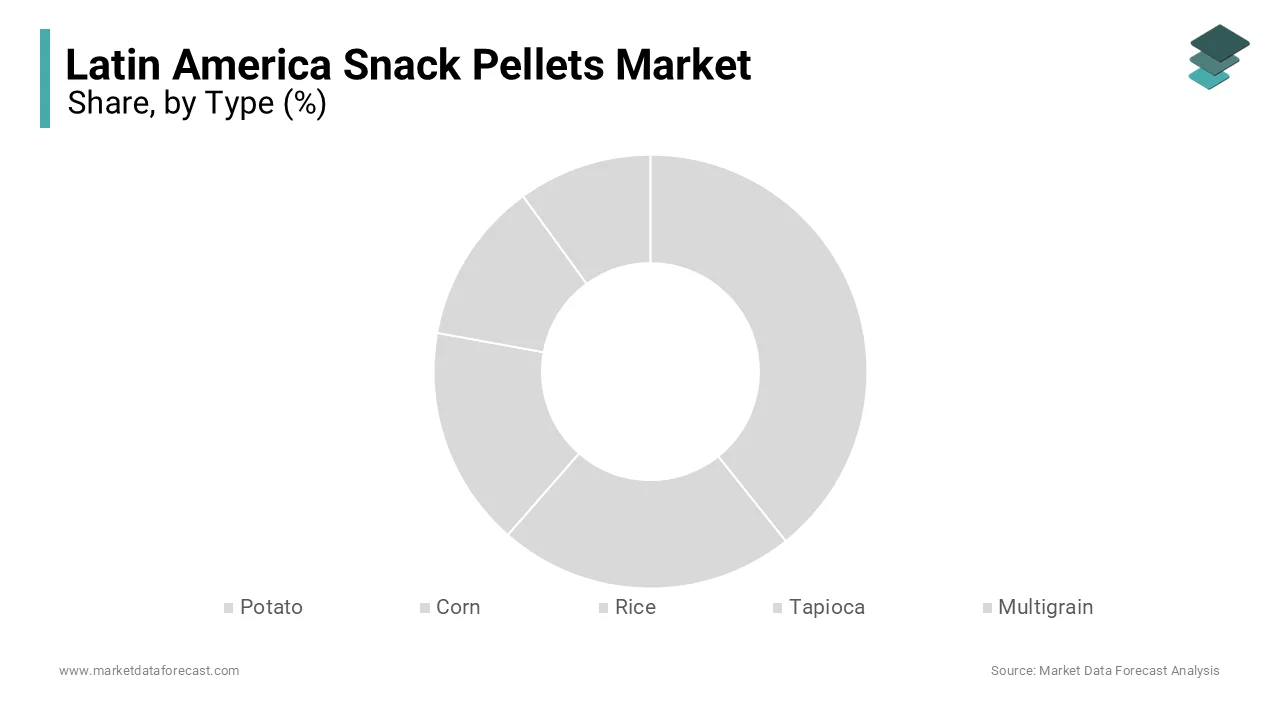
The multigrain segment is anticipated to witness the fastest CAGR of 14.2% between 2026 and 2034 owing to the rising consumer demand for healthier and more nutritious snack alternatives. The primary growth driver is the increasing awareness of dietary fiber and protein benefits leading consumers to seek snacks made from blends of quinoa amaranth oats and legumes. Manufacturers are responding by developing pellets that combine traditional grains with nutrient dense superfoods native to Latin America. These products appeal to health conscious millennials and parents looking for better options for their children. The premium positioning of multigrain snacks allows for higher profit margins encouraging innovation and marketing investment. Retailers are dedicating more shelf space to healthy snacks further boosting visibility. Additionally the gluten free nature of many multigrain blends attracts individuals with celiac disease or gluten sensitivity expanding the target audience. As functional food trends gain momentum the multigrain segment is poised for rapid expansion outpacing traditional single grain categories.
By Form Insights
In 2025, the die-face segment held the majority share of the Latin America snack pellets market because of its simplicity versatility and widespread use in producing classic snack shapes. One of the major factors behind this growth is the ease of manufacturing and the ability to create uniform consistent products that fry evenly and predictably. This form allows for quick customization of shapes by simply changing the die plate enabling producers to offer variety without significant retooling expenses. The familiar texture and appearance of die-face snacks align with consumer expectations for traditional fried treats. Furthermore the high expansion ratio achieved through die-face extrusion maximizes yield per kilogram of raw material improving economic efficiency for producers. The robustness of these pellets during transport and storage reduces breakage and waste. Their compatibility with various seasoning application methods ensures strong flavor adherence. The informal sector remains a significant contributor to snack consumption in Latin America. Consequently, the dominance of die-face pellets continues to be reinforced by their practicality and affordability.
The tridimensional segment is likely to experience the fastest CAGR of 12.8% during the forecast period owing to the demand for novel textures and premium snack experiences. The main factor pushing this segment forward is the innovation in snack design where complex shapes such as shells pillows and twisted forms offer a unique mouthfeel and visual appeal that differentiates products in crowded retail shelves. These shapes often trap more seasoning and provide a crunchier texture which enhances sensory satisfaction. The production of tridimensional pellets requires sophisticated twin screw extruders and precise process control which raises barriers to entry but also creates a premium product category. Large industrial players are leveraging this form to launch high margin branded products that compete with imported specialties. The aesthetic appeal of 3D snacks makes them popular for party mixes and premium retail packs. As manufacturing capabilities improve and costs decrease, more producers are adopting this form. This allows them to diversify their portfolios and meet evolving consumer tastes for novelty and quality.
By Equipment Insights
The single screw extruders segment dominated the Latin America snack pellets market and accounted for a substantial share in 2025. This dominance of the segment was driven by its affordability ease of maintenance and suitability for small to medium scale production units. The primary driver is the prevalence of small and medium sized enterprises and informal food processors who require cost effective solutions to enter the market. These machines are ideal for producing basic die-face pellets and simple shapes using corn or potato starch which dominate local consumption patterns. The technical expertise required to operate single screw extruders is minimal allowing local workers to manage production with basic training. Spare parts are widely available and repairs are straightforward reducing downtime and maintenance costs. For many local brands and street food suppliers the return on investment for single screw technology is faster and less risky. While they offer less flexibility in terms of ingredient complexity compared to twin screw systems they remain the workhorse of the regional industry. Their dominance is sustained by the vast number of small producers who form the backbone of the local snack ecosystem.
The twin screw extruder segment is on the rise and is expected to be the fastest growing segment in the market by witnessing a CAGR of 15.5% from 2026 to 2034. This rapid expansion of the segment is propelled by the industrialization of the snack sector and the demand for complex product formulations. The primary driver is the ability of twin screw extruders to handle a wider variety of ingredients including multigrain blends high protein flours and fresh vegetables which are gaining popularity. These machines allow for precise control over texture density and expansion enabling the creation of premium tridimensional and filled snacks. The efficiency and consistency of twin screw extruders reduce waste and improve yield which is critical for large scale operations. As global brands introduce sophisticated snack concepts to Latin American consumers local producers are upgrading their equipment to compete. The trend toward healthy and functional snacks requires the processing capabilities that only twin screw extruders can provide. Government incentives for modernizing agro industrial infrastructure also encourage adoption. This technological shift marks a transition from traditional low cost production to high value manufacturing driving rapid growth in this segment.
COUNTRY LEVEL ANALYSIS
Brazil led the Latin America snack pellets market and captured a 35.7% share in 2025. This leading position of the Brazilian market was attributed to its massive agricultural base and large consumer population. The country is a global leader in corn and soybean production providing abundant and cheap raw materials for pellet manufacturing. In addition, the Brazilian Food Processors' Association (ABIA) show the total food and beverage manufacturing sector expanded by 8.02%, highlighting robust consumer demand for ready-to-consume foods. The Brazilian Institute of Geography and Statistics (IBGE) demonstrates that household food budgets spent outside the home or on pre-packaged foods now command over one-third of total family food expenditures. Local manufacturers benefit from established supply chains and a wide distribution network reaching both modern retail and informal markets. The presence of major multinational companies alongside vibrant local brands fosters competition and innovation. Government policies supporting agro industrial development further strengthen the sector. However economic volatility and inflation can impact consumer purchasing power. Despite these challenges Brazil remains the central hub for snack production in the region with continuous investments in technology and capacity expansion. The diverse culinary culture also encourages experimentation with new flavors and formats sustaining market dynamism.
Mexico followed closely behind in the Latin America snack pellets market in 2025 because of a strong cultural affinity for corn based snacks and a robust manufacturing infrastructure. The country is the birthplace of maize and has a deep tradition of consuming tortilla chips and similar products which drives consistent demand for corn pellets. Moreover, the National Chamber of the Transformation Industry (CANACINTRA) classify food and beverage manufacturing as a primary industrial sector operating at scaled, internationally aligned baseline standards. Data from the Ministry of Economy indicates that Mexico is a major exporter of snack products to North America leveraging trade agreements to expand its reach. Local producers are increasingly adopting twin screw extrusion technologies to create premium and innovative shapes. The influence of US snack trends accelerates the introduction of new products and flavors. Street food culture remains vibrant providing a steady outlet for traditional pellet based snacks. Regulatory frameworks are well established ensuring food safety and compliance. The proximity to the US market facilitates technology transfer and investment from global players. Mexico’s strategic location and skilled workforce make it a key player in the regional and global snack pellet landscape.
Argentina is a significant player in the Latin America snack pellets market. This success is leveraged by the country's strong agricultural output, particularly in corn and wheat. The country has a well developed food processing industry with a focus on high quality exports and domestic consumption. In addition, the Coordinator of Food Industries Products (COPAL) note that domestic manufacturing has continuously adjusted product lines to sustain output amid shifts in localized consumer purchasing power. Local manufacturers are investing in modern extrusion equipment to produce multigrain and healthy alternatives catering to health conscious consumers. The economic situation poses challenges with currency fluctuations affecting import costs for machinery and packaging. However the devaluation of the peso makes Argentine snacks competitive in export markets. Government support for agro industrial exports helps mitigate domestic economic pressures. The strong tradition of bakery and confectionery extends to savory snacks fostering a culture of snacking. Innovation in flavors using local ingredients like yerba mate or alfajor inspired profiles offers unique differentiation opportunities. Argentina remains a key source of high quality snack pellets for the region.
Chile holds a noteworthy position in the Latin America snack pellets market due to its high regulatory standards and focus on premium quality products. The country has a smaller but sophisticated market driven by health conscious consumers and strict labeling laws. According to the Ministry of Health Chile implemented front of package warning labels which have pushed manufacturers to reformulate products and develop healthier snack options. Local producers are agile in adapting to these regulations often leading the region in clean label innovations. The strong retail sector dominated by large supermarket chains demands high quality and consistent supply from pellet manufacturers. Chile serves as a test market for new health focused snack concepts before regional rollout. Export opportunities to Asia and Europe are explored due to the country’s reputation for food safety. While the market size is smaller than Brazil or Mexico the value per unit is higher. Investment in research and development is prioritized to meet stringent consumer expectations. Chile’s role as a quality leader influences trends across the region.
COMPETITIVE LANDSCAPE
The competitive landscape of the Latin America snack pellets market is characterized by intense rivalry between global multinational corporations and strong regional players. Large companies leverage economies of scale extensive distribution networks and significant marketing budgets to dominate shelf space and brand recognition. Local manufacturers compete by offering affordable products tailored to specific regional tastes and cultural preferences. Innovation in flavors textures and nutritional profiles serves as a key differentiator as consumers become more health conscious. Price competition remains fierce particularly in the informal sector where small vendors operate with low margins. Regulatory pressures regarding labeling and ingredient safety force all participants to adapt quickly and invest in compliance. Strategic partnerships with retailers and food service providers enhance visibility and accessibility. The entry of private label products from major supermarket chains adds another layer of competition pressuring branded players to justify premium pricing. Continuous investment in technology and sustainability initiatives is essential for maintaining long term competitiveness. Market leaders focus on building emotional connections with consumers through targeted campaigns and community engagement. This dynamic environment requires agility and constant innovation to sustain growth and profitability.
KEY MARKET PLAYERS
Some of the key players in the Latin American snack pellets market are
- Intersnack Group GmBH & Co. KG
- J.R. Short Milling Company
- Quality Pellets A/S
- Balance Foods Inc.
- Dalmaza Food Industries Co.
- Grupo Industrial Michel
Top Players in the Market
- PepsiCo maintains a dominant presence in the Latin America snack pellets market through its extensive portfolio of iconic brands such as Sabritas and Cheetos. The company leverages its robust distribution network to reach both modern retail outlets and informal street vendors across the region. Recent strategic actions include investing in local manufacturing facilities in Mexico and Brazil to enhance supply chain efficiency and reduce logistics costs. PepsiCo has also launched initiatives to introduce multigrain and baked pellet options aligning with growing health consciousness among consumers. By partnering with local agricultural suppliers the company ensures a steady source of high quality corn and potatoes. Their focus on sustainable packaging and water conservation further strengthens brand loyalty. These efforts solidify their position as a leader in delivering consistent and innovative snack solutions to diverse consumer segments throughout Latin America.
- Kellogg Company contributes significantly to the Latin America snack pellets market by offering a wide range of ready to eat cereals and savory snacks derived from pellet technology. The company focuses on innovation in flavor profiles and nutritional enhancement to appeal to health aware families. Recent initiatives involve expanding production capabilities for corn based snacks in key markets like Argentina and Colombia. Kellogg has introduced new tridimensional shapes and fortified products to differentiate its offerings from competitors. Strategic partnerships with local distributors help penetrate rural areas where traditional snacks remain popular. The company also invests in digital marketing campaigns to engage younger demographics and promote brand awareness. Kellogg strengthens its reputation by emphasizing quality and convenience. This approach makes it a trusted provider of enjoyable and nutritious snack options for consumers across the region.
- Bimbo operates as a major player in the Latin America snack pellets market leveraging its strong heritage in bakery and confectionery to expand into savory snacks. The company utilizes its vast distribution infrastructure to deliver fresh pellet based products to millions of points of sale daily. Recent actions include acquiring regional snack brands to diversify its portfolio and gain access to local taste preferences. Bimbo has invested in advanced extrusion technologies to produce high quality corn and wheat pellets with improved texture and consistency. The company focuses on affordability and accessibility making its snacks available to a broad socioeconomic spectrum. Initiatives to reduce sodium and artificial additives align with regulatory trends and consumer demands. Grupo Bimbo reinforces its leadership position by combining operational excellence with product innovation. Consequently, this drives growth in the competitive Latin American snack landscape.
Top Strategies Used by Key Market Participants
Key players in the Latin America snack pellets market primarily focus on product innovation and supply chain optimization to maintain competitive advantage. Companies invest heavily in research and development to create healthier alternatives such as multigrain and baked pellets that meet evolving consumer preferences. Expanding distribution networks into rural and informal markets ensures broader reach and increased sales volume. Strategic acquisitions of local brands help multinational corporations gain insight into regional tastes and strengthen market presence. Implementing sustainable practices in sourcing and packaging enhances brand reputation and complies with regulatory standards. Collaborating with local farmers secures raw material supply and supports community development. Digital marketing campaigns target younger demographics to build brand loyalty and drive engagement. Cost management through efficient manufacturing processes allows companies to offer competitive pricing in price sensitive markets. These multifaceted strategies enable participants to navigate challenges and capitalize on growth opportunities in the dynamic regional environment.
MARKET SEGMENTATION
This research report on the Latin America snack pellets market has been segmented and sub-segmented based on the following categories.
By Type
- Potato
- Corn
- Rice
- Tapioca
- Multigrain
By Form
- Laminated
- Tri dimensional
- Die-face
- Gelatinized
By Equipment
- Twin Screw Extruder
- Single Screw Extruder
By Country
- Brazil
- Mexico
- Argentina
- Rest of Latin America