- Product Description Description
- Table of Contents TOC
- List of Table & Figure LOT
- Get Free Sample PDF Sample PDF
Market Size, 2025
$52.87 MnMarket Estimate, 2026
$60.20 MnMarket Forecast, 2034
$170.04 MnCAGR, 2026–2034
13.86%Executive Summary: Latin America Soil Moisture Monitoring System Market
- Market Scope: Comprehensive regional analysis of the Latin American soil moisture monitoring system market covering sensor types, applications, country-level insights, precision agriculture integration, and water resource management trends.
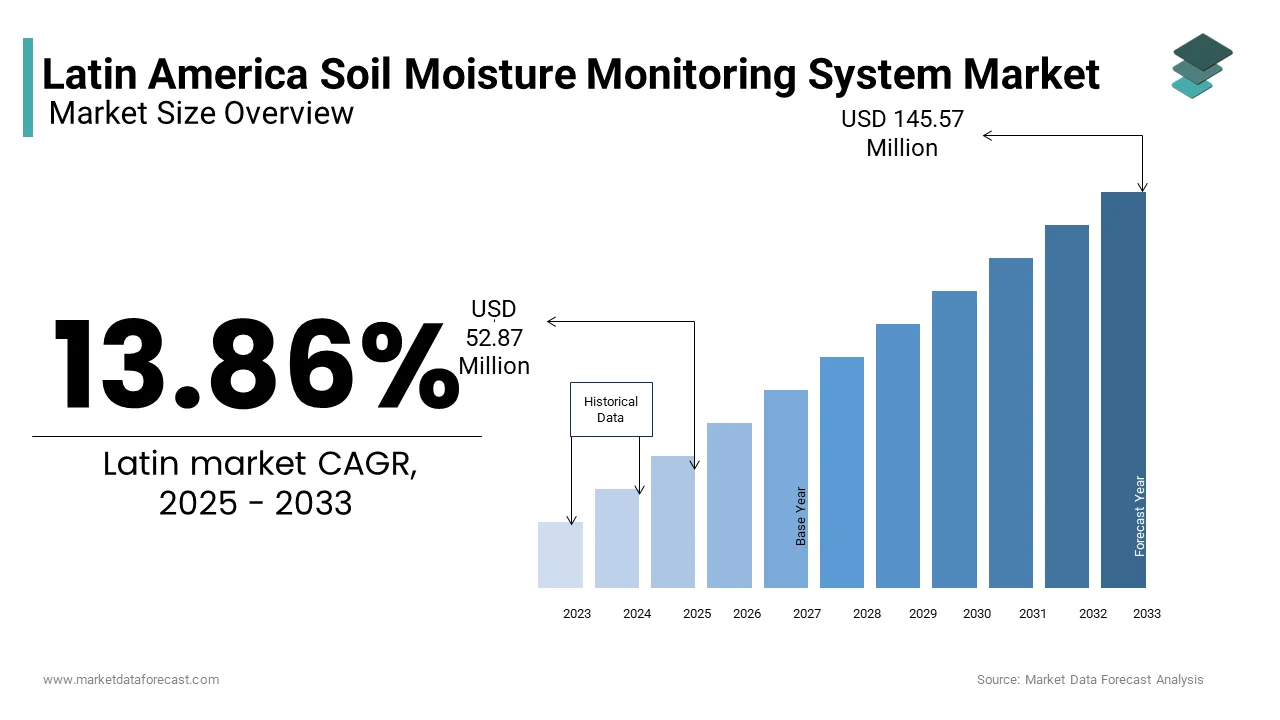
- Market Valuation: Valued at USD 52.87 million (2025), estimated at USD 60.20 million (2026), and projected to reach USD 170.04 million by 2034, registering a strong CAGR of 13.86% (2026–2034).
- Primary Growth Drivers: Escalating frequency and intensity of regional droughts; high freshwater consumption in agriculture; and the rapid adoption of precision farming technologies supported by government initiatives.
Key Market Segment Metrics (2026–2034)
| Category | Leading Segment (2025 Position) | Fastest-Growing Segment / Country |
|---|---|---|
| By Type | Granular Matrix Sensors System (held 39.2% market share in 2025 due to cost-effectiveness and reliability in loamy and sandy soils) | FullStop System (projected to grow with a 15.7% CAGR driven by high accuracy demands from research institutions and high-value crop producers) |
| By Application | Agriculture (dominated by capturing 58.3% of the share in 2025 due to pressing needs for irrigation optimization and drought tracking) | Environmental Protection (exhibiting a 14.5% CAGR from 2025 to 2033 owing to wildfire risk mitigation and wetland restoration) |
| By Country | Brazil (held 32.1% market share in 2025, driven by vast agricultural lands, federal incentives like the ABC Program, and EMBRAPA initiatives) | Argentina & Chile (experiencing solid growth backed by sustainable agriculture policies and modern vineyard/greenhouse technologies) |
Major Market Players & Market Structure
Market Structure: Highly competitive landscape featuring established environmental sensor manufacturers and technology providers focusing on IoT telemetry, wireless data integration, and regional calibrations.
Key Companies: Stevens Water Monitoring Systems, Campbell Scientific, Sentek Technologies, Delta-T Devices, Hebei Fei Meng Electric Technology, China Huayun Group, McCrometer, Isaacs & Associates, Eco-Drip, and Lindsay.
Latin America Soil Moisture Monitoring System Market Size
The Latin America soil moisture monitoring system market size was valued at USD 52.87 million in 2025 and is anticipated to reach a valuation of USD 60.20 million in 2026 and USD 170.04 million by 2034, growing at a CAGR of 13.86%, from 2026 to 2034.
The soil moisture monitoring system is a range of tools, including capacitance sensors, time-domain reflectometry (TDR), tensiometers, and satellite-based remote sensing platforms that provide real-time or near-real-time data on soil moisture levels. According to the Food and Agriculture Organization (FAO), agriculture accounts for more than 70% of freshwater withdrawals in several Latin American countries, which is making efficient water use a pressing concern. Brazil has integrated soil moisture monitoring into its national agricultural modernization strategy, especially in the Cerrado and São Paulo region, where large-scale soybean and sugarcane production occurs. Meanwhile, Mexico and Chile are leveraging IoT-enabled monitoring solutions to improve vineyard and orchard productivity.
MARKET DRIVERS
Increasing Frequency of Droughts and Water Scarcity Across the Region
The escalating frequency and intensity of droughts, which have severely impacted agricultural productivity and water availability, are driving the growth of the Latin America Soil Moisture Monitoring System Market. According to the World Meteorological Organization (WMO), Latin America experienced four major regional drought events between 2020 and 2023, which are affecting millions of hectares of farmland and leading to substantial yield losses in staple crops such as maize, soybeans, and coffee. These climatic extremes have heightened awareness among farmers and policymakers about the necessity of adopting precision tools to manage soil health and irrigation practices effectively. Additionally, international organizations such as the International Water Management Institute (IWMI) have supported pilot programs promoting sensor-based irrigation in Central America, further reinforcing the demand for soil moisture monitoring systems across the region.
Rising Adoption of Precision Agriculture Technologies
Precision agriculture is rapidly gaining traction across Latin America with the need to enhance farm efficiency, reduce input costs, and improve yield outcomes. Soil moisture monitoring systems are integral components of this agricultural transformation, providing actionable data that supports automated irrigation, variable rate fertilization, and crop health monitoring. In Brazil, the Ministry of Agriculture has actively promoted smart farming through subsidies and technology demonstration zones, particularly in Mato Grosso and Goiás. Moreover, the expansion of rural broadband and mobile connectivity has made it easier for farmers to deploy wireless soil sensors and access cloud-based analytics. As per the International Telecommunication Union (ITU), mobile internet penetration in rural areas of Colombia and Ecuador exceeded 65% in 2023, which is facilitating the widespread use of IoT-enabled monitoring systems.
MARKET RESTRAINTS
High Initial Investment Costs and Limited Access to Financing
The high initial investment costs are a significant barrier to widespread adoption, particularly among small and medium-sized farms across Latin America, which is hindering the growth of the Soil Moisture Monitoring System Market. In many developing countries within the region, including Bolivia, Guatemala, and Honduras, access to affordable financing remains limited. Technical complexity also poses a challenge. Farmers must not only invest in hardware but also acquire the skills necessary to interpret and act upon the collected data.
Limited Awareness and Technical Expertise Among Rural Farmers
The limited awareness and inadequate access to technical training in rural agricultural communities also restrict the growth of the Latin American Soil Moisture Monitoring System Market. While urban centers and large agribusinesses benefit from robust extension services and industry partnerships, many rural and family-run farms lack exposure to emerging technologies and best practices for their implementation. Furthermore, extension programs, which traditionally served as conduits for agricultural education that have seen budget cuts and reduced staffing in recent years, limiting their outreach capacity. Additionally, language barriers and digital divide issues persist in certain regions. Many educational resources and software interfaces are available exclusively in Spanish or Portuguese, posing challenges for indigenous-speaking farmers.
MARKET OPPORTUNITIES
Integration with Smart Irrigation Systems and AI-Powered Analytics
The integration of these systems with smart irrigation and AI-powered analytics platforms is fuelling the growth of the Latin American soil Moisture Monitoring System Market. Modern irrigation controllers can now receive real-time soil moisture data and automatically adjust water delivery schedules to match crop needs, significantly improving water-use efficiency. According to the International Commission on Irrigation and Drainage (ICID), smart irrigation systems can reduce water consumption by up to 40% when paired with accurate soil moisture feedback. Leading agritech firms such as Netafim Latin America and Jain Irrigation Systems have already introduced adaptive irrigation controllers that integrate seamlessly with soil moisture sensors. These systems use predictive algorithms to analyze weather forecasts, evapotranspiration rates, and historical data to optimize irrigation cycles. Artificial intelligence further enhances the value proposition of soil moisture monitoring by enabling predictive analytics. Startups like Satellogic and Arable are developing AI-driven platforms that combine soil moisture readings with satellite imagery and drone data to generate hyper-localized recommendations.
Expansion of Government Programs Supporting Sustainable Farming Practices
The government-backed sustainability initiatives are creating fertile ground for the expansion of the Latin American Soil Moisture Monitoring System Market. Several countries in the region have launched targeted programs aimed at promoting resource-efficient farming practices, with soil moisture monitoring playing a central role. In Brazil, the Ministry of Agriculture has allocated over BRL 2 billion under the ABC Program (Low Carbon Agriculture Plan) to promote micro-irrigation and sensor-based water management. In Central America, Costa Rica’s Ministry of Agriculture and Livestock has partnered with private sector players to roll out pilot projects integrating soil moisture data into coffee cultivation advisory services. The FAO has also launched a digital farming initiative targeting 500,000 farmers by 202, incorporating sensor-based irrigation planning.
MARKET CHALLENGES
Variability in Sensor Accuracy and Data Interpretation Across Different Soil Types
The variability in sensor accuracy and data interpretation across different soil types is restricting the growth of the Latin American Soil Moisture Monitoring System Market. Soil composition varies widely from sandy loam in the Cerrado to heavy clay soils in the Andean highland, each influencing how moisture is retained and measured. Field tests conducted by the Universidad de Buenos Aires revealed discrepancies of up to 20% in moisture readings between identical sensors placed in varying soil textures. As per a white paper published by the FAO, calibration standards tailored to specific regional soil profiles are still lacking, impeding widespread trust in sensor reliability.
Interoperability Issues Between Monitoring Devices and Farm Management Platform
Interoperabilityty is another challenge for the growth of the Latin American Soil Moisture Monitoring System Market. Farmers today often deploy multiple technologies from GPS-guided tractors to nutrient management apps, but face difficulties when attempting to consolidate soil moisture data with these systems. This fragmentation forces users to manually transfer data between systems, increasing the risk of errors and diminishing operational efficiency. Efforts are underway to standardize agricultural data exchange through initiatives like the Open Ag Data Alliance (OADA) and the AgGateway consortium, but widespread adoption remains slow. As per the Food and Agriculture Organization (FAO), achieving full interoperability could take another five to seven years.
REPORT COVERAGE
| REPORT METRIC | DETAILS |
| Market Size Available | 2025 to 2034 |
| Base Year | 2025 |
| Forecast Period | 2026 to 2034 |
| CAGR | 13.86% |
| Segments Covered | By Type, Application, and Region. |
| Various Analyses Covered | Global, Regional, and Country Level Analysis, Segment-Level Analysis, DROC, PESTLE Analysis, Porter’s Five Forces Analysis, Competitive Landscape, Analyst Overview of Investment Opportunities |
| Regions Covered | Brazil, Chile, Argentina, Mexico, and Colombia, etc |
| Market Leaders Profiled | Stevens Water Monitoring Systems, Hebei Fei Meng Electric Technology, Campbell Scientific, China Huayun Group, McCrometer, Isaacs & Associates, Eco-Drip, Lindsay. |
SEGMENTAL ANALYSIS
By Type Insights
The granular matrix sensors system segment was accounted for, holding 39.2% of the Latin America Soil Moisture Monitoring System Market share in 2025, with the widespread adoption of this technology across precision agriculture and environmental monitoring applications due to its reliability, ease of installation, and cost-effectiveness compared to other sensor types. According to the Food and Agriculture Organization (FAO), over 50% of cultivated land in Latin America consists of loamy and sandy soils, where granular matrix sensors deliver consistent readings without frequent recalibration. This adaptability makes them ideal for large-scale agricultural deployment in countries like Brazil and Mexico, where water resource management is a pressing concern.
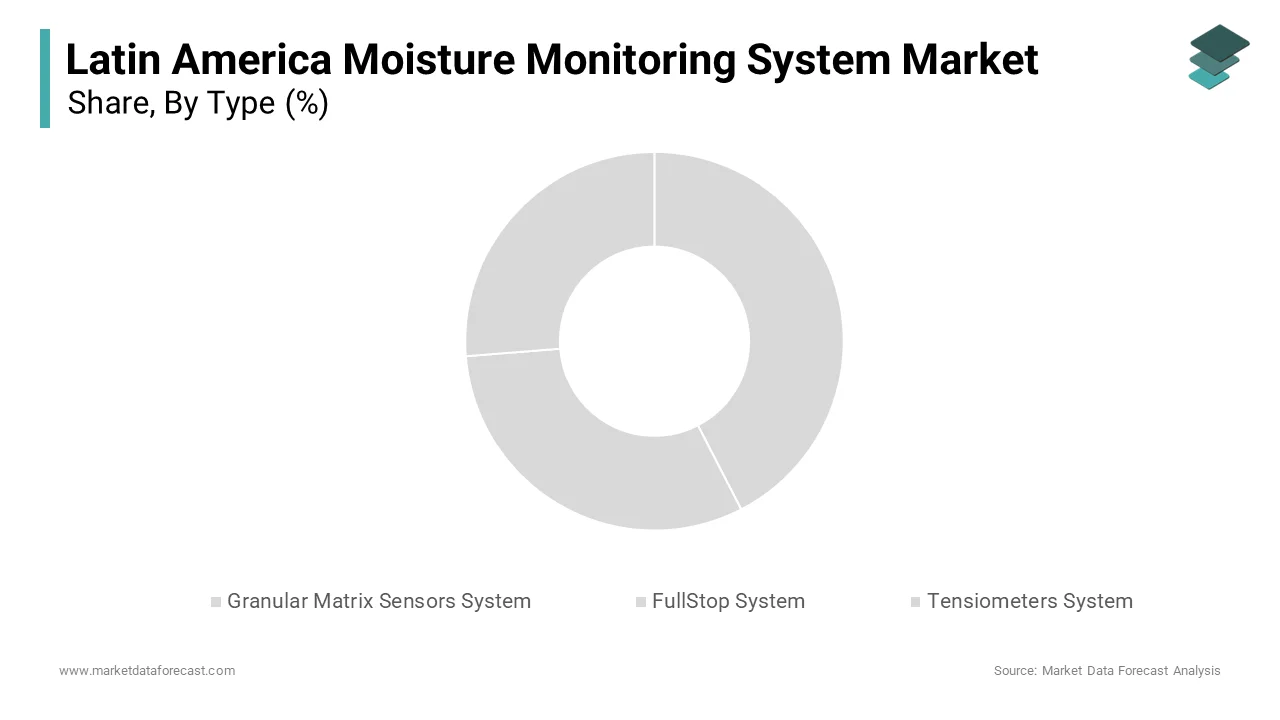
The FullStop System segment is swiftly emerging with a CAGR of 15.7% in the coming years, with the system’s high accuracy and minimal maintenance requirements by making it increasingly popular among research institutions and high-value crop producers seeking precise irrigation control. FullStop systems are particularly well-suited for hydroponic and vertical farming setups due to their ability to detect minute changes in soil moisture and prevent overwatering, which can lead to root diseases. Additionally, technological advancements in wireless connectivity and automated feedback loops have enhanced the usability of FullStop systems. Companies such as Sentek Technologies and Delta-T Devices have introduced versions equipped with Bluetooth and LoRaWAN capabilities, allowing seamless integration with farm automation systems.
By Application Insights
The agriculture segment dominated the Latin America Soil Moisture Monitoring System Market with 58.3% of share in 2025, with the increasing pressure on farmers to enhance water-use efficiency amid growing drought frequency According to the World Meteorological Organization (WMO), more than 55% of Latin America experienced moderate to extreme drought conditions in 2023, which is prompting growers to adopt real-time soil moisture tracking as a means of conserving water resources.
The expansion of precision agriculture technologies across large-scale commercial farms is driving the growth of the Latin American soil Moisture Monitoring System Market. The International Food Policy Research Institute (IFPRI) reports that over 20% of medium to large farms in South America now use some form of precision agriculture tool, including soil moisture sensors, to guide decision-making. Additionally, government incentive programs such as Brazil’s Low Carbon Agriculture Plan and Mexico’s National Strategy for Climate-Smart Agriculture support the adoption of these technologies.
COUNTRY ANALYSIS
The Environmental Protection segment is likely to grow with a CAGR of 14.5% from 2025 to 2033, with the rising focus on wildfire risk mitigation and forest health monitoring, particularly in drought-prone regions like central Brazil, northern Argentina, and parts of Chile. According to the Food and Agriculture Organization (FAO), more than 6 million hectares of forest were affected by wildfires in Latin America between 2020 and 2023. In addition, urban planning and stormwater management programs are increasingly integrating soil moisture monitoring systems to prevent flooding and manage green infrastructure. Similarly, countries like Colombia and Peru are investing in sensor-based monitoring to assess wetland restoration efforts and groundwater recharge rates.
Brazil
Brazil Soil Moisture Monitoring System Market held 32.1% of the share in 2025, with the country’s vast agricultural landscape, escalating water scarcity concerns, and proactive policy frameworks aimed at enhancing irrigation efficiency and climate resilience. The widespread adoption of precision agriculture technologies in major crop-producing states such as Mato Grosso, Goiás, and São Paulo is escalating the growth of the market. According to EMBRAPA (Brazilian Agricultural Research Corporation), over 18% of Brazilian farms had integrated precision agriculture tools by 2023, with soil moisture monitoring systems playing a central role in irrigation scheduling and crop health assessments. The availability of federal incentives, such as the Low Carbon Agriculture Plan (ABC), has further encouraged farmers to invest in sensor-based technologies. Additionally, the intensifying frequency of droughts and declining groundwater levels has heightened demand for real-time soil moisture data.
Argentina
Argentina Soil Moisture Monitoring System Market is expected to grow with prominent growth opportunities during the forecast period, with the recurrent drought conditions affecting major agricultural zones such as the Pampas and Patagonia regions, which together produce over 60% of Argentina’s grain output, according to the Ministry of Agroindustry. These events have prompted both government and private sector stakeholders to prioritize soil moisture monitoring as a tool for adaptive water management. Under the National Program for Sustainable Agriculture, over ARS 15 billion has been allocated between 2023 and 2025 to promote digital farming and water-saving irrigation technologies, including investments in precision irrigation and soil health monitoring. Moreover, academic institutions such as the Universidad de Buenos Aires and INTA have launched research programs focused on integrating soil moisture data into predictive agronomic models.
Mexico
Mexico Soil Moisture Monitoring System Market growth is likely to grow in the coming years, as the growing adoption of soil moisture monitoring systems is being driven by persistent water scarcity issues, increasing reliance on greenhouse farming, and growing government support for sustainable farming practices. Additionally, national water management policies and government-led digital farming initiatives are encouraging the adoption of sensor-based irrigation systems. Agritech companies and research institutions such as the Colef and Tecnológico de Monterrey are actively involved in developing region-specific soil moisture monitoring solutions.
ChileThe
Chile Soil Moisture Monitoring System Market is expected to grow in the coming years with the precision agriculture and controlled-environment farming. Chilean vineyards cover over 120,000 hectares, which produce a significant portion of the nation’s agricultural exports, as reported by the Chilean Agricultural Service (SAG). These highly managed environments require continuous soil moisture monitoring to maintain optimal growing conditions while minimizing water waste. The Ministry of Agriculture has also promoted the adoption of smart irrigation systems through various subsidies and research initiatives. Additionally, the strong presence of agritech startups and global agri-food corporations has fostered a favorable ecosystem for innovation in soil moisture monitoring. Companies such as Netafim Chile and Satellogic have developed cutting-edge sensor technologies tailored for intensive farming applications. Furthermore, Chile’s extensive network of agricultural knowledge institutes supports ongoing R&D in sensor calibration, data analytics, and AI-driven irrigation optimization.
ColombiaThe
Colombia Soil Moisture Monitoring System Market is expected to grow prominently during the forecast period. The country’s market growth is being driven by persistent water scarcity issues, increasing reliance on specialty crops, and growing government support for sustainable farming practices. In 2023, the Institute of Hydrology, Meteorology and Environmental Studies (IDEAM) reported that several river basins experienced historically low flow levels, which is leading to restrictions on irrigation water access. Additionally, national water management policies and international development programs are encouraging the adoption of sensor-based irrigation systems. Under the Digital Agriculture Transformation Plan, over COP 2 trillion has been allocated between 2023 and 2027 to modernize agricultural infrastructure and promote water-saving technologies. Agritech companies and research institutions such as Cenicaña and the University of Antioquia are actively involved in developing region-specific soil moisture monitoring solutions.
KEY MARKET PLAYERS
Stevens Water Monitoring Systems, Hebei Fei Meng Electric Technology, Campbell Scientific, China Huayun Group, McCrometer, Isaacs & Associates, Eco-Drip, Lindsay. Are the market players that are dominating the Soil Moisture Monitoring System Market?
Top Players In The Market
Campbell Scientific is known for its high-quality environmental monitoring equipment. The company provides durable and precise soil moisture sensors widely used in agricultural, hydrological, and climate research applications across the region. Campbell Scientific plays a vital role in supporting scientific studies and large-scale irrigation projects in countries such as Brazil, Argentina, and Chile, contributing to global advancements in climate resilience and water resource management.
Another key player is Sentek Technologies, recognized for its innovative multi-depth soil moisture probes that offer accurate insights into soil water dynamics. Sentek’s solutions are extensively adopted in precision agriculture, helping farmers across Latin America optimize irrigation practices and improve crop yields. Their technology has been instrumental in promoting sustainable farming methods globally in regions facing water scarcity and changing climatic conditions.
Delta-T Devices is also a major contributor to the market by offering advanced soil moisture monitoring systems tailored for both field agriculture and scientific research. The company emphasizes reliability, ease of integration, and long-term performance, making its products popular among researchers, agronomists, and farm managers across Latin America. Delta-T Devices continues to influence global trends in soil health monitoring and smart irrigation through continuous innovation and technical support.
Top Strategies Used by Key Market Participants
Key players in the Latin American soil Moisture Monitoring System Market are leveraging product innovation and technological integration to enhance functionality and usability. Companies are embedding IoT capabilities, wireless connectivity, and cloud-based analytics into their monitoring systems to provide real-time actionable insights for farmers and researchers across diverse agro-climatic zones.
Another major strategy involves strategic partnerships and collaborations with agricultural institutions and government agencies. Companies can align product development with user needs while also expanding awareness and adoption among end-users, especially smallholder farmers, by working closely with research organizations and extension services.
Additionally, firms are emphasizing localized product development and customer education programs to improve accessibility and ease of use. Training initiatives, digital platforms, and on-field demonstrations help bridge knowledge gaps by ensuring broader market penetration and long-term customer retention, particularly in rural and semi-urban areas across the region.
COMPETITION OVERVIEW
The competition in the Latin America Soil Moisture Monitoring System Market is marked by a dynamic mix of established industry leaders and agile emerging players striving to capture a larger share through differentiation in technology, application adaptability, and service excellence. As demand for precision agriculture and environmental monitoring grows, companies are intensifying efforts to develop more accurate, durable, and scalable solutions tailored to diverse soil types and climatic conditions. While dominant firms leverage their brand reputation and extensive distribution networks, newer entrants are gaining traction through niche product portfolios and agile R&D strategies. The market landscape is also shaped by strategic collaborations, mergers, and acquisitions aimed at enhancing technical capabilities and geographic reach. Additionally, the increasing emphasis on sustainability and resource efficiency has prompted vendors to focus on interoperability with farm automation systems, further intensifying competitive dynamics. This evolving environment fosters continuous innovation, which is driving advancements that benefit both commercial agriculture and environmental conservation sectors across the region.
RECENT HAPPENINGS IN THE MARKET
- In February 2024, Campbell Scientific launched an enhanced line of low-power, wireless soil moisture sensors designed for remote deployment in agricultural and ecological research settings, which improves data accuracy and transmission reliability across rural Latin America.
- In May 2024, Sentek Technologies expanded its presence in Central America by establishing a regional office in Costa Rica that aimed at strengthening customer support and facilitating faster deployment of monitoring systems for local farmers and agritech partners.
- In July 2024, Delta-T Devices introduced a new calibration service tailored specifically for Latin American soil types by enhancing sensor performance and reliability across different agricultural zones and climatic conditions.
- In October 2024, Arable partnered with a leading Brazilian agronomy institute to integrate its all-in-one soil and weather monitoring device into national irrigation advisory programs, which is increasing adoption among public and private sector users.
- In December 2024, Teralytic unveiled a modular soil moisture and nutrient sensing system compatible with existing farm automation platforms in Argentina by enabling seamless integration for precision irrigation and fertilization planning across diverse farming landscapes.
MARKET SEGMENTATION
This research report on the Latin American soil moisture monitoring market is segmented and sub-segmented into the following categories.
By Type
- Granular Matrix Sensors System
- FullStop System
- Tensiometers System
By Application
- Environmental protection
- Agriculture
- Sandstorm Warning
- Others
By Country
- Brazil
- Argentina
- Mexico
- South America