- Product Description Description
- Table of Contents TOC
- List of Table & Figure LOT
- Get Free Sample PDF Sample PDF
Market Size, 2025
$2.65 BnMarket Estimate, 2026
$2.84 BnMarket Forecast, 2034
$4.93 BnCAGR, 2026–2034
7.13%Latin America Titanium Dioxide Market Size
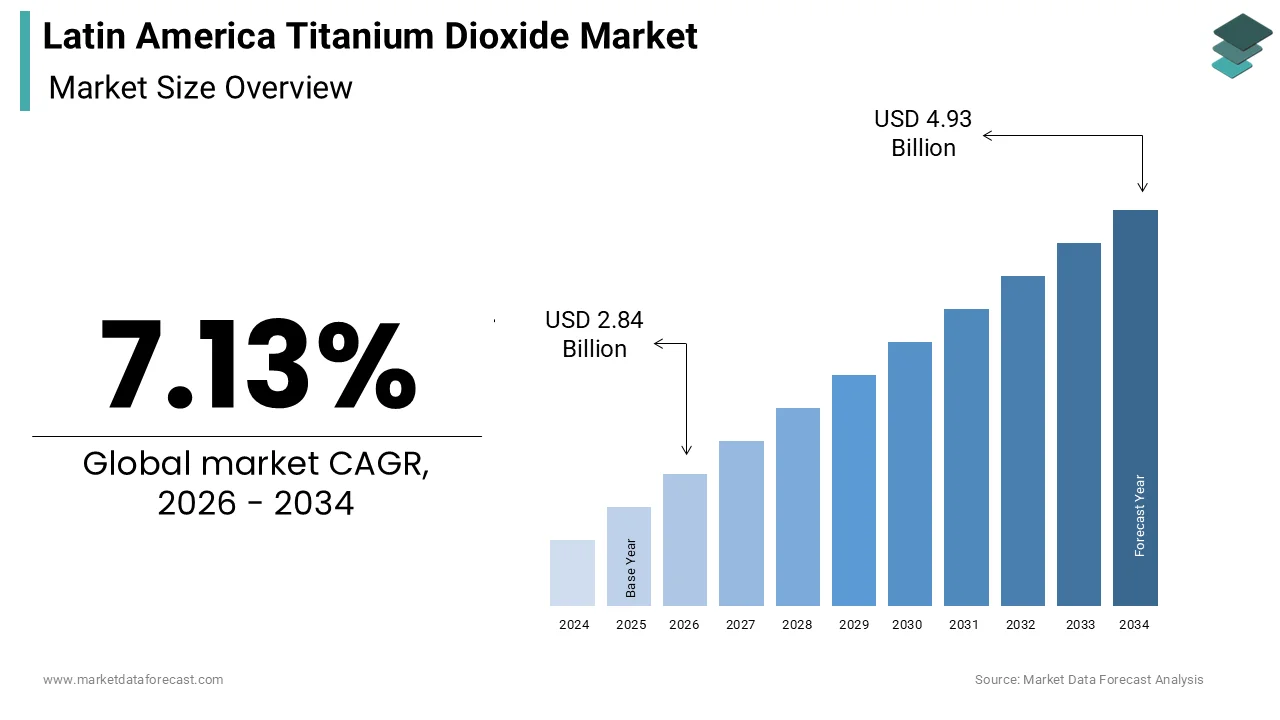
The Latin America titanium dioxide market was valued at USD 2.65 billion in 2025 and is anticipated to reach a valuation of USD 2.84 billion in 2026, from USD 4.93 billion by 2034, growing at a CAGR of 7.13% during the forecast period from 2026 to 2034.
MARKET OVERVIEW
The growth of the market is primarily driven by the construction sector, which uses a vast amount of Titanium Dioxide in paints, varnishes, and coatings. Construction and allied activities compose roughly 80% of Latin America's Titanium Dioxide consumption. The paper and Plastics industry is the next highest consumer of Titanium Dioxide. Titanium Dioxide extraction involves processes that are harmful to the environment, and hence its extraction has become a costly affair in Developed countries where environmental regulations are stringent and are strictly implemented. For this reason, several countries are investing in environmentally friendly ways to extract Titanium Dioxide.
REPORT COVERAGE
| REPORT METRIC | DETAILS |
| Market Size Available | 2025 to 2034 |
| Base Year | 2025 |
| Forecast Period | 2026 to 2034 |
| CAGR | 7.13% |
| Segments Covered | By Grade, Application and Region |
| Various Analyses Covered | Global, Regional, & Country Level Analysis; Segment-Level Analysis, DROC; PESTLE Analysis, Porter’s Five Forces Analysis; Competitive Landscape; Analyst Overview of Investment Opportunities |
| Regions Covered | Brazil, Argentina, Chile and Rest of Latin America |
| Market Leaders Profiled | Huntsman, Chemours, Kronos, Tronox, Venator, Lomon Billion, Argex Titanium Inc. |
SEGMENTATION ANALYSIS
By Application Insights
Ilmenite is more widely available than Rutile, and Ilmenite reserves are estimated at 700,000 metric tons, while Rutile is estimated at 48,000 tons. Most of the Titanium Dioxide reserves are located in Australia, China, India, and South Africa.
Titanium Dioxide is commonly used as a white pigment and thickener in many dyes, paints, varnishes, coatings, paper, plastics, soaps, and creams. This area of the market is set to grow in the coming years due to the construction boom in the developing areas of Latin America. It is also used in sunscreen lotions for its UV light-absorbing characteristics. It is used in tablets, toothpaste, and other food and health products for its white color. The growing middle class of the developing world, with its ever-increasing appetite for quality products, is expected to drive the Titanium Dioxide Market Growth.
KEY MARKET PLAYERS
Huntsman, Chemours, Kronos, Tronox, Venator, Lomon Billion, and Argex Titanium Inc. are the market players that dominate the players in Latin American titanium dioxide market.
MARKET SEGMENTATION
This research report on the Latin American titanium dioxide market is segmented and sub-segmented into the following categories.
By Grade
- Ilmenite
- Rutile
By Application
- Paints, Varnishes
- cosmetic products
- Paper and Plastics
- Healthcare,
- Food Industry
By Country
- Brazil
- Argentina
- Mexico