- Product Description Description
- Table of Contents TOC
- List of Table & Figure LOT
- Get Free Sample PDF Sample PDF
Market Size, 2025
$12.38 BnMarket Estimate, 2026
$13.13 BnMarket Forecast, 2034
$21.08 BnCAGR, 2026–2034
6.09%Latin America Trifluralin Market Size, Share, Trends & Forecast (2026–2034)
- Market Scope: Comprehensive market analysis of the Latin American trifluralin market covering product types, crop applications, weed targets, country-level adoption dynamics, and agricultural sector development drivers.
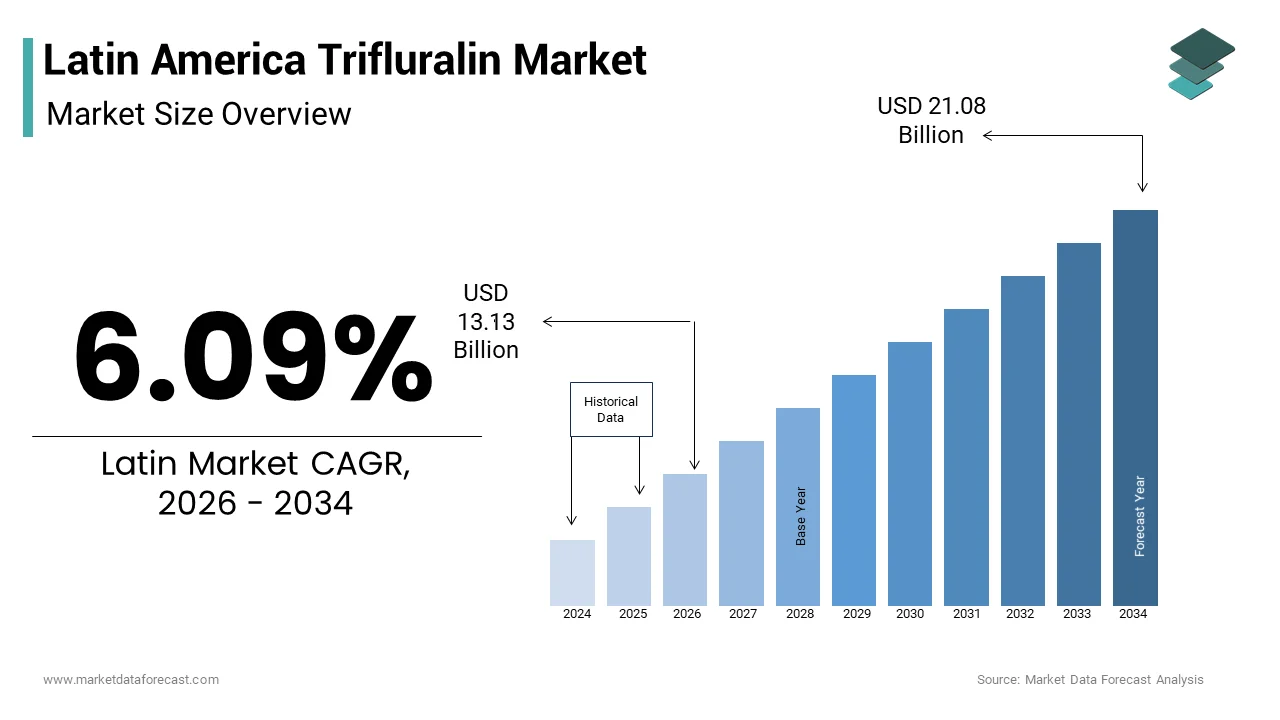
- Market Valuation: Valued at USD 12.38 billion (2025), estimated at USD 13.13 billion (2026), and projected to reach USD 21.08 billion by 2034, growing at a compound annual growth rate (CAGR) of 6.09% (2026–2034).
- Primary Growth Drivers: Rapid expansion of agricultural sectors across key economies (such as Brazil and Argentina), surging demand for efficient herbicide solutions that reduce weed-removal time, and rising adoption of chemical weed control in crop management.
Latin America Trifluralin Market Segment Metrics (2026–2034)
| Category | Leading Segment (2025 Position) | Fastest-Growing Segment |
|---|---|---|
| By Crop | Field Crops (dominant market share for extensive agricultural commodity production) | Fruit & Vegetable Crops (driven by high-value specialty horticulture) |
| By Type | Miscible Oil / Emulsifying Concentrate (widely preferred for liquid spray application) | Granular (GR) Formulations (expanding via modern precision farming practices) |
| By Application | Annual Grasses & Broadleaf Weed Control (essential for pre-emergence crop protection) | Specialized Weed Target Segments (spurrey, wireweed, and fathen management) |
| By Country / Region | Brazil & Argentina (holding the largest regional shares due to massive grain and oilseed acreage) | Mexico & Chile (accelerating through modernized commercial farming operations) |
Major Industry Players & Market Structure
Market Structure: Competitive regional landscape featuring global agrochemical leaders and chemical manufacturers navigating substitute competition, environmental toxicity constraints, and large-scale distribution networks.
Key Companies: Shandong Qiaochang Chemical Co., Ltd., Chongqing Shurong, Shenzhen Sunrising Industry Co., Ltd., BASF, Jiangsu Fengshan Group Co., Ltd., and Dow Chemical Company.
Latin America Trifluralin Market Size
The Latin America trifluralin market size will reach USD 12.38 billion in 2025 and is anticipated to reach USD 13.13 billion in 2026 to reach USD 21.08 billion by 2034, growing at a CAGR of 6.09% from 2026 to 2034. The Latin American trifluralin market is developing at a rapid pace.
Trifluralin is treated sewage sludge that is intended to be used as a soil conditioner. These are considered organic solids, which are derived from the sewage treatment processes. They are rich in minerals and nutrients and are used in various sectors, ranging from agriculture to energy production. Mostly,y they are used as a natural fertilizer. Trifluralin has major applications in the sectors of agriculture, energy recovery, mine reclamation, water treatment, and crop fertilizer.
The significant drivers are the development of the agricultural sector and the growing demand for herbicides. Trifluralin reduces the time required to remove weeds as compared to other herbicides, thus increasing its demand. The rise in demand for weed-removing chemicals in developed and developing nations is further expected to boost the trifluralin market. Trifluralin is toxtofor aquatic animals, and hence not recommended European Union (Ethe U). However, competition from substitute products and huge costs are proving to be a barrier in the Trifluralin market.
REPORT COVERAGE
| REPORT METRIC | DETAILS |
| Market Size Available | 2025 to 2034 |
| Base Year | 2025 |
| Forecast Period | 2026 to 2034 |
| CAGR | 6.09% |
| Segments Covered | By Crop, Type, Application, And Region. |
| Various Analyses Covered | Global, Regional and Country Level Analysis, Segment-Level Analysis, DROC, PESTLE Analysis, Porter’s Five Forces Analysis, Competitive Landscape, Analyst Overview of Investment Opportunities |
| Regions Covered | Brazil, Argentina, Mexico, Chile and Rest of Latin America |
| Market Leaders Profiled | Shandong Qiaochang Chemical Co., Ltd., Chongqing Shurong, Shenzhen Sunrising Industry Co., Ltd., Chemical Co., Ltd., BASF, Jiangsu Fengshan Group Co., Ltd., and Dow Chemical Company |
KEY MARKET PLAYERS
A few of the market players in the Latin American trifluralin market include
- Shandong Qiaochang Chemical Co., Ltd.
- Chongqing Shurong
- Shenzhen Sunrising Industry Co., Ltd.
- Chemical Co., Ltd.
- BASF
- Jiangsu Fengshan Group Co., Ltd
- Dow Chemical Company
MARKET SEGMENTATION
This research report on the Latin American trifluralin market is segmented and sub-segmented into the following categories.
By Crop
- field crops
- fruit & vegetable crops
By Type
- miscible oil (emulsifying concentrate)
- granular (GR)
By Application
- annual grasses
- wireweed
- spurrey
- father
- others
By Country
- Mexico
- Brazil
- Argentina
- Chile
- Rest of Latin America