- Product Description Description
- Table of Contents TOC
- List of Table & Figure LOT
- Get Free Sample PDF Sample PDF
Market Size, 2025
$580.00 MnMarket Estimate, 2026
$600.00 MnMarket Forecast, 2034
$790.00 MnCAGR, 2026–2034
3.45%Executive Summary: Latin America Turf & Ornamental Inputs Market
- Market Scope: Regional Latin American turf and ornamental inputs market analysis covering irrigation systems, application segments, end-user categories, and regional leadership frameworks.
- Market Valuation: Valued at USD 580 million (2025), estimated at USD 600 million (2026), and projected to reach USD 790 million by 2034, registering a robust CAGR of 3.45% (2026–2034).
- Primary Growth Drivers: Increasing water scarcity and climate variability necessitating efficient irrigation solutions, expansion of high-value crop cultivation, and integration of smart irrigation and IoT technologies. Key challenges include high initial capital investment, supply chain disruptions, and limited technical knowledge among farmers.
Key Market Segment Metrics (2026–2034)
| Category | Leading Segment (2025 Position) | Fastest-Growing Segment |
|---|---|---|
| By Irrigation System | Drip irrigation systems (held the leading share in 2025 due to superior water use efficiency of up to 90%) | Subsurface drip irrigation (SDI) systems (predicted to expand at a CAGR of 9.2%) |
| By Application | Orchard crops and vineyards (led the application segment in 2025) | Greenhouse crops (projected to record a CAGR of 10.4%) |
| By End User | Industrial growers (held the leading position among end users in 2025) | Small and medium-sized farmers (predicted to register a CAGR of 8.2%) |
| By Region / Country | Brazil (expected to expand its dominant position in the regional market over the next few years) | Emerging regional agricultural markets across Latin America |
Major Market Players & Market Structure
Market Structure: Highly competitive agricultural technology landscape featuring major global market leaders focusing on local manufacturing expansion, digital tool integration, government partnerships, and affordable solutions for small-scale farmers.
Key Companies: Jain Irrigation Systems Ltd., Lindsay Corporation, Nelson Irrigation Corporation, The Toro Company, EPC Industries Limited, Valmont Industries Inc., and T-L Irrigation.
 Download Free Sample Report
Latin America Turf & Ornamental Inputs Market
The Latin America turf & ornamental inputs market size was valued at USD 580 million in 2025 and is anticipated to reach a valuation of USD 600 million in 2026 and USD 790 million by 2034, growing at a CAGR of 3.45% from 2026 to 2034.
The turf & ornamental inputs market is a wide range of products used in the maintenance, enhancement, and protection of landscaped areas, golf courses, sports fields, public parks, and residential gardens. These inputs include fertilizers, herbicides, insecticides, fungicides, growth regulators, and soil amendments that are specifically formulated to support plant health, aesthetic appeal, and pest control in ornamental plants and turfgrass. According to the International Fertilizer Association, Brazil alone accounts for over 40% of agricultural and horticultural chemical consumption in Latin America, reflecting its dominant role in shaping regional trends. In addition, as per the Food and Agriculture Organization (FAO), the expansion of green infrastructure projects in cities like Mexico City, Bogotá, and Santiago has led to increased adoption of specialized turf care solutions. The rising number of golf courses and sports complexes, particularly in countries such as Argentina and Peru, further contributes to market momentum. Additionally, consumer interest in sustainable lawn care practices is influencing product development toward organic and bio-based formulations.
MARKET DRIVERS
Expansion of Urban Green Spaces and Landscaping Projects
The increasing development of urban green spaces and landscaping initiatives across major cities is primarily driving the growth of the Latin America Turf & Ornamental Inputs Market. Governments and private developers are investing heavily in beautification programs, recreational parks, and sustainable city planning to enhance environmental quality and improve urban aesthetics. This trend is particularly evident in countries like Colombia and Chile, where municipal authorities have implemented policies mandating green space inclusion in new real estate developments. As per the National Institute of Statistics and Geography (INEGI) in Mexico, urban parkland coverage expanded by nearly 12% in major metropolitan areas between 2020 and 2023. The maintenance of these landscapes requires consistent use of fertilizers, pesticides, and soil conditioners, directly boosting demand for turf and ornamental inputs.
Growth in Golf Course Development and Sports Turf Management
The steady expansion of golf course infrastructure and the increasing focus on maintaining high-quality sports turf are other factors boosting the growth of the Latin America Turf & Ornamental Inputs Market. Countries like Brazil, Argentina, and Costa Rica have witnessed a surge in golf tourism and private club memberships, prompting investments in state-of-the-art turf management systems. According to the World Golf Federation, Latin America added over 120 new golf facilities between 2020 and 2023, with Brazil leading the count at 45 new courses opened during this period.
These facilities require continuous application of specialized fertilizers, growth regulators, and disease control agents to maintain optimal playing conditions throughout the year. As per the Argentine Golf Association, more than 80% of golf clubs in Buenos Aires now employ dedicated agronomists to oversee turf health and sustainability. Similarly, sports stadiums and athletic fields are increasingly adopting advanced turf care protocols, including controlled-release nutrient systems and biological soil enhancers.
MARKET RESTRAINTS
Stringent Environmental Regulations and Pesticide Restrictions
The tightening of environmental regulations governing the use of synthetic pesticides and fertilizers is restricting the growth of the Latin American Turf & Ornamental Inputs Market. Several governments in the region have introduced restrictions on certain agrochemicals due to concerns about groundwater contamination, biodiversity loss, and human health risks. For example, in 2023, the Chilean Ministry of Environment issued a directive banning the outdoor use of glyphosate in urban landscaping, citing potential ecological harm. According to the Pan American Health Organization (PAHO), over 20 municipalities across Brazil, Argentina, and Ecuador have enacted local ordinances limiting or prohibiting the use of synthetic herbicides and insecticides in public parks and playgrounds. These regulatory shifts pose compliance challenges for landscaping companies and golf course operators who rely on conventional chemical inputs to manage weeds and pests.
High Cost of Advanced Turf Management Technologies
The high cost associated with adopting advanced turf management technologies and premium input formulations is also hindering the growth of the Latin America Turf & Ornamental Inputs Market. While demand for precision agriculture tools and biostimulants is rising, many small-scale landscapers and municipal agencies struggle with budget limitations. Additionally, as per the Mexican Horticultural Association, the price of premium turf nutrients and microbial enhancers remains significantly higher than traditional chemical alternatives, discouraging widespread adoption. In Argentina, for instance, the average cost of organic-based turf fertilizers is approximately 40% greater than standard mineral blends. Many independent contractors and small businesses are reluctant to invest in expensive inputs without guaranteed returns, especially in regions where labor-intensive manual maintenance remains prevalent. Furthermore, limited awareness and technical training regarding the benefits of integrated turf management systems hinder the transition to more efficient and sustainable practices.
MARKET OPPORTUNITIES
Rising Demand for Organic and Bio-Based Turf Inputs
The growing demand for organic and bio-based products, driven by environmental consciousness and regulatory incentives, is primarily to create new opportunities for the growth of the Latin America Turf & Ornamental Inputs Market. Consumers, landscapers, and institutional buyers are increasingly prioritizing sustainable inputs that minimize ecological impact while maintaining visual appeal and plant health. According to the Latin American Network for Sustainable Agriculture, sales of organic turf fertilizers and biopesticides in the region grew by 21% between 2021 and 2023. This shift is being supported by government-led initiatives promoting cleaner horticultural practices. In Brazil, for example, the Ministry of Agriculture has introduced subsidies for farmers and landscapers who adopt certified organic inputs, encouraging broader industry participation. As per the National Institute of Agricultural Technology (INTA) in Argentina, over 600 landscaping firms have transitioned to bio-based treatment regimens since 2022. Additionally, academic institutions such as the University of São Paulo have launched research programs focused on microbial soil enhancers and plant-derived growth stimulants, which are paving the way for innovative product development.
Expansion of Smart Landscaping and Digital Monitoring Systems
The integration of smart landscaping and digital monitoring systems also poses a substantial opportunity for growth in the Latin American Turf & Ornamental Inputs Market. Advances in Internet of Things (IoT) technology, remote sensing, and automated irrigation systems are enabling more precise and efficient turf management. These technologies allow for real-time data collection on soil moisture levels, nutrient content, and pest activity, optimizing the use of fertilizers and pesticides. In Mexico, several urban development projects have incorporated AI-driven turf analytics to reduce chemical overuse and improve water efficiency. As per the Center for Research and Advanced Studies (CINVESTAV), over 150 commercial properties in Guadalajara have installed sensor-based irrigation systems since 2022. Additionally, companies such as John Deere and Trimble have expanded their digital landscaping offerings into South America, which is partnering with local distributors to provide integrated input and equipment solutions.
MARKET CHALLENGES
Seasonal Variability and Climate-Induced Crop Stress
The impact of seasonal variability and climate-induced stress on turf and ornamental plant health slightly hampers the growth of the Latin America Turf & Ornamental Inputs Market. Unpredictable weather patterns, including prolonged droughts, heavy rainfall, and temperature extremes, disrupt regular maintenance schedules and alter the effectiveness of chemical treatments. According to the Intergovernmental Panel on Climate Change (IPCC), Latin America has experienced an increase in extreme weather events, with Brazil and Argentina witnessing record-breaking heat waves in 2023. These climatic fluctuations affect soil composition, nutrient absorption rates, and pest proliferation, necessitating frequent adjustments in input application. As per the Colombian Agricultural Institute (ICA), turf managers reported a 25% increase in fungal disease outbreaks in 2023 compared to previous years, attributed to erratic humidity levels. Additionally, prolonged dry spells in central Mexico have reduced soil fertility, requiring higher doses of fertilizers to sustain healthy grass growth. Such volatility increases operational complexity and raises input costs for landscapers and golf course managers.
Limited Access to Technical Expertise and Training Programs
The limited availability of technical expertise and formalized training programs for professionals in the landscaping and turf management sectors is also a key challenging factor for the growth of the Latin America Turf & Ornamental Inputs Market. As per the Brazilian Turf Association (ABRAT), improper pesticide application was identified as a contributing factor in 30% of turf failure cases reported in 2023. Furthermore, small-scale contractors often lack access to updated best practices and safety guidelines, increasing the risk of environmental contamination and regulatory non-compliance. To address this issue, universities and industry groups are beginning to introduce certification programs, but adoption remains slow. Bridging this skills deficit will be essential for improving input efficacy and fostering long-term market growth.
REPORT COVERAGE
| REPORT METRIC | DETAILS |
| Market Size Available | 2025 to 2034 |
| Base Year | 2025 |
| Forecast Period | 2026 to 2034 |
| CAGR | 3.45% |
| Segments Covered | By Synthetic Chemical Input, Type of Turn Grass, Type of Ornamental Grass, and Region. |
| Various Analyses Covered | Global, Regional, and Country-Level Analysis, Segment-Level Analysis, DROC, PESTLE Analysis, Porter’s Five Forces Analysis, Competitive Landscape, Analyst Overview of Investment Opportunities |
| Regions Covered | Brazil, Chile, Argentina, Chile, Mexico |
| Market Leaders Profiled | Bayer, Syngenta, BASF, Best Forage LLC, Chemtura Agro Solutions, American Vanguard Corporation, Dow Agro Sciences, Adama Agricultural Solutions, and Nufarm Ltd |
SEGMENTAL ANALYSIS
By Synthetic Chemical Inputs Insights
The fertilizers segment was the largest and held 38.2% of the Latin America Turf & Ornamental Inputs Market in 2025, with the increasing demand from golf courses, sports fields, and urban green spaces that require consistent nutrient supplementation. According to the International Fertilizer Association, Brazil alone consumed over 12 million metric tons of agricultural and horticultural fertilizers in 2023, a significant portion of which was allocated to turf and ornamental maintenance. Additionally, government-backed initiatives promoting green infrastructure development have spurred fertilizer use across public parks and recreational areas.
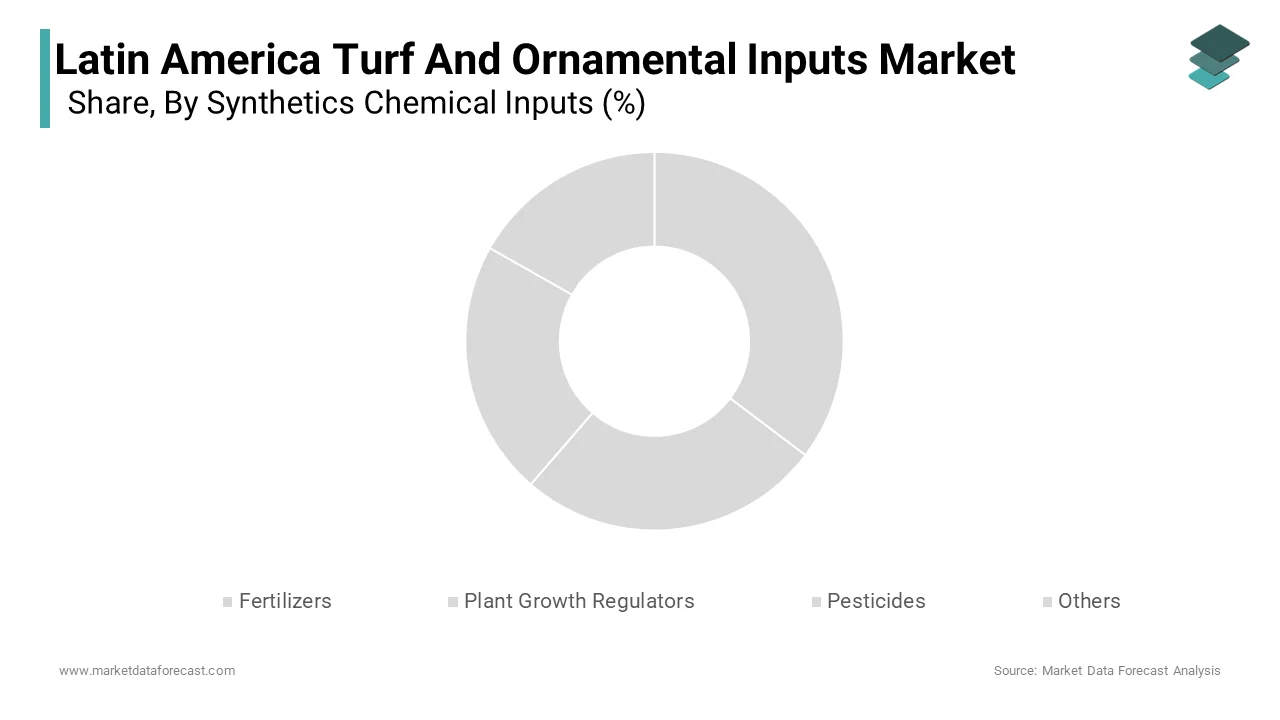
The Plant Growth Regulators (PGRs) segment is swiftly growing with an expected CAGR of 8.4% during the forecast period. The rising emphasis on cost-effective and sustainable turf management practices is driving the growth of the segment. PGRs help control excessive vegetative growth, thereby reducing labor costs and chemical usage associated with frequent trimming and maintenance. As per the Brazilian Turf Association (ABRAT), over 60% of golf course superintendents in São Paulo now incorporate PGRs into their maintenance protocols, citing improved playing surface consistency and lower operational expenses. Additionally, the integration of precision agriculture technologies has enabled more targeted application of these regulators, enhancing their efficacy. In Argentina, the Ministry of Agriculture has endorsed PGR usage in municipal landscaping programs to improve water efficiency and reduce carbon emissions from lawn equipment.
By Type of Turf Grass Insights
The Bermuda grass segment was accounted for in holding 34.2% of the Latin America Turf & Ornamental Inputs Market share in 2025 due to its adaptability to diverse soil types and low maintenance requirements compared to other grass varieties. According to the Latin American Turfgrass Society (LATS), over 1,200 golf courses and athletic facilities in Brazil and Argentina utilize Bermuda grass due to its ability to recover quickly from wear and maintain aesthetic appeal under intensive use. Furthermore, its compatibility with synthetic inputs such as controlled-release fertilizers and selective herbicides enhances its suitability for large-scale applications.
The tall fescue segment is expected to register a CAGR of 7.8% throughout the forecast period, with the popularity is its superior cold tolerance and deep root system, making it well-suited for lawns, parks, and sports fields in southern parts of South America, particularly in Chile and Argentina. According to the Argentine National Institute of Agricultural Technology (INTA), Tall Fescue cultivation increased by 14% in Patagonia between 2021 and 2023, supported by irrigation-efficient landscaping projects. Additionally, its resistance to fungal diseases and reduced need for frequent mowing appeals to environmentally conscious landscapers and homeowners. As per the University of São Paulo’s Center for Landscape Studies, residential developers in Curitiba have increasingly opted for Tall Fescue in eco-friendly housing complexes, citing lower water consumption and chemical input requirements.
By Type of Ornamental Grass Insights
The fountain grass segment was the largest by occupying 29.1% of the Latin America Turf & Ornamental Inputs Market share in 2025. The growth of the segment is attributed to be driven by its widespread use, driven by the growing preference for low-maintenance gardens and xeriscaping, especially in semi-arid regions like northern Mexico and northeastern Brazil. According to the Latin American Horticulture Association, over 450 landscaping companies in Colombia and Peru incorporated fountain grass into their 2023 project portfolios with its adaptability to different climates and soil conditions. Additionally, its ability to thrive with minimal synthetic inputs such as fertilizers and pesticides makes it a preferred option for eco-conscious consumers.
The purple millet segment is anticipated to grow with a CAGR of 9.2% during the forecast period due to the popularity is its vibrant coloration and textural contrast, which makes it a favored choice for accent planting in both public and private landscapes. According to the Colombian Agricultural Institute (ICA), purple millet was introduced in over 200 urban beautification projects in Bogotá and Medellín in 202, contributing to its rising demand. Additionally, its resilience to heat stress and moderate water requirements align with the growing trend toward drought-tolerant landscaping.
COUNTRY-LEVEL ANALYSIS
Brazil
Brazil was the largest contributor of the Latin American Turf & Ornamental Inputs Market with 37.2% of the share in 2025 due to the expansion of commercial and residential real estate projects that incorporate landscaped common areas and recreational zones. According to the Brazilian Institute of Geography and Statistics (IBGE), new construction permits increased by 13% in 202, many of which included integrated landscaping plans. Additionally, the rise in private and public golf facilities—particularly in states like São Paulo and Rio de Janeiro—has intensified the need for high-quality turf inputs. As per the Brazilian Golf Federation, the number of registered golf clubs rose by 8.5% in 2023, boosting demand for fertilizers, herbicides, and growth regulators. Moreover, the government’s push for green infrastructure under the National Urban Mobility Plan has led to increased investment in parks and green corridors, with a long-term outlook for the turf and ornamental chemicals sector in Brazil.
ChileThe
Chile turf & ornamental inputs market was next with 9.3% of share in 2025, with the engines in Chile being the increasing implementation of green building standards and urban renewal projects. According to the Chilean Ministry of Housing and Urbanism, over 120 new eco-friendly residential developments incorporating landscaped gardens were approved in Santiago in 2023. Additionally, the country’s vineyards and luxury resorts frequently integrate high-end turf areas, necessitating specialized chemical inputs for upkeep. As per the Chilean Agricultural Research Institute (INIA), turf-covered recreational spaces in Valparaíso and Viña del Mar expanded by 11% in 2023 with tourism-driven infrastructure upgrades. Regulatory support for environmentally responsible products has also influenced the shift toward bio-based inputs by encouraging manufacturers to tailor formulations to local preferences.
Argentina
Argentina's turf & ornamental inputs market growth is likely to grow with the expansion of municipal beautification programs, particularly in Buenos Aires and Córdoba. According to the National Institute of Agricultural Technology (INTA), public parkland coverage in Buenos Aires increased by 7.5% in 2025, necessitating regular applications of fertilizers and soil conditioners. Additionally, Argentina has seen a resurgence in golf course development, with over 30 new facilities opening since 2021. As per the Argentine Golf Association, more than 60% of golf clubs now employ dedicated agronomists to manage turf health with increasing demand for premium inputs. The country’s robust agricultural sector also supports the domestic production of ornamental grass seeds, enabling cost-effective supply chains for landscaping firms.
Mexico
The MexicoTurf & Ornamental Inputs Market is solely to have new opportunities with the proliferation of resort-style residential communities and commercial complexes that prioritize aesthetic landscaping. According to the Mexican National Institute of Statistics and Geography (INEGI), urban park development projects surged by 14% in 2025 in cities like Monterrey and Cancun. Additionally, the country’s thriving golf tourism industry, concentrated in Baja California and Quintana Roo, drives consistent demand for turf maintenance products. As per the Mexican Golf Industry Association, over 25 new golf courses were constructed between 2021 and 2023, significantly boosting input consumption. Government initiatives promoting sustainable landscaping practices and water-efficient irrigation systems are also shaping product development strategies.
Colombia
Colombia Turf & Ornamental Inputs Market growth is substantially to grow substantially with the expansion of public and private landscaping initiatives aimed at improving urban aesthetics and air quality. According to the Colombian Ministry of Environment, over 80 new green corridor projects were launched in Bogotá and Medellín in 2025, which require substantial volumes of fertilizers and soil enhancers. Additionally, the rise in corporate-sponsored parks and university campuses has further stimulated demand for professional-grade inputs. As per the Colombian Agricultural Institute (ICA), sales of ornamental grasses and turf-related chemicals grew by 12% year-over-year in 2023. The country’s favorable climate also supports year-round turf growth, allowing for continuous application of maintenance products.
KEY MARKET PLAYERS
Bayer, Syngenta, BASF, Best Forage LLC, Chemtura Agro Solutions, American Vanguard Corporation, Dow Agro Sciences, Adama Agricultural Solutions, and Nufarm Ltd. are the market players that are dominating the Latin America turf & ornamental inputs market.
Top Players In The Market
BASF SE
BASF plays a pivotal role in the Latin American turf & Ornamental Inputs Market through its comprehensive portfolio of high-performance agrochemicals and plant health solutions. The company offers specialized fertilizers, herbicides, and growth regulators tailored for turfgrass and ornamental plants. BASF supports both commercial landscaping and institutional projects across the continent by contributing to sustainable and efficient turf management practices.
Syngenta AG
Syngenta is a major contributor to the Latin American market due to its innovative crop protection and plant nutrition products adapted for ornamental and turf applications. The company emphasizes integrated solutions that enhance visual appeal while ensuring environmental safety. Syngenta’s commitment to training programs and technical support for landscapers and agronomists has strengthened its presence and reputation among professional users in the region.
Nufarm Limited
Nufarm has established a strong foothold in Latin America by providing a wide range of chemical inputs designed for turf maintenance and ornamental horticulture. The company focuses on localized product development and distribution networks, enabling it to meet specific regional needs. Nufarm's emphasis on sustainability and regulatory compliance makes it a trusted supplier for golf courses, public parks, and urban landscaping initiatives across the continent.
Top Strategies Used By Key Market Participants
One of the primary strategies employed by key players in the Latin American turf & Ornamental Inputs Market is product diversification and formulation customization. Companies are increasingly developing region-specific chemical blends that cater to local climate conditions, soil types, and pest pressures, enhancing effectiveness and user adoption.
Another critical approach is collaboration with local distributors, research institutions, and landscaping associations, which helps manufacturers better understand market demands, improve technical support, and facilitate knowledge transfer on best application practices.
The companies are focusing on enhancing their sustainability profiles by introducing bio-based alternatives, low-residue formulations, and eco-friendly packaging. This aligns with growing consumer awareness and regulatory trends promoting responsible input use in urban and recreational landscapes.
COMPETITION OVERVIEW
The Latin America Turf & Ornamental Inputs Market is evolving with a competitive landscape where global chemical manufacturers, regional suppliers, and specialty ingredient providers coexist. While multinational corporations dominate due to their extensive product portfolios and advanced R&D infrastructure, regional players are gaining traction by offering cost-effective, locally adapted solutions. The competition is intensifying as demand for premium turf care products rises alongside increasing investments in urban beautification, sports infrastructure, and residential landscaping. Market participants are differentiating themselves through innovation, sustainability initiatives, and strategic collaborations with academic and industry stakeholders. Additionally, the growing influence of environmental regulations is prompting companies to reformulate products and adopt greener alternatives. Firms must continuously adapt their offerings to maintain relevance and competitiveness as consumer expectations evolve toward transparency and ecological responsibility.
RECENT HAPPENINGS IN THE MARKET
- In March 2024, BASF launched a new line of slow-release nitrogen fertilizers specifically designed for tropical turfgrass species by expanding its regional product range and catering to the unique climatic conditions of Central and South America.
- In June 2024, Syngenta partnered with a Brazilian landscaping association to conduct a series of training workshops aimed at educating professionals on the safe and effective use of modern herbicides and plant growth regulators.
- In August 2024, Nufarm announced the establishment of a regional technical support center in Argentina to provide on-the-ground assistance to golf course managers and municipal landscapers, improving service delivery and customer engagement.
- In October 2024, Corteva Agriscience introduced an organic-certified fungicide for ornamental grasses in Mexico in response to rising demand for environmentally friendly alternatives in urban landscaping and botanical gardens.
- In December 2024, UPL Limited expanded its distribution network in Colombia by acquiring a local distributor specializing in turf care products, which is strengthening its presence in Andean markets and enhancing supply chain efficiency.
MARKET SEGMENTATION
This research report on the Latin American turf & ornamental inputs market is segmented and sub-segmented into the following categories.
By Synthetic Chemical Inputs
- Fertilizers
- Plant Growth Regulators
- Pesticides
- Others
By Type of Turf Grass
- Zoysia Grass
- Rye Grass
- Bermuda grass
- Blue Kentucky Grass
- Tall Fescue
- Others
By Type of Ornamental Grass
- Fountain Grass
- Ravenna grass
- Feather Reed Grass
- Purple millet
- Fibre Optic Grass
- Others
By Country
- Brazil
- Argentina
- Mexico