- Product Description Description
- Table of Contents TOC
- List of Table & Figure LOT
- Get Free Sample PDF Sample PDF
Market Size, 2025
$8.30 BnMarket Estimate, 2026
$10.58 BnMarket Forecast, 2034
$73.75 BnCAGR, 2026–2034
27.47%Executive Summary: Latin America Unmanned Aerial Vehicle (UAV) Market
- Market Scope: Comprehensive regional analysis of unmanned aerial vehicle systems deployed across civil, commercial, and military applications in Latin America, focusing on autonomous navigation, remote sensing, payload configurations, and multi-sector aerial operations.
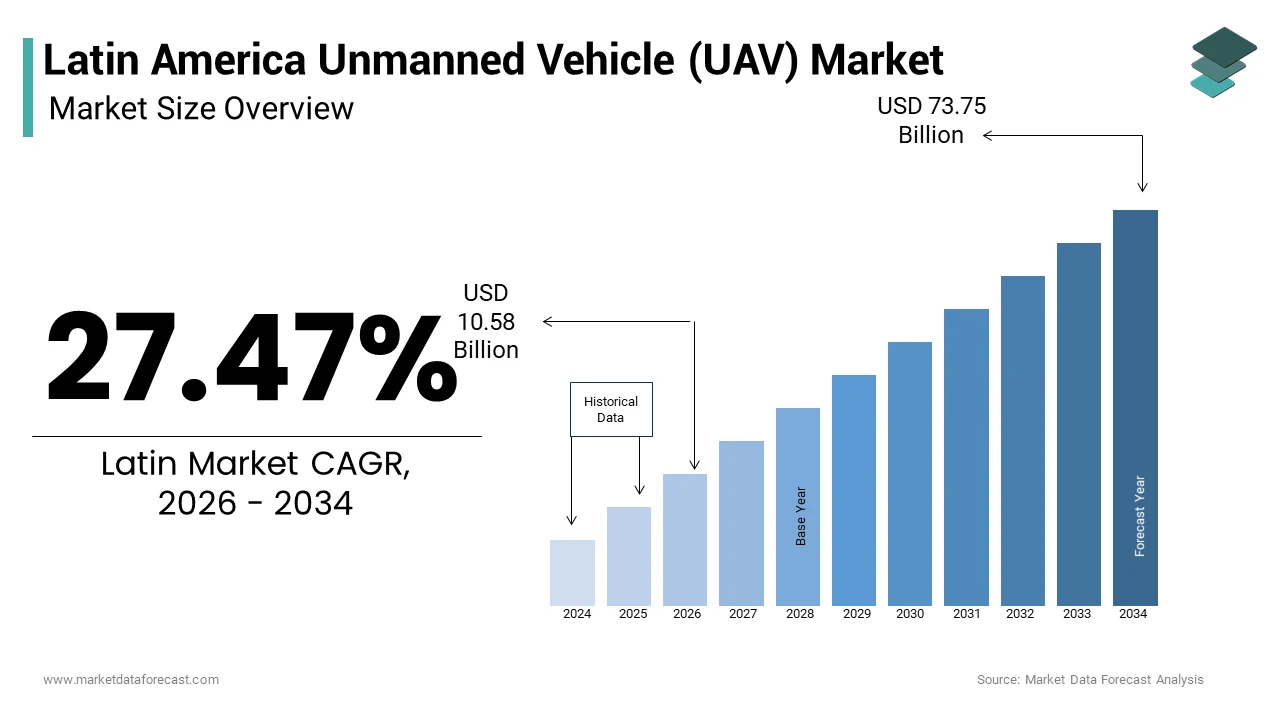
- Market Valuation: Valued at USD 8.30 billion in 2025, estimated at USD 10.58 billion in 2026, and projected to reach USD 73.75 billion by 2034, expanding at a high CAGR of 27.47% during the forecast period from 2026 to 2034.
- Primary Growth Drivers: Surging commercial drone adoption in product delivery, telecommunications, oil & gas, and mining; growing military budgets and border/maritime surveillance initiatives; and transition toward precision agriculture for crop and livestock monitoring. Key restraints include strict government airspace regulations and ethical concerns regarding autonomous operations.
Key Market Segment Metrics (2026–2034)
| Category | Leading Segment (2025 Position) | Fastest-Growing Segment |
|---|---|---|
| By UAV Size | Small & Medium UAVs (widely utilized across defense, search-and-rescue, and commercial mapping sectors due to operational flexibility) | Small UAV Segment (projected to register the highest CAGR driven by defense reconnaissance demands and precision farming applications) |
| By Application | Military & Defense (anchored by rising regional defense modernization budgets, border security, and tactical surveillance needs) | Commercial Segment (anticipated to grow at the highest CAGR driven by logistics, infrastructure inspection, mapping, and precision agriculture) |
| By Country | Brazil (leads regional adoption backed by massive agricultural land usage, domestic drone registrations, and military modernization contracts) | Mexico & Argentina (accelerating via industrial investments, security deployments, and smart infrastructure initiatives) |
Major Market Players & Market Structure
Market Structure: A dynamic and expanding market comprising international aerospace defense contractors alongside agile commercial drone technology providers scaling operations across Latin American trade corridors.
Key Companies: The Boeing Company, SZ DJI Technology, AeroVironment Inc., Lockheed Martin Corporation, Elbit Systems Limited, BAE Systems, Northrop Grumman Corporation, General Atomics, Parrot Drones SA, Thales SA, Airbus SE, and Microdrones GmbH.
 Download Free Sample Report
Latin America Unmanned Aerial Vehicle (UAV) Market Size
The Latin America UAV market size was valued at USD 8.30 billion by 2025 and is anticipated to reach a valuation of USD 10.58 billion in 2026 to USD 73.75 billion in 2034, growing at a CAGR of 27.47% during the forecast period 2026 to 2034.
Current Intro Definition of the Latin America Unmanned Aerial Vehicle Market
The unmanned aerial vehicle is the acquisition, deployment, and servicing of autonomous and remotely piloted aircraft systems across civilian, commercial, and government sectors within a region defined by complex topography and developing digital infrastructure. Data from the United Nations Economic Commission for Latin America and the Caribbean indicates that over 30% of the regional population lives in rural areas with limited road connectivity, positioning UAVs as vital infrastructure bridges for healthcare delivery and supply chain continuity. This is fundamentally characterized by its role as an enabler of leapfrog development by allowing nations to bypass legacy infrastructure constraints through aerial digitalization rather than waiting for ground based modernization that may take decades to materialize.
MARKET DRIVERS
Precision Agriculture Adoption in Export Oriented Farming
The export-oriented agribusiness in Brazil, Argentina, and Chile creates structural demand for UAV based remote sensing as producers face intensifying global competition and climate volatility requiring precise input optimization to maintain margin viability. The precision agriculture adoption in export-oriented farming is greatly influencing the growth of the latin America unmanned aerial vehicle market. The soybean farmers adopting variable rate technology guided by UAV crop scouting increased profit margins in 2025 compared to conventional blanket application methods, validating economic returns that justify capital expenditure even amid commodity price fluctuations. Chile’s Fruit Exporters Association reported that table grape exporters now employ drone based vigor mapping to optimize harvest timing and quality grading, meeting stringent European retailer specifications that command premium pricing. Unlike subsistence farming where technology adoption remains aspirational, large scale commercial operations treat UAV integration as competitive necessity rather than discretionary innovation.
Public Security and Border Surveillance Imperatives
The escalating transnational crime, illicit trafficking, and territorial disputes, as force multipliers enabling persistent surveillance coverage that manned platforms cannot sustain within constrained defense budgets. The public security and border surveillance imperatives are additionally promoting the growth of the Latin America unmanned aerial vehicle market. According to the study, cocaine production in the Andean region reached record levels in 2024 with cultivation area expanding 35% year on year, overwhelming traditional interdiction capacity and forcing reliance on automated detection systems for scalable monitoring. These security externalities transform UAVs from optional capability upgrades into non-discretionary national security infrastructure ensuring budgetary prioritization even during fiscal consolidation periods.
MARKET RESTRAINTS:
Fragmented Regulatory Frameworks and Airspace Integration Gaps
Despite progress in establishing national regulations, significant divergence in certification standards, operational limitations, and airspace integration protocols. The fragmented regulatory frameworks and airspace integration gaps are impeding the growth of the Latin America unmanned aerial vehicle market. According to the report, only 6 of 33 Latin American states have achieved full compliance with Annex 6 unmanned aircraft standards, forcing operators to navigate redundant certification processes when deploying across borders. Even within single countries, military controlled airspace restrictions frequently conflict with civil aviation authority designations creating jurisdictional ambiguity that delays approvals indefinitely. This institutional misalignment suppresses market velocity by converting technical readiness into administrative bottlenecks that no amount of technological advancement can overcome absent harmonized regional governance frameworks.
Limited Domestic Manufacturing Base and Import Dependency
Latin America’s near total dependence on imported UAV platforms and components exposes the market to exchange rate volatility, trade policy shifts, and global supply chain disruptions that create unpredictable cost structures and delay project implementations beyond original timelines. The limited domestic manufacturing base and import dependency is also declining the growth of the Latin America unmanned aerial vehicle market. This structural vulnerability discourages long term capacity commitments and incentivizes conservative procurement behaviors that suppress addressable market realization despite clear operational needs.
MARKET OPPORTUNITIES:
Last Mile Logistics in Remote and Underserved Communities
The extreme topographic diversity and underdeveloped rural infrastructure create unparalleled opportunity for UAV logistics networks serving communities where road transport is seasonally unreliable, economically unviable, or physically impossible for conventional vehicles. The last mile logistics in remote and undeserved communities is major factor to promote new opportunities for the growth of the Latin America unmanned aerial vehicle market. Brazil’s Ministry of Health allocated in 2025 for Amazonian health logistics pilot programs, targeting 200 remote municipalities where boat based supply chains fail during dry season low water periods. This emergence of humanitarian need, regulatory opening, and proven business models creates first mover advantages for operators establishing network effects before competitors achieve similar scale.
Renewable Energy Infrastructure Inspection and Maintenance
The rapid expansion of wind and solar generation capacity that UAV based solutions address more efficiently than traditional rope access or helicopter surveys, particularly as assets age and warranty periods expire transferring maintenance responsibility to operators. The renewable energy infrastructure inspection and maintenance is another attribute to fuel the growth of the Latin America unmanned aerial vehicle market. According to the study, Latin America added 28 gigawatts of renewable capacity in 2024 bringing cumulative installed base to 380 gigawatts, with wind turbines alone requiring annual blade inspections costing 800 to 1200 dollars. As per the Brazil’s Wind Energy Association, operating wind farms adopted drone inspection protocols in 2025 after insurers began offering premium discounts for verified aerial maintenance programs recognizing superior risk detection capabilities. As renewable portfolios mature and original equipment manufacturer warranties lapse, this creates durable aftermarket demand stream decoupled from new construction cycles and aligned with asset lifecycle management economics.
MARKET CHALLENGES:
Technical Talent Shortage Across Operations and Maintenance
The widespread shortage of certified UAV pilots, sensor specialists, data analysts, and maintenance technicians that prevents organizations from realizing full value of acquired technology and suppresses fleet utilization below economic thresholds. The technical talent shortage across operations and maintenance is to hinder the growth of the Latin America unmanned aerial vehicle market. The domestic demand for qualified UAV technicians exceeds supply by factor of 8, with training programs graduating fewer than 600 certified professionals annually against projected need exceeding 5000 positions, as per recent survey. Even when operators are available, advanced payload integration and data processing skills remain concentrated in major metropolitan centers, leaving rural and industrial sites dependent on expensive fly in expertise that erodes unit economics.
Cybersecurity Vulnerabilities and Data Sovereignty Concerns
Heavy reliance on foreign manufactured UAV platforms with opaque software architectures and extraterritorial data handling practices creates cybersecurity vulnerabilities and sovereignty concerns that trigger procurement restrictions and customer hesitation particularly in government and infrastructure applications. The cybersecurity vulnerabilities and date sovereignty concerns are also to inhibit the growth of the Latin America unmanned aerial vehicle market. Brazil’s Institutional Security Bureau issued directive in 2024 prohibiting use of Chinese manufactured drones for Amazon surveillance missions after identifying undocumented data transmission to overseas servers, forcing emergency procurement of more expensive Western alternatives and disrupting ongoing monitoring operations. Chile’s Comptroller General suspended 3 municipal drone programs in 2025 pending privacy impact assessments after civil society groups raised concerns about facial recognition capabilities in platforms lacking transparent audit trails. The cybersecurity remediation and platform replacement costs added 35% to total program budgets for affected government projects in 2024, according to the study.
REPORT COVERAGE
| REPORT METRIC | DETAILS |
| Market Size Available | 2025 to 2034 |
| Base Year | 2025 |
| Forecast Period | 2026 to 2034 |
| CAGR | 27.47% |
| Segments Covered | By UAV Size, Application, and Country |
| Various Analyses Covered | Global, Regional & Country Level Analysis, Segment-Level Analysis, DROC, PESTLE Analysis, Porter’s Five Forces Analysis, Competitive Landscape, Analyst Overview on Investment Opportunities |
| Regions Covered | Brazil, Argentina, Mexico, and the rest of Latin America |
| Market Leaders Profiled | The Boeing Company, SZ DJI Technology, Aerovironment Inc., Lockheed Martin Corporation, Elbit Systems Limited, BAE Systems, Northrop Grumman Corporation, General Atomics, Parrot Drones SA, Thales SA, Airbus SE, Microdrones GmbH. |
SEGMENTAL ANALYSIS
By UAV Size Insights
The small unmanned aerial vehicles weighing under 25 kilograms segment was the largest by holding a dominant share in 2025 due to their accessibility, regulatory simplicity, and alignment with predominant use cases in agriculture, inspection, and mapping that characterize regional demand. Chile’s Directorate General of Civil Aeronautics documented that many commercial drone service providers operate exclusively small UAV fleets, citing lower insurance premiums, reduced maintenance costs, and faster deployment cycles as decisive competitive advantages in price sensitive markets. The adopting drone technology selected sub 10 kilogram platforms due to compatibility with existing farm equipment transport capabilities and operator skill levels available in rural labor areas. Regulatory accessibility and lower entry barriers drive small UAV segment domination by minimizing compliance costs and administrative burdens that disproportionately affect resource constrained operators prevalent across Latin America’s fragmented commercial landscape. These policy choices create structural incentives favoring small UAV adoption independent of technical performance considerations, embedding size based segmentation into market fundamentals through governance design rather than pure market forces.
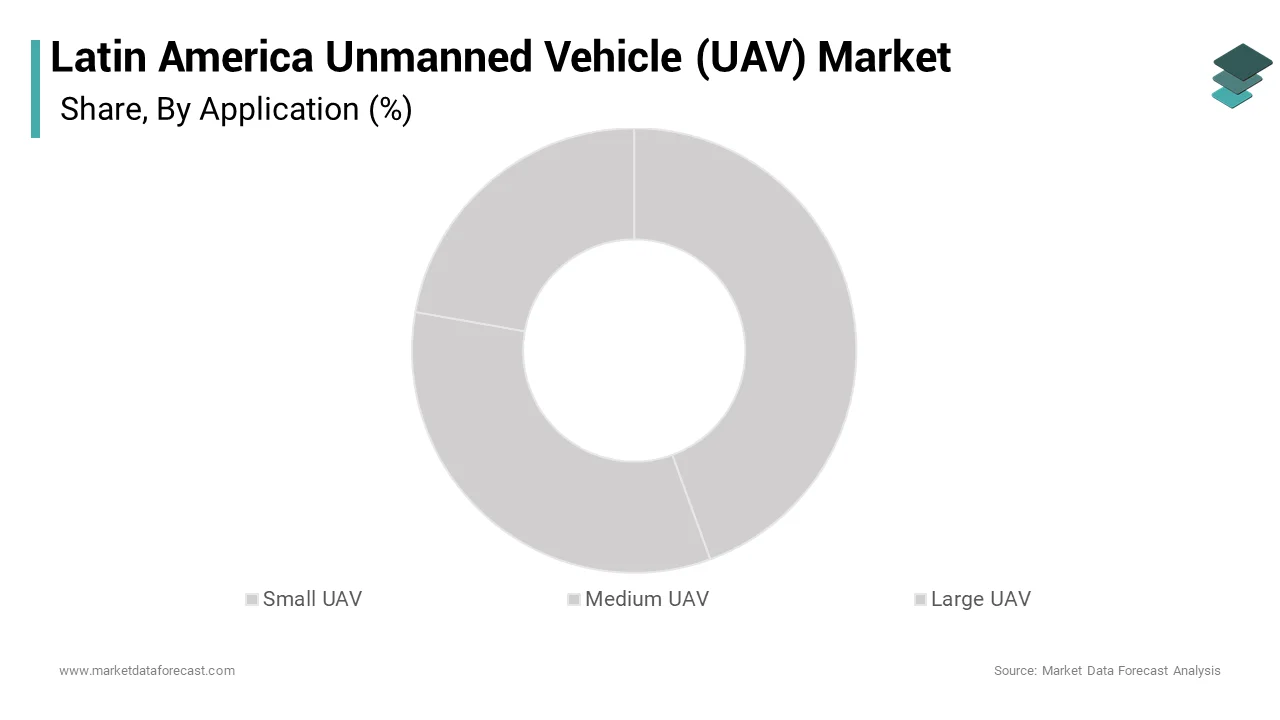
The medium unmanned aerial vehicles weighing between 25 and 150 kilograms segment is deemed to witness a fastest CAGR of 24.7% throughout the forecast period with the visual line of sight regulations, industrial scale agricultural operations requiring extended endurance, and emerging cargo logistics applications that exceed small platform payload capacities. Unlike small UAVs limited to short range visual operations, medium platforms enable autonomous corridor flights covering hundreds of kilometers per sortie, unlocking linear infrastructure inspection, large area surveying, and intercity delivery use cases previously requiring manned aviation at prohibitive cost multiples. Zipline’s Costa Rica medical delivery network transitioned to medium P2 aircraft in 2025 doubling range to 160 kilometers and payload to 3.5 kilograms by enabling service expansion to 48 additional health facilities previously outside small drone reach. This capability threshold crossing creates inflection point where medium UAVs become minimum viable solution for scaled commercial operations.
By Application Insights
The commercial applications segment was the largest by holding 52.3% of the Latin America UAV market share in 2025 with the widespread adoption in precision agriculture, mining surveying, infrastructure inspection, and media production where return on investment calculations justify capital expenditure independent of government budget cycles. Latin America’s economic structure where commodity exports and natural resource extraction create concentrated demand for efficiency enhancing technologies among private sector operators facing global competitive pressures and margin compression. As per the Mexico’s Construction Chamber, 67% of top 100 contractors now employ drone-based progress monitoring and site surveying by reducing project documentation labor hours. Commodity export competitiveness pressures drive commercial segment supremacy by forcing Latin American producers to adopt efficiency enhancing technologies like UAVs as survival mechanisms rather than discretionary innovations when facing global price taker dynamics and rising input costs.
The civil government applications segment is expected to grow at a fastest CAGR of 28.3% during the forecast period with the disaster response modernization, environmental enforcement scaling, and public service delivery innovation in remote areas where UAVs provide capabilities previously unavailable or cost prohibitive through traditional means. Unlike military procurement tied to long term strategic planning and budget rigidity, civil government adoption responds dynamically to acute crises, regulatory mandates, and political priorities creating acceleration potential when triggering events align with technology readiness and funding availability. Brazil’s Amazon Protection System integrated 42 long endurance UAVs in 2025, achieving real time deforestation detection latency reduction from 7 days to 4 hours versus previous satellite protocols, enabling enforcement response within illegal clearing windows rather than post facto documentation. Colombia’s National Disaster Risk Management Unit allocated 28 million dollars in 2025, specifically for municipal drone fleets targeting 200 high risk communities lacking permanent aerial surveillance capacity, creating distributed procurement wave beyond centralized federal programs.
COUNTRY LEVEL ANALYSIS
Brazil UAV Market Analysis
Brazil was the top performer in the Latin America UAV market by accounting for 42.2% of share in 2025 with the world class agribusiness sector, advanced regulatory framework, and domestic manufacturing ecosystem creating self-reinforcing adoption cycle unmatched elsewhere in region. The country’s scale advantages in agriculture and aerospace translate directly into UAV through both demand pull from sophisticated end users and supply push from local technology developers. Embraer’s subsidiary EVE Air Mobility received type certification for agricultural spray drone in 2025 leveraging decades of aeronautical expertise to produce domestically manufactured platform competing directly with Chinese imports on performance, while offering superior local support and financing options.
Mexico UAV Market Analysis
Mexico unmanned aerial vehicle market was ranked second by holding 24.3% of share in 2025 with the supply chains, strong manufacturing base, and dual demand drivers from industrial security needs and cross border logistics innovation creating unique application mix. The country’s integration with US economy through nearshoring trends and USMCA trade agreement generates spillover technology adoption while domestic security challenges sustain government procurement independent of commercial cycles. Secretariat of National Defense allocated 380 million dollars in 2024 for border surveillance UAV fleets covering southern frontier where migrant smuggling and cartel logistics operate through remote terrain inaccessible to ground patrols, creating sustained public sector demand buffer against commercial cyclicality. However, Mexican drone operators report difficulties accessing specialized maintenance services outside major metropolitan centers, suppressing fleet utilization rates and limiting geographic diffusion of technology benefits.
Argentina UAV Market Analysis
Argentina UAV market growth is having steady growth opportunities with the severe macroeconomic volatility creating paradoxical dynamics where currency depreciation simultaneously suppresses import capacity and incentivizes domestic technology development as alternative to dollar denominated foreign platforms. However, Central Bank’s foreign exchange allocation system imposed 90 day delays for electronic component imports in late 2024 causing production bottlenecks for domestic manufacturers dependent on overseas avionics and sensors, demonstrating how monetary policy creates unintended supply constraints.
Chile UAV Market Analysis
Chile unmanned aerial vehicle market growth is likely to grow with the institutional quality and natural resource wealth generate disproportionate influence through standards setting and validation of use cases transferable across Andean region. Directorate General of Civil Aeronautics issued first permanent beyond visual line of sight operational authorization to Enel Distribucion in 2024 for transmission line inspection of Andean terrain by creating regulatory precedent replicated by utilities in Peru and Colombia seeking similar approvals. However, mining drone incidents involved unregistered or non-compliant operators, indicating enforcement gaps undermining formal market development despite progressive regulations.
COMPETITIVE LANDSCAPE
Competition in the Latin America unmanned aerial vehicle market features stratified structure with Chinese hardware leaders dominating volume segments, while Western and domestic players compete in specialized applications requiring regulatory approval service integration or sovereign trust. DJI controls overwhelming share of small commercial drones through price performance advantages and distribution density but faces growing challenges from Embraer X and Aeroarbol leveraging national content preferences and localized financing in agricultural segments where government subsidies distort pure market economics. Military and security markets remain largely inaccessible to Chinese vendors due to sovereignty concerns creating protected niches for Israeli US and European suppliers commanding premium pricing despite inferior unit economics. Service provider competition intensifies as hardware commoditizes pushing margins toward data analytics and operational management where local knowledge creates defensible differentiation against global platforms lacking contextual intelligence. Regulatory capture emerges as critical competitive dimension with firms investing in standards body participation and government relationships to shape rules favoring incumbent capabilities and raising barriers for new entrants lacking institutional access. Geographic fragmentation prevents unified regional strategies forcing vendors to maintain country specific teams navigating divergent certification insurance and airspace integration requirements that multiply operating costs and suppress consolidation benefits.
KEY MARKET PLAYERS
Companies playing a noteworthy role in the Latin American unmanned aerial vehicle (UAV) market include The
- Boeing Company
- Sz DJI Technology
- Embraer X
- Zipline
- Aerovironment Inc.
- Lockheed Martin Corporation
- Elbit Systems Limited
- BAE Systems
- Northrop Grumman Corporation
- General Atomics
- Parrot Drones SA
- Thales SA
- Airbus SE
- Microdrones GmbH.
Top Players In The UAV Market
- DJI Agriculture maintains extensive involvement in the Latin America unmanned aerial vehicle market through dominant positioning in agricultural spraying and crop monitoring segments, across Brazil, Argentina, and Mexico where precision farming adoption drives volume demand. DJI strengthened its position by establishing authorized service centers in 12 Brazilian states reducing repair turnaround times from weeks to days addressing crucial downtime concerns during narrow application windows. Strategic partnerships with local agribusiness cooperatives enable bundled financing arrangements making technology accessible to medium scale farmers previously priced out of premium platforms. Their Spanish language training programs certified over 2800 operators in 2024 building human capital infrastructure essential for sustained fleet utilization. Continuous firmware updates incorporating regional crop disease detection algorithms demonstrate commitment to localization beyond hardware translation creating sticky ecosystem lock in through proprietary data value accumulation that competitors cannot replicate without equivalent installed base and field validation datasets.
- Embraer X contributes significantly to the Latin America unmanned aerial vehicle market leveraging decades of Brazilian aerospace expertise to develop domestically manufactured platforms optimized for regional operational environments and regulatory requirements, while reducing import dependency vulnerabilities. Embraer X strengthened its position by partnering with Banco do Brasil to offer preferential financing rates tied to domestic procurement supporting government industrial policy objectives while expanding addressable customer base among capital constrained farmers. Strategic collaboration with EMBRAPA enables joint development of crop specific application protocols validating performance under tropical conditions distinct from temperate zone benchmarks used by foreign competitors. Their maintenance training academy graduated 180 technicians in 2024 addressing skills shortage constraining fleet utilization across interior regions lacking specialized service infrastructure. This integrated approach combining manufacturing financing and knowledge transfer creates competitive moat rooted in national strategic priorities rather than pure product specifications alone.
- Zipline plays vital role in the Latin America unmanned aerial vehicle market through pioneering medical logistics networks demonstrating viability of autonomous beyond visual line of sight delivery in remote areas lacking ground transportation infrastructure. Zipline strengthened its position by signing memorandum of understanding with Pan American Health Organization in November 2024 to evaluate replication potential across Amazonian nations recognizing validated safety case as template for regional scaling. Strategic alignment with national civil aviation authorities enables regulatory sandbox participation accelerating approval timelines for corridor expansions that would otherwise require years of conventional certification processes.
Top Strategies Used By Key Market Participants
Key players in the Latin America unmanned aerial vehicle market prioritize regulatory engagement strategies, participating in standards development bodies and sandbox programs to shape favorable frameworks rather than reacting to imposed restrictions after market entry. Companies invest heavily in localized service infrastructure, establishing authorized maintenance centers, spare parts warehouses, and technician training academies across secondary cities to reduce downtime and build customer loyalty in regions where support gaps suppress utilization rates. Strategic partnerships with financial institutions enable innovative leasing and pay-per-use models, overcoming capital constraints preventing SME adoption while aligning vendor revenue with customer operational success metrics. Domestic manufacturing or assembly operations secure preferential treatment under national industrial policies, including tax incentives, subsidized credit, and government procurement preferences, creating structural advantages against pure import competitors. Application-specific software customization, incorporating regional crop varieties, pest databases, and topographic features, differentiates offerings beyond generic global platforms requiring costly post-purchase adaptation. Talent development initiatives, addressing pilot and technician shortages, create ecosystem dependencies, locking customers into vendor training ecosystems while solving industry-wide human capital bottlenecks. Cross-border harmonization efforts, pursuing mutual recognition agreements, reduce compliance fragmentation, enabling regional scale efficiencies impossible when treating each national market as an isolated silo requiring redundant certifications and operational approvals.
MARKET SEGMENTATION
This research report on the Latin American unmanned aerial vehicle (UAV) market has been segmented and sub-segmented based on the following categories.
By UAV Size
- Small UAV
- Medium UAV
- Large UAV
By Application
- Military
- Civil
- Commercial
By Country
- Brazil
- Argentina
- Mexico
- Rest of Latin America