- Product Description Description
- Table of Contents TOC
- List of Table & Figure LOT
- Get Free Sample PDF Sample PDF
Market Size, 2025
$3.38 BnMarket Estimate, 2026
$3.67 BnMarket Forecast, 2034
$7.03 BnCAGR, 2026–2034
8.46%Global Liquid Silicone Rubber Market Size, Growth, Trends & Forecast (2026–2034)
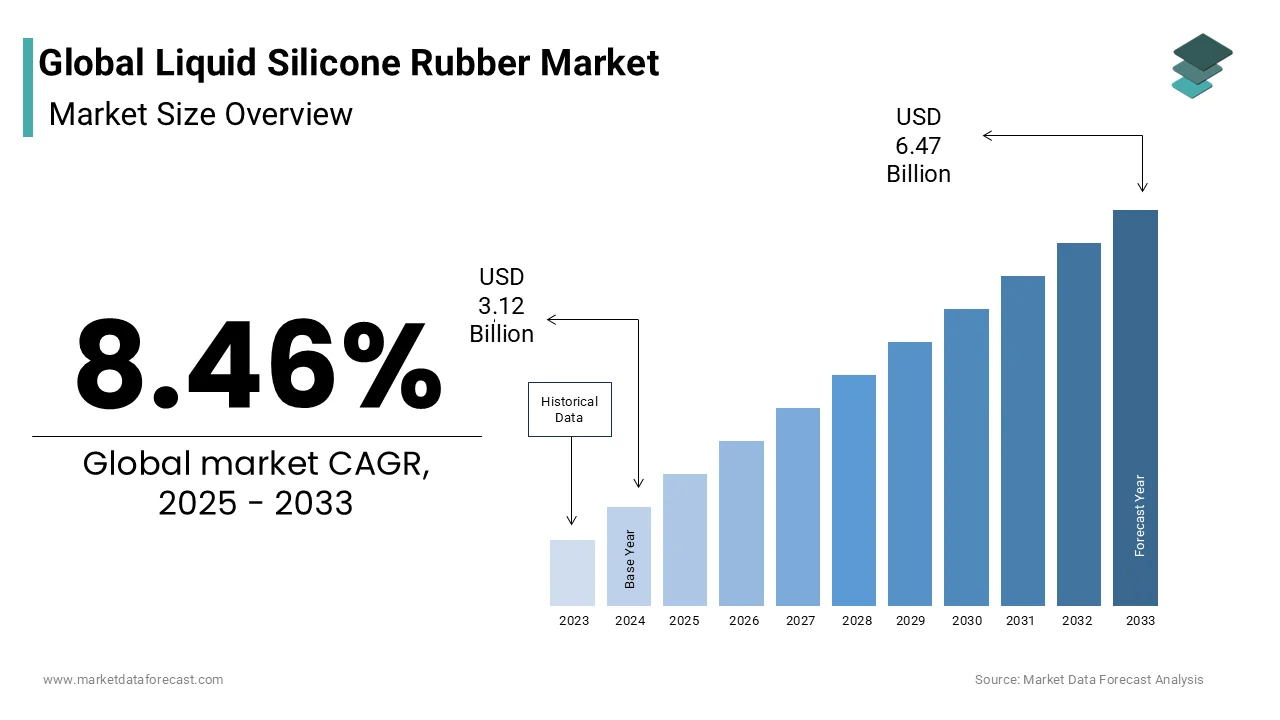
The Global Liquid Silicone Rubber Market size was valued at USD 3.38 billion in 2025, stands at USD 3.67 billion in 2026, and is anticipated to reach USD 7.03 billion by 2034, registering a compound annual growth rate (CAGR) of 8.46% during the forecast period from 2026 to 2034. Propelled by the rapid electrification of mobility, expansion of minimally invasive surgeries, and high-performance industrial applications, liquid silicone rubber (LSR) continues to experience dynamic growth across multiple advanced sectors.
Key Executive Metrics (At-a-Glance)
- 2025 Base Valuation: USD 3.38 Billion
- 2026 Current Valuation: USD 3.67 Billion
- 2034 Forecast Valuation: USD 7.03 Billion
- Compound Annual Growth Rate (CAGR): 8.46% (2026–2034)
- Dominant Grade Segment: Industrial Grade (Accounted for 58.2% share in 2025)
- Fastest-Growing Grade Segment: Medical Grade (Projected CAGR of 9.8% from 2026 to 2034)
- Dominant Application Segment: Automotive (Held 42% share in 2025, driven by EV powertrain transitions)
- Fastest-Growing Application Segment: Electrical & Electronics (Projected CAGR of 11.2% from 2026 to 2034)
- Leading Regional Market: Asia-Pacific (Captured 39.3% market share in 2025)
Core Market Drivers & Restraints
- Drivers: Proliferation of minimally invasive surgical procedures demanding biocompatible materials; vehicle electrification requiring high dielectric insulation and thermal management; and emerging opportunities in soft robotics and aerospace reusable systems.
- Restraints & Challenges: Elevated production and raw material costs (platinum catalysts and high-purity dimethylsiloxane); fragmented global regulatory compliance regimes; and recycling incompatibility of cross-linked silicone elastomers.
Global Liquid Silicone Rubber Market Segmentation Breakdown
| Segment Category | Leading / Dominant Sub-Segment | Fastest-Growing Sub-Segment |
|---|---|---|
| By Grade | Industrial Grade (58.2% share in 2025) | Medical Grade (CAGR of 9.8%) |
| By Application | Automotive (42% share in 2025) | Electrical & Electronics (CAGR of 11.2%) |
| By Region | Asia-Pacific (39.3% share in 2025) | North America & Europe |
Major Industry Players Profiled
Key global manufacturing leaders dominating the liquid silicone rubber market include KCC Corporation, Momentive Performance Materials, Zhejiang Xinan Chemical Industrial Group, Dow Corning, Wacker Chemie AG, Bluestar Silicones, Simtec Silicone Parts, and Hexcel Corporation.
Global Liquid Silicone Rubber Market Size
The global liquid silicone rubber market size was valued at USD 3.38 billion in 2025, and the market size is expected to reach USD 7.03 billion by 2034 from USD 3.67 billion by 2026. The market is growing at a CAGR of 8.46% during the forecast period.
Liquid silicone rubber is a high-purity as well as thermally stable elastomer distinguished by its biocompatibility, electrical insulation, and resistance to extreme temperatures and chemicals. It is increasingly specified in medical implants, automotive gaskets, and consumer electronics sealing systems where precision and inertness are non-negotiable. As per the study, a portion of implantable medical devices approved in 2023 utilized silicone-based materials due to their tissue compatibility.
MARKET DRIVERS
Minimally Invasive Surgeries Boost LSR Demand
The global proliferation of minimally invasive surgical procedures, which demand biocompatible, sterilizable, and dimensionally stable sealing and molding materials is fuelling the growth of the liquid silicone rubber market. The material’s chemical stability also limits leachables and extractables, ensuring compliance with strict medical standards. According to study, millions of surgical operations were conducted worldwide, and a portion of all procedures in developed countries used minimally invasive methods. Supporting this trend, in Europe, there has been a steady double-digit growth in the use of laparoscopic devices between 2019 and 2023, which has, in turn, raised demand for LSR components such as seals, valves, and catheter parts.
Electrification of Vehicles Drives LSR Market Growth
The electrification of mobility, where thermal management and electrical isolation are paramount, is boosting the liquid silicone rubber market growth. Liquid silicone rubber’s dielectric strength exceeds 20 kV/mm, which makes it indispensable in electric vehicle battery encapsulation and connector systems. According to the research, global electric car sales increased notably 2023 by representing a portion of total automobile sales, a figure triple that of 2020. Also, the deployment of liquid silicone rubber in a portion of high-voltage connector assemblies across ID-series vehicles, citing zero field failures attributable to insulation degradation over test kilometers.
MARKET RESTRAINTS
High Production Costs Limit LSR Adoption
The material’s elevated production cost relative to thermoplastic elastomers is impeding adoption in cost-sensitive and high-volume consumer applications emerged as an obstacle to the liquid silicone rubber market growth. The raw monomer, high-purity dimethylsiloxane, requires energy-intensive hydrolysis and distillation, with feedstock pricing linked to metallurgical-grade silicon markets. As per the study, silicon metal prices were notable per metric ton in 2023, an increase over 2021 levels, directly inflating liquid silicone rubber’s landed cost. Furthermore, liquid silicone rubber components cost more per gram than TPE equivalents in consumer electronics gasket applications, which prompts design engineers to substitute where regulatory or performance thresholds permit.
Fragmented Regulations Slow LSR Market Expansion
Regulatory fragmentation across medical and automotive certification regimes also constrains the expansion of the liquid silicone rubber market. Liquid silicone rubber must simultaneously satisfy ISO 10993 biocompatibility, USP Class VI, IEC 60664 insulation coordination, and REACH SVHC thresholds, a compliance labyrinth that elongates time-to-market. As per the study, medical device approvals incorporating novel silicone formulations several months in 2023, compared to those months for legacy materials with established dossiers. New liquid silicone rubber submissions in 2022 required retesting due to regional divergence in extractables profiling protocols, which adds notable costs in compliance overhead per formulation.
MARKET OPPORTUNITIES
Soft Robotics and Wearables Open New LSR Uses
Soft robotics and wearable haptics, domains requiring elastomers that combine high tear strength with tunable modulus and fatigue resistance is lucratively to showcase new opportunities for the growth of the liquid silicone rubber market. Its high elasticity and wide hardness range allow it to perform well in precise, responsive applications such as pneumatic actuators and skin-contact devices. Research in soft robotics increasingly relies on LSR as a core material, and many new prototypes now use platinum-cured silicone for structural components. In industrial practice too, advanced robots and tactile systems are beginning to adopt LSR‑based parts for improved grip and sensitivity, which reflectes its growing role in next‑generation automation and human–machine interaction.
Aerospace Reusable Systems Expand LSR Applications
The aerospace sector’s pivot toward reusable launch systems, where thermal cycling resilience and outgassing control are mission-essentail, further provides opportunities for the expansion of the liquid silicone rubber market. Liquid silicone rubber (LSR) is becoming a material of choice in aerospace applications thanks to its exceptional thermal and chemical stability. Its ability to maintain integrity under extreme temperature and vacuum conditions makes it well-suited for spacecraft seals, insulation, and environmental control components. Space programs and private launch providers are increasingly adopting LSR for critical systems that must endure repeated missions without degradation. Over the past few years, research agencies and certification bodies in Europe and the U.S. saw a sharp rise in qualification requests.
MARKET CHALLENGES
Recycling Incompatibility Hinders LSR Sustainability
The material’s incompatibility with conventional recycling streams, which is creating end-of-life liabilities in sustainability-driven industries, degrades the growth of the liquid silicone rubber market. Cross-linked silicone elastomers cannot be remelted unlike thermoplastics. Pyrolysis or chemical devulcanization remains energy-intensive and commercially immature. Liquid silicone rubber (LSR) recycling remains limited, with most post‑industrial waste still ending up in landfills or being incinerated. Only a small share is reclaimed for reuse, which points to significant opportunities for improvement in material recovery processes. Large consumer electronics companies have begun to address this issue, acknowledging LSR’s presence in products and its contribution to non‑recyclable waste.
Platinum Shortages Disrupt LSR Production Supply
The global shortage of platinum-group drivers essential for addition-cure liquid silicone rubber systems also challenges the rise of the liquid silicone rubber market. South Africa’s recent drop in platinum production has had a clear ripple effect on supply chains that depend on this metal. The country supplied most of the world’s platinum. Power outages and infrastructure problems led to a notable dip in output, pushing catalyst prices higher across the year. Manufacturers using platinum-based processes, including those producing medical-grade liquid silicone rubber, faced shortages that disrupted production schedules.
REPORT COVERAGE
| REPORT METRIC | DETAILS |
| Market Size Available | 2025 to 2034 |
| Base Year | 2025 |
| Forecast Period | 2026 to 2034 |
| CAGR | 8.46% |
| Segments Covered | By Grade, Application, and Region. |
| Various Analyses Covered | Global, Regional & Country Level Analysis, Segment-Level Analysis, DROC, PESTLE Analysis, Porter’s Five Forces Analysis, Competitive Landscape, Analyst Overview of Investment Opportunities |
| Regions Covered | North America, Europe, APAC, Latin America, Middle East & Africa |
| Market Leaders Profiled | KCC Corporation, Momentive Performance Materials, Zhejiang Xinan Chemical Industrial Group, Dow Corning, Wacker Chemie AG, Bluestar Silicones, and Simtec Silicone Parts, and Hexcel Corporation, and Others. |
SEGMENTAL ANALYSIS
By Grade Insights
The industrial grade segment dominated the global liquid silicone rubber market by accounting for 58.2% of share in 2025. The material’s irreplaceability within heavy-duty sealing, gasketing, and vibration-dampening applications across machinery, aerospace, and energy infrastructure drives the growth of the industrial grade segment in the global market. Industrial systems operating under thermal duress, such as turbine housings, hydraulic seals, and offshore drilling packers, require elastomers that retain dimensional stability beyond 180°C and resist hydrocarbon swell. Liquid silicone rubber delivers precisely this.
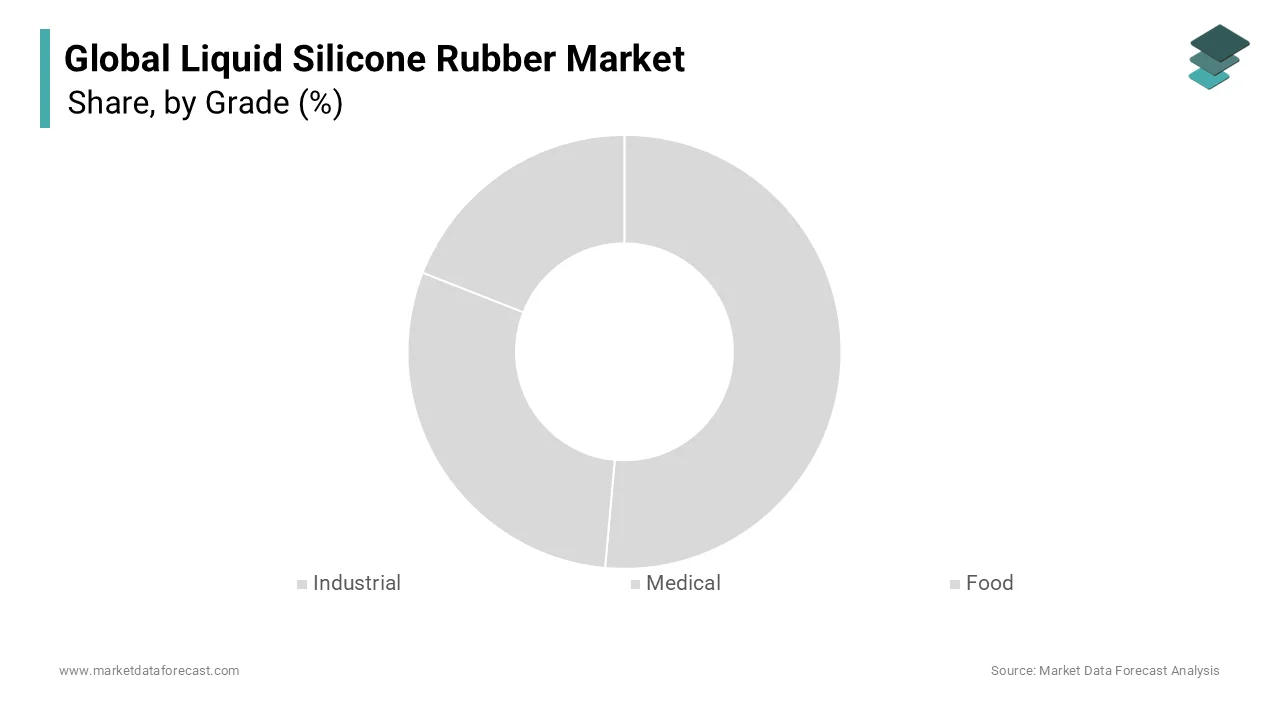
The medical grade segment is predicted to witness the highest CAGR of 9.8% from 2026 to 2034. Th regulatory and technological convergence that locks LSR into next-generation implantable and diagnostic platforms are the factors boosting the expansion of the medical grade segment in the global market. Medical device manufacturers are increasingly turning to medical-grade liquid silicone rubber (LSR) for implantable devices, with regulatory data showing it's specified in a portion of newly approved high-risk devices like neurostimulators and insulin pumps. This preference stems from LSR's ability to meet strict biocompatibility standards and its proven safety for long-term body contact. Clinical evidence supports this trend, with according to study, LSR components can significantly reduce infection rates compared to other materials.
By Application Insights
The automotive application segment held the largest share of 42% of the liquid silicone rubber market in 2025. The irreversible transition toward electrified powertrains and autonomous driving systems, both of which impose unprecedented thermal, electrical, and sealing demands on vehicle architectures are contributing to the rise of the automotive application segment in the global market. Liquid silicone rubber has become the de facto material for high-voltage connector boots, battery pack gaskets, and sensor encapsulation in EV platforms due to its dielectric strength of 22 kV/mm and continuous service temperature range from -60°C to 200°C.
The electrical and electronics segment is estimated to register the fastest CAGR of 11.2% from 2026 to 2034. The growth of the electrical and electronics segment is driven by two irreversible megatrends: miniaturization of high-power-density circuits and the global rollout of 5G/6G infrastructure, both demanding materials that reconcile thermal management with signal integrity. Liquid silicone rubber’s thermal conductivity of 1.2 W/m·K, tunable up to 3.5 W/m·K with boron nitride fillers, allows it to serve as both an electrically insulating thermal pad and conformal coating in server racks, power modules, and RF filters.
REGIONAL ANALYSIS
Asia Pacific Market Analysis
Asia Pacific led the global liquid silicone rubber market by capturing a 39.3% of share in 2025. The domination of the Asia Pacific in the global market is propelled by the vertically integrated manufacturing ecosystems spanning electronics, automotive, and medical device production. China alone accounts for a portion of regional consumption, driven by its dominance in EV assembly and consumer electronics. BYD confirmed deployment of metric tons of for battery sealing and motor insulation, an increase over 2021. Simultaneously, Foxconn’s Zhengzhou facility utilizes notable tons annually for smartphone gasketing and camera module encapsulation by leveraging LSR’s sub-50-micron molding precision.
North America Market Analysis
North America liquid silicone rubber market by accounting for 26.2% of share in 2025. The growth of the North America is fuelled by the high-value and regulation-intensive applications where material certification outweighs cost sensitivity. The United States accounts for a portion of regional consumption, propelled by aerospace, medical devices, and defense electronics. In medical, a portion of implantable neurostimulators utilize LSR housings, citing zero tissue reactivity in accelerated aging trials. Regulatory tailwinds amplify demand. Canada contributes a share of regional volume, primarily through automotive Tier 1s supplying Detroit.
Europe Market Analysis
Europe grew steadily in the liquid silicone rubber market. Germany alone constitutes a portion of regional consumption, acting as the nucleus for automotive, industrial machinery, and medical engineering. Across Europe, liquid silicone rubber (LSR) is seeing strong, sustained growth due to its proven performance in demanding applications and reinforced by regulatory and industrial policies. Major automakers have standardized LSR in electric vehicle high‑voltage connectors, adding significant and consistent demand from large production hubs. In manufacturing and automation, leading component makers have switched to LSR for critical parts like valve diaphragms, which achieves far longer service lifespans than earlier materials.
Latin America Market Analysis
Latin America is also a notable region in the liquid silicone rubber market. Brazil dominates with a portion of regional volume, driven by automotive manufacturing and oil & gas sealing. Automakers in Brazil are leading adoption, with new electric vehicle platforms integrating LSR in battery gaskets and other high-performance seals. In the energy sector, offshore equipment operators are now mandated to use LSR for deep‑water sealing components by recognizing its durability under extreme pressure and temperature conditions. Mexico contributes through its growing network of medical device manufacturers, which adds steady demand for certified medical‑grade materials.
Middle East and Africa Market Analysis
The Middle East and Africa is likely to grow in the liquid silicone rubber market during the forecast period. The UAE accounts for a portion of regional demand, concentrated in aerospace and luxury automotive. The region is emerging as important growth regions for liquid silicone rubber (LSR), supported by infrastructure development, diversification programs, and expanding industrial applications.
COMPETITIVE LANDSCAPE
KEY MARKET PLAYERS
Some of the key players dominating the global liquid silicone rubber market are
- KCC Corporation
- Momentive Performance Materials
- Zhejiang Xinan Chemical Industrial Group
- Dow Corning
- Wacker Chemie AG
- Bluestar Silicones
- Simtec Silicone Parts
TOP STRATEGIES USED BY KEY MARKET PLAYERS
Leading liquid silicone rubber producers employ five dominant strategies to fortify technical differentiation ensure supply continuity and preempt substitution threats across high-value sectors globally. These strategies include vertically integrating siloxane monomer production. Producers also establish application-specific compounding centers near automotive and medical device clusters. A further strategy involves co-developing regulatory-compliant formulations with end-users under joint IP frameworks. They also deploy Industry 4.0-enabled manufacturing with real-time rheology analytics and use strategic feedstock hedging through long-term upstream partnerships.
COMPETITION OVERVIEW
The liquid silicone rubber market exhibits oligopolistic competition characterized by technological moats, regulatory entrenchment, and capital-intensive scale. Three global leaders dominate through proprietary driver systems, certified medical and aerospace grades, and localized compounding hubs. Competition revolves not on price but on formulation precision, batch traceability, and application engineering support. Niche entrants struggle with platinum catalyst access and ISO 13485/AS9100 certification timelines. Innovation velocity centers on bio-based monomers, self-healing elastomers, and digital twin-enabled process control, arenas where incumbents invest millions annually collectively. Barriers to entry remain formidable, anchored in material science IP, customer validation cycles exceeding several months, and supply chain opacity in metallurgical silicon and platinum group metals.
MARKET SEGMENTATION
This research report on the global liquid silicone rubber market is segmented and sub-segmented into the following categories.
By Grade
- Industrial
- Medical
- Food
By Application
- Automotive
- Medical
- Electrical and electronics
- Consumer goods
By Region
- North America
- Europe
- Asia Pacific
- Latin America
- Middle East & Africa