- Product Description Description
- Table of Contents TOC
- List of Table & Figure LOT
- Get Free Sample PDF Sample PDF
Market Size, 2025
$874 MnMarket Estimate, 2026
$942 MnMarket Forecast, 2034
$1,708 MnCAGR, 2026–2034
7.72%Global Low Friction Coatings Market Size
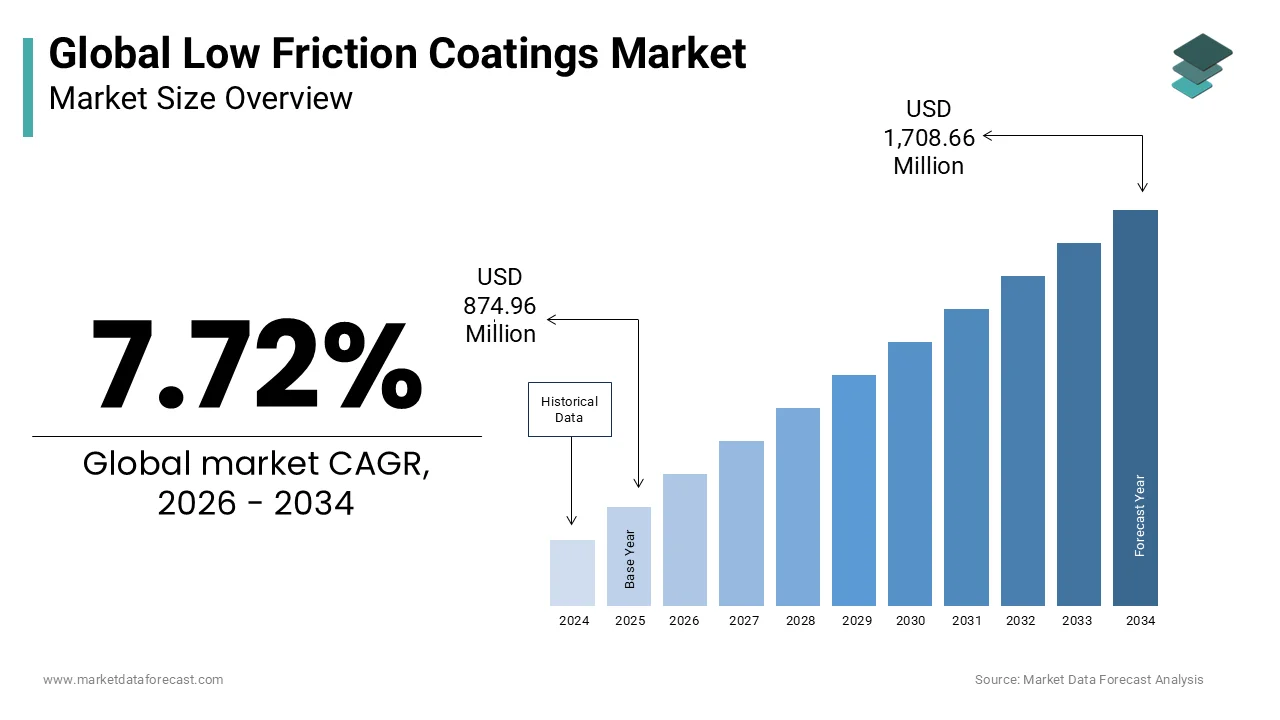
The global low friction coatings market size was valued at USD 874.96 million in 2025 and is projected to reach USD 1,708.66 million by 2034 from USD 942.51 million in 2026, growing at a CAGR of 7.72%.
MARKET OVERVIEW
Low-friction coatings are also employed in the transportation business as it assists in decreasing noise, vibration, and emissions in vehicles. The worldwide market can be categorized on the basis of end-use, product type, and geography. On the basis of the product type, the molybdenum disulfide sector is probable to hold a large chunk of the share owing to high wear resistance in the future years.
The call for low-friction coatings is seen in different businesses like healthcare, automobile, transportation, and several others. The urge for low-friction coatings is high in the food and healthcare segment since it initiates smooth contact between two surfaces and sure of less degradation. In the automobile market, utilizing low-friction coatings display escalates wear resistance and durability, which assists in enhancing the performance of the substrate to which it is applied. The call for low-friction coatings has risen highly in the past few years as they assist in enhancing surface properties with respect to wettability, corrosion resistance, and wear resistance. The rising utilization of low-friction coatings in different businesses has also been estimated to drive the market’s expansion in the coming future.
The rising automobile business, strict environmental rules, and rising calls for coating perfect for medical devices are the major drivers for the low friction coatings market. Automobile & transportation was the quickest developing end-user business for low friction coatings. Moreover, significant players in the low-friction coatings industry concentrate on product innovation and product enhancement. The introduction of the latest coatings perfect for various business verticals is also estimated to create better prospects for the low-friction coatings market. Nevertheless, limitations on the employment of some compounds like perfluorooctanoic acid and perfluorobutane sulfonate are restraining the market’s expansion. The fast expansion of end-user businesses in growing economies, owing to urbanization and industrialization, is a major driver of the worldwide low-friction coatings market. The great ability of the molybdenum disulfide to perform at extreme temperatures and pressure makes it the only perfect kind of industrial application for expanding the low-friction coatings business.
Although there is a good expansion in the low friction coatings market, the stringent rules imposed by the government agencies about the production of the coatings, in consideration of environmental damage, hampers the expansion of the global low friction coatings market. Also, the centralization of the worldwide low friction coatings market in regions such as the Asia Pacific makes the production mainly dependent on the geography and climate of the regions, hence restricting the worldwide low friction coatings market development.
REPORT COVERAGE
| REPORT METRIC | DETAILS |
| Market Size Available | 2025 to 2034 |
| Base Year | 2025 |
| Forecast Period | 2026 to 2034 |
| CAGR | 7.72% |
| Segments Covered | By Type, End User, and Region |
| Various Analyses Covered | Global, Regional and Country Level Analysis; Segment-Level Analysis; DROC; PESTLE Analysis; Porter’s Five Forces Analysis; Competitive Landscape; Analyst Overview of Investment Opportunities |
| Regions Covered | North America, Europe, Asia Pacific, Latin America, and Middle East & Africa |
| Market Leaders Profiled | Dow Corning Corporation (U.S.), AGC Chemicals Europe, Ltd. (U.K.), Whitford Corporation (U.S.), Poeton Industries (U.K.), Gujarat Fluorochemicals Limited (India), BECHEM (Germany), The Chemours Company (U.S.), Daikin North America LLC. (U.S.), Whitmore Manufacturing Company (U.S.), Uniflon America LLC (U.S.) Everlube Products (U.S.), and Endure Coatings (US) |
REGIONAL ANALYSIS
Asia-Pacific is one of the quickest-rising markets for many manufacturing businesses that have boosted the demand for low-friction coatings in the area. The rising automobile business has resulted in an escalating call for low-friction coatings, worldwide. India is estimated to be the quickest developing market for low friction coatings in the outlook period. The Asia Pacific is estimated to be the quickest developing market for low friction coatings, owing to fast expansion in end-use businesses, like automobile & transportation, food & healthcare, and general engineering.
The expansion of the manufacturing business in Asia-Pacific has resulted in an escalated need for low-friction coatings in the area. The Asia Pacific is probable to provide high development opportunities as industrialization is rising at a fast pace. Rising demand for low-friction in end-use businesses like transportation and automobiles is also estimated to drive the call for low-friction coatings in this locale. Advanced economies in Europe and North America are estimated to rise higher in the future years. Nevertheless, the Middle East and Africa markets have steady growth potential for low friction coatings. The Middle East and Africa and Latin America regions, being in the low-rising nations owing to the contribution of low GDP nations, have significantly lesser chances for industry expansion. Therefore, the low-friction coatings market in these areas is developing slowly.
KEY MARKET PLAYERS
Dow Corning Corporation (U.S.), AGC Chemicals Europe, Ltd. (U.K.), Whitford Corporation (U.S.), Poeton Industries (U.K.), Gujarat Fluorochemicals Limited (India), BECHEM (Germany), The Chemours Company (U.S.), Daikin North America LLC. (U.S.), Whitmore Manufacturing Company (U.S.), Uniflon America LLC (U.S.), Everlube Products (U.S.), and Endure Coatings (US) are some of the notable companies in the global low-friction coatings market.
MARKET SEGMENTATION
This research report on the global low friction coatings market has been segmented and sub-segmented based on type, end-user, and region.
By Type
- Molybdenum disulphide
- PTFE
- PFA
- FEP
- Graphite
- Tungsten disulfide
By End User
- Aerospace
- Automobile & Transportation
- General Engineering
- Energy
- Food & Healthcare
- Others
By Region
- North America
- Europe
- Asia Pacific
- Latin America
- The Middle East & Africa