- Product Description Description
- Table of Contents TOC
- List of Table & Figure LOT
- Get Free Sample PDF Sample PDF
Market Size, 2025
$16.87 BnMarket Estimate, 2026
$19.81 BnMarket Forecast, 2034
$71.47 BnCAGR, 2026–2034
17.4%Executive Summary: Loyalty Management Market
- Market Scope: Comprehensive global loyalty management market analysis covering component categories, deployment types, industry verticals, regional leadership frameworks, and consumer engagement metrics.
- Market Valuation: Valued at USD 16.87 billion (2025), estimated at USD 19.81 billion (2026), and projected to reach USD 71.47 billion by 2034, registering a robust CAGR of 17.40% (2026–2034).
- Primary Growth Drivers: Digital transformation, omnichannel engagement, and the integration of AI and behavioral analytics. Key consumer insights include >70% of millennials preferring digital loyalty cards, 44% hesitating due to data-use concerns, average consumers belonging to 14 programs but actively using only 4, and personalized rewards generating a 25% higher redemption rate.
Key Market Segment Metrics (2026–2034)
| Category | Leading Segment (2025 Position) | Fastest-Growing Segment |
|---|---|---|
| By Component & Deployment | Software (68.7% of global revenue in 2025); Cloud-Based Deployment (63.3% of revenue) | AI-Driven Software-as-a-Service (SaaS) Loyalty Platforms & Services |
| By Organization & Vertical | B2C Operators (59.4% share); Consumer Goods & Retail Verticals (34.2% share) | BFSI Verticals (14.8% CAGR) & Corporate Loyalty Management (13.6% CAGR) |
| By Engagement Type | Transactional Rewards & Standard Point-Accumulation Programs | Omnichannel Gamified Rewards & Behavior-Based Analytics Programs |
| By Region / Country | North America (led globally with a 35.5% market share in 2025) | Asia-Pacific (captured 22.6% share and identified as the fastest-growing regional market) |
Major Market Players & Market Structure
Market Structure: Highly competitive global customer engagement and enterprise software landscape featuring major platform providers and specialized loyalty agencies competing intensely on AI-driven personalization, omnichannel integration, robust cloud platforms, flexible reward structures, strategic partnerships, and localized solutions.
Key Companies: Antavo Limited, Capillary Technologies, Bond Brand Loyalty, Comarch SA, Epsilon Data Management LLC, Oracle Corporation, Salesforce.com Inc., TIBCO Software Inc., VeriPark, Annex Cloud, Cheetah Digital, Jakala, Kobie, Maritz Motivation, and Merkle.
Global Loyalty Management Market Size
The Global Loyalty Management Market is projected to grow from USD 16.87 billion in 2025 to USD 19.81 billion in 2026 and reach USD 71.47 billion by 2034, registering a CAGR of 17.40% from 2026 to 2034.
The Loyalty Management Market refers to the ecosystem of platforms, tools, and strategies used by businesses to design, implement, and optimize customer loyalty programs. These programs aim to enhance customer retention, increase repeat purchases, and foster long-term brand engagement through reward-based mechanisms such as points accumulation, tiered membership systems, discounts, and personalized offers.
In today’s highly competitive business environment, where customer acquisition costs are rising and consumer expectations are evolving rapidly, organizations across retail, hospitality, finance, and e-commerce sectors are increasingly relying on loyalty management solutions to differentiate themselves and build deeper relationships with their clientele.
In addition, advancements in artificial intelligence, data analytics, and mobile technology have transformed traditional loyalty programs into dynamic, real-time engagement platforms.
This evolution shows how the market is no longer just about rewarding customers but also about predicting behaviors, delivering tailored experiences, and integrating seamlessly into omnichannel ecosystems—setting the stage for a deeper exploration of its growth drivers.
 MARKET DRIVERS
Increasing Focus on Customer Retention and Lifetime Value
Among the main drivers of the Loyalty Management Market is the growing emphasis placed by businesses on enhancing customer retention and maximizing lifetime value. In an era where acquiring new customers is significantly more expensive than retaining existing ones, brands are investing heavily in loyalty programs to ensure repeat engagement and reduce churn.
This has led retailers, financial institutions, and service providers to adopt sophisticated loyalty management platforms that track consumer behavior, segment audiences, and deliver targeted incentives. For instance, Starbucks’ Rewards Program reported that loyal members accounted for nearly half of the company's U.S. revenue in 2023 , demonstrating the tangible impact of well-executed loyalty strategies.
Moreover, the integration of big data and behavioral analytics enables brands to tailor rewards based on individual preferences, thereby increasing redemption rates and emotional attachment to the brand. As businesses shift from transactional interactions to relationship-building models, loyalty management has become a strategic imperative rather than a supplementary marketing tactic.
Rise of Digital Transformation and Omnichannel Engagement
An additional key driver fueling the growth of the Loyalty Management Market is the rapid pace of digital transformation and the demand for seamless omnichannel experiences. Consumers now expect consistent and personalized interactions across online and offline touchpoints, prompting companies to deploy integrated loyalty platforms that unify data from mobile apps, websites, social media, and in-store transactions.
This has caused increased adoption of cloud-based loyalty solutions that allow for real-time updates, cross-channel point accumulation, and instant reward redemption.
Also, mobile-first loyalty applications have gained traction due to their convenience and ease of use. According to a 2023 survey conducted by Accenture, over 70% of millennials prefer digital loyalty cards over physical ones, reinforcing the shift toward mobile-enabled loyalty ecosystems. With technologies like AI-powered recommendation engines and blockchain-based reward tracking entering the space, loyalty management platforms are becoming smarter and more adaptable to evolving consumer expectations.
MARKET RESTRAINTS
High Implementation and Maintenance Costs for SMEs
Among the major restraints affecting the Loyalty Management Market is the high cost associated with implementing and maintaining advanced loyalty solutions, particularly for small and medium-sized enterprises (SMEs). While large corporations can afford comprehensive platforms with AI-driven analytics and real-time engagement features, smaller businesses often struggle with the financial and technical demands of deploying such systems.
Moreover, integrating loyalty systems with existing CRM, POS, or ERP software requires specialized expertise, further increasing deployment complexity.
Without access to scalable and affordable solutions, many SMEs continue to rely on basic, manual reward schemes that fail to leverage data insights or drive meaningful engagement, limiting the overall market penetration of advanced loyalty management systems.
Data Privacy Concerns and Regulatory Compliance Challenges
An additional notable restraint in the Loyalty Management Market is the growing concern around data privacy and the regulatory complexities surrounding consumer information handling. As loyalty programs collect vast amounts of personal and behavioral data to enable personalization and targeted marketing, they also become prime targets for cyber threats and regulatory scrutiny.
The enforcement of stringent data protection laws such as the General Data Protection Regulation (GDPR) in Europe and the California Consumer Privacy Act (CCPA) in the U.S. has added compliance burdens for companies managing global loyalty initiatives.
As per a 2023 survey by PwC, 44% of consumers are hesitant to join loyalty programs due to concerns about how their data will be used, indicating a potential erosion of trust if not managed transparently. Organizations must invest in robust cybersecurity measures, obtain explicit user consent, and ensure full compliance with evolving regulations—factors that add operational complexity and cost, potentially slowing down market expansion.
MARKET OPPORTUNITIES
Integration of Artificial Intelligence and Predictive Analytics
Among the most promising opportunities in the Loyalty Management Market lies in the integration of artificial intelligence (AI) and predictive analytics to create hyper-personalized customer experiences. By analyzing consumer behavior, purchase history, and engagement patterns, AI-powered loyalty platforms can anticipate customer needs and deliver relevant offers in real time.
Companies like Sephora and Amazon have leveraged machine learning algorithms to customize promotions and recommend products based on user preferences, resulting in stronger customer engagement.
Furthermore, AI enables dynamic segmentation and adaptive loyalty tiers, allowing brands to reward high-value customers differently while encouraging lower-tier members to ascend. As cognitive computing capabilities evolve, the ability to predict future purchasing intent and tailor loyalty incentives accordingly presents a transformative opportunity for marketers seeking to maximize return on investment in customer engagement programs.
Expansion into Emerging Markets with Rising Smartphone Penetration
The growing adoption of smartphones and digital payment systems in emerging markets presents a substantial opportunity for the Loyalty Management Market. Countries in Asia-Pacific, Latin America, and Africa are witnessing a surge in mobile commerce, creating fertile ground for mobile-first loyalty programs that cater to digitally savvy populations.
According to the GSMA, mobile internet adoption in developing economies reached 65% in 2023 , with India and Indonesia leading the way in terms of smartphone usage growth. This digital shift has enabled local businesses to bypass traditional loyalty models and directly engage customers through app-based reward programs and mobile wallets.
With expanding internet infrastructure and increasing disposable incomes, emerging markets offer immense potential for global loyalty solution providers looking to scale beyond mature economies.
MARKET CHALLENGES
Fragmentation of Loyalty Ecosystems Across Channels
A major challenge in the Loyalty Management Market is the fragmentation of loyalty ecosystems across various customer interaction channels. Many organizations operate multiple, siloed loyalty programs across e-commerce, mobile apps, physical stores, and third-party platforms, making it difficult to provide a unified experience.
According to a 2023 study by Capgemini, nearly 50% of consumers abandon loyalty programs due to inconsistent experiences across digital and physical touchpoints . When points earned online cannot be redeemed in-store or vice versa, customers perceive the system as inconvenient, reducing engagement and participation.
In addition, integrating disparate loyalty systems often requires complex backend configurations, especially when dealing with legacy infrastructure. As per a report by Salesforce, only 30% of mid-sized companies had fully synchronized loyalty programs across all sales channels , underscoring the operational hurdles involved. Overcoming this fragmentation necessitates investment in centralized platforms capable of aggregating data from multiple sources and delivering seamless, real-time experiences—a critical but challenging endeavor for many businesses.
Low Customer Engagement and Program Fatigue
Many suffer from low engagement levels and declining participation due to consumer fatigue and perceived lack of value. Customers are often enrolled in multiple programs simultaneously, leading to dilution in brand-specific loyalty and reduced incentive to actively participate.
According to a 2023 survey by Bond Brand Loyalty, the average consumer belongs to 14 loyalty programs but actively engages with only 4 , illustrating the gap between enrollment and actual usage. If rewards are not perceived as meaningful or easily attainable, customers tend to disengage, undermining the effectiveness of the loyalty strategy.
Moreover, generic reward structures without personalization contribute to this issue. A study by McKinsey & Company revealed that programs offering personalized rewards saw a 25% higher redemption rate compared to those with standardized incentives . As competition intensifies, brands must continuously innovate their loyalty offerings to remain relevant and valuable in the eyes of consumers—an ongoing challenge in an increasingly saturated market.
REPORT COVERAGE
| REPORT METRIC | DETAILS |
| Market Size Available | 2025 to 2034 |
| Base Year | 2025 |
| Forecast Period | 2026 to 2034 |
| Segments Covered | By Component, Operator, Industry Vertical, Deployment, and Region |
| Various Analyses Covered | Global, Regional & Country Level Analysis, Segment-Level Analysis, DROC, PESTLE Analysis, Porter’s Five Forces Analysis, Competitive Landscape, Analyst Overview of Investment Opportunities |
| Regions Covered | North America, Europe, APAC, Latin America, Middle East & Africa |
| Market Leaders Profiled | Antavo Limited, Capillary Technologies, Bond Brand Loyalty, Comarch SA, Epsilon Data Management LLC, Oracle Corporation, Salesforce.com Inc., Target Brands Inc., TIBCO Software Inc., VeriPark, Annex Cloud, Apex Loyalty, Brierley+Partners, Cheetah Digital, Fivestars, ICF Next, Jakala, Kobie, Maritz Motivation, Merkle. |
SEGMENTAL ANALYSIS
By Component Insights
The software segment commanded the global Loyalty Management Market , accounting for 68.7% of total market revenue in 2025. This segment’s dominence is basically attributed to the increasing adoption of cloud-based, AI-integrated, and mobile-first loyalty platforms that enable real-time customer engagement and data-driven decision-making.
One key driver is the growing demand for scalable and customizable software solutions across retail, hospitality, and financial services industries.
Also, advancements in artificial intelligence and machine learning have enhanced the ability of loyalty software to predict consumer behavior and optimize engagement strategies. With businesses increasingly relying on data analytics to refine marketing strategies, the software component remains at the core of modern loyalty program deployment.
The services segment is projected to grow at the fastest CAGR of 14.2% between 2025 and 2033. This rapid expansion is driven by rising demand for managed services, consulting, and integration support as companies seek to deploy complex loyalty solutions without internal expertise.
A main growth catalyst is the need for professional assistance in designing, implementing, and optimizing loyalty programs tailored to specific industry requirements. Moreover, ongoing maintenance, system upgrades, and compliance-related advisory services are gaining traction. A 2023 study by Deloitte found that organizations leveraging managed loyalty services saw a 25% reduction in time-to-market for new loyalty initiatives , demonstrating the strategic advantage of outsourcing. As more companies adopt omnichannel and AI-driven loyalty strategies, the demand for expert-led service offerings is expected to accelerate further.
By Operator Insights
The B2C operator segment held the largest share of the Loyalty Management Market, capturing 59.4% of total market revenue in 2025. This is due to the widespread use of consumer-facing loyalty programs in retail, e-commerce, hospitality, and food services, where brands directly engage with end-users to drive repeat purchases and enhance brand affinity.
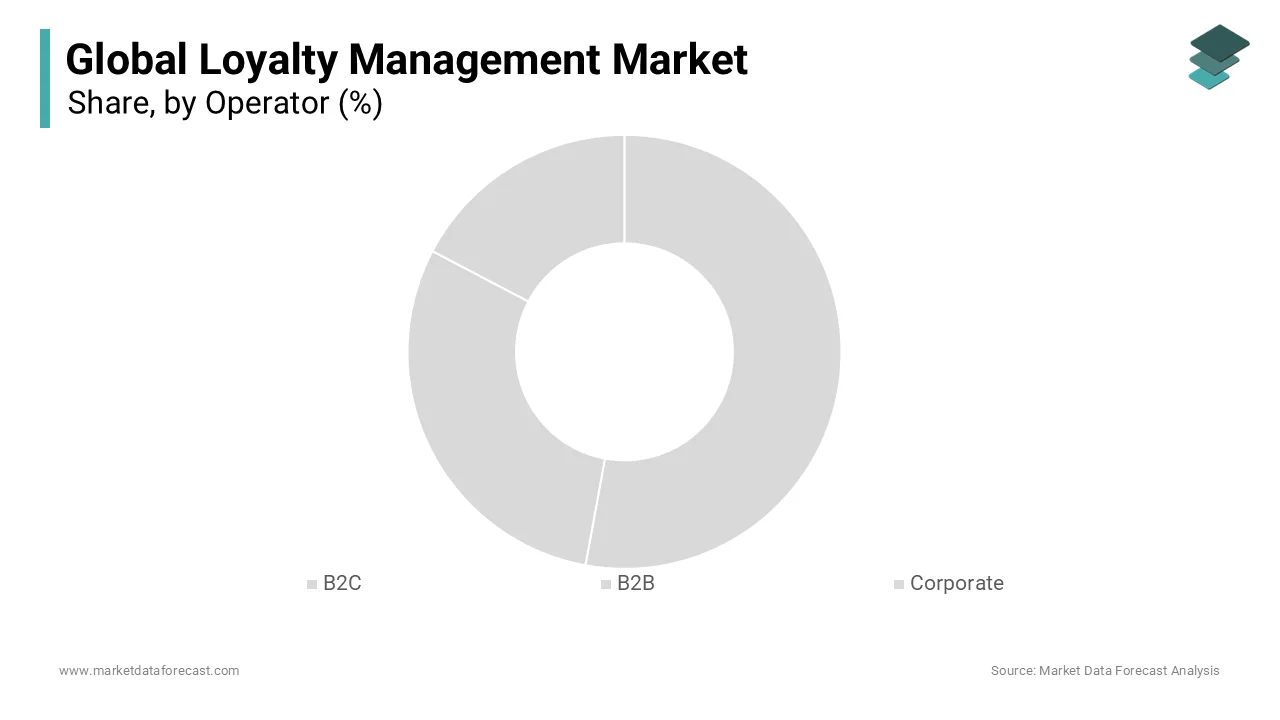
A key factor driving this segment’s leadership is the rise in digital commerce and the increasing expectation among consumers for personalized rewards and instant gratification. According to a 2025 report by McKinsey & Company, more than 70% of consumers expect brands to offer tailored experiences based on their purchasing history , making loyalty programs an essential tool for customer retention.
In addition, mobile app-based loyalty programs have gained significant traction, particularly among younger demographics. With businesses continuously innovating to meet evolving consumer preferences, the B2C segment remains the most influential in the broader loyalty management landscape.
The corporate segment is anticipated to rise at the highest CAGR of 13.6% in the coming years. This quick progress is fueled by the increasing adoption of employee recognition and internal engagement programs within large enterprises, aimed at improving workforce motivation, retention, and organizational culture.
One major growth driver is the rising emphasis on corporate wellness and incentive-based performance management systems.
Furthermore, the integration of gamified reward platforms and digital recognition tools has transformed how organizations manage internal incentives. A study published by Deloitte in 2023 found that employee engagement scores improved in firms using AI-driven corporate loyalty platforms , enhancing productivity and morale. As remote work models become more prevalent, corporate loyalty management solutions are playing a crucial role in maintaining cohesive workplace dynamics.
By Deployment Insights
The on-demand or cloud-based deployment segment led the Loyalty Management Market , capturing 63.3% of total market revenue in 2025. This superiority is largely due to the scalability, cost-effectiveness, and ease of integration offered by cloud-based loyalty platforms, especially for businesses looking to implement agile and flexible customer engagement strategies.
A key driver is the shift toward digital transformation and the growing preference for SaaS-based business models.
Besides, cloud-based loyalty systems facilitate real-time data synchronization across multiple channels—enabling seamless omnichannel experiences. As per Salesforce, brands using integrated cloud loyalty platforms saw an increase in customer engagement levels in 2023 , highlighting the operational advantages of cloud deployments. With increasing reliance on mobile apps, social media, and online storefronts, cloud-based solutions continue to be the preferred choice for modern loyalty program implementations.
Despite being smaller in size, the on-premises deployment segment is projected to grow at a CAGR of 11.4% during the forecast period. This development is basically driven by niche demand from highly regulated industries such as banking, healthcare, and government sectors, where data sovereignty and security concerns outweigh the benefits of cloud-based alternatives.
A key contributing factor is the need for complete control over customer data and compliance with stringent regulatory frameworks. Also, a notable share of financial institutions in North America still prefer on-premises deployment for mission-critical customer engagement systems due to privacy and auditability reasons.
Moreover, some large enterprises with established IT infrastructures are reluctant to migrate entirely to the cloud, opting instead for hybrid or on-premises solutions that align with existing enterprise resource planning (ERP) and customer relationship management (CRM) ecosystems.
By Industry Vertical Insights
The Consumer Goods & Retail segment secured the maximum share of the Loyalty Management Market, accounting for 34.2% of total market revenue in 2025. This lead position is supported by the intense competition in the retail sector, where customer retention and repeat purchase behaviors are critical to long-term profitability.
A key growth factor is the increasing adoption of digital loyalty programs by both online and offline retailers to personalize shopping experiences and encourage frequent visits.
Apart from these, the proliferation of mobile commerce and contactless payments has accelerated the integration of loyalty programs into point-of-sale systems and e-commerce platforms. With omnichannel retailing becoming the norm, loyalty management has become an indispensable tool for maintaining competitive differentiation in the consumer goods and retail space.
The BFSI segment is likely to advance at the highest CAGR of 14.8% in the years to come. This rapid expansion is driven by the increasing use of loyalty programs to enhance customer retention, deepen product cross-selling opportunities, and differentiate financial institutions in a highly commoditized market.
A main growth catalyst is the rising demand for tiered loyalty programs among banks offering credit cards, personal loans, and wealth management services.
Moreover, fintech disruption has compelled traditional financial institutions to invest in innovative loyalty offerings, including points-based rewards, cashback schemes, and exclusive partner discounts. As per Mastercard, credit card-linked loyalty programs generated over $15 billion in incremental spending in 2023, reflecting strong consumer engagement.
REGIONAL ANALYSIS
North America
North America maintained its position as the largest regional contributor to the Loyalty Management Market, holding 35.5% of the global market share in 2025. The region's dominant stance is underpinned by high digital adoption rates, a mature retail ecosystem, and the presence of leading technology providers offering advanced loyalty solutions.
The United States, in particular, leads the market due to its robust e-commerce infrastructure and the prevalence of sophisticated customer engagement strategies.
Canada also plays a significant role, with increasing investment in AI-powered loyalty platforms by local banks and telecom providers. As per StatCan, Canadian retailers reported a 19% year-over-year increase in loyalty program enrollments in 2023 , indicating growing consumer responsiveness.
Europe
Europe is another significant player in the global Loyalty Management Market. The region’s market strength lies in its well-established financial services, retail, and travel sectors, all of which heavily rely on loyalty programs to retain customers and drive brand differentiation.
Germany stands out as a key market, with high digitalization rates and a growing focus on personalized customer experiences. According to the German Retail Association, the number of active loyalty program users in Germany increased by 14% in 2023 , driven by omnichannel retail strategies and mobile-first engagement models.
The UK also remains a major player, particularly in the financial services and hospitality industries. Besides, the enforcement of GDPR has led to increased transparency in data handling, fostering greater consumer trust in digital loyalty programs. As European businesses prioritize customer-centric strategies, the region continues to expand its footprint in the global loyalty management landscape.
Asia-Pacific
The Asia-Pacific region is emerging as the fastest-growing market in the Loyalty Management industry, capturing 22.6% of global revenue in 2025. This expansion is basically driven by rapid digital transformation, increasing smartphone penetration, and the rise of e-commerce and fintech ecosystems across countries like China, India, and Japan.
India, in particular, has witnessed a surge in loyalty program adoption due to the booming retail and digital payment sectors. Companies like Paytm and PhonePe have introduced reward-based systems to boost user engagement and retention.
China, on the other hand, is leveraging big data and AI to build hyper-personalized loyalty experiences. As per Alibaba Group, Tmall and Taobao users participating in loyalty programs spent 30% more annually compared to non-members, highlighting the impact of targeted engagement. With expanding middle-class consumption and government-backed digital initiatives, the Asia-Pacific region is set to play a pivotal role in shaping the future of global loyalty management.
Latin America
Latin America is seeing gradual growth in the global Loyalty Management Market. While still a relatively small player compared to North America and Europe, the region is experiencing gradual growth driven by increasing digital commerce, mobile banking expansion, and evolving consumer expectations.
Brazil leads the regional market, with major retailers and telecom operators investing in digital loyalty programs to enhance customer retention. Nubank, Latin America’s largest digital bank, has successfully implemented a points-based rewards system that has contributed to its rapid customer acquisition.
Mexico is also showing promise, particularly in urban centers where multinational brands are extending their loyalty offerings. Despite economic fluctuations and limited infrastructure in rural areas, Latin America presents untapped potential for future market expansion.
Middle East & Africa – Emerging Markets with High Mobile Penetration
The Middle East and Africa collectively are emerging loyalty management market. While traditionally underdeveloped in terms of structured loyalty programs, the region is witnessing growth due to increasing mobile internet adoption, digital banking expansion, and a young, tech-savvy population.
The United Arab Emirates (UAE) leads the Gulf Cooperation Council (GCC) in loyalty program adoption, supported by a strong retail and hospitality sector. According to the Dubai Chamber of Commerce, over 60% of UAE consumers participate in branded loyalty programs , particularly in fashion, dining, and travel segments. The introduction of blockchain-based loyalty currencies in the region is also gaining attention for secure and transparent reward tracking.
South Africa remains An additional focal point, with major banks and telecom providers introducing mobile-based loyalty systems. As per FNB South Africa, customers enrolled in digital loyalty programs showed a 20% higher transaction frequency compared to non-participants in 2023 , demonstrating the effectiveness of these initiatives.
KEY MARKET PLAYERS AND COMPETITIVE LANDSCAPE
Companies playing a major role in the global loyalty management market include Antavo Limited, Capillary Technologies, Bond Brand Loyalty, Comarch SA, Epsilon Data Management LLC, Oracle Corporation, Salesforce.com Inc., Target Brands Inc., TIBCO Software Inc., VeriPark, Annex Cloud, Apex Loyalty, Brierley+Partners, Cheetah Digital, Fivestars, ICF Next, Jakala, Kobie, Maritz Motivation, Merkle.
The competition in the Loyalty Management Market is marked by rapid technological evolution, increasing customer expectations, and the convergence of data-driven personalization with omnichannel engagement. Established enterprise software providers coexist with agile startups and niche solution developers, all vying to meet the growing demand for scalable, intelligent loyalty platforms. As businesses seek to differentiate themselves through enhanced customer experiences, the ability to offer real-time insights, flexible reward structures, and seamless integrations has become a critical differentiator.
In this landscape, larger vendors leverage their extensive infrastructure, global client networks, and deep integration capabilities to maintain dominance, particularly in sectors like retail, banking, and travel. Meanwhile, specialized loyalty platform providers are gaining traction by offering innovative, modular solutions tailored to specific verticals or small-to-midsize enterprises. Strategic acquisitions and product launches are common tactics used to strengthen market positions and capture new segments. Ultimately, the market remains highly competitive, with innovation and adaptability serving as the main drivers of success.
TOP 3 PLAYERS IN THE MARKET
SAP SE
SAP is a global leader in enterprise software solutions, with a strong presence in the loyalty management space through its SAP Customer Experience suite. The company offers end-to-end loyalty program capabilities that enable businesses to design, manage, and optimize customer engagement strategies across multiple channels. SAP’s integration of AI and analytics into its loyalty platforms allows brands to deliver personalized experiences at scale, making it a preferred choice for large enterprises seeking robust, data-driven solutions.
Oracle Corporation
Oracle plays a pivotal role in the loyalty management industry by providing cloud-based solutions through its Oracle CX (Customer Experience) portfolio. Its loyalty management offerings are designed to support omnichannel engagement, allowing companies to unify customer interactions across digital and physical touchpoints. Oracle emphasizes seamless integration with CRM systems, enabling real-time insights and targeted marketing campaigns. Its focus on innovation and strategic partnerships has solidified its position as a key player in the global market.
Aimia Inc. (now part of Groupe Aeroplan)
Aimia, now integrated into Groupe Aeroplan, has historically been a major force in loyalty program development and management. Known for operating large-scale coalition loyalty programs such as Canada’s Aeroplan and the UK’s Nectar, the company brings deep expertise in designing complex, multi-partner loyalty ecosystems. Its strength lies in managing high-volume transactional data and delivering value-driven rewards, positioning it as a critical partner for brands looking to enhance long-term customer relationships through sophisticated loyalty strategies.
TOP STRATEGIES USED BY KEY MARKET PLAYERS
Product Innovation and Technology Integration
Leading players prioritize continuous innovation by incorporating advanced technologies such as artificial intelligence, machine learning, and blockchain into their loyalty management platforms. These enhancements allow for more personalized customer engagement, dynamic reward allocation, and secure data handling, setting new benchmarks for loyalty program performance and scalability.
Strategic Partnerships and Ecosystem Collaborations
To expand their reach and offer more comprehensive loyalty solutions, top vendors form alliances with payment gateways, CRM providers, and retail technology firms. These collaborations help create interconnected loyalty ecosystems that facilitate cross-industry reward redemption and improve customer stickiness across diverse brand portfolios.
Global Expansion and Localization of Solutions
Market leaders are increasingly focusing on entering emerging markets while tailoring their offerings to regional consumer behaviors and regulatory environments. By localizing loyalty program features and deploying region-specific support structures, they enhance adoption rates and ensure compliance with varying data privacy and financial regulations across geographies.
RECENT HAPPENINGS IN THE MARKET
- In February 2024, SAP launched a new AI-powered loyalty engine within its Customer Experience suite, enabling real-time personalization and predictive customer engagement for enterprise clients across retail and finance sectors.
- In April 2024, Oracle expanded its partnership with a leading fintech platform to integrate loyalty points directly into digital wallets, enhancing cross-channel reward usability and boosting user engagement for joint clients.
- In June 2024, Groupe Aeroplan announced the rollout of a blockchain-based loyalty tracking system to improve transparency, reduce fraud, and streamline point transfers across its coalition partners in North America.
- In August 2024, Ant Group introduced an upgraded version of its loyalty-as-a-service platform in Southeast Asia, targeting SMEs with plug-and-play loyalty tools integrated into mobile payment infrastructures.
- In October 2024, Blackhawk Network acquired a European-based digital rewards provider to expand its B2B loyalty offerings, aiming to strengthen its foothold in the corporate incentive and employee recognition space.
MARKET SEGMENTATION
This research report on the global loyalty management market has been segmented and sub-segmented based on component, operator, deployment, industry vertical, and region.
By Component
- Software
- Service
- Professional Services
- Consulting
- Implementation
- Support & Maintenance
- Managed Services
- Professional Services
By Operator
- B2C
- B2B
- Corporate
By Industry Vertical
- BFSI
- Consumer Goods & Retail
- Healthcare
- IT & Telecom
- Travel & Hospitality
- Manufacturing
- Others
By Deployment
- On-premises
- On-demand
By Region
- North America
- Europe
- Asia-Pacific
- Latin America
- Middle East and Africa