- Product Description Description
- Table of Contents TOC
- List of Table & Figure LOT
- Get Free Sample PDF Sample PDF
Market Size, 2025
$240.37 BnMarket Estimate, 2026
$254.02 BnMarket Forecast, 2034
$395.19 BnCAGR, 2026–2034
5.68%Global Luxury SUV Market Report Summary
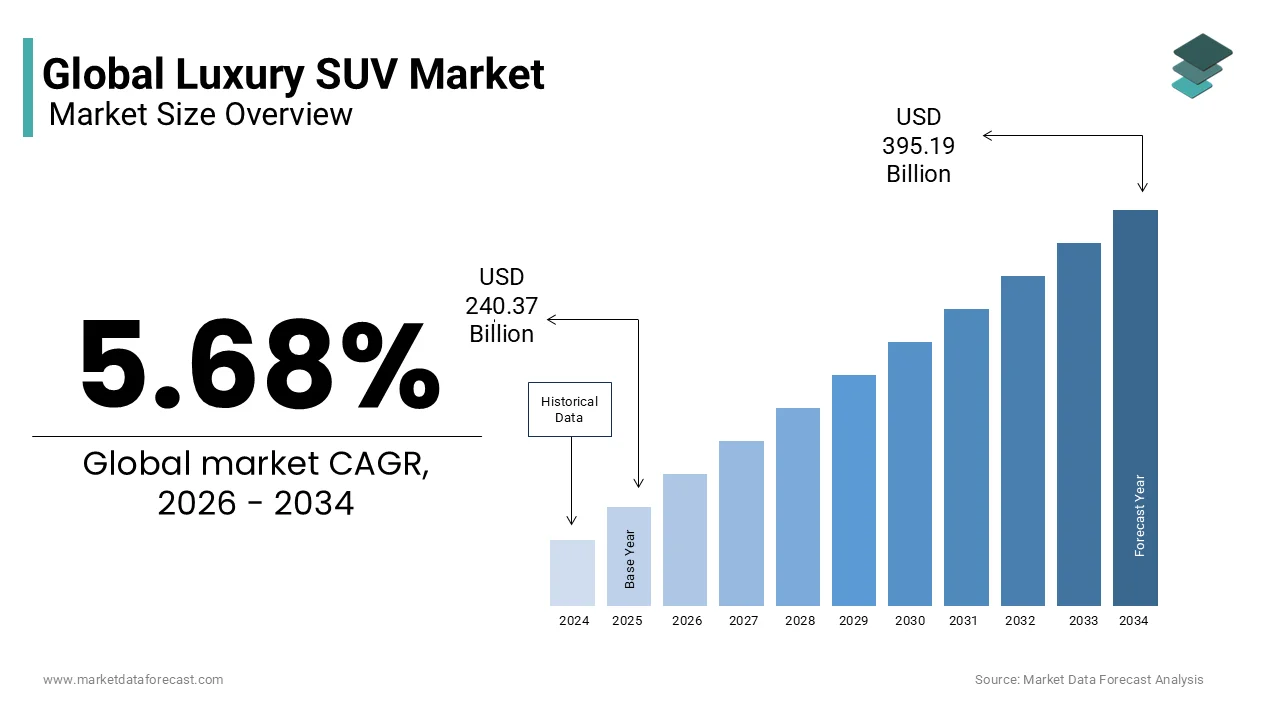
The global luxury SUV market was valued at USD 240.37 billion in 2025, is estimated to reach USD 254.02 billion in 2026, and is projected to reach USD 395.19 billion by 2034, growing at a CAGR of 5.68% during the forecast period from 2026 to 2034. The growth of the global luxury SUV market is driven by rising disposable incomes, increasing consumer preference for premium vehicles with advanced safety and comfort features, and growing demand for high-performance SUVs. The integration of advanced driver assistance systems (ADAS), connected vehicle technologies, and electrified powertrains is further supporting market expansion. Additionally, the rising popularity of luxury SUVs among families and urban consumers, coupled with continuous product innovation by leading automakers, is contributing to sustained market growth.
Key Market Trends
-
Rising consumer preference for premium SUVs offering superior comfort, performance, and advanced safety features is driving market growth.
-
Increasing adoption of hybrid and electric luxury SUVs is supporting the transition toward sustainable mobility.
-
Growing integration of connected vehicle technologies, AI-powered infotainment systems, and advanced driver assistance features is enhancing the driving experience.
-
Rising demand for all-wheel-drive luxury SUVs is driven by improved traction, safety, and off-road capabilities.
-
Luxury automakers are expanding their SUV portfolios with performance-oriented and personalized models to cater to evolving consumer preferences.
Segmental Insights
-
Based on body style, the standard segment dominated the global luxury SUV market and accounted for 55.5% of the market share in 2025. The segment's leadership is attributed to the strong demand for traditional body-on-frame and unibody SUVs that offer spacious interiors, enhanced utility, and superior off-road capability.
-
Based on fuel type, the petrol-powered segment held the largest share of 45.6% of the global luxury SUV market in 2025. The segment's dominance is driven by the widespread availability of petrol-powered luxury models, strong performance characteristics, and well-established refueling infrastructure.
-
Based on drivetrain, the all-wheel-drive segment accounted for 54.3% of the global luxury SUV market share in 2025. The segment's growth is supported by increasing consumer demand for enhanced traction, vehicle stability, and improved safety across diverse weather and road conditions.
-
Based on seating capacity, the five-seater segment held a significant share of the global luxury SUV market in 2025. The segment's leadership is driven by consumer preference for spacious second-row seating, larger cargo capacity, and enhanced comfort for everyday family use.
Regional Insights
-
The global luxury SUV market is witnessing steady growth due to rising premium vehicle demand, increasing urbanization, and continuous advancements in automotive technology.
-
North America dominated the global luxury SUV market by accounting for 35.3% of the market share in 2025. The region's leadership is driven by high disposable incomes, strong consumer preference for large premium vehicles, extensive road infrastructure, and the presence of leading luxury automotive manufacturers.
Competitive Landscape
The global luxury SUV market is highly competitive, with leading automotive manufacturers focusing on electrification, advanced safety technologies, connected vehicle features, and premium customer experiences. Companies are investing in research and development, expanding their electric luxury SUV portfolios, and introducing personalized vehicle options to strengthen their competitive position and meet evolving consumer preferences. Key players operating in the global luxury SUV market include Mercedes-Benz Group AG, BMW AG, Audi AG, Jaguar Land Rover Automotive PLC, Lexus (Toyota Motor Corporation), Porsche AG, Volvo Car AB, Tesla Inc., General Motors Company (Cadillac), Ford Motor Company (Lincoln), Hyundai Motor Group (Genesis), Nissan Motor Co., Ltd. (Infiniti), Maserati S.p.A., Alfa Romeo (Stellantis), Rivian Automotive Inc., Lamborghini S.p.A., Rolls-Royce Motor Cars Ltd., Bentley Motors Ltd., Aston Martin Lagonda PLC, Ferrari N.V., and Honda Motor Co., Ltd. (Acura).
 Download Free Sample Report
Global Luxury SUV Market Size
The global luxury SUV market size was valued at USD 240.37 billion in 2025, and the market size is expected to be worth USD 395.19 billion by 2034 from USD 254.02 billion by 2026. The market is growing at a CAGR of 5.68% during the forecast period.
The luxury suv vehicles are combine premium craftsmanship advanced technology and superior performance with elevated ride height and versatile utility. These vehicles serve as status symbols while offering practical benefits such as all wheel drive capability spacious interiors and towing capacity. The European automotive landscape reflects a decisive shift toward larger premium vehicles with the European Automobile Manufacturers Association stating that suvs accounted for 42% of new car registrations in the European Union in 2023. This trend indicates a fundamental change in consumer preference away from traditional sedans and wagons. Regulatory frameworks such as the European Green Deal mandate stricter emission standards pushing manufacturers to electrify their luxury fleets. Consumers increasingly prioritize sustainability alongside opulence demanding vehicles made from recycled materials and powered by clean energy. The integration of autonomous driving features and connected services further defines the modern luxury experience.
MARKET DRIVERS
Rising Affluence and Expansion of High Net Worth Individuals
The growing population of high net worth individuals globally is another factor boosting the growth of the luxury suv market. Luxury suvs offer a unique value proposition by combining status with practicality appealing to families and business leaders alike. The ability to customize these vehicles with bespoke materials and features enhances their appeal to discerning buyers who seek individuality. Automakers report that customization options can increase the final vehicle price by up to 30% indicating strong willingness to pay for personalization. The psychological aspect of ownership also plays a role as luxury suvs signal success and social standing. As wealth distribution shifts toward Asia and the Middle East, manufacturers are tailoring their offerings to regional preferences, such as longer wheelbases and rear seat entertainment systems.
Preference for Versatility and Elevated Driving Experience
The consumer preference for vehicles that offer versatility safety is another factor fuelling the growth of the luxury SUV market. Modern buyers seek vehicles that can handle diverse terrains weather conditions and family needs without compromising on luxury or performance. The initial quality studies luxury suvs consistently rank high in customer satisfaction due to their blend of comfort and utility. The elevated seating position provides better visibility and a sense of security which appeals to many drivers particularly in urban environments with heavy traffic. All wheel drive systems standard in most luxury suvs enhance traction and stability making them suitable for regions with harsh winters or rough roads. The spacious interior allows for flexible seating configurations and ample cargo space catering to active lifestyles involving sports equipment or travel gear. Advanced suspension technologies ensure a smooth ride despite the larger vehicle size addressing previous concerns about handling. The perception of safety is another key factor as the larger mass and structure of suvs are often associated with better crash protection. Families prioritize these attributes making luxury suvs the default choice for multi purpose premium transportation.
MARKET RESTRAINTS
Stringent Environmental Regulations and Emission Standards
The strict environmental regulations and emission standards imposed by governments worldwide for models with large internal combustion engines is restricting the growth of the luxury SUV market. Luxury suvs are typically heavier and less aerodynamic than sedans resulting in higher fuel consumption and carbon dioxide emissions. According to the European Commission, the average co2 emissions of new suvs sold in Europe were 10% higher than those of medium sized cars in 2023. Non-compliance results in substantial fines, which can erode profit margins. In the United States, the Environmental Protection Agency has tightened fuel economy standards requiring automakers to improve efficiency across their fleets. These regulations limit the availability of high performance gasoline and diesel engines, which have traditionally been a selling point for luxury suvs. Manufacturers must balance performance expectations with regulatory compliance often resulting in compromised driving dynamics or increased vehicle weight due to battery packs. The cost of developing compliant powertrains is passed on to consumers potentially pricing out some buyers. Additionally, cities like London and Paris have introduced low emission zones that restrict access for high polluting vehicles reducing their utility in urban centers.
High Purchase Price and Economic Volatility
The substantial purchase price of luxury suvs makes them highly sensitive to economic fluctuations and changes in consumer confidence. The high purchase price and economic volatility is another factor hindering the growth of the luxury SUV market. Luxury suvs often cost between 80000 and 200000 dollars or more placing them out of reach for the majority of consumers and making them discretionary purchases. High interest rates increase the cost of financing which is commonly used for luxury vehicle purchases. Economic uncertainty leads consumers to delay major purchases or opt for more affordable alternatives. Supply chain disruptions and inflation in raw material costs, such as aluminum and semiconductors have further driven up production expenses. Manufacturers face pressure to maintain margins while keeping prices competitive. The total cost of ownership including insurance maintenance and fuel also deters potential buyers.
MARKET OPPORTUNITIES
Electrification of Premium Vehicle Segments
The rapid electrification of the automotive industry to redefine performance and sustainability is ascribed to promote new opportunities for the growth of the luxury suv market. Electric powertrains offer instant torque silent operation and zero tailpipe emissions aligning with the values of environmentally conscious luxury buyers. The electric vehicle sales are growing faster due to higher affordability of battery costs relative to vehicle price. Brands like Porsche Audi and Mercedes Benz have launched successful electric suv models, such as the Taycan Cross Turismo Q8 e tron and EQS SUV. These vehicles offer superior acceleration and handling characteristics that appeal to performance oriented customers. The absence of a large engine allows for more innovative interior designs with increased cabin space and storage. Governments provide incentives such as tax credits and subsidies for electric vehicles, which can offset the higher purchase price. In Germany, electric luxury suvs are exempt from certain urban restrictions enhancing their appeal. The development of solid state batteries promises even greater range and faster charging addressing current limitations. Luxury brands can leverage their heritage to create exclusive electric experiences such as private charging networks and concierge services.
Expansion into Emerging Markets and Urbanization
The rapid urbanization and rising middle class in emerging countries create substantial opportunities for the growth of the luxury suv market. Countries in Asia Pacific, Latin America, and the Middle East are experiencing increased demand for premium vehicles as infrastructure improves and wealth grows. The middle class in Asia is expected to reach 1.7 billion people by 2030 creating a vast new customer base, as per study. Urbanization leads to congestion and poor road conditions in some areas making the ruggedness and comfort of suvs attractive. Local manufacturing initiatives in countries like China and India reduce import tariffs and lower prices making luxury suvs more accessible. Cultural preferences in these regions often favor larger vehicles as symbols of status and success. Manufacturers are adapting their models to local tastes, such as offering extended wheelbases for rear passenger comfort in China. Digital marketing and e commerce platforms enable brands to reach customers in remote areas effectively. Partnerships with local dealers and service providers enhance after sales support building trust.
MARKET CHALLENGES
Supply Chain Disruptions for Critical Components
The significant challenges due to ongoing supply chain disruptions for components, such as semiconductors and rare earth metals is to limit the growth of the luxury suv market. Modern luxury suvs rely heavily on advanced electronics for infotainment driver assistance and powertrain management. Luxury vehicles require more sophisticated chips than mass market cars making them more vulnerable to supply constraints. Delays in component delivery force manufacturers to halt production lines resulting in lost revenue and delayed deliveries. The reliance on single source suppliers for specialized parts increases risk exposure. Geopolitical tensions affecting trade routes further complicate logistics. The restrictions on exports of certain materials from China impact the production of batteries and motors. Manufacturers struggle to predict lead times making inventory management difficult. The complexity of luxury suv assemblies means that a missing small component can prevent the completion of an entire vehicle. This inefficiency increases costs and frustrates customers who expect prompt delivery.
Intense Competition and Market Saturation
The intense competition and increasing saturation, as nearly every premium brand launches multiple suv models is also to slow down the growth of the luxury suv market. This proliferation dilutes brand exclusivity and makes it difficult for manufacturers to differentiate their products. Consumers face overwhelming choices, which can lead to decision paralysis and longer sales cycles. Price wars and aggressive discounting erode profit margins, as brands compete for the same pool of buyers. Traditional luxury brands must innovate continuously to maintain relevance against tech focused competitors. Marketing costs increase as brands strive to stand out in a noisy environment. Customer loyalty becomes harder to retain as buyers easily switch between brands offering similar features. The risk of cannibalization within a brand own lineup is also high when multiple suv models overlap in size and price. Maintaining distinct brand identity, while expanding the portfolio is a delicate balancing act.
REPORT COVERAGE
| REPORT METRIC | DETAILS |
| Market Size Available | 2025 to 2034 |
| Base Year | 2025 |
| Forecast Period | 2026 to 2034 |
| CAGR | 5.68% |
| Segments Covered | By Body Style, Fuel Type, Drivetrain, Seating Capacity, and Region. |
| Various Analyses Covered | Global, Regional & Country Level Analysis, Segment-Level Analysis, DROC, PESTLE Analysis, Porter’s Five Forces Analysis, Competitive Landscape, Analyst Overview of Investment Opportunities |
| Regions Covered | North America, Europe, APAC, Latin America, Middle East & Africa |
| Market Leaders Profiled | Mercedes-Benz Group AG, BMW AG, Audi AG, Jaguar Land Rover Automotive PLC, Lexus (Toyota Motor Corp.), Porsche AG, Volvo Car AB, Tesla Inc., General Motors Co. (Cadillac), Ford Motor Co. (Lincoln), Hyundai Motor Group (Genesis), Nissan Motor Co. Ltd. (Infiniti), Maserati S.p.A., Alfa Romeo (Stellantis), Rivian Automotive Inc., Lamborghini S.p.A., Rolls-Royce Motor Cars Ltd., Bentley Motors Ltd., Aston Martin Lagonda PLC, Ferrari N.V., and Honda Motor Co. Ltd. (Acura) |
SEGMENTAL ANALYSIS
By Body Style Insights
The standard segment was the largest by holding 55.5% of the luxury suv market share in 2025, includes traditional body on frame and unibody vehicles that prioritize interior space utility and off road capability. The versatility these vehicles offer to affluent families and individuals, who require ample cargo space and passenger comfort without compromising on prestige. The standard luxury SUVs, such as the Mercedes Benz GLE and BMW X5, consistently rank highest in owner satisfaction due to their balanced performance and practicality. The ability to tow trailers and navigate rough terrain appeals to buyers with active lifestyles involving boating skiing or rural property ownership. In North America where large driveways and long distance travel are common standard SUVs are preferred for their robust build quality and commanding presence. Automakers invest heavily in refining ride quality and noise insulation in this segment to ensure a premium experience. The widespread availability of third row seating options in larger standard models further enhances their appeal to multi-generational families. Regulatory incentives for safety features also favor this segment as manufacturers integrate advanced driver assistance systems as standard equipment.
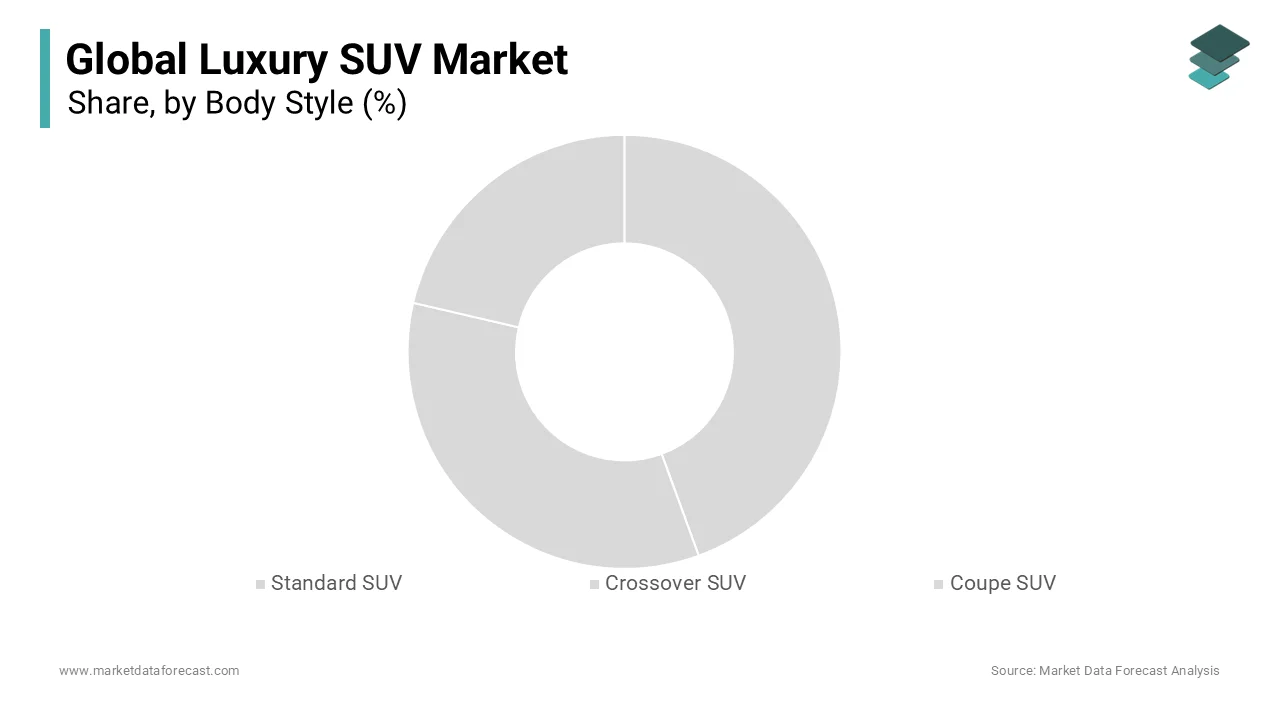
The coupe segment is attributed to grow at a fastest CAGR of 9.8% from 2026 to 2034 with the desire for sportier aesthetics and dynamic driving characteristics among younger affluent buyers. Coupe SUVs feature a sloping roofline and streamlined profile that differentiate them from traditional boxy designs. These vehicles appeal to consumers who prioritize style and performance over maximum cargo space. The lower center of gravity improves handling and cornering stability making them feel more like sports cars than utility vehicles. The introduction of high performance variants with powerful engines further attracts driving enthusiasts. Urban dwellers appreciate the sleek design which fits well in modern city environments. As competition intensifies more brands are entering this niche creating a wider selection for consumers. The trend toward personalization allows buyers to customize exterior colors and interior trims enhancing emotional attachment.
By Fuel Type Insights
The petrol fueled luxury SUVs segment was the largest by holding 45.6% of the luxury suv market share in 2025. According to the International Energy Agency, petrol accounts for the majority of light duty vehicle fuel consumption globally, particularly in regions with limited electric charging networks. Luxury buyers appreciate the smooth power delivery and high revving nature of petrol engines which align with the premium driving experience. High performance variants often rely on large displacement petrol engines to achieve impressive acceleration and top speeds. The familiarity of petrol technology reduces range anxiety and simplifies ownership for consumers who travel long distances frequently. Automakers continue to refine petrol engines with turbocharging and direct injection to improve efficiency and reduce emissions. The extensive service network for petrol vehicles ensures easy maintenance and repair anywhere in the world.
The electric luxury SUVs segment is expected to grow at a fastest CAGR of 22.5% from 2026 to 2034 with the stringent emission regulations technological advancements in battery energy density and shifting consumer preferences toward sustainability. Governments worldwide offer subsidies tax exemptions and non monetary incentives such as access to bus lanes to encourage electric adoption. Luxury brands are leveraging their reputation for innovation to lead the electric transition attracting early adopters. The instant torque and silent operation of electric motors provide a unique driving experience that complements the luxury positioning. Improvements in charging infrastructure and battery range are alleviating consumer concerns about practicality. High net worth individuals are increasingly viewing electric vehicles as status symbols of environmental responsibility. Automakers are investing billions in dedicated electric platforms to expand their model offerings.
By Drivetrain Insights
The all-wheel segment was the largest by holding 54.3% of the luxury SUV market share in 2025 owing to the expectation of superior traction stability and safety in diverse weather and road conditions. Luxury buyers prioritize all wheel drive for its ability to distribute power to all four wheels enhancing grip on wet snowy or uneven surfaces. The added confidence and control appeal to families and professionals who drive in varying climates. Advanced systems can dynamically adjust torque distribution between axles and wheels to optimize handling and performance. This technology enhances the driving experience by reducing understeer and improving cornering precision. The perceived value of all wheel drive justifies the higher price point for many consumers. It also contributes to higher resale values as buyers seek versatile vehicles. Also, the enhanced safety and traction they provide in adverse weather conditions is fuelling the growth of the segment. Snow ice rain and mud pose significant challenges to vehicle stability which all wheel drive systems effectively mitigate. Many vehicles with all wheel drive have lower rates of single vehicle crashes in winter conditions. The system ensures that power is sent to wheels with the most grip preventing skidding and loss of control.
The electric all-wheel drive systems segment is esteemd to grow at a fastest CAGR of 24.0% from 2026 to 2034 with the inherent architecture of electric vehicles which often use dual motor setups for all wheel drive. The configuration provides independent control of front and rear axles enabling precise torque vectoring. The instantaneous response of electric motors enhances traction control and stability management. Luxury buyers appreciate the seamless and silent operation of electric all wheel drive systems. The ability to adjust torque distribution in milliseconds improves handling and safety. Automakers market this technology as a superior alternative to mechanical all wheel drive systems. The performance benefits, such as faster acceleration and better cornering attract driving enthusiasts. As electric SUV sales rise the proportion of electric all wheel drive units naturally increases. This trend is supported by consumer preference for maximum performance and safety in electric vehicles.
By Seating Capacity Insights
The five seater luxury SUVs segment held a significant share of the luxury suv market in 2025 owing to the preference for spacious second row seating and ample cargo capacity over additional passenger seats. The five seater configuration allows for larger individual seats with more legroom and recline features. Cargo space is significantly larger without the third-row folding mechanism occupying trunk area. This practicality appeals to small families couples and professionals who rarely carry more than four passengers. The lower weight of five-seater models improves fuel efficiency and handling dynamics. Manufacturing costs are lower as fewer seats and safety systems are required. This price advantage makes five-seater models more accessible within the luxury segment. Most entry level and mid size luxury SUVs are exclusively five seaters. The design flexibility allows for innovative interior layouts with lounge like rear seats.
The seven seater luxury SUVs segment is projected to exhibit a fastest CAGR of 8.5% from 2026 to 2034 owing to the increasing size of affluent families and the demand for versatile multi purpose vehicles. Models like the Volvo XC90 Audi Q7 and Mercedes GLS offer genuine third row space and premium amenities. The ability to transport extended family or friends comfortably appeals to social buyers. Advances in packaging allow for usable third row space without excessive vehicle bulk. Folding mechanisms have become easier to operate enhancing usability. The prestige of owning a large flagship SUV drives demand among status conscious consumers. As urbanization increases, the need for a single vehicle that can handle various tasks grows. Seven seaters offer the flexibility to switch between passenger and cargo modes.
REGIONAL ANALYSIS
North America Luxury SUV Market Analysis
North America Luxury SUV Market was the largest contributor by accounting for 35.3% of share in 2025 through high disposable income a culture of large vehicle preference and extensive road infrastructure. Unites States was the largest contributor with the growing personal consumption expenditures on motor vehicles remained robust despite economic fluctuations. Canadian buyers also boost the growth of the luxury SUV market due to their capability in winter conditions. Long driving distances and suburban living arrangements make spacious SUVs practical. The availability of financing and leasing options facilitates access to high end models. Consumer preference for powerful engines and large screens drives product development. The region leads in the adoption of large flagship SUVs such as the Escalade and Navigator. Regulatory standards for safety and emissions influence model availability but do not dampen demand.
Europe Luxury SUV Market Analysis
Europe luxury SUV market held 24.3% of share in 2025 through heritage brands and stringent quality standards. The region is home to leading luxury manufacturers, such as BMW, Mercedes Benz, Audi, Porsche, and Range Rover. Germany, France, and the United Kingdom are the largest contributors. European buyers prioritize driving dynamics build quality and environmental sustainability. The push for electric luxury SUVs is stronger in Europe due to regulatory pressure. Compact and mid size luxury SUVs are more popular than large ones due to narrow streets and parking constraints. Diesel engines still hold a significant share for long distance travelers. The region leads in innovation for autonomous driving and connected services. High fuel prices encourage efficient powertrains. Brand loyalty is strong with customers often sticking to their preferred marque. The dense urban environment favors plug in hybrids for local commuting.
Asia Pacific Luxury SUV Market Analysis
Asia Pacific luxury suv market is deemed to have steady growth opportunities in next coming years. China is the largest contributor by rising middle class and urbanization. India Japan South Korea and Australia also contribute significantly to regional growth. Chinese buyers prefer long wheelbase models with rear seat entertainment and luxury features. Local production by international brands reduces costs and tariffs. The region shows high acceptance of new technologies such as electric powertrains and digital cockpits. Young affluent buyers view luxury SUVs as status symbols. Government policies in China support new energy vehicles boosting electric luxury SUV sales. Infrastructure development in emerging economies improves accessibility. Cultural preference for large prestigious vehicles drives demand for flagship models.
Latin America Luxury SUV Market Analysis
Latin America luxury SUV market growth is majorly propelled by the high import tariffs and local assembly initiatives. The luxury vehicle sales are concentrated among the ultra-wealthy due to high prices. Economic volatility affects demand but loyal customers continue to purchase flagship models. SUVs are preferred for their durability on varied road conditions. Security features are a major selling point due to crime concerns. Limited model availability compared to other regions restricts choice. High taxes make luxury SUVs significantly more expensive than in other markets. Local manufacturing of some models helps mitigate costs. Brand prestige remains a key driver despite economic headwinds. Dealerships focus on personalized service to retain high net worth clients.
Middle East and Africa Luxury SUV Market Analysis
The Middle East and Africa luxury SUV market growth is driven by oil wealth and love for large vehicles. The luxury SUVs are popular for their status and off road capability. Extreme heat requires robust air conditioning and cooling systems. Large displacement engines are preferred for power and prestige. The region has a high concentration of ultra high net worth individuals. Customization and bespoke options are highly valued. The Middle East serves as a showcase for flagship models and limited editions. Government projects and tourism drive rental and fleet sales. Cultural affinity for American and German brands is strong.
COMPETITIVE LANDSCAPE
The competition in the luxury SUV market is characterized by intense rivalry among established European marques and emerging electric vehicle manufacturers who are redefining premium standards. Traditional brands leverage their heritage engineering excellence and extensive dealer networks to maintain customer loyalty while new entrants disrupt the sector with innovative technology and direct sales models. Differentiation increasingly relies on software defined features autonomous driving capabilities and sustainable materials rather than mechanical specifications alone. Price competition remains moderate as brands focus on value perception and exclusivity but promotional incentives are used to clear inventory during economic downturns. The entry of ultra luxury brands into the SUV segment has intensified competition at the top end of the market forcing mainstream luxury players to elevate their offerings. Intellectual property disputes regarding design and technology are common as companies protect their innovations.
KEY MARKET PLAYERS
Some of the key players dominating the global luxury SUV market are
- Mercedes-Benz Group AG
- BMW AG
- Audi AG
- Jaguar Land Rover Automotive PLC
- Lexus (Toyota Motor Corp.)
- Porsche AG
- Volvo Car AB
- Tesla Inc.
- General Motors Co. (Cadillac)
- Ford Motor Co. (Lincoln)
- Hyundai Motor Group (Genesis)
- Nissan Motor Co. Ltd. (Infiniti)
- Maserati S.p.A.
- Alfa Romeo (Stellantis)
- Rivian Automotive Inc.
- Lamborghini S.p.A.
- Rolls-Royce Motor Cars Ltd.
- Bentley Motors Ltd.
- Aston Martin Lagonda PLC
- Ferrari N.V.
- Honda Motor Co. Ltd. (Acura)
Top Players in the Market
- Mercedes Benz Group AG remains a dominant force in the luxury SUV segment by consistently delivering vehicles that blend opulence with cutting edge technology. The company recently expanded its electric vehicle portfolio with the launch of the EQS and EQE SUV models targeting environmentally conscious premium buyers. Mercedes Benz focuses on enhancing digital user experiences through its MBUX infotainment system which integrates artificial intelligence for personalized interactions. Strategic investments in battery production facilities ensure a stable supply chain for its electrified lineup. The brand continues to emphasize bespoke customization options allowing customers to tailor interiors and exteriors to their specific tastes.
- BMW AG strengthens its position in the luxury SUV market through a dual strategy of performance enhancement and sustainable mobility solutions. The company has aggressively expanded its X series lineup including high performance M variants and fully electric iX models. BMW recently invested heavily in its Neue Klasse platform which will underpin next generation electric SUVs with improved range and charging speeds. The brand emphasizes driver engagement and dynamic handling characteristics that distinguish its vehicles from competitors. Recent initiatives include integrating advanced driver assistance systems and over the air software updates to keep vehicles current. BMW also focuses on circular economy principles by using recycled materials in interior components. These actions reinforce its commitment to ultimate driving pleasure while adapting to regulatory and consumer shifts toward electrification.
- Audi AG contributes significantly to the luxury SUV market by combining sophisticated design with quattro all wheel drive technology. The company has accelerated its electrification strategy with the introduction of the Q8 e tron and Q4 e tron models catering to diverse customer needs. Audi recently announced plans to phase out internal combustion engines in favor of fully electric powertrains by 2033. Strategic partnerships with battery suppliers ensure reliable access to critical components for its growing electric fleet. The brand focuses on digital lighting technologies and virtual cockpit interfaces to enhance the premium user experience. Recent updates to its manufacturing processes aim to reduce carbon emissions and improve sustainability. These initiatives maintain Audi's competitive edge in technology and design within the highly contested luxury SUV segment.
Top Strategies Used by Key Market Participants
Key players in the luxury SUV market primarily focus on accelerating electrification strategies to comply with stringent global emission regulations and meet growing consumer demand for sustainable mobility. Companies invest heavily in developing dedicated electric platforms that offer superior range performance and charging capabilities. Brand differentiation through bespoke customization and exclusive design elements helps maintain premium positioning and justify higher price points. Strategic partnerships with technology firms enable integration of advanced autonomous driving features and connected services that enhance user experience. Expansion into emerging countries, particularly in Asia allows manufacturers to tap into rising affluent populations and diversify revenue streams. Supply chain localization reduces dependency on single sources and mitigates risks associated with geopolitical tensions. Continuous innovation in interior luxury materials and digital interfaces ensures products remain desirable to discerning buyers.
MARKET SEGMENTATION
This research report on the global luxury SUV market is segmented and sub-segmented into the following categories.
By Body Style
- Standard SUV
- Crossover SUV
- Coupe SUV
By Fuel Type
- Petrol
- Diesel
- Hybrid
- Electric
By Drivetrain
- 2WD
- 4WD
- AWD
By Seating Capacity
- 5-Seater
- 7-Seater
By Region
- North America
- Europe
- Asia Pacific
- Latin America
- Middle East & Africa