- Product Description Description
- Table of Contents TOC
- List of Table & Figure LOT
- Get Free Sample PDF Sample PDF
Market Size, 2025
$14.85 BnMarket Estimate, 2026
$15.93 BnMarket Forecast, 2034
$28 BnCAGR, 2026–2034
7.3%Executive Summary: Global Machine Vision Systems and Components Market
- Market Scope: Comprehensive global analysis of the machine vision systems and components market covering hardware and software components, deployment models, product types, application areas, end-user industries, and regional market dynamics.
- Market Valuation: Valued at USD 14.85 billion in 2025, estimated at USD 15.93 billion in 2026, and projected to reach USD 28.00 billion by 2034, registering a steady CAGR of 7.3% during the forecast period from 2026 to 2034.
- Primary Growth Drivers: Growing demand for vision-guided robotics, increasing adoption of artificial vision and AI, advancements in electronic miniaturization, and higher efficiency of image sensors and digital signal processors (DSP). Key market restraints include integration complexity and a lack of flexible machine vision solutions.
Key Market Segment Metrics (2026–2034)
| Category | Leading Segment (2025 Position) | Fastest-Growing Segment |
|---|---|---|
| By Component | Hardware / Cameras (prominent share driven by smart camera utilization in 3D imaging and inspection) | Advanced Software & Processing Modules |
| By Deployment | General Machine Vision Systems (widespread industrial implementation) | Robotic Cells (flexible vision-based robotic work cells with end-effector cameras) |
| By Product | PC-based Machine Vision Systems (stable traditional industrial share) | Smart Camera-based Vision Systems (scaling with IoT adoption) |
| By Application | Quality Assurance & Inspection (prominent share in food and automotive industries) | 3D Measurement (expanding with the highest growth rate driven by 3D machine vision advances) |
| By End-User Industry | Automotive & Electronics & Semiconductor (established core demand sectors) | Automotive & Food & Packaging (expanding with the highest CAGR) |
| By Region | North America & Europe (account for leading industry portions due to advanced automotive and manufacturing applications) | Asia-Pacific (projected to expand with the highest growth rate supported by rapid industrialization and automobile manufacturing) |
Major Market Players & Market Structure
Market Structure: A highly competitive, technology-driven global marketplace populated by leading machine vision hardware and software developers engaging in strategic distributor partnerships and industrial network integrations.
Key Companies: Vitronic GmbH, Scorpion Vision Ltd., Qualcomm Inc., Point Grey Research Inc., Perceptron Inc., Omron Corporation, National Instruments, Microscan Systems, Machine Vision Technology Ltd., Lumenera Corporation, Keyence Corporation, IDS Imaging Development Systems GmbH, Cypress Semiconductor Corporation, Cognex Corporation, Basler AG, Allied Vision Technologies, and Adept Technology Inc.
Global Machine Vision Systems and Components Market Size
The global machine vision system and components market was valued at USD 14.85 billion in 2025. The global market is expected to reach USD 15.93 billion in 2026 and USD 28 billion by 2034, growing at a CAGR of 7.3% during the forecast period.
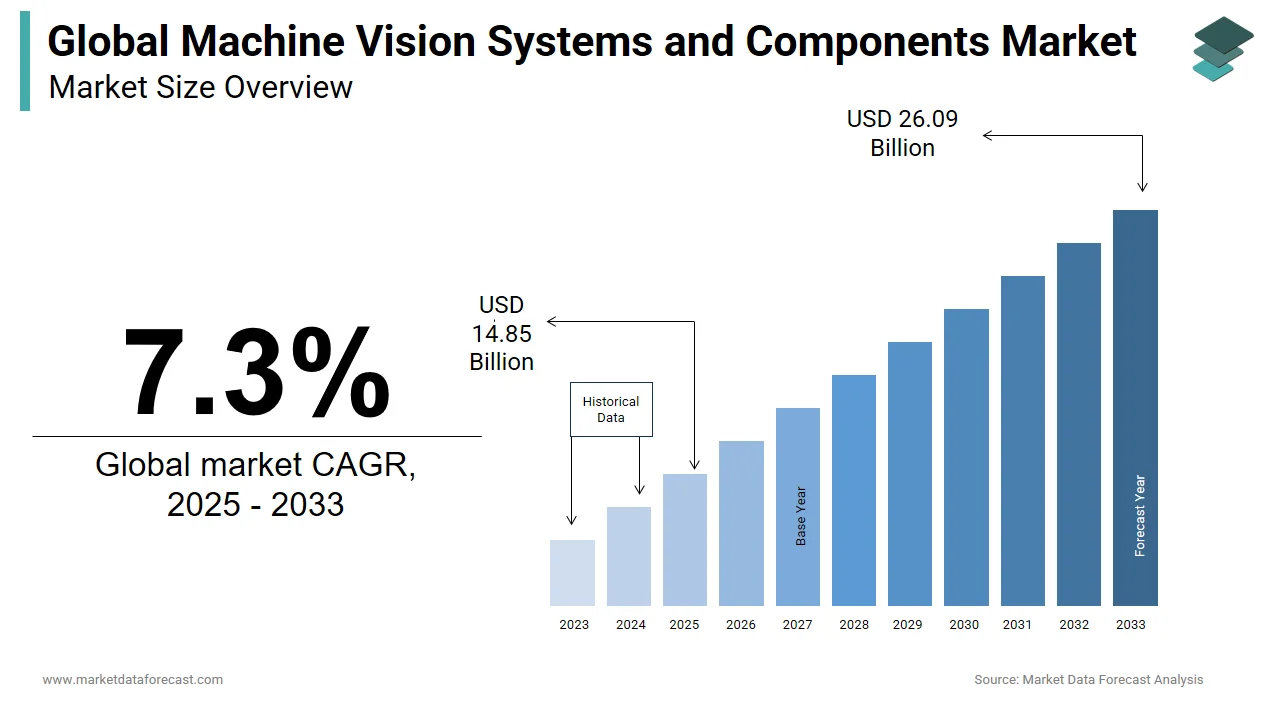
One of the latest market trends is the miniaturization of machine vision systems. Researchers have developed a microchip that consumes extremely little energy to capture the visual details of video images. According to the researchers, the chip's video function uses 20 times less power than the best existing chips in its class. One of these chips is called EQSCALE, which could reduce the size of intelligent vision systems to the nearest millimeter.
The lower cost of robots now allows the development of cheaper but more flexible vision systems. These vision-based robotic work cells consist of one or more robots with cameras and lighting mounted on their end effectors. This system can inspect different product variants and can be reprogrammed quickly. System software can be programmed to check the locations of any subsequent product presented to you.
Advances in 3D machine vision are becoming more flexible in automation and intelligent manufacturing. In the near future, such artificial vision innovations will allow the analysis of 3D scenes and 2D processing in a 3D image. It will also enable machine learning applications where a robot can learn in real time.
MARKET DRIVERS
Growing demand for vision-guided robotics and an increase in demand for artificial vision AI have been the driving factors in the global machine vision systems and components market.
Technological advances in the electronics industry, such as the miniaturization of electronic components, the improvement of the energy efficiency of image sensors, and the higher efficiency of digital signal processors (DSP), have benefited the global machine vision systems and components market. Thanks to these advances, the acceptance of vision systems and components has increased in several applications, such as security equipment, cameras, coding and decoding algorithms, and traceability applications, such as text verification, reading identification codes, label inspection, and brand quality assessment.
MARKET RESTRAINTS
On the other hand, aspects such as complexity in the integration of artificial vision systems and the lack of flexible machine vision solutions are hampering the rapid expansion of this business.
REPORT COVERAGE
| REPORT METRIC | DETAILS |
| Market Size Available | 2025 to 2034 |
| Base Year | 2025 |
| Forecast Period | 2026 to 2034 |
| CAGR | 7.3% |
| Segments Covered | By Component, Deployment, Product, Application, End-User Industry, and Region |
|
Various Analyses Covered | Global, Regional & Country Level Analysis, Segment-Level Analysis, DROC, PESTLE Analysis, Porter’s Five Forces Analysis, Competitive Landscape, Analyst Overview on Investment Opportunities |
| Regions Covered | North America, Europe, APAC, Latin America, Middle East & Africa |
|
Market Leaders Profiled | Vitronic GMBH, Scorpion Vision Ltd., Qualcomm Inc., Point Gray Research Inc., Perceptron Inc., Omron Corporation, National Instruments, Microscan Systems, Machine Vision Technology Ltd., Lumenera Corporation, Keyence Corporation, IDS Imaging Development Systems GmbH, Cypress Semiconductor Corporation, Cognex Corporation, Basler AG, Allied Vision Technologies, Adept Technology Inc., and others. |
SEGMENTAL ANALYSIS
By Components Insights
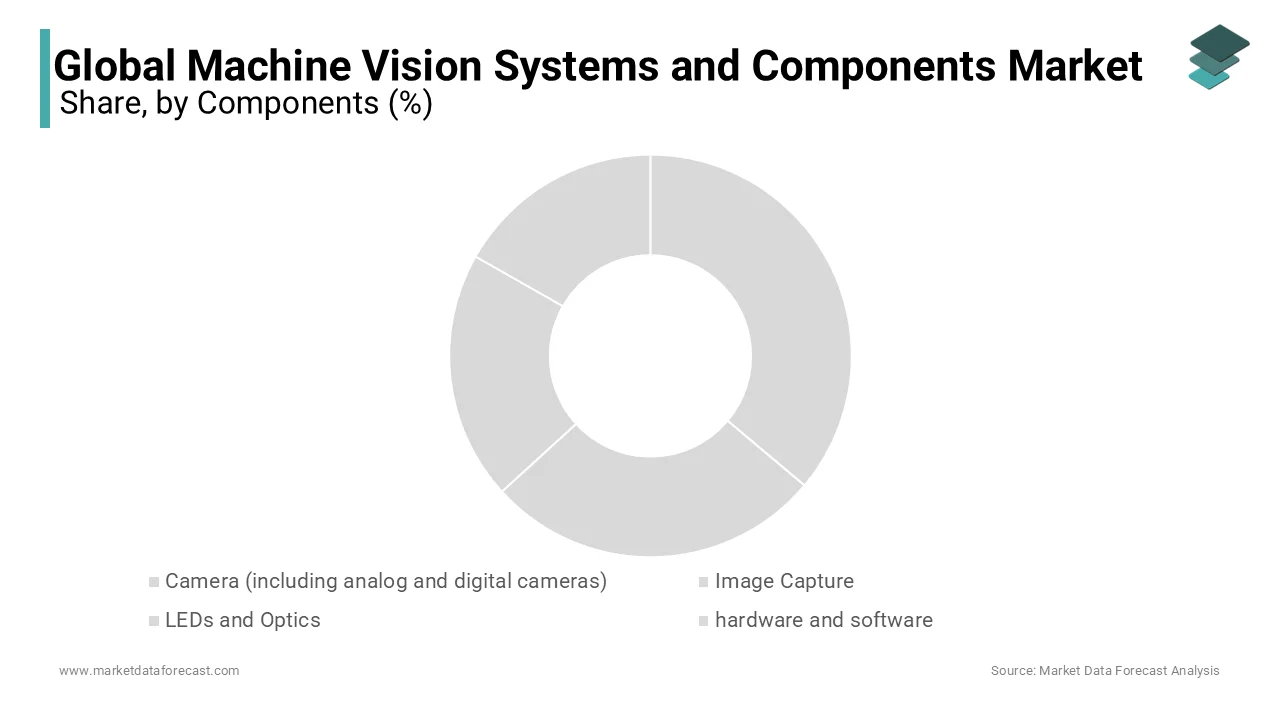
Of these, the camera segment accounted for the prominent share in the global market due to the applications of the smart camera in 3D imaging and others.
By Application Insights
Among these, the quality assurance and inspection segment is registered as a prominent portion of the world market, owing to its applications in the food and automotive industries. The 3D measurement segment is likely to expand with the highest growth rate in the foreseen period.
By Product Insights
With the increasing applications and adoption of IoT, smart camera-based vision systems are predicted to account for a remarkable market share in the coming years.
By End-User Industry Insights
The automotive segment, along with food packaging, is anticipated to expand with the highest CAGR in the foreseen years.
REGIONAL ANALYSIS
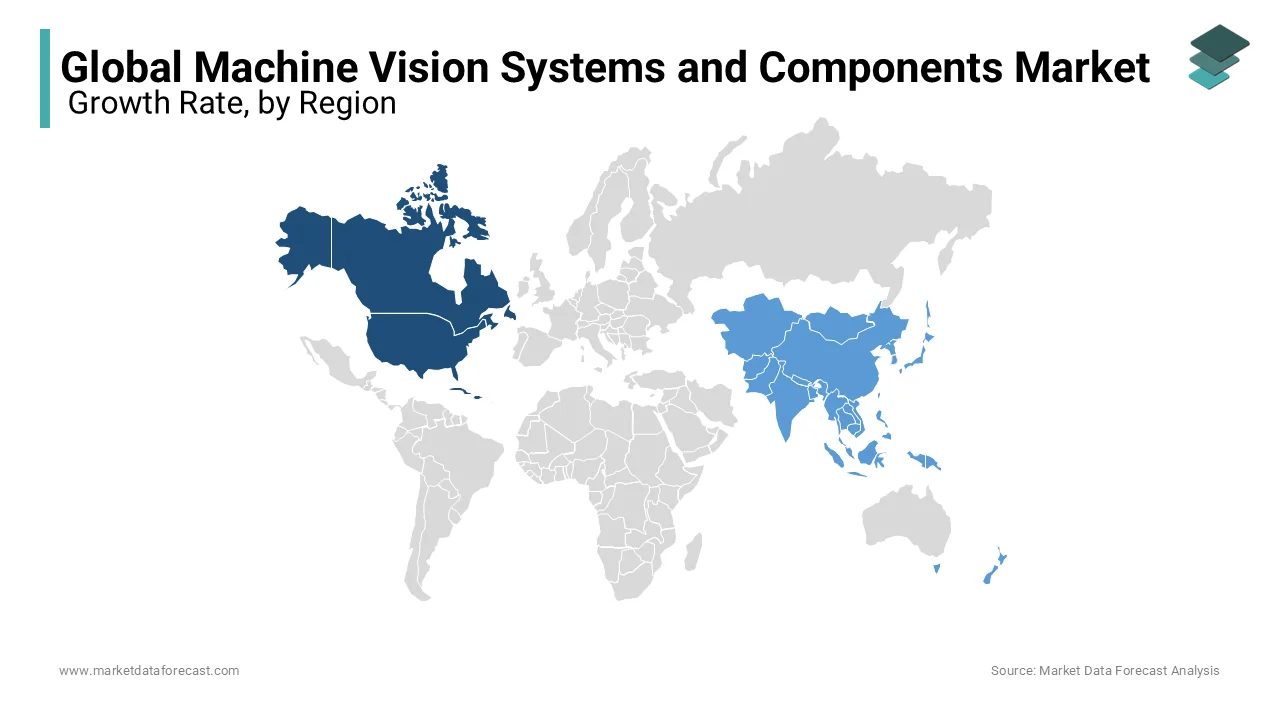
North America and Europe account for a leading portion of the global industry, attributing to the increased applications in automotive and other end-users. These regions are further predicted to expand with a moderate growth rate in the coming years.
Nevertheless, the Asia Pacific region is projected to expand with the highest growth rate in the forecast period, which is supported by the rapid industrialization and automobile manufacturing in the area.
KEY MARKET PLAYERS
Vitronic GMBH, Scorpion Vision Ltd., Qualcomm Inc., Point Gray Research Inc., Perceptron Inc., Omron Corporation, National Instruments, Microscan Systems, Machine Vision Technology Ltd., Lumenera Corporation, Keyence Corporation, IDS Imaging Development Systems GmbH, Cypress Semiconductor Corporation, Cognex Corporation, Basler AG, Allied Vision Technologies, Adept Technology Inc., and others.
RECENT MARKET DEVELOPMENTS
-
In July 2018, Basler strengthened its position in the Chinese market by partnering with Beijing Sanbao Xingye (MVLZ) Image Tech. Co., Ltd., a leading Chinese distributor of image processing components.
-
In April 2018, OMRON and Cisco Systems GK collaborated on the integration of advanced Cisco network and security technologies in OMRON Programmable Logic Controllers (APIs).
-
In November 2018, OMRON and Cisco Systems GK worked on the integration of advanced Cisco network and security technologies into OMRON programmable logic controllers (APIs).
MARKET SEGMENTATION
This research report on the global machine vision systems and components market has been segmented and sub-segmented into the following categories.
By Component
- Hardware
- Software
By Deployment
- General
- Robotic Cells
By Product
- PC-based Machine Vision System
- Smart Camera-based Machine Vision System
By Application
- Quality Assurance & Inspection
- Positioning & Guidance
- Measurement
- Identification
By End-User Industry
- Automotive
- Electronics & Semiconductor
- Consumer Electronics
- Pharmaceuticals
- Food & Packaging
- Others
By Region
- North America
- Europe
- Asia Pacific
- Latin America
- Middle East & Africa